Heritage · Museum
Musee d'Orsay: History, Collection and Visitor Guide
Opened in 1986 in Paris's former Gare d'Orsay railway station, the Musee d'Orsay holds the finest collection of Impressionist and Post-Impressionist art.Written to last.
By Confinity Heritage Editorial · Updated 2026-07-31 · 7-minute readQuiet tools, kept out of the way.
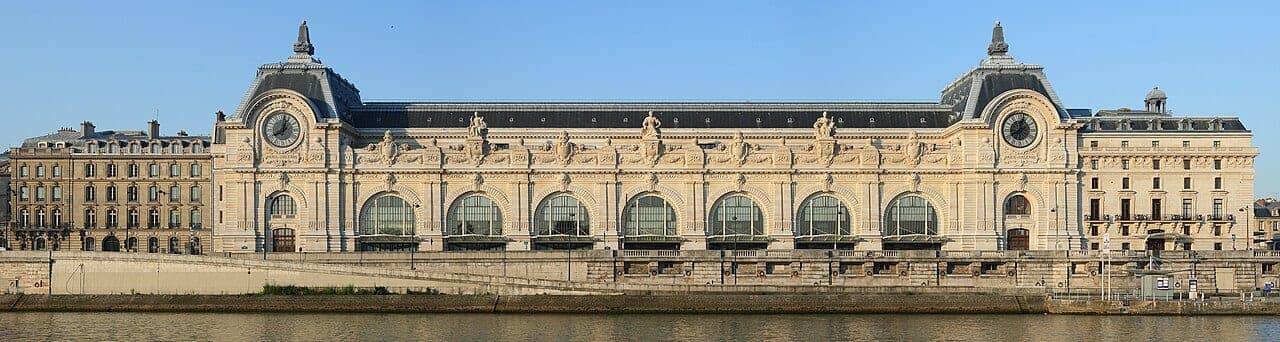
The Musée d'Orsay occupies one of the most unusual homes of any major art museum: a former railway station on the Left Bank of the Seine, directly across the water from the Tuileries and the Louvre. Behind its stone facade and beneath a great vaulted hall, it holds the largest gathering of Impressionist and Post-Impressionist painting anywhere, together with sculpture, decorative arts and photography from the later nineteenth century and the years before 1914 (Britannica).
The collection is built around a single stretch of time, roughly 1848 to 1914. That span begins where the Louvre's account of Western art tails off and closes where the Centre Pompidou's story of the modern age begins (Wikipedia). In effect the three museums divide the history of art in Paris between them.
The building began as the Gare d'Orsay, a railway terminus put up between 1898 and 1900 for the Chemin de Fer de Paris à Orléans and timed to open for the Exposition Universelle of 1900 (Britannica). Its principal architect, Victor Laloux, faced the metal train shed with a Beaux-Arts stone shell to suit its grand riverside setting near the centre of the city. Inside, a barrel-vaulted hall covered the platforms, lit by tall arched windows and a glazed roof, while an adjoining hotel served travellers arriving from the south west of France.
The station's working life was short. Its platforms had been laid out for the shorter trains of 1900, and by the late 1930s they could not take the longer mainline carriages then in service. In 1939 the Gare d'Orsay closed to long-distance traffic and was left to suburban trains and a run of stray uses, among them a mailing centre, a film set and an auction house (Wikipedia). By the 1960s the empty station faced demolition. Permission to pull it down was granted in 1970 and a modern hotel was proposed for the site, but the plan was blocked and opinion turned toward saving the building. The station was listed as a Historic Monument in 1978 (Wikipedia).
The idea of turning the station into a museum of the nineteenth century took shape in the mid-1970s and was confirmed by successive governments. A design competition in 1978 was won by ACT Architecture, the practice of Pierre Colboc, Renaud Bardon and Jean-Paul Philippon, who were charged with adapting Laloux's hall into gallery space while keeping its character (Wikipedia). From 1980 the Italian architect Gae Aulenti designed the interiors, setting stone-clad galleries and terraces along the length of the central nave so that the vast hall stayed legible as one continuous space. The museum was inaugurated by President François Mitterrand on 1 December 1986 and opened to the public a week later, on 9 December (Britannica).
The heart of the Orsay is its painting, and above all the Impressionists. The galleries hold major works by Claude Monet, Pierre-Auguste Renoir, Edgar Degas, Camille Pissarro and Alfred Sisley, the artists who in the 1870s left the studio for the open air and painted light, weather and modern life in loose, visible strokes (Britannica). Édouard Manet, whose Olympia and Luncheon on the Grass unsettled the official Salon, hangs here as the figure who bridged the academic tradition and the new painting.
 The hall is the concourse of the Gare d'Orsay, built for the 1900 exhibition and obsolete within forty years because its platforms were too short for longer trains. Photograph by Sandor Laza, CC BY-SA 3.0, via Wikimedia Commons.
The Post-Impressionists follow. The museum keeps one of the strongest groups of work by Vincent van Gogh outside the Netherlands, including a self-portrait and the night scene Starry Night Over the Rhône, alongside the structured landscapes and still lifes of Paul Cézanne and the flat colour and Tahitian subjects of Paul Gauguin (Britannica).
Painting is only part of the holdings. The central nave is given over to sculpture, with pieces by Auguste Rodin, Jean-Baptiste Carpeaux and others, and the museum also gathers decorative arts of the Art Nouveau period, architectural drawings and one of the important public collections of early photography (Wikipedia). Because everything on view falls within the same span of about seventy years, a visitor can follow the passage from Second Empire Salon painting to the eve of the First World War in one building.
The Orsay completed a plan that had been forming in Paris for decades: to spread the history of art across three linked institutions. The Louvre carries the account up to the middle of the nineteenth century; the Musée d'Orsay takes it from 1848 to 1914; and the Centre Pompidou, opened in 1977, continues into the modern and contemporary (Wikipedia). Gathering the Impressionists into a museum of their own also settled a long argument: paintings the Salon turned away in the 1860s and 1870s now fill a national collection seen by millions.
The decision to keep the station rather than replace it also preserved one of the largest examples of nineteenth-century railway architecture in Paris and gave it a new public purpose. Close to four million people visited in 2023, making the Orsay the second most visited art museum in France after the Louvre (Britannica).
The Musée d'Orsay stands on the Left Bank of the Seine in the 7th arrondissement, with its entrance on the Rue de la Légion d'Honneur, a short walk from the Louvre across the Pont Royal. The nearest rail stop, Musée d'Orsay, is served by RER line C, and the Solférino Métro station is close by; several bus routes serve the quay (Musée d'Orsay).
The building keeps clear signs of its first life. High on the end wall of the great hall hangs the ornate station clock designed by Laloux, and on the upper level a second glazed clock face looks out over the Seine toward Montmartre, one of the most photographed views in the museum (Wikipedia). The galleries are open every day except Monday, with a late opening on Thursday evenings, and the museum closes on 1 May and 25 December. Because hours, prices and the conditions for reduced-rate and free entry change through the year, the official website is the most reliable source for current visitor information (Musée d'Orsay).
The hall is the concourse of the Gare d'Orsay, built for the 1900 exhibition and obsolete within forty years because its platforms were too short for longer trains. Photograph by Sandor Laza, CC BY-SA 3.0, via Wikimedia Commons.
The Post-Impressionists follow. The museum keeps one of the strongest groups of work by Vincent van Gogh outside the Netherlands, including a self-portrait and the night scene Starry Night Over the Rhône, alongside the structured landscapes and still lifes of Paul Cézanne and the flat colour and Tahitian subjects of Paul Gauguin (Britannica).
Painting is only part of the holdings. The central nave is given over to sculpture, with pieces by Auguste Rodin, Jean-Baptiste Carpeaux and others, and the museum also gathers decorative arts of the Art Nouveau period, architectural drawings and one of the important public collections of early photography (Wikipedia). Because everything on view falls within the same span of about seventy years, a visitor can follow the passage from Second Empire Salon painting to the eve of the First World War in one building.
The Orsay completed a plan that had been forming in Paris for decades: to spread the history of art across three linked institutions. The Louvre carries the account up to the middle of the nineteenth century; the Musée d'Orsay takes it from 1848 to 1914; and the Centre Pompidou, opened in 1977, continues into the modern and contemporary (Wikipedia). Gathering the Impressionists into a museum of their own also settled a long argument: paintings the Salon turned away in the 1860s and 1870s now fill a national collection seen by millions.
The decision to keep the station rather than replace it also preserved one of the largest examples of nineteenth-century railway architecture in Paris and gave it a new public purpose. Close to four million people visited in 2023, making the Orsay the second most visited art museum in France after the Louvre (Britannica).
The Musée d'Orsay stands on the Left Bank of the Seine in the 7th arrondissement, with its entrance on the Rue de la Légion d'Honneur, a short walk from the Louvre across the Pont Royal. The nearest rail stop, Musée d'Orsay, is served by RER line C, and the Solférino Métro station is close by; several bus routes serve the quay (Musée d'Orsay).
The building keeps clear signs of its first life. High on the end wall of the great hall hangs the ornate station clock designed by Laloux, and on the upper level a second glazed clock face looks out over the Seine toward Montmartre, one of the most photographed views in the museum (Wikipedia). The galleries are open every day except Monday, with a late opening on Thursday evenings, and the museum closes on 1 May and 25 December. Because hours, prices and the conditions for reduced-rate and free entry change through the year, the official website is the most reliable source for current visitor information (Musée d'Orsay).
History
The collection
Cultural role
Visiting
References and resources
- Encyclopaedia Britannica: Musée d'Orsay: the 1986 opening, the Gare d'Orsay origin, the conversion and the collection.
- Musée d'Orsay, official site: hours, tickets, access and the collection database.
- Wikipedia: Musée d'Orsay: history, the 1978 competition, Gae Aulenti's interiors and the holdings.
- Wikipedia: Gare d'Orsay: the station's construction, its 1939 closure and its preservation.