Heritage · Landmark
Mont-Saint-Michel: History and Visitor Guide
Mont-Saint-Michel is a tidal island in Normandy, France, crowned by a medieval Benedictine abbey and famed for some of Europe's greatest tides.Written to last.
By Confinity Heritage Editorial · Updated 2026-07-31 · 7-minute readQuiet tools, kept out of the way.
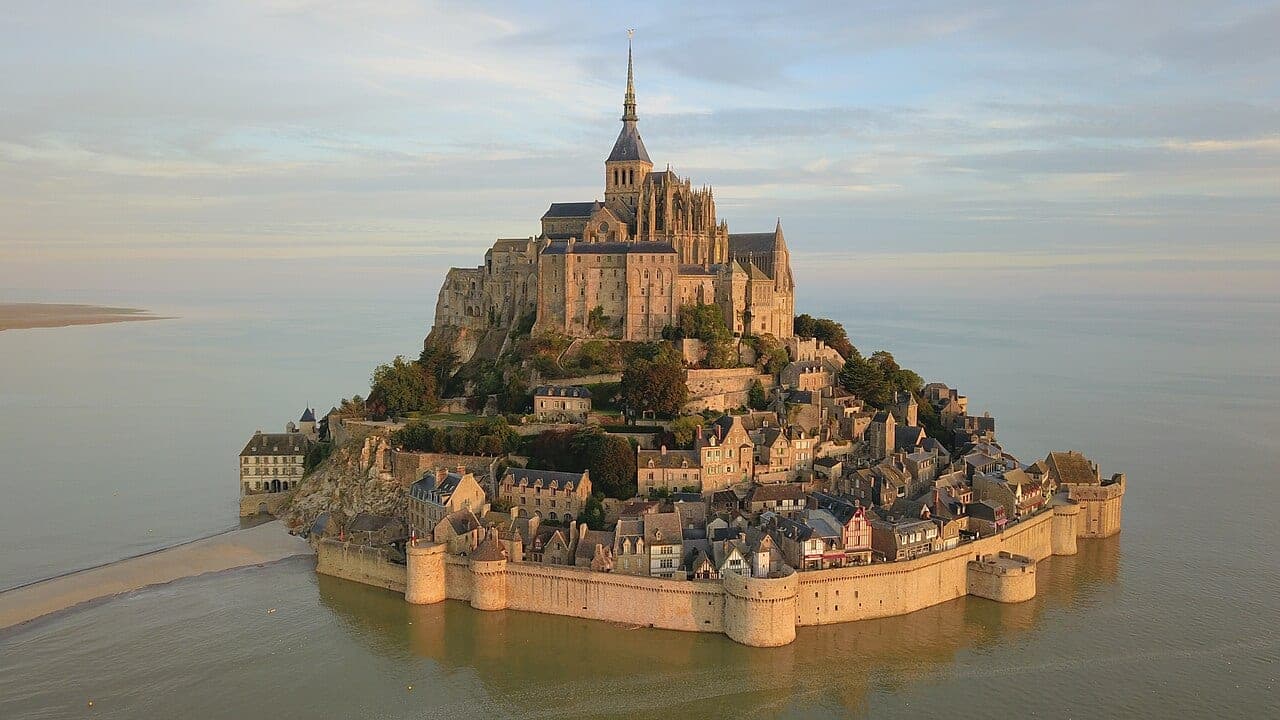
Mont-Saint-Michel is a rocky tidal island rising from a wide bay on the coast of Normandy, in northwestern France, where the mouth of the Couesnon and neighbouring rivers meets the sea. A small village and a Benedictine abbey climb its granite cone, which reaches about 92 metres above sea level, and the whole silhouette is topped by a gilded statue of the Archangel Michael. UNESCO inscribed "Mont-Saint-Michel and its Bay" on the World Heritage List in 1979, recognising both the abbey and the natural setting shaped by some of the greatest tides in Europe (UNESCO).
Tradition dates the site's Christian origins to 708, when Aubert, bishop of Avranches, is said to have had a vision of the Archangel Michael instructing him to build a sanctuary on the islet, then known as Mont-Tombe (Wikipedia). The Benedictine abbey was formally established around 966 under Richard I, Duke of Normandy, and monks settled the mount as a centre of learning and pilgrimage. Building on the summit began in the 11th century and continued in phases into the 16th (UNESCO). Through the Middle Ages the mount drew pilgrims from across Europe who crossed the perilous sands at low tide. Its position on the frontier between Normandy and Brittany made it a fortress as well as a monastery: during the Hundred Years' War a small garrison held out against repeated English pressure, repelled a full assault in 1433, and the mount was never captured (Britannica). After the French Revolution the abbey was closed and turned into a prison, a role it kept until 1863. It was declared a historic monument in 1874, and a long campaign of restoration began under the architect Édouard Corroyer (Wikipedia).
The abbey is a feat of medieval engineering, since every major structure had to be anchored to a steep granite peak. The Romanesque abbey church of the 11th century, attributed to the Italian builder William of Volpiano, was daringly set with its crossing at the very top of the rock (Wikipedia). After a fire and siege in 1204, King Philip Augustus funded a Gothic rebuilding. Its finest expression is "La Merveille" (The Marvel), a three-storey Gothic monastery raised against the north face between 1211 and 1228, stacking the cloister, refectory, guest halls and cellars one above another (montsaintmichel.net). Below the abbey, a compact village of narrow lanes, stairways and houses winds up the slope inside encircling ramparts that once guarded against attack from land and sea. Later Gothic work, including the flamboyant choir rebuilt in the 15th and 16th centuries, completes an ensemble constructed across roughly five hundred years.
The bay around Mont-Saint-Michel experiences one of the largest tidal ranges in Europe, with the difference between high and low water reaching around 14 metres at the strongest tides (Wikipedia). At low tide the sea withdraws several kilometres, exposing broad flats of sand and salt marsh; at high tide the water returns quickly across the shallow bay. For centuries this rhythm both protected the abbey and endangered pilgrims, who risked being caught by the incoming tide or by patches of quicksand. Walking on the sands today is safe only with a qualified guide, and the bay's shifting channels and fast currents remain genuinely dangerous (UNESCO).
 The bay at low water. The tidal range here is among the largest in Europe, and the sands it uncovers have drowned pilgrims for a thousand years. Photograph by Velvet, CC BY-SA 4.0, via Wikimedia Commons.
For more than a thousand years Mont-Saint-Michel has been one of the principal pilgrimage destinations of Western Christianity, dedicated to the Archangel Michael and linked to a wider network of Michael sanctuaries across Europe. It became a national symbol of France, a subject for painters and writers, and one of the country's most visited monuments outside Paris. UNESCO recognised this cultural weight, alongside the site's aesthetic and natural value, when it listed the location in 1979 (UNESCO).
The mount sits near the boundary of Normandy and Brittany and is reached from the mainland by a footbridge. A causeway built in 1879 had gradually silted the bay and interrupted the tidal flow around the island; it was replaced by a slender bridge designed by the architect Dietmar Feichtinger, opened in 2014, which lets water circulate freely and restores the island's insular character (Wikipedia). Visitors park on the mainland and reach the mount on foot or by shuttle. The village and abbey draw large crowds, so early or late visits tend to be quieter, and tide timetables are worth checking, both for the spectacle of the highest tides and for safety on the surrounding sands. Around two dozen people still live on the island year round (Wikipedia).
The bay at low water. The tidal range here is among the largest in Europe, and the sands it uncovers have drowned pilgrims for a thousand years. Photograph by Velvet, CC BY-SA 4.0, via Wikimedia Commons.
For more than a thousand years Mont-Saint-Michel has been one of the principal pilgrimage destinations of Western Christianity, dedicated to the Archangel Michael and linked to a wider network of Michael sanctuaries across Europe. It became a national symbol of France, a subject for painters and writers, and one of the country's most visited monuments outside Paris. UNESCO recognised this cultural weight, alongside the site's aesthetic and natural value, when it listed the location in 1979 (UNESCO).
The mount sits near the boundary of Normandy and Brittany and is reached from the mainland by a footbridge. A causeway built in 1879 had gradually silted the bay and interrupted the tidal flow around the island; it was replaced by a slender bridge designed by the architect Dietmar Feichtinger, opened in 2014, which lets water circulate freely and restores the island's insular character (Wikipedia). Visitors park on the mainland and reach the mount on foot or by shuttle. The village and abbey draw large crowds, so early or late visits tend to be quieter, and tide timetables are worth checking, both for the spectacle of the highest tides and for safety on the surrounding sands. Around two dozen people still live on the island year round (Wikipedia).
History
Architecture
The tides