Heritage · Country
Saint Pierre and Miquelon Culture and Heritage
Eight small islands off Newfoundland, the last piece of New France, where about 6,000 people live under French law with Canadian neighbours. This is a guide to their heritage, from the cod beaches and the Basque pelota court to the abandoned village on Île aux Marins.Written to last.
By Confinity Heritage Editorial · Updated 2026-08-17 · 8-minute readQuiet tools, kept out of the way.
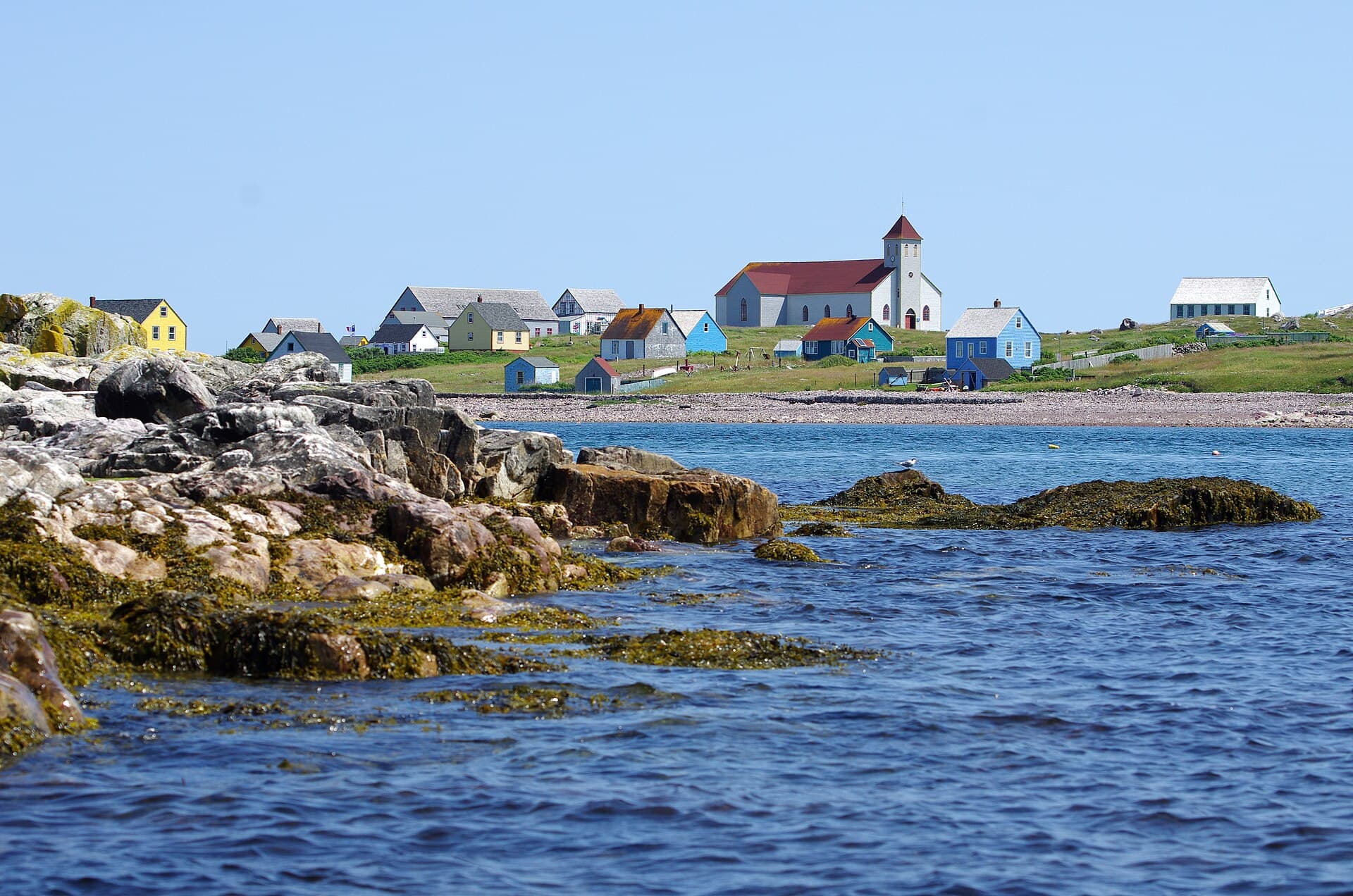
About a kilometre off the quay at Saint-Pierre there is an island where nobody has lived year-round since 1965. At the end of the nineteenth century it held close to seven hundred people, and the men who lived there rowed out to the cod grounds before dawn while the women and boys worked the catch on the beach. The church, the school, the presbytery and a run of wooden houses are all still standing on Île aux Marins, repaired and repainted by an association of islanders, and the ferry across takes ten minutes.
Saint Pierre and Miquelon is what remains of New France in North America: eight islands totalling 242 square kilometres, twenty-five kilometres south of Newfoundland, with about 6,000 inhabitants, French law, French schools and the euro. Almost everything in its heritage runs back to cod, and the cod are gone. Twice the British removed the entire population and burned what they had built; once, during American Prohibition, the harbour became a warehouse for whisky moving into the United States; once, on Christmas Eve 1941, four Free French ships took the islands in twenty minutes and started a diplomatic row that reached the White House.
The archipelago covers 242 square kilometres in the North Atlantic at the mouth of the Gulf of Saint Lawrence, and only two of its eight islands are inhabited. Miquelon-Langlade is much the larger at about 201 square kilometres, two islands joined by a sand isthmus that formed in the mid-eighteenth century as sand collected around the wrecks piling up on the reefs between them; Saint-Pierre, at 26 square kilometres, holds the harbour, the airport and the great majority of the people. The 2022 census counted 5,819 residents, 5,223 of them on Saint-Pierre (Britannica). The islands became a French overseas department on 19 July 1976, a territorial collectivity on 11 June 1985, and an overseas collectivity with its own statute after the constitutional reform of 28 March 2003. The currency is the euro, adopted in 2002, though Canadian dollars circulate freely, and the clock runs half an hour ahead of Newfoundland next door.
Saint-Pierre. The only town of any size wraps around a deep harbour, its wooden houses painted in flat blocks of red, yellow, blue and green against a treeless hillside. The centre holds the cathedral, rebuilt after the fire of 1902, the Place du Général de Gaulle, the Zazpiak Bat pelota court, the L'Arche museum and archives, and a cemetery climbing the slope behind the town.
 These islands are the last of New France, a few kilometres off Newfoundland and still administratively part of France, with the euro and French school terms. Photograph by Shawn, CC BY-SA 2.0, via Wikimedia Commons.
Miquelon. The village at the north end of Miquelon island has fewer than 600 people, many of them descended from Acadians who came after the deportations of the eighteenth century. Its church is Notre-Dame-des-Ardilliers, horses run loose on the dune, and the Grand Barachois lagoon to the south holds one of the largest seal colonies in the region.
Langlade. Nobody lives on Langlade in winter. In summer several hundred families move into wooden cabins along its shore, most without mains electricity or running water, and the island empties again in September.
Île aux Marins. The former commune in the harbour, abandoned as a permanent settlement in 1965, is now the archipelago's principal heritage site, with a museum in the old school and a scatter of restored buildings among the grass.
Basque, Breton and Norman fishermen were working these waters within a few decades of Cabot's voyages, drawn by the cod of the Grand Banks and by harbours where they could dry the catch ashore. The seasonal camps came before any settlement, and the three provincial origins are still marked on the archipelago's flag. France claimed the islands in the seventeenth century and lost them repeatedly to Britain, and when the Treaty of Paris ended the Seven Years' War in 1763 and France surrendered Canada, Saint Pierre and Miquelon were the fragment kept back, retained as a base for the fishery and resettled with about 350 Acadians who had been deported to France (The Canadian Encyclopedia).
Continuity was broken twice, and violently. In 1778, in reprisal for French support of the American Revolution, Newfoundland's governor John Montagu landed troops, deported the whole population of roughly 2,000 to France and destroyed the settlements. Some returned after the peace of 1783. In 1793 Britain seized the islands again in the wars of the French Revolution, expelled the population a second time and tried to plant British settlers, whom French troops in turn drove out in 1796. The islands changed hands until the second Treaty of Paris returned them to France in 1815, and they were repopulated in 1816. Almost every family on the archipelago today counts its continuous presence from that return rather than from the first settlement.
What they came back to was a fishery on an industrial scale. By 1866 some four thousand French fishermen were coming out each year from Saint-Malo in a fleet of two hundred schooners, and much of the shore work was done by young men called graviers on the graves, the pebble beaches where split and salted cod was laid out to dry, turned and stacked against the weather. The saltfish went to the Caribbean, to the Mediterranean and to France. Alongside the French bank fleet, the islands supplied and traded with the Newfoundland coast, and the two populations intermarried steadily.
The twentieth century took the fishery apart in stages. The agreement of 1904 that settled the Entente Cordiale ended French fishing rights on the Newfoundland coast, the French Shore, which devastated the fleet and left the archipelago as France's only foothold. The bank fishery declined between the wars, revived briefly with trawlers and freezing plants after 1945, and then met two decisions in the same year. On 10 June 1992 an international arbitral tribunal in New York fixed the maritime boundary with Canada, awarding France a zone of 12,348 square kilometres, roughly a quarter of what it had claimed, most of it a corridor about ten nautical miles wide running two hundred miles south. Three weeks later Canada declared a moratorium on northern cod. Between them, the two rulings ended the economy the islands had lived on for four hundred years.
French is the only language of public life, taught and administered exactly as in the mainland, and the local speech carries a maritime vocabulary that has largely disappeared elsewhere: the doris, the flat-bottomed rowing boat worked in pairs off a schooner; the graves where the cod dried; barachois for a shallow coastal lagoon closed by a bar, a word shared with Acadian French whose origin is disputed between Basque and Portuguese candidates. Contact with Newfoundland has added English words at the edges, and the Prohibition years added a few more.
The names hold the same layers. Saint-Pierre is for the patron of fishermen. Miquelon is generally traced to a Basque form of the name Michel, one of several explanations offered without decisive evidence. Langlade is a worn-down form of l'île à l'Anglais, the Englishman's island. Île aux Marins was Île aux Chiens, the island of dogs, until the inhabitants had it renamed in 1931. Around the coast the map reads like a working chart: Anse à Bertrand, Cap à l'Aigle, Pointe aux Canons, Grand Colombier, Île aux Vainqueurs.
The Basque inheritance is the most visible of the three founding strands. The islands have a fronton, the high open-air wall for pelota, on the Place Richard Briand in Saint-Pierre, built in the first decade of the twentieth century, with an enclosed trinquet added beside the Basque club in 2010. The club, Zazpiak Bat, takes its name from the motto of the seven Basque provinces, and every August it runs a Basque festival of pelota tournaments, dance, singing and rural strength contests that has been held for decades and draws players and performers from the Basque Country itself (EuskalKultura). For a community of a few thousand people in the North Atlantic, keeping a live pelota tradition on the far side of an ocean is a considerable feat of transmission.
The rest of the year is shaped by the sea and the weather. Dory rowing survives as a sport, the Saint-Pierre houses are painted in strong colours partly against months of fog, and the summer migration to the cabins on Langlade functions as a collective holiday with its own etiquette. The kitchen is French with a North Atlantic accent: cod in every preparation, snow crab and lobster, wine and cheese landed from France, and baguettes baked daily on an island three hours from Newfoundland by boat. School holidays, the baccalauréat and the public television schedule all run to metropolitan French time, which is part of what visitors from Canada find disorienting.
The archipelago is overwhelmingly Catholic, and the parish has been the organising institution of island life since the seventeenth century. The cathedral of Saint-Pierre, rebuilt after the fire of 1902 that destroyed much of the town, is the main church; Notre-Dame-des-Ardilliers serves Miquelon, and Notre-Dame-des-Marins on Île aux Marins, consecrated in the 1870s, keeps its original furnishings and remains in occasional use for summer services and weddings.
Maritime devotion runs through all of it. Boats were blessed at the start of the season, votive offerings and model ships were left in the churches by families whose men had come back, and prayers for those at sea were part of the ordinary Sunday. Practice has fallen away here as it has in mainland France, and the calendar is now marked more by the patronal feasts and the summer festivals than by weekly attendance, but the churches remain the buildings where the archipelago gathers when someone is lost.
The cemetery at Saint-Pierre climbs the hillside immediately above the town in tight, orderly rows, and almost all of it is above ground: cement vaults and family tombs set close together, whitewashed and repainted, with iron crosses and enamel plaques. More than 5,000 people are buried there, which is close to the number living below. Islanders explain the above-ground burial by the thin soil over rock and the depth of winter frost, and while that account is repeated locally rather than documented, anyone who has tried to dig on Saint-Pierre finds it plausible. Families tend the tombs through the summer and gather at them on All Saints.
The harder grief in a cod community has no grave at all. Men were lost from dories in fog, from schooners on the Banks and from trawlers within sight of home, and the standard form of mourning became a name on a monument and a mass said for the missing. The clearest modern case is the Ravenel, a trawler that left Saint-Pierre on 29 January 1962 and vanished without a distress call with fifteen men aboard, aged between twenty-one and thirty-five, in the worst maritime disaster in the islands' history. No trace was found for sixty-three years. In May 2025 the wreck was located intact at 122 metres, about seven nautical miles off the port, and families who had spent their lives without an answer were finally given one (France Info).
One death is remembered for a different reason. In August 1889 a fisherman named Joseph Néel was executed by guillotine at Saint-Pierre for a murder committed during a drinking bout the previous December. There was no guillotine on the islands, so one was disassembled and shipped from Martinique for the purpose, and two local men of poor reputation were found to work it. It was the only such execution ever carried out on the archipelago, and the machine is now held by the L'Arche museum in Saint-Pierre, where it is displayed rather than hidden. Islanders still discuss the case, and Patrice Leconte's film La Veuve de Saint-Pierre (2000) took it as its subject.
Saint-Pierre and Miquelon is the last piece of New France, and its records are the records of the cod.
France has held these islands, with interruptions, since the sixteenth century, and they are what remained after the loss of Canada in 1763 and Newfoundland's fisheries. French civil registration applies and runs continuously, held on the islands and duplicated in France, and Catholic parish registers carry the earlier events. The archives are small, complete and well kept, and the population has never much exceeded six thousand.
The founding families came from Normandy, Brittany and above all the Basque Country, and Basque surnames remain common. The fishery drew crews from the mainland each season, and many stayed.
Two episodes give the archive its character. The Acadian deportation of 1755 sent refugees here, some of whom stayed and some of whom were deported again when Britain took the islands in 1778 and 1793, so Acadian families in Louisiana and the Maritimes have Saint-Pierre entries in their line.
And Prohibition. Between 1920 and 1933 the islands became the transshipment point for liquor going into the United States, the population and the customs revenue boomed, and the warehouse and shipping records of that decade document a trade that everyone knew about. When it ended the islands went back to fish, and then in 1992 the moratorium on northern cod ended that too.
Île aux Marins is the best heritage story the archipelago has. When the last permanent resident left in 1965 the village could have been left to the weather, as similar Newfoundland outports were. Instead the Association de Sauvegarde du Patrimoine de l'Archipel took on the buildings, restoring the former public school as the Archipélitude museum and conserving the Maison Jézéquel, the Maison Grise and a run of fishermen's houses; several structures were listed as historic monuments by the Ministry of Culture between 2011 and 2014. The church of Notre-Dame-des-Marins survives with its fittings, the bow of the German cargo ship Transpacific lies where it grounded on the north shore in 1971, and the island is worked as a heritage site through the summer with guides drawn from island families (Wikipedia).
In the town, L'Arche Musée et Archives brings together the collectivity's museum and its archive service in one building, opened at the end of the 1990s. The museum covers settlement, the fishery, the deportations, Prohibition and the war years, and holds the 1889 guillotine; the archives hold the civil registers, notarial papers and photographic collections of the islands (L'Arche Musée et Archives). Beyond the buildings, the Grand Barachois lagoon and the dune at Langlade are managed for their seal population and their fragile geology, and the lighthouse at Pointe aux Canons and the batteries above the harbour are maintained as part of the town's protected fabric.
Genealogy is unusually tractable here, because the population is small and the record is nearly complete. The Archives Nationales d'Outre-Mer publish digitised parish and civil registers for the archipelago from 1763 to 1907, and L'Arche has put census returns and further population records online, so that a family in Newfoundland or Brittany can trace an island ancestor without leaving home (Archives Nationales d'Outre-Mer).
Alongside the official archive sits an unusually good private one. GrandColombier.com, run by island historians, has for years published transcriptions of nineteenth-century newspapers, court records, photographs and long-form accounts of episodes such as the Néel affair and the rally to Free France, and it is often the first place a researcher finds a contemporary source. Heritage Newfoundland and Labrador covers the archipelago from the other side of the boundary, which is useful, because so much of the history is shared with the Burin peninsula.
Prohibition is the episode the outside world knows. From 1920 the United States banned alcohol and the islands, a French customs territory a short run from the American coast, became the transfer point. Imports rose from about 11,000 cases in the seven years to 1918 to 435,700 cases in 1923, and in the peak year of 1929 nearly 5.8 million litres of whisky passed through, worth something like sixty million dollars. Warehouses went up along the harbour, the fishery emptied of hands, and public revenue from duties paid for roads and schools. One house in Saint-Pierre is still called the Villa Cutty Sark because it was built from recycled whisky crates. Al Capone's name is attached to the story locally and in his family's own telling, but the historian Daniel Okrent has stated flatly that there is no evidence Capone ever went near Saint-Pierre, and the claim is best treated as island tradition (Smithsonian Magazine). When repeal came in December 1933 the trade stopped within weeks and the islands went back to fish.
The war episode has a better documented cast. On 24 December 1941, on de Gaulle's orders and against the express wishes of Washington, Vice-Admiral Émile Muselier arrived with the submarine Surcouf and three corvettes and took the islands in about twenty minutes without a shot. A plebiscite the next day returned 783 votes for Free France against 14 for collaboration. The United States still recognised Vichy and read the operation as a breach of hemispheric agreements; on Christmas Day, with Churchill staying at the White House, Secretary of State Cordell Hull issued a statement calling the action arbitrary and referring to "the so-called Free French", a phrase that caused lasting offence and became a small landmark in the quarrel between Roosevelt and de Gaulle. The islands stayed with Free France.
Since 1992 the archipelago has been rebuilding an economy from public employment, a reduced fishery, aquaculture, shipping services and a modest tourism trade largely fed by day visitors from Newfoundland. The population has fallen slowly for thirty years. What the islands sell now is the thing they nearly lost: a French town in North America, with its own accent, its own bread and its own dead.
A village kept instead of abandoned. Île aux Marins was left empty in 1965 and could have gone the way of the Newfoundland outports; islanders restored the school, the church and the houses, and several were listed as historic monuments between 2011 and 2014.
A Basque tradition kept alive across an ocean. The Zazpiak Bat club has maintained pelota and an annual Basque festival on an island 4,000 kilometres from the Basque Country, with players still travelling in both directions.
An uncomfortable object put on display. The guillotine shipped from Martinique in 1889 for the islands' only execution is kept and shown by the L'Arche museum rather than quietly disposed of.
An answer after sixty-three years. The trawler Ravenel, lost with fifteen men in January 1962, was found on the seabed in May 2025, giving the archipelago's defining bereavement a location at last.
These islands are the last of New France, a few kilometres off Newfoundland and still administratively part of France, with the euro and French school terms. Photograph by Shawn, CC BY-SA 2.0, via Wikimedia Commons.
Miquelon. The village at the north end of Miquelon island has fewer than 600 people, many of them descended from Acadians who came after the deportations of the eighteenth century. Its church is Notre-Dame-des-Ardilliers, horses run loose on the dune, and the Grand Barachois lagoon to the south holds one of the largest seal colonies in the region.
Langlade. Nobody lives on Langlade in winter. In summer several hundred families move into wooden cabins along its shore, most without mains electricity or running water, and the island empties again in September.
Île aux Marins. The former commune in the harbour, abandoned as a permanent settlement in 1965, is now the archipelago's principal heritage site, with a museum in the old school and a scatter of restored buildings among the grass.
Basque, Breton and Norman fishermen were working these waters within a few decades of Cabot's voyages, drawn by the cod of the Grand Banks and by harbours where they could dry the catch ashore. The seasonal camps came before any settlement, and the three provincial origins are still marked on the archipelago's flag. France claimed the islands in the seventeenth century and lost them repeatedly to Britain, and when the Treaty of Paris ended the Seven Years' War in 1763 and France surrendered Canada, Saint Pierre and Miquelon were the fragment kept back, retained as a base for the fishery and resettled with about 350 Acadians who had been deported to France (The Canadian Encyclopedia).
Continuity was broken twice, and violently. In 1778, in reprisal for French support of the American Revolution, Newfoundland's governor John Montagu landed troops, deported the whole population of roughly 2,000 to France and destroyed the settlements. Some returned after the peace of 1783. In 1793 Britain seized the islands again in the wars of the French Revolution, expelled the population a second time and tried to plant British settlers, whom French troops in turn drove out in 1796. The islands changed hands until the second Treaty of Paris returned them to France in 1815, and they were repopulated in 1816. Almost every family on the archipelago today counts its continuous presence from that return rather than from the first settlement.
What they came back to was a fishery on an industrial scale. By 1866 some four thousand French fishermen were coming out each year from Saint-Malo in a fleet of two hundred schooners, and much of the shore work was done by young men called graviers on the graves, the pebble beaches where split and salted cod was laid out to dry, turned and stacked against the weather. The saltfish went to the Caribbean, to the Mediterranean and to France. Alongside the French bank fleet, the islands supplied and traded with the Newfoundland coast, and the two populations intermarried steadily.
The twentieth century took the fishery apart in stages. The agreement of 1904 that settled the Entente Cordiale ended French fishing rights on the Newfoundland coast, the French Shore, which devastated the fleet and left the archipelago as France's only foothold. The bank fishery declined between the wars, revived briefly with trawlers and freezing plants after 1945, and then met two decisions in the same year. On 10 June 1992 an international arbitral tribunal in New York fixed the maritime boundary with Canada, awarding France a zone of 12,348 square kilometres, roughly a quarter of what it had claimed, most of it a corridor about ten nautical miles wide running two hundred miles south. Three weeks later Canada declared a moratorium on northern cod. Between them, the two rulings ended the economy the islands had lived on for four hundred years.
French is the only language of public life, taught and administered exactly as in the mainland, and the local speech carries a maritime vocabulary that has largely disappeared elsewhere: the doris, the flat-bottomed rowing boat worked in pairs off a schooner; the graves where the cod dried; barachois for a shallow coastal lagoon closed by a bar, a word shared with Acadian French whose origin is disputed between Basque and Portuguese candidates. Contact with Newfoundland has added English words at the edges, and the Prohibition years added a few more.
The names hold the same layers. Saint-Pierre is for the patron of fishermen. Miquelon is generally traced to a Basque form of the name Michel, one of several explanations offered without decisive evidence. Langlade is a worn-down form of l'île à l'Anglais, the Englishman's island. Île aux Marins was Île aux Chiens, the island of dogs, until the inhabitants had it renamed in 1931. Around the coast the map reads like a working chart: Anse à Bertrand, Cap à l'Aigle, Pointe aux Canons, Grand Colombier, Île aux Vainqueurs.
The Basque inheritance is the most visible of the three founding strands. The islands have a fronton, the high open-air wall for pelota, on the Place Richard Briand in Saint-Pierre, built in the first decade of the twentieth century, with an enclosed trinquet added beside the Basque club in 2010. The club, Zazpiak Bat, takes its name from the motto of the seven Basque provinces, and every August it runs a Basque festival of pelota tournaments, dance, singing and rural strength contests that has been held for decades and draws players and performers from the Basque Country itself (EuskalKultura). For a community of a few thousand people in the North Atlantic, keeping a live pelota tradition on the far side of an ocean is a considerable feat of transmission.
The rest of the year is shaped by the sea and the weather. Dory rowing survives as a sport, the Saint-Pierre houses are painted in strong colours partly against months of fog, and the summer migration to the cabins on Langlade functions as a collective holiday with its own etiquette. The kitchen is French with a North Atlantic accent: cod in every preparation, snow crab and lobster, wine and cheese landed from France, and baguettes baked daily on an island three hours from Newfoundland by boat. School holidays, the baccalauréat and the public television schedule all run to metropolitan French time, which is part of what visitors from Canada find disorienting.
The archipelago is overwhelmingly Catholic, and the parish has been the organising institution of island life since the seventeenth century. The cathedral of Saint-Pierre, rebuilt after the fire of 1902 that destroyed much of the town, is the main church; Notre-Dame-des-Ardilliers serves Miquelon, and Notre-Dame-des-Marins on Île aux Marins, consecrated in the 1870s, keeps its original furnishings and remains in occasional use for summer services and weddings.
Maritime devotion runs through all of it. Boats were blessed at the start of the season, votive offerings and model ships were left in the churches by families whose men had come back, and prayers for those at sea were part of the ordinary Sunday. Practice has fallen away here as it has in mainland France, and the calendar is now marked more by the patronal feasts and the summer festivals than by weekly attendance, but the churches remain the buildings where the archipelago gathers when someone is lost.
The cemetery at Saint-Pierre climbs the hillside immediately above the town in tight, orderly rows, and almost all of it is above ground: cement vaults and family tombs set close together, whitewashed and repainted, with iron crosses and enamel plaques. More than 5,000 people are buried there, which is close to the number living below. Islanders explain the above-ground burial by the thin soil over rock and the depth of winter frost, and while that account is repeated locally rather than documented, anyone who has tried to dig on Saint-Pierre finds it plausible. Families tend the tombs through the summer and gather at them on All Saints.
The harder grief in a cod community has no grave at all. Men were lost from dories in fog, from schooners on the Banks and from trawlers within sight of home, and the standard form of mourning became a name on a monument and a mass said for the missing. The clearest modern case is the Ravenel, a trawler that left Saint-Pierre on 29 January 1962 and vanished without a distress call with fifteen men aboard, aged between twenty-one and thirty-five, in the worst maritime disaster in the islands' history. No trace was found for sixty-three years. In May 2025 the wreck was located intact at 122 metres, about seven nautical miles off the port, and families who had spent their lives without an answer were finally given one (France Info).
One death is remembered for a different reason. In August 1889 a fisherman named Joseph Néel was executed by guillotine at Saint-Pierre for a murder committed during a drinking bout the previous December. There was no guillotine on the islands, so one was disassembled and shipped from Martinique for the purpose, and two local men of poor reputation were found to work it. It was the only such execution ever carried out on the archipelago, and the machine is now held by the L'Arche museum in Saint-Pierre, where it is displayed rather than hidden. Islanders still discuss the case, and Patrice Leconte's film La Veuve de Saint-Pierre (2000) took it as its subject.
Saint-Pierre and Miquelon is the last piece of New France, and its records are the records of the cod.
France has held these islands, with interruptions, since the sixteenth century, and they are what remained after the loss of Canada in 1763 and Newfoundland's fisheries. French civil registration applies and runs continuously, held on the islands and duplicated in France, and Catholic parish registers carry the earlier events. The archives are small, complete and well kept, and the population has never much exceeded six thousand.
The founding families came from Normandy, Brittany and above all the Basque Country, and Basque surnames remain common. The fishery drew crews from the mainland each season, and many stayed.
Two episodes give the archive its character. The Acadian deportation of 1755 sent refugees here, some of whom stayed and some of whom were deported again when Britain took the islands in 1778 and 1793, so Acadian families in Louisiana and the Maritimes have Saint-Pierre entries in their line.
And Prohibition. Between 1920 and 1933 the islands became the transshipment point for liquor going into the United States, the population and the customs revenue boomed, and the warehouse and shipping records of that decade document a trade that everyone knew about. When it ended the islands went back to fish, and then in 1992 the moratorium on northern cod ended that too.
Île aux Marins is the best heritage story the archipelago has. When the last permanent resident left in 1965 the village could have been left to the weather, as similar Newfoundland outports were. Instead the Association de Sauvegarde du Patrimoine de l'Archipel took on the buildings, restoring the former public school as the Archipélitude museum and conserving the Maison Jézéquel, the Maison Grise and a run of fishermen's houses; several structures were listed as historic monuments by the Ministry of Culture between 2011 and 2014. The church of Notre-Dame-des-Marins survives with its fittings, the bow of the German cargo ship Transpacific lies where it grounded on the north shore in 1971, and the island is worked as a heritage site through the summer with guides drawn from island families (Wikipedia).
In the town, L'Arche Musée et Archives brings together the collectivity's museum and its archive service in one building, opened at the end of the 1990s. The museum covers settlement, the fishery, the deportations, Prohibition and the war years, and holds the 1889 guillotine; the archives hold the civil registers, notarial papers and photographic collections of the islands (L'Arche Musée et Archives). Beyond the buildings, the Grand Barachois lagoon and the dune at Langlade are managed for their seal population and their fragile geology, and the lighthouse at Pointe aux Canons and the batteries above the harbour are maintained as part of the town's protected fabric.
Genealogy is unusually tractable here, because the population is small and the record is nearly complete. The Archives Nationales d'Outre-Mer publish digitised parish and civil registers for the archipelago from 1763 to 1907, and L'Arche has put census returns and further population records online, so that a family in Newfoundland or Brittany can trace an island ancestor without leaving home (Archives Nationales d'Outre-Mer).
Alongside the official archive sits an unusually good private one. GrandColombier.com, run by island historians, has for years published transcriptions of nineteenth-century newspapers, court records, photographs and long-form accounts of episodes such as the Néel affair and the rally to Free France, and it is often the first place a researcher finds a contemporary source. Heritage Newfoundland and Labrador covers the archipelago from the other side of the boundary, which is useful, because so much of the history is shared with the Burin peninsula.
Prohibition is the episode the outside world knows. From 1920 the United States banned alcohol and the islands, a French customs territory a short run from the American coast, became the transfer point. Imports rose from about 11,000 cases in the seven years to 1918 to 435,700 cases in 1923, and in the peak year of 1929 nearly 5.8 million litres of whisky passed through, worth something like sixty million dollars. Warehouses went up along the harbour, the fishery emptied of hands, and public revenue from duties paid for roads and schools. One house in Saint-Pierre is still called the Villa Cutty Sark because it was built from recycled whisky crates. Al Capone's name is attached to the story locally and in his family's own telling, but the historian Daniel Okrent has stated flatly that there is no evidence Capone ever went near Saint-Pierre, and the claim is best treated as island tradition (Smithsonian Magazine). When repeal came in December 1933 the trade stopped within weeks and the islands went back to fish.
The war episode has a better documented cast. On 24 December 1941, on de Gaulle's orders and against the express wishes of Washington, Vice-Admiral Émile Muselier arrived with the submarine Surcouf and three corvettes and took the islands in about twenty minutes without a shot. A plebiscite the next day returned 783 votes for Free France against 14 for collaboration. The United States still recognised Vichy and read the operation as a breach of hemispheric agreements; on Christmas Day, with Churchill staying at the White House, Secretary of State Cordell Hull issued a statement calling the action arbitrary and referring to "the so-called Free French", a phrase that caused lasting offence and became a small landmark in the quarrel between Roosevelt and de Gaulle. The islands stayed with Free France.
Since 1992 the archipelago has been rebuilding an economy from public employment, a reduced fishery, aquaculture, shipping services and a modest tourism trade largely fed by day visitors from Newfoundland. The population has fallen slowly for thirty years. What the islands sell now is the thing they nearly lost: a French town in North America, with its own accent, its own bread and its own dead.
A village kept instead of abandoned. Île aux Marins was left empty in 1965 and could have gone the way of the Newfoundland outports; islanders restored the school, the church and the houses, and several were listed as historic monuments between 2011 and 2014.
A Basque tradition kept alive across an ocean. The Zazpiak Bat club has maintained pelota and an annual Basque festival on an island 4,000 kilometres from the Basque Country, with players still travelling in both directions.
An uncomfortable object put on display. The guillotine shipped from Martinique in 1889 for the islands' only execution is kept and shown by the L'Arche museum rather than quietly disposed of.
An answer after sixty-three years. The trawler Ravenel, lost with fifteen men in January 1962, was found on the seabed in May 2025, giving the archipelago's defining bereavement a location at last.
National Overview
Notable Cities
Historical Foundations
Linguistic and Etymological Roots
Cultural Identity
Religion and Spirituality
Remembrance and Mourning Traditions
Tracing a Family in Saint Pierre and Miquelon
Heritage Preservation Efforts
Digital Heritage
Contemporary Cultural Influences
Success Stories
References and resources
- Encyclopaedia Britannica, Saint Pierre and Miquelon: geography, population and status.
- The Canadian Encyclopedia, Saint-Pierre and Miquelon: the isthmus, the 1763 Acadian resettlement, the schooner fishery and the 1992 award.
- L'Arche Musée et Archives: the collectivity's museum and archive service.
- Île-aux-Marins, Wikipedia: the abandoned village, its buildings and their listing.
- Smithsonian Magazine, America's alcohol warehouse: the Prohibition trade and the Capone claim.
- EuskalKultura, Basque Festival in Saint Pierre and Miquelon: the Zazpiak Bat club, the fronton and the August festival.
- France Info, the Ravenel: the 1962 loss and the 2025 discovery of the wreck.
- GrandColombier.com, the Néel affair: contemporary sources on the 1889 execution.
- Archives Nationales d'Outre-Mer, Saint-Pierre-et-Miquelon: digitised registers from 1763.