Heritage · Landmark
Chartres Cathedral: A High Gothic Masterpiece
Rebuilt in barely a generation after a fire in 1194, Chartres is among the most complete and unified of the great Gothic cathedrals. Its medieval stained glass, its two mismatched spires, and the labyrinth set into the nave floor still draw travellers and pilgrims to the plain southwest of Paris.Written to last.
By Confinity Heritage Editorial · Updated 2026-07-31 · 7-minute readQuiet tools, kept out of the way.
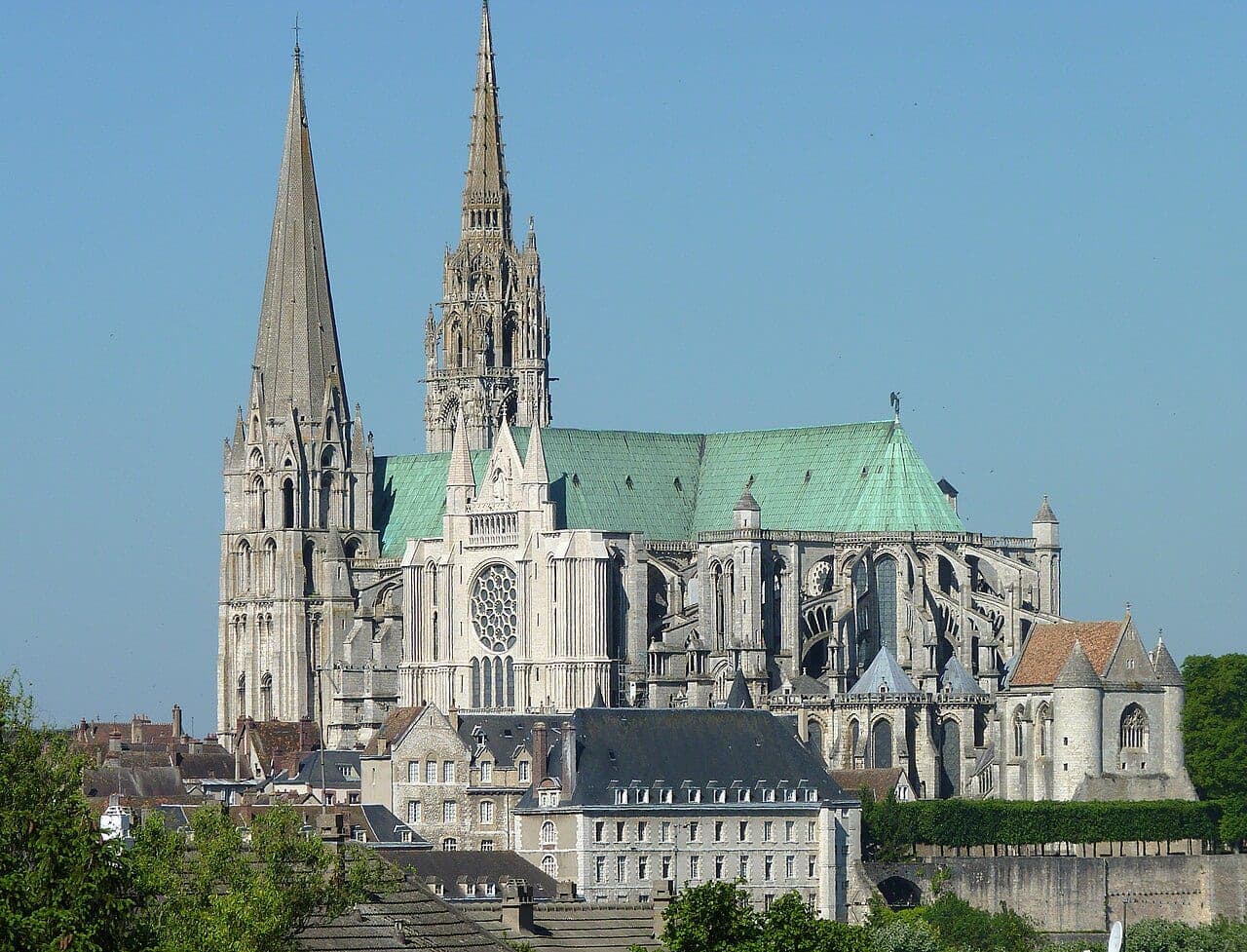
On a low rise above the wheat plain of the Beauce, roughly ninety kilometres southwest of Paris, the Cathedral of Our Lady of Chartres can be seen from far out across the fields long before the town gathers around it. Its two towers carry spires of visibly different ages, and beneath them stretches one of the most complete surviving works of the Gothic age. Where many medieval cathedrals were altered, patched, and half-rebuilt across four or five centuries, Chartres was raised in a single sustained effort and has kept most of what it was given.
That is what makes the building matter to anyone interested in how the past is held rather than merely recorded. Its walls still carry the coloured glass, the carved portals, and the floor labyrinth that pilgrims knew eight hundred years ago. To stand in the nave is to see, more or less intact, a medieval community's picture of itself and its faith, preserved in stone and light rather than in writing. The full name, the Cathedrale Notre-Dame de Chartres, marks it as a church dedicated to the Virgin Mary, whose cult drew crowds here throughout the Middle Ages and shaped everything the cathedral became.
A church has stood on this ground since at least the 4th century, and a sequence of earlier cathedrals rose and burned across the following centuries, with major fires recorded in 743, 858, and 1020 (Wikipedia). After the fire of 1020, Bishop Fulbert began a large Romanesque cathedral, whose crypt still runs beneath the present building and remains the longest in France. The west front, with its sculpted portals and its lower towers, was added in the mid-12th century.
Everything changed on the night of 10 June 1194, when fire again swept through the town and gutted the cathedral. The crypt, the west front, and the towers survived, but the main body was lost (Britannica). At first the disaster was read as catastrophe. What turned it into a beginning was the cathedral's most treasured possession, the relic known as the Sancta Camisia, a length of silk cloth held by tradition to be the tunic worn by the Virgin Mary at the birth of Christ. The relic had been given to Chartres in the 9th century, by tradition a gift of the Carolingian ruler Charles the Bald, and it had made the town one of the foremost centres of Marian pilgrimage in Europe. When the cloth was found undamaged in the crypt, clergy and townspeople took it as a sign that the Virgin wished a greater church built in her honour.
Money, labour, and gifts poured in from across France and beyond, and the rebuilding advanced with a speed that has few parallels among the great cathedrals. The main structure, with much of its glass and sculpture, was largely complete within about twenty-five years, so that the essential building we see today was standing by around 1220 (Britannica). A formal reconsecration followed in 1260. Because it went up so quickly and was altered so little afterwards, Chartres possesses a stylistic unity that older, more piecemeal cathedrals never achieved, and it is often studied as the clearest single statement of High Gothic design.
The plan is a long Latin cross with a wide nave, a broad transept, and an ambulatory wrapping the choir. Inside, the elevation rises in three clear stages: a tall arcade, a narrow middle band called the triforium, and above it a band of large windows, the clerestory, that fills the upper walls with light. This proportioning, repeated bay after bay, gives the interior its calm and its great height.
Height on that scale required a structural answer, and Chartres provided one of the earliest mature examples of the flying buttress, the arched external prop that carries the outward thrust of the stone vaults down to piers set clear of the walls (Wikipedia). Freed from carrying much of the load, the walls could be opened up and given over to glass, which is why the interior feels less like a masonry box than a cage of coloured light.
The two spires are the building's most immediately recognisable feature, and they do not match. The south spire, sometimes called the Old Bell Tower, was completed around the middle of the 12th century in a restrained Romanesque manner and rises to about 105 metres. The north spire, the New Bell Tower, is later and far more elaborate: after the earlier wooden steeple was struck by lightning, the master mason Jehan de Beauce raised an ornate stone spire in the Flamboyant Gothic style between 1507 and 1513, reaching roughly 113 metres (Wikipedia). The contrast between the plain older spire and the lacework of the newer one reads almost as a diagram of how Gothic taste changed across three and a half centuries.
The west front carries the Royal Portal, a set of three doorways carved in about 1145 to 1155 that survived the 1194 fire and so predate the rest of the standing church. Its tall column figures of Old Testament kings, queens, and prophets, elongated and serene, are among the most admired works of early Gothic sculpture, and the central tympanum shows Christ in Majesty surrounded by the symbols of the four evangelists. Later, richer sculptural programmes fill the north and south transept porches, added in the 13th century.
Chartres is renowned above all for its windows. Around 170 medieval windows survive, the largest such ensemble to come down to us from the Middle Ages, and together they present hundreds of scenes from scripture, the lives of the saints, and the daily trades of the townspeople who paid for them (Chartres Cathedral). The glaziers achieved a deep, saturated cobalt so distinctive that it is known simply as "Chartres blue," produced by adding small amounts of cobalt to the molten glass so that the colour belongs to the body of the sheet rather than sitting on its surface (stained glass at Chartres).
 A detail of the south rose. The blue is the reason people come: a colour thirteenth-century glaziers achieved and later ones could not reproduce. Photograph by PtrQs, CC BY-SA 4.0, via Wikimedia Commons.
Among the most celebrated panels is Notre-Dame de la Belle-Verriere, the "Blue Virgin," a figure salvaged from the pre-1194 glass and reset into the rebuilt choir. Three great rose windows, in the west front and at the ends of both transept arms, spread wheels of glass across the upper walls. So valued are these windows that they were carefully removed and hidden away for safekeeping during both World Wars, then returned once the fighting was over.
Set into the stone floor of the nave is the labyrinth, laid in the early 13th century and one of the best preserved of its kind. It is a single winding path with no dead ends, about 12.9 metres across, whose route doubles back and forth for roughly 261.5 metres before reaching the centre (labyrinth records). Medieval visitors are thought to have walked it as a slow act of devotion, a symbolic journey standing in for a pilgrimage to Jerusalem, and it continues to be walked for reflection today when the covering chairs are cleared away.
Chartres was inscribed on the UNESCO World Heritage List in 1979, described by the World Heritage Centre as a high point of French Gothic art and valued for its exceptional completeness (UNESCO). Its survival owes much to circumstance: the town escaped the heaviest destruction of later wars, and successive generations left the fabric largely as they found it.
The building's condition has, even so, been the subject of recent debate. A major restoration campaign begun in 2009 set out to clean centuries of soot and grime from the interior and to reinstate a painted decorative scheme, giving the walls a pale, creamy finish with detailing intended to approximate the medieval original (Britannica). Supporters argue that the darkened surfaces were themselves an accident of age rather than the medieval intention, and that the cleaned interior returns the church closer to the luminous effect its builders sought. Critics counter that repainting bare stone introduces conjecture about colours that cannot be known with certainty, and that it removes the settled patina of centuries. The disagreement is one of philosophy as much as technique, and it continues among conservators without a single agreed verdict.
The cathedral sits at the heart of the town of Chartres, which is easily reached from Paris. Trains from the Gare Montparnasse run to Chartres in about an hour, and the towers are visible from the station on arrival. Entry to the cathedral itself is free, and it is open daily, though visitors are asked to be quiet and unobtrusive during Mass and other services.
Guided visits and ticketed access allow a closer look at parts that reward the effort: the ancient crypt beneath the nave, and the climb up the north tower for a view across the roofs and out over the plain. The labyrinth is usually walkable on certain days, most often in the warmer months, when the chairs that normally cover it are removed. Those with time should linger until the light moves through the windows, since the character of "Chartres blue" shifts with the hour and the weather. In the evenings of the warmer season, the town's Chartres en Lumieres festival projects illuminations across the cathedral and other buildings, a modern way of returning colour and light to old stone.
A detail of the south rose. The blue is the reason people come: a colour thirteenth-century glaziers achieved and later ones could not reproduce. Photograph by PtrQs, CC BY-SA 4.0, via Wikimedia Commons.
Among the most celebrated panels is Notre-Dame de la Belle-Verriere, the "Blue Virgin," a figure salvaged from the pre-1194 glass and reset into the rebuilt choir. Three great rose windows, in the west front and at the ends of both transept arms, spread wheels of glass across the upper walls. So valued are these windows that they were carefully removed and hidden away for safekeeping during both World Wars, then returned once the fighting was over.
Set into the stone floor of the nave is the labyrinth, laid in the early 13th century and one of the best preserved of its kind. It is a single winding path with no dead ends, about 12.9 metres across, whose route doubles back and forth for roughly 261.5 metres before reaching the centre (labyrinth records). Medieval visitors are thought to have walked it as a slow act of devotion, a symbolic journey standing in for a pilgrimage to Jerusalem, and it continues to be walked for reflection today when the covering chairs are cleared away.
Chartres was inscribed on the UNESCO World Heritage List in 1979, described by the World Heritage Centre as a high point of French Gothic art and valued for its exceptional completeness (UNESCO). Its survival owes much to circumstance: the town escaped the heaviest destruction of later wars, and successive generations left the fabric largely as they found it.
The building's condition has, even so, been the subject of recent debate. A major restoration campaign begun in 2009 set out to clean centuries of soot and grime from the interior and to reinstate a painted decorative scheme, giving the walls a pale, creamy finish with detailing intended to approximate the medieval original (Britannica). Supporters argue that the darkened surfaces were themselves an accident of age rather than the medieval intention, and that the cleaned interior returns the church closer to the luminous effect its builders sought. Critics counter that repainting bare stone introduces conjecture about colours that cannot be known with certainty, and that it removes the settled patina of centuries. The disagreement is one of philosophy as much as technique, and it continues among conservators without a single agreed verdict.
The cathedral sits at the heart of the town of Chartres, which is easily reached from Paris. Trains from the Gare Montparnasse run to Chartres in about an hour, and the towers are visible from the station on arrival. Entry to the cathedral itself is free, and it is open daily, though visitors are asked to be quiet and unobtrusive during Mass and other services.
Guided visits and ticketed access allow a closer look at parts that reward the effort: the ancient crypt beneath the nave, and the climb up the north tower for a view across the roofs and out over the plain. The labyrinth is usually walkable on certain days, most often in the warmer months, when the chairs that normally cover it are removed. Those with time should linger until the light moves through the windows, since the character of "Chartres blue" shifts with the hour and the weather. In the evenings of the warmer season, the town's Chartres en Lumieres festival projects illuminations across the cathedral and other buildings, a modern way of returning colour and light to old stone.
History
Architecture
The stained glass and the labyrinth