Heritage · University
University of Yangon: History and Overview
The University of Yangon, founded in 1920 under the University of Rangoon Act, is Myanmar's oldest university and the ground on which the country's independence movement began. The student strikes of 1920, 1936 and 1938 all started here, and the union building at the centre of them was destroyed with dynamite by the army on the morning of 8 July 1962. Undergraduates returned to the main campus only in December 2013.Written to last.
By Confinity Heritage Editorial · 2026-08-25 · 8-minute readQuiet tools, kept out of the way.
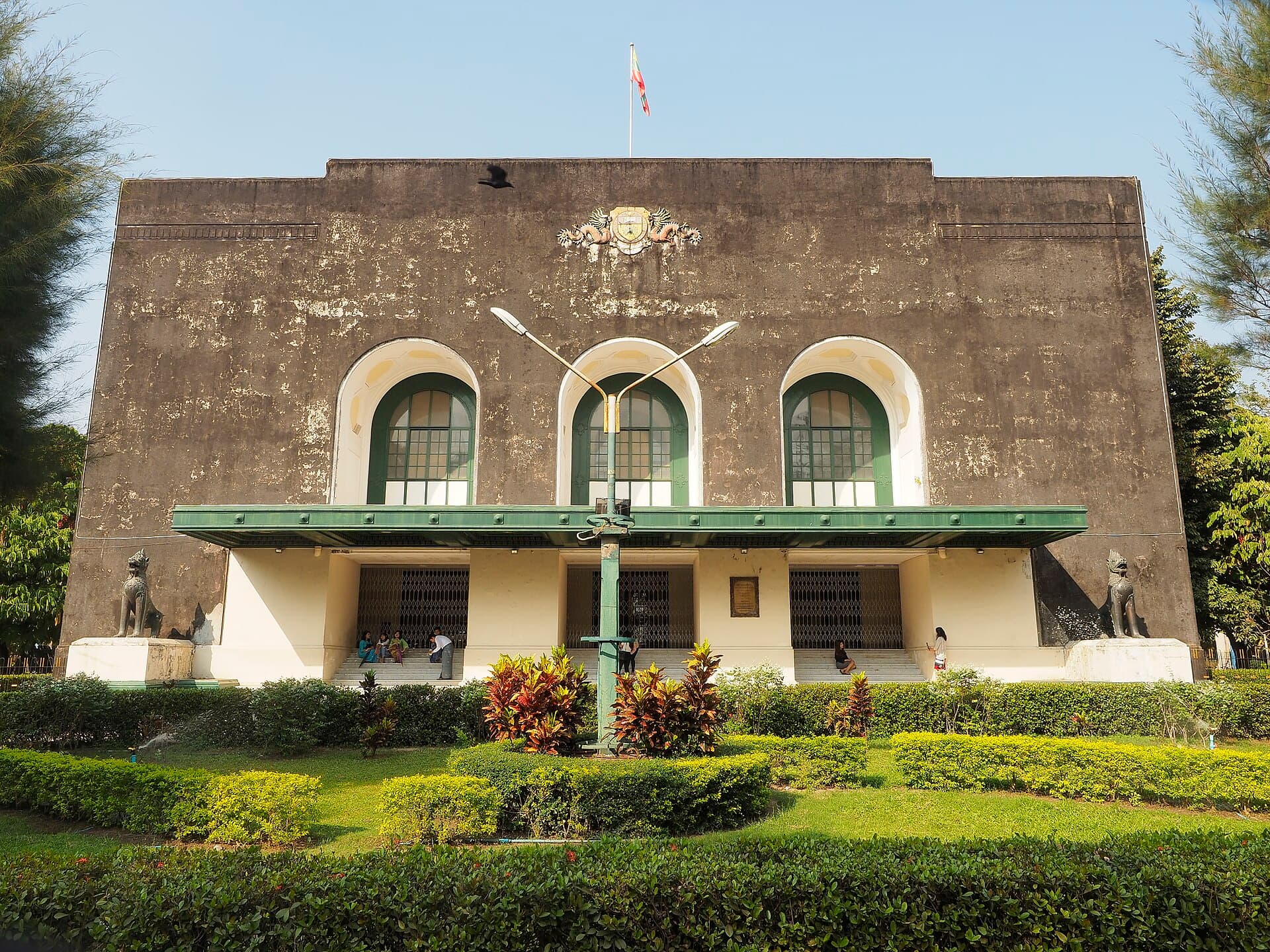
The University of Yangon occupies a wooded campus in Kamayut Township, on the southwestern bank of Inya Lake. It is the oldest university in Myanmar, established on 1 December 1920 under the University of Rangoon Act out of two existing colleges: Rangoon College, which the university dates to 1878 and which taught as an affiliate of the University of Calcutta, and Judson College, founded by the American Baptist Mission. Its Convocation Hall, a grey block flanked by a pair of chinthe, the mythical lions of Burmese temple architecture, has held the degree ceremonies since 1931.
The campus is best known, though, for something no longer on it. A patch of ground near its centre held the Rangoon University Students' Union building, finished in 1930, where the union that produced Aung San and U Nu met, argued and printed. At six in the morning on 8 July 1962, the day after soldiers had fired on students here, the army destroyed it with dynamite. The ground has stayed open ever since, and the date has never stopped being marked.
The Act answered years of pressure from the Young Men's Buddhist Association for a university in Burma rather than a distant examining body in Bengal, and what arrived was not what had been asked for: residence requirements and entrance standards that put a degree out of reach of students from the provinces and from poorer families, in an institution whose first chancellor was the Governor of Burma. Four days after the Act took effect, on 5 December 1920, a committee of twenty-six students led a walkout in support of sixteen demands. The boycott spread past the campus and produced a network of national schools teaching in Burmese. Myanmar keeps the anniversary as National Day, set by the Burmese calendar on the tenth day after the full moon of Tazaungmon, so the national holiday commemorates a strike against the country's own first university.
In February 1936 the university expelled U Nu, president of the Rangoon University Students' Union, and Aung San, editor of its magazine Oway, over an article titled "Hell Hound at Large" that attacked a senior university figure; Aung San had refused to name its author. The second students' strike ran about three months, both men were reinstated, and both went straight on into national politics. Aung San was elected president of the union in 1938, the year of a third strike and of the nationwide unrest known as the 1300 Revolution. U Nu became the first prime minister of independent Burma in 1948; Aung San, assassinated the year before, became its founding figure.
The university closed in January 1942 as Burma fell to Japan and reopened in 1943 as the State University under Ba Maw. Through the 1950s Rangoon University was reckoned among the strongest in Asia, and its alumni ran the new state; one of them, U Thant, served as Secretary-General of the United Nations from 1961 to 1971.
The first building on the new campus was the Convocation Hall, its foundation stone laid on 22 December 1922 and the hall opened on 28 July 1931. Degree ceremonies have been held there ever since, and in November 2012 Barack Obama gave the public address of his visit to the country from its platform. Beside it grows a thitpok tree that has stood since 1920, listed by the Yangon Heritage Trust as the first natural heritage site in the city. On the Pyay Road side is Judson Church, its cornerstone laid on 27 July 1931. Five halls of residence finished by 1928 carry the names of old Burmese capitals. Room 113 on the third floor of Bago Hall, where Aung San lived as a student, is kept as the Aung San Room.
Teaching runs across twenty-one departments, twelve in the arts and nine in the sciences, together with the Universities' Research Centre of 1985. For 2025 to 2026 the university records 1,404 students reading for bachelor's degrees and 780 for doctorates.
The union building was completed on 17 November 1930 and the Rangoon University Students' Union formally constituted on 31 January 1931, modelled on the debating societies of Oxford and Cambridge. Within five years it was the training ground of the independence movement, and after 1948 it remained the most politically weighted room in the country.
General Ne Win took power in a coup on 2 March 1962, and the student unions, following the party they were aligned with, endorsed him within days. The relationship soured that term. On 17 May the Revolutionary Council dissolved the university councils at Rangoon and Mandalay and ended academic self-administration. On 18 June it imposed new hostel rules: doors locked at eight in the evening, a register to be signed, and a ban on food sellers coming onto the campus to reach students who had missed their supper.
On 7 July students met in the union's assembly hall to discuss the rules, and about two thousand marched across the campus before dispersing at three in the afternoon. Police then stormed the union building and arrested its leaders, including the president. Students came out of the halls, fought the police and were met with tear gas. At about half past five, soldiers of the No. 4 Burma Rifles took positions around the campus, and after the crowd did not disperse the order was given to fire. The shooting lasted under half an hour. Official reports put the dead at fifteen and the wounded at twenty-seven; unofficial accounts gathered since put the dead at more than a hundred, and arrest estimates run into the thousands. No record establishes who gave the order. Ne Win broadcast that evening, calling the day the work of a treacherous group of communist students and warning that the government would fight "sword with sword and spear with spear". At six the next morning the army blew up the students' union building.
Taking the building down cost the regime more than the shooting had. It was the physical seat of the nationalist movement and bound closely to Aung San, and its demolition read as a break with a tradition most of the political class still claimed. All universities were closed for four months. The 1964 University Education Act then broke Rangoon University apart, moving medicine, economics, technology and education into separate institutes and renaming the remainder Rangoon Arts and Sciences University. Between 1962 and 1999 the country's universities were shut thirteen times.
The empty ground did not stay quiet. When U Thant died in 1974 and the government arranged no state honours, students took his coffin from the funeral procession on 5 December, buried him three days later at the site of the demolished union building and barricaded the campus. Troops entered at about two in the morning on 11 December and removed the casket; official figures gave nine dead, seventy-four injured and 2,887 arrested, and other accounts give higher numbers. Students led the 8888 Uprising of 1988, and in his resignation speech that year Ne Win called the destruction of the union building one of the defining episodes of his rule, while denying he had ordered it and attributing the order to his deputy Aung Gyi, who said he had only passed on Ne Win's instruction.
A new students' union formed on the campus in December 2014 with seventeen members, and from 2017 the government led by Aung San Suu Kyi began planning to rebuild it; the work was left unfinished, partly because generations disagreed on what to rebuild. Two other campuses in this archive sharpen the comparison. Chulalongkorn University in Bangkok still graduates its students in the halls it opened with. The University of the Philippines Diliman lost its Manila campus to the battle for the city in 1945 and rebuilt on open ground, carrying its statue and its records over. Rangoon lost its building to its own government, and the place where it stood has been left as it was.
Pe Maung Tin was appointed Burma's first professor of Pali at University College in 1912, at twenty-four, and became the first Burmese to lead the institution. With Gordon H. Luce he translated the Glass Palace Chronicle of the Kings of Burma in 1923 and compiled Selections from the Inscriptions of Pagan in 1928, opening the stone record of Bagan to scholars who could not read the inscriptions themselves.
Honorary degrees here track the country's foreign relations as clearly as its politics: after independence they went in law to Sihanouk of Cambodia, Tito of Yugoslavia, Ho Chi Minh of Vietnam and David Ben-Gurion of Israel. The practice stopped in 1962 and resumed in 2003.
The alumni run the country's political history in both directions at once. Aung San, U Nu, Ba Maw and U Thant studied here, and so did seven of the country's presidents and six of its prime ministers, Ne Win among them. Min Aung Hlaing, who has led the country since the coup of 2021, read law at Rangoon Arts and Sciences University in 1973 and 1974 before entering the Defence Services Academy. The same rooms produced the resistance and the governments that put it down.
Undergraduate programmes were suspended in 1996 and stayed suspended for sixteen years, while undergraduates were sent to newer institutions built on the edges of the city, among them Dagon University, opened in 1993 as part of a policy of spreading students across many campuses. The main site kept only postgraduate and diploma courses, and its avenues emptied. Aung San Suu Kyi, then an opposition member of parliament, proposed a new university law and the restoration of the campus in November 2012; the Hluttaw passed the motion by 248 votes. Undergraduates returned in December 2013, at first in classes of fifteen, and the Hlaing campus reopened in 2017.
The university regained its autonomy in 2020 and held its centenary the same year. In November 2014 its students were among those protesting the National Education Bill; the law was amended and student and teacher unions were given legal recognition. In February 2026 it conferred an honorary doctorate in public administration on Min Aung Hlaing at a special convocation, a decision that drew public criticism.
The campus sits on University Avenue Road in Kamayut Township, near Inya Lake. The Convocation Hall, Judson Church, the thitpok tree and the open ground where the students' union stood are within a few minutes' walk of one another: 1920s and 1930s buildings weathered by ninety monsoons, with a gap in the middle. A few kilometres south stands Shwedagon Pagoda, where the students of 1920 met in a pavilion at the southwest corner of the platform to plan their strike and where the strikers of 1936 camped on the terraces. Access depends on the university and on conditions in the country, unsettled since the coup of February 2021.
History
Campus and academics
Six in the morning, 8 July 1962
Scholarship
The university today
Visiting
References and resources
- University of Yangon: Yangon University (official)
- University of Yangon: Rector's Message (official)
- Wikipedia: University of Yangon
- Wikipedia: 1962 Rangoon University protests
- Wikipedia: U Thant funeral crisis
- Wikipedia: National Day (Myanmar)
- Wikipedia: Aung San
- Wikipedia: U Nu
- Wikipedia: Pe Maung Tin
- Wikipedia: Dagon University
- Wikipedia: Shwedagon Pagoda
- Remarks by President Obama at the University of Yangon (White House archives)