Heritage · University
University of the Philippines Diliman: History and Overview
The University of the Philippines was founded in 1908 as a secular public university, and after its Manila campus was destroyed in the Battle of Manila it rebuilt itself on new ground at Diliman in 1949. The flagship of the UP System, the campus is anchored by the Oblation, Guillermo Tolentino's statue of a self-offering figure inspired by Rizal's final poem.Written to last.
By Confinity Heritage Editorial · 2026-08-25 · 8-minute readQuiet tools, kept out of the way.
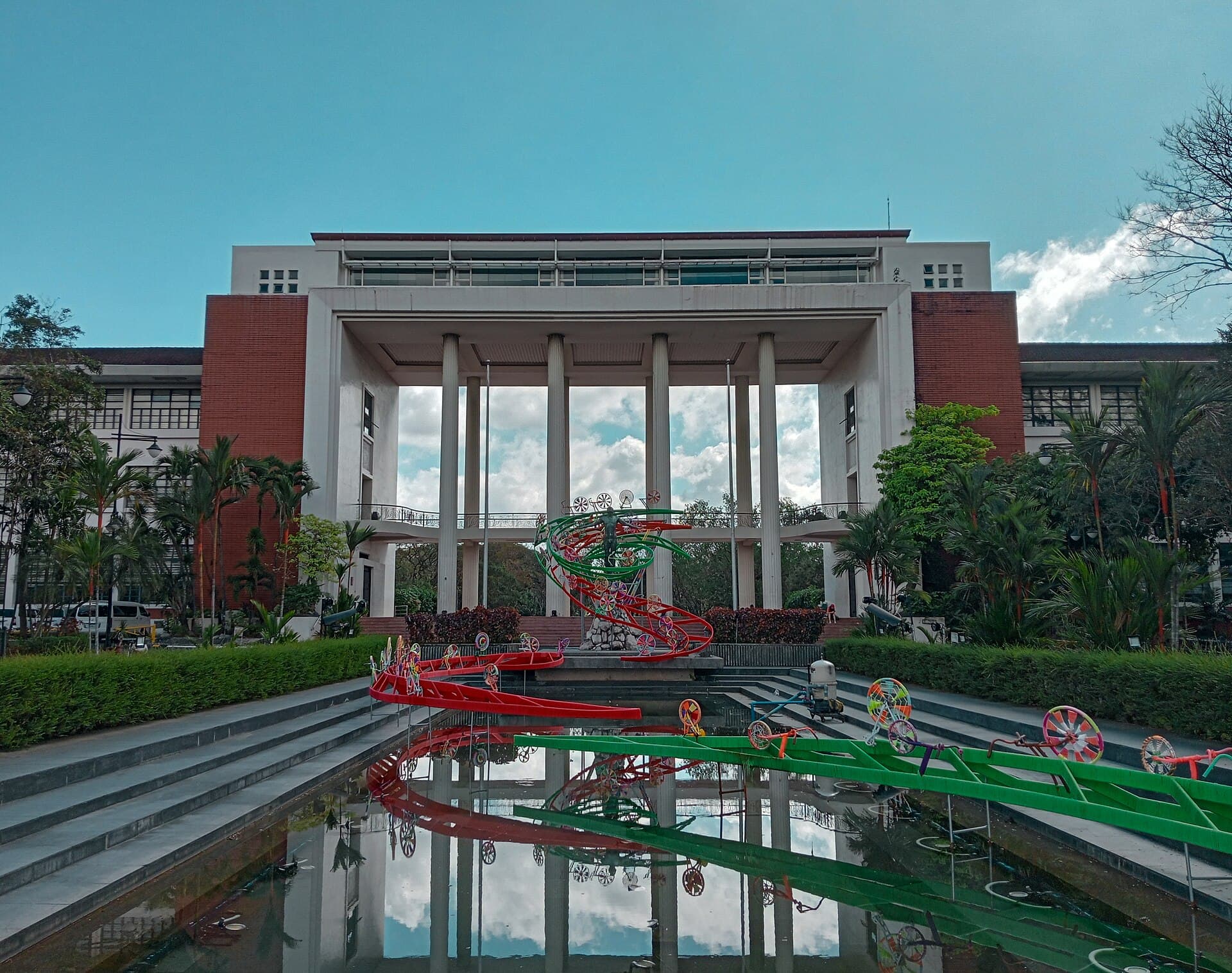
The University of the Philippines Diliman is the flagship campus of the Philippines' national university, spread across some 493 hectares of former grassland in Quezon City. Its ceremonial heart is the long approach up University Avenue to Quezon Hall, where a naked bronze figure stands on a plinth with its arms flung wide and its face turned to the sky. The statue is called the Oblation, and it is the closest thing the country has to a monument of its own idea of sacrifice, modelled on the last poem of the national hero Jose Rizal and reproduced on every campus the university has since built.
Diliman is also a campus with an unusual relationship to memory, because the university had to rebuild itself from ruin within living memory of its founding. The original campus in Manila was destroyed in the Battle of Manila in 1945, and the institution that moved north to Diliman four years later carried its statue, its records and its sense of purpose onto empty ground. What stands today is both a university and the result of a deliberate act of reconstruction.
The University of the Philippines was created on 18 June 1908, when the Philippine Assembly, the first elected legislature of the American colonial era, passed Act No. 1870 establishing a university "for the Filipino people." It was a deliberately secular foundation in a country whose older universities were religious, and it was public from the start, charged with giving advanced instruction in literature, philosophy, the sciences and the arts, and with offering professional and technical training to any qualified student regardless of age, sex, nationality or religious belief. The early colleges gathered around Padre Faura Street in the Ermita district of Manila, with outposts for agriculture at Los Baños, and the university grew through the American period into the country's main training ground for its lawyers, doctors, engineers and civil servants.
The Second World War broke that first campus. Manila was occupied in 1942, and in February 1945 the battle to retake the city levelled much of Ermita, including most of the university's buildings; the Battle of Manila ranks among the most destructive urban battles of the war. Even before the war, the government had bought land in Quezon City for a larger campus, and in the late 1940s the university decided not to rebuild in place but to start again. In 1949, under President Bienvenido Gonzalez, the university transferred to Diliman, moving faculty, students and the salvaged Oblation onto a plain of new buildings and young acacia trees. The move gave the institution a rare kind of memory: a university old enough to have traditions, young enough on its own ground to remember making them.
Diliman filled out through the postwar decades and became the seat of the university's administration. When the University of the Philippines was reorganised as a system of autonomous constituent universities, Diliman emerged as the largest and the flagship, the campus that holds the widest spread of disciplines and the national research institutes.
The campus is organised around the Academic Oval, a two-kilometre loop shaded by acacias, with Quezon Hall and the Oblation at one end and the main academic buildings ranged along its length. Inside the loop lies the Sunken Garden, a broad natural depression of lawn that serves as the university's common: fairs, concerts, pick-up football and evening crowds waiting out the sunset. Nearby rises the Carillon Tower, whose bells were inaugurated in 1952 by President Elpidio Quirino, himself a graduate; the instrument is generally described as the first carillon in Southeast Asia, and its restored bells still mark occasions on campus. Movement around the oval has its own institution in the Ikot jeepneys, the shared vehicles that loop the campus and whose name simply means "around."
Academically, Diliman is the most comprehensive campus of the system, teaching across the arts and letters, social sciences, law, engineering, business, education, music, fine arts, mass communication and the natural sciences, and housing national research institutes in fields from marine science to physics. The university's College of Medicine and the Philippine General Hospital, its teaching hospital, belong to the health-sciences constituent in Manila, but Diliman trains a large share of the country's scientists, economists and engineers, and its School of Economics and College of Law carry particular national weight.
The campus also carries a political history. In the first days of February 1971, students, joined by some faculty and residents, barricaded the campus in sympathy with striking jeepney drivers protesting oil price rises, declared a short-lived "Diliman Commune," and ran the university radio station until the barricades came down about a week later; one student was shot dead during the confrontations. Under martial law after 1972, student publications were shut and students and faculty were among those arrested, and the campus remained a centre of protest through the years that followed. Filipinos often call the university the conscience of the nation. The fairer statement is that UP has supplied the republic with both its governments and its opposition, often in the same graduating class, and Diliman is where the two traditions share a campus.
The Oblation was commissioned in 1935 by Rafael Palma, the university's first Filipino president, from the sculptor Guillermo Tolentino, who took as his brief the second stanza of Rizal's farewell poem Mi último adiós, the lines that offer up a life "without doubt, without gloom" for the country's sake. Tolentino answered with a naked young man, head thrown back, arms spread wide, standing on a base of rough stone. He built the figure to a height of three and a half metres, a measure usually explained as standing for the three and a half centuries of Spanish rule. His student Anastacio Caedo posed for the figure, though campus legend long preferred to name the actor Fernando Poe Sr. as the model. The original, made of concrete painted to look like bronze, survived the war and was carried to Diliman in 1949; it is now kept safe in the Main Library, while a bronze replica stands before Quezon Hall, and further replicas front every constituent university of the system.
The statue works as the university's memory of Rizal's sacrifice, and the campus treats it as a living object rather than an ornament. In seasons of protest, students drape it in banners so that the figure itself seems to join the demonstration, and once a year members of a fraternity honour it, after their fashion, by running past it wearing nothing at all, a tradition dating from the 1970s that has become part of campus folklore.
The university wears its memory in a second way. At graduation, UP students do not wear the Western cap and gown but the sablay, a loose woven sash in maroon and green inspired by the malong of Muslim Mindanao, patterned with indigenous motifs and bearing the letters "UP" in Baybayin, the pre-colonial Filipino script. Introduced in 1990 and adopted as the official academic costume in 2000, it is worn over the right shoulder and shifted to the left at the moment a degree is conferred. Between the statue and the sash, this is a university that has chosen to carry the nation's memory on its own body.
The roll of graduates runs through the history of the republic. Several presidents of the Philippines passed through the university, most of them through its College of Law: Jose P. Laurel, Manuel Roxas, Elpidio Quirino and Ferdinand Marcos Sr. all took law degrees there, and Gloria Macapagal-Arroyo earned her doctorate at the UP School of Economics and taught there before entering politics. The university has produced a long roll of National Artists, among them Tolentino himself in sculpture, his successor in the art Napoleon Abueva, and the poet and translator Virgilio Almario, along with many of the country's National Scientists. Its faculties have supplied the supreme court with justices, the diplomatic service with secretaries, and the sciences with the researchers who built the country's institutes of physics, marine biology and public health.
The University of the Philippines is today a system of eight constituent universities, from Baguio in the north to Mindanao in the south, with Diliman as its largest campus and administrative seat. Diliman enrols more than twenty thousand students and consistently places as the country's top-ranked university in the major international tables. Admission is fiercely competitive, and the university's mandated role as an instrument of national development keeps its research pointed at Philippine problems: typhoon science, marine resources in an archipelagic state, Filipino language and literature, and the digitisation of the national record.
The Diliman campus is open, and many residents of Quezon City treat it as a public park. The classic visit is a slow circuit of the Academic Oval under the acacias, on foot or by bicycle, with pauses at the Oblation and Quezon Hall, the Carillon Tower, and the Sunken Garden toward late afternoon, when students gather on the grass for sunset. The Vargas Museum on campus holds a strong collection of Philippine art, and the parish Church of the Holy Sacrifice, a round modernist landmark, is worth a look for its architecture. Jeepneys marked "Ikot" circle the campus cheaply. Classes and examinations take priority over sightseeing, and weekday traffic on the surrounding roads argues for an early morning or a weekend.