Heritage · Landmark
The Shwedagon Pagoda: Myanmar's golden stupa
On Singuttara Hill above Yangon, a gilded spire close to 100 metres tall guards relics said to include eight hairs of the Buddha. The Shwedagon is the most sacred Buddhist site in Myanmar, crowned by a jewelled umbrella and a diamond that catches the first light of morning.Written to last.
By Confinity Heritage Editorial · Updated 2026-07-31 · 7-minute readQuiet tools, kept out of the way.
On Singuttara Hill, above the low roofs and river light of Yangon, a single gilded spire climbs close to 100 metres into the sky. This is the Shwedagon Pagoda, the most sacred Buddhist stupa in Myanmar, a solid mountain of brick sheathed in gold and set with jewels (Britannica). Tradition holds that it enshrines relics of four Buddhas of the present world age, among them eight hairs given by Gautama Buddha himself, which makes the hill one of the holiest places in the Theravada Buddhist world (UNESCO).
For the people who climb its stairways at dawn and dusk, the Shwedagon is not a monument to be viewed from a distance but a place to be entered, circled, and touched. Pilgrims walk clockwise around its terrace, press squares of gold leaf onto smaller shrines, pour water over stone images, and light candles for the living and the dead (Wikipedia). The gold that covers the spire is renewed again and again by their gifts, so that the pagoda is at once very old and endlessly made new.
The pagoda's own story begins more than two thousand years ago. According to Burmese tradition, two merchant brothers, Tapussa and Bhallika, met the Buddha soon after his enlightenment and offered him honey cakes, and in return he gave them eight hairs from his head (Britannica). Carried home by sea and guarded on the way, the hairs were enshrined on Singuttara Hill with the help of the local king, Okkalapa, and of the spirits, on a spot where relics of three earlier Buddhas were already believed to rest: the staff of Kakusandha, the water filter of Konagamana, and a piece of the robe of Kassapa (Wikipedia). Together these gifts made the hill a shrine to four Buddhas.
Historians place the first stupa later, and think it was raised by the Mon people at some point between the sixth and tenth centuries (Wikipedia). The written record grows clearer in the fourteenth century, when King Binnya U is said to have rebuilt the pagoda to about 18 metres in the 1360s. In the following century Queen Shin Sawbu, who made the pagoda a lifelong care, raised it to roughly 40 metres, laid out its terraces, and, by tradition, gave her own weight in gold to gild it (Britannica). Her successor, King Dhammazedi, left inscriptions in Mon, Pali, and Burmese that recorded the pagoda's history for those who came after.
Earthquakes shaped the rest. Set on ground crossed by active faults, the stupa was cracked and shaken many times, and a severe earthquake in 1768 brought down its upper spire. King Hsinbyushin rebuilt it soon afterward, close to its present height, and later kings added further gold and ornament (Wikipedia). Each collapse and repair, across the centuries, lifted the pagoda a little higher than before.
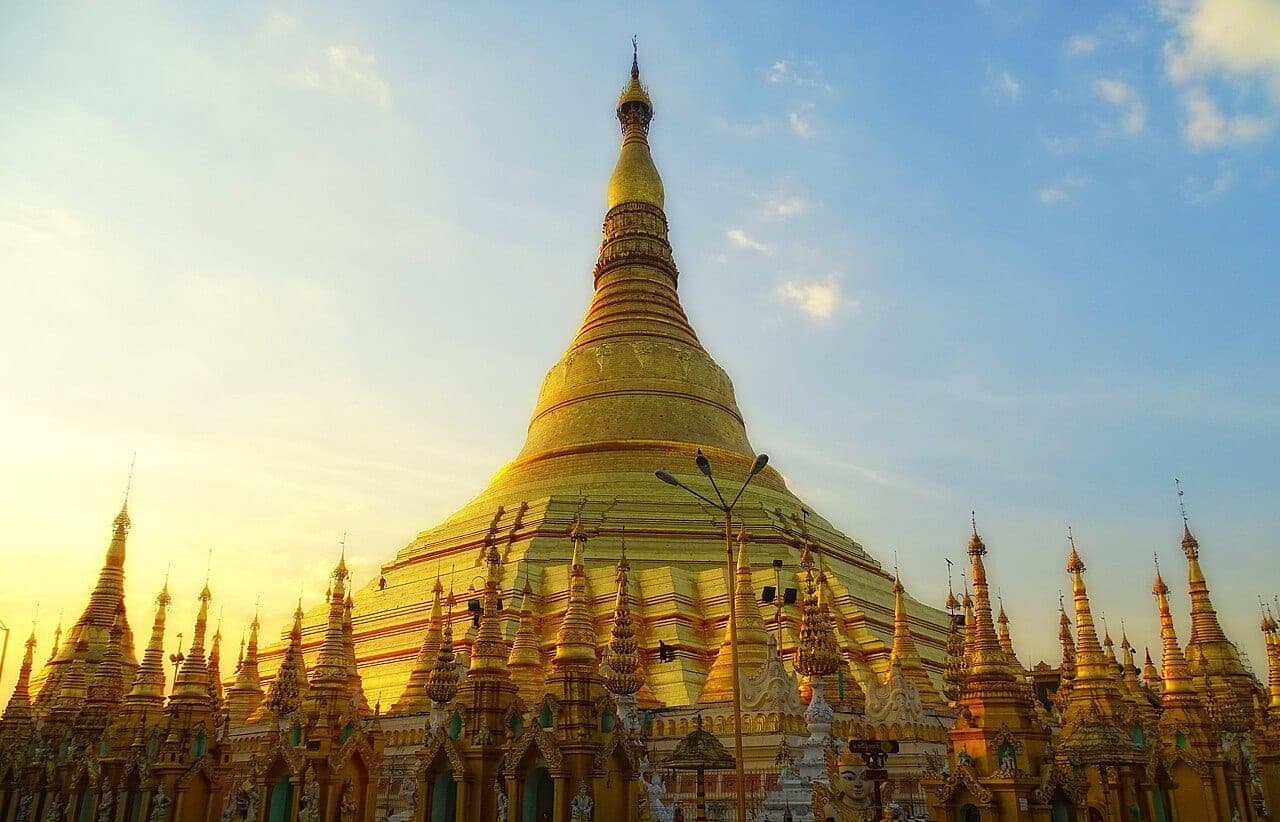
In form the Shwedagon is a bell, or an alms bowl turned upside down, rising from an eight-sided base through moulded bands to a slender point. From the marble terrace the gilded stupa climbs close to 99 metres (Britannica). Below the crown the surface passes through a sequence of named shapes familiar across Burmese stupas: the bell, the turban band, the inverted and upright lotus petals, and near the top a swelling like a plantain bud.
 The gold is not paint but plate, renewed by donation, and the terrace around the stupa is crowded with shrines given by individual families. Photograph by Marcin Konsek, CC BY-SA 4.0, via Wikimedia Commons.
The gold is real. The lower stupa is clad in gold plates, while the upper reaches are covered in gold leaf pressed on by generations of pilgrims, and the whole surface is renewed as the metal wears (Wikipedia). Above it hangs the hti, the tiered umbrella finial that crowns almost every Burmese pagoda. The present hti was given by King Mindon in 1871, a structure of gilded iron in seven rings, hung with gold and silver bells that sound in the wind (Wikipedia). Its metalwork is set with thousands of gems, by long count some 5,448 diamonds and 2,317 rubies, sapphires, and other stones. At the very summit sits the diamond bud, or seinbu, tipped with a single large diamond of about 76 carats that catches the sun and, from the right angle on the terrace below, throws off a point of coloured light.
The Shwedagon is first of all a place of Theravada Buddhist practice. Worshippers climb one of the four covered stairways, leave their shoes at the foot, and walk clockwise around the great stupa, keeping it on their right (UNESCO). They offer flowers and candles, kneel to recite and to meditate, and gain merit by their devotion, dedicating it to their families and to all beings.
Around the base of the stupa stand the eight planetary posts, small shrines that give the pagoda much of its daily rhythm (Wikipedia). They mark the eight points of the compass, and each is tied to one day of the Burmese week, in which Wednesday is divided into morning and afternoon, and to a planet and an animal sign. Burmese Buddhists know the day on which they were born, and so they know their corner. There they bathe the Buddha image and its animal with cups of water, often one for each year of their life and one more, a small and particular rite repeated countless times a day. Between the posts the terrace is crowded with pavilions, image houses, bells, and prayer halls, so that the platform is never still.
For much of Burmese history the pagoda and the crown were closely bound. Kings and queens measured their piety in gifts to the Shwedagon, in gold, in spires, and above all in bells. The Maha Ganda bell, cast for King Singu in 1779 and weighing some 23 tonnes, was seized by British forces in the 1820s to be shipped away, but it slipped into the river; local people raised it from the water and returned it to the hill, where it hangs still (Wikipedia). Larger yet is the Maha Tissada bell, of about 42 tonnes, given by King Tharrawaddy in 1841.
The pagoda has also known occupation and return. After the war of 1852 the British army held the terrace as a fortified garrison, and the platform was not given back to religious use until 1929 (Wikipedia). In the years since, the Shwedagon has remained a natural gathering place at moments of national importance, as well as the setting for the yearly pagoda festival held in the month of Tabaung, when the terraces fill with pilgrims through the night. Across many changes of rule, it has kept its place at the centre of the city's shared life.
Caring for such a monument never ends. The pagoda is managed by a board of trustees, and its gold is renewed on a regular cycle, worn leaf and plate replaced with new metal, much of it donated by the faithful (Wikipedia). The hti and its jewels are inspected and, when needed, taken down, refitted, and raised again, work carried out with ceremony. Gold beaten within the compound, together with gifts of leaf from pilgrims, keeps the surface bright.
The longer concern is the ground itself. Myanmar lies along the Sagaing Fault, one of the most active in the region, and the pagoda has been damaged and rebuilt after earthquakes many times, most severely in 1768 (Britannica). A strong earthquake near Bagan in 2016 largely spared distant Yangon, and the far greater earthquake of March 2025, centred near Sagaing, devastated much of central Myanmar while the pagoda, well to the south, was reported to have come through without serious harm (Britannica). Engineers and conservators continue to watch its stability closely.
To stand on the marble at first light, as the gold turns from grey to fire and the small bells of the hti move in the wind, is to feel why the Shwedagon has held its people for so long. It is a place made of gifts, each plate of gold and each square of leaf pressed on by a hand that hoped for something: health, a safe journey, a good rebirth, the ease of someone who has died. Families return across generations to the same corner of the same terrace, and the merit earned there is often dedicated to parents and grandparents no longer living.
In that sense the pagoda is a great keeping place for memory as much as for relics. What is enshrined at its heart cannot be seen, and what is offered on its terrace is mostly quiet, but both are carried forward, day after day, by those who climb the hill. To leave a light burning at the Shwedagon is to trust that it will still be burning long after the one who lit it has gone.
The gold is not paint but plate, renewed by donation, and the terrace around the stupa is crowded with shrines given by individual families. Photograph by Marcin Konsek, CC BY-SA 4.0, via Wikimedia Commons.
The gold is real. The lower stupa is clad in gold plates, while the upper reaches are covered in gold leaf pressed on by generations of pilgrims, and the whole surface is renewed as the metal wears (Wikipedia). Above it hangs the hti, the tiered umbrella finial that crowns almost every Burmese pagoda. The present hti was given by King Mindon in 1871, a structure of gilded iron in seven rings, hung with gold and silver bells that sound in the wind (Wikipedia). Its metalwork is set with thousands of gems, by long count some 5,448 diamonds and 2,317 rubies, sapphires, and other stones. At the very summit sits the diamond bud, or seinbu, tipped with a single large diamond of about 76 carats that catches the sun and, from the right angle on the terrace below, throws off a point of coloured light.
The Shwedagon is first of all a place of Theravada Buddhist practice. Worshippers climb one of the four covered stairways, leave their shoes at the foot, and walk clockwise around the great stupa, keeping it on their right (UNESCO). They offer flowers and candles, kneel to recite and to meditate, and gain merit by their devotion, dedicating it to their families and to all beings.
Around the base of the stupa stand the eight planetary posts, small shrines that give the pagoda much of its daily rhythm (Wikipedia). They mark the eight points of the compass, and each is tied to one day of the Burmese week, in which Wednesday is divided into morning and afternoon, and to a planet and an animal sign. Burmese Buddhists know the day on which they were born, and so they know their corner. There they bathe the Buddha image and its animal with cups of water, often one for each year of their life and one more, a small and particular rite repeated countless times a day. Between the posts the terrace is crowded with pavilions, image houses, bells, and prayer halls, so that the platform is never still.
For much of Burmese history the pagoda and the crown were closely bound. Kings and queens measured their piety in gifts to the Shwedagon, in gold, in spires, and above all in bells. The Maha Ganda bell, cast for King Singu in 1779 and weighing some 23 tonnes, was seized by British forces in the 1820s to be shipped away, but it slipped into the river; local people raised it from the water and returned it to the hill, where it hangs still (Wikipedia). Larger yet is the Maha Tissada bell, of about 42 tonnes, given by King Tharrawaddy in 1841.
The pagoda has also known occupation and return. After the war of 1852 the British army held the terrace as a fortified garrison, and the platform was not given back to religious use until 1929 (Wikipedia). In the years since, the Shwedagon has remained a natural gathering place at moments of national importance, as well as the setting for the yearly pagoda festival held in the month of Tabaung, when the terraces fill with pilgrims through the night. Across many changes of rule, it has kept its place at the centre of the city's shared life.
Caring for such a monument never ends. The pagoda is managed by a board of trustees, and its gold is renewed on a regular cycle, worn leaf and plate replaced with new metal, much of it donated by the faithful (Wikipedia). The hti and its jewels are inspected and, when needed, taken down, refitted, and raised again, work carried out with ceremony. Gold beaten within the compound, together with gifts of leaf from pilgrims, keeps the surface bright.
The longer concern is the ground itself. Myanmar lies along the Sagaing Fault, one of the most active in the region, and the pagoda has been damaged and rebuilt after earthquakes many times, most severely in 1768 (Britannica). A strong earthquake near Bagan in 2016 largely spared distant Yangon, and the far greater earthquake of March 2025, centred near Sagaing, devastated much of central Myanmar while the pagoda, well to the south, was reported to have come through without serious harm (Britannica). Engineers and conservators continue to watch its stability closely.
To stand on the marble at first light, as the gold turns from grey to fire and the small bells of the hti move in the wind, is to feel why the Shwedagon has held its people for so long. It is a place made of gifts, each plate of gold and each square of leaf pressed on by a hand that hoped for something: health, a safe journey, a good rebirth, the ease of someone who has died. Families return across generations to the same corner of the same terrace, and the merit earned there is often dedicated to parents and grandparents no longer living.
In that sense the pagoda is a great keeping place for memory as much as for relics. What is enshrined at its heart cannot be seen, and what is offered on its terrace is mostly quiet, but both are carried forward, day after day, by those who climb the hill. To leave a light burning at the Shwedagon is to trust that it will still be burning long after the one who lit it has gone.
The eight hairs and the rising of the spire
Gold, the hti, and the diamond bud
A living centre of devotion
Kings, bells, and the life of a city
Keeping the gold, standing through earthquakes
A place of memory
References and resources
- Encyclopaedia Britannica: Shwe Dagon Pagoda: overview of the pagoda's height, enshrined relics, history, and gilding.
- Wikipedia: Shwedagon Pagoda: detailed history, dimensions, the hti and its jewels, the great bells, and the planetary posts.
- UNESCO World Heritage tentative list: Shwedagon Pagoda on Singuttara Hill: the tentative-list entry and a description of the site's significance.
- Shwedagon Pagoda Board of Trustees (official): About Shwedagon: the traditional account of the eight hairs and the pagoda's religious role.
- Eos: A Golden Opportunity to Save Shwedagon Pagoda's Acclaimed Dome: conservation of the gilded stupa and its seismic risk.
- Encyclopaedia Britannica: Myanmar earthquake of 2025: the March 2025 earthquake and its effects across Myanmar.