Heritage · University
University of Vienna: History and Overview
Founded in 1365 by Duke Rudolf IV, the University of Vienna is the oldest university in the German-speaking world and one of the largest in Europe. Its story runs from a medieval studium generale to a research university of some 85,000 students, and it now openly confronts the persecution its members suffered after 1938.Written to last.
By Confinity Heritage Editorial · Updated 2026-07-31 · 8-minute readQuiet tools, kept out of the way.
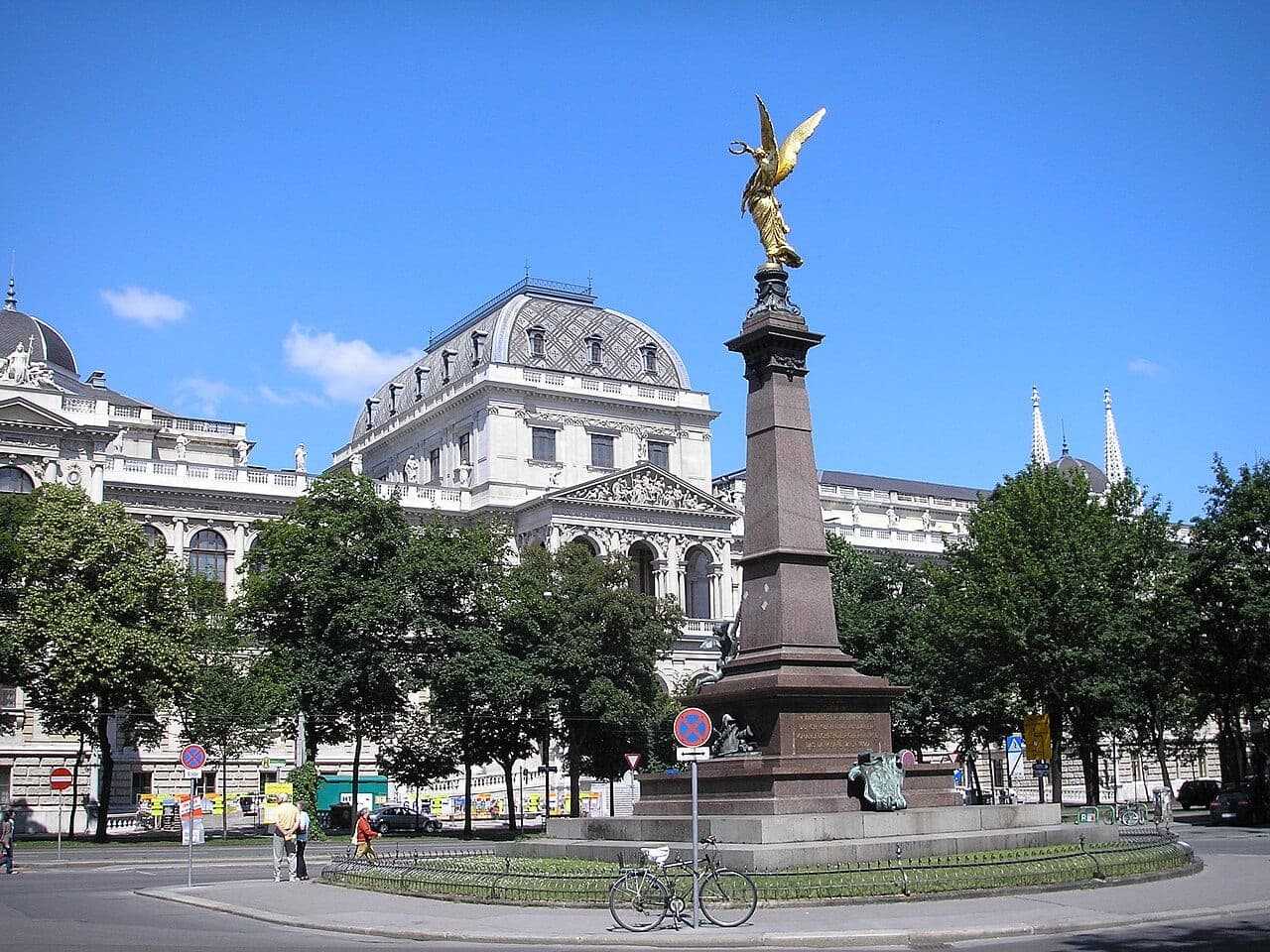
On 12 March 1365, Duke Rudolf IV of Austria sealed a founding document that created a place of study in Vienna, and in doing so he became the first ruler to found a university without wearing a royal crown (University of Vienna). The institution he established, later known in Latin as the Alma Mater Rudolphina Vindobonensis after its founder, is the oldest university in the German-speaking world and among the oldest still teaching anywhere (Britannica). More than six and a half centuries later it remains one of the largest universities in Europe, with roughly 85,000 students enrolled (Wikipedia).
To walk into its main building on the Vienna Ringstrasse is to enter a memory that holds both achievement and grief. The arcaded courtyard is lined with busts and plaques of scholars who taught here, among them Nobel laureates and the physicians who made Viennese medicine famous. Set into the same institution is a memorial to the more than 2,700 members of the university who were dismissed, driven out, or murdered after 1938 (University of Vienna, Memorial Book). The archive this page belongs to exists to keep such names from vanishing, and the University of Vienna has spent recent decades doing the same work on its own past.
Rudolf IV modelled his new studium generale on the University of Paris and granted it the right to award doctorates in all permitted sciences (University of Vienna). His motive was partly dynastic pride. His father-in-law and rival, Emperor Charles IV, had founded the University of Prague in 1348, and Rudolf wanted a comparable seat of learning for the Habsburg lands (Britannica). Pope Urban V confirmed the foundation on 18 June 1365 but withheld permission for a faculty of theology, most likely under pressure from Charles IV, which left the young institution short of full university status. Rudolf himself did not live to see it grow; he died in Milan on 27 July 1365 at the age of twenty-five. Only in 1384, under his brother Duke Albert III and with papal consent, did the theology faculty open and the university take its complete form with four faculties (University of Vienna).
Through the Habsburg centuries the university's fortunes rose and fell with the dynasty and the church. The Reformation and the Counter-Reformation reshaped its teaching, and for long stretches the Jesuits controlled much of its instruction. The decisive modern turn came in the eighteenth century, when Empress Maria Theresa brought the university firmly under state control and reorganised it to train physicians and civil servants for the monarchy (Britannica). Her son Joseph II went further, permitting Protestant and Jewish students to enrol from 1782 and making German the language of instruction in 1783 (Wikipedia).
The building that now defines the university belongs to the great nineteenth-century remaking of Vienna. When the city's medieval walls were pulled down to create the Ringstrasse boulevard, the architect Heinrich von Ferstel designed a grand new main building in the Italian Renaissance manner, constructed between 1877 and 1884 (Wikipedia). A little over a decade later the university opened its doors to women: from 1897 they could enrol in the Faculty of Philosophy, with medicine following in 1900 and law in 1919 (Wikipedia). The change was slow and contested, but it reshaped who the university served.
The darkest chapter came in the twentieth century. Antisemitism had long shadowed the university, and the authoritarian Austrofascist regime of the 1930s had already dismissed political opponents from its staff. After the Anschluss of March 1938, when Nazi Germany annexed Austria, the persecution became total. More than 2,700 members of the university, among them teachers, researchers, and students, most of them Jewish, were expelled for so-called racial or political reasons; many were forced into exile and many were murdered in the Holocaust (University of Vienna). Around 350 members of the teaching staff alone were driven out. The university did not merely comply with these measures; parts of it welcomed them.
For decades afterward this history was largely unspoken. Since 2009 the University of Vienna has formally acknowledged its shared responsibility for what it describes as an inconceivable atrocity committed against its own members, and it maintains an online Memorial Book that records the names, birth years, and faculties of those who were driven out (University of Vienna, Memorial Book). For its 650th anniversary in 2015 the university also opened a wide public research project into its whole history, including its conduct under National Socialism. Rebuilding after the war was slow, and the restoration of the damaged main building continued into 1951 (Wikipedia).
Ferstel's main building on the Universitätsring remains the symbolic heart of the university, though the institution long ago outgrew a single address. Its arcaded courtyard, the Arkadenhof, works as a kind of open-air hall of honour, ringed by monuments to former professors. Behind the ceremonial rooms lies one of the largest university libraries in the German-speaking world.
 The arcaded courtyard inside carries busts of about 150 scholars of the university. The first woman among them was added in 2006. Photograph by Ian Ehm, CC BY 4.0, via Wikimedia Commons.
Today the university is spread across dozens of sites throughout Vienna rather than gathered on one campus. One of the best known is the Campus of the University of Vienna in the former general hospital in the ninth district, a complex of courtyards and gardens now given over to lecture halls and institutes. The university is organised into fifteen faculties and five research-focused centres, covering theology, law, the humanities, the social sciences, and the natural sciences, and it offers on the order of 185 degree programmes (Wikipedia). One notable change came in 2004, when the historic Faculty of Medicine separated to become the independent Medical University of Vienna, carrying much of the old medical school's legacy with it (Medical University of Vienna).
Few universities have shaped modern thought as widely as Vienna. Some seventeen Nobel laureates have been connected to it as students, teachers, or researchers, among them the physicist Erwin Schrödinger, the immunologist Karl Landsteiner, who discovered the human blood groups, and the ethologist Konrad Lorenz (Wikipedia). The city's medical tradition, the celebrated Vienna medical school, grew up largely within the university: the reforms of Gerard van Swieten under Maria Theresa and, in the nineteenth century, the work of pathologists and surgeons such as Carl von Rokitansky and Theodor Billroth made Vienna a leading centre of clinical medicine.
It was into this medical world that a young Sigmund Freud arrived. He entered the university's medical school in 1873, worked in Ernst von Brücke's Institute of Physiology, and took his medical degree in 1881 before going on to develop psychoanalysis (Britannica). The university was also the home of the Vienna Circle, the group of philosophers and scientists who, meeting from 1924 to 1936 under the chairmanship of Moritz Schlick, formulated logical positivism and its insistence that meaningful claims be grounded in logic and evidence (Britannica). That story too carries a shadow: in 1936 Schlick was shot dead on the steps of the main building by a former student, and the killing was exploited by antisemitic and Nazi sympathisers even though Schlick himself was not Jewish. The Austrian School of economics, from Carl Menger to Friedrich Hayek, likewise took shape in Vienna's lecture rooms.
When the university set out in 2008 to name the people it had driven out seventy years earlier, it found that no such list existed. The dismissals of teaching staff were on file. The students were not: they had simply stopped appearing. Enrolment fell from about 9,180 in the winter semester of 1937/38 to roughly 5,350 a year later, and statistical work fixed the number of persecuted students at 2,230 (University of Vienna).
The names had to be recovered from the paperwork of enrolment. Every student had filled in a Nationale, the registration sheet with its lines for religion, mother tongue and ethnicity. Researchers went through the sheets for the winter of 1937/38 and the following summer, marking everyone whose answers would have brought them under the racial rules, then checking which of them had failed to re-enrol the next term (University of Vienna, Memorial Book).
What came of that work is the Gedenkbuch, put online at the end of June 2009 and added to since. It carries roughly 2,200 entries, each with a name, a year of birth and a faculty, the subject taught in the case of lecturers, and for graduates whose doctorates were annulled the year and the degree that was taken from them. By the end of 2021 more than 1,850 expelled students had been documented. Among the two hundred or so dismissed teachers listed is Elise Richter, the first woman to hold the habilitation at Vienna, deported to Theresienstadt in October 1942 and killed there in June 1943.
The handwritten original is kept a short walk from the lecture halls, in the former Jewish prayer house on the old general hospital grounds: a pavilion of 1903, desecrated in the pogrom of November 1938, later hollowed out for a transformer station serving the Narrenturm next door, and restored as the memorial called Marpe Lanefesch, healing for the soul (University of Vienna, Memorial Book).
The University of Vienna is now the largest university in Austria and one of the largest in the German-speaking world, with roughly 85,000 students and about 10,000 staff (Wikipedia). It remains a broad research university rather than a specialist school, and it consistently ranks among the leading institutions in the German-speaking countries. Its self-understanding has changed in important ways. Alongside the pride it takes in its founders and its Nobel laureates, it now presents its history honestly, memorial and all, treating the people it failed as part of the record it is responsible for. For an archive built around remembrance, that combination of long achievement and frank reckoning is precisely what makes the place worth keeping in memory.
The main building on the Universitätsring is open to the public, and the Arkadenhof courtyard with its monuments to former scholars can usually be seen during opening hours; guided tours of the building and its history are offered regularly. The building sits directly on Vienna's Ringstrasse, close to the Rathaus and the Burgtheater, and is easily reached by tram or by the U2 underground line. Visitors interested in the harder parts of the story can consult the online Memorial Book, and the original handwritten volume is kept at the Marpe Lanefesch memorial on the former general-hospital campus (University of Vienna, Memorial Book). As with any working university, access to individual institutes and libraries may be limited during term, so checking the university's official website before a visit is wise.
The arcaded courtyard inside carries busts of about 150 scholars of the university. The first woman among them was added in 2006. Photograph by Ian Ehm, CC BY 4.0, via Wikimedia Commons.
Today the university is spread across dozens of sites throughout Vienna rather than gathered on one campus. One of the best known is the Campus of the University of Vienna in the former general hospital in the ninth district, a complex of courtyards and gardens now given over to lecture halls and institutes. The university is organised into fifteen faculties and five research-focused centres, covering theology, law, the humanities, the social sciences, and the natural sciences, and it offers on the order of 185 degree programmes (Wikipedia). One notable change came in 2004, when the historic Faculty of Medicine separated to become the independent Medical University of Vienna, carrying much of the old medical school's legacy with it (Medical University of Vienna).
Few universities have shaped modern thought as widely as Vienna. Some seventeen Nobel laureates have been connected to it as students, teachers, or researchers, among them the physicist Erwin Schrödinger, the immunologist Karl Landsteiner, who discovered the human blood groups, and the ethologist Konrad Lorenz (Wikipedia). The city's medical tradition, the celebrated Vienna medical school, grew up largely within the university: the reforms of Gerard van Swieten under Maria Theresa and, in the nineteenth century, the work of pathologists and surgeons such as Carl von Rokitansky and Theodor Billroth made Vienna a leading centre of clinical medicine.
It was into this medical world that a young Sigmund Freud arrived. He entered the university's medical school in 1873, worked in Ernst von Brücke's Institute of Physiology, and took his medical degree in 1881 before going on to develop psychoanalysis (Britannica). The university was also the home of the Vienna Circle, the group of philosophers and scientists who, meeting from 1924 to 1936 under the chairmanship of Moritz Schlick, formulated logical positivism and its insistence that meaningful claims be grounded in logic and evidence (Britannica). That story too carries a shadow: in 1936 Schlick was shot dead on the steps of the main building by a former student, and the killing was exploited by antisemitic and Nazi sympathisers even though Schlick himself was not Jewish. The Austrian School of economics, from Carl Menger to Friedrich Hayek, likewise took shape in Vienna's lecture rooms.
When the university set out in 2008 to name the people it had driven out seventy years earlier, it found that no such list existed. The dismissals of teaching staff were on file. The students were not: they had simply stopped appearing. Enrolment fell from about 9,180 in the winter semester of 1937/38 to roughly 5,350 a year later, and statistical work fixed the number of persecuted students at 2,230 (University of Vienna).
The names had to be recovered from the paperwork of enrolment. Every student had filled in a Nationale, the registration sheet with its lines for religion, mother tongue and ethnicity. Researchers went through the sheets for the winter of 1937/38 and the following summer, marking everyone whose answers would have brought them under the racial rules, then checking which of them had failed to re-enrol the next term (University of Vienna, Memorial Book).
What came of that work is the Gedenkbuch, put online at the end of June 2009 and added to since. It carries roughly 2,200 entries, each with a name, a year of birth and a faculty, the subject taught in the case of lecturers, and for graduates whose doctorates were annulled the year and the degree that was taken from them. By the end of 2021 more than 1,850 expelled students had been documented. Among the two hundred or so dismissed teachers listed is Elise Richter, the first woman to hold the habilitation at Vienna, deported to Theresienstadt in October 1942 and killed there in June 1943.
The handwritten original is kept a short walk from the lecture halls, in the former Jewish prayer house on the old general hospital grounds: a pavilion of 1903, desecrated in the pogrom of November 1938, later hollowed out for a transformer station serving the Narrenturm next door, and restored as the memorial called Marpe Lanefesch, healing for the soul (University of Vienna, Memorial Book).
The University of Vienna is now the largest university in Austria and one of the largest in the German-speaking world, with roughly 85,000 students and about 10,000 staff (Wikipedia). It remains a broad research university rather than a specialist school, and it consistently ranks among the leading institutions in the German-speaking countries. Its self-understanding has changed in important ways. Alongside the pride it takes in its founders and its Nobel laureates, it now presents its history honestly, memorial and all, treating the people it failed as part of the record it is responsible for. For an archive built around remembrance, that combination of long achievement and frank reckoning is precisely what makes the place worth keeping in memory.
The main building on the Universitätsring is open to the public, and the Arkadenhof courtyard with its monuments to former scholars can usually be seen during opening hours; guided tours of the building and its history are offered regularly. The building sits directly on Vienna's Ringstrasse, close to the Rathaus and the Burgtheater, and is easily reached by tram or by the U2 underground line. Visitors interested in the harder parts of the story can consult the online Memorial Book, and the original handwritten volume is kept at the Marpe Lanefesch memorial on the former general-hospital campus (University of Vienna, Memorial Book). As with any working university, access to individual institutes and libraries may be limited during term, so checking the university's official website before a visit is wise.
History
Campus and academics
Scholarship
The Gedenkbuch and the enrolment sheets
The university today
Visiting
References and resources
- University of Vienna: 650 plus history portal
- University of Vienna: The beginnings of the Alma Mater Rudolphina
- University of Vienna: Expulsion of teachers and students in 1938
- University of Vienna: Memorial Book (Gedenkbuch)
- Encyclopaedia Britannica: University of Vienna
- Encyclopaedia Britannica: Vienna Circle
- Encyclopaedia Britannica: Sigmund Freud
- Wikipedia: University of Vienna
- Wikipedia: Medical University of Vienna