Heritage · Country
Myanmar Culture and Heritage
From the gilded cone of the Shwedagon to the temple plain of Bagan, Myanmar keeps one of Asia's deepest Buddhist inheritances. A guide to Burmese heritage, the kingdoms of Pagan, Toungoo and Konbaung, and the merit-making customs by which families carry their dead onward.Written to last.
By Confinity Heritage Editorial · Updated 2026-07-31 · 8-minute readQuiet tools, kept out of the way.
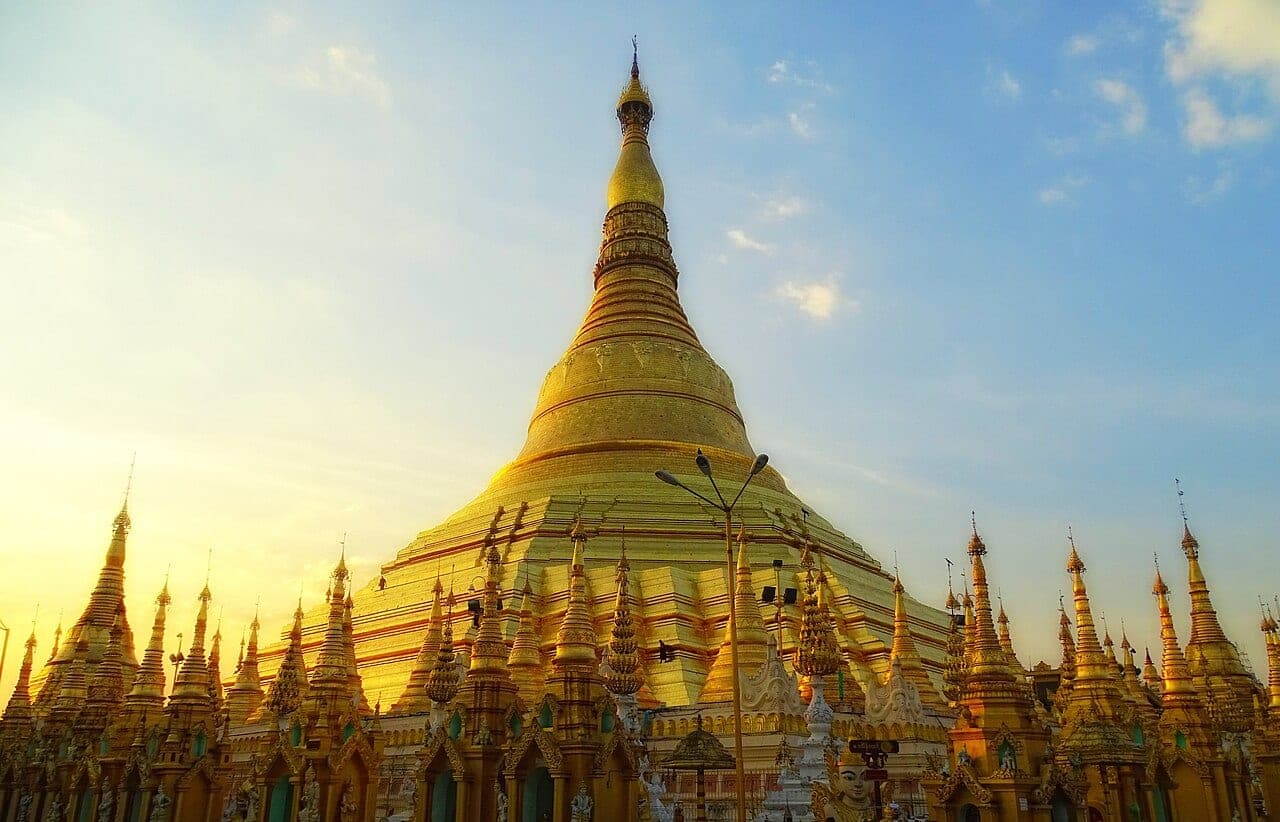
Few countries gather a whole civilisation into a single silhouette the way Myanmar does. On the central plain, the temple field of Bagan spreads more than two thousand surviving stupas and shrines across a bend of the Irrawaddy, raised by a kingdom whose kings, masons and scribes set the pattern for much that followed. In Yangon, the gilded cone of the Shwedagon Pagoda rises 99 metres above Singuttara Hill, said to enshrine eight hairs of the Gautama Buddha together with relics of three Buddhas before him, its crown tipped with thousands of diamonds and rubies. Between them lie royal Mandalay, the older capitals of Toungoo and Ava, the stilt villages of Inle Lake, and a calendar in which Theravada Buddhism orders the year, the household and the passage of the dead.
That inheritance belongs to many peoples. The Bamar majority shares the land with the Shan, Karen, Mon, Rakhine, Chin, Kachin, Kayah and scores of smaller communities, each with its own language, dress and rites; the state recognises 135 ethnic groups in all. Recent decades have brought conflict and displacement, noted here soberly and in a single place; the emphasis throughout is on heritage and remembrance.
Myanmar covers 676,579 square kilometres, making it the largest country in mainland Southeast Asia (Encyclopaedia Britannica). It borders Bangladesh and India to the north-west, China to the north and north-east, and Laos and Thailand to the east, while the Bay of Bengal and the Andaman Sea wash its long southern coast. The land is shaped by the Irrawaddy (Ayeyarwady), which runs almost the length of the country from the northern mountains to a wide delta, watering the dry central plain where Burmese civilisation took root. Highland ranges rim that heartland: the Shan Plateau to the east, the Rakhine Yoma to the west, and in the far north the eastern Himalaya, crowned by Hkakabo Razi, one of the highest summits in the region.
The population is estimated at around 54 million. The Bamar make up roughly 68 per cent, with the Shan, Karen (Kayin), Rakhine, Mon, Chin, Kachin and Kayah among the larger minorities. About 88 per cent follow Theravada Buddhism, the predominant faith, alongside Christian, Muslim, Hindu and animist communities. Yangon, the former capital, remains the largest city; the purpose-built city of Naypyidaw has been the seat of government since 2006.
Yangon. The largest city and commercial heart of Myanmar grew around the Shwedagon Pagoda, the country's most sacred Buddhist site, whose golden stupa dominates the skyline. British rule made the port, then called Rangoon, a centre of trade, and its downtown keeps one of the largest ensembles of colonial-era architecture in Southeast Asia. The National Museum holds the Lion Throne of the last kings.
Mandalay. Founded by King Mindon in 1857 as the last royal capital of the Konbaung dynasty, Mandalay is regarded as the cultural and Buddhist centre of the country (Wikipedia). Beneath Mandalay Hill lie the reconstructed royal palace, the revered Mahamuni Buddha image, and the Kuthodaw Pagoda, where the entire Pali canon is inscribed on 729 marble slabs housed in their own shrines, often called the world's largest book.
Bagan. Capital of the Pagan kingdom from the ninth to the thirteenth century, Bagan preserves more than two thousand temples, pagodas and monasteries on the plain beside the Irrawaddy, among them the Ananda, Thatbyinnyu and Dhammayangyi. It remains one of the great sacred landscapes of the Buddhist world and a place of continuing pilgrimage.
Bago (Pegu). A former royal capital of the Mon and later of the Toungoo dynasty, Bago holds the Shwemawdaw Pagoda, taller even than the Shwedagon, and the vast reclining Buddha of Shwethalyaung.
Mrauk U. In Rakhine State, the fortified capital of the Arakan kingdom from the fifteenth to the eighteenth century keeps hundreds of stone-and-brick temples among low hills, a distinct tradition shaped by contact with Bengal and the wider Bay of Bengal world.
The first cities of the country were built by the Pyu, Tibeto-Burman speakers whose walled and moated settlements flourished on the central plain for more than a thousand years, roughly 200 BCE–900 CE. Three of them, Halin, Beikthano and Sri Ksetra, survive as brick ramparts, palace sites and Buddhist stupas, and they carry the earliest evidence for Buddhism in this part of Southeast Asia. In 2014 they became Myanmar's first UNESCO World Heritage Site (UNESCO).
 More than two thousand temples still stand on the plain at Bagan, out of perhaps ten thousand built between the eleventh and thirteenth centuries. Photograph by Jakub Halun, CC BY-SA 4.0, via Wikimedia Commons.
Out of the plain rose the Pagan kingdom. Its transformation into an empire began with King Anawrahta (reigned 1044–1077), who unified the Irrawaddy valley and, after his conquest of the Mon city of Thaton in 1057, embraced Theravada Buddhism and drew Mon scholars, scriptures and craftsmen north. From that turn came the Burmese alphabet, adapted from Mon script around 1058, and the two centuries of temple-building that filled the Bagan plain. Pagan became the leading Theravada stronghold of the region and even helped restore the ordination lineage in Sri Lanka. Repeated Mongol invasions late in the thirteenth century broke the kingdom, which ended in 1287, opening 250 years of fragmentation among competing Shan, Mon and Burmese courts.
Two later dynasties reunited the country. The Toungoo dynasty (1510–1752), under Tabinshwehti and especially Bayinnaung, assembled what was probably the largest empire in the history of Southeast Asia, ruling from Toungoo, Pegu and Ava. When it fell, the village leader Alaungpaya founded the Konbaung dynasty (1752–1885), the last Burmese monarchy, which expanded westward until it met British India. Three Anglo-Burmese Wars (1824–1826, 1852 and 1885) ended in the annexation of the whole country; the last king, Thibaw, was deposed and exiled to India in 1885, and Burma was governed as a province of British India, then as a separate colony from 1937.
Japanese occupation during the Second World War was followed by independence on 4 January 1948. The decades since have included parliamentary government, long periods of military rule from the 1962 coup, a partial opening from 2011, and renewed upheaval and armed conflict in later years. Among these events, the violence in Rakhine State in 2017 drove more than 742,000 Rohingya, a Muslim minority, across the border into Bangladesh, a displacement the United Nations described as an example of ethnic cleansing (UNHCR). These matters remain contested and are recorded here only as context; the heritage that follows belongs to all the peoples of the country.
Burmese, the national language, belongs to the Tibeto-Burman branch of the Sino-Tibetan family. It is written in a rounded script whose circular letters were shaped for inscribing on palm leaves, and which descends, by way of Mon and Pyu, from the Brahmic writing of southern India. A deep layer of vocabulary entered from Pali, the scriptural language of Theravada Buddhism, giving Burmese a formal register for religion and learning alongside its everyday speech.
The country is far from monolingual. The Shan speak a Tai-Kadai language kin to Thai and Lao; the Mon and Wa speak Austroasiatic languages related to Khmer and Vietnamese; and the Karen, Chin, Kachin and Rakhine tongues, like Burmese, belong to the Sino-Tibetan family, a spread that records centuries of migration across the plateaus and valleys.
The names of the country reflect the same history. Both "Myanmar" and "Burma" derive from the ethnonym of the Bamar majority (Wikipedia): Myanma is the written, literary form and Bama the spoken, colloquial one. In 1989 the governing authorities changed the official English name from Burma to Myanmar, and Rangoon to Yangon, arguing that the literary term was more inclusive of the many peoples. Usage still varies internationally, and both names are widely understood to refer to the same land.
Daily dress across Myanmar centres on the longyi, a wide tube of cloth wrapped at the waist by both women and men. On the face and arms, many women and children wear thanaka, a pale yellow paste ground from fragrant bark on a stone slab and applied in circles or leaf shapes to cool the skin and screen the sun, used since at least the Bagan period (Wikipedia). Burmese cooking joins these markers of identity, from mohinga, the fish-and-noodle breakfast broth, to lahpet thoke, the salad of pickled tea leaves served at gatherings and once used to seal agreements.
The country keeps a long tradition of fine craft, summarised as the ten flowers or pan sè myo, which include work in gold and silver, wood and stone carving, and above all lacquerware, whose Bagan and Myinkaba workshops build vessels from bamboo and horsehair coated in layer upon layer of sap and incised with fine designs. Marionette theatre, yoke thé, and the classical music and dance of the courts carry older stories, while the mural cycles of Bagan and the marble Buddhas of Mandalay show the depth of Buddhist art. The year turns on Thingyan, the water festival of the Burmese new year in mid-April, and Thadingyut, the festival of lights ending the Buddhist rains retreat. One of the most cherished rites is the shinbyu, when a boy is dressed as a prince and paraded to the monastery to be ordained as a novice, re-enacting the Buddha's own renunciation and earning great merit for his family (Myanmar Tours).
Theravada Buddhism has shaped Burmese life since the Pagan period, and the monastery, or kyaung, remains the centre of the village: school, gathering place, refuge and the ground where merit is made. Most boys spend at least a short season as novices, and laypeople support the sangha with daily alms. Beneath and beside this Buddhism runs the older veneration of the nats, a company of guardian and ancestral spirits, the best known numbering thirty-seven, honoured at household shrines and at festivals such as the pilgrimage to Mount Popa near Bagan.
More than two thousand temples still stand on the plain at Bagan, out of perhaps ten thousand built between the eleventh and thirteenth centuries. Photograph by Jakub Halun, CC BY-SA 4.0, via Wikimedia Commons.
Out of the plain rose the Pagan kingdom. Its transformation into an empire began with King Anawrahta (reigned 1044–1077), who unified the Irrawaddy valley and, after his conquest of the Mon city of Thaton in 1057, embraced Theravada Buddhism and drew Mon scholars, scriptures and craftsmen north. From that turn came the Burmese alphabet, adapted from Mon script around 1058, and the two centuries of temple-building that filled the Bagan plain. Pagan became the leading Theravada stronghold of the region and even helped restore the ordination lineage in Sri Lanka. Repeated Mongol invasions late in the thirteenth century broke the kingdom, which ended in 1287, opening 250 years of fragmentation among competing Shan, Mon and Burmese courts.
Two later dynasties reunited the country. The Toungoo dynasty (1510–1752), under Tabinshwehti and especially Bayinnaung, assembled what was probably the largest empire in the history of Southeast Asia, ruling from Toungoo, Pegu and Ava. When it fell, the village leader Alaungpaya founded the Konbaung dynasty (1752–1885), the last Burmese monarchy, which expanded westward until it met British India. Three Anglo-Burmese Wars (1824–1826, 1852 and 1885) ended in the annexation of the whole country; the last king, Thibaw, was deposed and exiled to India in 1885, and Burma was governed as a province of British India, then as a separate colony from 1937.
Japanese occupation during the Second World War was followed by independence on 4 January 1948. The decades since have included parliamentary government, long periods of military rule from the 1962 coup, a partial opening from 2011, and renewed upheaval and armed conflict in later years. Among these events, the violence in Rakhine State in 2017 drove more than 742,000 Rohingya, a Muslim minority, across the border into Bangladesh, a displacement the United Nations described as an example of ethnic cleansing (UNHCR). These matters remain contested and are recorded here only as context; the heritage that follows belongs to all the peoples of the country.
Burmese, the national language, belongs to the Tibeto-Burman branch of the Sino-Tibetan family. It is written in a rounded script whose circular letters were shaped for inscribing on palm leaves, and which descends, by way of Mon and Pyu, from the Brahmic writing of southern India. A deep layer of vocabulary entered from Pali, the scriptural language of Theravada Buddhism, giving Burmese a formal register for religion and learning alongside its everyday speech.
The country is far from monolingual. The Shan speak a Tai-Kadai language kin to Thai and Lao; the Mon and Wa speak Austroasiatic languages related to Khmer and Vietnamese; and the Karen, Chin, Kachin and Rakhine tongues, like Burmese, belong to the Sino-Tibetan family, a spread that records centuries of migration across the plateaus and valleys.
The names of the country reflect the same history. Both "Myanmar" and "Burma" derive from the ethnonym of the Bamar majority (Wikipedia): Myanma is the written, literary form and Bama the spoken, colloquial one. In 1989 the governing authorities changed the official English name from Burma to Myanmar, and Rangoon to Yangon, arguing that the literary term was more inclusive of the many peoples. Usage still varies internationally, and both names are widely understood to refer to the same land.
Daily dress across Myanmar centres on the longyi, a wide tube of cloth wrapped at the waist by both women and men. On the face and arms, many women and children wear thanaka, a pale yellow paste ground from fragrant bark on a stone slab and applied in circles or leaf shapes to cool the skin and screen the sun, used since at least the Bagan period (Wikipedia). Burmese cooking joins these markers of identity, from mohinga, the fish-and-noodle breakfast broth, to lahpet thoke, the salad of pickled tea leaves served at gatherings and once used to seal agreements.
The country keeps a long tradition of fine craft, summarised as the ten flowers or pan sè myo, which include work in gold and silver, wood and stone carving, and above all lacquerware, whose Bagan and Myinkaba workshops build vessels from bamboo and horsehair coated in layer upon layer of sap and incised with fine designs. Marionette theatre, yoke thé, and the classical music and dance of the courts carry older stories, while the mural cycles of Bagan and the marble Buddhas of Mandalay show the depth of Buddhist art. The year turns on Thingyan, the water festival of the Burmese new year in mid-April, and Thadingyut, the festival of lights ending the Buddhist rains retreat. One of the most cherished rites is the shinbyu, when a boy is dressed as a prince and paraded to the monastery to be ordained as a novice, re-enacting the Buddha's own renunciation and earning great merit for his family (Myanmar Tours).
Theravada Buddhism has shaped Burmese life since the Pagan period, and the monastery, or kyaung, remains the centre of the village: school, gathering place, refuge and the ground where merit is made. Most boys spend at least a short season as novices, and laypeople support the sangha with daily alms. Beneath and beside this Buddhism runs the older veneration of the nats, a company of guardian and ancestral spirits, the best known numbering thirty-seven, honoured at household shrines and at festivals such as the pilgrimage to Mount Popa near Bagan.
 Shwedagon is regilded with gold leaf donated by the public, so the surface a visitor sees was paid for a few grams at a time. Photograph by kallerna, CC BY-SA 4.0, via Wikimedia Commons.
The country's other faiths belong largely to its minorities. Christianity, brought by nineteenth-century missionaries, is strong among the Chin, Kachin and many Karen; Islam has a long presence in the ports and in Rakhine; Hindu communities descend from ancient contact with India and from colonial-era migration; and animist traditions endure among several highland peoples. These communities have coexisted for centuries within a country whose public culture remains predominantly Buddhist.
Burmese Buddhism treats death as a passage the family must help the departed to make well, and the care given in the days afterward is understood to shape the next rebirth. The body is washed, dressed and kept at home for a vigil while relatives gather; the windows and doors may be left open so that the leippya, the "butterfly spirit" or consciousness, can depart, and burial or cremation traditionally follows on the third day (Facts and Details). Mourners wear white rather than black, and monks chant protective verses, the parittas, for the living and the dead.
The central observance comes on the seventh day, called yet le. The family offers a meal, the soon, to the monks of their monastery, often mohinga, and the monks recite blessings and formally transfer to the deceased the merit that the offering has produced. This dedication is sealed with a water-libation ceremony, yay zet cha, in which water is poured slowly to the ground while the merit is shared with the departed and with all beings, an act that turns the family's generosity into support for the dead on their onward path. Where means allow, the offering is repeated at the hundredth day and on the anniversary each year, so that remembrance is measured out in acts of giving rather than in a single farewell. Grief is answered by merit: the surest gift to the dead is a good deed done in their name, and the monastery, where the ashes of many families rest, keeps the living and the departed in company.
Burmese names are not inherited, which removes the tool almost every other genealogy depends on.
A Burmese person's name is chosen, often on astrological principles tied to the day of the week they were born, and it does not pass from parent to child. There is no family name to follow, and no surname index to search. Descent is therefore traced through place, village and living memory rather than through a name, and the practical anchor is the household list kept by the ward or village administrator, which records who lives where with their relationships.
Buddhist monasteries hold the older record: ordination lists, donation inscriptions and the palm-leaf manuscripts that carried chronicles and family histories. The royal chronicles of Ava and Konbaung document the court.
British administration from the nineteenth century created a substantial archive, including the censuses of British Burma and the records of Indian migration, which brought a large population from Bengal and Madras and then largely reversed it during and after the Second World War.
The most consequential modern document is a citizenship law. The 1982 act defined national races and excluded the Rohingya, so a population that had been recorded in colonial censuses found itself outside the register. Documents were confiscated in stages, and after 2017 more than seven hundred thousand people crossed to Bangladesh, where they are registered by UNHCR and the Bangladeshi authorities. For those families the only record of their own existence in Myanmar is now held outside it.
Myanmar's heritage protection is led by the Department of Archaeology and the National Museum system, with international partners under UNESCO. The Pyu Ancient Cities were inscribed in 2014 as the country's first World Heritage listing (UNESCO), and Bagan followed in 2019, recognised as a sacred landscape holding an exceptional range of Buddhist art and architecture (UNESCO). Bagan's path to inscription was long: earlier restorations in the 1990s had rebuilt temples in ways conservators judged unsympathetic, and the listing came only after a management framework balanced repair with the protection of original fabric.
Conservation was tested again when a magnitude-6.8 earthquake struck in August 2016, damaging close to 400 monuments at Bagan and prompting international teams to stabilise the most fragile temples. The country's tentative list includes Inle Lake and the Mon and Rakhine capitals, and Inle Lake was designated a UNESCO Biosphere Reserve in 2015, the first in Myanmar, protecting its endemic fish and the floating gardens and stilt villages of the Intha (Wikipedia).
Much of Myanmar's written memory survives on palm-leaf manuscripts and folding parabaik books, and recent work has aimed at recording these fragile materials before they are lost. The British Library's Endangered Archives Programme has funded projects to catalogue and digitise Buddhist manuscripts and monastery collections across the country, and the corpus of Bagan-period stone inscriptions, among the oldest dated Burmese writing, has been photographed and transcribed for study.
Digital documentation now helps safeguard the monuments themselves. After the 2016 earthquake, specialists used laser scanning and photogrammetry to record damaged temples at Bagan, creating models that guide restoration and preserve a record even where masonry cannot be saved. Museum collections and court sculptures are increasingly published online, extending access to an inheritance visitors cannot always reach in person.
Modern Burmese culture carries its heritage into new forms. The classical mahagita repertoire once performed at court still frames the country's music, even as popular styles absorb influences from abroad, while literature and cinema draw on the monastery, the village and the memory of the kingdoms. The diaspora, in Thailand, Malaysia, the United States and beyond, sustains temples, language schools and festivals far from home.
Myanmar's most far-reaching cultural export has been meditation. The insight, or vipassana, methods taught by teachers such as Ledi Sayadaw and Mahasi Sayadaw in the nineteenth and twentieth centuries spread across the Buddhist world and into the secular West, and the lay lineage that passed from Saya Thetgyi and U Ba Khin to S. N. Goenka now offers courses on every continent. Everyday markers of identity travel too: thanaka, the longyi and the shared plate of lahpet remain recognisable wherever Burmese communities gather.
The first inscription. The listing of the Pyu Ancient Cities in 2014 gave Myanmar its first place on the World Heritage List and drew international expertise to Halin, Beikthano and Sri Ksetra, sites whose importance to the early history of Buddhism had long been under-recognised.
Bagan protected. After decades of debate over restoration, Bagan was inscribed in 2019 with a plan to reconcile the needs of pilgrims and visitors with the protection of its temples, and the response to the 2016 earthquake showed how quickly expertise can be marshalled to save a threatened landscape.
Inle Lake safeguarded. The 2015 designation of Inle Lake as a Biosphere Reserve linked the protection of an unusual wetland ecology to the living culture of the Intha, whose leg-rowing fishermen and floating gardens depend on the health of the lake.
Meditation carried worldwide. The Burmese revival of insight meditation, transmitted through teachers of the U Ba Khin and Mahasi lineages, has become one of the most widely practised expressions of Buddhist heritage anywhere, woven into daily life on several continents.
Shwedagon is regilded with gold leaf donated by the public, so the surface a visitor sees was paid for a few grams at a time. Photograph by kallerna, CC BY-SA 4.0, via Wikimedia Commons.
The country's other faiths belong largely to its minorities. Christianity, brought by nineteenth-century missionaries, is strong among the Chin, Kachin and many Karen; Islam has a long presence in the ports and in Rakhine; Hindu communities descend from ancient contact with India and from colonial-era migration; and animist traditions endure among several highland peoples. These communities have coexisted for centuries within a country whose public culture remains predominantly Buddhist.
Burmese Buddhism treats death as a passage the family must help the departed to make well, and the care given in the days afterward is understood to shape the next rebirth. The body is washed, dressed and kept at home for a vigil while relatives gather; the windows and doors may be left open so that the leippya, the "butterfly spirit" or consciousness, can depart, and burial or cremation traditionally follows on the third day (Facts and Details). Mourners wear white rather than black, and monks chant protective verses, the parittas, for the living and the dead.
The central observance comes on the seventh day, called yet le. The family offers a meal, the soon, to the monks of their monastery, often mohinga, and the monks recite blessings and formally transfer to the deceased the merit that the offering has produced. This dedication is sealed with a water-libation ceremony, yay zet cha, in which water is poured slowly to the ground while the merit is shared with the departed and with all beings, an act that turns the family's generosity into support for the dead on their onward path. Where means allow, the offering is repeated at the hundredth day and on the anniversary each year, so that remembrance is measured out in acts of giving rather than in a single farewell. Grief is answered by merit: the surest gift to the dead is a good deed done in their name, and the monastery, where the ashes of many families rest, keeps the living and the departed in company.
Burmese names are not inherited, which removes the tool almost every other genealogy depends on.
A Burmese person's name is chosen, often on astrological principles tied to the day of the week they were born, and it does not pass from parent to child. There is no family name to follow, and no surname index to search. Descent is therefore traced through place, village and living memory rather than through a name, and the practical anchor is the household list kept by the ward or village administrator, which records who lives where with their relationships.
Buddhist monasteries hold the older record: ordination lists, donation inscriptions and the palm-leaf manuscripts that carried chronicles and family histories. The royal chronicles of Ava and Konbaung document the court.
British administration from the nineteenth century created a substantial archive, including the censuses of British Burma and the records of Indian migration, which brought a large population from Bengal and Madras and then largely reversed it during and after the Second World War.
The most consequential modern document is a citizenship law. The 1982 act defined national races and excluded the Rohingya, so a population that had been recorded in colonial censuses found itself outside the register. Documents were confiscated in stages, and after 2017 more than seven hundred thousand people crossed to Bangladesh, where they are registered by UNHCR and the Bangladeshi authorities. For those families the only record of their own existence in Myanmar is now held outside it.
Myanmar's heritage protection is led by the Department of Archaeology and the National Museum system, with international partners under UNESCO. The Pyu Ancient Cities were inscribed in 2014 as the country's first World Heritage listing (UNESCO), and Bagan followed in 2019, recognised as a sacred landscape holding an exceptional range of Buddhist art and architecture (UNESCO). Bagan's path to inscription was long: earlier restorations in the 1990s had rebuilt temples in ways conservators judged unsympathetic, and the listing came only after a management framework balanced repair with the protection of original fabric.
Conservation was tested again when a magnitude-6.8 earthquake struck in August 2016, damaging close to 400 monuments at Bagan and prompting international teams to stabilise the most fragile temples. The country's tentative list includes Inle Lake and the Mon and Rakhine capitals, and Inle Lake was designated a UNESCO Biosphere Reserve in 2015, the first in Myanmar, protecting its endemic fish and the floating gardens and stilt villages of the Intha (Wikipedia).
Much of Myanmar's written memory survives on palm-leaf manuscripts and folding parabaik books, and recent work has aimed at recording these fragile materials before they are lost. The British Library's Endangered Archives Programme has funded projects to catalogue and digitise Buddhist manuscripts and monastery collections across the country, and the corpus of Bagan-period stone inscriptions, among the oldest dated Burmese writing, has been photographed and transcribed for study.
Digital documentation now helps safeguard the monuments themselves. After the 2016 earthquake, specialists used laser scanning and photogrammetry to record damaged temples at Bagan, creating models that guide restoration and preserve a record even where masonry cannot be saved. Museum collections and court sculptures are increasingly published online, extending access to an inheritance visitors cannot always reach in person.
Modern Burmese culture carries its heritage into new forms. The classical mahagita repertoire once performed at court still frames the country's music, even as popular styles absorb influences from abroad, while literature and cinema draw on the monastery, the village and the memory of the kingdoms. The diaspora, in Thailand, Malaysia, the United States and beyond, sustains temples, language schools and festivals far from home.
Myanmar's most far-reaching cultural export has been meditation. The insight, or vipassana, methods taught by teachers such as Ledi Sayadaw and Mahasi Sayadaw in the nineteenth and twentieth centuries spread across the Buddhist world and into the secular West, and the lay lineage that passed from Saya Thetgyi and U Ba Khin to S. N. Goenka now offers courses on every continent. Everyday markers of identity travel too: thanaka, the longyi and the shared plate of lahpet remain recognisable wherever Burmese communities gather.
The first inscription. The listing of the Pyu Ancient Cities in 2014 gave Myanmar its first place on the World Heritage List and drew international expertise to Halin, Beikthano and Sri Ksetra, sites whose importance to the early history of Buddhism had long been under-recognised.
Bagan protected. After decades of debate over restoration, Bagan was inscribed in 2019 with a plan to reconcile the needs of pilgrims and visitors with the protection of its temples, and the response to the 2016 earthquake showed how quickly expertise can be marshalled to save a threatened landscape.
Inle Lake safeguarded. The 2015 designation of Inle Lake as a Biosphere Reserve linked the protection of an unusual wetland ecology to the living culture of the Intha, whose leg-rowing fishermen and floating gardens depend on the health of the lake.
Meditation carried worldwide. The Burmese revival of insight meditation, transmitted through teachers of the U Ba Khin and Mahasi lineages, has become one of the most widely practised expressions of Buddhist heritage anywhere, woven into daily life on several continents.
National Overview
Notable Cities
Historical Foundations
Linguistic and Etymological Roots
Cultural Identity
Religion and Spirituality
Remembrance and Mourning Traditions
Tracing a Family in Myanmar
Heritage Preservation Efforts
Digital Heritage
Contemporary Cultural Influences
Success Stories
References and resources
- UNESCO World Heritage Centre - Pyu Ancient Cities - the 2014 inscription of Halin, Beikthano and Sri Ksetra.
- UNESCO World Heritage Centre - Bagan - the 2019 inscription of the sacred landscape on the Irrawaddy.
- Encyclopaedia Britannica - Myanmar - geography, history and society.
- Wikipedia - Shwedagon Pagoda - the relics, gilding and history of Myanmar's most sacred site.
- Wikipedia - Pagan Kingdom - Anawrahta, the turn to Theravada Buddhism and the fall of Bagan.
- Wikipedia - Ethnic groups in Myanmar - the Bamar majority and the recognised national races.
- Wikipedia - Names of Myanmar - the shared etymology and the 1989 renaming.
- Wikipedia - Inle Lake - the Intha, the leg-rowers and the 2015 Biosphere Reserve.
- Facts and Details - Buddhist funerals and death customs - the seventh-day observance and merit transfer.
- British Library - Endangered Archives Programme - digitisation of Burmese manuscripts and monastery collections.