Heritage · University
University of Calcutta: History and Overview
Incorporated in January 1857, the University of Calcutta was the first of the three modern universities established in India that year, ahead of Bombay and Madras. From its quarter on College Street it examined and later taught a generation that included India's first women graduates, its first science Nobel laureate, and many of the leaders of its independence movement.Written to last.
By Confinity Heritage Editorial · 2026-08-24 · 8-minute readQuiet tools, kept out of the way.
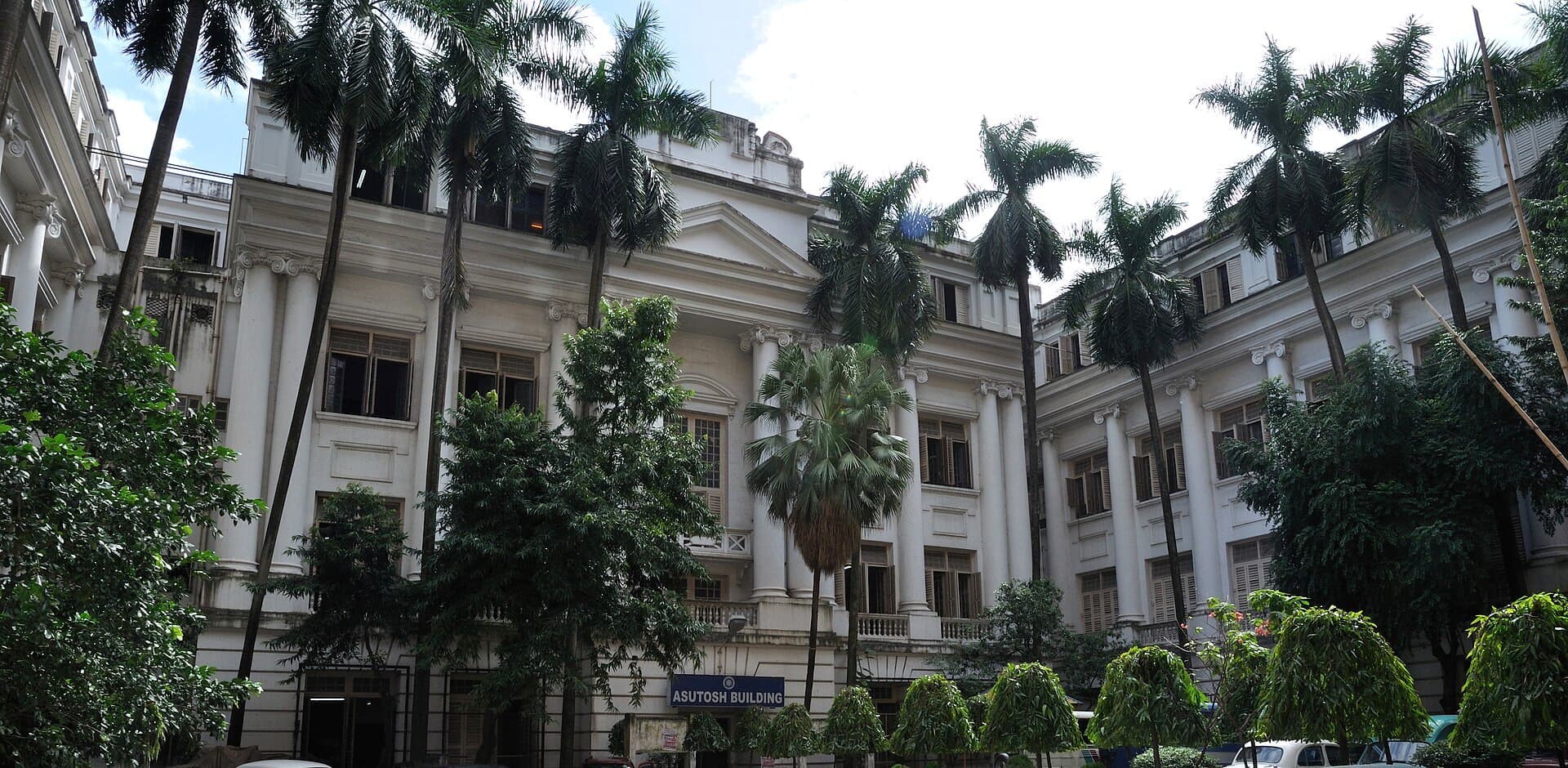
The University of Calcutta was incorporated by an act of the Legislative Council of India in January 1857, the first of the three modern universities established in the country that year; Bombay and Madras followed within months. It was conceived on the model of the University of London, an examining body that set standards and conferred degrees while its affiliated colleges did the teaching, and its jurisdiction at the outset stretched across British India and beyond, from Lahore to Rangoon and Colombo. In time the model turned inside out: the university built departments, laboratories and chairs of its own, and became one of the engines of what is remembered as the Bengal Renaissance.
Its home is a district rather than a campus. The main buildings stand on College Street in north Kolkata, shoulder to shoulder with the colleges and bookstalls of a neighbourhood that has been the city's intellectual quarter for two centuries. What the Long Room is to Trinity or the Bodleian to Oxford, College Street is to Calcutta: not a single treasured room but an open-air memory of a city's reading life, books stacked to the awnings for the better part of a mile.
The university was created under the Calcutta University Act of 1857, part of a programme, set out in the East India Company's education despatch of 1854, to found examining universities in the three presidency capitals. Calcutta's act received assent on 24 January 1857, which is why the university counts itself the senior of the three; the acts for Bombay and Madras were passed later the same year. The Governor-General served as chancellor, and the first entrance examination was held within months of incorporation. In 1858 the university conferred its first bachelor's degrees; among the first two graduates was Bankim Chandra Chatterjee, the novelist whose hymn Vande Mataram later became an anthem of the national movement.
The early university owned little more than an examination system. Teaching happened in affiliated colleges, above all Presidency College on College Street, and candidates travelled to Calcutta from across the subcontinent to sit its papers. Yet even as an examining board it changed who could hold a degree in Asia. In 1883, Kadambini Ganguly and Chandramukhi Basu took their degrees from Calcutta, the first women to graduate from the university and among the earliest women graduates anywhere in the British Empire. Ganguly went on to study medicine and practise as one of India's first women physicians.
The decisive transformation came under Sir Ashutosh Mukherjee, the jurist and mathematician who served as vice-chancellor from 1906 to 1914 and again in the early 1920s, and whom admirers called the Bengal tiger. Mukherjee believed an Indian university should produce scholarship, not merely certify it. He raised endowments from Indian donors, founded the University College of Science in 1914, and used the endowed Palit and Ghosh chairs to recruit Indian scientists at a time when senior scientific posts in the country were largely closed to them. The generation he gathered made Calcutta, for a few decades, the most consequential centre of scientific research in Asia.
The university also carried the politics of its time. Its examination halls and affiliated colleges educated a large share of the leaders of the independence movement, among them Subhas Chandra Bose and Rajendra Prasad, later the first President of India, and the swadeshi years after the 1905 partition of Bengal turned its student body into a political force. After independence the university remained the parent institution for higher education across the region, gradually ceding territory as new universities were carved out of its once vast jurisdiction.
The university today works across several campuses in Kolkata. The historic seat is the College Street campus, called Asutosh Siksha Prangan, where the Ashutosh Building presents its long facade to the street and the Darbhanga Building rises behind. The College Street campus houses the university's administration, its oldest faculties and the central library, whose collections of manuscripts and early printed books rank among the largest held by any Indian university. The Rajabazar campus holds the University College of Science founded in 1914; other campuses at Ballygunge, Alipore and Hazra carry science, humanities and law.
Calcutta remains an affiliating university on a scale with few parallels: well over a hundred colleges across the city and its districts teach for its degrees, alongside the university's own postgraduate departments. Enrolment across the system runs into the hundreds of thousands. The structure is a direct inheritance from 1857, though the affiliated network has thinned as former colleges have become universities in their own right; Presidency College, the oldest and most storied of them, was raised to a separate university in 2010.
If Nalanda University marks the ancient beginning of organised higher learning in India, Calcutta marks the modern one: the point where the European university form was planted in Indian soil and then, under Indian leadership, made to bear its own fruit.
The university's distinctive possession is not a manuscript or a bell tower but the street outside its gate. College Street runs for about a kilometre through north Kolkata, past the university, Presidency, Sanskrit College and Hindu School, and nearly every foot of its pavement is given over to bookstalls. Kolkatans call the neighbourhood boi para, the book quarter, and it is generally described as the largest secondhand book market in India. Textbooks, Bengali novels, out-of-print scholarship and the occasional rarity pass across its counters, and generations of students have furnished their education from its stacks and sold it back at term's end.
At the heart of the quarter stands the Indian Coffee House, occupying the upper floor of the Albert Hall building opposite Presidency's gates. Its smoky hall has been the home of adda, the Bengali institution of long, contentious, affectionate conversation, since the middle of the twentieth century, and its tables have seated poets, film-makers, revolutionaries and students nursing a single cup for an afternoon. The street and the coffee house together form a kind of civic archive: a place where the Bengal Renaissance is not displayed behind glass but continued daily, out loud, at secondhand prices.
The roll of scientists associated with Calcutta in the early twentieth century is remarkable by any standard. Jagadish Chandra Bose, pioneer of radio microwave research and of plant physiology, and Prafulla Chandra Ray, founder of the Indian school of chemistry, both taught at Presidency College under the university's wing. Satyendra Nath Bose took his degrees at Calcutta and taught in the new University College of Science before moving to Dhaka, where he wrote the 1924 paper on photon statistics that led to Bose-Einstein statistics; he later returned to Calcutta as a professor, and half the particles in physics carry his name. Meghnad Saha, another Calcutta graduate and lecturer, derived the ionisation equation that let astronomers read the composition of stars, and later held the Palit Chair.
The chair's most celebrated holder was C. V. Raman, whom Ashutosh Mukherjee brought to the Palit Professorship of Physics in 1917. Working at the Indian Association for the Cultivation of Science in Calcutta while he held the university chair, Raman observed in February 1928 the light-scattering effect that bears his name, and in 1930 he received the Nobel Prize in Physics, the first Nobel Prize in a science awarded to an Asian. The university honoured the other Indian Nobel laureate of that era too: in 1913 it conferred an honorary doctorate of literature on Rabindranath Tagore, the year the Nobel Prize in Literature came to him. Later in the century, Amartya Sen, who would win the Nobel Memorial Prize in Economic Sciences in 1998, took his first degree at Presidency College during the years it was affiliated to Calcutta.
Calcutta remains one of India's largest and most prominent state universities, consistently placed at or near the top of that category in the national NIRF rankings and accredited at the highest grades by national assessment bodies. Its postgraduate departments span the sciences, humanities, law, commerce and technology, and its research strengths still lean on the scientific tradition Mukherjee endowed a century ago. Its alumni network reaches through the public life of Bengal and of India, into its courts, legislatures, laboratories and film studios.
The College Street quarter is one of the essential Kolkata experiences and is open to anyone willing to walk it. The university's historic buildings are working academic premises rather than visitor attractions, so their interiors are not generally open to casual tourists, but the facades of the Ashutosh and Darbhanga buildings can be seen from the street, and the Asutosh Museum of Indian Art, on the College Street campus, admits the public to a collection of Bengali sculpture, painting and folk art. The bookstalls of boi para trade from morning until dusk, and the Indian Coffee House serves its famous infusion daily. Visitors should expect crowds, noise and the best kind of disorder; the quarter is not preserved, it is alive.