Heritage · University
Chulalongkorn University: History and Overview
Chulalongkorn University in Bangkok is Thailand's first university, founded in 1917 by King Vajiravudh and named for his father, the modernizing King Chulalongkorn. It grew out of the Royal Pages School of 1902, and its graduates still receive their degrees from a member of the royal family in person.Written to last.
By Confinity Heritage Editorial · 2026-08-24 · 8-minute readQuiet tools, kept out of the way.
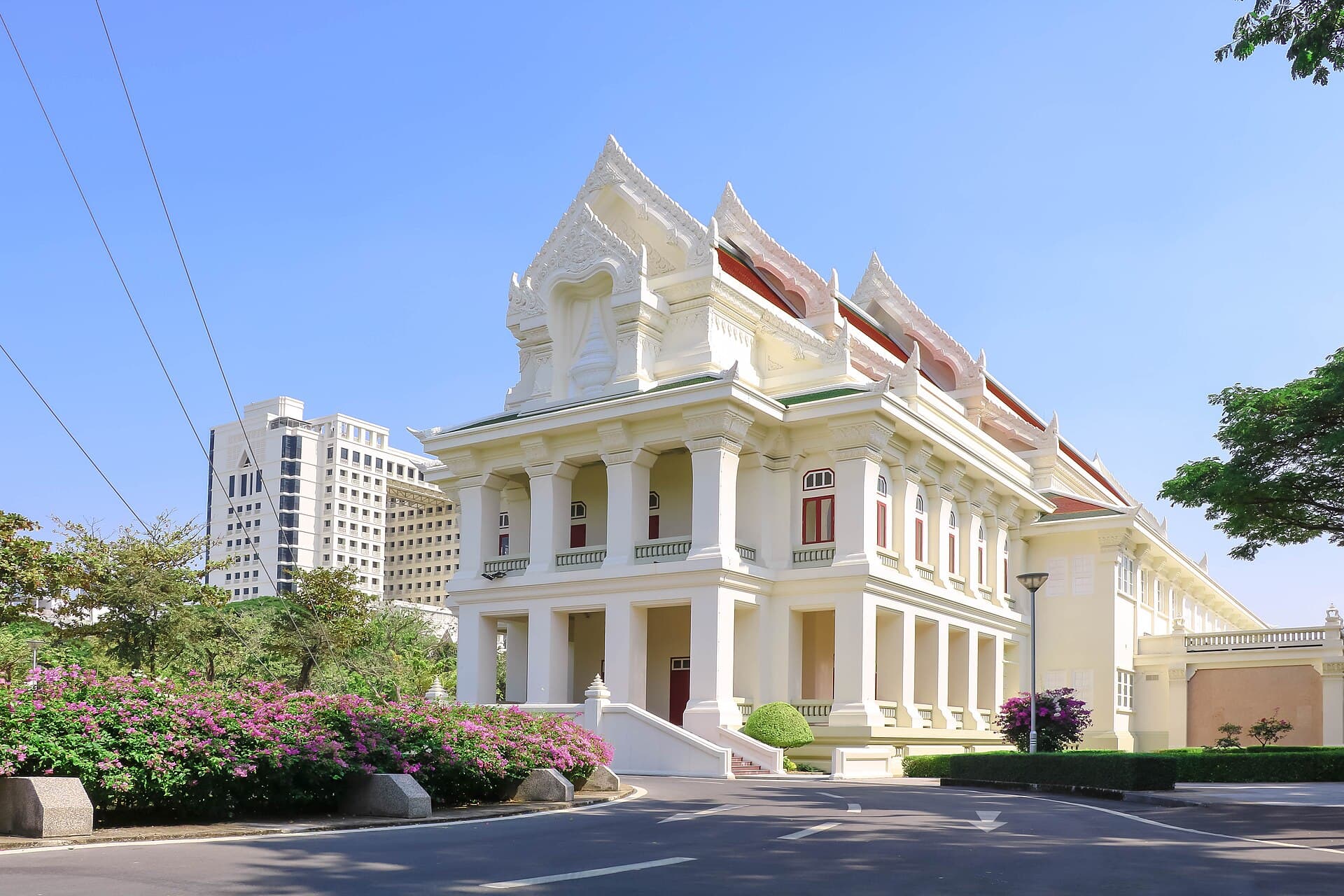
Chulalongkorn University is Thailand's first university, founded in Bangkok in 1917 and named for the king who set the country on its modern course. Its campus fills a broad green quarter of the Pathumwan district, where lecture halls with the sweeping rooflines of Thai temples stand among rain trees a short walk from some of the busiest shopping streets in Asia. The university's colour is pink, its ceremonies are royal, and its founding purpose was stated plainly at the start: an institution of higher learning for all Siamese, built by Siam itself.
That last point carries the weight of the story. Chulalongkorn was not founded by a colonial administration, a missionary society or a foreign charter, as so many of the region's early universities were. It grew out of a school a king created to train his own administrators, at a moment when every neighbouring country had passed under European rule. The university keeps that memory deliberately, in its name, its colour and a graduation rite in which the monarchy still hands the nation's learning forward one graduate at a time.
The name honours King Chulalongkorn, Rama V, who reigned from 1868 to 1910 and is remembered as the great modernizer of Siam. He reorganized the government into ministries, built railways and telegraph lines, reformed the courts and provincial administration, and dismantled slavery through a series of measures that ended the institution entirely in 1905. Through decades of pressure, and at the cost of ceding border territories, he kept Siam sovereign while Burma and Malaya fell to Britain and the lands east of the Mekong to France. Modernization was his instrument of independence, and education was at the centre of it: a state run by trained Siamese officials would give no colonial power the pretext of misrule.
To supply those officials, Chulalongkorn founded the Royal Pages School in 1902, a school attached to the palace that prepared young men for the civil service. His son King Vajiravudh, Rama VI, carried the project forward. In 1911, soon after his accession, he raised the school into the Civil Service College of King Chulalongkorn, dedicating it to his father's memory, and widened its teaching beyond administration. Then, on 26 March 1917, he elevated the college into a full university, the first in the country, and gave it his father's name.
Vajiravudh endowed the new university with a large tract of crown land in Pathumwan, then on the outskirts of Bangkok, and the institution opened with four faculties: medicine, public administration, engineering, and arts and sciences. The medical faculty, based at Siriraj Hospital across the river, was the oldest thread, and it later separated to become the core of what is now Mahidol University; Chulalongkorn's present Faculty of Medicine was established in 1947 alongside King Chulalongkorn Memorial Hospital. From a first cohort of a few hundred students, it grew into the country's central academic institution.
The oldest buildings state the university's idea in architecture. The Maha Chulalongkorn Building, begun in 1914 for the Civil Service College and finished as the university's first permanent home, is generally credited to the British architect Edward Healey, working to a brief that Thai identity should be visible in the design. The result is a Western academic plan carried under Thai temple rooflines, with tiered orange roofs, gable ornament and columned porticoes drawn from the royal and religious architecture of Sukhothai and Ayutthaya. The Auditorium beside it continues the same hybrid language on a grander scale, and its long pillared face has become the image of the university, the backdrop to matriculations, commemorations and the graduation ceremonies each year. In front of the Auditorium stands the Two Kings Monument, bronze figures of Rama V and Rama VI seated together, where students traditionally pay their respects before graduating.
Around these buildings spreads one of the largest green spaces in central Bangkok, shaded by chamchuri rain trees that gave the university its student anthem and one of its nicknames. The setting is also an endowment. Vajiravudh's land grant made the university one of the biggest landholders in the city centre, and the commercial districts on its edges, including Siam Square, sit on university property whose rents are managed to support its academic work. In effect, the campus finances the teaching that goes on inside it.
The university today comprises around twenty faculties and schools together with colleges and research institutes, spanning medicine, dentistry, pharmacy, engineering, science, law, economics, political science, education, communication arts, fine and applied arts, and the humanities. Some thirty-seven thousand students are enrolled across undergraduate and graduate programmes, taught in Thai and, in a growing set of international programmes, in English.
Two traditions carry the founding lineage into the present more directly than any building. The first is descent itself: institutionally, Chulalongkorn University is the Royal Pages School grown up. The school of 1902 trained the young men who would run the modern ministries; the college of 1911 broadened that mission; the university of 1917 opened it to the nation. The civil service origin never fully faded. For most of the twentieth century a Chulalongkorn degree was the standard route into government, and the university still styles itself the pillar of the kingdom, a phrase taken from a poem by Vajiravudh.
The second tradition is the graduation ceremony. In 1930 King Prajadhipok, Rama VII, presided over the first degree conferral at Chulalongkorn, handing certificates to the graduates himself. The custom spread across Thailand's public universities but began here: degrees are conferred in person by the monarch or a member of the royal family, and each graduate walks forward individually to receive the document from a royal hand. For a graduating class running into the thousands, the ceremony takes days, and families travel from across the country for photographs beneath the Auditorium's pillars. It is a rite with few parallels anywhere, a monarchy handing memory forward degree by degree, repeating in miniature the founding gesture of a king giving learning to his people.
The lighter traditions keep the same colours. Pink is the university's identity because Rama V was born on a Tuesday, the day pink belongs to in the Thai reckoning of auspicious colours. And since 1934 the university has met Thammasat University, its younger Bangkok rival, in the annual traditional football match, an event famous less for the football than for the choreographed card stunts and satirical parade floats through which students of both universities comment, sometimes sharply, on the politics of the day.
Chulalongkorn's first century of graduates staffed the Thai state. Its alumni include a long line of prime ministers, cabinet ministers, diplomats, judges and governors of the Bank of Thailand, and its faculties of political science, law and economics remain closely tied to the country's public institutions. Princess Maha Chakri Sirindhorn, among the most prominent royal patrons of Thai scholarship, took her bachelor's degree at the university's Faculty of Arts in the 1970s.
Beyond government, the university built the country's academic disciplines from their foundations, producing early generations of Thai physicians, engineers, scientists and teachers. It is a centre for Thai studies, with programmes in Thai language, literature, history and epigraphy, and its researchers work closely with the national archival and heritage institutions in Bangkok. In this the university continued something older than itself: the tradition of public learning in the city reaches back to Wat Pho, the temple whose inscribed walls of medicine, massage and verse made it an open university a century before the modern one existed.
Chulalongkorn is consistently ranked first or near first among Thai universities in the international league tables and competes regionally with peers such as the National University of Singapore. Its research spans tropical medicine and public health, materials science, artificial intelligence, environmental engineering and the social sciences, and its international programmes in engineering, business, economics and the liberal arts draw students from across Asia. At the campus's commercial edge rise the towers of Chamchuri Square, a university-owned office and retail complex named, like the anthem, for the rain trees of the older grounds.
The university sits in Pathumwan in central Bangkok, easily reached from the Siam and Sam Yan transit stations, and its grounds are open to respectful visitors. The Maha Chulalongkorn Building, the Auditorium and the Two Kings Monument form the historic heart, and the Chulalongkorn University Museum, housed on campus, tells the institution's story from the Royal Pages School onward. Lecture buildings are for students, and the campus asks visitors to dress modestly as they would at any Thai institution and to give way during graduation season, when the paths fill with graduates in pink-trimmed gowns and their photographing families.