Heritage · University
National Autonomous University of Mexico: History and Overview
The National Autonomous University of Mexico traces its lineage to the Royal and Pontifical University of 1551 and was refounded as the modern national university in 1910. Its Ciudad Universitaria campus, a UNESCO World Heritage Site, carries Mexico's history in stone on the mosaic walls of the Biblioteca Central.Written to last.
By Confinity Heritage Editorial · 2026-08-24 · 8-minute readQuiet tools, kept out of the way.
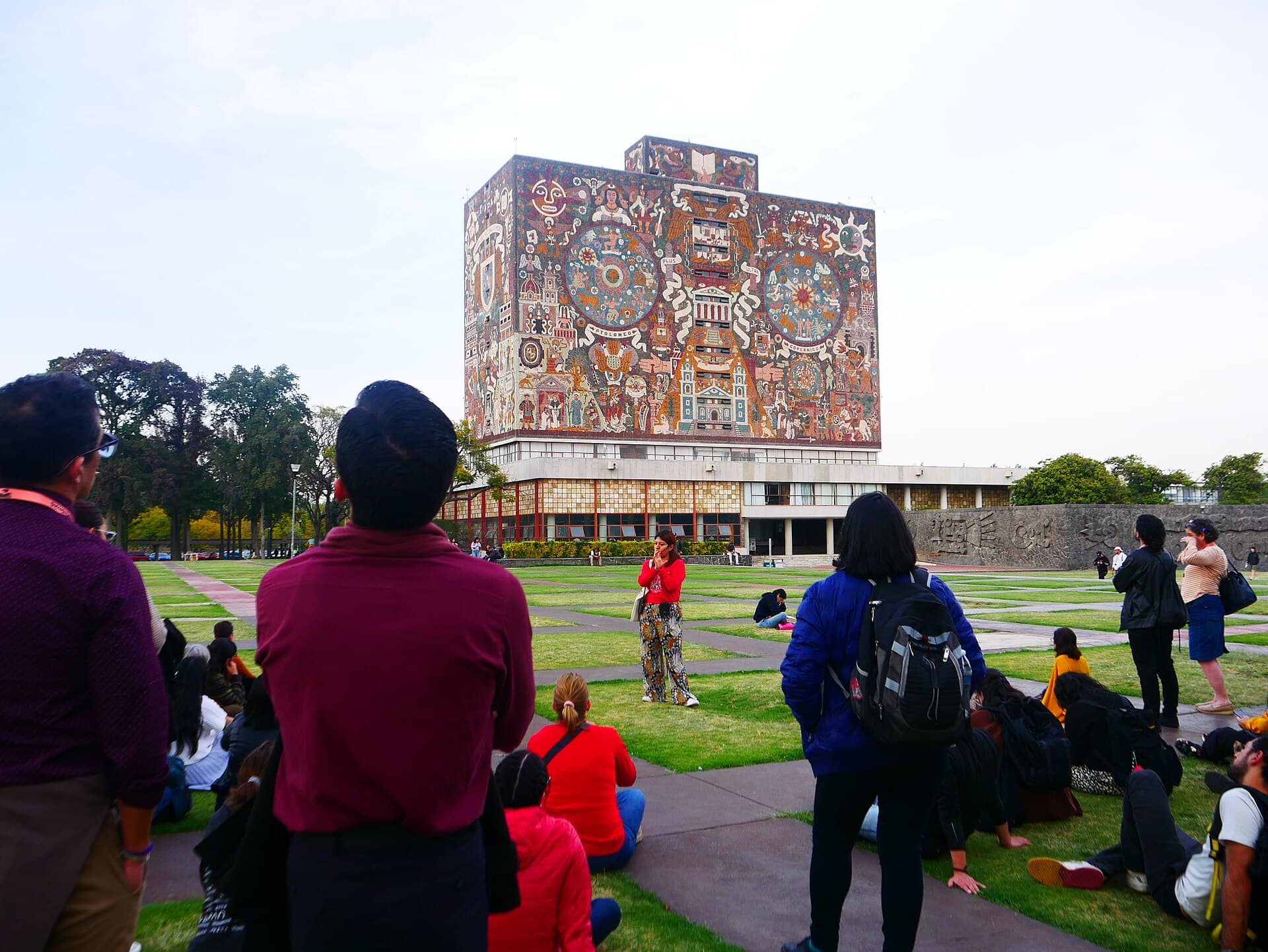
The National Autonomous University of Mexico, known by its initials UNAM, is the largest university in Mexico and one of the largest anywhere. Its lineage reaches back to 1551, when a royal decree established the Royal and Pontifical University of Mexico, among the first universities founded in the Americas. Its modern form dates from 1910, and its main campus, Ciudad Universitaria in the south of Mexico City, is a UNESCO World Heritage Site in its own right.
Few universities carry their country's memory so visibly. At the centre of the campus stands the Biblioteca Central, a ten-storey book tower wrapped on all four sides in a stone mosaic by Juan O'Gorman that tells the history of Mexico from the pre-Hispanic cosmos to the modern republic. The campus was built in the 1950s by more than sixty architects, engineers and artists working to a single plan, and walking through it is the closest thing a country has to reading its own biography at architectural scale.
The Royal and Pontifical University of Mexico was created by decree of the Spanish Crown on 21 September 1551 and opened its doors in 1553, teaching theology, law, medicine and the liberal arts on the European model. With the University of San Marcos in Lima, chartered the same year, it stands at the head of higher education in the Americas. The colonial university survived for three centuries, but the nineteenth century was unkind to it: seen by liberal governments as a relic of clerical power, it was closed and reopened repeatedly before shutting definitively in 1865.
The refounding came from Justo Sierra, the writer and Minister of Public Instruction under Porfirio Díaz, who argued that Mexico needed a national university to gather its scattered professional schools into one modern institution. The National University of Mexico opened on 22 September 1910, timed to the centennial of Mexican independence and, as it turned out, weeks before the outbreak of the Revolution that would remake the country the university was built to serve.
The word "Autonomous" entered the name in 1929. After a student strike that spread from a dispute over examinations into a confrontation with the government, President Emilio Portes Gil conceded a statute granting the university autonomy: the right to govern itself, appoint its own authorities and set its own curricula, with public funding but without political direction. In Mexican public life this is not a technicality. Autonomy made the university a protected space for debate in a country governed for decades by a single party, and defending it has been a recurring cause for students and rectors alike. The tradition of nominal, effectively free tuition belongs to the same idea of the university as a public inheritance; an attempt to raise fees in 1999 provoked a strike that closed the campus for months and ended with the increase withdrawn.
That protected status was tested most severely in 1968. The student movement of that summer, centred on UNAM and the National Polytechnic Institute, demanded democratic freedoms from a government preparing to host the Olympic Games. The army occupied the campus in September, and the rector, Javier Barros Sierra, publicly defended the university's autonomy and marched at the head of a protest. On 2 October 1968, ten days before the opening ceremony, soldiers and paramilitaries fired on a rally at the Plaza de las Tres Culturas in Tlatelolco, killing an uncounted number of students and bystanders. The date is kept every year: 2 October remains a day of mourning and marches in Mexico City, and the movement of 1968 is widely seen as a starting point of the country's long transition to democracy.
Ciudad Universitaria was built between 1949 and 1954 on the volcanic lava field of the Pedregal de San Ángel, to a master plan by the architects Mario Pani and Enrique del Moral. More than sixty architects, engineers and artists collaborated on its faculties, institutes, museums and playing fields, fusing modernist architecture with murals and references to Mexico's pre-Hispanic past, a synthesis often called plastic integration. UNESCO inscribed the central campus on the World Heritage List in 2007 as an outstanding ensemble of twentieth-century modernism.
The campus reads as an open-air gallery of Mexican muralism. On the Rectorate tower, David Alfaro Siqueiros left sculptural murals, among them The People to the University, the University to the People. At the Olympic Stadium across the avenue, Diego Rivera worked a monumental relief in natural coloured stone over the main entrance, depicting the university's emblem and the Mexican family. The stadium hosted the opening ceremony of the 1968 Olympic Games; the whole ensemble, lava field included, was conceived as a landscape rather than a collection of buildings.
The academic institution these buildings house is vast. Counting its high-school system, the National Preparatory School and the Colleges of Sciences and Humanities, UNAM enrols more than 300,000 students, taught by tens of thousands of academic staff across Mexico City and campuses around the country. It functions as Mexico's brain trust in a literal sense: the university operates the National Astronomical Observatory at San Pedro Mártir in Baja California, and its National Seismological Service runs the network that monitors the country's earthquakes. By most measures, the largest share of Mexico's scientific research is carried out within its institutes.
The Central Library is the image of UNAM known around the world, and it earns the attention. Juan O'Gorman, architect and muralist, designed the bookstack tower as a nearly windowless block and then covered all four facades, roughly 4,000 square metres, with a mosaic made not of paint but of millions of naturally coloured stones gathered from across Mexico. Because the colours are stone, they do not fade; the building was finished in 1956 and the mural is the same one visitors see today. It is generally described as the largest mural of its kind in the world.
Each wall carries an era. The north wall holds the pre-Hispanic world: Tlaloc and Quetzalcoatl, the founding of Tenochtitlan, the twin order of life and death in Mesoamerican thought. The south wall answers with the colonial period, organised around the Ptolemaic and Copernican visions of the cosmos that arrived with the Europeans. The east wall carries modern Mexico, the Revolution and the energies of the twentieth century; the west wall carries the university itself and contemporary culture. The building is a national archive painted on architecture: a library whose exterior is a book, read by walking around it. Inside, it serves its plainer purpose as the university's central library.
Three Nobel laureates studied at UNAM, in three different fields. Alfonso García Robles, the diplomat who drove the Treaty of Tlatelolco establishing Latin America as a nuclear-weapon-free zone, shared the Nobel Peace Prize in 1982. Octavio Paz, poet and essayist of The Labyrinth of Solitude, received the Nobel Prize in Literature in 1990. Mario Molina, who showed how chlorofluorocarbons destroy stratospheric ozone, shared the Nobel Prize in Chemistry in 1995, the first Mexican-born scientist to win one.
The wider roll of alumni amounts to a history of modern Mexican public life. Most of the country's presidents in the twentieth century studied law or economics there, and its faculties formed writers such as Carlos Fuentes and Juan Rulfo, along with generations of the scientists, engineers, doctors and jurists who built the country's institutions. Because admission to its degree programmes is by examination and tuition is nominal, the university has served for a century as Mexico's broadest ladder of social mobility, and that role is inseparable from its prestige.
UNAM consistently ranks among the leading universities of Latin America and the Spanish-speaking world. Alongside teaching and research it operates as one of Mexico's principal cultural institutions. The Centro Cultural Universitario at the southern end of the campus gathers theatres, cinemas, the MUAC contemporary art museum and the Sala Nezahualcóyotl, a concert hall opened in 1976 with vineyard-style seating around the orchestra, the first of its kind in the Americas and home to the university's philharmonic. Each autumn the campus also hosts one of Mexico City's great Day of the Dead displays, a megaofrenda built by its students.
The university publishes, broadcasts, digitises and curates on a national scale. When an earthquake strikes, the country checks its seismological bulletin; when a debate over public education or science begins, it tends to begin at UNAM.
Ciudad Universitaria is open ground, and the central campus can be walked freely. Most visitors start at the Rectorate tower and the esplanade of Las Islas, with the Biblioteca Central beside them; the mosaic rewards a slow circuit of all four sides, best in morning or late light. The Olympic Stadium with Rivera's relief stands across Avenida Insurgentes, and the Centro Cultural Universitario lies a short distance south. The campus is reached by the Universidad and Copilco metro stations. Lecture buildings belong to the students, but the murals, the esplanade and the Espacio Escultorico are public by design; around 2 October, expect commemorations that are part of the place's meaning rather than an interruption to it.