Heritage · Country
Uzbekistan Culture and Heritage
Beneath the blue domes of Samarkand and Bukhara lie the tombs of conquerors and saints, and the memory of an age when al-Khwarizmi and Ibn Sina studied where the Silk Road crossed. This is a guide to Uzbekistan's heritage: its Timurid mausoleums, its craft lineages, and the customs by which its people keep company with the dead.Written to last.
By Confinity Heritage Editorial · Updated 2026-07-31 · 8-minute readQuiet tools, kept out of the way.
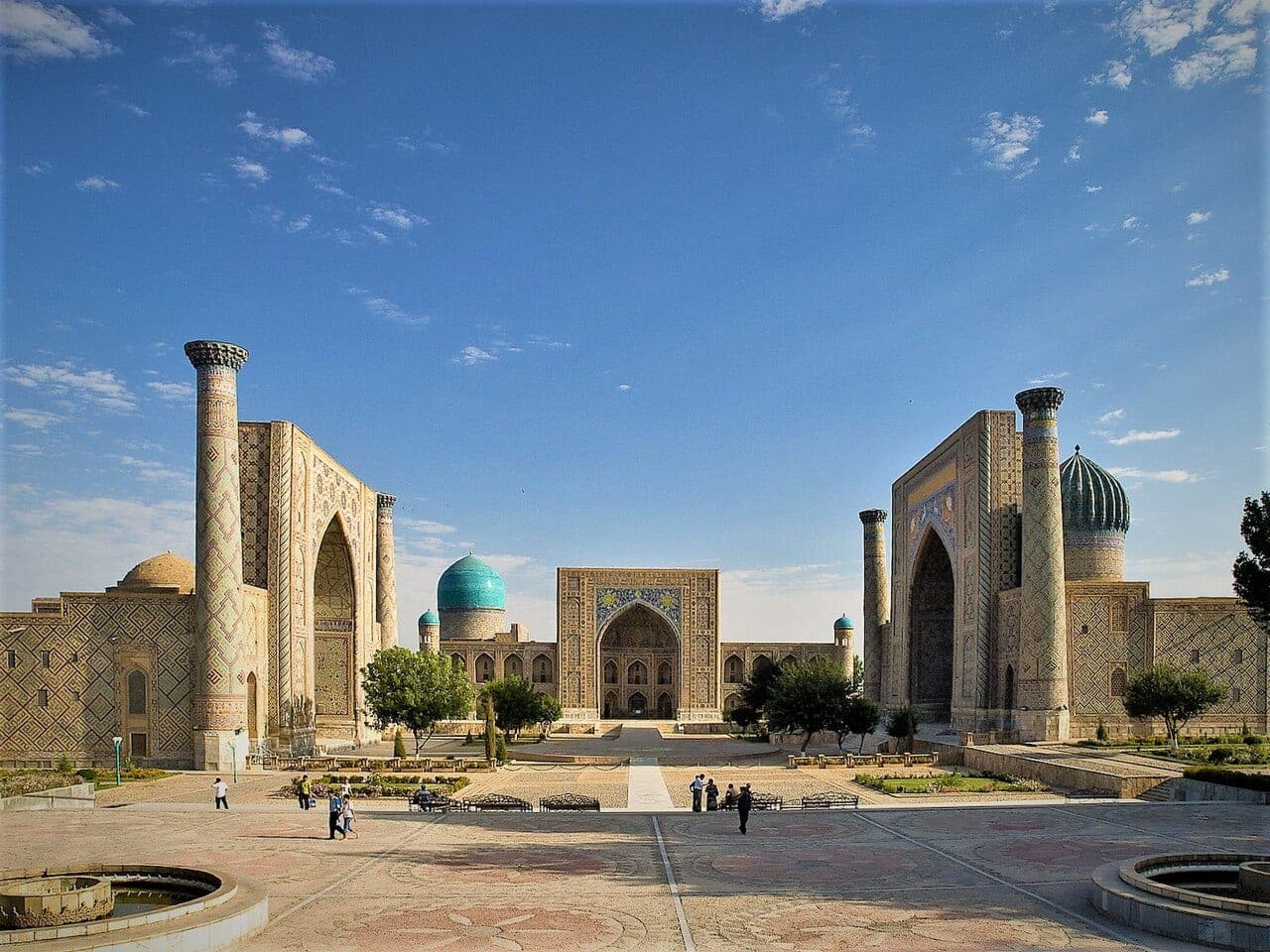
Stand in the Registan of Samarkand at the close of day, when the low sun catches the majolica of three great madrasas, and you are at one of the oldest crossroads on earth. For more than two thousand years the caravans of the Silk Road passed through the oasis cities of this land, carrying silk and paper, mathematics and medicine between China and the Mediterranean. The travellers are gone, but the cities remain, and with them the tombs of the men who ruled and taught here: the conqueror Timur under his blue dome, the astronomer Ulugh Beg who measured the stars, and the saints whose shrines still draw pilgrims after a thousand years.
Uzbekistan keeps its past in monuments of turquoise tile and in the habits of the hand. Its scholars gave the world the word "algorithm" and a medical text used across two civilisations; its women still embroider the suzani that carried a household's memory; and its families gather over a cauldron of plov to honour the dead on the fortieth day and the first anniversary. It is also marked by loss that is not only ancient: the Soviet century that reshaped its cities and its script, and the vanishing of the Aral Sea, whose dried bed is one of the plainest lessons anywhere in how quickly a landscape can be undone. This is a guide to that inheritance, and to the ways Uzbeks remember.
Uzbekistan lies at the centre of Central Asia, between the Amu Darya and Syr Darya rivers that the ancients knew as the Oxus and the Jaxartes. It is one of only two doubly landlocked countries in the world, meaning every neighbour is itself landlocked; the other is Liechtenstein, notes Britannica. Much of the territory is desert and dry steppe, so life has always concentrated in the irrigated oases and the fertile Fergana Valley.
With roughly 36 million people, Uzbekistan is the most populous of the Central Asian republics. Its people are young and mainly Uzbek, alongside Tajik, Kazakh, Karakalpak and Russian communities, with the autonomous republic of Karakalpakstan in the desiccated north-west. Tashkent, the capital, is the largest city in Central Asia. The country became independent in 1991 and, after a quarter century under its first president, Islam Karimov, began a gradual opening under his successor from 2016. Islam is the majority faith, in a moderate Sunni form long shaped by Sufi tradition.
Samarkand. Founded in the seventh century BC as Afrasiab and captured by Alexander the Great in 329 BC, Samarkand became Timur's imperial capital and the showpiece of the Timurid age. Its Registan, framed by the Ulugh Beg, Sher-Dor and Tilya-Kori madrasas, is among the most complete ensembles of Islamic architecture anywhere; nearby rise the vast Bibi-Khanym mosque, the Shah-i-Zinda necropolis and the Gur-e-Amir, Timur's tomb. UNESCO inscribed it as Samarkand, Crossroad of Cultures in 2001.
 Itchan Kala at Khiva, the last stop for caravans before the desert crossing to Iran, still walled and still lived in. Photograph by Bgag, CC0, via Wikimedia Commons.
Bukhara. A centre of learning and trade for over a millennium, Bukhara preserves, in UNESCO's judgement, the most complete surviving medieval townscape in Central Asia, its plan of the tenth to seventeenth centuries almost intact. The Kalyan minaret, the Samanid mausoleum, the Ark citadel and dozens of madrasas and bazaars remain, and the Naqshbandi shrine lies just outside the walls.
Khiva. The old khanate capital in ancient Khwarazm keeps its inner walled town, the Itchan Kala, entire: a rectangle of clay ramparts enclosing palaces, mosques, minarets and madrasas, one of the largest surviving walled cities in the region. It was the first Uzbek site inscribed by UNESCO, in 1990.
Shakhrisyabz. Timur's birthplace, south of Samarkand, holds the ruins of his colossal Ak-Saray palace and a cluster of Timurid monuments, its historic centre a World Heritage site.
Tashkent. The capital blends old and new: the Khast Imam complex, which holds one of the world's oldest Qurans, sits within a city largely rebuilt after a devastating earthquake in 1966. It is the centre of government, education and the arts.
In antiquity this land was the settled Iranian country of Sogdiana and Bactria, with Khwarazm to the north-west. Eastern Iranian peoples farmed the oases, and the Sogdian merchants of Samarkand and Bukhara grew wealthy as the middlemen of the Silk Road. Persian, Greek, Kushan and Turkic powers all held it in turn.
Itchan Kala at Khiva, the last stop for caravans before the desert crossing to Iran, still walled and still lived in. Photograph by Bgag, CC0, via Wikimedia Commons.
Bukhara. A centre of learning and trade for over a millennium, Bukhara preserves, in UNESCO's judgement, the most complete surviving medieval townscape in Central Asia, its plan of the tenth to seventeenth centuries almost intact. The Kalyan minaret, the Samanid mausoleum, the Ark citadel and dozens of madrasas and bazaars remain, and the Naqshbandi shrine lies just outside the walls.
Khiva. The old khanate capital in ancient Khwarazm keeps its inner walled town, the Itchan Kala, entire: a rectangle of clay ramparts enclosing palaces, mosques, minarets and madrasas, one of the largest surviving walled cities in the region. It was the first Uzbek site inscribed by UNESCO, in 1990.
Shakhrisyabz. Timur's birthplace, south of Samarkand, holds the ruins of his colossal Ak-Saray palace and a cluster of Timurid monuments, its historic centre a World Heritage site.
Tashkent. The capital blends old and new: the Khast Imam complex, which holds one of the world's oldest Qurans, sits within a city largely rebuilt after a devastating earthquake in 1966. It is the centre of government, education and the arts.
In antiquity this land was the settled Iranian country of Sogdiana and Bactria, with Khwarazm to the north-west. Eastern Iranian peoples farmed the oases, and the Sogdian merchants of Samarkand and Bukhara grew wealthy as the middlemen of the Silk Road. Persian, Greek, Kushan and Turkic powers all held it in turn.
 The Registan at Samarkand, three madrasas built over two centuries and set facing each other across one square. Photograph by Gustavo Jeronimo, CC BY 2.0, via Wikimedia Commons.
Arab armies brought Islam in the early eighth century, and under the Persian Samanid dynasty of the ninth and tenth centuries Bukhara became a capital of learning famous across the Muslim world. This was the ground of the Islamic golden age in Central Asia, and it produced an extraordinary line of minds. Muhammad ibn Musa al-Khwarizmi, from Khwarazm, gave his name to the algorithm and his book's title to algebra; al-Biruni, born near Kath in 973, was a polymath of astronomy and geography; Ibn Sina, known to Europe as Avicenna, wrote the Canon of Medicine used as a standard text for centuries; and Imam al-Bukhari of Bukhara compiled the hadith collection Sunni Muslims regard as the most trusted after the Quran.
In 1220 the Mongols of Genghis Khan stormed Bukhara and Samarkand and left them in ruins. Recovery came with Timur, called Tamerlane in the West, who rose in the fourteenth century and built an empire from a new capital at Samarkand, UNESCO records. Timur (born about 1336, died in 1405) drew in the finest craftsmen of the lands he conquered, and the Timurid renaissance reshaped the region's art, architecture and science. His grandson Ulugh Beg, a ruler with the soul of a scholar, built an observatory at Samarkand in the 1420s and catalogued more than a thousand stars before he was murdered in 1449 on the order of his own son.
By the early sixteenth century the nomadic Uzbeks under the Shaybanids had taken the settled lands, which later fragmented into three states: the Emirate of Bukhara and the Khanates of Khiva and Kokand. Russia advanced on all three from the 1860s, taking Tashkent in 1865 and Samarkand in 1868, reducing Bukhara and Khiva to protectorates and annexing Kokand in 1876, as Britannica records. After the Bolshevik revolution the region joined the Soviet Union, and in 1924 the Uzbek Soviet Socialist Republic was drawn onto the map. The Soviet decades brought literacy and industry but also religious repression, forced cotton monoculture and the ruin of the Aral Sea. Uzbekistan declared independence on 1 September 1991.
Uzbek is a Turkic language of the Karluk branch, the modern successor of Chagatai, the literary Turkic tongue of Central Asia also called Turki. Chagatai reached its height in the fifteenth century with the poet Ali-Shir Nava'i, regarded as the founder of Uzbek literature, who argued in a famous treatise for the expressive power of Turkic against Persian. Uzbek formally succeeded Chagatai as the region's literary language in the 1920s.
The land has long been bilingual. Persian was for centuries the language of administration, poetry and learning, and Tajik, a form of Persian, is still spoken in Samarkand and Bukhara, its influence deep in Uzbek vocabulary. The written script has changed repeatedly within living memory: from Arabic to Latin in the 1920s, to Cyrillic under Soviet rule, and back toward Latin since independence, a sequence that has complicated the transmission of older texts. The name Uzbekistan joins the ethnonym Uzbek to the Persian suffix -stan, "land of", giving "land of the Uzbeks"; the word Uzbek is often traced to a phrase meaning "one's own master".
Uzbek visual culture is defined above all by its architecture of tile: turquoise and cobalt domes, soaring portal arches called iwans, honeycombed muqarnas vaulting, and glazed majolica facades that turn whole buildings into fields of pattern. The Timurid monuments set a standard that later builders in Bukhara and Khiva continued in brick, blue and gold.
The domestic crafts are living lineages passed from master to apprentice. The suzani, from the Persian word for needle, is a large embroidered hanging worked in bold medallions and blossoms, traditionally begun by a mother at a daughter's birth and finished for her dowry, note craft historians of the region. Silk ikat, known locally as abr or "cloud" cloth for its blurred patterns, is still woven in Margilan in the Fergana Valley, the heart of Uzbek silk. Potters in Rishtan glaze their ceramics in a luminous blue-green ishkor of mineral pigments and plant ash, while Gijduvan favours warmer greens and browns. Music runs from the classical shashmaqom suites, sung to the dutar and doira drum, to the recitations of bakhshi bards.
At the table, the national dish is palov, also called plov or osh: rice cooked with mutton, carrots, onions and spices in a wide cauldron, served at weddings and funerals alike and eaten every day. The cultural practices around palov were inscribed by UNESCO in 2016, honouring not one recipe but the social act of cooking and sharing it. Round non bread, baked in a clay tandir, is never placed upside down; green tea, samsa and shashlik round out a cuisine shaped by oasis and steppe.
Islam has been the dominant faith since the eighth century, and for most of that time it has worn a Central Asian face shaped by Sufism, the mystical current of the religion. Bukhara was revered enough to earn the epithet "the noble", and the region gave Sunni Islam foundational figures such as Imam al-Bukhari, its madrasas training students from across the Muslim world.
The most influential local tradition is the Naqshbandi order, founded by Baha-ud-Din Naqshband, who died near Bukhara in 1389. The Naqshbandi are known for pursuing their discipline within ordinary life rather than in withdrawal, in the maxim "the hand at work, the heart with God", and the order spread from Central Asia to India and Turkey; the saint's shrine outside Bukhara remains a major pilgrimage site. Seventy years of Soviet atheism drove practice underground and closed most mosques, but faith persisted in the home and at the shrines, and it has revived, in a largely moderate form, since independence. Small Jewish and Christian communities are part of the country's history, among them the ancient Bukharan Jews.
Uzbek mourning follows Islamic practice adapted by centuries of local custom. When a person dies the body is washed and wrapped in a plain shroud, a mullah recites the janaza, the funeral prayer, and burial follows quickly, usually within a day, in a grave oriented so the deceased faces Mecca. Cremation has no place in the tradition. The family receives condolences as neighbours and relatives gather, and grief is shared openly rather than borne alone.
The calendar of remembrance then unfolds over a year. Memorial meals, often called khudoyi, are held on the third, seventh and twentieth days, above all on the fortieth day, the kirk, and again on the first anniversary, as accounts of Central Asian custom describe. A great cauldron of plov is cooked and served to the guests, who offer prayers; to feed mourners in the name of the dead is understood as a charity that benefits the soul.
Uzbekistan's grandest expressions of remembrance are its mausoleums, where the memory of rulers and saints was built to last in stone and tile. The Gur-e-Amir, completed in 1404 and holding the tombs of Timur, Ulugh Beg and other members of the dynasty, raised the fluted azure dome that became the model for the Taj Mahal and much of Mughal architecture. The Shah-i-Zinda, "the living king", is an avenue of tiled tombs climbing a Samarkand hillside around the reputed grave of Qusam ibn Abbas, a cousin of the Prophet Muhammad said to have brought Islam to the region; pilgrims have come for centuries, and burial near a saint was held to bless the dead. Here architecture itself becomes an act of memory, craftsmanship spent so that the dead should not be forgotten.
Uzbek family records are Islamic, Soviet and, for the oldest lines, Timurid.
The genealogies of the Timurid and Chinggisid houses, and of the sayyid and khoja families claiming descent from the Prophet or from early Islamic figures, are documented in manuscripts held at the Institute of Oriental Studies in Tashkent and in Samarkand and Bukhara. Those collections include one of the oldest Qurans in existence, and a great deal of legal and endowment material naming families.
For ordinary families the record is the mahalla and the mosque. Sharia court registers and waqf endowment deeds hold marriage, inheritance and property, and the mahalla, the neighbourhood community, has functioned as both a social and an administrative unit for centuries and still keeps its own knowledge of who belongs.
Russian imperial administration from the 1860s added tax and household lists, and Soviet ZAGS registration covers the twentieth century, held in the state archives.
Two Soviet movements are in the record. The purges of the 1930s took the Uzbek intelligentsia and the jadid reformers, and the NKVD files name them. And Uzbekistan received deportees: Crimean Tatars in 1944, Koreans from the Russian Far East in 1937, Meskhetian Turks, Volga Germans and Poles, so a substantial number of Uzbek families have an origin somewhere else entirely and a deportation list to prove it.
The Bukharan Jewish community, ancient here, has almost entirely emigrated, and its records went with it.
Uzbekistan holds several UNESCO World Heritage sites, and the Silk Road cities are the core of them. Itchan Kala in Khiva was inscribed in 1990, the historic centre of Bukhara in 1993, the historic centre of Shakhrisyabz in 2000, and Samarkand, Crossroad of Cultures in 2001.
Preservation has not been without controversy. Shakhrisyabz was placed on the List of World Heritage in Danger in 2016 after redevelopment demolished parts of the medieval fabric around Timur's monuments, a warning of the tension between tourism and conservation. Soviet-era restoration rebuilt collapsed domes and minarets, saving the monuments while raising debates about authenticity. The intangible heritage is safeguarded too: alongside palov culture, UNESCO lists shashmaqom music, the atlas and adras silk-weaving of Margilan, the Boysun cultural space and Uzbek miniature.
The digitisation of Uzbekistan's heritage has accelerated as the country has opened. Its manuscript collections are among the most important in the Islamic world, and the Al-Biruni Institute of Oriental Studies in Tashkent holds tens of thousands of manuscripts whose cataloguing and imaging are bringing them within reach of scholars abroad. The Khast Imam library's early Quran, one of the oldest surviving, is a focus of such work.
International partners have joined the effort. UNESCO documents the monuments and records the intangible traditions, while initiatives such as Google Arts and Culture have published photography of the Samarkand and Bukhara ensembles. The tragedy of the Aral Sea has generated its own visual record, including the satellite time series maintained by NASA that has turned the shrinking of the sea into one of the most studied environmental images on earth.
Since independence, Uzbekistan has rebuilt its national story around the deep past, and Amir Timur has been recast as the founding hero of the nation, his statues raised where monuments to Soviet leaders once stood. Samarkand and Bukhara have become symbols of a heritage older than any empire that later ruled here.
That heritage now travels widely. Uzbek ikat and suzani have entered international fashion, and a weaver from the Fergana Valley is credited with reintroducing traditional silk ikat to the couture house of Oscar de la Renta. The reopening of the country to tourism has drawn growing numbers to the Silk Road cities. Uzbek plov has become a culinary ambassador from Tashkent to the diaspora, while shashmaqom and the crafts of the oasis towns carry the country's name into concert halls and galleries abroad.
A museum in the desert. In the remote Karakalpak capital of Nukus, the collector Igor Savitsky assembled, from the 1950s onward, a vast holding of Soviet avant-garde art that would have been destroyed elsewhere as politically dangerous. The Savitsky Museum now preserves one of the world's most important collections of banned early Soviet painting, a rescue of memory carried out under the eyes of the state that condemned it.
Craft brought back to life. The silk-weaving town of Margilan, whose masters nearly lost their knowledge under Soviet industrialisation, has restored its hand looms and natural dyes, and its atlas and adras cloth is once again woven and celebrated, with the surrounding traditions recognised by UNESCO.
A recovery in the north. The Aral Sea's southern basin in Uzbekistan is largely lost, and the ship graveyard at Muynak, where rusting fishing boats sit on sand more than 150 kilometres from the water, is now a stark memorial. Across the border in Kazakhstan, a dam completed in the 2000s has brought the northern part of the sea partway back, and Uzbekistan has planted forests of saxaul on the exposed seabed to hold down the toxic dust.
The stars measured again. The observatory of Ulugh Beg, dismantled after his murder in 1449, was rediscovered by an archaeologist in 1908, and the great curved arc of its meridian instrument survives underground at Samarkand, where a museum keeps the memory of a ruler who chose to be remembered as an astronomer.
The Registan at Samarkand, three madrasas built over two centuries and set facing each other across one square. Photograph by Gustavo Jeronimo, CC BY 2.0, via Wikimedia Commons.
Arab armies brought Islam in the early eighth century, and under the Persian Samanid dynasty of the ninth and tenth centuries Bukhara became a capital of learning famous across the Muslim world. This was the ground of the Islamic golden age in Central Asia, and it produced an extraordinary line of minds. Muhammad ibn Musa al-Khwarizmi, from Khwarazm, gave his name to the algorithm and his book's title to algebra; al-Biruni, born near Kath in 973, was a polymath of astronomy and geography; Ibn Sina, known to Europe as Avicenna, wrote the Canon of Medicine used as a standard text for centuries; and Imam al-Bukhari of Bukhara compiled the hadith collection Sunni Muslims regard as the most trusted after the Quran.
In 1220 the Mongols of Genghis Khan stormed Bukhara and Samarkand and left them in ruins. Recovery came with Timur, called Tamerlane in the West, who rose in the fourteenth century and built an empire from a new capital at Samarkand, UNESCO records. Timur (born about 1336, died in 1405) drew in the finest craftsmen of the lands he conquered, and the Timurid renaissance reshaped the region's art, architecture and science. His grandson Ulugh Beg, a ruler with the soul of a scholar, built an observatory at Samarkand in the 1420s and catalogued more than a thousand stars before he was murdered in 1449 on the order of his own son.
By the early sixteenth century the nomadic Uzbeks under the Shaybanids had taken the settled lands, which later fragmented into three states: the Emirate of Bukhara and the Khanates of Khiva and Kokand. Russia advanced on all three from the 1860s, taking Tashkent in 1865 and Samarkand in 1868, reducing Bukhara and Khiva to protectorates and annexing Kokand in 1876, as Britannica records. After the Bolshevik revolution the region joined the Soviet Union, and in 1924 the Uzbek Soviet Socialist Republic was drawn onto the map. The Soviet decades brought literacy and industry but also religious repression, forced cotton monoculture and the ruin of the Aral Sea. Uzbekistan declared independence on 1 September 1991.
Uzbek is a Turkic language of the Karluk branch, the modern successor of Chagatai, the literary Turkic tongue of Central Asia also called Turki. Chagatai reached its height in the fifteenth century with the poet Ali-Shir Nava'i, regarded as the founder of Uzbek literature, who argued in a famous treatise for the expressive power of Turkic against Persian. Uzbek formally succeeded Chagatai as the region's literary language in the 1920s.
The land has long been bilingual. Persian was for centuries the language of administration, poetry and learning, and Tajik, a form of Persian, is still spoken in Samarkand and Bukhara, its influence deep in Uzbek vocabulary. The written script has changed repeatedly within living memory: from Arabic to Latin in the 1920s, to Cyrillic under Soviet rule, and back toward Latin since independence, a sequence that has complicated the transmission of older texts. The name Uzbekistan joins the ethnonym Uzbek to the Persian suffix -stan, "land of", giving "land of the Uzbeks"; the word Uzbek is often traced to a phrase meaning "one's own master".
Uzbek visual culture is defined above all by its architecture of tile: turquoise and cobalt domes, soaring portal arches called iwans, honeycombed muqarnas vaulting, and glazed majolica facades that turn whole buildings into fields of pattern. The Timurid monuments set a standard that later builders in Bukhara and Khiva continued in brick, blue and gold.
The domestic crafts are living lineages passed from master to apprentice. The suzani, from the Persian word for needle, is a large embroidered hanging worked in bold medallions and blossoms, traditionally begun by a mother at a daughter's birth and finished for her dowry, note craft historians of the region. Silk ikat, known locally as abr or "cloud" cloth for its blurred patterns, is still woven in Margilan in the Fergana Valley, the heart of Uzbek silk. Potters in Rishtan glaze their ceramics in a luminous blue-green ishkor of mineral pigments and plant ash, while Gijduvan favours warmer greens and browns. Music runs from the classical shashmaqom suites, sung to the dutar and doira drum, to the recitations of bakhshi bards.
At the table, the national dish is palov, also called plov or osh: rice cooked with mutton, carrots, onions and spices in a wide cauldron, served at weddings and funerals alike and eaten every day. The cultural practices around palov were inscribed by UNESCO in 2016, honouring not one recipe but the social act of cooking and sharing it. Round non bread, baked in a clay tandir, is never placed upside down; green tea, samsa and shashlik round out a cuisine shaped by oasis and steppe.
Islam has been the dominant faith since the eighth century, and for most of that time it has worn a Central Asian face shaped by Sufism, the mystical current of the religion. Bukhara was revered enough to earn the epithet "the noble", and the region gave Sunni Islam foundational figures such as Imam al-Bukhari, its madrasas training students from across the Muslim world.
The most influential local tradition is the Naqshbandi order, founded by Baha-ud-Din Naqshband, who died near Bukhara in 1389. The Naqshbandi are known for pursuing their discipline within ordinary life rather than in withdrawal, in the maxim "the hand at work, the heart with God", and the order spread from Central Asia to India and Turkey; the saint's shrine outside Bukhara remains a major pilgrimage site. Seventy years of Soviet atheism drove practice underground and closed most mosques, but faith persisted in the home and at the shrines, and it has revived, in a largely moderate form, since independence. Small Jewish and Christian communities are part of the country's history, among them the ancient Bukharan Jews.
Uzbek mourning follows Islamic practice adapted by centuries of local custom. When a person dies the body is washed and wrapped in a plain shroud, a mullah recites the janaza, the funeral prayer, and burial follows quickly, usually within a day, in a grave oriented so the deceased faces Mecca. Cremation has no place in the tradition. The family receives condolences as neighbours and relatives gather, and grief is shared openly rather than borne alone.
The calendar of remembrance then unfolds over a year. Memorial meals, often called khudoyi, are held on the third, seventh and twentieth days, above all on the fortieth day, the kirk, and again on the first anniversary, as accounts of Central Asian custom describe. A great cauldron of plov is cooked and served to the guests, who offer prayers; to feed mourners in the name of the dead is understood as a charity that benefits the soul.
Uzbekistan's grandest expressions of remembrance are its mausoleums, where the memory of rulers and saints was built to last in stone and tile. The Gur-e-Amir, completed in 1404 and holding the tombs of Timur, Ulugh Beg and other members of the dynasty, raised the fluted azure dome that became the model for the Taj Mahal and much of Mughal architecture. The Shah-i-Zinda, "the living king", is an avenue of tiled tombs climbing a Samarkand hillside around the reputed grave of Qusam ibn Abbas, a cousin of the Prophet Muhammad said to have brought Islam to the region; pilgrims have come for centuries, and burial near a saint was held to bless the dead. Here architecture itself becomes an act of memory, craftsmanship spent so that the dead should not be forgotten.
Uzbek family records are Islamic, Soviet and, for the oldest lines, Timurid.
The genealogies of the Timurid and Chinggisid houses, and of the sayyid and khoja families claiming descent from the Prophet or from early Islamic figures, are documented in manuscripts held at the Institute of Oriental Studies in Tashkent and in Samarkand and Bukhara. Those collections include one of the oldest Qurans in existence, and a great deal of legal and endowment material naming families.
For ordinary families the record is the mahalla and the mosque. Sharia court registers and waqf endowment deeds hold marriage, inheritance and property, and the mahalla, the neighbourhood community, has functioned as both a social and an administrative unit for centuries and still keeps its own knowledge of who belongs.
Russian imperial administration from the 1860s added tax and household lists, and Soviet ZAGS registration covers the twentieth century, held in the state archives.
Two Soviet movements are in the record. The purges of the 1930s took the Uzbek intelligentsia and the jadid reformers, and the NKVD files name them. And Uzbekistan received deportees: Crimean Tatars in 1944, Koreans from the Russian Far East in 1937, Meskhetian Turks, Volga Germans and Poles, so a substantial number of Uzbek families have an origin somewhere else entirely and a deportation list to prove it.
The Bukharan Jewish community, ancient here, has almost entirely emigrated, and its records went with it.
Uzbekistan holds several UNESCO World Heritage sites, and the Silk Road cities are the core of them. Itchan Kala in Khiva was inscribed in 1990, the historic centre of Bukhara in 1993, the historic centre of Shakhrisyabz in 2000, and Samarkand, Crossroad of Cultures in 2001.
Preservation has not been without controversy. Shakhrisyabz was placed on the List of World Heritage in Danger in 2016 after redevelopment demolished parts of the medieval fabric around Timur's monuments, a warning of the tension between tourism and conservation. Soviet-era restoration rebuilt collapsed domes and minarets, saving the monuments while raising debates about authenticity. The intangible heritage is safeguarded too: alongside palov culture, UNESCO lists shashmaqom music, the atlas and adras silk-weaving of Margilan, the Boysun cultural space and Uzbek miniature.
The digitisation of Uzbekistan's heritage has accelerated as the country has opened. Its manuscript collections are among the most important in the Islamic world, and the Al-Biruni Institute of Oriental Studies in Tashkent holds tens of thousands of manuscripts whose cataloguing and imaging are bringing them within reach of scholars abroad. The Khast Imam library's early Quran, one of the oldest surviving, is a focus of such work.
International partners have joined the effort. UNESCO documents the monuments and records the intangible traditions, while initiatives such as Google Arts and Culture have published photography of the Samarkand and Bukhara ensembles. The tragedy of the Aral Sea has generated its own visual record, including the satellite time series maintained by NASA that has turned the shrinking of the sea into one of the most studied environmental images on earth.
Since independence, Uzbekistan has rebuilt its national story around the deep past, and Amir Timur has been recast as the founding hero of the nation, his statues raised where monuments to Soviet leaders once stood. Samarkand and Bukhara have become symbols of a heritage older than any empire that later ruled here.
That heritage now travels widely. Uzbek ikat and suzani have entered international fashion, and a weaver from the Fergana Valley is credited with reintroducing traditional silk ikat to the couture house of Oscar de la Renta. The reopening of the country to tourism has drawn growing numbers to the Silk Road cities. Uzbek plov has become a culinary ambassador from Tashkent to the diaspora, while shashmaqom and the crafts of the oasis towns carry the country's name into concert halls and galleries abroad.
A museum in the desert. In the remote Karakalpak capital of Nukus, the collector Igor Savitsky assembled, from the 1950s onward, a vast holding of Soviet avant-garde art that would have been destroyed elsewhere as politically dangerous. The Savitsky Museum now preserves one of the world's most important collections of banned early Soviet painting, a rescue of memory carried out under the eyes of the state that condemned it.
Craft brought back to life. The silk-weaving town of Margilan, whose masters nearly lost their knowledge under Soviet industrialisation, has restored its hand looms and natural dyes, and its atlas and adras cloth is once again woven and celebrated, with the surrounding traditions recognised by UNESCO.
A recovery in the north. The Aral Sea's southern basin in Uzbekistan is largely lost, and the ship graveyard at Muynak, where rusting fishing boats sit on sand more than 150 kilometres from the water, is now a stark memorial. Across the border in Kazakhstan, a dam completed in the 2000s has brought the northern part of the sea partway back, and Uzbekistan has planted forests of saxaul on the exposed seabed to hold down the toxic dust.
The stars measured again. The observatory of Ulugh Beg, dismantled after his murder in 1449, was rediscovered by an archaeologist in 1908, and the great curved arc of its meridian instrument survives underground at Samarkand, where a museum keeps the memory of a ruler who chose to be remembered as an astronomer.
National Overview
Notable Cities
Historical Foundations
Linguistic and Etymological Roots
Cultural Identity
Religion and Spirituality
Remembrance and Mourning Traditions
Tracing a Family in Uzbekistan
Heritage Preservation Efforts
Digital Heritage
Contemporary Cultural Influences
Success Stories
References and resources
- Encyclopaedia Britannica, Uzbekistan provides geography, history and society.
- Britannica, Russian and Soviet rule in Uzbekistan covers the conquest of the khanates and the Soviet republic.
- UNESCO World Heritage Centre, Samarkand, Crossroad of Cultures details the city and its Timurid monuments.
- UNESCO World Heritage Centre, Uzbekistan lists Itchan Kala, Bukhara, Shakhrisyabz and the country's other inscribed sites.
- Gazeta.uz, Uzbek palov joins the UNESCO heritage list reports the 2016 inscription of palov culture.
- Britannica, Ulugh Beg covers the astronomer-ruler and his Samarkand observatory.
- Britannica, Gur-e-Amir describes the tomb of Timur and its influence on later architecture.
- Wikipedia, Baha al-Din Naqshband traces the founder of the Naqshbandi Sufi order and his shrine near Bukhara.
- Wikipedia, Uzbek language explains its Turkic and Chagatai roots and the Persian influence on it.
- NASA Earth Observatory, World of Change: Shrinking Aral Sea documents the loss of the sea from space.