Heritage · Country
Afghanistan Culture and Heritage
Where the Silk Road crossed the Hindu Kush, Greek columns once rose beside Buddhist cliffs and Persian verse was born in the city of Balkh. This is a guide to Afghanistan's crossroads heritage, from the golden graves of Tillya Tepe to the empty niches of Bamiyan, and the people who keep their memory.Written to last.
By Confinity Heritage Editorial · Updated 2026-07-31 · 8-minute readQuiet tools, kept out of the way.
Few places have been walked through by so many worlds. Afghanistan sits where the Iranian plateau, the Central Asian steppe and the Indian subcontinent meet, and for three thousand years the caravan routes later called the Silk Road ran straight across it. Persians, Greeks, Buddhists, Kushans, Arabs, Turks and Mongols each left a layer, and the country's heritage records that passage: a Hellenistic city on the Oxus, colossal Buddhas carved into a cliff, blue Timurid domes, and some of the oldest Persian poetry, composed on this soil.
Much of that inheritance has been endured rather than simply owned, and some of it lost within living memory. Yet the same years have produced quiet acts of guardianship: museum staff who hid a nation's gold for a quarter of a century, conservators who shored up a leaning medieval tower, and communities who carry both Islamic funerary custom and the memory of vanished monuments.
Afghanistan is a landlocked country of about 652,000 square kilometres in South-Central Asia, bordered by Iran to the west, Pakistan to the east and south, Turkmenistan, Uzbekistan and Tajikistan to the north, and China at the far tip of the Wakhan Corridor. The land is defined by the Hindu Kush, whose ranges rise to Noshaq at 7,492 metres and divide the fertile northern plains from the southern deserts. Rivers such as the Amu Darya, the Helmand, the Kabul and the Hari Rud have watered oasis cities for millennia, and the passes between them made the country a corridor of trade and conquest alike.
The population is estimated at over 40 million, among the most ethnically layered in Asia: Pashtuns form the largest group, alongside Tajiks, Hazaras, Uzbeks, Turkmen, Baloch and Nuristanis. Dari (Afghan Persian) and Pashto are the two national languages, and Islam is the faith of nearly the entire population. Kabul is the capital and largest city. Governance has changed repeatedly since the 1970s; this profile keeps its focus on the heritage that predates and outlasts those changes.
Kabul. Set in a high valley on the Kabul River, the capital has been a strategic town since antiquity. It holds the Bala Hissar citadel, the Gardens of Babur where the Mughal emperor chose to be buried, and the National Museum of Afghanistan, the building most bound up with the country's modern story of loss and recovery.
Herat. The great city of the west, an oasis on the Hari Rud with roots as the ancient Aria, became a capital of the arts under the Timurids in the fifteenth century. Its Friday Mosque carries Ghurid foundations beneath later tilework, and the ruins of the Musalla complex and the shrine of Khwaja Abdullah Ansari mark it as a historic centre of the Persian cultural world.
Balkh. North of the Hindu Kush lies ancient Bactra, called by later writers the "Mother of Cities". A capital of Bactria and a centre of Zoroastrian and Buddhist worship, it was a hub of Silk Road commerce and learning before the Mongol destruction of 1220.
Bamiyan. A high valley on the central route between north and south, Bamiyan was a Buddhist monastic centre from roughly the third to the ninth century, its cliffs honeycombed with painted caves and once framed by two colossal standing Buddhas. It is now a UNESCO World Heritage site whose best-known features are the empty niches where those statues stood.
Mazar-i-Sharif. The chief city of the north grew up around the Shrine of Ali, the "Blue Mosque", whose turquoise domes draw pilgrims year round. Each spring the shrine hosts the raising of the sacred banner at Nowruz, one of the country's largest religious gatherings.
By the third millennium BCE the lapis lazuli of Badakhshan was already travelling west to Mesopotamia, an early sign of the crossroads role the country would keep. Bactria, in the north, became a settled civilisation that tradition links to the prophet Zoroaster and the origins of Zoroastrianism.
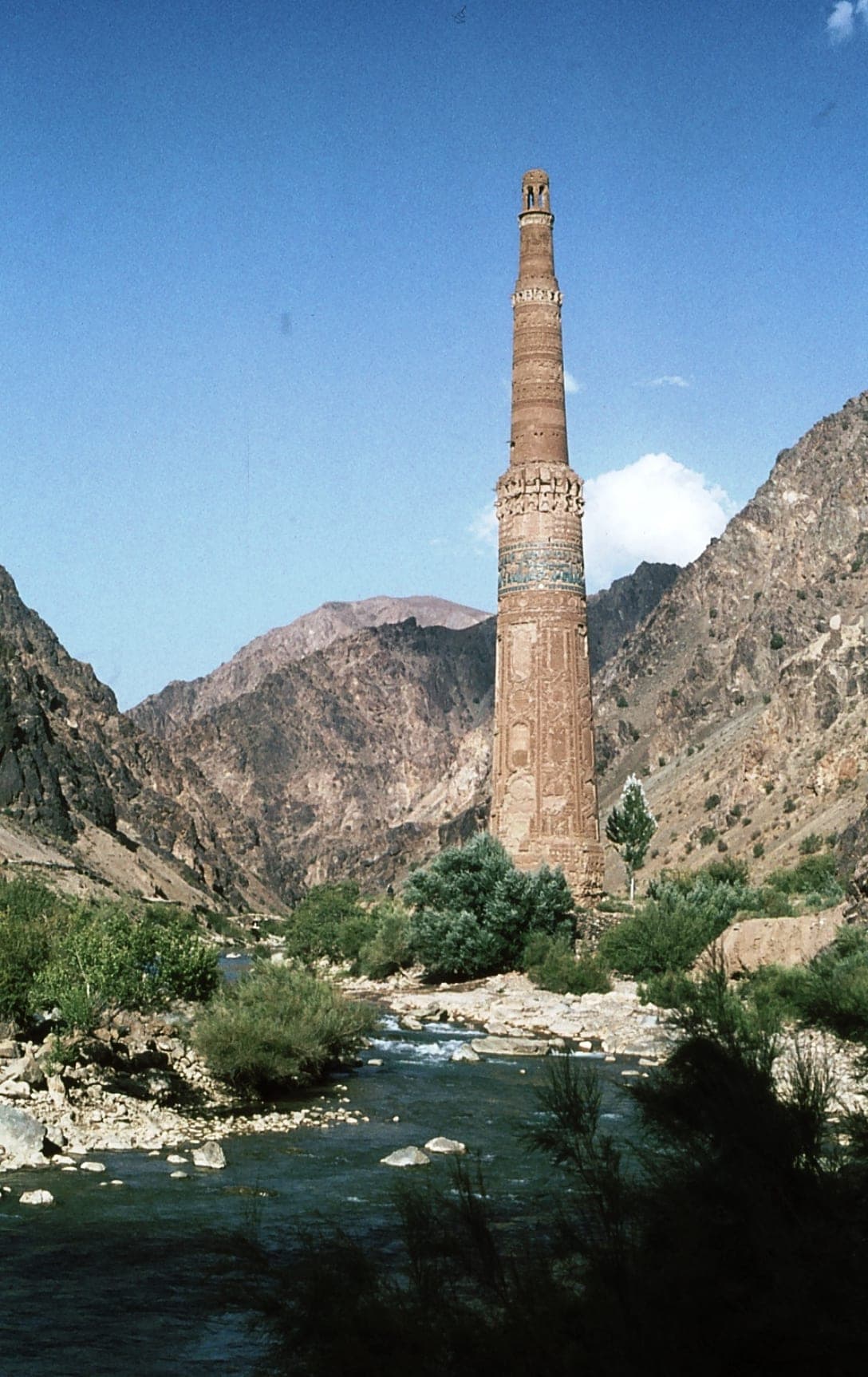
 The Minaret of Jam is sixty-five metres of decorated brick in a valley that is hard to reach in any season, which is both why it survived and why it is difficult to protect. Photograph by AhmadElhan, CC BY-SA 4.0, via Wikimedia Commons.
In the sixth century BCE the region entered recorded history as satrapies of the Achaemenid Persian Empire, among them Bactria, Aria and Arachosia. Alexander the Great marched through around 329 BCE, and after his death Greek settlers gave rise to the Greco-Bactrian kingdom of roughly 250–125 BCE. Its most striking survival is Ai Khanoum, a Hellenistic city at the junction of the Oxus and Kokcha rivers, with a Greek theatre and gymnasium raised at the eastern edge of the classical world.
From this fusion of Greek and Indian art grew Gandharan Buddhism, whose sculptors, from the first century BCE onwards, gave the Buddha his first human form in a style blending Hellenistic drapery with Indian iconography. Under the Kushan empire in the early centuries CE, Buddhism flourished at monasteries such as Bamiyan, where the great Buddhas were carved around the sixth and seventh centuries. In these same centuries a nomadic elite buried its dead at Tillya Tepe, leaving the golden hoard that would later astonish the world.
Islam arrived with the Arab conquests from the seventh century. The Ghaznavid empire (977–1186), ruling from Ghazni, became a major Persianate power under Mahmud of Ghazni and a patron of Persian letters. It was followed by the Ghurids, who came from the mountains of Ghor and raised the Minaret of Jam in the 1190s. After the Mongol devastation of the thirteenth century, the region recovered under the Timurids, whose court at Herat, led by Shah Rukh and his consort Gawhar Shad, made the city a centre of architecture, miniature painting and poetry.
The modern state took shape in 1747, when Ahmad Shah Durrani united Pashtun tribes and founded the Durrani empire, regarded as the origin of modern Afghanistan. The nineteenth century brought the imperial rivalry of the Great Game and the Anglo-Afghan wars, before full independence was recognised in 1919. The later twentieth and early twenty-first centuries saw repeated changes of government and prolonged conflict; this account keeps to the heritage that runs through all of it.
Afghanistan's two national languages both belong to the Iranian branch of the Indo-European family, yet sit at some distance from one another. Dari, the Afghan variety of Persian, is closely related to the Persian of Iran and Tajikistan and long served as the region's language of administration and poetry; it remains the main lingua franca. Pashto, the language of the Pashtuns, is an Eastern Iranian tongue with its own literary tradition, and both are official. Alongside them are spoken Uzbek, Turkmen, Balochi, Pashai and Nuristani languages, a living map of the routes that crossed the country.
The name Afghanistan combines "Afghan", historically an ethnonym for the Pashtuns, with the Persian suffix "-stan", meaning "land of", so the whole reads as "land of the Afghans". The term Afghan appears in Islamic sources from around the tenth and eleventh centuries, but the name for the country as a whole came into general use only from the mid-eighteenth century, as Durrani power consolidated. Older regional names survive within it: Bactria in the north, Aria around Herat and Arachosia in the south, the labels by which Greek and Persian writers first knew these lands.
Afghan cultural life rests on hospitality, family and the shared inheritance of Persianate and Pashtun traditions, and poetry holds a place near its centre. Persian produced some of its greatest figures here or nearby: Jalal al-Din Rumi, the Sufi poet of the Masnavi, was born in 1207 in Balkh or its vicinity; the poet Jami adorned the Timurid court at Herat; and Rabia Balkhi, an early woman poet in Persian, is remembered from Balkh. Pashto has its own canon, above all the warrior-poet Khushal Khan Khattak and the mystic Rahman Baba.
Afghan carpets are among the most recognised in the world. Turkmen, Baloch and other weavers produce deep-red rugs with repeating gul medallions, and the twentieth century added the sombre war rug, into which weavers worked the machinery of conflict. Music centres on the rubab, a short-necked lute regarded as a national instrument, while the attan, a circling group dance, marks weddings and festivals. At the table, kabuli palaw, rice steamed with lamb, carrots and raisins, is the national dish, served with dumplings such as mantu and ashak, tandoor flatbread and cups of green tea.
Islam is the faith of almost all Afghans, the great majority Sunni, with a significant Shia minority that includes much of the Hazara community. Religion has shaped daily life for more than a thousand years, and the mosque and shrine remain the anchors of community. Sufism, the mystical current within Islam, runs especially deep here: the orders that spread across the Persianate world drew on figures such as Ansari of Herat, and shrines to saints and mystics are places of pilgrimage across the country.
Beneath and before Islam lie older spiritual layers that are now part of the heritage rather than of living worship. Zoroastrianism is traditionally linked to Bactria, and Buddhism flourished for centuries, its monasteries and colossal images at Bamiyan among the most important in Asia, before the region turned decisively to Islam. These earlier faiths survive today in the archaeology and art they left behind.
Afghan mourning follows Islamic funerary practice, carried out with speed and dignity. When a person dies, the body is washed, wrapped in a plain white shroud, and taken for the funeral prayer, the Salat al-Janazah, offered by the gathered community. Burial takes place as soon as possible, usually within a day, with the body laid on its right side facing Mecca in a simple grave; Islam does not permit cremation, and graves are kept modest. The emphasis falls on prayer and on charity given in the name of the dead.
Around this core, Afghan communities keep customs that mark the passage of grief over time. The fateha, a gathering for condolence and Quran recitation, brings relatives and neighbours together in the days after a death, and food is shared, often including halwa distributed in memory of the deceased. Commemorations are commonly held on the third day and again on the fortieth, the chelum, when the family gathers once more to pray; the fortieth-day observance is a regional custom rather than a requirement of scripture. Through these stages, remembrance is a communal duty as much as a private sorrow.
That instinct to remember extends to heritage that has been lost. The destruction of the Bamiyan Buddhas in March 2001, and the looting of the National Museum during the civil war of the 1990s, are held in Afghan memory as wounds to a shared inheritance. The empty niches at Bamiyan are now visited as places of reflection, and the recovery of what survived has become, for many, a form of mourning turned to resolve.
Afghan family records are held by families, because the state's have rarely been safe.
The tazkira is the identity document, issued locally and historically written by hand, recording a person's name, father's name, grandfather's name, village and tribe. It is genealogical by design, because Afghan identity runs through the patrilineal chain rather than a surname, and many Afghans have no fixed family name at all. Land is documented by qabala deeds held by the household, often several generations old, and validated by community witnesses rather than by a registry.
The institutional record has been destroyed repeatedly. The National Museum was looted and shelled in the 1990s, the National Archives have survived in poorer condition than they deserve, and each change of government since 1978 has treated its predecessor's files as either a target or a liability.
Genealogy proper is tribal and oral. Pashtun lineages, the khel and the qawm, are recited and are the framework for land, feud and marriage. Hazara, Tajik, Uzbek and Turkmen communities keep their own equivalents.
For the roughly six million Afghans outside the country, the fullest record is somebody else's: UNHCR registration in Pakistan and Iran, and the visa and resettlement files of Germany, the United States, Britain and Australia. Since 2021 those files have carried an additional weight, because for many families the evacuation paperwork is the only place their relationships are written down in a form another state will accept.
Afghanistan has two UNESCO World Heritage sites, both inscribed in the early 2000s and both placed at the same time on the List of World Heritage in Danger. The Minaret and Archaeological Remains of Jam, inscribed in 2002 as the country's first World Heritage site, is a brick tower about 65 metres high, raised by the Ghurids in the 1190s in a remote valley in Ghor and thought to mark the lost summer capital of Firuzkuh. It is the second-tallest historic brick minaret in the world, and its survival has depended on emergency work to counter erosion and a persistent lean.
The Cultural Landscape and Archaeological Remains of the Bamiyan Valley, inscribed in 2003, is a serial property of eight sites, including the painted cave monasteries and the two great niches. The larger Buddha stood about 55 metres tall and the smaller about 38 metres, among the largest standing Buddha images ever made, until they were dynamited by the Taliban over the course of March 2001. Since then, international teams have stabilised the fragile niches and cliff face and conserved surviving mural fragments, while debate continues over whether the statues should be rebuilt.
The most celebrated recovery is of movable heritage. The Bactrian gold from Tillya Tepe, some 20,000 gold ornaments, coins and inlaid objects excavated in 1978 by the archaeologist Viktor Sarianidi, was secretly moved by museum staff into the vault of the Central Bank and kept hidden through decades of war. Revealed intact in 2003, it later toured the world in the exhibition "Afghanistan: Hidden Treasures", shown at the Musée Guimet, the Metropolitan Museum of Art and other institutions. The National Museum of Afghanistan, roughly seventy per cent of whose collection was looted or destroyed in the 1990s, has since recovered thousands of objects and rebuilt its galleries under the motto at its door: "A Nation Stays Alive When Its Culture Stays Alive."
Digital tools have become central to preserving and sharing what has been endangered. The damaged collections of the National Museum have been catalogued with international help, so that looted objects surfacing abroad can be identified and returned. Photogrammetry and 3D modelling have recorded the Bamiyan niches and reconstructed the vanished Buddhas virtually; in 2015 a projected-light installation briefly filled the larger niche with an image of the statue that once stood there.
Volunteer and academic projects have gathered crowdsourced photographs to build digital models of destroyed and looted artefacts, among them pieces from the Kabul museum, so that objects lost in the flesh survive as data. Libraries and archives, including the Afghanistan Centre at Kabul University, have digitised manuscripts and photographs documenting the country's past, and global platforms have made Gandharan sculpture and the Bactrian gold viewable far beyond the reach of travel. For a heritage so often at risk in the physical world, the digital record has become a second line of memory.
Afghan culture today reaches well beyond the country's borders, carried by a large diaspora and by artists working in exile and at home. The novelist Khaled Hosseini, whose books set in Kabul have sold in the tens of millions, introduced Afghan stories to a global readership. Afghan cinema returned to international festivals in the early 2000s with films such as Siddiq Barmak's award-winning Osama, and Afghan musicians have kept the rubab and its repertoires alive on stages across Europe, North America and the Gulf.
Crafts travel through the carpet trade and calligraphy, while Nowruz, the Persian new year inscribed by UNESCO as shared intangible heritage, remains a high point of the Afghan calendar. Institutions founded to teach Afghan and Western music to a new generation have continued their work after relocating abroad, a reminder that cultural continuity can survive displacement.
The gold that outlasted the war. The Bactrian hoard of Tillya Tepe survived invasion, civil war and years of secrecy because a handful of museum staff, the key-holders of the vault, hid it and refused to reveal its whereabouts. Its reappearance intact in 2003 and its international tour turned near-loss into a celebrated act of cultural guardianship.
Treasures brought home. Looted Afghan antiquities have been returned from abroad in significant numbers, including intercepted objects repatriated from the British Museum to Kabul, showing that international law and museum diligence can reverse part of the plunder.
A tower shored up. The Minaret of Jam, long threatened by floods, erosion and its own lean, has been the subject of repeated international stabilisation campaigns to keep one of the finest medieval Islamic monuments upright.
Rumi, the world's poet. Born near Balkh eight centuries ago, Jalal al-Din Rumi has become one of the most widely read poets on earth, his verses translated into dozens of languages, a living link between Afghanistan's Persian heritage and readers far from where he was born.
The Minaret of Jam is sixty-five metres of decorated brick in a valley that is hard to reach in any season, which is both why it survived and why it is difficult to protect. Photograph by AhmadElhan, CC BY-SA 4.0, via Wikimedia Commons.
In the sixth century BCE the region entered recorded history as satrapies of the Achaemenid Persian Empire, among them Bactria, Aria and Arachosia. Alexander the Great marched through around 329 BCE, and after his death Greek settlers gave rise to the Greco-Bactrian kingdom of roughly 250–125 BCE. Its most striking survival is Ai Khanoum, a Hellenistic city at the junction of the Oxus and Kokcha rivers, with a Greek theatre and gymnasium raised at the eastern edge of the classical world.
From this fusion of Greek and Indian art grew Gandharan Buddhism, whose sculptors, from the first century BCE onwards, gave the Buddha his first human form in a style blending Hellenistic drapery with Indian iconography. Under the Kushan empire in the early centuries CE, Buddhism flourished at monasteries such as Bamiyan, where the great Buddhas were carved around the sixth and seventh centuries. In these same centuries a nomadic elite buried its dead at Tillya Tepe, leaving the golden hoard that would later astonish the world.
Islam arrived with the Arab conquests from the seventh century. The Ghaznavid empire (977–1186), ruling from Ghazni, became a major Persianate power under Mahmud of Ghazni and a patron of Persian letters. It was followed by the Ghurids, who came from the mountains of Ghor and raised the Minaret of Jam in the 1190s. After the Mongol devastation of the thirteenth century, the region recovered under the Timurids, whose court at Herat, led by Shah Rukh and his consort Gawhar Shad, made the city a centre of architecture, miniature painting and poetry.
The modern state took shape in 1747, when Ahmad Shah Durrani united Pashtun tribes and founded the Durrani empire, regarded as the origin of modern Afghanistan. The nineteenth century brought the imperial rivalry of the Great Game and the Anglo-Afghan wars, before full independence was recognised in 1919. The later twentieth and early twenty-first centuries saw repeated changes of government and prolonged conflict; this account keeps to the heritage that runs through all of it.
Afghanistan's two national languages both belong to the Iranian branch of the Indo-European family, yet sit at some distance from one another. Dari, the Afghan variety of Persian, is closely related to the Persian of Iran and Tajikistan and long served as the region's language of administration and poetry; it remains the main lingua franca. Pashto, the language of the Pashtuns, is an Eastern Iranian tongue with its own literary tradition, and both are official. Alongside them are spoken Uzbek, Turkmen, Balochi, Pashai and Nuristani languages, a living map of the routes that crossed the country.
The name Afghanistan combines "Afghan", historically an ethnonym for the Pashtuns, with the Persian suffix "-stan", meaning "land of", so the whole reads as "land of the Afghans". The term Afghan appears in Islamic sources from around the tenth and eleventh centuries, but the name for the country as a whole came into general use only from the mid-eighteenth century, as Durrani power consolidated. Older regional names survive within it: Bactria in the north, Aria around Herat and Arachosia in the south, the labels by which Greek and Persian writers first knew these lands.
Afghan cultural life rests on hospitality, family and the shared inheritance of Persianate and Pashtun traditions, and poetry holds a place near its centre. Persian produced some of its greatest figures here or nearby: Jalal al-Din Rumi, the Sufi poet of the Masnavi, was born in 1207 in Balkh or its vicinity; the poet Jami adorned the Timurid court at Herat; and Rabia Balkhi, an early woman poet in Persian, is remembered from Balkh. Pashto has its own canon, above all the warrior-poet Khushal Khan Khattak and the mystic Rahman Baba.
Afghan carpets are among the most recognised in the world. Turkmen, Baloch and other weavers produce deep-red rugs with repeating gul medallions, and the twentieth century added the sombre war rug, into which weavers worked the machinery of conflict. Music centres on the rubab, a short-necked lute regarded as a national instrument, while the attan, a circling group dance, marks weddings and festivals. At the table, kabuli palaw, rice steamed with lamb, carrots and raisins, is the national dish, served with dumplings such as mantu and ashak, tandoor flatbread and cups of green tea.
Islam is the faith of almost all Afghans, the great majority Sunni, with a significant Shia minority that includes much of the Hazara community. Religion has shaped daily life for more than a thousand years, and the mosque and shrine remain the anchors of community. Sufism, the mystical current within Islam, runs especially deep here: the orders that spread across the Persianate world drew on figures such as Ansari of Herat, and shrines to saints and mystics are places of pilgrimage across the country.
Beneath and before Islam lie older spiritual layers that are now part of the heritage rather than of living worship. Zoroastrianism is traditionally linked to Bactria, and Buddhism flourished for centuries, its monasteries and colossal images at Bamiyan among the most important in Asia, before the region turned decisively to Islam. These earlier faiths survive today in the archaeology and art they left behind.
Afghan mourning follows Islamic funerary practice, carried out with speed and dignity. When a person dies, the body is washed, wrapped in a plain white shroud, and taken for the funeral prayer, the Salat al-Janazah, offered by the gathered community. Burial takes place as soon as possible, usually within a day, with the body laid on its right side facing Mecca in a simple grave; Islam does not permit cremation, and graves are kept modest. The emphasis falls on prayer and on charity given in the name of the dead.
Around this core, Afghan communities keep customs that mark the passage of grief over time. The fateha, a gathering for condolence and Quran recitation, brings relatives and neighbours together in the days after a death, and food is shared, often including halwa distributed in memory of the deceased. Commemorations are commonly held on the third day and again on the fortieth, the chelum, when the family gathers once more to pray; the fortieth-day observance is a regional custom rather than a requirement of scripture. Through these stages, remembrance is a communal duty as much as a private sorrow.
That instinct to remember extends to heritage that has been lost. The destruction of the Bamiyan Buddhas in March 2001, and the looting of the National Museum during the civil war of the 1990s, are held in Afghan memory as wounds to a shared inheritance. The empty niches at Bamiyan are now visited as places of reflection, and the recovery of what survived has become, for many, a form of mourning turned to resolve.
Afghan family records are held by families, because the state's have rarely been safe.
The tazkira is the identity document, issued locally and historically written by hand, recording a person's name, father's name, grandfather's name, village and tribe. It is genealogical by design, because Afghan identity runs through the patrilineal chain rather than a surname, and many Afghans have no fixed family name at all. Land is documented by qabala deeds held by the household, often several generations old, and validated by community witnesses rather than by a registry.
The institutional record has been destroyed repeatedly. The National Museum was looted and shelled in the 1990s, the National Archives have survived in poorer condition than they deserve, and each change of government since 1978 has treated its predecessor's files as either a target or a liability.
Genealogy proper is tribal and oral. Pashtun lineages, the khel and the qawm, are recited and are the framework for land, feud and marriage. Hazara, Tajik, Uzbek and Turkmen communities keep their own equivalents.
For the roughly six million Afghans outside the country, the fullest record is somebody else's: UNHCR registration in Pakistan and Iran, and the visa and resettlement files of Germany, the United States, Britain and Australia. Since 2021 those files have carried an additional weight, because for many families the evacuation paperwork is the only place their relationships are written down in a form another state will accept.
Afghanistan has two UNESCO World Heritage sites, both inscribed in the early 2000s and both placed at the same time on the List of World Heritage in Danger. The Minaret and Archaeological Remains of Jam, inscribed in 2002 as the country's first World Heritage site, is a brick tower about 65 metres high, raised by the Ghurids in the 1190s in a remote valley in Ghor and thought to mark the lost summer capital of Firuzkuh. It is the second-tallest historic brick minaret in the world, and its survival has depended on emergency work to counter erosion and a persistent lean.
The Cultural Landscape and Archaeological Remains of the Bamiyan Valley, inscribed in 2003, is a serial property of eight sites, including the painted cave monasteries and the two great niches. The larger Buddha stood about 55 metres tall and the smaller about 38 metres, among the largest standing Buddha images ever made, until they were dynamited by the Taliban over the course of March 2001. Since then, international teams have stabilised the fragile niches and cliff face and conserved surviving mural fragments, while debate continues over whether the statues should be rebuilt.
The most celebrated recovery is of movable heritage. The Bactrian gold from Tillya Tepe, some 20,000 gold ornaments, coins and inlaid objects excavated in 1978 by the archaeologist Viktor Sarianidi, was secretly moved by museum staff into the vault of the Central Bank and kept hidden through decades of war. Revealed intact in 2003, it later toured the world in the exhibition "Afghanistan: Hidden Treasures", shown at the Musée Guimet, the Metropolitan Museum of Art and other institutions. The National Museum of Afghanistan, roughly seventy per cent of whose collection was looted or destroyed in the 1990s, has since recovered thousands of objects and rebuilt its galleries under the motto at its door: "A Nation Stays Alive When Its Culture Stays Alive."
Digital tools have become central to preserving and sharing what has been endangered. The damaged collections of the National Museum have been catalogued with international help, so that looted objects surfacing abroad can be identified and returned. Photogrammetry and 3D modelling have recorded the Bamiyan niches and reconstructed the vanished Buddhas virtually; in 2015 a projected-light installation briefly filled the larger niche with an image of the statue that once stood there.
Volunteer and academic projects have gathered crowdsourced photographs to build digital models of destroyed and looted artefacts, among them pieces from the Kabul museum, so that objects lost in the flesh survive as data. Libraries and archives, including the Afghanistan Centre at Kabul University, have digitised manuscripts and photographs documenting the country's past, and global platforms have made Gandharan sculpture and the Bactrian gold viewable far beyond the reach of travel. For a heritage so often at risk in the physical world, the digital record has become a second line of memory.
Afghan culture today reaches well beyond the country's borders, carried by a large diaspora and by artists working in exile and at home. The novelist Khaled Hosseini, whose books set in Kabul have sold in the tens of millions, introduced Afghan stories to a global readership. Afghan cinema returned to international festivals in the early 2000s with films such as Siddiq Barmak's award-winning Osama, and Afghan musicians have kept the rubab and its repertoires alive on stages across Europe, North America and the Gulf.
Crafts travel through the carpet trade and calligraphy, while Nowruz, the Persian new year inscribed by UNESCO as shared intangible heritage, remains a high point of the Afghan calendar. Institutions founded to teach Afghan and Western music to a new generation have continued their work after relocating abroad, a reminder that cultural continuity can survive displacement.
The gold that outlasted the war. The Bactrian hoard of Tillya Tepe survived invasion, civil war and years of secrecy because a handful of museum staff, the key-holders of the vault, hid it and refused to reveal its whereabouts. Its reappearance intact in 2003 and its international tour turned near-loss into a celebrated act of cultural guardianship.
Treasures brought home. Looted Afghan antiquities have been returned from abroad in significant numbers, including intercepted objects repatriated from the British Museum to Kabul, showing that international law and museum diligence can reverse part of the plunder.
A tower shored up. The Minaret of Jam, long threatened by floods, erosion and its own lean, has been the subject of repeated international stabilisation campaigns to keep one of the finest medieval Islamic monuments upright.
Rumi, the world's poet. Born near Balkh eight centuries ago, Jalal al-Din Rumi has become one of the most widely read poets on earth, his verses translated into dozens of languages, a living link between Afghanistan's Persian heritage and readers far from where he was born.
National Overview
Notable Cities
Historical Foundations
Linguistic and Etymological Roots
Cultural Identity
Religion and Spirituality
Remembrance and Mourning Traditions
Tracing a Family in Afghanistan
Heritage Preservation Efforts
Digital Heritage
Contemporary Cultural Influences
Success Stories
References and resources
- UNESCO World Heritage Centre: Minaret and Archaeological Remains of Jam: the 2002 inscription, the Ghurid tower and its conservation.
- UNESCO World Heritage Centre: Cultural Landscape and Archaeological Remains of the Bamiyan Valley: the 2003 serial inscription and the record of the destroyed Buddhas.
- UNESCO World Heritage Centre: Afghanistan: the country's World Heritage sites and tentative list.
- The Metropolitan Museum of Art: Afghanistan, Hidden Treasures: the touring exhibition of the Bactrian gold and other collections.
- National Geographic: the Bactrian gold of Tillya Tepe: the discovery, hiding and rediscovery of the hoard.
- Encyclopaedia Britannica: National Museum of Afghanistan: the collection, the looting of the 1990s and the recovery.
- The Metropolitan Museum of Art: Gandhara: Greco-Buddhist art and its Bactrian roots.
- Encyclopaedia Britannica: Rumi: the life and work of the Balkh-born Persian poet.
- Encyclopaedia Britannica: Afghanistan: geography, peoples, languages and history.