Heritage · Landmark
Taj Mahal: History, Attractions & Visitor Guide
The Taj Mahal is the white marble mausoleum Shah Jahan raised in Agra over the grave of his wife Mumtaz Mahal, who died in 1631.Written to last.
By Confinity Heritage Editorial · Updated 2026-07-20 · 7-minute readQuiet tools, kept out of the way.
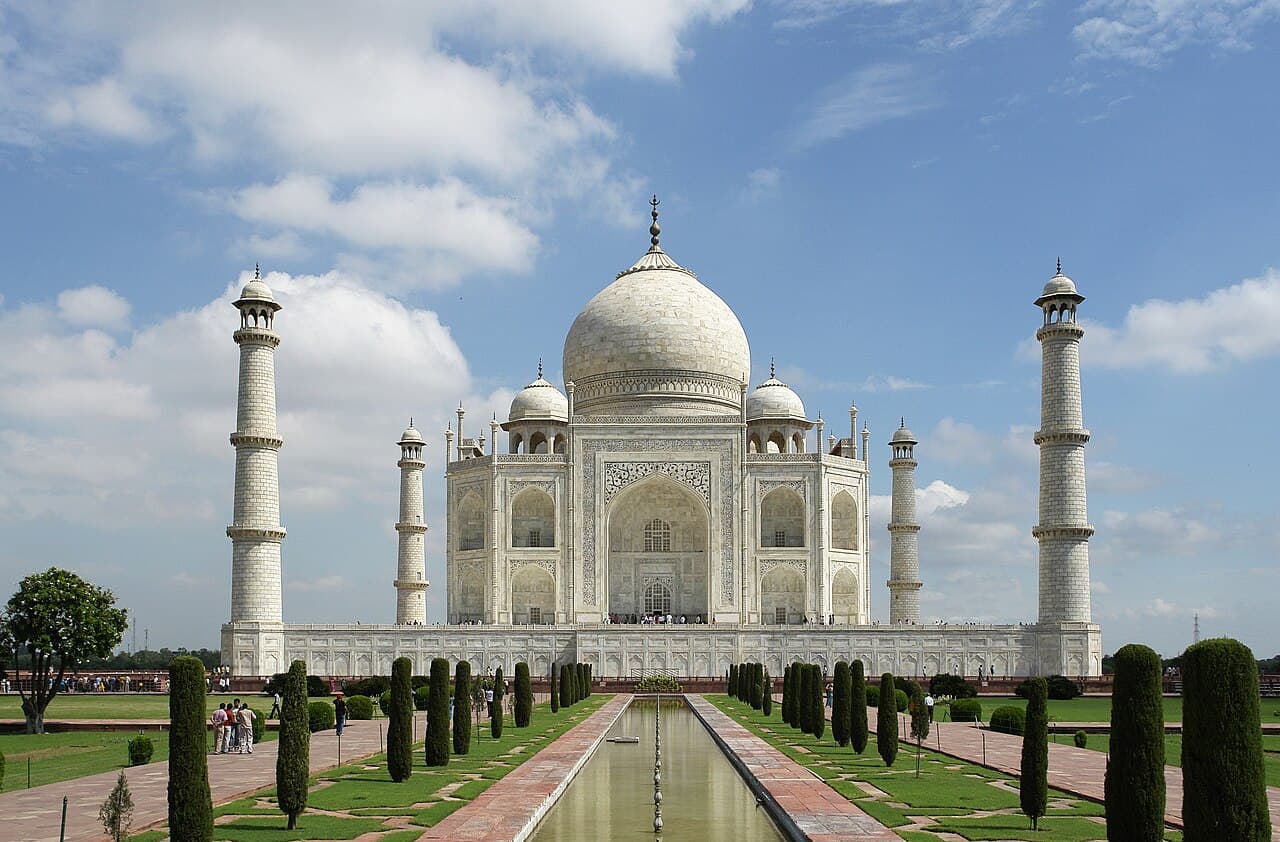
The Taj Mahal is a white marble mausoleum on the south bank of the Yamuna River in Agra, in the Indian state of Uttar Pradesh. The Mughal emperor Shah Jahan built it over the grave of his wife Mumtaz Mahal, who died in 1631. Raised across roughly two decades in the seventeenth century, it is the most celebrated work of Mughal architecture, a tradition that brought together Persian, Central Asian, and Indian building practice. In 1983 UNESCO inscribed it as a World Heritage Site, describing it as "the jewel of Muslim art in India and one of the universally admired masterpieces of the world's heritage."
It is, before anything else, a tomb. Mumtaz Mahal lies in the chamber at its centre, and Shah Jahan was buried beside her after his own death in 1666. The building's reputation as a monument of grief and devotion has never been separable from that plain fact. What visitors read as a symbol of love is, in the first place, a grave that a ruler chose to make as beautiful as the craft of his age allowed.
The complex is more than the domed tomb that appears on postcards. It includes a monumental gateway of red sandstone, a formal garden laid out on Persian principles, a mosque, and a matching hall that mirrors the mosque across the garden's axis. Together these parts form one of the most complete surviving statements of Mughal design, planned so that the tomb sits at the far end of the garden against the sky and the river rather than at the centre, an arrangement scholars still debate.
Mumtaz Mahal, born Arjumand Banu Begum, was the favoured wife of Shah Jahan, the fifth Mughal emperor. She died in 1631 in Burhanpur while giving birth to the couple's fourteenth child, according to Britannica and Wikipedia's account. Her body was later moved to Agra, where Shah Jahan resolved to build a mausoleum grander than any the dynasty had raised. Construction began in 1632 on a site beside the Yamuna, land that had belonged to a Rajput noble and was exchanged for property elsewhere in the city.
The main mausoleum was largely finished by about 1648, and the wider complex of gateway, garden, mosque, and outbuildings was completed around 1653, per the UNESCO record and Britannica. Contemporary accounts and later estimates put the workforce at roughly 20,000 artisans and labourers drawn from across the empire and beyond, with the total cost recorded at about 32 million rupees in the currency of the day. The Archaeological Survey of India, which manages the site today, credits a board of architects led by Ustad Ahmad Lahauri with the design, though Mughal practice makes single authorship difficult to pin down.
The building was raised near the end of the empire's most prosperous period. Within a few years of its completion Shah Jahan fell ill, and a war of succession among his sons brought his son Aurangzeb to the throne. Shah Jahan spent his final years confined in the nearby Agra Fort, from which the Taj Mahal was visible across the river. On his death he was interred beside Mumtaz Mahal, the one asymmetry in an otherwise strictly balanced building, since his cenotaph sits off-centre next to hers.
Over the following centuries the monument passed through neglect and revival. It was damaged and looted during periods of unrest in the eighteenth and nineteenth centuries. Under British administration a major restoration was carried out around the turn of the twentieth century, and the gardens were replanted in a more open, lawn-heavy style that survives today and differs from the denser Mughal planting.
The tomb stands on a raised marble plinth at the northern edge of the complex, with the Yamuna behind it. Its plan is symmetrical about a central axis, and each of its four facades is nearly identical, framed by a deep central arch, or iwan, set into a screen of smaller recessed arches. Above rises a double-shelled onion dome topped by a gilded metal finial. With the finial, the tomb reaches roughly 73 metres, about 240 feet, above the terrace, according to Wikipedia's architectural description. Four slender minarets stand at the corners of the plinth, each more than 40 metres tall and set to lean very slightly outward so that, in an earthquake, they would tend to fall away from the tomb rather than onto it.
 The mausoleum sits at the end of the garden rather than in its centre, which is unusual for a Mughal charbagh and puts the whole length of the water in front of it. Photograph by Daniel Villafruela, CC BY-SA 3.0, via Wikimedia Commons.
The principal material is white marble quarried at Makrana in Rajasthan and carried some hundreds of kilometres to Agra. Red sandstone, much of it from the Fatehpur Sikri region, faces the gateway, the mosque, and the flanking hall. The contrast of white tomb against red subsidiary buildings is one of the design's defining choices. The marble surfaces carry two kinds of ornament. The first is pietra dura, an inlay technique in which pieces of coloured semi-precious stone are cut and fitted into the marble to form flowers, vines, and arabesques. Sources record about 28 varieties of precious and semi-precious stone used in this work, including jasper, jade, turquoise, lapis lazuli, and carnelian, brought from across Asia.
The second kind of ornament is calligraphy. Passages from the Quran run in inlaid black stone around the great arches and gateway, executed in the flowing thuluth script by the Persian calligrapher Amanat Khan, whose signature appears on the building, according to the Archaeological Survey of India's calligraphy notes. The lettering is graded in size so that it appears uniform when read from the ground, a correction for the way the eye foreshortens height.
Inside, an octagonal central chamber holds the ornate cenotaphs of Mumtaz Mahal and Shah Jahan behind a screen of pierced marble. These are markers only. The actual graves lie in a plainer crypt directly below, in keeping with the Islamic custom of simple burial.
The garden is a charbagh, a four-part Persian layout divided into quadrants by raised walkways and water channels. A marble reflecting pool sits on the central axis, holding the image of the tomb along the approach from the gateway. Two red sandstone buildings face each other across that axis. To the west is a working mosque, oriented toward Mecca. To the east stands its mirror image, known as the jawab, meaning "answer," which could not serve as a mosque because of its orientation and is thought to have been built for symmetry and used as an assembly hall or guest house, as noted in the architectural record. The placement of the tomb at the garden's far end, rather than at its centre, is unusual among Mughal tomb-gardens and has prompted long scholarly discussion about how the whole was meant to be read.
The Taj Mahal has become one of the most widely recognised buildings in the world and a standing emblem of India itself. Its image is used to represent the country in countless contexts, and it is often invoked as a shorthand for architectural beauty. Much of that reputation rests on the story attached to it: a grieving emperor raising an extraordinary monument to a wife he loved. The story is real in outline, though centuries of retelling have added embellishments that historians treat with caution, including the persistent legend that Shah Jahan planned a matching tomb in black marble across the river, for which there is no firm evidence.
Beyond the love story, the building marks a high point of Indo-Islamic art. It gathered techniques and motifs from Persia, Central Asia, and the Indian subcontinent into a single coherent design, and it influenced later tomb architecture in the region. UNESCO recognised it under criterion (i), reserved for works that represent a masterpiece of human creative genius. In 2007 it was named one of the New 7 Wonders of the World in a global public poll organised by a private foundation, a designation without official standing but one that reflects the building's popular reach.
The Taj Mahal also carries the weight of the many meanings later generations have assigned to it. For some it is chiefly a religious and funerary monument; for others a national landmark, an economic engine for Agra, or a subject for painters, poets, and photographers. Those readings coexist, and the site's managers work to hold them together without letting any one crowd out the others.
The most visible threat to the Taj Mahal is air pollution. Dust, soot, and airborne particles settle on the marble and gradually dull its white surface to yellow and brown. Industrial emissions, vehicle exhaust, and the burning of fuels in and around Agra all contribute, and acidic pollutants can etch the stone over time. Concern about this damage led India's Supreme Court, in a long-running case, to establish the Taj Trapezium Zone, an area of about 10,400 square kilometres around the monument within which industries are required to control emissions, switch to cleaner fuels such as natural gas, or relocate.
To counter the discolouration, the Archaeological Survey of India has periodically applied a mud-pack treatment using Multani Mitti, a fine clay also known as Fuller's earth. The clay is spread over the marble in a thin layer, left to draw out embedded grease and grime as it dries, then removed and the surface washed with distilled water. Reporting on the treatment records that it was used on parts of the building in 1994, 2001, and 2008, with work extended to the main dome from about 2017.
The Yamuna River poses a second, quieter concern. The tomb rests on a foundation of wells sunk into the riverbank, and its long-term stability depends in part on the ground beneath remaining stable and moist. A shrinking, polluted river has prompted worries about subsidence, though the extent of the risk is debated among engineers. Heavy monsoon rain has at times caused water to reach the burial chamber, and storms have damaged parts of the complex.
Visitor pressure adds a further strain. The volume of people passing through, and the humidity they bring into enclosed spaces, can accelerate wear on the marble and inlay. In response the authorities have restricted vehicles near the monument, required visitors to wear shoe covers on the plinth, and at times capped daily ticket numbers. Insect activity from the river has also stained surfaces during certain seasons, prompting cleaning and monitoring. None of these measures is a permanent fix, and conservation of the building is a continuing effort rather than a task ever finished.
The Taj Mahal stands in the Tajganj area of Agra, roughly 200 kilometres south of Delhi and reachable by train, road, or air. Agra Cantt is the main railway station, and the city sits on national highways connecting it to Delhi and Jaipur, the three points of the popular tourist circuit often called the Golden Triangle.
The monument is open from sunrise to sunset every day except Friday, when it closes for congregational prayers at the mosque. Tickets are sold by the Archaeological Survey of India, online and at counters near the gates, with separate rates for Indian nationals, visitors from neighbouring South Asian countries, and other international visitors; entry to the raised platform of the main tomb carries an additional charge. Night viewing is offered on a small number of nights each month around the full moon, in limited groups.
Early morning is widely recommended, both for softer light on the marble and for thinner crowds, and the weather is most comfortable from roughly October to March. Large bags, tripods, and food are not permitted inside, and photography is restricted within the tomb chamber itself. Because the Taj Mahal is an active tomb and place of prayer, modest dress and quiet conduct are expected. A common way to see the building from a distance is from Mehtab Bagh, a Mughal garden on the opposite bank of the Yamuna, which offers a clear view across the river at sunset. Agra also holds two other major Mughal sites within a short distance, the Agra Fort and the tomb of Itimad-ud-Daulah, often visited on the same trip.
The mausoleum sits at the end of the garden rather than in its centre, which is unusual for a Mughal charbagh and puts the whole length of the water in front of it. Photograph by Daniel Villafruela, CC BY-SA 3.0, via Wikimedia Commons.
The principal material is white marble quarried at Makrana in Rajasthan and carried some hundreds of kilometres to Agra. Red sandstone, much of it from the Fatehpur Sikri region, faces the gateway, the mosque, and the flanking hall. The contrast of white tomb against red subsidiary buildings is one of the design's defining choices. The marble surfaces carry two kinds of ornament. The first is pietra dura, an inlay technique in which pieces of coloured semi-precious stone are cut and fitted into the marble to form flowers, vines, and arabesques. Sources record about 28 varieties of precious and semi-precious stone used in this work, including jasper, jade, turquoise, lapis lazuli, and carnelian, brought from across Asia.
The second kind of ornament is calligraphy. Passages from the Quran run in inlaid black stone around the great arches and gateway, executed in the flowing thuluth script by the Persian calligrapher Amanat Khan, whose signature appears on the building, according to the Archaeological Survey of India's calligraphy notes. The lettering is graded in size so that it appears uniform when read from the ground, a correction for the way the eye foreshortens height.
Inside, an octagonal central chamber holds the ornate cenotaphs of Mumtaz Mahal and Shah Jahan behind a screen of pierced marble. These are markers only. The actual graves lie in a plainer crypt directly below, in keeping with the Islamic custom of simple burial.
The garden is a charbagh, a four-part Persian layout divided into quadrants by raised walkways and water channels. A marble reflecting pool sits on the central axis, holding the image of the tomb along the approach from the gateway. Two red sandstone buildings face each other across that axis. To the west is a working mosque, oriented toward Mecca. To the east stands its mirror image, known as the jawab, meaning "answer," which could not serve as a mosque because of its orientation and is thought to have been built for symmetry and used as an assembly hall or guest house, as noted in the architectural record. The placement of the tomb at the garden's far end, rather than at its centre, is unusual among Mughal tomb-gardens and has prompted long scholarly discussion about how the whole was meant to be read.
The Taj Mahal has become one of the most widely recognised buildings in the world and a standing emblem of India itself. Its image is used to represent the country in countless contexts, and it is often invoked as a shorthand for architectural beauty. Much of that reputation rests on the story attached to it: a grieving emperor raising an extraordinary monument to a wife he loved. The story is real in outline, though centuries of retelling have added embellishments that historians treat with caution, including the persistent legend that Shah Jahan planned a matching tomb in black marble across the river, for which there is no firm evidence.
Beyond the love story, the building marks a high point of Indo-Islamic art. It gathered techniques and motifs from Persia, Central Asia, and the Indian subcontinent into a single coherent design, and it influenced later tomb architecture in the region. UNESCO recognised it under criterion (i), reserved for works that represent a masterpiece of human creative genius. In 2007 it was named one of the New 7 Wonders of the World in a global public poll organised by a private foundation, a designation without official standing but one that reflects the building's popular reach.
The Taj Mahal also carries the weight of the many meanings later generations have assigned to it. For some it is chiefly a religious and funerary monument; for others a national landmark, an economic engine for Agra, or a subject for painters, poets, and photographers. Those readings coexist, and the site's managers work to hold them together without letting any one crowd out the others.
The most visible threat to the Taj Mahal is air pollution. Dust, soot, and airborne particles settle on the marble and gradually dull its white surface to yellow and brown. Industrial emissions, vehicle exhaust, and the burning of fuels in and around Agra all contribute, and acidic pollutants can etch the stone over time. Concern about this damage led India's Supreme Court, in a long-running case, to establish the Taj Trapezium Zone, an area of about 10,400 square kilometres around the monument within which industries are required to control emissions, switch to cleaner fuels such as natural gas, or relocate.
To counter the discolouration, the Archaeological Survey of India has periodically applied a mud-pack treatment using Multani Mitti, a fine clay also known as Fuller's earth. The clay is spread over the marble in a thin layer, left to draw out embedded grease and grime as it dries, then removed and the surface washed with distilled water. Reporting on the treatment records that it was used on parts of the building in 1994, 2001, and 2008, with work extended to the main dome from about 2017.
The Yamuna River poses a second, quieter concern. The tomb rests on a foundation of wells sunk into the riverbank, and its long-term stability depends in part on the ground beneath remaining stable and moist. A shrinking, polluted river has prompted worries about subsidence, though the extent of the risk is debated among engineers. Heavy monsoon rain has at times caused water to reach the burial chamber, and storms have damaged parts of the complex.
Visitor pressure adds a further strain. The volume of people passing through, and the humidity they bring into enclosed spaces, can accelerate wear on the marble and inlay. In response the authorities have restricted vehicles near the monument, required visitors to wear shoe covers on the plinth, and at times capped daily ticket numbers. Insect activity from the river has also stained surfaces during certain seasons, prompting cleaning and monitoring. None of these measures is a permanent fix, and conservation of the building is a continuing effort rather than a task ever finished.
The Taj Mahal stands in the Tajganj area of Agra, roughly 200 kilometres south of Delhi and reachable by train, road, or air. Agra Cantt is the main railway station, and the city sits on national highways connecting it to Delhi and Jaipur, the three points of the popular tourist circuit often called the Golden Triangle.
The monument is open from sunrise to sunset every day except Friday, when it closes for congregational prayers at the mosque. Tickets are sold by the Archaeological Survey of India, online and at counters near the gates, with separate rates for Indian nationals, visitors from neighbouring South Asian countries, and other international visitors; entry to the raised platform of the main tomb carries an additional charge. Night viewing is offered on a small number of nights each month around the full moon, in limited groups.
Early morning is widely recommended, both for softer light on the marble and for thinner crowds, and the weather is most comfortable from roughly October to March. Large bags, tripods, and food are not permitted inside, and photography is restricted within the tomb chamber itself. Because the Taj Mahal is an active tomb and place of prayer, modest dress and quiet conduct are expected. A common way to see the building from a distance is from Mehtab Bagh, a Mughal garden on the opposite bank of the Yamuna, which offers a clear view across the river at sunset. Agra also holds two other major Mughal sites within a short distance, the Agra Fort and the tomb of Itimad-ud-Daulah, often visited on the same trip.
History
Architecture and the garden
Cultural significance
Preservation and threats
Visiting
References and resources
- UNESCO World Heritage Centre: Taj Mahal (site 252)
- UNESCO feature article: Taj Mahal
- Encyclopaedia Britannica: Taj Mahal
- Wikipedia: Taj Mahal
- Wikipedia: Origins and architecture of the Taj Mahal
- Archaeological Survey of India, official Taj Mahal site
- Archaeological Survey of India: calligraphy of the Taj Mahal
- Quartz India: the mud-pack treatment and the fight against decay