Heritage · Country
India Culture and Heritage
From the burning ghats of Varanasi, where the Ganges is asked to carry the dead toward release, to the shraddha rites that seat departed ancestors at the family table each autumn, India has kept faith with its dead for millennia. A guide to the country's heritage, its many faiths and languages, and the remembrance traditions that bind the living to those who came before.Written to last.
By Confinity Heritage Editorial · Updated 2026-07-31 · 8-minute readQuiet tools, kept out of the way.
At Varanasi, one of the oldest continuously lived-in cities on earth, the dead are carried down stone steps to the Ganges before first light. Many Hindus hold that to be cremated at Kashi, the city's ancient name, and to have one's ashes given to the river is to be released from the long cycle of rebirth, and so the funeral pyres of the Manikarnika ghat are never allowed to go cold. The Ganga is not only a river here but a goddess, addressed as mother and asked to carry the departed toward moksha, liberation. Few countries have sustained so long a conversation with their ancestors, and fewer still across so many faiths and languages at once.
India is a subcontinent governed as a single republic: more than 1.4 billion people, the most populous nation on earth since 2023, speaking hundreds of languages and following every major religion, several of which were born on its soil. Its inheritance is kept at every scale, from the 44 properties India holds on the UNESCO World Heritage List and the 3,600-odd monuments in the care of the Archaeological Survey of India to the small yearly rite a family performs for a grandparent.
India occupies most of the South Asian subcontinent, reaching from the Himalaya, the highest mountains on earth, down to the tropical coasts of the Indian Ocean, with the Thar desert in the west and the fertile Indo-Gangetic plain across the north. It is a federal union of 28 states and 8 union territories and the world's largest democracy by number of voters, governed under a constitution adopted in 1950. New Delhi is the capital.
The population passed 1.4 billion in 2023, when India overtook China as the most populous country; more than 40 per cent of its people are under 25. No single faith defines it: the 2011 census recorded Hindus at 79.8 per cent of the population, Muslims at 14.2, Christians at 2.3, Sikhs at 1.7, Buddhists at 0.7 and Jains at 0.4 per cent, alongside older and smaller communities of Zoroastrians, Jews and followers of tribal religions. India's Muslim population, close to 200 million, is among the largest of any country.
Delhi. The capital region has been the seat of empires for a thousand years, its ground holding the ruins of at least seven earlier cities. Three of its monuments carry World Heritage status: the twelfth-century Qutb Minar, the Mughal Red Fort, and Humayun's Tomb, the garden mausoleum whose form the Taj Mahal would later perfect. Old Delhi keeps the Jama Masjid, and the British-built New Delhi centres on the former viceroy's house, now the presidential residence.
Mumbai. The financial capital and home of the Hindi film industry grew from seven islands into a major port. Its Victorian Gothic and Art Deco ensembles form a World Heritage Site, the Chhatrapati Shivaji Terminus is another, and the rock-cut temples of Elephanta Island, carved with a three-headed Shiva, are a third.
Kolkata. Capital of British India until 1911 and the heart of Bengali letters, Kolkata gave the country its first Nobel laureate in Rabindranath Tagore. Its autumn Durga Puja, when the city fills with commissioned clay images of the goddess, is inscribed on UNESCO's intangible heritage list.
Chennai. The chief city of the Tamil south preserves the Dravidian world of temple towers, Carnatic music and classical dance. Its Kapaleeshwarar temple and the nearby shore temples of Mahabalipuram, a World Heritage Site of seventh-century Pallava carving, anchor a culture whose literary record runs back two thousand years.
Varanasi. Held by many to be the oldest living city in India and sacred to Shiva, Kashi draws pilgrims to the Kashi Vishwanath temple and the stepped ghats along the Ganges. It is at once a place of ritual bathing, learning and death, and a short way off at Sarnath the Buddha is held to have preached his first sermon.
India's recorded past opens with the Indus Valley Civilisation, whose planned brick cities at Harappa, Mohenjo-daro and Dholavira flourished between roughly 2600 and 1900 BC, with planned drainage, standardised weights and a still-undeciphered script. The Vedas were composed over the following millennia, and by the sixth century BC the Gangetic plain produced both the Buddha and Mahavira. The Maurya empire then united most of the subcontinent under Chandragupta and his grandson Ashoka, who after a bloody war renounced conquest for the Buddhist dharma and inscribed his edicts on pillars across the land, while the later Gupta centuries are remembered for advances in mathematics, astronomy and Sanskrit letters.
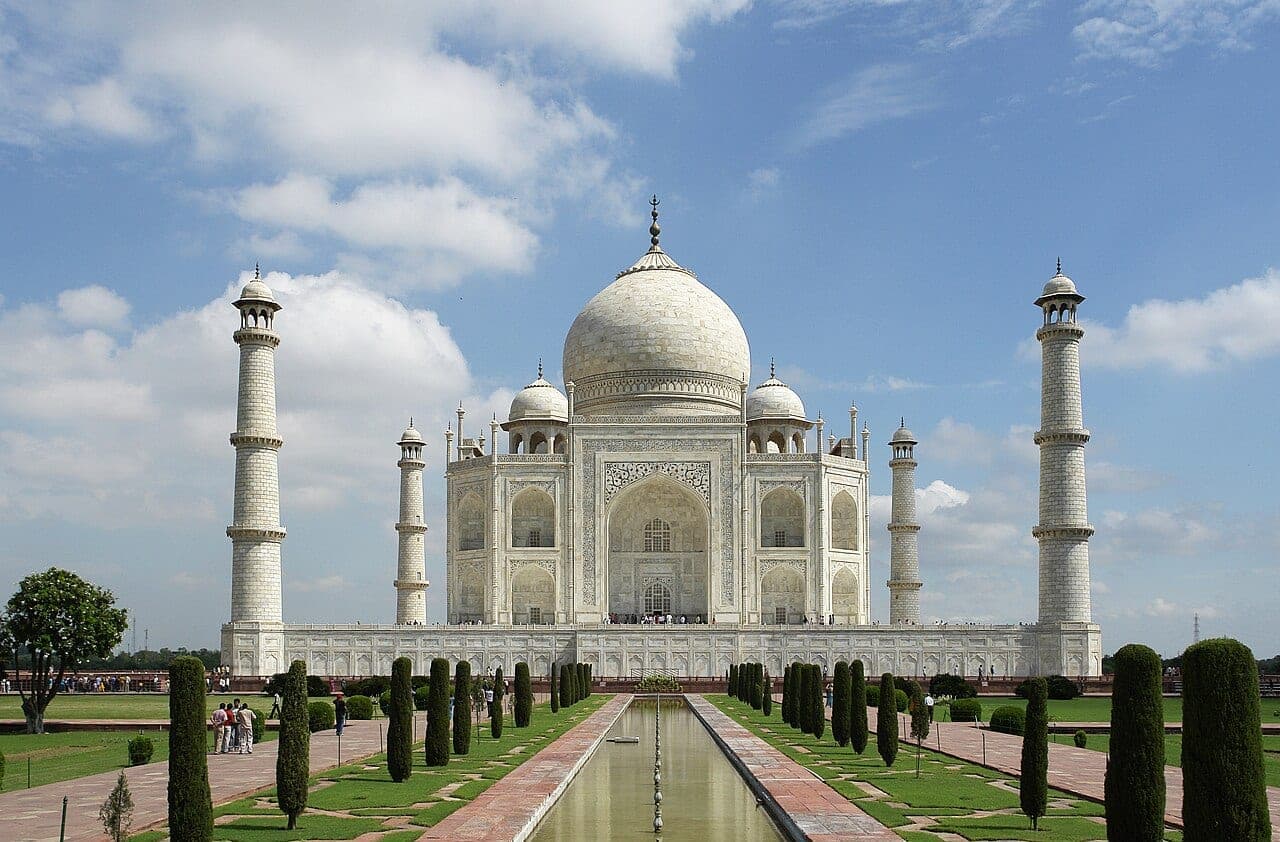
Islamic dynasties ruled Delhi from 1206, and the Mughal empire, established in 1526, presided over a fusion of Persian and Indian culture that produced the Taj Mahal, built by Shah Jahan between 1632 and 1653 as a tomb for his wife Mumtaz Mahal. European trading companies followed by sea, and the British East India Company turned commerce into dominion, giving way after 1858 to direct Crown rule. A long independence movement, led in its final decades by Mohandas Gandhi's method of non-violent resistance, ended British rule on 15 August 1947. Independence came together with Partition, the division of British India into the two dominions of India and Pakistan along lines drawn by a boundary commission under Cyril Radcliffe. The migration that followed was among the largest in modern history, displacing between twelve and twenty million people, and the accompanying violence, which fell on Hindu, Muslim and Sikh communities alike, is estimated to have cost several hundred thousand to two million lives. India adopted its republican constitution on 26 January 1950.
India's languages, among the most diverse of any country, fall mainly into two great families. The Indo-Aryan branch, descended from Sanskrit, covers most of the north, with Hindi, Bengali, Marathi, Gujarati and Punjabi; the older Dravidian family of the peninsula includes Tamil, Telugu, Kannada and Malayalam. Sanskrit, the classical language of the Vedas and the epics, remains a source from which many modern tongues draw their vocabulary. Tamil, by contrast, has a continuous literary record of some two millennia and is among the oldest languages still in daily use.
The constitution's Eighth Schedule recognises 22 languages, and the Union government conducts its business in Hindi, written in the Devanagari script, and in English, which was retained after independence as an associate official language and remains the common tongue of higher courts, commerce and much of higher education, while states legislate in their own languages. In 2024 India expanded its list of officially recognised classical languages to eleven, adding Marathi, Bengali, Assamese, Pali and Prakrit to the earlier six, among them Tamil and Sanskrit. The country's own names carry this layered past: "India" and "Hindu" both descend, by way of Persian and Greek, from the Sanskrit Sindhu, the river now called the Indus, while "Bharat", the constitutional name used in Indian languages, derives from a legendary ancestor of the epics.
Indian life is organised around the family, the festival and the season, and its calendar is crowded because it belongs to everyone at once. Diwali, the festival of lights, draws Hindus, Sikhs and Jains into the same weeks of lamps and sweets; Holi greets spring with coloured powder; and the two Eids, Christmas, Guru Nanak's birthday and countless regional harvest feasts share the same public holidays. The classical arts remain living professions: the dance forms of Bharatanatyam, Kathak, Odissi and Kathakali; the two streams of classical music, Hindustani in the north and Carnatic in the south; and a handloom and block-print textile inheritance.
The everyday culture is as distinctive. Indian food changes every few hundred kilometres, from the wheat and dairy of the north to the rice, coconut and fish of the coasts. Yoga and Ayurveda, both rooted in ancient texts, are daily discipline for millions and have travelled far beyond the country, and cricket is close to a national passion.
India is the birthplace of four of the world's religions and a long-settled home to several others, and its spiritual life is best understood as plurality rather than uniformity. Hinduism, followed by the great majority, is less a single creed than a family of traditions: the worship of deities such as Vishnu, Shiva and the Goddess in her many forms, the authority of the Vedas and epics, the ideas of dharma, karma and rebirth, and a sacred geography of temples and pilgrimage across the country. Islam, present since Arab traders reached the Kerala coast in the seventh century and later carried by the Delhi Sultanate and the Mughals, gave India some of its finest architecture and a deep Sufi tradition, with shrines such as that of Moinuddin Chishti at Ajmer drawing pilgrims of every faith.
 The ghats at Varanasi, where the same steps serve bathing and cremation. Photograph by Dialog Center Images, CC BY-SA 2.0, via Wikimedia Commons.
Sikhism arose in the Punjab in the fifteenth century with Guru Nanak, first of ten Gurus, and centres on the scripture the Guru Granth Sahib and the Golden Temple at Amritsar, whose free kitchen, the langar, feeds all comers. Buddhism began with the enlightenment of the Buddha at Bodh Gaya and spread across Asia under Ashoka; Jainism, taught by Mahavira, holds non-violence, ahimsa, to so strict a standard that its monks sweep the ground before they step. Christianity traces its Indian roots to the tradition that the apostle Thomas reached Kerala in the first century, and later grew through the Portuguese churches of Goa. To these are added the Parsi Zoroastrians who came from Persia more than a thousand years ago and Jewish communities in Kochi and elsewhere of comparable antiquity, so that many faiths share the same streets, festivals and public calendar.
Hindu mourning is governed by the antyesti, the "last sacrifice", the final rite of a life understood as a series of sacraments. Where possible death is met at home, and the body is carried to the cremation ground without delay, the soul being held distinct from the body it leaves. The pyre is most often lit by the eldest son, and after cremation the ashes and remaining bones are gathered and, within a day or two, given to flowing water, ideally the Ganges, whose current is asked to carry the dead toward release. A mourning period of around thirteen days follows, during which priests recite the rites that turn the newly dead, understood as a restless spirit, into a settled ancestor.
The ghats at Varanasi, where the same steps serve bathing and cremation. Photograph by Dialog Center Images, CC BY-SA 2.0, via Wikimedia Commons.
Sikhism arose in the Punjab in the fifteenth century with Guru Nanak, first of ten Gurus, and centres on the scripture the Guru Granth Sahib and the Golden Temple at Amritsar, whose free kitchen, the langar, feeds all comers. Buddhism began with the enlightenment of the Buddha at Bodh Gaya and spread across Asia under Ashoka; Jainism, taught by Mahavira, holds non-violence, ahimsa, to so strict a standard that its monks sweep the ground before they step. Christianity traces its Indian roots to the tradition that the apostle Thomas reached Kerala in the first century, and later grew through the Portuguese churches of Goa. To these are added the Parsi Zoroastrians who came from Persia more than a thousand years ago and Jewish communities in Kochi and elsewhere of comparable antiquity, so that many faiths share the same streets, festivals and public calendar.
Hindu mourning is governed by the antyesti, the "last sacrifice", the final rite of a life understood as a series of sacraments. Where possible death is met at home, and the body is carried to the cremation ground without delay, the soul being held distinct from the body it leaves. The pyre is most often lit by the eldest son, and after cremation the ashes and remaining bones are gathered and, within a day or two, given to flowing water, ideally the Ganges, whose current is asked to carry the dead toward release. A mourning period of around thirteen days follows, during which priests recite the rites that turn the newly dead, understood as a restless spirit, into a settled ancestor.
 The Taj Mahal is a grave. Shah Jahan built it for one woman, and the building the world photographs is her tomb. Photograph by Antrix3, CC BY-SA 4.0, via Wikimedia Commons.
That transformation begins a new relationship rather than ending the old one. Through the ritual of shraddha, the living continue to sustain the pitrs, the ancestors, with offerings of rice balls, called pind, and libations of water, or tarpana, performed on death anniversaries and at sacred sites such as Gaya in Bihar. Once a year the whole tradition turns toward the dead together during Pitru Paksha, a fortnight in the lunar month of Bhadrapada, in September or October, when families make daily offerings and invite three generations of ancestors back to be fed, the period closing on the new-moon day of Sarvapitri Amavasya. The other faiths keep their own forms: Muslims and Christians bury their dead, most often marked by prayer; Sikhs cremate and recite from their scripture; and the small Parsi community traditionally exposes its dead in the Towers of Silence, so that no element is defiled. Across all of them runs the conviction found at the Varanasi ghats, that the dead remain in some sense present and owed a continuing duty by the living.
India has two genealogical traditions running side by side, and the older one is not held by the state at all.
At Haridwar, and at Varanasi, Kurukshetra, Trimbakeshwar and other pilgrimage towns, Brahmin priests called pandas keep handwritten ledgers, the vahis, recording the families who come to perform rites for their dead. Each family is entered under its village and its clan, and the entry is added to on every visit, so a single page can carry twenty generations. Some of these records are said to reach back to the twelfth century. Indian courts have accepted them as evidence in inheritance disputes, which makes them one of the few private genealogical records anywhere with legal standing.
The state record is late and uneven. Registration of births and deaths was made a legal requirement across India only by the Act of 1969, and compliance took decades to become general, so for most families the twentieth century is documented better by school admission registers, land records and electoral rolls than by vital records.
The colonial archive is enormous and it is in London. The India Office Records at the British Library hold the baptisms, marriages and burials of the European and Anglo-Indian population from the seventeenth century, along with the army lists, pension papers and wills that go with them. For Indian families the same collection holds the land settlement records, the famine papers and the indenture registers that followed labourers to Mauritius, Fiji, Trinidad and Natal, which is often where a diaspora family's trail begins.
Care for India's monuments began under colonial rule and was expanded and nationalised after independence. The Archaeological Survey of India was founded in 1861 under Alexander Cunningham, its first director-general, and today maintains more than 3,600 monuments of national importance, from the caves of Ajanta to the temples of Khajuraho and Hampi. Its work is backed by the Ancient Monuments Act of 1958 and the Antiquities and Art Treasures Act of 1972, which govern excavation, conservation and the export of antiquities.
India holds 44 UNESCO World Heritage Sites, the sixth-highest total of any country, ranging from the Taj Mahal and the Sun Temple at Konark to the Harappan city of Dholavira and, most recently, the Maratha Military Landscapes inscribed in 2025. Beyond state agencies, the Indian National Trust for Art and Cultural Heritage works outside the official lists, and international partners have taken on landmark projects, notably the Aga Khan Trust for Culture's restoration of Humayun's Tomb and the surrounding Nizamuddin quarter in Delhi, a widely studied conservation model.
India's scale has pushed its memory institutions toward the digital at speed. The National Digital Library of India, built at IIT Kharagpur and sponsored by the Ministry of Education, gathers tens of millions of items of educational and cultural content in more than a hundred languages into a single point of access. The National Mission for Manuscripts has digitised millions of folios from what is thought to be the world's largest manuscript collection, and the Museums of India portal and its JATAN software have put high-resolution images of national-museum objects online.
Sahapedia, an open online encyclopedia of Indian arts and cultures, documents crafts and oral traditions that no monument list records. And memory of the most difficult kind has its own archive: the 1947 Partition Archive has recorded thousands of oral histories from survivors on every side of the new borders, digital testimony from a generation now passing.
Modern India exports its imagination on a global scale. Its cinema, made in Hindi and several regional languages, reaches audiences far beyond the diaspora; the song "Naatu Naatu" from the Telugu film "RRR" won the Academy Award for Best Original Song in 2023, the same year the Tamil-set documentary "The Elephant Whisperers" took its own Oscar, and the composer A. R. Rahman had won two earlier. In literature the line runs from Tagore, the first non-European Nobel laureate in 1913, through R. K. Narayan to the Booker Prize winners Salman Rushdie in 1981 and Arundhati Roy in 1997, and a large contemporary generation writing in English and the regional languages alike.
Indian classical music travelled the world with Ravi Shankar, and yoga has become a global practice, marked since 2015 by the United Nations International Day of Yoga on 21 June and inscribed on UNESCO's intangible heritage list in 2016. Behind much of this stands the world's largest diaspora, put by the Indian government at more than 30 million people of Indian origin, carrying festivals, temples, gurdwaras and mosques to cities on every continent.
A monument and its neighbourhood, restored together. The Aga Khan Trust for Culture's decade-long work on Humayun's Tomb and the Sunder Nursery gardens in Delhi, opened to the public in 2018, revived a World Heritage monument while improving sanitation, schooling and livelihoods in the Nizamuddin quarter around it, and is now cited as a conservation model.
The world's largest gathering, safeguarded. The Kumbh Mela, the cyclical Hindu pilgrimage rotating between Prayagraj, Haridwar, Nashik and Ujjain, was inscribed on UNESCO's intangible heritage list in 2017; the Maha Kumbh at Prayagraj in 2025 drew crowds reported in the hundreds of millions.
Partition, remembered rather than erased. The 1947 Partition Archive has gathered thousands of first-person testimonies from survivors across India, Pakistan and Bangladesh, and the Partition Museum in Amritsar has turned that record into public history, keeping a shared and painful memory available to descendants on all sides.
Stolen gods, brought home. After decades in which sculptures were smuggled out of temples and sold abroad, India has secured the return of hundreds of antiquities from museums and collections abroad in recent years, restoring bronze and stone deities to the country and, in some cases, to worship.
The Taj Mahal is a grave. Shah Jahan built it for one woman, and the building the world photographs is her tomb. Photograph by Antrix3, CC BY-SA 4.0, via Wikimedia Commons.
That transformation begins a new relationship rather than ending the old one. Through the ritual of shraddha, the living continue to sustain the pitrs, the ancestors, with offerings of rice balls, called pind, and libations of water, or tarpana, performed on death anniversaries and at sacred sites such as Gaya in Bihar. Once a year the whole tradition turns toward the dead together during Pitru Paksha, a fortnight in the lunar month of Bhadrapada, in September or October, when families make daily offerings and invite three generations of ancestors back to be fed, the period closing on the new-moon day of Sarvapitri Amavasya. The other faiths keep their own forms: Muslims and Christians bury their dead, most often marked by prayer; Sikhs cremate and recite from their scripture; and the small Parsi community traditionally exposes its dead in the Towers of Silence, so that no element is defiled. Across all of them runs the conviction found at the Varanasi ghats, that the dead remain in some sense present and owed a continuing duty by the living.
India has two genealogical traditions running side by side, and the older one is not held by the state at all.
At Haridwar, and at Varanasi, Kurukshetra, Trimbakeshwar and other pilgrimage towns, Brahmin priests called pandas keep handwritten ledgers, the vahis, recording the families who come to perform rites for their dead. Each family is entered under its village and its clan, and the entry is added to on every visit, so a single page can carry twenty generations. Some of these records are said to reach back to the twelfth century. Indian courts have accepted them as evidence in inheritance disputes, which makes them one of the few private genealogical records anywhere with legal standing.
The state record is late and uneven. Registration of births and deaths was made a legal requirement across India only by the Act of 1969, and compliance took decades to become general, so for most families the twentieth century is documented better by school admission registers, land records and electoral rolls than by vital records.
The colonial archive is enormous and it is in London. The India Office Records at the British Library hold the baptisms, marriages and burials of the European and Anglo-Indian population from the seventeenth century, along with the army lists, pension papers and wills that go with them. For Indian families the same collection holds the land settlement records, the famine papers and the indenture registers that followed labourers to Mauritius, Fiji, Trinidad and Natal, which is often where a diaspora family's trail begins.
Care for India's monuments began under colonial rule and was expanded and nationalised after independence. The Archaeological Survey of India was founded in 1861 under Alexander Cunningham, its first director-general, and today maintains more than 3,600 monuments of national importance, from the caves of Ajanta to the temples of Khajuraho and Hampi. Its work is backed by the Ancient Monuments Act of 1958 and the Antiquities and Art Treasures Act of 1972, which govern excavation, conservation and the export of antiquities.
India holds 44 UNESCO World Heritage Sites, the sixth-highest total of any country, ranging from the Taj Mahal and the Sun Temple at Konark to the Harappan city of Dholavira and, most recently, the Maratha Military Landscapes inscribed in 2025. Beyond state agencies, the Indian National Trust for Art and Cultural Heritage works outside the official lists, and international partners have taken on landmark projects, notably the Aga Khan Trust for Culture's restoration of Humayun's Tomb and the surrounding Nizamuddin quarter in Delhi, a widely studied conservation model.
India's scale has pushed its memory institutions toward the digital at speed. The National Digital Library of India, built at IIT Kharagpur and sponsored by the Ministry of Education, gathers tens of millions of items of educational and cultural content in more than a hundred languages into a single point of access. The National Mission for Manuscripts has digitised millions of folios from what is thought to be the world's largest manuscript collection, and the Museums of India portal and its JATAN software have put high-resolution images of national-museum objects online.
Sahapedia, an open online encyclopedia of Indian arts and cultures, documents crafts and oral traditions that no monument list records. And memory of the most difficult kind has its own archive: the 1947 Partition Archive has recorded thousands of oral histories from survivors on every side of the new borders, digital testimony from a generation now passing.
Modern India exports its imagination on a global scale. Its cinema, made in Hindi and several regional languages, reaches audiences far beyond the diaspora; the song "Naatu Naatu" from the Telugu film "RRR" won the Academy Award for Best Original Song in 2023, the same year the Tamil-set documentary "The Elephant Whisperers" took its own Oscar, and the composer A. R. Rahman had won two earlier. In literature the line runs from Tagore, the first non-European Nobel laureate in 1913, through R. K. Narayan to the Booker Prize winners Salman Rushdie in 1981 and Arundhati Roy in 1997, and a large contemporary generation writing in English and the regional languages alike.
Indian classical music travelled the world with Ravi Shankar, and yoga has become a global practice, marked since 2015 by the United Nations International Day of Yoga on 21 June and inscribed on UNESCO's intangible heritage list in 2016. Behind much of this stands the world's largest diaspora, put by the Indian government at more than 30 million people of Indian origin, carrying festivals, temples, gurdwaras and mosques to cities on every continent.
A monument and its neighbourhood, restored together. The Aga Khan Trust for Culture's decade-long work on Humayun's Tomb and the Sunder Nursery gardens in Delhi, opened to the public in 2018, revived a World Heritage monument while improving sanitation, schooling and livelihoods in the Nizamuddin quarter around it, and is now cited as a conservation model.
The world's largest gathering, safeguarded. The Kumbh Mela, the cyclical Hindu pilgrimage rotating between Prayagraj, Haridwar, Nashik and Ujjain, was inscribed on UNESCO's intangible heritage list in 2017; the Maha Kumbh at Prayagraj in 2025 drew crowds reported in the hundreds of millions.
Partition, remembered rather than erased. The 1947 Partition Archive has gathered thousands of first-person testimonies from survivors across India, Pakistan and Bangladesh, and the Partition Museum in Amritsar has turned that record into public history, keeping a shared and painful memory available to descendants on all sides.
Stolen gods, brought home. After decades in which sculptures were smuggled out of temples and sold abroad, India has secured the return of hundreds of antiquities from museums and collections abroad in recent years, restoring bronze and stone deities to the country and, in some cases, to worship.
National Overview
Notable Cities
Historical Foundations
Linguistic and Etymological Roots
Cultural Identity
Religion and Spirituality
Remembrance and Mourning Traditions
Tracing a Family in India
Heritage Preservation Efforts
Digital Heritage
Contemporary Cultural Influences
Success Stories
References and resources
- UNESCO World Heritage Centre, India: the state-party page for all 44 Indian World Heritage sites.
- UNESCO Intangible Cultural Heritage, India: Kumbh Mela, yoga, Durga Puja, Garba and India's other inscriptions.
- Archaeological Survey of India: the national body for monuments, excavation and conservation, founded 1861.
- Census of India 2011, Religious Communities: the official figures for India's religious composition.
- Ministry of Home Affairs, Eighth Schedule Languages: the 22 constitutionally recognised languages.
- National Digital Library of India: the national aggregator of educational and cultural content, built at IIT Kharagpur.
- National Mission for Manuscripts: the programme documenting and digitising India's manuscript heritage.
- The 1947 Partition Archive: the oral-history archive of Partition survivors on all sides of the border.
- Encyclopaedia Britannica, India: geography, history and society.
- Encyclopaedia Britannica, Partition of India: a neutral account of the 1947 division and its human cost.