Heritage · Country
Liechtenstein Culture and Heritage
A doubly landlocked Alpine principality where a medieval keep still houses a reigning prince and November graves glow with candlelight. This is a guide to Liechtenstein's castles, its Princely art, its Alemannic dialects and the Catholic customs by which its people remember their dead.Written to last.
By Confinity Heritage Editorial · Updated 2026-07-31 · 8-minute readQuiet tools, kept out of the way.
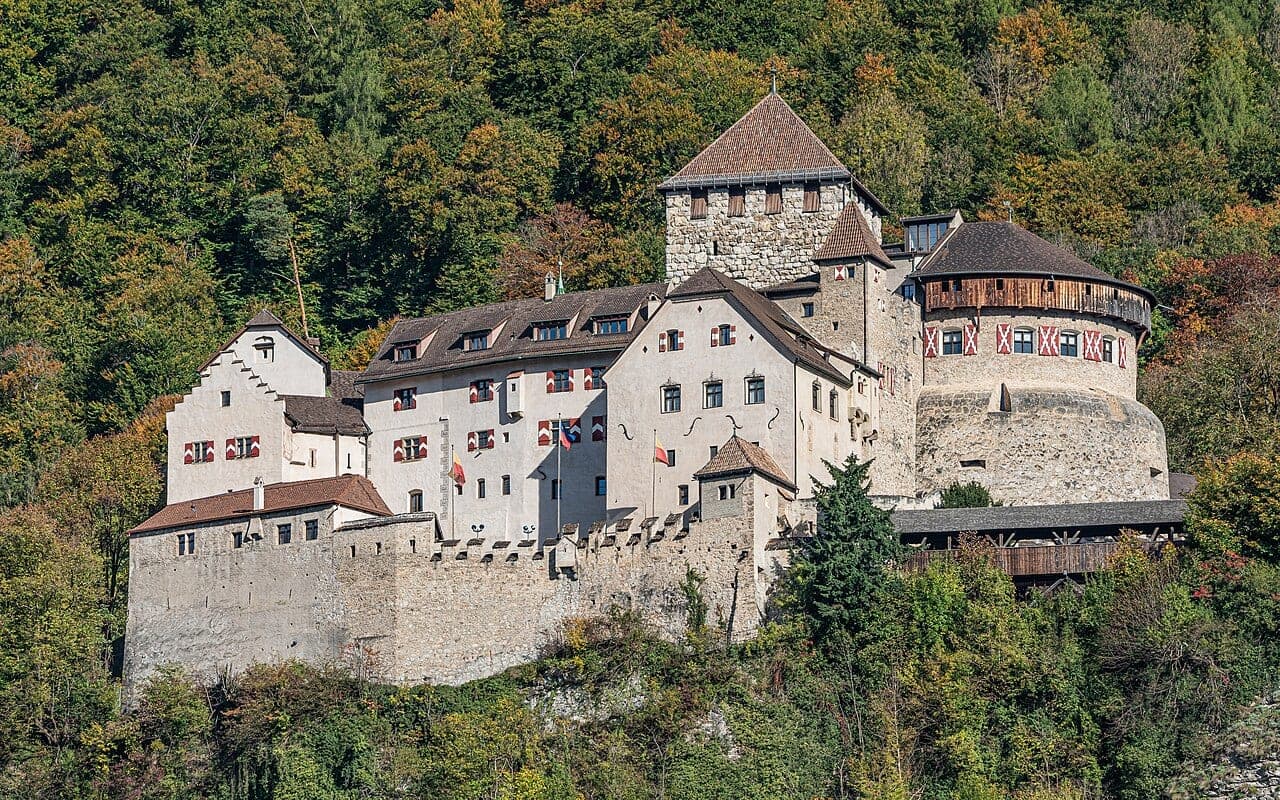
Liechtenstein is a country you can walk across in an afternoon, yet it holds a remarkable depth of remembered history. A doubly landlocked Alpine principality of about 160 square kilometres, wedged between Switzerland and Austria with the young Rhine along its whole western edge, it climbs from the river plain through terraced villages to the Grauspitz at 2,599 metres. Above the capital, Vaduz, the medieval keep of Vaduz Castle keeps watch from its hilltop, still home to the reigning Prince, a sight that captures the country whole: small, mountainous and conscious of a lineage three centuries old.
This is a nation that keeps its past in small compass. Its famous stamps are miniature archives, once a pillar of the national budget; its Roman Catholic calendar turns each November to the graves, lit with candles for the feast of All Saints; its mountain villages still speak Alemannic dialects that carry the memory of a medieval migration. Behind it all sits the Princely House of Liechtenstein, whose art collection is among the greatest in private hands anywhere.
Liechtenstein is one of the smallest sovereign states on earth, covering 160.5 square kilometres and home to roughly 41,000 people. It is also one of only two doubly landlocked countries in the world, surrounded entirely by landlocked neighbours; the other is Uzbekistan. The Rhine forms the entire western border with Switzerland, while the Rätikon mountains rise toward Austria in the east, dividing the country between the fertile Rhine valley and the Alpine highlands that culminate at the Grauspitz (Encyclopaedia Britannica).
It is a constitutional monarchy with unusually strong elements of direct democracy. Prince Hans-Adam II has reigned since 1989, and his son Hereditary Prince Alois has served as regent since 2004. Of the eleven municipalities, the capital, Vaduz, is smaller than the largest, Schaan. The country has used the Swiss franc since a customs and monetary union with Switzerland in 1920, keeps no army (disbanded in 1868), and joined the United Nations in 1990, EFTA in 1991 and the European Economic Area in 1995. German is the sole official language, spoken everywhere in its Alemannic form.
Vaduz. A village-sized capital of some five thousand residents at the foot of the castle hill, Vaduz gathers the neo-Gothic Cathedral of St Florin, the arts quarter with the Kunstmuseum and the Liechtenstein National Museum, and the pedestrian "Städtle." It is the seat of parliament, government and court, and the address of the Princely wine cellars whose vines grow within the town.
Schaan. North of Vaduz on the valley floor, Schaan is the most populous municipality, with about six thousand inhabitants, and the country's industrial engine; the tool company Hilti is based here. It also holds the country's deepest Roman memory, where a late Roman fort guarded the valley road against Alemannic raids, and the church of St Laurentius anchors the old settlement (Schaan, Wikipedia).
Balzers. The southernmost municipality, toward the Swiss canton of Graubünden, is crowned by Gutenberg Castle on a free-standing rock above the houses. The hill beneath has been inhabited since the Neolithic and gave up one of the country's most celebrated artefacts, the Bronze Age statuette known as the Mars of Gutenberg.
Triesenberg. Spread across a mountain terrace between about 880 and 1,000 metres, Triesenberg is the highland heart of Liechtenstein and home to its Walser community, descendants of German-speaking migrants from the Valais who settled here from the late thirteenth century. It keeps its own Walser dialect and museum, and its territory reaches up to Malbun, the country's only ski resort.
The Rhine valley has been a corridor of settlement for millennia. Rome held the region from the first century, and the fort at Schaan marks the frontier era against the Alemanni, the Germanic people who settled the valley from roughly the fifth century and whose speech the country still uses. Through the Middle Ages the land was two small feudal territories: the lowland Lordship of Schellenberg and, upstream, the County of Vaduz, each held in turn by regional noble houses (Lordship of Schellenberg, Wikipedia).
 Vaduz Castle is the residence of the princely family and is not open to the public, so the country's best known building is one almost nobody goes inside. Photograph by Christian David, CC BY-SA 4.0, via Wikimedia Commons.
The principality is a deliberate creation of the early eighteenth century. The House of Liechtenstein took its name from Liechtenstein Castle south of Vienna and had served the Habsburgs as counsellors for centuries. For all its riches, the family lacked a territory held directly from the emperor, and so a seat in the Imperial Diet. To gain that standing it bought two territories in the Rhine valley: Prince Johann Adam Andreas I acquired the Lordship of Schellenberg in 1699 and the County of Vaduz in 1712. On 23 January 1719 the Holy Roman Emperor Charles VI united them into a principality bearing the family's own name (Swiss National Museum; fuerstenhaus.li).
Sovereignty followed the shocks that dissolved the old imperial order. In 1806 Liechtenstein entered the Confederation of the Rhine as a sovereign state; it then belonged to the German Confederation from 1815 until that body dissolved in 1866, when the last external tie fell away. The army was disbanded in 1868 for cost, and the country has kept out of armed conflict since, staying neutral through both world wars. Poor and agrarian for its first two centuries and bound to Austria, it reoriented toward Switzerland after 1945 and became the prosperous, industrialised microstate of today, still ruled by the House whose deed of 1719 called it into being.
Liechtenstein is German-speaking, but the German of daily life is Alemannic, the dialect family shared with neighbouring Switzerland, Austria's Vorarlberg and south-western Germany. Standard German is the language of writing, schooling and administration, while the spoken tongue, which locals call something close to "Liachtaschta," varies from village to village. The sharpest contrast is at Triesenberg, where the Walser settlers of the late thirteenth century brought a Highest Alemannic dialect from the Valais that remains audibly different from the valley speech below, a spoken fossil of a medieval migration (Triesenberg, Wikipedia).
The country's name is itself dynastic memory. It does not describe the land; it records the family, for the principality was named after the House of Liechtenstein rather than the reverse. The House took its name from its ancestral seat, Liechtenstein Castle near Vienna, and the name is generally understood to join the old German elements "lieht," meaning light or bright, and "stein," meaning stone. Liechtenstein is thus among the few nations named after a ruling family, and one of the very few whose name traces to a single castle on foreign soil.
The grandest expression of Liechtenstein's culture is not in the principality but in Vienna, where the Princely Collections rank among the largest private art holdings in the world. Assembled over four centuries and shaped above all by Prince Karl Eusebius, whose writings of the 1670s set out a philosophy of collecting, they run from the Renaissance and the Baroque to the Biedermeier period and include the largest group of paintings by Peter Paul Rubens in private hands, alongside works associated with Raphael, Rembrandt and Van Dyck. Much is displayed in the family's Garden Palace in Vienna, where the Great Gallery centres on Rubens's Decius Mus cycle (liechtensteincollections.at).
Closer to the mountains, cultural identity is Alpine and communal: Alpine farming, brass bands and choral singing, and the pre-Lenten carnival of Fasnacht. Two smaller traditions have become almost emblematic. The first is wine: the Princely family has grown vines in the Rhine valley since 1712, and its Court Winery, the Hofkellerei, still works the Herawingert, a monopole vineyard of about four hectares in the heart of Vaduz planted overwhelmingly with Pinot Noir (Hofkellerei Liechtenstein). The second is philately: the country issued its first stamps in 1912 and gained postal independence in 1920, and into the 1970s the sale of finely engraved stamps to collectors abroad provided more than a fifth of national income, earning it the name of a postage-stamp country and giving Vaduz its own Postal Museum (postage history, Wikipedia).
Liechtenstein is a Roman Catholic country, and Catholicism is written into both its law and its rhythm of life. The constitution names the Roman Catholic Church as the state church, and at the 2020 count roughly 70 per cent of the population identified as Catholic. Long part of the Swiss Diocese of Chur, the country was raised in 1997 to its own Archdiocese of Vaduz, with the Cathedral of St Florin, a neo-Gothic church of 1874, as its seat (Encyclopaedia Britannica).
Faith here shows less through doctrine than through the year's turning: the parish churches of St Laurentius in Schaan, St Nicholas in Balzers mark a calendar of baptisms, first communions, weddings and funerals. Marian devotion runs strong, and the national holiday on 15 August coincides with the feast of the Assumption. Beneath the formal church, older Alpine strata persist in blessings of fields and animals, in wayside shrines and chapels, and in the Fasnacht rites before Lent.
Death in Liechtenstein is handled as it is across the Catholic Alemannic world, as an affair of the whole village rather than the family alone. A death is announced through a printed notice and a mourning circular sent to relatives, and the church bells toll. The funeral centres on a Requiem Mass in the parish church, after which the coffin is carried in procession to the churchyard that almost always lies beside it, so the dead stay within sight of the community that knew them. Turnout is a duty of belonging; in a country this small, most funerals draw a crowd the deceased would know by name.
Remembrance then continues on a fixed schedule familiar throughout the region. A memorial Mass is held about a month after the death, the "Dreissigster," and an anniversary Mass, the "Jahrtag," each year, keeping the dead in the parish's prayers long after burial. The graves are tended and planted with flowers, and the churchyard is treated as a shared garden of memory rather than a neglected margin.
The high point of the year of the dead comes in early November. On All Saints' Day, "Allerheiligen," on 1 November, and All Souls' Day, "Allerseelen," on the 2nd, families gather at the cemeteries to clean and dress the graves with wreaths and autumn flowers and to light candles, while a priest walks the rows to bless them in the rite of the "Gräbersegnung." As dusk falls the churchyards fill with points of flame, a quiet collective act repeated in every village at once (All Saints' Day, Wikipedia). It is the clearest picture of how a small Catholic nation keeps its dead: not privately and out of sight, but together, on an appointed day, in candlelight.
Liechtenstein's records are parish records and princely records, and the two archives describe the same valley from different heights.
Catholic parish registers for the eleven communes begin in the seventeenth century and are the vital record before the state's. The Liechtensteinisches Landesarchiv in Vaduz holds the public series, and the Princely House keeps its own archive, which documents the family's estates across Austria, Moravia and Bohemia as well as the principality, and is one of the more substantial private archives in Europe.
The organising concept is the Bürgerrecht, citizenship in a commune. A Liechtensteiner belongs to one of the eleven communes and inherits that membership, which historically carried rights to communal land and support, and the commune keeps the register of its citizens. So, as in Switzerland, the family record follows the place of origin rather than the place of residence, and a family that moved down the valley two centuries ago is still documented where it started.
Emigration in the nineteenth century, when the principality was poor, took a substantial number of people to the American Midwest, and those departures are recorded in the communal and parish books.
The twentieth-century record is complicated by the family's own history: the Princely House lost its Czechoslovak estates in 1945, and the dispute over that expropriation is still running, which means a good deal of the archive relating to those lands is a live legal matter rather than a historical one.
The country's built memory is guarded first of all by its castles. Vaduz Castle, whose oldest part, the great keep, dates from the twelfth century, was burned by the Swiss Confederacy in the Swabian War of 1499 and stood partly ruinous for centuries; a restoration between 1904 and 1920 under Prince Johann II rescued it, and it has been the family's principal residence since 1938. Because the Prince still lives there, it is closed to the public, a working seat rather than a museum (Vaduz Castle, Wikipedia). Gutenberg Castle at Balzers took the opposite path: one of only two castles in the principality to survive intact, it passed into state and municipal care in 1979, and its outer bailey is open free of charge (Gutenberg Castle, Wikipedia).
Vaduz holds the two central museums. The Liechtenstein National Museum, established in 1890 in a building of 1438 that once served as the princely tavern and customs house, reopened after renovation in 2003 and presents the country's history, culture and natural history, including the Mars of Gutenberg statuette (Liechtenstein National Museum). Nearby, the Kunstmuseum Liechtenstein opened in 2000 as the state museum of modern and contemporary art, a black cube of tinted concrete and river-pebbled basalt, joined in 2015 by the Hilti Art Foundation building. Alpine walking heritage survives as living practice: the Fürstensteig, the "Prince's Path" cut into the cliffs of the Rätikon and opened in 1898 with the support of Prince Johann II, is a secured rite of passage completed by generations of residents. At Triesenberg the Walser Museum, founded in 1961, keeps the settlers' dialect, dress and daily life on record.
For a microstate, Liechtenstein has invested seriously in putting its memory online. The centrepiece is the Historical Lexicon of the Principality of Liechtenstein, first published as two printed volumes in 2013 and, since November 2018, freely available as an open-access reference of roughly 2,600 thematic, biographical and geographical articles, maintained by the Liechtenstein Institute. It is, in effect, the country's collective knowledge of itself, from prehistory to the present, made searchable for anyone (Historisches Lexikon).
Around it a wider digital record has grown. The Liechtenstein National Library runs eLiechtensteinensia, a digital collection bringing historical newspapers, books, maps and images from and about the country onto the open web, while the National Archives digitise historical records for public consultation. The Princely Collections publish their catalogue and imagery online, so a collection begun in the seventeenth century can be studied from anywhere. Together these projects let a nation of forty thousand offer an outsized share of its heritage to a global public.
Modern Liechtenstein carries its identity lightly but insistently. The Kunstmuseum and the touring exhibitions of the Princely Collections give the country an international art presence out of proportion to its size, and the Theater am Kirchsaal in Schaan sustains a small resident cultural life. The University of Liechtenstein draws students in architecture and finance, and companies such as Hilti carry the country's name worldwide, a quiet counterpart to the older export of stamps.
The strongest thread of contemporary identity is public and shared. Each 15 August the National Day gathers much of the population in the meadow below Vaduz Castle, where the gardens are opened and the Prince addresses and mingles with the citizens, a ceremony fusing the feast of the Assumption, the dynasty and the state into a single day of belonging. Malbun and the mountain trails keep the Alpine tradition alive, the Walser dialect is consciously cultivated as heritage, and the November candlelight continues to bind the living to the dead. In a country this small, culture is less a set of institutions than a round of gatherings everyone attends.
A nation's history opened to all. The Historical Lexicon of the Principality of Liechtenstein moved from two printed volumes in 2013 to a free online encyclopaedia of some 2,600 articles in 2018, an open-access record of its own past.
A ruined seat brought back to life. Vaduz Castle, burned in 1499 and long left partly derelict, was restored between 1904 and 1920 and has been the reigning family's home since 1938, so the country's defining landmark is a lived-in castle.
A castle saved for the public. Gutenberg Castle at Balzers, one of only two intact castles in the principality, entered public and municipal care in 1979 and now opens its bailey free of charge, its Neolithic-to-medieval story preserved above the village.
A dialect kept on the record. The Walser Museum at Triesenberg, founded in 1961, documents the speech, dress and daily life of the Walser settlers and safeguards a four-hundred-year-old house, so that a distinct medieval community is not quietly absorbed.
A private collection shared with the world. The Princely Collections, built over four centuries, reopened to the public in Vienna's Garden Palace in 2004 and are now catalogued online, turning a dynastic treasure into a resource for everyone.
Vaduz Castle is the residence of the princely family and is not open to the public, so the country's best known building is one almost nobody goes inside. Photograph by Christian David, CC BY-SA 4.0, via Wikimedia Commons.
The principality is a deliberate creation of the early eighteenth century. The House of Liechtenstein took its name from Liechtenstein Castle south of Vienna and had served the Habsburgs as counsellors for centuries. For all its riches, the family lacked a territory held directly from the emperor, and so a seat in the Imperial Diet. To gain that standing it bought two territories in the Rhine valley: Prince Johann Adam Andreas I acquired the Lordship of Schellenberg in 1699 and the County of Vaduz in 1712. On 23 January 1719 the Holy Roman Emperor Charles VI united them into a principality bearing the family's own name (Swiss National Museum; fuerstenhaus.li).
Sovereignty followed the shocks that dissolved the old imperial order. In 1806 Liechtenstein entered the Confederation of the Rhine as a sovereign state; it then belonged to the German Confederation from 1815 until that body dissolved in 1866, when the last external tie fell away. The army was disbanded in 1868 for cost, and the country has kept out of armed conflict since, staying neutral through both world wars. Poor and agrarian for its first two centuries and bound to Austria, it reoriented toward Switzerland after 1945 and became the prosperous, industrialised microstate of today, still ruled by the House whose deed of 1719 called it into being.
Liechtenstein is German-speaking, but the German of daily life is Alemannic, the dialect family shared with neighbouring Switzerland, Austria's Vorarlberg and south-western Germany. Standard German is the language of writing, schooling and administration, while the spoken tongue, which locals call something close to "Liachtaschta," varies from village to village. The sharpest contrast is at Triesenberg, where the Walser settlers of the late thirteenth century brought a Highest Alemannic dialect from the Valais that remains audibly different from the valley speech below, a spoken fossil of a medieval migration (Triesenberg, Wikipedia).
The country's name is itself dynastic memory. It does not describe the land; it records the family, for the principality was named after the House of Liechtenstein rather than the reverse. The House took its name from its ancestral seat, Liechtenstein Castle near Vienna, and the name is generally understood to join the old German elements "lieht," meaning light or bright, and "stein," meaning stone. Liechtenstein is thus among the few nations named after a ruling family, and one of the very few whose name traces to a single castle on foreign soil.
The grandest expression of Liechtenstein's culture is not in the principality but in Vienna, where the Princely Collections rank among the largest private art holdings in the world. Assembled over four centuries and shaped above all by Prince Karl Eusebius, whose writings of the 1670s set out a philosophy of collecting, they run from the Renaissance and the Baroque to the Biedermeier period and include the largest group of paintings by Peter Paul Rubens in private hands, alongside works associated with Raphael, Rembrandt and Van Dyck. Much is displayed in the family's Garden Palace in Vienna, where the Great Gallery centres on Rubens's Decius Mus cycle (liechtensteincollections.at).
Closer to the mountains, cultural identity is Alpine and communal: Alpine farming, brass bands and choral singing, and the pre-Lenten carnival of Fasnacht. Two smaller traditions have become almost emblematic. The first is wine: the Princely family has grown vines in the Rhine valley since 1712, and its Court Winery, the Hofkellerei, still works the Herawingert, a monopole vineyard of about four hectares in the heart of Vaduz planted overwhelmingly with Pinot Noir (Hofkellerei Liechtenstein). The second is philately: the country issued its first stamps in 1912 and gained postal independence in 1920, and into the 1970s the sale of finely engraved stamps to collectors abroad provided more than a fifth of national income, earning it the name of a postage-stamp country and giving Vaduz its own Postal Museum (postage history, Wikipedia).
Liechtenstein is a Roman Catholic country, and Catholicism is written into both its law and its rhythm of life. The constitution names the Roman Catholic Church as the state church, and at the 2020 count roughly 70 per cent of the population identified as Catholic. Long part of the Swiss Diocese of Chur, the country was raised in 1997 to its own Archdiocese of Vaduz, with the Cathedral of St Florin, a neo-Gothic church of 1874, as its seat (Encyclopaedia Britannica).
Faith here shows less through doctrine than through the year's turning: the parish churches of St Laurentius in Schaan, St Nicholas in Balzers mark a calendar of baptisms, first communions, weddings and funerals. Marian devotion runs strong, and the national holiday on 15 August coincides with the feast of the Assumption. Beneath the formal church, older Alpine strata persist in blessings of fields and animals, in wayside shrines and chapels, and in the Fasnacht rites before Lent.
Death in Liechtenstein is handled as it is across the Catholic Alemannic world, as an affair of the whole village rather than the family alone. A death is announced through a printed notice and a mourning circular sent to relatives, and the church bells toll. The funeral centres on a Requiem Mass in the parish church, after which the coffin is carried in procession to the churchyard that almost always lies beside it, so the dead stay within sight of the community that knew them. Turnout is a duty of belonging; in a country this small, most funerals draw a crowd the deceased would know by name.
Remembrance then continues on a fixed schedule familiar throughout the region. A memorial Mass is held about a month after the death, the "Dreissigster," and an anniversary Mass, the "Jahrtag," each year, keeping the dead in the parish's prayers long after burial. The graves are tended and planted with flowers, and the churchyard is treated as a shared garden of memory rather than a neglected margin.
The high point of the year of the dead comes in early November. On All Saints' Day, "Allerheiligen," on 1 November, and All Souls' Day, "Allerseelen," on the 2nd, families gather at the cemeteries to clean and dress the graves with wreaths and autumn flowers and to light candles, while a priest walks the rows to bless them in the rite of the "Gräbersegnung." As dusk falls the churchyards fill with points of flame, a quiet collective act repeated in every village at once (All Saints' Day, Wikipedia). It is the clearest picture of how a small Catholic nation keeps its dead: not privately and out of sight, but together, on an appointed day, in candlelight.
Liechtenstein's records are parish records and princely records, and the two archives describe the same valley from different heights.
Catholic parish registers for the eleven communes begin in the seventeenth century and are the vital record before the state's. The Liechtensteinisches Landesarchiv in Vaduz holds the public series, and the Princely House keeps its own archive, which documents the family's estates across Austria, Moravia and Bohemia as well as the principality, and is one of the more substantial private archives in Europe.
The organising concept is the Bürgerrecht, citizenship in a commune. A Liechtensteiner belongs to one of the eleven communes and inherits that membership, which historically carried rights to communal land and support, and the commune keeps the register of its citizens. So, as in Switzerland, the family record follows the place of origin rather than the place of residence, and a family that moved down the valley two centuries ago is still documented where it started.
Emigration in the nineteenth century, when the principality was poor, took a substantial number of people to the American Midwest, and those departures are recorded in the communal and parish books.
The twentieth-century record is complicated by the family's own history: the Princely House lost its Czechoslovak estates in 1945, and the dispute over that expropriation is still running, which means a good deal of the archive relating to those lands is a live legal matter rather than a historical one.
The country's built memory is guarded first of all by its castles. Vaduz Castle, whose oldest part, the great keep, dates from the twelfth century, was burned by the Swiss Confederacy in the Swabian War of 1499 and stood partly ruinous for centuries; a restoration between 1904 and 1920 under Prince Johann II rescued it, and it has been the family's principal residence since 1938. Because the Prince still lives there, it is closed to the public, a working seat rather than a museum (Vaduz Castle, Wikipedia). Gutenberg Castle at Balzers took the opposite path: one of only two castles in the principality to survive intact, it passed into state and municipal care in 1979, and its outer bailey is open free of charge (Gutenberg Castle, Wikipedia).
Vaduz holds the two central museums. The Liechtenstein National Museum, established in 1890 in a building of 1438 that once served as the princely tavern and customs house, reopened after renovation in 2003 and presents the country's history, culture and natural history, including the Mars of Gutenberg statuette (Liechtenstein National Museum). Nearby, the Kunstmuseum Liechtenstein opened in 2000 as the state museum of modern and contemporary art, a black cube of tinted concrete and river-pebbled basalt, joined in 2015 by the Hilti Art Foundation building. Alpine walking heritage survives as living practice: the Fürstensteig, the "Prince's Path" cut into the cliffs of the Rätikon and opened in 1898 with the support of Prince Johann II, is a secured rite of passage completed by generations of residents. At Triesenberg the Walser Museum, founded in 1961, keeps the settlers' dialect, dress and daily life on record.
For a microstate, Liechtenstein has invested seriously in putting its memory online. The centrepiece is the Historical Lexicon of the Principality of Liechtenstein, first published as two printed volumes in 2013 and, since November 2018, freely available as an open-access reference of roughly 2,600 thematic, biographical and geographical articles, maintained by the Liechtenstein Institute. It is, in effect, the country's collective knowledge of itself, from prehistory to the present, made searchable for anyone (Historisches Lexikon).
Around it a wider digital record has grown. The Liechtenstein National Library runs eLiechtensteinensia, a digital collection bringing historical newspapers, books, maps and images from and about the country onto the open web, while the National Archives digitise historical records for public consultation. The Princely Collections publish their catalogue and imagery online, so a collection begun in the seventeenth century can be studied from anywhere. Together these projects let a nation of forty thousand offer an outsized share of its heritage to a global public.
Modern Liechtenstein carries its identity lightly but insistently. The Kunstmuseum and the touring exhibitions of the Princely Collections give the country an international art presence out of proportion to its size, and the Theater am Kirchsaal in Schaan sustains a small resident cultural life. The University of Liechtenstein draws students in architecture and finance, and companies such as Hilti carry the country's name worldwide, a quiet counterpart to the older export of stamps.
The strongest thread of contemporary identity is public and shared. Each 15 August the National Day gathers much of the population in the meadow below Vaduz Castle, where the gardens are opened and the Prince addresses and mingles with the citizens, a ceremony fusing the feast of the Assumption, the dynasty and the state into a single day of belonging. Malbun and the mountain trails keep the Alpine tradition alive, the Walser dialect is consciously cultivated as heritage, and the November candlelight continues to bind the living to the dead. In a country this small, culture is less a set of institutions than a round of gatherings everyone attends.
A nation's history opened to all. The Historical Lexicon of the Principality of Liechtenstein moved from two printed volumes in 2013 to a free online encyclopaedia of some 2,600 articles in 2018, an open-access record of its own past.
A ruined seat brought back to life. Vaduz Castle, burned in 1499 and long left partly derelict, was restored between 1904 and 1920 and has been the reigning family's home since 1938, so the country's defining landmark is a lived-in castle.
A castle saved for the public. Gutenberg Castle at Balzers, one of only two intact castles in the principality, entered public and municipal care in 1979 and now opens its bailey free of charge, its Neolithic-to-medieval story preserved above the village.
A dialect kept on the record. The Walser Museum at Triesenberg, founded in 1961, documents the speech, dress and daily life of the Walser settlers and safeguards a four-hundred-year-old house, so that a distinct medieval community is not quietly absorbed.
A private collection shared with the world. The Princely Collections, built over four centuries, reopened to the public in Vienna's Garden Palace in 2004 and are now catalogued online, turning a dynastic treasure into a resource for everyone.
National Overview
Notable Cities
Historical Foundations
Linguistic and Etymological Roots
Cultural Identity
Religion and Spirituality
Remembrance and Mourning Traditions
Tracing a Family in Liechtenstein
Heritage Preservation Efforts
Digital Heritage
Contemporary Cultural Influences
Success Stories
References and resources
- Encyclopaedia Britannica: Liechtenstein: geography, history, government and economy of the principality.
- Liechtenstein, Wikipedia: overview of the country, its statistics and institutions.
- The Princely House of Liechtenstein (fuerstenhaus.li): the official history of the reigning family.
- Swiss National Museum blog: How the Principality of Liechtenstein came into being: the acquisition of Schellenberg and Vaduz and the deed of 1719.
- LIECHTENSTEIN. The Princely Collections: the family art collections and their history.
- Vaduz Castle, Wikipedia: the keep, the 1499 burning, restoration and residence.
- Gutenberg Castle, Wikipedia: the Balzers castle, its preservation and prehistoric finds.
- Liechtenstein National Museum: the national collections of history, culture and nature in Vaduz.
- Postage stamps and postal history of Liechtenstein, Wikipedia: the philatelic tradition and its economic role.
- Hofkellerei Liechtenstein: the Princely Winery: the Court Winery and the Herawingert vineyard.
- Historical Lexicon of the Principality of Liechtenstein (eHLFL): the open-access online reference to the country's history.
- Official tourism website of the Principality of Liechtenstein: the Fürstensteig, the Walser Museum and other heritage sites.