Heritage · Country
Turkmenistan Culture and Heritage
Across the Karakum sands lie ancient Merv and Kunya-Urgench, Silk Road cities that once rivalled Baghdad, and the Parthian fortresses of Nisa. This is a guide to Turkmen heritage, from the golden Akhal-Teke horse and the carpet gols woven into the national flag to the saints' tombs where families still gather to remember their dead.Written to last.
By Confinity Heritage Editorial · Updated 2026-07-31 · 8-minute readQuiet tools, kept out of the way.
Most of Turkmenistan is desert. The Karakum, the Black Sand, covers roughly seventy per cent of the country, a vast slab of dune and clay, and for millennia the story of Turkmen life has been the story of the oases and rivers at its edges. Along the Murgab, the Amu Darya and the streams that fall from the Kopet Dag once ran the caravan roads that linked China to the Mediterranean, and on them rose cities that the medieval world counted among its greatest: Merv, which briefly held more people than Baghdad, and Kunya-Urgench, the seat of the Khwarazmian kings. The desert kept those places, and in the twentieth century a Soviet drilling accident gave the Karakum its strangest landmark, the burning gas crater at Darvaza that travellers now call the Door to Hell.
Between the ruined cities moved the Turkmen themselves, Oghuz Turkic tribes whose inheritance was portable: the golden Akhal-Teke horse, prized for three thousand years; the deep-red carpet whose tribal medallions, the gols, are woven into the national flag; and the sung epics and the poetry of Magtymguly, who gave the Turkmen a written literary voice in the eighteenth century. That inheritance passed through the Russian conquest and seven decades as a Soviet republic before Turkmenistan became independent in 1991.
Turkmenistan covers about 491,210 square kilometres of Central Asia, which makes it the region's second-largest country after Kazakhstan, and the Karakum desert fills the greater part of that space. It borders Kazakhstan to the north, Uzbekistan to the north and east, Afghanistan to the south-east, Iran to the south, and the Caspian Sea to the west. The Kopet Dag mountains rise along the Iranian frontier behind the capital; the Amu Darya, one of Central Asia's two great rivers, crosses the east on its way towards the Aral basin; and the Murgab and Tejen rivers water the southern oases where settled life has always concentrated.
The country is home to an estimated six million people, the large majority of them ethnic Turkmen, with Uzbek and Russian minorities among others. The currency is the manat, and the predominant faith is Sunni Islam. Turkmenistan is a presidential republic that declared a policy of permanent neutrality, recognised by the United Nations General Assembly in 1995. Its capital and largest city is Ashgabat, near the Kopet Dag in the south.
Ashgabat. The capital sits on the desert plain below the Kopet Dag, close to the ruins of Parthian Nisa. Almost the entire city dates from after 6 October 1948, when an earthquake struck in the small hours and, by later estimates, killed a large share of its population; the 1948 disaster remains one of the deadliest recorded. Rebuilt across the Soviet decades and then again after independence, Ashgabat is now clad in white marble on a monumental scale, and its museums, monuments and government quarter give it an unmistakable, planned character.
Turkmenabat. The second city, on the Amu Darya in the eastern province of Lebap, began as Amul, a Silk Road crossing where caravans forded the river. Known in the Russian and Soviet periods as Chardzhou, it took the name Turkmenabat after independence and remains the main eastern hub.
Dashoguz. In the far north, on the old Khwarazmian oasis near the Uzbek border, Dashoguz is the gateway to the ruins of Kunya-Urgench a short distance away. The region keeps the agricultural and craft traditions of Khwarazm, cut off from the rest of the country by the width of the Karakum.
Mary. Standing on the Murgab oasis, Mary is the nearest modern city to ancient Merv, whose successive walled cities lie just to the east. A centre of the cotton and gas economy, it is the base for visitors and archaeologists working the Merv site and the Bronze Age mounds nearby.
Human settlement in the Murgab delta reaches deep into the Bronze Age. Here flourished the civilisation of ancient Margiana, part of the wider Bactria-Margiana Archaeological Complex, or Oxus Civilization, of the late third and early second millennia BCE. Its capital, Gonur Depe, excavated from the 1970s by the Greek-Russian archaeologist Viktor Sarianidi, was a planned city of palaces, temples and elaborate graves dated to roughly 2400–1600 BCE, evidence of a sophisticated urban society long before the Silk Road.
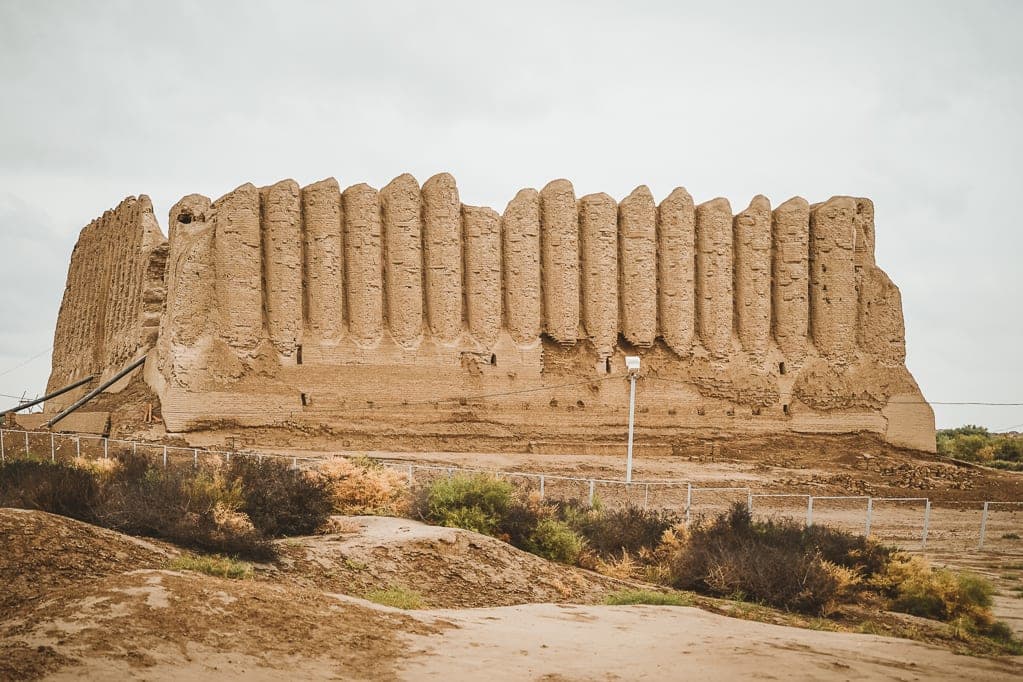
 The Great Kyz Kala at Merv, built with corrugated walls of packed earth, a technique used nowhere else at this scale. Photograph by Alexey Yakovlev, CC BY-SA 2.0, via Wikimedia Commons.
Margiana later became a satrapy of the Achaemenid Persian Empire, and in the third century BCE the region entered its Parthian age. At Nisa, beside modern Ashgabat, the Arsacid dynasty raised one of the earliest cities of the Parthian Empire, with royal residences, treasuries and a probable dynastic shrine; the twin mounds of Old and New Nisa preserve a rare record of a power that long rivalled Rome.
Merv, on the Murgab, grew into one of the pivotal cities of the Silk Road. Under the Seljuk Turks in the eleventh and twelfth centuries it became an imperial capital, and in its golden age under Sultan Sanjar its population is said to have approached half a million, ranking it among the largest cities on earth, with libraries and observatories that drew scholars including Omar Khayyam. The mausoleum of Sultan Sanjar, completed in 1157, still rises from the plain with a double dome nearly forty metres high. In 1221 a Mongol army under Tolui, son of Genghis Khan, took the city and massacred its inhabitants; Merv never fully recovered its former standing.
Downriver on the Amu Darya, Kunya-Urgench served as the capital of Khwarazm, the powerful state of the Khwarazm-Shahs, until it too fell to the Mongols. Its surviving monuments, dating mainly from the eleventh to sixteenth centuries, include the elegant Turabek-Khanum mausoleum and the Kutlug-Timur minaret, which at some sixty metres is among the tallest surviving medieval minarets in Central Asia.
The Turkmen people themselves emerged as the Oghuz Turkic tribes moved into the region between the ninth and eleventh centuries, mingling with the settled Iranian-speaking population; the Seljuk dynasty that ruled Merv rose from among these Oghuz. Over the following centuries the Turkmen tribes, among them the Teke, Yomut, Ersari and Salyr, lived largely as pastoral nomads across the oases and steppe.
Russian expansion reached the Turkmen lands in the later nineteenth century. Resistance ended at the Battle of Geok Tepe in January 1881, when General Mikhail Skobelev stormed the Teke fortress near Ashgabat; the assault and its aftermath cost many thousands of Turkmen lives, and the region was absorbed into the Russian Empire as Transcaspia. After the revolution the territory became the Turkmen Soviet Socialist Republic in 1924. Turkmenistan declared independence on 27 October 1991 as the Soviet Union dissolved, and has since developed as an independent state, a subject recorded here in outline only.
The national language is Turkmen, a member of the Oghuz branch of the Turkic family, closely related to Azerbaijani and to the Turkish of Anatolia. It was written in the Arabic script until the Soviet period, switched to Latin and then to Cyrillic in the 1920s and 1930s, and returned to a Latin-based alphabet after independence. The name Turkmen is usually explained as a compound of Turk with a suffix carrying the sense of resemblance, understood by medieval writers as meaning something like "Turk-like", a label for the Oghuz who adopted Islam. Russian remains widely understood as a second language and a legacy of the Soviet decades, and it long served as a lingua franca across the wider region.
The Akhal-Teke horse is the country's living emblem. Bred for some three thousand years and named for the Akhal oasis and the Teke tribe, it is famed for its slender build, its endurance across desert distances and the metallic sheen of its coat, which earns it the epithet of a "heavenly horse". The Akhal-Teke appears on the national coat of arms, and in 2024 UNESCO inscribed the art of its breeding and decoration on the Representative List of Intangible Cultural Heritage.
Equally central is the Turkmen carpet, a dense woollen weave, most often in deep red, ornamented with the repeated tribal medallions known as gols. Each of the main Turkmen tribes traditionally carried its own gol, so that a carpet signalled identity as much as it furnished a tent; the five gols on the national flag draw directly on this tradition. In 2019 UNESCO added the art of traditional Turkmen carpet-making to the intangible heritage list.
The oral tradition centres on the epic of Gorogly, the deeds of a legendary hero recited by dessanchy bagshy performers who sing and narrate to instrumental accompaniment; it was inscribed by UNESCO in 2015. Its music is carried on the dutar, the two-stringed long-necked lute whose making and playing tradition UNESCO recognised in 2021. Above the folk repertoire stands Magtymguly Pyragy (1724 to about 1807), the Sufi poet regarded as the father of written Turkmen literature, whose verse shaped the literary language and whose 300th anniversary was marked internationally in 2024. Turkmen cuisine reflects the same pastoral and oasis roots: rice pilaf known as palaw, mutton soups, manty dumplings, and the round tamdyr-baked bread called chorek, all served with green tea.
Most Turkmen are Sunni Muslims of the Hanafi school, but Islam in Turkmenistan has long been woven together with older Turkmen custom, ancestor veneration and the influence of Sufi brotherhoods. Sufi teachers and holy lineages, the ovlat, carried the faith to the nomadic tribes, and their memory endures in a landscape of revered graves. Among the most venerated figures is the mystic Najmeddin Kubra, founder of the Kubrawiya order, whose mausoleum at Kunya-Urgench remains a major pilgrimage site, alongside shrines such as Gozli Ata in the western desert and Parau Bibi.
Turkmen funerary practice follows the broad pattern of Sunni Islam. The dead are washed, wrapped in a plain shroud and buried without delay, laid on the right side to face Mecca, after the congregational janaza prayer. Grief is expressed communally, and the family opens its home to relatives and neighbours who come to offer condolences and share in the mourning.
The Great Kyz Kala at Merv, built with corrugated walls of packed earth, a technique used nowhere else at this scale. Photograph by Alexey Yakovlev, CC BY-SA 2.0, via Wikimedia Commons.
Margiana later became a satrapy of the Achaemenid Persian Empire, and in the third century BCE the region entered its Parthian age. At Nisa, beside modern Ashgabat, the Arsacid dynasty raised one of the earliest cities of the Parthian Empire, with royal residences, treasuries and a probable dynastic shrine; the twin mounds of Old and New Nisa preserve a rare record of a power that long rivalled Rome.
Merv, on the Murgab, grew into one of the pivotal cities of the Silk Road. Under the Seljuk Turks in the eleventh and twelfth centuries it became an imperial capital, and in its golden age under Sultan Sanjar its population is said to have approached half a million, ranking it among the largest cities on earth, with libraries and observatories that drew scholars including Omar Khayyam. The mausoleum of Sultan Sanjar, completed in 1157, still rises from the plain with a double dome nearly forty metres high. In 1221 a Mongol army under Tolui, son of Genghis Khan, took the city and massacred its inhabitants; Merv never fully recovered its former standing.
Downriver on the Amu Darya, Kunya-Urgench served as the capital of Khwarazm, the powerful state of the Khwarazm-Shahs, until it too fell to the Mongols. Its surviving monuments, dating mainly from the eleventh to sixteenth centuries, include the elegant Turabek-Khanum mausoleum and the Kutlug-Timur minaret, which at some sixty metres is among the tallest surviving medieval minarets in Central Asia.
The Turkmen people themselves emerged as the Oghuz Turkic tribes moved into the region between the ninth and eleventh centuries, mingling with the settled Iranian-speaking population; the Seljuk dynasty that ruled Merv rose from among these Oghuz. Over the following centuries the Turkmen tribes, among them the Teke, Yomut, Ersari and Salyr, lived largely as pastoral nomads across the oases and steppe.
Russian expansion reached the Turkmen lands in the later nineteenth century. Resistance ended at the Battle of Geok Tepe in January 1881, when General Mikhail Skobelev stormed the Teke fortress near Ashgabat; the assault and its aftermath cost many thousands of Turkmen lives, and the region was absorbed into the Russian Empire as Transcaspia. After the revolution the territory became the Turkmen Soviet Socialist Republic in 1924. Turkmenistan declared independence on 27 October 1991 as the Soviet Union dissolved, and has since developed as an independent state, a subject recorded here in outline only.
The national language is Turkmen, a member of the Oghuz branch of the Turkic family, closely related to Azerbaijani and to the Turkish of Anatolia. It was written in the Arabic script until the Soviet period, switched to Latin and then to Cyrillic in the 1920s and 1930s, and returned to a Latin-based alphabet after independence. The name Turkmen is usually explained as a compound of Turk with a suffix carrying the sense of resemblance, understood by medieval writers as meaning something like "Turk-like", a label for the Oghuz who adopted Islam. Russian remains widely understood as a second language and a legacy of the Soviet decades, and it long served as a lingua franca across the wider region.
The Akhal-Teke horse is the country's living emblem. Bred for some three thousand years and named for the Akhal oasis and the Teke tribe, it is famed for its slender build, its endurance across desert distances and the metallic sheen of its coat, which earns it the epithet of a "heavenly horse". The Akhal-Teke appears on the national coat of arms, and in 2024 UNESCO inscribed the art of its breeding and decoration on the Representative List of Intangible Cultural Heritage.
Equally central is the Turkmen carpet, a dense woollen weave, most often in deep red, ornamented with the repeated tribal medallions known as gols. Each of the main Turkmen tribes traditionally carried its own gol, so that a carpet signalled identity as much as it furnished a tent; the five gols on the national flag draw directly on this tradition. In 2019 UNESCO added the art of traditional Turkmen carpet-making to the intangible heritage list.
The oral tradition centres on the epic of Gorogly, the deeds of a legendary hero recited by dessanchy bagshy performers who sing and narrate to instrumental accompaniment; it was inscribed by UNESCO in 2015. Its music is carried on the dutar, the two-stringed long-necked lute whose making and playing tradition UNESCO recognised in 2021. Above the folk repertoire stands Magtymguly Pyragy (1724 to about 1807), the Sufi poet regarded as the father of written Turkmen literature, whose verse shaped the literary language and whose 300th anniversary was marked internationally in 2024. Turkmen cuisine reflects the same pastoral and oasis roots: rice pilaf known as palaw, mutton soups, manty dumplings, and the round tamdyr-baked bread called chorek, all served with green tea.
Most Turkmen are Sunni Muslims of the Hanafi school, but Islam in Turkmenistan has long been woven together with older Turkmen custom, ancestor veneration and the influence of Sufi brotherhoods. Sufi teachers and holy lineages, the ovlat, carried the faith to the nomadic tribes, and their memory endures in a landscape of revered graves. Among the most venerated figures is the mystic Najmeddin Kubra, founder of the Kubrawiya order, whose mausoleum at Kunya-Urgench remains a major pilgrimage site, alongside shrines such as Gozli Ata in the western desert and Parau Bibi.
Turkmen funerary practice follows the broad pattern of Sunni Islam. The dead are washed, wrapped in a plain shroud and buried without delay, laid on the right side to face Mecca, after the congregational janaza prayer. Grief is expressed communally, and the family opens its home to relatives and neighbours who come to offer condolences and share in the mourning.
 The mausoleum of Sultan Sanjar is the one large building left standing at Merv, a city the Mongols emptied in 1221. Photograph by Alexey Yakovlev, CC BY-SA 2.0, via Wikimedia Commons.
The commemorations that follow are marked chiefly by the sadaka, the memorial meal offered as charity in the name of the deceased. Families hold sadaka at intervals after a death, commonly on the third, seventh and fortieth days and again at the year's end, gathering guests for a meal at which the Quran is recited and prayers are said for the departed. Woven through this is the long Turkmen tradition of ziyarat, pilgrimage to the tombs of saints. Pilgrims travel considerable distances to sites such as the shrine of Najmeddin Kubra at Kunya-Urgench or Gozli Ata, where they pray, sometimes circle the tomb, tie cloths as tokens of a vow, and hold sadaka meals nearby, asking the saint's blessing and protection for the living and the dead. In these customs the care of the ancestors and the veneration of the holy dead belong to a single continuous practice of remembrance.
Turkmen genealogy is tribal and precise, and the state's twentieth-century record has a hole in it caused by an earthquake.
A Turkmen belongs to one of the great tribal groupings, Teke, Yomut, Ersari, Saryk, Salyr, Chowdur, and within it to a lineage, and the divisions are still recognised in politics, marriage and the patterns woven into carpets, each tribe having its own gul motif. The genealogy is recited and it is the primary record.
Russian imperial administration from the 1880s and Soviet ZAGS registration produced the written series, held in Ashgabat.
On 6 October 1948 an earthquake destroyed Ashgabat in the night. The death toll is usually put at over a hundred thousand people, a very large share of the city's population, and it was not publicly acknowledged in the Soviet Union for decades. The city's records went with the city. For families who lost people that night there was no announcement and often no death record, and the reconstruction of what happened has been done largely from memory.
Since independence Turkmenistan has been among the most closed states in the world, and its archives are not accessible to outside researchers. Civil registration functions internally and its records are not published.
The oldest layer is Merv, one of the largest cities in the world in the twelfth century, destroyed by the Mongols in 1221, whose ruins are inscribed by UNESCO and whose written record is in Arabic and Persian chronicles elsewhere.
Turkmenistan holds three UNESCO World Heritage Sites, all of them the great cities of its past. The State Historical and Cultural Park "Ancient Merv", inscribed in 1999, protects the oasis where a sequence of walled cities rose and fell across two and a half millennia. Kunya-Urgench, inscribed in 2005, preserves the monuments of the old Khwarazmian capital, including its towering minaret and mausolea. The Parthian Fortresses of Nisa, inscribed in 2007, safeguard the twin tells of one of the earliest cities of the Parthian Empire.
These sites are supported by national institutions in the capital, among them the National Museum of Turkmenistan and the museum devoted to the Turkmen carpet, which together hold the country's archaeological, ethnographic and craft collections. International research has played a large part in interpreting the ruins, notably the long-running Ancient Merv archaeological project carried out with British institutions, which has mapped and conserved the site's mudbrick monuments. The Bronze Age mounds of the Murgab delta, including Gonur Depe, continue to yield finds that reach ever further into the region's urban past.
Efforts to record Turkmenistan's heritage in digital form are still developing, and much of the most accessible material is held on international platforms. The UNESCO World Heritage and Intangible Cultural Heritage registers provide the fullest openly available documentation of Merv, Kunya-Urgench, Nisa and the country's living traditions, with descriptions, maps and photography. Global reference and museum resources hold digitised Turkmen carpets, manuscripts and archaeological objects gathered by collections abroad, and scholarly work on the Margiana excavations circulates through academic archives online. Within the country, the poetry of Magtymguly and other national texts have been issued in digital editions tied to the anniversary commemorations.
Turkmen heritage remains highly visible in national life, structured around a calendar of observances that celebrate the country's defining symbols. Dedicated public holidays honour the Akhal-Teke horse and the Turkmen carpet, and the memory of Magtymguly is marked each year in a day devoted to poetry and revival. Horse festivals keep the Akhal-Teke at the centre of public attention, carpet-weaving is promoted as a craft of national pride, and the dutar and the bagshy singers continue to perform the old repertoire. Abroad, communities of Turkmen origin sustain the same customs of music, weaving and remembrance beyond the country's borders.
A run of UNESCO recognitions. In little more than a decade Turkmenistan secured intangible-heritage inscriptions for the epic of Gorogly in 2015, the art of Turkmen carpet-making in 2019, the making and music of the dutar in 2021, and the breeding and decoration of the Akhal-Teke horse in 2024, giving international standing to four of the traditions most closely bound up with Turkmen identity.
Merv brought back into view. Decades of collaborative archaeology at Ancient Merv have stabilised its fragile mudbrick monuments, from the mausoleum of Sultan Sanjar to its long walls, and turned one of the Silk Road's lost giants into a documented, protected World Heritage landscape.
Margiana's deep past uncovered. The excavation of Gonur Depe and the other Bronze Age sites of the Murgab delta revealed an entire early civilisation on Turkmen soil, extending the region's urban history back more than four thousand years.
A national poet honoured worldwide. The international commemoration of Magtymguly Pyragy's 300th anniversary in 2024 renewed attention to the founder of written Turkmen literature and to the language he helped to shape.
The mausoleum of Sultan Sanjar is the one large building left standing at Merv, a city the Mongols emptied in 1221. Photograph by Alexey Yakovlev, CC BY-SA 2.0, via Wikimedia Commons.
The commemorations that follow are marked chiefly by the sadaka, the memorial meal offered as charity in the name of the deceased. Families hold sadaka at intervals after a death, commonly on the third, seventh and fortieth days and again at the year's end, gathering guests for a meal at which the Quran is recited and prayers are said for the departed. Woven through this is the long Turkmen tradition of ziyarat, pilgrimage to the tombs of saints. Pilgrims travel considerable distances to sites such as the shrine of Najmeddin Kubra at Kunya-Urgench or Gozli Ata, where they pray, sometimes circle the tomb, tie cloths as tokens of a vow, and hold sadaka meals nearby, asking the saint's blessing and protection for the living and the dead. In these customs the care of the ancestors and the veneration of the holy dead belong to a single continuous practice of remembrance.
Turkmen genealogy is tribal and precise, and the state's twentieth-century record has a hole in it caused by an earthquake.
A Turkmen belongs to one of the great tribal groupings, Teke, Yomut, Ersari, Saryk, Salyr, Chowdur, and within it to a lineage, and the divisions are still recognised in politics, marriage and the patterns woven into carpets, each tribe having its own gul motif. The genealogy is recited and it is the primary record.
Russian imperial administration from the 1880s and Soviet ZAGS registration produced the written series, held in Ashgabat.
On 6 October 1948 an earthquake destroyed Ashgabat in the night. The death toll is usually put at over a hundred thousand people, a very large share of the city's population, and it was not publicly acknowledged in the Soviet Union for decades. The city's records went with the city. For families who lost people that night there was no announcement and often no death record, and the reconstruction of what happened has been done largely from memory.
Since independence Turkmenistan has been among the most closed states in the world, and its archives are not accessible to outside researchers. Civil registration functions internally and its records are not published.
The oldest layer is Merv, one of the largest cities in the world in the twelfth century, destroyed by the Mongols in 1221, whose ruins are inscribed by UNESCO and whose written record is in Arabic and Persian chronicles elsewhere.
Turkmenistan holds three UNESCO World Heritage Sites, all of them the great cities of its past. The State Historical and Cultural Park "Ancient Merv", inscribed in 1999, protects the oasis where a sequence of walled cities rose and fell across two and a half millennia. Kunya-Urgench, inscribed in 2005, preserves the monuments of the old Khwarazmian capital, including its towering minaret and mausolea. The Parthian Fortresses of Nisa, inscribed in 2007, safeguard the twin tells of one of the earliest cities of the Parthian Empire.
These sites are supported by national institutions in the capital, among them the National Museum of Turkmenistan and the museum devoted to the Turkmen carpet, which together hold the country's archaeological, ethnographic and craft collections. International research has played a large part in interpreting the ruins, notably the long-running Ancient Merv archaeological project carried out with British institutions, which has mapped and conserved the site's mudbrick monuments. The Bronze Age mounds of the Murgab delta, including Gonur Depe, continue to yield finds that reach ever further into the region's urban past.
Efforts to record Turkmenistan's heritage in digital form are still developing, and much of the most accessible material is held on international platforms. The UNESCO World Heritage and Intangible Cultural Heritage registers provide the fullest openly available documentation of Merv, Kunya-Urgench, Nisa and the country's living traditions, with descriptions, maps and photography. Global reference and museum resources hold digitised Turkmen carpets, manuscripts and archaeological objects gathered by collections abroad, and scholarly work on the Margiana excavations circulates through academic archives online. Within the country, the poetry of Magtymguly and other national texts have been issued in digital editions tied to the anniversary commemorations.
Turkmen heritage remains highly visible in national life, structured around a calendar of observances that celebrate the country's defining symbols. Dedicated public holidays honour the Akhal-Teke horse and the Turkmen carpet, and the memory of Magtymguly is marked each year in a day devoted to poetry and revival. Horse festivals keep the Akhal-Teke at the centre of public attention, carpet-weaving is promoted as a craft of national pride, and the dutar and the bagshy singers continue to perform the old repertoire. Abroad, communities of Turkmen origin sustain the same customs of music, weaving and remembrance beyond the country's borders.
A run of UNESCO recognitions. In little more than a decade Turkmenistan secured intangible-heritage inscriptions for the epic of Gorogly in 2015, the art of Turkmen carpet-making in 2019, the making and music of the dutar in 2021, and the breeding and decoration of the Akhal-Teke horse in 2024, giving international standing to four of the traditions most closely bound up with Turkmen identity.
Merv brought back into view. Decades of collaborative archaeology at Ancient Merv have stabilised its fragile mudbrick monuments, from the mausoleum of Sultan Sanjar to its long walls, and turned one of the Silk Road's lost giants into a documented, protected World Heritage landscape.
Margiana's deep past uncovered. The excavation of Gonur Depe and the other Bronze Age sites of the Murgab delta revealed an entire early civilisation on Turkmen soil, extending the region's urban history back more than four thousand years.
A national poet honoured worldwide. The international commemoration of Magtymguly Pyragy's 300th anniversary in 2024 renewed attention to the founder of written Turkmen literature and to the language he helped to shape.
National Overview
Notable Cities
Historical Foundations
Linguistic and Etymological Roots
Cultural Identity
Religion and Spirituality
Remembrance and Mourning Traditions
Tracing a Family in Turkmenistan
Heritage Preservation Efforts
Digital Heritage
Contemporary Cultural Influences
Success Stories
References and resources
- Ancient Merv, UNESCO World Heritage Centre: the 1999 inscription of the Silk Road oasis city.
- Kunya-Urgench, UNESCO World Heritage Centre: the old Khwarazmian capital, its minaret and mausolea.
- Parthian Fortresses of Nisa, UNESCO World Heritage Centre: the twin tells of Old and New Nisa.
- Turkmen carpet-making, UNESCO Intangible Cultural Heritage: the 2019 inscription of the carpet tradition and its gols.
- Akhal-Teke horse breeding, UNESCO Intangible Cultural Heritage: the 2024 inscription of the horse tradition.
- Gorogly epic art, UNESCO Intangible Cultural Heritage: the 2015 inscription of the Turkmen epic tradition.
- Turkmenistan, Encyclopaedia Britannica: geography, history and society.
- Magtymguly, Encyclopaedia Britannica: the life and work of the national poet.