Heritage · Country
Kazakhstan Culture and Heritage
From the golden armour of a Saka prince who rode the steppe twenty-four centuries ago to the launch pad where the first human left Earth, Kazakhstan holds the memory of the world's largest grassland. A guide to the country's nomadic inheritance, its Silk Road mausoleums, and the sober keeping of a hard century.Written to last.
By Confinity Heritage Editorial · Updated 2026-07-31 · 8-minute readQuiet tools, kept out of the way.
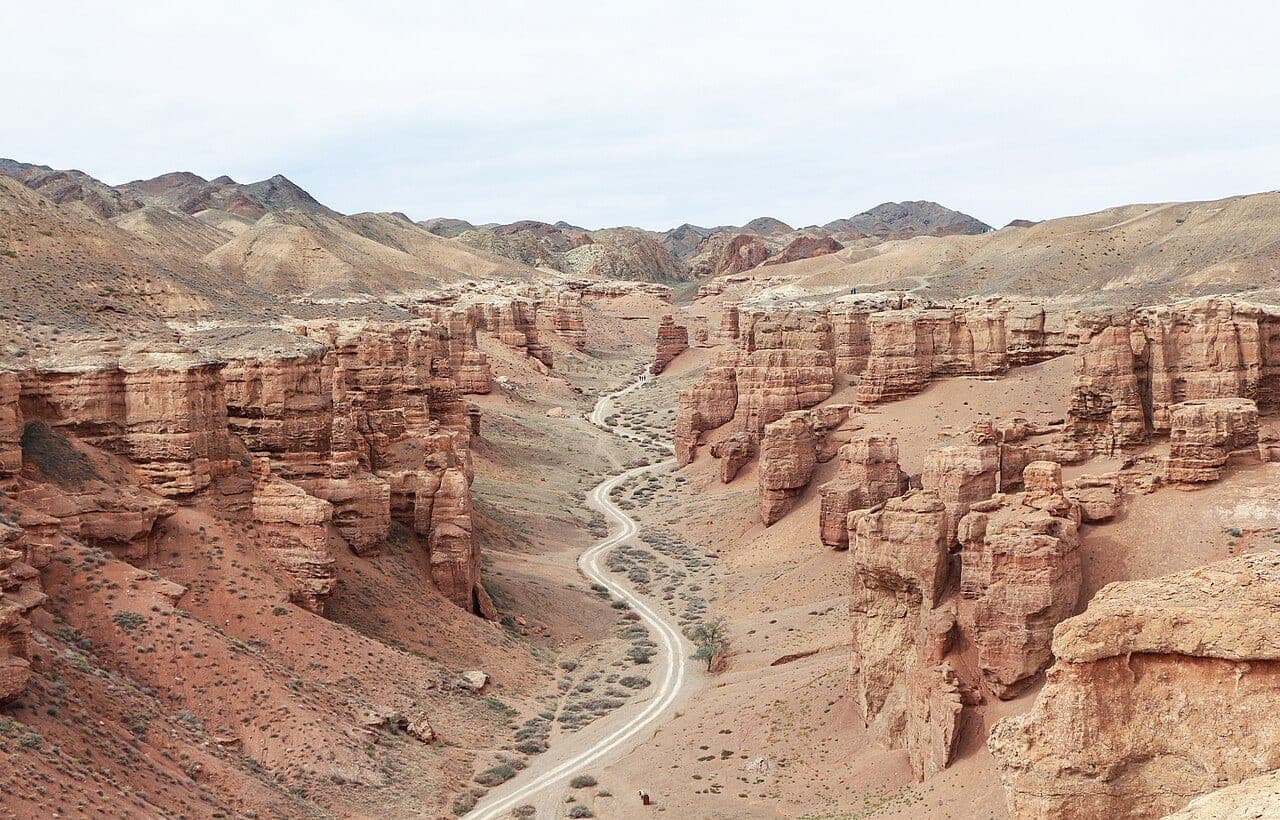
Kazakhstan is the ninth-largest country on earth and the largest without a coastline, a land roughly the size of Western Europe carrying fewer than 21 million people across the open Eurasian steppe. For most of recorded history that steppe belonged to people who did not raise cities to be remembered by; the Kazakhs and the nomads before them measured a life in herds, songs and the graves left on the high ground, and carried their heritage on horseback rather than in walls. The result is a memory culture that lives in the mouth and the hand: in the two strings of the dombra, in the improvised verse duel of the aitys, and in the kurgans that still stud the grasslands from the Altai to the Caspian.
It is also a country that has had to remember a hard century. Within living memory the steppe endured a famine that killed perhaps two Kazakhs in five, a nuclear test range that irradiated whole districts, and the draining of an inland sea; since independence in 1991 Kazakhstan has turned much of that grief into public memory. From the Sufi mausoleum that Timur raised at Turkestan to the cosmodrome from which the first human reached orbit, the country keeps a heritage that runs from the Bronze Age to the space age, and this guide follows it.
Kazakhstan covers about 2.7 million square kilometres, the ninth-largest area of any country and the biggest that is entirely landlocked. The land is mostly steppe and semi-desert, rising to the Tian Shan and Altai ranges in the south and east and falling to the Caspian shore in the west. Between these extremes lie the red walls of Charyn Canyon and the Kyzylkum desert, a country of long horizons in which distance has always shaped how people live.
The population is around 20 million, one of the most sparsely settled on earth. Kazakhs make up roughly 71 percent of it, with a Russian minority of about 14 percent and smaller Uzbek, Uyghur, Ukrainian, German, Tatar and Korean communities, many descended from peoples deported to the steppe under Stalin. The state language is Kazakh and Russian holds official status. The capital sits in the north at Astana, a purpose-built city on the Ishim River; the seat of government moved there from Almaty in 1997, was renamed Astana in 1998, briefly renamed Nur-Sultan in 2019 and restored to Astana in 2022. Kazakhstan is a republic and the largest economy in Central Asia, built on oil, gas, uranium and metals, a crossroads between Russia, China and the Turkic and Islamic worlds.
Almaty. The former capital and still the largest city, Almaty lies at the foot of the snow-capped Zailiysky Alatau, in mountains thought to be an ancestral home of the domestic apple, from which the city takes its name. Rebuilt after a devastating earthquake in 1911, it holds the wooden Ascension Cathedral and the Issyk mound nearby where the Golden Man was found.
Astana. Raised on the northern steppe over three decades, the capital is a showcase of contemporary architecture, from the Bayterek tower to the peaked Khan Shatyr. It houses the National Museum of the Republic of Kazakhstan, opened in 2014, the largest in Central Asia.
Turkestan. The spiritual heart of the Kazakh south, Turkestan grew from the medieval town of Yasi around the shrine of a revered Sufi teacher. Its Mausoleum of Khoja Ahmed Yasawi is the country's most important Islamic monument and its first World Heritage Site.
Shymkent. The third city, near the Uzbek border, Shymkent lies close to the Silk Road town of Sayram and the ruins of Otrar, the caravan city sacked in the opening act of the Mongol invasion.
Semey. Known for most of the twentieth century as Semipalatinsk, this eastern city on the Irtysh was a place of exile, where Dostoevsky served part of his sentence, and later gave its name to the Soviet nuclear test range outside it.
The Kazakh steppe's earliest fame belongs to the Saka, the eastern branch of the Scythians who dominated the Eurasian steppe from roughly 900 to 200 BC. These mounted warriors left thousands of kurgans, and in 1969 archaeologists led by Kimal Akishev opened one at Issyk near Almaty to find the Golden Man, a Saka noble buried around the fourth century BC in a costume of more than 4,000 gold pieces, the tall headdress crowned with winged beasts and snow leopards. It has since become an emblem of the nation.
From the sixth century the steppe belonged to a succession of Turkic khaganates, and the oasis towns of the south, Otrar, Sayram, Taraz and Yasi, became stations on the Silk Road, exchanging goods and faiths between China, Persia and the Mediterranean. In 1219 the armies of Genghis Khan swept through, and the region passed into the Mongol empire and its western successor, the Golden Horde. Out of the horde's decline the Kazakhs emerged as a distinct people: the Kazakh Khanate was founded around 1465 by the sultans Kerei and Zhanibek, who led their followers away to form a new polity. In time it divided into three federations, the Great, Middle and Little Hordes, or juzes, each with its own grazing lands and lineage.
Pressed by the Dzungars to the east, the hordes turned to the Russian Empire for protection in the eighteenth century; by the mid-nineteenth century the whole steppe was under Russian rule and Slavic settlers were arriving. Soviet power brought the deepest wounds. Forced collectivisation and the settling of nomads under the republic's leader Filipp Goloshchekin produced the Asharshylyk, the famine of 1930 to 1933, in which an estimated 1.5 million people died, between 38 and 42 percent of all Kazakhs, the highest proportional loss of any people in the Soviet famines; historians continue to debate whether it should be classed as genocide. From 1949 the Soviet military used the steppe near Semipalatinsk to detonate nuclear weapons, carrying out more than 450 tests until 1989 and exposing hundreds of thousands of residents to fallout. Kazakhstan declared independence on 16 December 1991, the last Soviet republic to do so.
Kazakh is a Turkic language of the Kipchak branch, close to Kyrgyz and Nogai. Dense with the vocabulary of horses, herds and kinship, its oral poetry sustained a literature for centuries before much of it was written down. Russian remains widely spoken as a second language and the medium of much administration and business, a legacy of two centuries of Russian and Soviet rule. Kazakh was written in Arabic, then Latin, then Cyrillic script during the twentieth century, and the country is now carrying out a gradual transition back to a Latin alphabet, a change bound up with national identity.
The country's name joins two elements. The first, qazaq, is an old Turkic word meaning roughly "free person" or "wanderer", one who has broken away to live on the open steppe, as the followers of Kerei and Zhanibek did in the fifteenth century. The Persian suffix -stan means "land of", so Kazakhstan reads as the land of the free wanderers, a fitting name for a nation whose identity was formed in movement.
Kazakh culture is that of the nomad, shaped by centuries of moving the herds between summer and winter pastures. Its architecture is the yurt, the round felt-covered dwelling whose lattice walls and domed frame can be packed onto camels and rebuilt in an afternoon; its crown, the shanyrak, appears on the national coat of arms, and the knowledge of making a Kazakh yurt is inscribed on UNESCO's intangible heritage list. Around it grew the crafts of a mobile people: patterned felt shyrdaqs, woven bands and the heavy silver jewellery of steppe women.
 The Tamgaly gorge holds some five thousand carvings made over three thousand years by people who kept returning to the same rocks. Photograph by Ninaras, CC BY-SA 4.0, via Wikimedia Commons.
Music carries the deepest identity. The dombra, a two-stringed lute, is often called the soul of the Kazakhs, and its solo pieces, the kuy, each tell a story without words; the art of the dombra kuy joined the UNESCO list in 2014. Alongside it stands the aitys, a contest in which two poets improvise verse to the dombra's accompaniment, recognised in 2015. On horseback the steppe keeps berkutchi, hunting with golden eagles trained to take foxes and hares, part of the falconry tradition UNESCO listed in 2021. The table is nomadic too: the national dish, beshbarmak, is boiled horse or lamb served over wide noodles and eaten with the hands, its name meaning "five fingers", washed down with kumis, fermented mare's milk. The old solar new year, Nauryz, celebrated at the spring equinox, remains the greatest festival of the year.
Most Kazakhs are Muslims, following the Hanafi school of Sunni Islam, which reached the steppe along the Silk Road and spread under the influence of Sufi teachers such as Khoja Ahmed Yasawi. About 70 percent of the population is Muslim and around 17 percent Christian, the latter mostly Russian Orthodox, whose cathedrals are landmarks in the northern cities. Kazakh Islam has long been comparatively relaxed, a faith of the herder and the shrine rather than the strict madrasa.
Beneath it lies the older spirituality of the steppe, Tengrism, the worship of Tengri the sky god together with the earth-mother Umai and the spirits of ancestors, mountains and rivers. Though no longer an organised religion, its habits survive in daily life: reverence for the open sky, the honour paid to the aruaqtar, the spirits of the ancestors, and the shamanic memory carried in the kobyz, the bowed instrument linked to the legendary bard Korkyt Ata. Catholicism, Lutheranism brought by German deportees, Judaism and Buddhism are also present, and the capital hosts a recurring Congress of Leaders of World and Traditional Religions.
Kazakh mourning weaves Islamic practice together with the customs of the steppe. When a death occurs the body is washed, wrapped in white cloth and buried quickly, usually within a day, after the zhanaza, the Islamic funeral prayer, with the grave oriented toward Mecca. In the old custom the widow and kinswomen would raise the zhoqtau, a keening lament for the dead. Remembrance then follows a long calendar shared across the Turkic and Islamic worlds: memorial meals are held on the third, seventh and fortieth days after death, and again at one year, the fortieth day, the qyrqy, marking when the soul is felt to depart, and the year's-end as gathering the community for a large feast that affirms the family's standing.
The Tamgaly gorge holds some five thousand carvings made over three thousand years by people who kept returning to the same rocks. Photograph by Ninaras, CC BY-SA 4.0, via Wikimedia Commons.
Music carries the deepest identity. The dombra, a two-stringed lute, is often called the soul of the Kazakhs, and its solo pieces, the kuy, each tell a story without words; the art of the dombra kuy joined the UNESCO list in 2014. Alongside it stands the aitys, a contest in which two poets improvise verse to the dombra's accompaniment, recognised in 2015. On horseback the steppe keeps berkutchi, hunting with golden eagles trained to take foxes and hares, part of the falconry tradition UNESCO listed in 2021. The table is nomadic too: the national dish, beshbarmak, is boiled horse or lamb served over wide noodles and eaten with the hands, its name meaning "five fingers", washed down with kumis, fermented mare's milk. The old solar new year, Nauryz, celebrated at the spring equinox, remains the greatest festival of the year.
Most Kazakhs are Muslims, following the Hanafi school of Sunni Islam, which reached the steppe along the Silk Road and spread under the influence of Sufi teachers such as Khoja Ahmed Yasawi. About 70 percent of the population is Muslim and around 17 percent Christian, the latter mostly Russian Orthodox, whose cathedrals are landmarks in the northern cities. Kazakh Islam has long been comparatively relaxed, a faith of the herder and the shrine rather than the strict madrasa.
Beneath it lies the older spirituality of the steppe, Tengrism, the worship of Tengri the sky god together with the earth-mother Umai and the spirits of ancestors, mountains and rivers. Though no longer an organised religion, its habits survive in daily life: reverence for the open sky, the honour paid to the aruaqtar, the spirits of the ancestors, and the shamanic memory carried in the kobyz, the bowed instrument linked to the legendary bard Korkyt Ata. Catholicism, Lutheranism brought by German deportees, Judaism and Buddhism are also present, and the capital hosts a recurring Congress of Leaders of World and Traditional Religions.
Kazakh mourning weaves Islamic practice together with the customs of the steppe. When a death occurs the body is washed, wrapped in white cloth and buried quickly, usually within a day, after the zhanaza, the Islamic funeral prayer, with the grave oriented toward Mecca. In the old custom the widow and kinswomen would raise the zhoqtau, a keening lament for the dead. Remembrance then follows a long calendar shared across the Turkic and Islamic worlds: memorial meals are held on the third, seventh and fortieth days after death, and again at one year, the fortieth day, the qyrqy, marking when the soul is felt to depart, and the year's-end as gathering the community for a large feast that affirms the family's standing.
 Timur ordered this mausoleum built over the grave of a Sufi poet, and work stopped when Timur died, so the entrance still stands unfinished with the scaffolding beams in place. Photograph by Petar Milosevic, CC BY-SA 4.0, via Wikimedia Commons.
The steppe has always marked its dead on the land: kurgans covered the Saka nobility, and later Kazakhs raised domed brick mausoleums that became places of pilgrimage. The shrine of Khoja Ahmed Yasawi at Turkestan draws visitors from across Central Asia, as do the twelfth-century tomb of Aisha Bibi near Taraz and the underground mosque of Beket-Ata on the Mangystau plateau. Modern Kazakhstan has also built memory for its twentieth-century wounds: monuments to the victims of the Asharshylyk stand in Almaty and Astana, marking a loss long unspoken under Soviet rule, and the ALZHIR museum, on the site of a camp near the capital that held the wives of men condemned as "traitors to the motherland", preserves the memory of Stalinist repression. The nuclear test range near Semey is remembered each year.
Kazakh genealogy is called shezhire, and every Kazakh is expected to know theirs to seven generations.
The system is precise and it is structural: a person belongs to a ru, a clan, which belongs to a larger grouping, which belongs to one of the three zhuz, the hordes of the Kazakh steppe. Knowing your seven fathers, the zheti ata, was a practical requirement rather than a sentiment, because marriage within seven generations was forbidden. Shezhire was carried orally and written down in the nineteenth and twentieth centuries, and it survived the Soviet period partly because it did not need to be filed anywhere.
The written record is Russian and Soviet. Imperial administration produced tax and household lists for the steppe from the nineteenth century, and Soviet ZAGS registration covers births, marriages and deaths from the 1920s. The archives are in Almaty and Astana.
Two Soviet catastrophes are the reason so many Kazakh families have gaps. The famine of the early 1930s, caused by forced collectivisation and the destruction of nomadic pastoralism, killed something between a quarter and a third of the Kazakh population. And Kazakhstan was where the Soviet Union sent people: deported Volga Germans, Chechens, Ingush, Koreans, Crimean Tatars and Poles, along with the Gulag camps and ALZHIR, the camp for the wives of men declared enemies of the people. The deportation and camp lists in the archives are, for a great many families across the former Soviet Union, the document that says where their grandmother went.
Kazakhstan has five UNESCO World Heritage Sites. The first, inscribed in 2003, is the Mausoleum of Khoja Ahmed Yasawi, the shrine Timur ordered built at Turkestan around 1389 to honour the twelfth-century Sufi poet; left unfinished at his death in 1405, it preserves the largest surviving brick dome in Central Asia and methods later echoed in Mughal architecture, including the Taj Mahal. The petroglyphs of the Tanbaly, or Tamgaly, landscape, inscribed in 2004, gather some 5,000 rock carvings made from the Bronze Age onward north-west of Almaty. The natural site of Saryarka, the Steppe and Lakes of Northern Kazakhstan, was added in 2008 for its wetlands and bird migration routes, and the Western Tian Shan followed in 2016. In 2014 eight Kazakh sites joined the transnational Silk Roads: Chang'an-Tianshan Corridor, shared with China and Kyrgyzstan.
Beyond the international lists, the state has invested in its own heritage. The Madeni Mura, or Cultural Heritage, programme launched in 2004 funded archaeology, restoration and the publication of hundreds of volumes of Kazakh history and literature. The National Museum of the Republic of Kazakhstan, opened in Astana in 2014, gathered the Golden Man, ethnographic collections and modern galleries under one roof, while regional museums keep the memory of their districts.
Kazakhstan has moved much of its record online. The state history portal e-history.kz publishes archival documents, scholarship and teaching material on the country's past in Kazakh, Russian and English. National archives and libraries have digitised manuscripts, photographs and the papers of the Soviet period, including files on the famine and the repressions, so that families can trace names once erased from the record.
The digital turn is bound up with a broader modernisation programme, Rukhani Zhangyru, launched in 2017, which set out to digitise Kazakh heritage, translate a hundred key works into Kazakh, and map historic sites through a "Sacred Geography" project. Museums have followed with online collections and virtual tours, and the memory of the nuclear test range and the famine is increasingly preserved in searchable form for generations who will not meet the survivors.
Modern Kazakh identity draws on a canon of nineteenth- and twentieth-century figures. The poet Abai Kunanbayuly, whose bicentenary was marked in 2020, is honoured as the father of written Kazakh literature, and the novelist Mukhtar Auezov gave the nation its great epic in his life of Abai. Since independence the country has reached wider audiences: the films "Tulpan", "Nomad" and "Mongol" carried the steppe to festival screens, and the singer Dimash Kudaibergen has built a large international following.
Independence also brought a homecoming. Under a state repatriation policy, more than a million ethnic Kazakhs, the qandas or oralman, have returned from Mongolia, China, Uzbekistan and beyond, bringing older forms of language and custom home. The revival of Nauryz, the spread of the dombra and aitys, and the return of Kazakh names, dress and cuisine have followed the recovery of a heritage Soviet policy had pushed to the margins. Baikonur, meanwhile, keeps Kazakhstan at the frontier of the space age; the cosmodrome from which Sputnik launched in 1957 and Yuri Gagarin reached orbit in 1961 remains in use under a Russian lease running to 2050.
The sea that came back. After Soviet irrigation shrank the Aral Sea by more than 90 percent, Kazakhstan built the Kokaral Dam in 2005 to save the northern basin; water levels and fish stocks have since recovered, and further works aim to enlarge the North Aral through the late 2020s.
A test range closed. On 29 August 1991 the government shut the Semipalatinsk range for good, and independent Kazakhstan gave up the nuclear arsenal it had inherited. At its initiative the United Nations later made 29 August the International Day against Nuclear Tests.
The Golden Man reclaimed. The Saka warrior found at Issyk in 1969 has become a symbol of the nation, its image on monuments and emblems and its treasures displayed in the National Museum, a link between the modern republic and the steppe cultures of the deep past.
A shrine restored. The Mausoleum of Khoja Ahmed Yasawi has been conserved and made the centre of a renewed pilgrimage city at Turkestan, and the wider Madeni Mura programme has rebuilt and documented monuments across the country.
A heritage brought home. The return of more than a million diaspora Kazakhs, the revival of Nauryz and the aitys, and the recovery of the Kazakh language and its literature have carried a nomadic inheritance from the edge of memory back into daily life.
Timur ordered this mausoleum built over the grave of a Sufi poet, and work stopped when Timur died, so the entrance still stands unfinished with the scaffolding beams in place. Photograph by Petar Milosevic, CC BY-SA 4.0, via Wikimedia Commons.
The steppe has always marked its dead on the land: kurgans covered the Saka nobility, and later Kazakhs raised domed brick mausoleums that became places of pilgrimage. The shrine of Khoja Ahmed Yasawi at Turkestan draws visitors from across Central Asia, as do the twelfth-century tomb of Aisha Bibi near Taraz and the underground mosque of Beket-Ata on the Mangystau plateau. Modern Kazakhstan has also built memory for its twentieth-century wounds: monuments to the victims of the Asharshylyk stand in Almaty and Astana, marking a loss long unspoken under Soviet rule, and the ALZHIR museum, on the site of a camp near the capital that held the wives of men condemned as "traitors to the motherland", preserves the memory of Stalinist repression. The nuclear test range near Semey is remembered each year.
Kazakh genealogy is called shezhire, and every Kazakh is expected to know theirs to seven generations.
The system is precise and it is structural: a person belongs to a ru, a clan, which belongs to a larger grouping, which belongs to one of the three zhuz, the hordes of the Kazakh steppe. Knowing your seven fathers, the zheti ata, was a practical requirement rather than a sentiment, because marriage within seven generations was forbidden. Shezhire was carried orally and written down in the nineteenth and twentieth centuries, and it survived the Soviet period partly because it did not need to be filed anywhere.
The written record is Russian and Soviet. Imperial administration produced tax and household lists for the steppe from the nineteenth century, and Soviet ZAGS registration covers births, marriages and deaths from the 1920s. The archives are in Almaty and Astana.
Two Soviet catastrophes are the reason so many Kazakh families have gaps. The famine of the early 1930s, caused by forced collectivisation and the destruction of nomadic pastoralism, killed something between a quarter and a third of the Kazakh population. And Kazakhstan was where the Soviet Union sent people: deported Volga Germans, Chechens, Ingush, Koreans, Crimean Tatars and Poles, along with the Gulag camps and ALZHIR, the camp for the wives of men declared enemies of the people. The deportation and camp lists in the archives are, for a great many families across the former Soviet Union, the document that says where their grandmother went.
Kazakhstan has five UNESCO World Heritage Sites. The first, inscribed in 2003, is the Mausoleum of Khoja Ahmed Yasawi, the shrine Timur ordered built at Turkestan around 1389 to honour the twelfth-century Sufi poet; left unfinished at his death in 1405, it preserves the largest surviving brick dome in Central Asia and methods later echoed in Mughal architecture, including the Taj Mahal. The petroglyphs of the Tanbaly, or Tamgaly, landscape, inscribed in 2004, gather some 5,000 rock carvings made from the Bronze Age onward north-west of Almaty. The natural site of Saryarka, the Steppe and Lakes of Northern Kazakhstan, was added in 2008 for its wetlands and bird migration routes, and the Western Tian Shan followed in 2016. In 2014 eight Kazakh sites joined the transnational Silk Roads: Chang'an-Tianshan Corridor, shared with China and Kyrgyzstan.
Beyond the international lists, the state has invested in its own heritage. The Madeni Mura, or Cultural Heritage, programme launched in 2004 funded archaeology, restoration and the publication of hundreds of volumes of Kazakh history and literature. The National Museum of the Republic of Kazakhstan, opened in Astana in 2014, gathered the Golden Man, ethnographic collections and modern galleries under one roof, while regional museums keep the memory of their districts.
Kazakhstan has moved much of its record online. The state history portal e-history.kz publishes archival documents, scholarship and teaching material on the country's past in Kazakh, Russian and English. National archives and libraries have digitised manuscripts, photographs and the papers of the Soviet period, including files on the famine and the repressions, so that families can trace names once erased from the record.
The digital turn is bound up with a broader modernisation programme, Rukhani Zhangyru, launched in 2017, which set out to digitise Kazakh heritage, translate a hundred key works into Kazakh, and map historic sites through a "Sacred Geography" project. Museums have followed with online collections and virtual tours, and the memory of the nuclear test range and the famine is increasingly preserved in searchable form for generations who will not meet the survivors.
Modern Kazakh identity draws on a canon of nineteenth- and twentieth-century figures. The poet Abai Kunanbayuly, whose bicentenary was marked in 2020, is honoured as the father of written Kazakh literature, and the novelist Mukhtar Auezov gave the nation its great epic in his life of Abai. Since independence the country has reached wider audiences: the films "Tulpan", "Nomad" and "Mongol" carried the steppe to festival screens, and the singer Dimash Kudaibergen has built a large international following.
Independence also brought a homecoming. Under a state repatriation policy, more than a million ethnic Kazakhs, the qandas or oralman, have returned from Mongolia, China, Uzbekistan and beyond, bringing older forms of language and custom home. The revival of Nauryz, the spread of the dombra and aitys, and the return of Kazakh names, dress and cuisine have followed the recovery of a heritage Soviet policy had pushed to the margins. Baikonur, meanwhile, keeps Kazakhstan at the frontier of the space age; the cosmodrome from which Sputnik launched in 1957 and Yuri Gagarin reached orbit in 1961 remains in use under a Russian lease running to 2050.
The sea that came back. After Soviet irrigation shrank the Aral Sea by more than 90 percent, Kazakhstan built the Kokaral Dam in 2005 to save the northern basin; water levels and fish stocks have since recovered, and further works aim to enlarge the North Aral through the late 2020s.
A test range closed. On 29 August 1991 the government shut the Semipalatinsk range for good, and independent Kazakhstan gave up the nuclear arsenal it had inherited. At its initiative the United Nations later made 29 August the International Day against Nuclear Tests.
The Golden Man reclaimed. The Saka warrior found at Issyk in 1969 has become a symbol of the nation, its image on monuments and emblems and its treasures displayed in the National Museum, a link between the modern republic and the steppe cultures of the deep past.
A shrine restored. The Mausoleum of Khoja Ahmed Yasawi has been conserved and made the centre of a renewed pilgrimage city at Turkestan, and the wider Madeni Mura programme has rebuilt and documented monuments across the country.
A heritage brought home. The return of more than a million diaspora Kazakhs, the revival of Nauryz and the aitys, and the recovery of the Kazakh language and its literature have carried a nomadic inheritance from the edge of memory back into daily life.
National Overview
Notable Cities
Historical Foundations
Linguistic and Etymological Roots
Cultural Identity
Religion and Spirituality
Remembrance and Mourning Traditions
Tracing a Family in Kazakhstan
Heritage Preservation Efforts
Digital Heritage
Contemporary Cultural Influences
Success Stories
References and resources
- UNESCO World Heritage Centre: Kazakhstan. The country's five World Heritage sites, from Turkestan to the Silk Roads corridor.
- UNESCO Intangible Cultural Heritage: Kazakhstan. Yurt-making, dombra kuy, aitys, falconry and more.
- UNESCO: Mausoleum of Khoja Ahmed Yasawi. The Timurid shrine at Turkestan and its architecture.
- Wikipedia: Kazakhstan. Geography, population, government and national symbols.
- Wikipedia: Kazakh famine of 1930–1933. The Asharshylyk, its causes and death toll.
- Nuclear Threat Initiative: Semipalatinsk Test Site. The Soviet nuclear range and its closure.
- Nuclear Threat Initiative: Baikonur Cosmodrome. The first spaceport and its history.
- Wikipedia: Issyk kurgan and the Golden Man. The Saka burial and its treasures.
- Global Voices: How Kazakhstan resurrected the North Aral Sea. The Kokaral Dam and the sea's recovery.
- Qazaqstan Tarihy (e-history.kz). The national history portal, archives and scholarship.