Heritage · Country
Sweden Culture and Heritage
On the first Saturday of November, Swedes carry candles into the cemeteries and thousands of small flames burn in the dark, in one of Europe's most secular countries. A guide to Sweden's heritage and to how the Swedes record, mourn and remember their dead, from Viking runestones to the digitised parish book.Written to last.
By Confinity Heritage Editorial · 2026-07-11 · 8-minute readQuiet tools, kept out of the way.
On All Saints' weekend, held on the Saturday between 31 October and 6 November, Swedes go to the graveyards after dark and light candles. The custom is barely a century old, spread across the country only after the Second World War, yet it has become one of the most widely observed rituals in a nation that is otherwise among the least churchgoing on earth. The graveside lights burn in special lidded holders so the wind cannot put them out, and on that one night the cemeteries of Stockholm, Gothenburg and the smallest rural parish fill with tens of thousands of flames, laid on family graves and around the memorial groves where cremated ashes are scattered without a name.
Sweden also carries memory in stone. Scattered across the countryside, in fields, beside roads and built into church walls, stand roughly 2,500 runestones, most raised in the eleventh century by Vikings to commemorate their dead: "Björn had this stone raised in memory of his father." They are the oldest surviving Swedish sentences, and they say almost exactly what a modern headstone says. From those carved memorials to the parish registers that clergymen were ordered to keep from the seventeenth century, to the world's oldest continuous population statistics, Sweden has spent a very long time writing down who lived and who died.
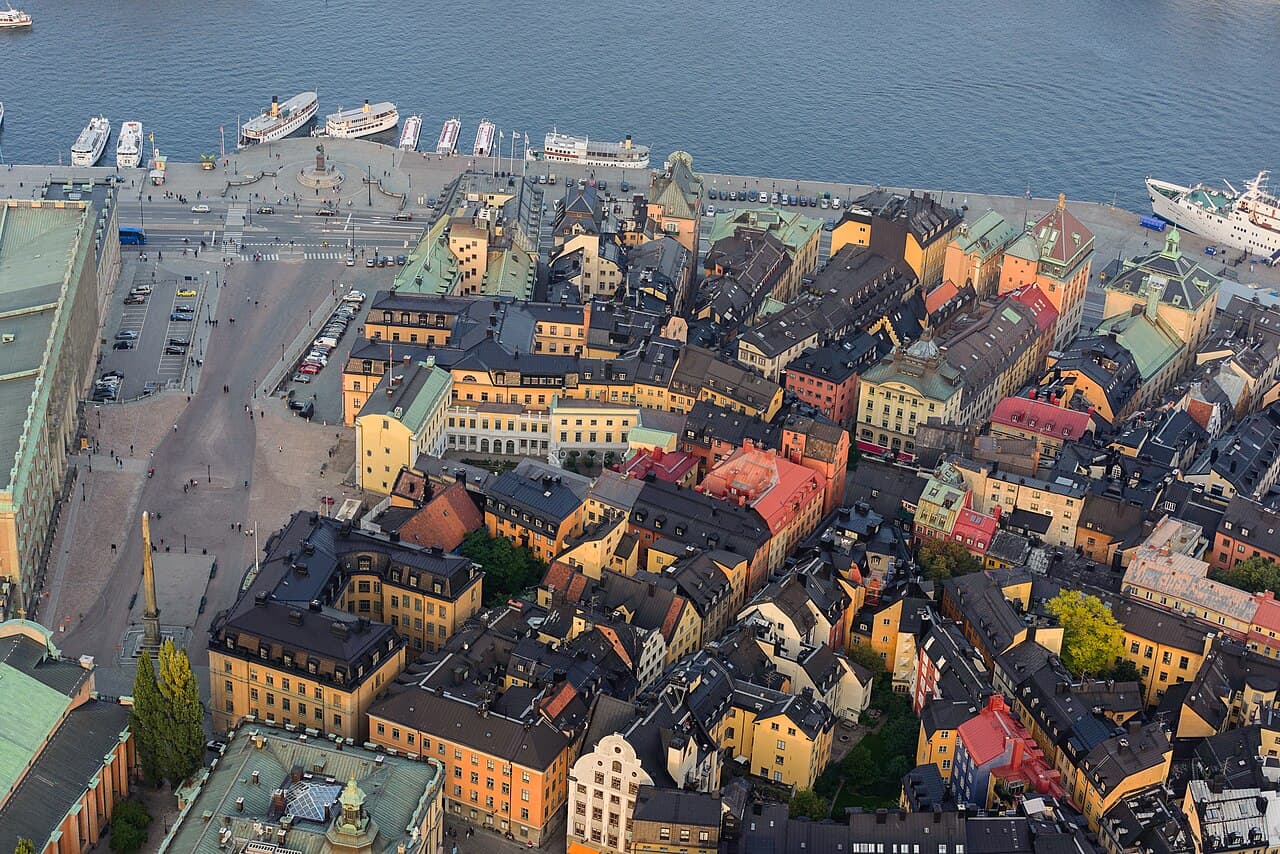
 Stockholm City Hall, completed in 1923, where the Nobel Prize banquet is held each December in the Blue Hall. CC BY 4.0, via Wikimedia Commons.
Sweden is a long country, stretching some 1,600 kilometres from the beech woods and open farmland of Skåne in the south to the Arctic fells of Lapland, where the sun does not set in high summer and barely rises in midwinter. It covers about 450,000 square kilometres, which makes it the largest state in the European Union after France and Spain, yet only around 10.5 million people live in it. Forest covers roughly two-thirds of the land, there are close to 100,000 lakes, and the Baltic coast dissolves into archipelagos of tens of thousands of islands. The highest point, Kebnekaise, reaches just over 2,000 metres in the far north, in the homeland of the Sami, the indigenous reindeer-herding people whose territory of Sápmi spreads across the top of Norway, Sweden, Finland and Russia.
Sweden is a constitutional monarchy with a ceremonial king, Carl XVI Gustaf, who came to the throne in 1973, and a single-chamber parliament, the Riksdag, that has governed a famously comprehensive welfare state, the folkhem or "people's home", since the mid-twentieth century. The population is concentrated in the south, around Stockholm, Gothenburg and Malmö, and has been reshaped by immigration: a country that was strikingly homogeneous into the 1960s now has roughly a fifth of its residents born abroad, many from Finland, the former Yugoslavia, the Middle East and the Horn of Africa. Neutral in both world wars and formally non-aligned for two centuries, Sweden made a historic break in 2024 when it joined NATO, ending the policy that had defined its place in the world since 1814.
Stockholm. The capital sits where Lake Mälaren meets the Baltic, spread across fourteen islands joined by more than fifty bridges. It grew from a fortified trading post founded around 1252 and traditionally credited to the regent Birger Jarl, and its medieval core, Gamla Stan, still crowds around the Royal Palace and the narrow lane of Mårten Trotzigs gränd. Stockholm holds an extraordinary density of memory institutions: Skansen, the world's first open-air museum, opened in 1891; the Vasa Museum, built around a single salvaged warship; the Nordic Museum of Swedish life; and, on the southern edge of the city, the Woodland Cemetery, a UNESCO World Heritage Site.
Gothenburg. Sweden's second city and great port was founded in 1621 by King Gustav II Adolf and laid out by Dutch engineers, which is why canals still run through its centre. It made its early fortune through the Swedish East India Company, whose ships sailed to Canton, and its later one through Volvo and shipbuilding. Its fish market, the "Feskekôrka" or fish church, and its seafood traditions speak to a working maritime culture, and the Museum of Gothenburg occupies the old East India Company house.
Malmö. Facing Denmark across the narrow Øresund, Malmö was Danish until 1658 and has always looked outward. Since the Øresund Bridge opened in 2000 it has been physically joined to Copenhagen, and it is now one of Sweden's most diverse cities, with a large immigrant population, the medieval castle of Malmöhus and a skyline marked by the Turning Torso tower.
Uppsala. North of Stockholm lies the country's ancient religious capital. Uppsala Cathedral, consecrated in 1435, is the tallest church building in the Nordic countries and the seat of the Archbishop of the Church of Sweden; the university, founded in 1477, is the oldest in Scandinavia and was the home of the botanist Carl Linnaeus. A few kilometres north stand the great pagan burial mounds of Gamla Uppsala, the seat of kings and, according to the medieval chronicler Adam of Bremen, of a temple where sacrifices were once made.
Visby. On the Baltic island of Gotland, Visby is one of the best-preserved medieval towns in northern Europe, ringed by a three-and-a-half kilometre limestone wall studded with towers and full of ruined Hanseatic churches. Inscribed by UNESCO in 1995, it fills each August with the costumed crowds of Medieval Week.
Kiruna. The northernmost town of any size, Kiruna exists because of the iron ore beneath it, and that ore is now forcing the whole town to move: as the mine expands and the ground subsides, homes, monuments and, in August 2025, the beloved wooden church have been relocated eastward, in one of the strangest heritage projects anywhere.
The land was settled as the ice retreated after the last glaciation, and the Bronze Age left the astonishing rock carvings of Tanum in the west, thousands of images of ships, animals and warriors pecked into the granite around 1000 BC and now a World Heritage Site. But it is the Viking Age, roughly 793 to 1066, that shaped the popular idea of Sweden. From the trading town of Birka on an island in Lake Mälaren, Swedish Norsemen turned east rather than west, following the great rivers of Russia down to Constantinople and the Caliphate; the Slavic word "Rus", and so the name of Russia, may derive from these Swedish traders and raiders. Christianity arrived slowly, and the country was not fully converted until the twelfth century, later than most of Europe.
Medieval Sweden was joined to Denmark and Norway in the Kalmar Union of 1397, but the union fractured in blood: the Stockholm Bloodbath of 1520, when the Danish king executed scores of Swedish nobles, provoked the rebellion that brought Gustav Vasa to the throne in 1523 and made Sweden an independent kingdom again. Gustav Vasa also broke with Rome and turned the country Lutheran, seizing church lands in the process. In the seventeenth century Sweden became briefly a great power: under Gustavus Adolphus it intervened decisively in the Thirty Years' War and built a Baltic empire reaching into modern Germany, the Baltic states and Finland. That era ended at Poltava in 1709, where Charles XII's army was destroyed by Russia, and by 1721 the empire was gone. Sweden lost Finland to Russia in 1809, and in 1810 the royal line was replaced, remarkably, by one of Napoleon's marshals, Jean-Baptiste Bernadotte, whose descendants reign today.
Stockholm City Hall, completed in 1923, where the Nobel Prize banquet is held each December in the Blue Hall. CC BY 4.0, via Wikimedia Commons.
Sweden is a long country, stretching some 1,600 kilometres from the beech woods and open farmland of Skåne in the south to the Arctic fells of Lapland, where the sun does not set in high summer and barely rises in midwinter. It covers about 450,000 square kilometres, which makes it the largest state in the European Union after France and Spain, yet only around 10.5 million people live in it. Forest covers roughly two-thirds of the land, there are close to 100,000 lakes, and the Baltic coast dissolves into archipelagos of tens of thousands of islands. The highest point, Kebnekaise, reaches just over 2,000 metres in the far north, in the homeland of the Sami, the indigenous reindeer-herding people whose territory of Sápmi spreads across the top of Norway, Sweden, Finland and Russia.
Sweden is a constitutional monarchy with a ceremonial king, Carl XVI Gustaf, who came to the throne in 1973, and a single-chamber parliament, the Riksdag, that has governed a famously comprehensive welfare state, the folkhem or "people's home", since the mid-twentieth century. The population is concentrated in the south, around Stockholm, Gothenburg and Malmö, and has been reshaped by immigration: a country that was strikingly homogeneous into the 1960s now has roughly a fifth of its residents born abroad, many from Finland, the former Yugoslavia, the Middle East and the Horn of Africa. Neutral in both world wars and formally non-aligned for two centuries, Sweden made a historic break in 2024 when it joined NATO, ending the policy that had defined its place in the world since 1814.
Stockholm. The capital sits where Lake Mälaren meets the Baltic, spread across fourteen islands joined by more than fifty bridges. It grew from a fortified trading post founded around 1252 and traditionally credited to the regent Birger Jarl, and its medieval core, Gamla Stan, still crowds around the Royal Palace and the narrow lane of Mårten Trotzigs gränd. Stockholm holds an extraordinary density of memory institutions: Skansen, the world's first open-air museum, opened in 1891; the Vasa Museum, built around a single salvaged warship; the Nordic Museum of Swedish life; and, on the southern edge of the city, the Woodland Cemetery, a UNESCO World Heritage Site.
Gothenburg. Sweden's second city and great port was founded in 1621 by King Gustav II Adolf and laid out by Dutch engineers, which is why canals still run through its centre. It made its early fortune through the Swedish East India Company, whose ships sailed to Canton, and its later one through Volvo and shipbuilding. Its fish market, the "Feskekôrka" or fish church, and its seafood traditions speak to a working maritime culture, and the Museum of Gothenburg occupies the old East India Company house.
Malmö. Facing Denmark across the narrow Øresund, Malmö was Danish until 1658 and has always looked outward. Since the Øresund Bridge opened in 2000 it has been physically joined to Copenhagen, and it is now one of Sweden's most diverse cities, with a large immigrant population, the medieval castle of Malmöhus and a skyline marked by the Turning Torso tower.
Uppsala. North of Stockholm lies the country's ancient religious capital. Uppsala Cathedral, consecrated in 1435, is the tallest church building in the Nordic countries and the seat of the Archbishop of the Church of Sweden; the university, founded in 1477, is the oldest in Scandinavia and was the home of the botanist Carl Linnaeus. A few kilometres north stand the great pagan burial mounds of Gamla Uppsala, the seat of kings and, according to the medieval chronicler Adam of Bremen, of a temple where sacrifices were once made.
Visby. On the Baltic island of Gotland, Visby is one of the best-preserved medieval towns in northern Europe, ringed by a three-and-a-half kilometre limestone wall studded with towers and full of ruined Hanseatic churches. Inscribed by UNESCO in 1995, it fills each August with the costumed crowds of Medieval Week.
Kiruna. The northernmost town of any size, Kiruna exists because of the iron ore beneath it, and that ore is now forcing the whole town to move: as the mine expands and the ground subsides, homes, monuments and, in August 2025, the beloved wooden church have been relocated eastward, in one of the strangest heritage projects anywhere.
The land was settled as the ice retreated after the last glaciation, and the Bronze Age left the astonishing rock carvings of Tanum in the west, thousands of images of ships, animals and warriors pecked into the granite around 1000 BC and now a World Heritage Site. But it is the Viking Age, roughly 793 to 1066, that shaped the popular idea of Sweden. From the trading town of Birka on an island in Lake Mälaren, Swedish Norsemen turned east rather than west, following the great rivers of Russia down to Constantinople and the Caliphate; the Slavic word "Rus", and so the name of Russia, may derive from these Swedish traders and raiders. Christianity arrived slowly, and the country was not fully converted until the twelfth century, later than most of Europe.
Medieval Sweden was joined to Denmark and Norway in the Kalmar Union of 1397, but the union fractured in blood: the Stockholm Bloodbath of 1520, when the Danish king executed scores of Swedish nobles, provoked the rebellion that brought Gustav Vasa to the throne in 1523 and made Sweden an independent kingdom again. Gustav Vasa also broke with Rome and turned the country Lutheran, seizing church lands in the process. In the seventeenth century Sweden became briefly a great power: under Gustavus Adolphus it intervened decisively in the Thirty Years' War and built a Baltic empire reaching into modern Germany, the Baltic states and Finland. That era ended at Poltava in 1709, where Charles XII's army was destroyed by Russia, and by 1721 the empire was gone. Sweden lost Finland to Russia in 1809, and in 1810 the royal line was replaced, remarkably, by one of Napoleon's marshals, Jean-Baptiste Bernadotte, whose descendants reign today.
 A steam tram on a Stockholm street in 1901, in the decades when poverty drove more than a million Swedes to emigrate. Public domain, via Wikimedia Commons.
From 1846 to 1930 poverty and famine drove roughly 1.3 million Swedes, a quarter of the population, to emigrate, most of them to the American Midwest, an exodus so large it left a permanent mark on both countries. The twentieth century then remade Sweden as a byword for social democracy, prosperity and neutrality, a small country with an outsize cultural and industrial reach. Its post-war confidence was shaken by two political killings that Swedes still discuss with a kind of national bruise: the unsolved assassination of Prime Minister Olof Palme, shot on a Stockholm street in 1986, and the murder of foreign minister Anna Lindh in 2003. Sweden joined the European Union in 1995 and NATO in 2024.
Swedish is a North Germanic language, descended, like Danish and Norwegian, from the Old Norse of the Viking Age, and the three remain close enough that their speakers can often understand one another. The name of the country, Sverige, comes from Svea rike, "the realm of the Svear", the tribe of central Sweden around Lake Mälaren whose name the whole nation eventually took; the English "Sweden" travelled in by way of Dutch and Low German. The oldest written Swedish is the runic inscriptions of the futhark alphabet, carved on those thousands of memorial stones, and the map of the country preserves layer upon layer of the past in its place-names: the "-by" and "-stad" of settlements, the "-berg" of hills, and older sacred names like Torslunda and Odensala that still carry the names of the pagan gods Thor and Odin.
Standard Swedish grew out of the central dialects and was fixed by the Reformation, above all by the Gustav Vasa Bible of 1541, the first complete translation into the language. Strong regional dialects survive, from the sing-song of Gotland to the almost unintelligible speech of parts of Dalarna, and the far south of Skåne keeps a soft, guttural accent that betrays its centuries under Denmark. Sweden also recognises five official national minority languages, each tied to a historic community: Finnish, Meänkieli (the Finnish variety of the Torne Valley), Yiddish, Romani and Sami. The Sami languages, several of them spoken by only a few hundred people, are the most endangered, and their revival, through schools, media and place-name signage across the north, is one of the country's live cultural projects.
Everyday Swedish life runs on a few strong institutions. The fika, a pause for coffee and something sweet, is close to a national sacrament, and Swedes are among the world's heaviest coffee drinkers. The allemansrätten, the right of public access, lets anyone walk, camp and pick berries across private land, an old freedom that shapes the country's deep attachment to nature. Lagom, the untranslatable ideal of "just the right amount", is invoked as a national temperament, half praised and half mocked. The calendar is marked by Midsummer, celebrated near the solstice with a flower-decked maypole, dancing, pickled herring, new potatoes and, for many, a good deal of aquavit; by the crayfish parties of late summer; and by Saint Lucia on 13 December, when a girl in a crown of candles leads a procession of song through the winter dark.
A steam tram on a Stockholm street in 1901, in the decades when poverty drove more than a million Swedes to emigrate. Public domain, via Wikimedia Commons.
From 1846 to 1930 poverty and famine drove roughly 1.3 million Swedes, a quarter of the population, to emigrate, most of them to the American Midwest, an exodus so large it left a permanent mark on both countries. The twentieth century then remade Sweden as a byword for social democracy, prosperity and neutrality, a small country with an outsize cultural and industrial reach. Its post-war confidence was shaken by two political killings that Swedes still discuss with a kind of national bruise: the unsolved assassination of Prime Minister Olof Palme, shot on a Stockholm street in 1986, and the murder of foreign minister Anna Lindh in 2003. Sweden joined the European Union in 1995 and NATO in 2024.
Swedish is a North Germanic language, descended, like Danish and Norwegian, from the Old Norse of the Viking Age, and the three remain close enough that their speakers can often understand one another. The name of the country, Sverige, comes from Svea rike, "the realm of the Svear", the tribe of central Sweden around Lake Mälaren whose name the whole nation eventually took; the English "Sweden" travelled in by way of Dutch and Low German. The oldest written Swedish is the runic inscriptions of the futhark alphabet, carved on those thousands of memorial stones, and the map of the country preserves layer upon layer of the past in its place-names: the "-by" and "-stad" of settlements, the "-berg" of hills, and older sacred names like Torslunda and Odensala that still carry the names of the pagan gods Thor and Odin.
Standard Swedish grew out of the central dialects and was fixed by the Reformation, above all by the Gustav Vasa Bible of 1541, the first complete translation into the language. Strong regional dialects survive, from the sing-song of Gotland to the almost unintelligible speech of parts of Dalarna, and the far south of Skåne keeps a soft, guttural accent that betrays its centuries under Denmark. Sweden also recognises five official national minority languages, each tied to a historic community: Finnish, Meänkieli (the Finnish variety of the Torne Valley), Yiddish, Romani and Sami. The Sami languages, several of them spoken by only a few hundred people, are the most endangered, and their revival, through schools, media and place-name signage across the north, is one of the country's live cultural projects.
Everyday Swedish life runs on a few strong institutions. The fika, a pause for coffee and something sweet, is close to a national sacrament, and Swedes are among the world's heaviest coffee drinkers. The allemansrätten, the right of public access, lets anyone walk, camp and pick berries across private land, an old freedom that shapes the country's deep attachment to nature. Lagom, the untranslatable ideal of "just the right amount", is invoked as a national temperament, half praised and half mocked. The calendar is marked by Midsummer, celebrated near the solstice with a flower-decked maypole, dancing, pickled herring, new potatoes and, for many, a good deal of aquavit; by the crayfish parties of late summer; and by Saint Lucia on 13 December, when a girl in a crown of candles leads a procession of song through the winter dark.
 "Midsommardans" (Midsummer Dance) by Anders Zorn, 1897, in the Nationalmuseum, Stockholm. Public domain, via Wikimedia Commons.
The country's folk culture is bound up with the province of Dalarna, source of the red-painted Falu cottage, the carved and painted Dala horse, and the imagery that Anders Zorn and Carl Larsson turned into the visual idea of Sweden around 1900. That inheritance sits alongside one of the most successful cultural export machines in the world. Astrid Lindgren's Pippi Longstocking and Ingmar Bergman's films gave the country a literary and cinematic voice; ABBA, and later the songwriters and producers led by Max Martin, made Sweden a pop-music superpower far out of proportion to its size; and Nordic crime fiction, from Henning Mankell to Stieg Larsson, exported a darker self-image. Design and engineering do the same work, from IKEA to Volvo, while ice hockey, football and the figure of Zlatan Ibrahimović carry the national mood in sport.
Before Christianity, the peoples of Sweden worshipped the Norse gods, and Gamla Uppsala was one of the last great centres of that religion; Adam of Bremen described a temple there, hung with gold, where animals and men were said to be sacrificed every ninth year. The Sami of the north kept their own animist tradition, with sacred sites, drums and ritual specialists, the noaidi, long after the south had converted, and it was suppressed as heathen witchcraft well into the eighteenth century. Christianity, once established, ran through the Catholic Middle Ages until Gustav Vasa's Reformation in the 1530s made the Church of Sweden Lutheran and tied it tightly to the crown.
For centuries the Lutheran church was the state church, and membership was effectively universal and compulsory; the parish was the basic unit of local government, and the clergy kept the population records. That bond loosened over the twentieth century and was formally cut in the year 2000, when church and state were separated. Sweden is now often described as one of the most secular societies in the world, and by measures of active belief it is: regular churchgoing is rare. Yet a slight majority of Swedes are still members of the Church of Sweden, mainly for baptisms, weddings, confirmations and funerals, and the great festivals of Christmas, Easter and Midsummer keep a Christian or older seasonal shape. Immigration has added new communities, with a growing Muslim minority and long-established free churches, so that the religious map is now more plural than at any time since the Reformation.
Sweden's memory of its dead is unusually well documented and, in its modern forms, unusually restrained. The paper trail begins with the church. A law of 1686 required every parish to keep registers of births, marriages, deaths and, most distinctively, the husförhörslängder, the household examination rolls in which the clergy recorded every parishioner, family by family, tracking who could read their catechism and who moved where. Out of the same impulse came Tabellverket, founded in 1749, the oldest continuous official population statistics in the world. The result is that Sweden, like few other countries, can trace ordinary families back through three centuries of unbroken record, which is why genealogy is one of its most popular pastimes and why Swedish-Americans return in such numbers to find the parish their ancestors left.
The physical culture of remembrance is spare and modern. Cremation is now the norm for the great majority of Swedes, and one strikingly Swedish institution is the minneslund, the memorial grove, where ashes are buried or scattered anonymously in a common lawn or grove, with no individual marker at all; families come to a shared place to lay flowers and light candles rather than to a named grave. The masterpiece of this sensibility is Skogskyrkogården, the Woodland Cemetery in southern Stockholm, designed by the young architects Gunnar Asplund and Sigurd Lewerentz between 1917 and 1920 and inscribed as a World Heritage Site in 1994. Its low chapels, its great granite cross and its rising Meditation Grove of birches were conceived to hold grief within the northern landscape itself; the film star Greta Garbo is buried there. Above all these sits the candle-lighting of All Saints' weekend, the single night when the whole country visits its dead at once.
"Midsommardans" (Midsummer Dance) by Anders Zorn, 1897, in the Nationalmuseum, Stockholm. Public domain, via Wikimedia Commons.
The country's folk culture is bound up with the province of Dalarna, source of the red-painted Falu cottage, the carved and painted Dala horse, and the imagery that Anders Zorn and Carl Larsson turned into the visual idea of Sweden around 1900. That inheritance sits alongside one of the most successful cultural export machines in the world. Astrid Lindgren's Pippi Longstocking and Ingmar Bergman's films gave the country a literary and cinematic voice; ABBA, and later the songwriters and producers led by Max Martin, made Sweden a pop-music superpower far out of proportion to its size; and Nordic crime fiction, from Henning Mankell to Stieg Larsson, exported a darker self-image. Design and engineering do the same work, from IKEA to Volvo, while ice hockey, football and the figure of Zlatan Ibrahimović carry the national mood in sport.
Before Christianity, the peoples of Sweden worshipped the Norse gods, and Gamla Uppsala was one of the last great centres of that religion; Adam of Bremen described a temple there, hung with gold, where animals and men were said to be sacrificed every ninth year. The Sami of the north kept their own animist tradition, with sacred sites, drums and ritual specialists, the noaidi, long after the south had converted, and it was suppressed as heathen witchcraft well into the eighteenth century. Christianity, once established, ran through the Catholic Middle Ages until Gustav Vasa's Reformation in the 1530s made the Church of Sweden Lutheran and tied it tightly to the crown.
For centuries the Lutheran church was the state church, and membership was effectively universal and compulsory; the parish was the basic unit of local government, and the clergy kept the population records. That bond loosened over the twentieth century and was formally cut in the year 2000, when church and state were separated. Sweden is now often described as one of the most secular societies in the world, and by measures of active belief it is: regular churchgoing is rare. Yet a slight majority of Swedes are still members of the Church of Sweden, mainly for baptisms, weddings, confirmations and funerals, and the great festivals of Christmas, Easter and Midsummer keep a Christian or older seasonal shape. Immigration has added new communities, with a growing Muslim minority and long-established free churches, so that the religious map is now more plural than at any time since the Reformation.
Sweden's memory of its dead is unusually well documented and, in its modern forms, unusually restrained. The paper trail begins with the church. A law of 1686 required every parish to keep registers of births, marriages, deaths and, most distinctively, the husförhörslängder, the household examination rolls in which the clergy recorded every parishioner, family by family, tracking who could read their catechism and who moved where. Out of the same impulse came Tabellverket, founded in 1749, the oldest continuous official population statistics in the world. The result is that Sweden, like few other countries, can trace ordinary families back through three centuries of unbroken record, which is why genealogy is one of its most popular pastimes and why Swedish-Americans return in such numbers to find the parish their ancestors left.
The physical culture of remembrance is spare and modern. Cremation is now the norm for the great majority of Swedes, and one strikingly Swedish institution is the minneslund, the memorial grove, where ashes are buried or scattered anonymously in a common lawn or grove, with no individual marker at all; families come to a shared place to lay flowers and light candles rather than to a named grave. The masterpiece of this sensibility is Skogskyrkogården, the Woodland Cemetery in southern Stockholm, designed by the young architects Gunnar Asplund and Sigurd Lewerentz between 1917 and 1920 and inscribed as a World Heritage Site in 1994. Its low chapels, its great granite cross and its rising Meditation Grove of birches were conceived to hold grief within the northern landscape itself; the film star Greta Garbo is buried there. Above all these sits the candle-lighting of All Saints' weekend, the single night when the whole country visits its dead at once.
 The royal mounds of Gamla Uppsala, sixth-century burial mounds of kings, north of Uppsala. CC BY 4.0, via Wikimedia Commons.
Because Sweden has not fought a war since 1814, it has little of the war-memorial culture that dominates remembrance elsewhere in Europe; there are no village crosses listing the fallen of the world wars. Its great modern griefs have been civil disasters instead. The sinking of the ferry Estonia in the Baltic in September 1994, which killed 852 people, most of them Swedes, remains the deepest wound, marked by memorials in Stockholm and by the still-contested question of whether the wreck should be a grave left in peace. The country also carries a harder reckoning with its own past. From the seventeenth century onward, skulls and skeletons of Sami people were taken for the race-biology collections of Swedish universities, and in recent years those remains have begun to come home: in 2019, twenty-five Sami individuals whose bones had been dug up in the 1950s were reburied at Gammplatsen in Lycksele in a formal ceremony, one of several repatriations that have forced Sweden to confront how it once treated its indigenous dead.
Sweden keeps the best parish records in the world, and it does so because of a law about literacy. From 1686 the church was required to examine every parishioner on their knowledge of the catechism, and the priest recorded the results household by household in the husförhörslängd, the household examination roll.
The effect is that Sweden has something no other country has at that date: a rolling register of who lived in each house, updated year after year, with births, marriages, deaths, moves in and moves out, and a column recording how well each person could read. You can follow a family through the same book for decades and see a servant arrive, a grandmother die and a son leave for Stockholm, all on one spread.
The moving records are the other Swedish gift. Anyone changing parish needed a certificate from the priest, and both parishes recorded it, so a person who crossed the country can be traced from parish to parish without guesswork. For the million and a quarter Swedes who emigrated between 1850 and 1930, mostly to North America, the trail usually runs unbroken to the port.
The National Archives have digitised the church books and publish them free at Riksarkivet, with the household examinations under the classification AI. ArkivDigital, a commercial service, has rephotographed much of the same material in colour and at higher quality, which is worth paying for when a page is faded, and not otherwise.
Sweden protects its heritage through some of the oldest such institutions in the world. The office that became the Swedish National Heritage Board, the Riksantikvarieämbetet, traces its origins to a royal antiquary appointed in 1630, when Sweden's imperial ambitions bred an interest in a glorious national past. Today the board administers the Historic Environment Act, under which every prehistoric grave, runestone and ancient monument, some two million registered sites, is automatically protected by law without the owner needing to apply. The National Archives, the Riksarkivet, hold the state's records back to the Middle Ages, and the great museums, from the Nordic Museum and Skansen founded by Artur Hazelius in the 1870s and 1880s to the History Museum and the Nationalmuseum, keep the material culture of the country.
Sweden has fifteen UNESCO World Heritage Sites, and the list reads like a summary of its story: the royal palace of Drottningholm, the Viking town of Birka, the Tanum rock carvings, the Woodland Cemetery, medieval Visby, the church town of Gammelstad at Luleå, the mixed natural and Sami landscape of Laponia, the naval port of Karlskrona, the great copper mine at Falun and the decorated farmhouses of Hälsingland. Alongside the official machinery runs a vast voluntary movement, the hembygd or "home district" associations, tens of thousands of local enthusiasts who maintain old farmsteads, collect dialect words and keep local memory alive, a very Swedish blend of the amateur and the meticulous.
Sweden has put its formidable records online at scale. The National Archives digitises and publishes historical documents through its platforms, and the commercial service ArkivDigital has photographed and indexed the country's church books in high resolution, making the husförhörslängder and parish registers searchable from anywhere; between the archives, ArkivDigital and the Swedish records on Ancestry and FamilySearch, Swedish genealogy is among the best-served in the world. Statistics Sweden's long historical population data has been digitised, and specialist emigration databases link departing Swedes to their arrival records in North America.
Cultural heritage has its own aggregators. The Swedish Open Cultural Heritage service, known as SOCH or K-samsök, pulls together millions of records from museums, archives and the Heritage Board into a single searchable resource that also feeds Europeana, the pan-European portal. The Institute for Language and Folklore, Isof, keeps and increasingly digitises a huge archive of dialect recordings, folklore, folk music and place-names gathered over more than a century, returning the country's oral tradition to public use, and museums have shared their collections through the DigitaltMuseum platform.
For a country of ten million people, Sweden's cultural footprint is enormous. Its music industry is a genuine world power, from ABBA's revival as a digital "ABBA Voyage" avatar show to the songwriting behind much of Anglo-American pop and the electronic music of the late Avicii, mourned worldwide after his death in 2018. Its writers fill the global crime shelf, and the Nobel Prizes, awarded in Stockholm each December and crowned by the banquet in the City Hall, give the country an annual moment on the world stage. The climate activist Greta Thunberg turned a solitary school strike outside the Riksdag in 2018 into a global movement, a very modern kind of Swedish export.
The living cultural debates are serious ones. Immigration and integration have dominated politics for a decade, straining the folkhem ideal of a cohesive society. The rights of the Sami, and the clash between reindeer husbandry and the mining and forestry the economy depends on, run through cases like the relocation of Kiruna and a landmark 2020 court ruling that recognised Sami hunting and fishing rights. The Swedish diaspora, above all the roughly four million Americans of Swedish descent, keeps its own heritage alive through festivals, museums and a steady traffic of family historians crossing the Atlantic in both directions.
A warship raised whole. In 1628 the royal warship Vasa capsized and sank in Stockholm harbour on its maiden voyage, a catastrophe that preserved it: the brackish Baltic water spared it the shipworm that destroys wood elsewhere. Salvaged almost intact in 1961 after more than three centuries on the seabed, the ship was conserved over decades and now stands in its own purpose-built museum, the most visited in Scandinavia, a seventeenth-century vessel that visitors can walk around at close quarters.
The Woodland Cemetery. Asplund and Lewerentz's Skogskyrkogården, begun in 1917, showed that a modern cemetery could be a work of landscape art rather than a grid of stones, and its influence on cemetery and memorial design spread worldwide. Its inscription as a World Heritage Site in 1994 recognised a functioning burial ground, still used by Stockholmers every week, as one of the great achievements of twentieth-century architecture.
A church that went for a drive. In August 2025, over two days, the 113-year-old wooden church of Kiruna, weighing more than 670 tonnes, was lifted onto a custom trailer and driven five kilometres across the reshaping Arctic town to save it from the subsidence caused by the world's largest underground iron ore mine. Some 10,000 people, including the king, came to watch a beloved heritage building move, intact, to safe ground, a spectacle that made Sweden's willingness to relocate a whole city into world news.
Bringing the Sami dead home. After decades of pressure, Swedish universities have begun returning the remains of Sami people taken for race-biology research. The reburial of twenty-five individuals at Gammplatsen in Lycksele in 2019, conducted with Sami ceremony, marked a turning point in how the state confronts a shameful chapter and restores dignity to the ancestors of its indigenous people.
The parish book online. By photographing Sweden's church registers in full colour and indexing them, ArkivDigital and the National Archives turned three centuries of the world's most complete population records into a resource used daily by Swedes and Swedish-Americans alike, letting a family in Minnesota trace a great-grandmother back to the exact Småland farm and the exact page on which a clergyman recorded her birth.
The royal mounds of Gamla Uppsala, sixth-century burial mounds of kings, north of Uppsala. CC BY 4.0, via Wikimedia Commons.
Because Sweden has not fought a war since 1814, it has little of the war-memorial culture that dominates remembrance elsewhere in Europe; there are no village crosses listing the fallen of the world wars. Its great modern griefs have been civil disasters instead. The sinking of the ferry Estonia in the Baltic in September 1994, which killed 852 people, most of them Swedes, remains the deepest wound, marked by memorials in Stockholm and by the still-contested question of whether the wreck should be a grave left in peace. The country also carries a harder reckoning with its own past. From the seventeenth century onward, skulls and skeletons of Sami people were taken for the race-biology collections of Swedish universities, and in recent years those remains have begun to come home: in 2019, twenty-five Sami individuals whose bones had been dug up in the 1950s were reburied at Gammplatsen in Lycksele in a formal ceremony, one of several repatriations that have forced Sweden to confront how it once treated its indigenous dead.
Sweden keeps the best parish records in the world, and it does so because of a law about literacy. From 1686 the church was required to examine every parishioner on their knowledge of the catechism, and the priest recorded the results household by household in the husförhörslängd, the household examination roll.
The effect is that Sweden has something no other country has at that date: a rolling register of who lived in each house, updated year after year, with births, marriages, deaths, moves in and moves out, and a column recording how well each person could read. You can follow a family through the same book for decades and see a servant arrive, a grandmother die and a son leave for Stockholm, all on one spread.
The moving records are the other Swedish gift. Anyone changing parish needed a certificate from the priest, and both parishes recorded it, so a person who crossed the country can be traced from parish to parish without guesswork. For the million and a quarter Swedes who emigrated between 1850 and 1930, mostly to North America, the trail usually runs unbroken to the port.
The National Archives have digitised the church books and publish them free at Riksarkivet, with the household examinations under the classification AI. ArkivDigital, a commercial service, has rephotographed much of the same material in colour and at higher quality, which is worth paying for when a page is faded, and not otherwise.
Sweden protects its heritage through some of the oldest such institutions in the world. The office that became the Swedish National Heritage Board, the Riksantikvarieämbetet, traces its origins to a royal antiquary appointed in 1630, when Sweden's imperial ambitions bred an interest in a glorious national past. Today the board administers the Historic Environment Act, under which every prehistoric grave, runestone and ancient monument, some two million registered sites, is automatically protected by law without the owner needing to apply. The National Archives, the Riksarkivet, hold the state's records back to the Middle Ages, and the great museums, from the Nordic Museum and Skansen founded by Artur Hazelius in the 1870s and 1880s to the History Museum and the Nationalmuseum, keep the material culture of the country.
Sweden has fifteen UNESCO World Heritage Sites, and the list reads like a summary of its story: the royal palace of Drottningholm, the Viking town of Birka, the Tanum rock carvings, the Woodland Cemetery, medieval Visby, the church town of Gammelstad at Luleå, the mixed natural and Sami landscape of Laponia, the naval port of Karlskrona, the great copper mine at Falun and the decorated farmhouses of Hälsingland. Alongside the official machinery runs a vast voluntary movement, the hembygd or "home district" associations, tens of thousands of local enthusiasts who maintain old farmsteads, collect dialect words and keep local memory alive, a very Swedish blend of the amateur and the meticulous.
Sweden has put its formidable records online at scale. The National Archives digitises and publishes historical documents through its platforms, and the commercial service ArkivDigital has photographed and indexed the country's church books in high resolution, making the husförhörslängder and parish registers searchable from anywhere; between the archives, ArkivDigital and the Swedish records on Ancestry and FamilySearch, Swedish genealogy is among the best-served in the world. Statistics Sweden's long historical population data has been digitised, and specialist emigration databases link departing Swedes to their arrival records in North America.
Cultural heritage has its own aggregators. The Swedish Open Cultural Heritage service, known as SOCH or K-samsök, pulls together millions of records from museums, archives and the Heritage Board into a single searchable resource that also feeds Europeana, the pan-European portal. The Institute for Language and Folklore, Isof, keeps and increasingly digitises a huge archive of dialect recordings, folklore, folk music and place-names gathered over more than a century, returning the country's oral tradition to public use, and museums have shared their collections through the DigitaltMuseum platform.
For a country of ten million people, Sweden's cultural footprint is enormous. Its music industry is a genuine world power, from ABBA's revival as a digital "ABBA Voyage" avatar show to the songwriting behind much of Anglo-American pop and the electronic music of the late Avicii, mourned worldwide after his death in 2018. Its writers fill the global crime shelf, and the Nobel Prizes, awarded in Stockholm each December and crowned by the banquet in the City Hall, give the country an annual moment on the world stage. The climate activist Greta Thunberg turned a solitary school strike outside the Riksdag in 2018 into a global movement, a very modern kind of Swedish export.
The living cultural debates are serious ones. Immigration and integration have dominated politics for a decade, straining the folkhem ideal of a cohesive society. The rights of the Sami, and the clash between reindeer husbandry and the mining and forestry the economy depends on, run through cases like the relocation of Kiruna and a landmark 2020 court ruling that recognised Sami hunting and fishing rights. The Swedish diaspora, above all the roughly four million Americans of Swedish descent, keeps its own heritage alive through festivals, museums and a steady traffic of family historians crossing the Atlantic in both directions.
A warship raised whole. In 1628 the royal warship Vasa capsized and sank in Stockholm harbour on its maiden voyage, a catastrophe that preserved it: the brackish Baltic water spared it the shipworm that destroys wood elsewhere. Salvaged almost intact in 1961 after more than three centuries on the seabed, the ship was conserved over decades and now stands in its own purpose-built museum, the most visited in Scandinavia, a seventeenth-century vessel that visitors can walk around at close quarters.
The Woodland Cemetery. Asplund and Lewerentz's Skogskyrkogården, begun in 1917, showed that a modern cemetery could be a work of landscape art rather than a grid of stones, and its influence on cemetery and memorial design spread worldwide. Its inscription as a World Heritage Site in 1994 recognised a functioning burial ground, still used by Stockholmers every week, as one of the great achievements of twentieth-century architecture.
A church that went for a drive. In August 2025, over two days, the 113-year-old wooden church of Kiruna, weighing more than 670 tonnes, was lifted onto a custom trailer and driven five kilometres across the reshaping Arctic town to save it from the subsidence caused by the world's largest underground iron ore mine. Some 10,000 people, including the king, came to watch a beloved heritage building move, intact, to safe ground, a spectacle that made Sweden's willingness to relocate a whole city into world news.
Bringing the Sami dead home. After decades of pressure, Swedish universities have begun returning the remains of Sami people taken for race-biology research. The reburial of twenty-five individuals at Gammplatsen in Lycksele in 2019, conducted with Sami ceremony, marked a turning point in how the state confronts a shameful chapter and restores dignity to the ancestors of its indigenous people.
The parish book online. By photographing Sweden's church registers in full colour and indexing them, ArkivDigital and the National Archives turned three centuries of the world's most complete population records into a resource used daily by Swedes and Swedish-Americans alike, letting a family in Minnesota trace a great-grandmother back to the exact Småland farm and the exact page on which a clergyman recorded her birth.
National Overview
Notable Cities
Historical Foundations
Linguistic and Etymological Roots
Cultural Identity
Religion and Spirituality
Remembrance and Mourning Traditions
Tracing a Family in Sweden
Heritage Preservation Efforts
Digital Heritage
Contemporary Cultural Influences
Success Stories
References and resources
- Riksantikvarieämbetet, Swedish National Heritage Board, the national authority for cultural heritage, ancient monuments and the Historic Environment Act.
- Riksarkivet, The National Archives of Sweden, the state archives, holding records from the Middle Ages onward, with digitised collections.
- UNESCO World Heritage Centre, Sweden, the state-party page listing Sweden's fifteen inscribed sites.
- Skogskyrkogården, The Woodland Cemetery, City of Stockholm, the World Heritage cemetery designed by Asplund and Lewerentz.
- Nordiska museet, Nordic Museum, the museum of Swedish cultural history founded by Artur Hazelius, and its open-air companion Skansen.
- The House of Emigrants (Utvandrarnas hus), Växjö, the archive and museum of the great Swedish emigration to North America.
- sweden.se, All Saints' Day in Sweden, the official portal's account of the graveside candle tradition.
- Isof, Institute for Language and Folklore, the national archive of dialects, folklore, folk music and place-names.
- Encyclopaedia Britannica, Sweden, geography, history and society.