Heritage · Country
Saint Lucia Culture and Heritage
Two volcanic spires rise straight from the sea above Soufriere, and from an island of fewer than 200,000 people came two Nobel laureates born on the very same day.Written to last.
By Confinity Heritage Editorial · Updated 2026-07-31 · 8-minute readQuiet tools, kept out of the way.
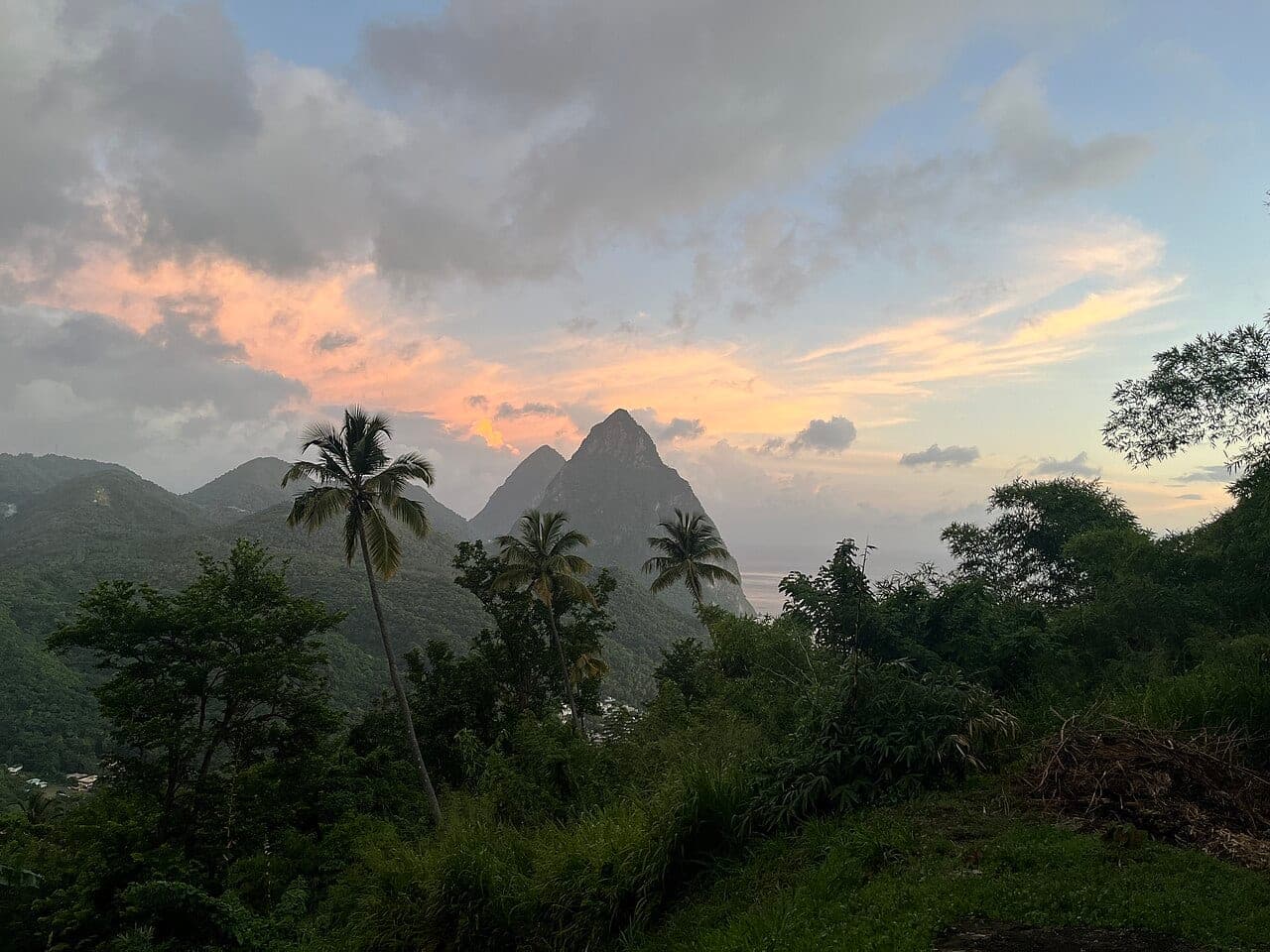
Saint Lucia is a single mountainous island in the eastern Caribbean, one of the Windward group, yet few places of its size carry so dense a record of contest and creation. Two forested volcanic spires, the Pitons, rise almost sheer from the sea beside the town of Soufriere, and the geothermal field behind them still steams and boils as the hottest, most active such site in the Lesser Antilles. Around that landscape gather the stories that made the island: the Kalinago who named it, the many occasions on which Britain and France seized it from one another, the sugar estates worked by enslaved Africans, and the Kwéyòl-speaking society that emancipation and independence left behind.
What sets Saint Lucia apart is how much it has returned to the wider world from so little. From a population that has never reached 200,000 came two Nobel laureates, the poet Derek Walcott and the economist Sir Arthur Lewis, born on the same date fifteen years apart. And the island keeps its own dead in ways particular to it: the Roman Catholic wake and requiem inherited from France, the graveside candles of All Souls', and two flower societies, La Rose and La Marguerite, whose feasts began among the enslaved as mutual-aid brotherhoods and endure as acts of communal remembrance.
Saint Lucia lies between Martinique and Saint Vincent, a volcanic island of about 617 square kilometres in the Lesser Antilles. Its interior is steep and green, crowned by Mount Gimie at roughly 950 metres, while most of its people, some 180,000, live along the coast and in the north around the capital, Castries. English is the official language, but the everyday tongue of homes, markets and much of the island's music is Saint Lucian Creole, known as Kwéyòl or Patwa.
The island is a Commonwealth realm, independent from the United Kingdom since 22 February 1979, with King Charles III as head of state represented by a governor-general. Sugar built the colonial economy and then failed; bananas carried the twentieth century until the loss of protected European markets in the 1990s pushed the island toward tourism, which now anchors it. Roman Catholicism, the legacy of French settlement, remains the largest faith, and Saint Lucia is often described as the only sovereign nation named for a historical woman, Saint Lucy of Syracuse, according to Britannica.
Castries. The capital, home with its suburbs to more than a third of the island, sits on a sheltered harbour that made it a naval prize for two empires. Fire has repeatedly remade it, most severely in 1948, so much of its centre is mid-century concrete rather than old timber. What endures is the square renamed for Derek Walcott, shaded by a great samaan tree, and the Cathedral of the Immaculate Conception, the largest church in the Caribbean, its interior painted by the Saint Lucian artist Dunstan St Omer.
Soufriere. The first French town, laid out in 1746 on the west coast beneath the Pitons, and the island's early capital. Its name, from the French for a sulphur works, points to the geothermal springs just inland. Around it cluster the sites that define Saint Lucian tourism: the Pitons themselves, the boiling Sulphur Springs marketed as a drive-in volcano, the Diamond Falls and the old estate gardens.
Vieux Fort. The southern town, beside Hewanorra International Airport, the island's long-haul gateway. Off its windswept point lie the Maria Islands, a nature reserve protecting the Saint Lucia whiptail lizard, the zandoli te, found nowhere else, while Cape Moule à Chique marks the island's southern tip.
Gros Islet. A fishing settlement in the north turned resort district around Rodney Bay, best known for its Friday-night street party, the jump-up, and for neighbouring Pigeon Island, whose forts once watched the French fleet at Martinique. The area has long hosted the Saint Lucia Jazz festival.
The island's first known inhabitants were Arawak-speaking peoples who reached it in the early centuries of the common era, followed from around 800 by the Kalinago, or Island Caribs, whose seafaring society dominated the Lesser Antilles at European contact. The Kalinago called the island Iouanalao and later Hewanorra, understood as the land of the iguana, a name the international airport still carries. Columbus is unlikely to have landed here.
Permanent European settlement came slowly and violently. An English attempt in 1605, when the ship Olive Branch was blown off course, ended with most colonists dead or driven off, and a further effort in 1638 also failed against Kalinago resistance. The French established a lasting presence from Martinique in the 1650s and pressed their claim against Britain for the next century and a half. Between the seventeenth and early nineteenth centuries the island changed hands fourteen times, a record that earned it the epithet the Helen of the West Indies, after Helen of Troy. Britain took final possession in 1814.
The economy those powers fought over was built on sugar and on the labour of enslaved Africans, brought in large numbers through the eighteenth century and held under a plantation regime as harsh here as anywhere in the Caribbean. Resistance was constant, and bands of escapees, the Neg Mawon, held out in the forested interior. Abolition of the slave trade in 1807 was followed by emancipation in 1834, though freedom was deferred by a period of compelled apprenticeship that ended only in 1838. The society that remained was overwhelmingly of African descent, Catholic and Kwéyòl-speaking. Self-government came by stages: the West Indies Federation from 1958 to 1962, associated statehood in 1967, and full independence on 22 February 1979.
English, the legacy of the final British century, is the language of law, administration and formal schooling. Alongside it, and far older in daily use, is Saint Lucian Creole, called Kwéyòl or Patwa, a French-lexifier creole forged on the plantations from a French vocabulary carried on West African grammatical structure. It is closely related to the creoles of Martinique, Guadeloupe and Dominica, and for most of the island's history it was the first language of the majority. Long dismissed as broken French and discouraged in classrooms, Kwéyòl has been reclaimed since the late twentieth century as the true carrier of Saint Lucian identity, with a standardised orthography, published dictionaries and a translation of the New Testament.
The island's name comes not from a landmark but from a saint, Saint Lucy of Syracuse, the fourth-century virgin martyr whose feast falls on 13 December and whose name derives from the Latin lux, light. Tradition holds that French sailors, shipwrecked on the island, came ashore on her feast day and named the place for her, though the story is more legend than record. The Kalinago name Hewanorra survives at the airport, and French place-names remain everywhere, from Soufriere and Vieux Fort to Gros Islet, layered over the English of the modern state.
The heart of Saint Lucian culture is Kwéyòl, and its clearest annual expression is Jounen Kwéyòl, Creole Day. Marked on the last Sunday of October as the island's contribution to International Creole Day, observed across the French-creole world since 1983, it fills chosen communities with Kwéyòl language, madras dress, folk music and traditional food, turning the once-scorned tongue into a point of national pride. Much of the documentation behind it is the work of the Folk Research Centre, founded in 1973 to record the island's oral heritage.
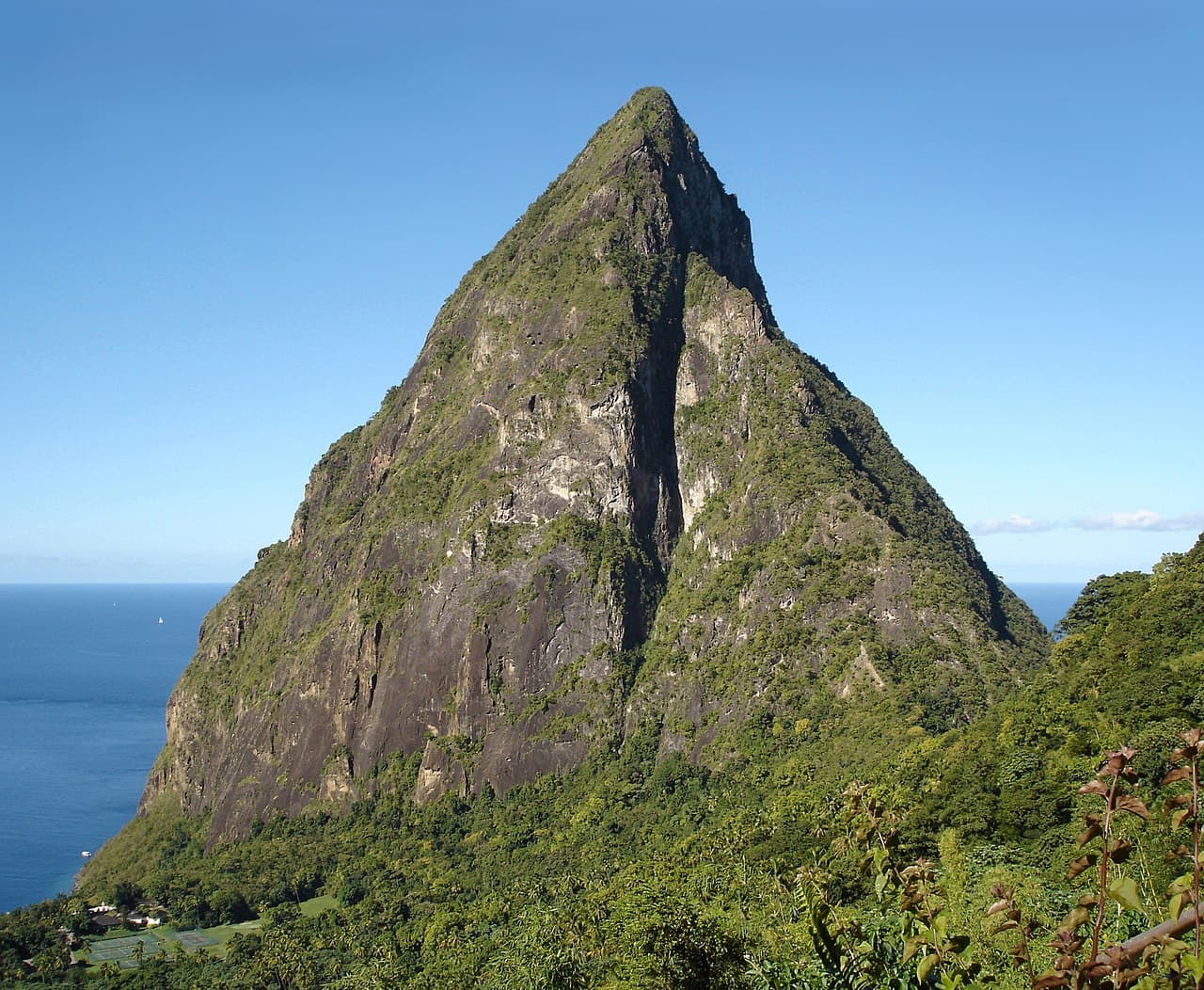 The Pitons are volcanic plugs and the island's defining image, inscribed by UNESCO in 2004 for the geology rather than the view. Photograph by Jayen466, public domain, via Wikimedia Commons.
Older still are the flower societies, La Rose and La Marguerite, uniquely Saint Lucian institutions that began in the time of slavery as co-operative brotherhoods for mutual support, akin to the coumbite of Haiti. Each is organised as a mock royal court, with a king, a queen and ranks of princes, officers and courtiers, and each keeps its own feast: La Rose celebrates Saint Rose of Lima on 30 August, La Marguerite the feast of Saint Margaret Mary Alacoque on 17 October. Through the year members gather for all-night song sessions, the séances, whose music blends European court pageantry with African rhythm, and the two societies frame a gentle rivalry that knits their members into a network of care.
Music and food complete the picture. The Saint Lucia Jazz festival, launched in 1991 and staged mainly on Pigeon Island, grew into the island's signature cultural event, spanning jazz, soul and Caribbean styles. The national dish pairs green figs, the local name for green bananas, with saltfish, a plantation-era combination of salted cod and boiled fruit that is now a Sunday-morning ritual, served alongside bouyon stews and cocoa tea.
Saint Lucia is a strongly Christian and predominantly Roman Catholic country, the Church a direct inheritance of French settlement. Catholics remain the largest single group, though their share has declined from near-universal a century ago toward roughly half today as Seventh-day Adventist, Pentecostal and other Protestant congregations have grown. The parish church anchors community life, and the calendar of saints supplies the feast days that the flower societies and village patrons observe.
Beneath and beside the Church runs an Afro-Creole spiritual world carried from West Africa. It includes obeah, the folk practice of healing, protection and divination; the Kélé rite maintained by descendants of later African arrivals, in which drumming and offerings honour the ancestors and the deity Ogun; and a body of folklore peopled by figures such as Papa Bwa, guardian of the forest, and La Djablès, the beautiful woman with a cloven hoof. These beliefs long coexisted quietly with Catholic devotion, and elements of both often accompany the same family through birth, sickness and death.
Saint Lucian mourning joins the Catholic rites of the Church to older Afro-Creole custom. When a death occurs, family and neighbours gather for the wake, the veye, held in the home of the deceased over one or more nights before burial. Prayers and hymns alternate with coffee, food and unhurried storytelling, and in the older pattern the gathering could stretch to nine nights of the rosary, the nèf-nwit, so that the household is never left alone with its grief. A Requiem Mass and burial follow, and further prayers are said on the ninth and fortieth days and the first anniversary, marking the family's slow return to ordinary time.
At the turn of November the whole island remembers together. On the eve of All Saints' and All Souls', families gather at the cemeteries to clean the graves and set them alight with candles, so that the burial grounds glow through the night in one of the most widely kept observances of the year. The flower societies extend that work of memory across the calendar. Because their membership crosses generations and their rolls include the departed as well as the living, the feasts and séances of La Rose and La Marguerite honour past kings and queens of the society and bind the community to those who have gone before. What began as mutual aid in hardship remains, in its music and ceremony, a way of holding the dead within the living body of the group.
Saint Lucia changed hands fourteen times between France and Britain, and the records change language accordingly.
Catholic parish registers, kept under French administration and continued afterwards because the island stayed Catholic, are the earliest and most useful vital records. British administration from 1814 brought Anglican registers and eventually civil registration, held by the Registrar of Civil Status in Castries, and the National Archives hold the colonial series with parallel material at Kew and in France.
Because French civil law persisted in parts of the legal system, Saint Lucia has notarial records of the French type, which name relationships in marriage contracts and inheritances in a way British colonial records do not.
The slave registers of 1815 to 1834 name individuals, and the compensation records name the owners. Emancipation came in 1834, and indenture after it brought several thousand Indian labourers between 1858 and 1893, whose arrival records survive.
Kwéyòl, the French-based creole almost everyone speaks, is the linguistic evidence of the French century, and place names are French on a formerly British island.
The Indigenous record is Kalinago and archaeological, and the island's own name for itself, Iouanalao, comes from that period.
Two Nobel laureates were born here, Arthur Lewis and Derek Walcott, on the same day of the year twenty-five years apart, in a country of fewer than two hundred thousand people, which is the statistic every Saint Lucian knows.
The island's foremost protected place is the Pitons Management Area, inscribed on the UNESCO World Heritage List in 2004 for its natural values. The 2,909-hectare site takes in the two Pitons, Gros Piton reaching 798 metres and Petit Piton 743 metres, joined by the Piton Mitan ridge, together with the geothermal field of the Sulphur Springs, the surrounding forest and a stretch of coast whose coral reefs cover much of the marine area. The site is managed to reconcile that heritage with the tourism and fishing on which nearby communities depend.
Heritage across the rest of the island falls largely to the Saint Lucia National Trust, established at independence to hold and protect sites of importance. Its best-known property is Pigeon Island National Landmark, a headland in the north joined to the mainland by a 1970s causeway. Fortified by Britain from 1778, it served as Admiral George Rodney's base for watching the French fleet at Martinique before the decisive Battle of the Saintes in 1782, and remained a garrison into the twentieth century; the Trust has restored its ruins, laid trails and opened a small museum. The Trust also manages the Maria Islands reserve and other protected areas, while the Folk Research Centre safeguards the intangible heritage of language, song and ceremony.
Saint Lucia's digital heritage work centres on language and archive. The Folk Research Centre, whose collection suffered a serious fire in 2013, has rebuilt and digitised much of its recorded material on Kwéyòl speech, folk music and oral history, and Kwéyòl now has an online presence unusual for a creole its size, including digital dictionaries and scripture. National records and historical newspapers are increasingly accessible through the Digital Library of the Caribbean, making documents once held only in Castries readable from anywhere.
The island's literary heritage is moving online too, as the papers of its two Nobel laureates circulate through university and library collections abroad, and cultural bodies use recordings and social media to carry Jounen Kwéyòl and traditional music to a diaspora in the United Kingdom, the United States and Canada. For a nation of its scale, the priority is less to build large institutions than to keep a fragile oral culture legible to a generation now growing up mainly in English.
No single fact defines Saint Lucia's modern reputation more than its two Nobel laureates. Sir Arthur Lewis, born in Castries in 1915, became a founding figure of development economics, best known for the dual-sector model of growth that bears his name, and in 1979 shared the Nobel Memorial Prize in Economic Sciences, the first person of African descent to win a Nobel in a category other than Peace. Derek Walcott, born in Castries in 1930, drew on the island's landscape, history and Kwéyòl voices across a body of poetry and drama that culminated in the epic Omeros, and in 1992 won the Nobel Prize in Literature. That an island of well under 200,000 people produced two laureates gives it one of the highest such rates per head in the world.
The island's creative reach runs wider than its laureates. Dunstan St Omer designed the national flag and painted the murals that fill Saint Lucian churches; Walcott's twin brother Roderick was a leading playwright, and poets such as Kendel Hippolyte have continued the literary line. Its cuisine, festivals and Kwéyòl are sustained by a diaspora that keeps close ties to home, and across the Caribbean, Saint Lucia's rehabilitation of its creole is cited as a model for reclaiming a heritage once dismissed as inferior.
The Pitons enter the World Heritage List. The 2004 inscription of the Pitons Management Area gave international protection to the island's defining landscape and tied its conservation to the livelihoods of Soufriere, a rare pairing of natural heritage with the working communities beneath it.
Two laureates, one birthday. Arthur Lewis and Derek Walcott were both born on 23 January, fifteen years apart, a coincidence the island marks each year with Nobel Laureate Week, turning an improbable statistic into a celebration of learning.
Kwéyòl reclaimed. A language once barred from the classroom is now written, taught, translated and honoured every October at Jounen Kwéyòl, the fruit of half a century of documentation by the Folk Research Centre and a source of pride across the French-creole Caribbean.
Pigeon Island restored. The Saint Lucia National Trust turned a ruined military headland into a landmark that reads its own layered past, from Kalinago camp to British fort to festival ground, and keeps it open to residents and visitors alike.
The Pitons are volcanic plugs and the island's defining image, inscribed by UNESCO in 2004 for the geology rather than the view. Photograph by Jayen466, public domain, via Wikimedia Commons.
Older still are the flower societies, La Rose and La Marguerite, uniquely Saint Lucian institutions that began in the time of slavery as co-operative brotherhoods for mutual support, akin to the coumbite of Haiti. Each is organised as a mock royal court, with a king, a queen and ranks of princes, officers and courtiers, and each keeps its own feast: La Rose celebrates Saint Rose of Lima on 30 August, La Marguerite the feast of Saint Margaret Mary Alacoque on 17 October. Through the year members gather for all-night song sessions, the séances, whose music blends European court pageantry with African rhythm, and the two societies frame a gentle rivalry that knits their members into a network of care.
Music and food complete the picture. The Saint Lucia Jazz festival, launched in 1991 and staged mainly on Pigeon Island, grew into the island's signature cultural event, spanning jazz, soul and Caribbean styles. The national dish pairs green figs, the local name for green bananas, with saltfish, a plantation-era combination of salted cod and boiled fruit that is now a Sunday-morning ritual, served alongside bouyon stews and cocoa tea.
Saint Lucia is a strongly Christian and predominantly Roman Catholic country, the Church a direct inheritance of French settlement. Catholics remain the largest single group, though their share has declined from near-universal a century ago toward roughly half today as Seventh-day Adventist, Pentecostal and other Protestant congregations have grown. The parish church anchors community life, and the calendar of saints supplies the feast days that the flower societies and village patrons observe.
Beneath and beside the Church runs an Afro-Creole spiritual world carried from West Africa. It includes obeah, the folk practice of healing, protection and divination; the Kélé rite maintained by descendants of later African arrivals, in which drumming and offerings honour the ancestors and the deity Ogun; and a body of folklore peopled by figures such as Papa Bwa, guardian of the forest, and La Djablès, the beautiful woman with a cloven hoof. These beliefs long coexisted quietly with Catholic devotion, and elements of both often accompany the same family through birth, sickness and death.
Saint Lucian mourning joins the Catholic rites of the Church to older Afro-Creole custom. When a death occurs, family and neighbours gather for the wake, the veye, held in the home of the deceased over one or more nights before burial. Prayers and hymns alternate with coffee, food and unhurried storytelling, and in the older pattern the gathering could stretch to nine nights of the rosary, the nèf-nwit, so that the household is never left alone with its grief. A Requiem Mass and burial follow, and further prayers are said on the ninth and fortieth days and the first anniversary, marking the family's slow return to ordinary time.
At the turn of November the whole island remembers together. On the eve of All Saints' and All Souls', families gather at the cemeteries to clean the graves and set them alight with candles, so that the burial grounds glow through the night in one of the most widely kept observances of the year. The flower societies extend that work of memory across the calendar. Because their membership crosses generations and their rolls include the departed as well as the living, the feasts and séances of La Rose and La Marguerite honour past kings and queens of the society and bind the community to those who have gone before. What began as mutual aid in hardship remains, in its music and ceremony, a way of holding the dead within the living body of the group.
Saint Lucia changed hands fourteen times between France and Britain, and the records change language accordingly.
Catholic parish registers, kept under French administration and continued afterwards because the island stayed Catholic, are the earliest and most useful vital records. British administration from 1814 brought Anglican registers and eventually civil registration, held by the Registrar of Civil Status in Castries, and the National Archives hold the colonial series with parallel material at Kew and in France.
Because French civil law persisted in parts of the legal system, Saint Lucia has notarial records of the French type, which name relationships in marriage contracts and inheritances in a way British colonial records do not.
The slave registers of 1815 to 1834 name individuals, and the compensation records name the owners. Emancipation came in 1834, and indenture after it brought several thousand Indian labourers between 1858 and 1893, whose arrival records survive.
Kwéyòl, the French-based creole almost everyone speaks, is the linguistic evidence of the French century, and place names are French on a formerly British island.
The Indigenous record is Kalinago and archaeological, and the island's own name for itself, Iouanalao, comes from that period.
Two Nobel laureates were born here, Arthur Lewis and Derek Walcott, on the same day of the year twenty-five years apart, in a country of fewer than two hundred thousand people, which is the statistic every Saint Lucian knows.
The island's foremost protected place is the Pitons Management Area, inscribed on the UNESCO World Heritage List in 2004 for its natural values. The 2,909-hectare site takes in the two Pitons, Gros Piton reaching 798 metres and Petit Piton 743 metres, joined by the Piton Mitan ridge, together with the geothermal field of the Sulphur Springs, the surrounding forest and a stretch of coast whose coral reefs cover much of the marine area. The site is managed to reconcile that heritage with the tourism and fishing on which nearby communities depend.
Heritage across the rest of the island falls largely to the Saint Lucia National Trust, established at independence to hold and protect sites of importance. Its best-known property is Pigeon Island National Landmark, a headland in the north joined to the mainland by a 1970s causeway. Fortified by Britain from 1778, it served as Admiral George Rodney's base for watching the French fleet at Martinique before the decisive Battle of the Saintes in 1782, and remained a garrison into the twentieth century; the Trust has restored its ruins, laid trails and opened a small museum. The Trust also manages the Maria Islands reserve and other protected areas, while the Folk Research Centre safeguards the intangible heritage of language, song and ceremony.
Saint Lucia's digital heritage work centres on language and archive. The Folk Research Centre, whose collection suffered a serious fire in 2013, has rebuilt and digitised much of its recorded material on Kwéyòl speech, folk music and oral history, and Kwéyòl now has an online presence unusual for a creole its size, including digital dictionaries and scripture. National records and historical newspapers are increasingly accessible through the Digital Library of the Caribbean, making documents once held only in Castries readable from anywhere.
The island's literary heritage is moving online too, as the papers of its two Nobel laureates circulate through university and library collections abroad, and cultural bodies use recordings and social media to carry Jounen Kwéyòl and traditional music to a diaspora in the United Kingdom, the United States and Canada. For a nation of its scale, the priority is less to build large institutions than to keep a fragile oral culture legible to a generation now growing up mainly in English.
No single fact defines Saint Lucia's modern reputation more than its two Nobel laureates. Sir Arthur Lewis, born in Castries in 1915, became a founding figure of development economics, best known for the dual-sector model of growth that bears his name, and in 1979 shared the Nobel Memorial Prize in Economic Sciences, the first person of African descent to win a Nobel in a category other than Peace. Derek Walcott, born in Castries in 1930, drew on the island's landscape, history and Kwéyòl voices across a body of poetry and drama that culminated in the epic Omeros, and in 1992 won the Nobel Prize in Literature. That an island of well under 200,000 people produced two laureates gives it one of the highest such rates per head in the world.
The island's creative reach runs wider than its laureates. Dunstan St Omer designed the national flag and painted the murals that fill Saint Lucian churches; Walcott's twin brother Roderick was a leading playwright, and poets such as Kendel Hippolyte have continued the literary line. Its cuisine, festivals and Kwéyòl are sustained by a diaspora that keeps close ties to home, and across the Caribbean, Saint Lucia's rehabilitation of its creole is cited as a model for reclaiming a heritage once dismissed as inferior.
The Pitons enter the World Heritage List. The 2004 inscription of the Pitons Management Area gave international protection to the island's defining landscape and tied its conservation to the livelihoods of Soufriere, a rare pairing of natural heritage with the working communities beneath it.
Two laureates, one birthday. Arthur Lewis and Derek Walcott were both born on 23 January, fifteen years apart, a coincidence the island marks each year with Nobel Laureate Week, turning an improbable statistic into a celebration of learning.
Kwéyòl reclaimed. A language once barred from the classroom is now written, taught, translated and honoured every October at Jounen Kwéyòl, the fruit of half a century of documentation by the Folk Research Centre and a source of pride across the French-creole Caribbean.
Pigeon Island restored. The Saint Lucia National Trust turned a ruined military headland into a landmark that reads its own layered past, from Kalinago camp to British fort to festival ground, and keeps it open to residents and visitors alike.
National Overview
Notable Cities
Historical Foundations
Linguistic and Etymological Roots
Cultural Identity
Religion and Spirituality
Remembrance and Mourning Traditions
Tracing a Family in Saint Lucia
Heritage Preservation Efforts
Digital Heritage
Contemporary Cultural Influences
Success Stories
References and resources
- UNESCO World Heritage Centre, Pitons Management Area: the 2004 natural inscription, its criteria and boundaries.
- Encyclopaedia Britannica, Saint Lucia: geography, history and political background.
- Saint Lucia National Trust: Pigeon Island National Landmark and other protected sites.
- Folk Research Centre: Kwéyòl language, Jounen Kwéyòl and Saint Lucian oral heritage.
- Cultural Development Foundation, National Flower Festivals: the origins of La Rose and La Marguerite.
- The Nobel Prize, Derek Walcott: the 1992 Nobel Prize in Literature.
- The Nobel Prize, Sir Arthur Lewis: the 1979 Nobel Memorial Prize in Economic Sciences.
- Digital Library of the Caribbean: digitised Saint Lucian newspapers and cultural material.