Heritage · Country
Estonia Culture and Heritage
Between the Hanseatic spires of Tallinn's Old Town and the open-air stage where a hundred thousand voices sing as one, Estonia has kept its identity in song through centuries of foreign rule. This guide follows the country's heritage and the quiet customs by which Estonians remember their dead, from the autumn souls' visiting time to the candles that glow in cemeteries on winter nights.Written to last.
By Confinity Heritage Editorial · Updated 2026-07-31 · 8-minute readQuiet tools, kept out of the way.
Few small nations have entrusted so much of their survival to a song. When a foreign empire held the schools, the manor estates and the government, Estonians gathered in their tens of thousands on an open field to sing in their own language, and it was there, more than in any parliament, that the nation kept itself alive. The first such gathering met in Tartu in 1869 with 878 male singers, and in the late 1980s the same festival ground became the cradle of a peaceful revolution.
Estonia's memory is also a memory of interruption. In a single century the country won its independence, lost it to two occupations, saw tens of thousands of its people deported to Siberia, and recovered it without a shot fired. Precisely because so much was taken and so much was hidden, Estonians have built one of the most complete digital records of any nation.
Estonia is the northernmost of the three Baltic states, a low, forested country of about 45,335 square kilometres on the eastern shore of the Baltic Sea, facing Finland across the Gulf of Finland and bordering Russia to the east and Latvia to the south (Britannica). Roughly half of its land is under forest, and the coastline scatters into more than 2,300 islands and islets, of which Saaremaa and Hiiumaa are the largest. The population is small, about 1.3 million, roughly a third of it in the capital, Tallinn.
Independent from 1918, occupied and annexed by the Soviet Union from 1940, Estonia restored its independence in 1991 and has since anchored itself in the West, joining both the European Union and NATO in 2004 and adopting the euro in 2011. Estonian is the sole official language, and unlike the languages of almost all its neighbours it is not Indo-European but Finnic, kin to Finnish. The country is often described as Nordic rather than simply Baltic, a reflection of its Lutheran inheritance, its long ties to Sweden and Finland, and a temperament that prizes reserve and a deep attachment to the forest.
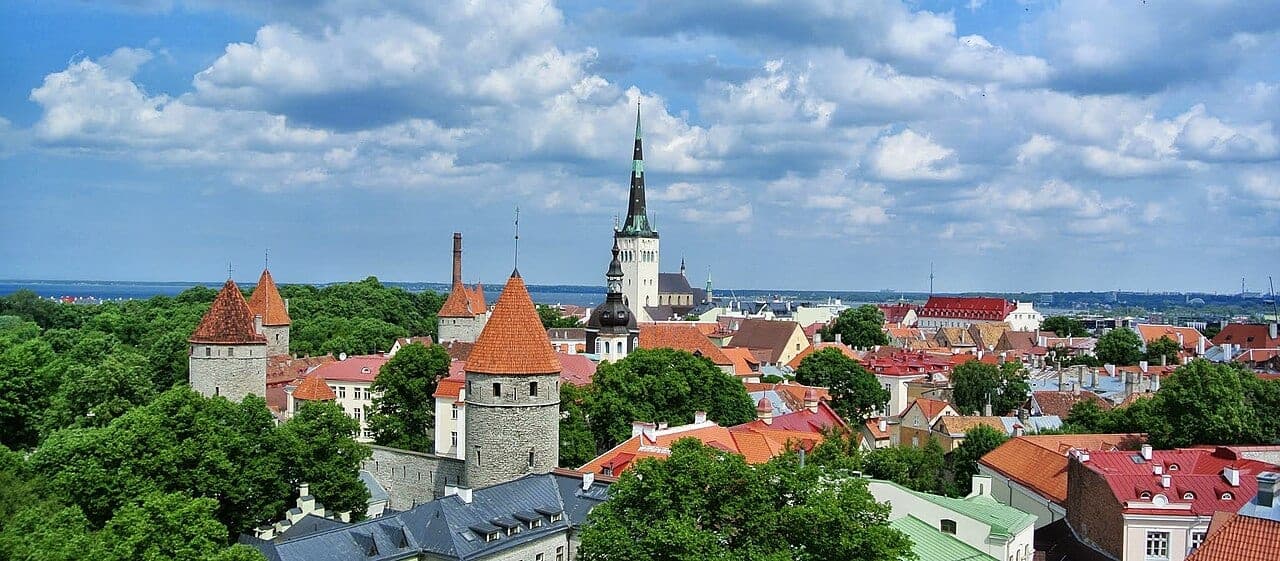
Tallinn. The capital is one of the best-preserved medieval trading cities in northern Europe, and its Old Town has been a UNESCO World Heritage Site since 1997. A castle rose on Toompea hill in the thirteenth century, and by 1285 the town had entered the Hanseatic League, growing wealthy on the trade route between western Europe and Novgorod. Its walled Lower Town of merchant houses and guild halls, its gothic spires and its ring of towers survive largely intact (UNESCO).
 Tallinn's old town survived the Second World War largely intact, which is unusual on this coast, and it kept its medieval street plan whole. Photograph by Ivar Leidus, CC BY-SA 3.0 EE, via Wikimedia Commons.
Tartu. Estonia's second city and its intellectual heart, Tartu was first recorded in 1030 and is the oldest named settlement in the country. Its University, founded in 1632 by the Swedish king Gustavus Adolphus, made the city the cradle of the national awakening and the home of the first song festival in 1869. Tartu carried the title of European Capital of Culture in 2024, and the old observatory beside its cathedral hill holds the origin point of the Struve Geodetic Arc.
Pärnu. On the south-western coast, Pärnu was a Hanseatic port on the route to Novgorod before it became the country's chief seaside resort. Its first bathing establishment opened in 1838, and its mud cures and long beach still draw visitors; it holds the honorary title of Estonia's summer capital, granted in 1996.
Narva. At the far eastern border, Narva faces Russia across a narrow river, its medieval Hermann Castle staring directly at the Ivangorod Fortress on the opposite bank. Founded by the Danes in 1256 and later held by the Livonian Order, the city was almost entirely destroyed in the battles of 1944 and rebuilt under Soviet rule. Its population today is overwhelmingly Russian-speaking, near 96 per cent, which places questions of language and belonging at the centre of the city's life.
Human settlement in Estonia reaches back some 11,000 years to the retreat of the ice, and the ancient Estonians lived as farmers, traders and seafarers organised into small counties and parishes, worshipping in sacred groves. That independence ended with the Northern Crusades of the thirteenth century, when German and Danish crusaders subdued the country in a long and bloody conquest, fixing Estonia within Latin Christendom and beginning seven centuries of foreign rule. Danish, German, Swedish, Polish and finally Russian power passed over the country, while a German-speaking nobility, the Baltic Germans, held the manor estates.
The Swedish period of the seventeenth century, remembered in folk memory as the good old Swedish time, brought the University of Tartu before Estonia fell to the Russian Empire in the Great Northern War in 1710. Under Russian rule the Baltic German landowners kept their privileges, and at their height there were more than 2,000 manors across the country; Palmse, long the seat of the von der Pahlen family, and Sagadi are among the finest, both preserved within Lahemaa National Park. After serfdom was abolished, a newly literate peasantry produced the national awakening, whose defining moment was the first song festival in Tartu in 1869, gathering Estonians as a people rather than as subjects.
Independence came in the turmoil of 1918. Estonia declared a republic on 24 February 1918 and defended it in the War of Independence against both German and Soviet Russian forces, securing recognition in 1920. That freedom lasted barely two decades. The Molotov-Ribbentrop Pact of August 1939 assigned Estonia to the Soviet sphere, and in 1940 the Soviet Union occupied and annexed the country. What followed must be stated plainly. On 14 June 1941 more than 10,000 people were deported to Siberia in a single operation, most of them women, children and the elderly (Estonian World). Days later Nazi Germany invaded, and Estonia endured a German occupation from 1941 to 1944, during which the country's small Jewish community and thousands of others were murdered. The Red Army returned in 1944, and on 25 March 1949 a second and larger deportation, Operation Priboi, removed more than 20,000 people, close to three per cent of the population, to break resistance to collectivisation, while tens of thousands more fled west as refugees. These losses are the sombre foundation of modern Estonian remembrance.
Recovery, when it came, was sung. From 1987 a wave of mass demonstrations known as the Singing Revolution swept the Baltic republics. In September 1988 an estimated 300,000 Estonians gathered at the Tallinn song festival ground to call openly for freedom, and on 23 August 1989, the fiftieth anniversary of the Molotov-Ribbentrop Pact, around two million people joined hands across all three countries in the Baltic Way, a human chain some 670 kilometres long (Estonian World). Estonia restored its independence on 20 August 1991 as the Soviet Union collapsed, without civil war and without an armed struggle; that date is now Restoration of Independence Day.
Estonian belongs to the Finnic branch of the Uralic language family, which sets it apart from nearly all of Europe. It is closely related to Finnish and, more distantly, to Hungarian, and shares nothing of the grammar of the Indo-European languages around it, having fourteen grammatical cases and no grammatical gender. Its northern and southern dialect groups were once distinct enough that a separate southern literary language developed around Tartu, and its Seto and Võro varieties survive today.
The country's name comes from far away in time. The Roman historian Tacitus, writing around AD 98, described a people he called the Aesti living on the eastern Baltic shore, and though scholars debate exactly whom he meant, the name attached over the centuries to this land and gave the Estonians their own word for themselves, Eesti (Britannica). The people long called their country simply Maa, the land, and themselves maarahvas, the people of the land, a name carrying an older sense of belonging to the earth.
At the centre of Estonian culture is the Song and Dance Celebration, held in Tallinn roughly every five years and joined by tens of thousands of singers and dancers before audiences of a hundred thousand or more. The tradition runs unbroken from 1869, and in 2003 the Baltic song and dance festivals were inscribed on the UNESCO Representative List of the Intangible Cultural Heritage of Humanity (UNESCO). Beneath the choral repertoire lies something older: the regilaul, the ancient runic folk song, alliterative and repetitive. These songs, gathered in the nineteenth century, gave Friedrich Reinhold Kreutzwald the material for the national epic Kalevipoeg, published around 1860.
Two regional cultures carry distinctive traditions recognised by UNESCO. On the small islands of Kihnu and Manija, a community of around 600 people keeps a way of life whose songs, dances, weddings, handicrafts and striped woollen skirts have been sustained largely by the island's women while the men were away at sea; the Kihnu cultural space was inscribed by UNESCO in 2003 and 2008 (UNESCO). In the south-eastern corner of the country, the Orthodox Seto people preserve leelo, a polyphonic singing in which a lead singer improvises a line and the choir answers, inscribed by UNESCO in 2009. Estonian food belongs to the northern and forest world: dark rye bread treated almost as sacred, herring and Baltic sprats, pork and potatoes, wild mushrooms and berries, and blood sausage at Christmas.
Estonia is frequently described as one of the least religious countries in the world, and in survey after survey only a small minority say religion is important to their daily lives. Formal affiliation is divided between Lutheran and Orthodox Christianity, the legacy of German and Swedish reformers and of Russian rule in the east; the 2021 census recorded a larger share of Orthodox than Lutheran believers, with the great majority of the population professing no religion at all (Estonian World).
Yet that figure understates a quieter spirituality. A strong strand of nature-based folk belief runs through Estonian life, expressed in the loose traditions known as maausk, the faith of the earth, and rooted in a pre-Christian world in which the sky god Taara and other powers were honoured in sacred groves, springs and stones. Many of these holy sites still stand, protected and visited, and a wider feeling that the forest, the bog and the sea hold something sacred colours Estonian attitudes to the land far beyond those who name a nature faith as their own.
Estonian mourning weaves Christian rite together with beliefs far older than any church. Funerals in the Lutheran and Orthodox traditions structure the formal farewell, and the tending of family graves is a serious and continuing duty; Estonian cemeteries, often set among pines, are kept with great care.
Older still is hingedeaeg, the souls' visiting time, a period in late autumn, broadly from Michaelmas through November, when the souls of the dead were believed to return to their former homes (Estonian Folklore Archives). In earlier centuries a household would heat the sauna for the ancestors, set out food, and quietly name the dead one by one to guide them home. The custom survives in gentler form: on All Souls' Day, at Christmas, and through the dark months, Estonians light candles on windowsills and carry them to the graves of their people, so that on a winter evening a cemetery becomes a field of small flames. The song festivals, too, have become a form of collective remembrance, and each 14 June and 25 March the country marks the days of the great deportations.
Estonia has put its history online more completely than almost any country in Europe, and it is free.
Saaga, run by the National Archives, publishes digitised images of parish registers, revision lists, church and civil records, and a great deal of the Baltic German estate material, without charge and without registration. Lutheran and Orthodox parish registers survive from the seventeenth century in places, and the revision lists taken as Russian tax censuses between 1782 and 1858 name households in detail. Estonia adopted hereditary surnames unusually late, mostly in 1816 to 1835, when they were assigned to peasant families, so research before that runs on farm names and patronymics rather than surnames.
Civil registration began in 1926, with Soviet ZAGS registration after 1940.
The deportations are the sharpest part of the record. In June 1941 and again in March 1949 Soviet authorities deported tens of thousands of Estonians, mostly women, children and the elderly, to Siberia. The lists survive, and Estonia has published them, so families can find the exact wagon their grandmother was on. The Memento database and the Estonian Repressed Persons Records Bureau exist to do precisely that.
The country has also done the digital-state version of the same instinct: birth, marriage and death registration is electronic and integrated, so the modern record has none of the fragmentation that makes twentieth-century research hard.
Estonia holds two UNESCO World Heritage Sites. The Historic Centre of Tallinn, inscribed in 1997, preserves an unusually complete medieval Hanseatic town of walls, towers, churches and merchant houses. The Struve Geodetic Arc, inscribed in 2005, is a chain of survey stations running from Norway to the Black Sea by which the astronomer Friedrich Georg Wilhelm Struve measured the shape of the earth between 1816 and 1855; of the 34 listed points across ten countries, three lie in Estonia, one being the origin point in the Tartu observatory and two at Simuna (University of Tartu). To these are added the country's contributions to the intangible-heritage lists: the song and dance celebration, the Kihnu cultural space, and Seto leelo, each safeguarded through community practice (UNESCO).
Beyond the listed sites, the Baltic German manor estates and the sacred natural sites are protected by the National Heritage Board, while the Estonian National Museum in Tartu, reopened in a striking new building in 2016, and the Estonian Open Air Museum in Tallinn preserve rural and vernacular life. The restoration of the country's historic manors as schools, museums and hotels since 1991 has become a national project of reclaiming a once foreign inheritance as a shared one.
Estonia has turned its scale and its history of interruption into an advantage, building one of the most advanced digital states in the world. Known as e-Estonia, the project dates from an information-society strategy of the late 1990s and the X-Road data exchange layer introduced in 2000, which now carries billions of transactions a year across thousands of e-services; the e-Residency programme, launched in 2014, opened digital citizenship to people anywhere on earth (e-Estonia).
The same energy has been applied to heritage. The National Archives of Estonia have digitised vast holdings of parish registers, court records and photographs, freely searchable through the Saaga portal, so that Estonians and their diaspora can trace families through the very records once used to deport them (National Archives of Estonia). The museums portal MuIS brings hundreds of collections online, the Estonian Literary Museum's Kivike opens its folklore and manuscript archives, and the Estonian Folklore Archives, one of the largest collections of folk song and belief in the world, are being opened to anyone with a connection. For a nation whose records were repeatedly scattered and seized, this gathering is a form of repair.
Estonian music carries the country's name across the world, and no figure more than the composer Arvo Pärt. After years of official disapproval in the Soviet Union, Pärt developed in 1976 a spare, bell-like style he called tintinnabuli, and works such as Spiegel im Spiegel and Fratres have made him one of the most performed living composers on earth; the Arvo Pärt Centre near Tallinn now holds his archive (Arvo Pärt Centre). He belongs to a wider choral culture whose other great figure, Veljo Tormis, built more than 500 choral works on the foundation of the ancient regilaul, carrying the runic song into the concert hall.
That choral culture, sustained by the song festivals, gives Estonia singers and composers far beyond its size, alongside film, design and literature, and a cultural signature, quiet and rooted in song, recognised well beyond the Baltic.
A revolution that was sung. Between 1987 and 1991 Estonians recovered their independence through mass singing and peaceful protest, from the 300,000 gathered at the song ground in 1988 to the two-million-strong Baltic Way of 1989, without an armed struggle.
A festival kept unbroken since 1869. The Song and Dance Celebration has run through empire, occupation and independence, and its inscription on the UNESCO intangible-heritage list in 2003 confirmed it as one of the great living traditions of Europe.
Island culture carried by its women. On Kihnu, a community of a few hundred has kept its songs, weddings, handicrafts and dress alive largely through its women, earning UNESCO recognition and showing that a very small culture can safeguard itself.
A nation's records brought online. Through e-Estonia and the digitisation of its archives, museums and folklore collections, a country whose documents were repeatedly seized has made its heritage searchable to its people and its diaspora worldwide.
Tallinn's old town survived the Second World War largely intact, which is unusual on this coast, and it kept its medieval street plan whole. Photograph by Ivar Leidus, CC BY-SA 3.0 EE, via Wikimedia Commons.
Tartu. Estonia's second city and its intellectual heart, Tartu was first recorded in 1030 and is the oldest named settlement in the country. Its University, founded in 1632 by the Swedish king Gustavus Adolphus, made the city the cradle of the national awakening and the home of the first song festival in 1869. Tartu carried the title of European Capital of Culture in 2024, and the old observatory beside its cathedral hill holds the origin point of the Struve Geodetic Arc.
Pärnu. On the south-western coast, Pärnu was a Hanseatic port on the route to Novgorod before it became the country's chief seaside resort. Its first bathing establishment opened in 1838, and its mud cures and long beach still draw visitors; it holds the honorary title of Estonia's summer capital, granted in 1996.
Narva. At the far eastern border, Narva faces Russia across a narrow river, its medieval Hermann Castle staring directly at the Ivangorod Fortress on the opposite bank. Founded by the Danes in 1256 and later held by the Livonian Order, the city was almost entirely destroyed in the battles of 1944 and rebuilt under Soviet rule. Its population today is overwhelmingly Russian-speaking, near 96 per cent, which places questions of language and belonging at the centre of the city's life.
Human settlement in Estonia reaches back some 11,000 years to the retreat of the ice, and the ancient Estonians lived as farmers, traders and seafarers organised into small counties and parishes, worshipping in sacred groves. That independence ended with the Northern Crusades of the thirteenth century, when German and Danish crusaders subdued the country in a long and bloody conquest, fixing Estonia within Latin Christendom and beginning seven centuries of foreign rule. Danish, German, Swedish, Polish and finally Russian power passed over the country, while a German-speaking nobility, the Baltic Germans, held the manor estates.
The Swedish period of the seventeenth century, remembered in folk memory as the good old Swedish time, brought the University of Tartu before Estonia fell to the Russian Empire in the Great Northern War in 1710. Under Russian rule the Baltic German landowners kept their privileges, and at their height there were more than 2,000 manors across the country; Palmse, long the seat of the von der Pahlen family, and Sagadi are among the finest, both preserved within Lahemaa National Park. After serfdom was abolished, a newly literate peasantry produced the national awakening, whose defining moment was the first song festival in Tartu in 1869, gathering Estonians as a people rather than as subjects.
Independence came in the turmoil of 1918. Estonia declared a republic on 24 February 1918 and defended it in the War of Independence against both German and Soviet Russian forces, securing recognition in 1920. That freedom lasted barely two decades. The Molotov-Ribbentrop Pact of August 1939 assigned Estonia to the Soviet sphere, and in 1940 the Soviet Union occupied and annexed the country. What followed must be stated plainly. On 14 June 1941 more than 10,000 people were deported to Siberia in a single operation, most of them women, children and the elderly (Estonian World). Days later Nazi Germany invaded, and Estonia endured a German occupation from 1941 to 1944, during which the country's small Jewish community and thousands of others were murdered. The Red Army returned in 1944, and on 25 March 1949 a second and larger deportation, Operation Priboi, removed more than 20,000 people, close to three per cent of the population, to break resistance to collectivisation, while tens of thousands more fled west as refugees. These losses are the sombre foundation of modern Estonian remembrance.
Recovery, when it came, was sung. From 1987 a wave of mass demonstrations known as the Singing Revolution swept the Baltic republics. In September 1988 an estimated 300,000 Estonians gathered at the Tallinn song festival ground to call openly for freedom, and on 23 August 1989, the fiftieth anniversary of the Molotov-Ribbentrop Pact, around two million people joined hands across all three countries in the Baltic Way, a human chain some 670 kilometres long (Estonian World). Estonia restored its independence on 20 August 1991 as the Soviet Union collapsed, without civil war and without an armed struggle; that date is now Restoration of Independence Day.
Estonian belongs to the Finnic branch of the Uralic language family, which sets it apart from nearly all of Europe. It is closely related to Finnish and, more distantly, to Hungarian, and shares nothing of the grammar of the Indo-European languages around it, having fourteen grammatical cases and no grammatical gender. Its northern and southern dialect groups were once distinct enough that a separate southern literary language developed around Tartu, and its Seto and Võro varieties survive today.
The country's name comes from far away in time. The Roman historian Tacitus, writing around AD 98, described a people he called the Aesti living on the eastern Baltic shore, and though scholars debate exactly whom he meant, the name attached over the centuries to this land and gave the Estonians their own word for themselves, Eesti (Britannica). The people long called their country simply Maa, the land, and themselves maarahvas, the people of the land, a name carrying an older sense of belonging to the earth.
At the centre of Estonian culture is the Song and Dance Celebration, held in Tallinn roughly every five years and joined by tens of thousands of singers and dancers before audiences of a hundred thousand or more. The tradition runs unbroken from 1869, and in 2003 the Baltic song and dance festivals were inscribed on the UNESCO Representative List of the Intangible Cultural Heritage of Humanity (UNESCO). Beneath the choral repertoire lies something older: the regilaul, the ancient runic folk song, alliterative and repetitive. These songs, gathered in the nineteenth century, gave Friedrich Reinhold Kreutzwald the material for the national epic Kalevipoeg, published around 1860.
Two regional cultures carry distinctive traditions recognised by UNESCO. On the small islands of Kihnu and Manija, a community of around 600 people keeps a way of life whose songs, dances, weddings, handicrafts and striped woollen skirts have been sustained largely by the island's women while the men were away at sea; the Kihnu cultural space was inscribed by UNESCO in 2003 and 2008 (UNESCO). In the south-eastern corner of the country, the Orthodox Seto people preserve leelo, a polyphonic singing in which a lead singer improvises a line and the choir answers, inscribed by UNESCO in 2009. Estonian food belongs to the northern and forest world: dark rye bread treated almost as sacred, herring and Baltic sprats, pork and potatoes, wild mushrooms and berries, and blood sausage at Christmas.
Estonia is frequently described as one of the least religious countries in the world, and in survey after survey only a small minority say religion is important to their daily lives. Formal affiliation is divided between Lutheran and Orthodox Christianity, the legacy of German and Swedish reformers and of Russian rule in the east; the 2021 census recorded a larger share of Orthodox than Lutheran believers, with the great majority of the population professing no religion at all (Estonian World).
Yet that figure understates a quieter spirituality. A strong strand of nature-based folk belief runs through Estonian life, expressed in the loose traditions known as maausk, the faith of the earth, and rooted in a pre-Christian world in which the sky god Taara and other powers were honoured in sacred groves, springs and stones. Many of these holy sites still stand, protected and visited, and a wider feeling that the forest, the bog and the sea hold something sacred colours Estonian attitudes to the land far beyond those who name a nature faith as their own.
Estonian mourning weaves Christian rite together with beliefs far older than any church. Funerals in the Lutheran and Orthodox traditions structure the formal farewell, and the tending of family graves is a serious and continuing duty; Estonian cemeteries, often set among pines, are kept with great care.
Older still is hingedeaeg, the souls' visiting time, a period in late autumn, broadly from Michaelmas through November, when the souls of the dead were believed to return to their former homes (Estonian Folklore Archives). In earlier centuries a household would heat the sauna for the ancestors, set out food, and quietly name the dead one by one to guide them home. The custom survives in gentler form: on All Souls' Day, at Christmas, and through the dark months, Estonians light candles on windowsills and carry them to the graves of their people, so that on a winter evening a cemetery becomes a field of small flames. The song festivals, too, have become a form of collective remembrance, and each 14 June and 25 March the country marks the days of the great deportations.
Estonia has put its history online more completely than almost any country in Europe, and it is free.
Saaga, run by the National Archives, publishes digitised images of parish registers, revision lists, church and civil records, and a great deal of the Baltic German estate material, without charge and without registration. Lutheran and Orthodox parish registers survive from the seventeenth century in places, and the revision lists taken as Russian tax censuses between 1782 and 1858 name households in detail. Estonia adopted hereditary surnames unusually late, mostly in 1816 to 1835, when they were assigned to peasant families, so research before that runs on farm names and patronymics rather than surnames.
Civil registration began in 1926, with Soviet ZAGS registration after 1940.
The deportations are the sharpest part of the record. In June 1941 and again in March 1949 Soviet authorities deported tens of thousands of Estonians, mostly women, children and the elderly, to Siberia. The lists survive, and Estonia has published them, so families can find the exact wagon their grandmother was on. The Memento database and the Estonian Repressed Persons Records Bureau exist to do precisely that.
The country has also done the digital-state version of the same instinct: birth, marriage and death registration is electronic and integrated, so the modern record has none of the fragmentation that makes twentieth-century research hard.
Estonia holds two UNESCO World Heritage Sites. The Historic Centre of Tallinn, inscribed in 1997, preserves an unusually complete medieval Hanseatic town of walls, towers, churches and merchant houses. The Struve Geodetic Arc, inscribed in 2005, is a chain of survey stations running from Norway to the Black Sea by which the astronomer Friedrich Georg Wilhelm Struve measured the shape of the earth between 1816 and 1855; of the 34 listed points across ten countries, three lie in Estonia, one being the origin point in the Tartu observatory and two at Simuna (University of Tartu). To these are added the country's contributions to the intangible-heritage lists: the song and dance celebration, the Kihnu cultural space, and Seto leelo, each safeguarded through community practice (UNESCO).
Beyond the listed sites, the Baltic German manor estates and the sacred natural sites are protected by the National Heritage Board, while the Estonian National Museum in Tartu, reopened in a striking new building in 2016, and the Estonian Open Air Museum in Tallinn preserve rural and vernacular life. The restoration of the country's historic manors as schools, museums and hotels since 1991 has become a national project of reclaiming a once foreign inheritance as a shared one.
Estonia has turned its scale and its history of interruption into an advantage, building one of the most advanced digital states in the world. Known as e-Estonia, the project dates from an information-society strategy of the late 1990s and the X-Road data exchange layer introduced in 2000, which now carries billions of transactions a year across thousands of e-services; the e-Residency programme, launched in 2014, opened digital citizenship to people anywhere on earth (e-Estonia).
The same energy has been applied to heritage. The National Archives of Estonia have digitised vast holdings of parish registers, court records and photographs, freely searchable through the Saaga portal, so that Estonians and their diaspora can trace families through the very records once used to deport them (National Archives of Estonia). The museums portal MuIS brings hundreds of collections online, the Estonian Literary Museum's Kivike opens its folklore and manuscript archives, and the Estonian Folklore Archives, one of the largest collections of folk song and belief in the world, are being opened to anyone with a connection. For a nation whose records were repeatedly scattered and seized, this gathering is a form of repair.
Estonian music carries the country's name across the world, and no figure more than the composer Arvo Pärt. After years of official disapproval in the Soviet Union, Pärt developed in 1976 a spare, bell-like style he called tintinnabuli, and works such as Spiegel im Spiegel and Fratres have made him one of the most performed living composers on earth; the Arvo Pärt Centre near Tallinn now holds his archive (Arvo Pärt Centre). He belongs to a wider choral culture whose other great figure, Veljo Tormis, built more than 500 choral works on the foundation of the ancient regilaul, carrying the runic song into the concert hall.
That choral culture, sustained by the song festivals, gives Estonia singers and composers far beyond its size, alongside film, design and literature, and a cultural signature, quiet and rooted in song, recognised well beyond the Baltic.
A revolution that was sung. Between 1987 and 1991 Estonians recovered their independence through mass singing and peaceful protest, from the 300,000 gathered at the song ground in 1988 to the two-million-strong Baltic Way of 1989, without an armed struggle.
A festival kept unbroken since 1869. The Song and Dance Celebration has run through empire, occupation and independence, and its inscription on the UNESCO intangible-heritage list in 2003 confirmed it as one of the great living traditions of Europe.
Island culture carried by its women. On Kihnu, a community of a few hundred has kept its songs, weddings, handicrafts and dress alive largely through its women, earning UNESCO recognition and showing that a very small culture can safeguard itself.
A nation's records brought online. Through e-Estonia and the digitisation of its archives, museums and folklore collections, a country whose documents were repeatedly seized has made its heritage searchable to its people and its diaspora worldwide.
National Overview
Notable Cities
Historical Foundations
Linguistic and Etymological Roots
Cultural Identity
Religion and Spirituality
Remembrance and Mourning Traditions
Tracing a Family in Estonia
Heritage Preservation Efforts
Digital Heritage
Contemporary Cultural Influences
Success Stories
References and resources
- Encyclopaedia Britannica, Estonia for geography, history and the origin of the name.
- UNESCO World Heritage Centre, Historic Centre (Old Town) of Tallinn for the medieval Hanseatic city.
- UNESCO World Heritage Centre, Struve Geodetic Arc and the University of Tartu account of the Estonian points.
- UNESCO Intangible Cultural Heritage, Baltic song and dance celebrations and the history of the Estonian song celebration.
- UNESCO Intangible Cultural Heritage, Kihnu cultural space and Estonia's lists and nominations, including Seto leelo.
- Estonian World, Soviet deportations of 1941 and the Singing Revolution.
- Estonian Folklore Archives, Souls' visiting time in the Estonian folk calendar for hingedeaeg and remembrance customs.
- Estonian World, Religion in Estonia for the religious and folk-belief landscape.
- e-Estonia and the National Archives of Estonia digitisation programme for the digital state and digital heritage.
- Arvo Pärt Centre for the composer and the Estonian choral tradition.