Heritage · Country
Denmark Culture and Heritage
On the evening of 4 May, Danes still set lit candles in their windows to mark the end of the wartime blackout, and on a stone at Jelling a tenth-century king carved the country's name for the first time. A guide to Denmark's heritage and to how the Danes keep, mourn and remember.Written to last.
By Confinity Heritage Editorial · 2026-07-11 · 8-minute readQuiet tools, kept out of the way.
Every year on the evening of 4 May, hundreds of thousands of Danes place a single lit candle in a front window. The custom dates from a precise moment: the BBC's Danish service announced the German surrender in Denmark at 8:35 on the evening of 4 May 1945, and people across the occupied country lifted the blackout blinds they had kept drawn for five years and lit candles in the newly legal light. Eighty years on, the small flames in kitchen windows are how the country still marks the end of the occupation, a habit of remembrance passed from grandparents to grandchildren without any state instruction at all.
Denmark has been naming and recording itself for a very long time. Around the year 965, at Jelling in central Jutland, King Harald Bluetooth raised a great granite stone carved with the first known use of the word "Denmark" written by Danes, and with a boast that he had "made the Danes Christian." Historians have called it the country's baptismal certificate.
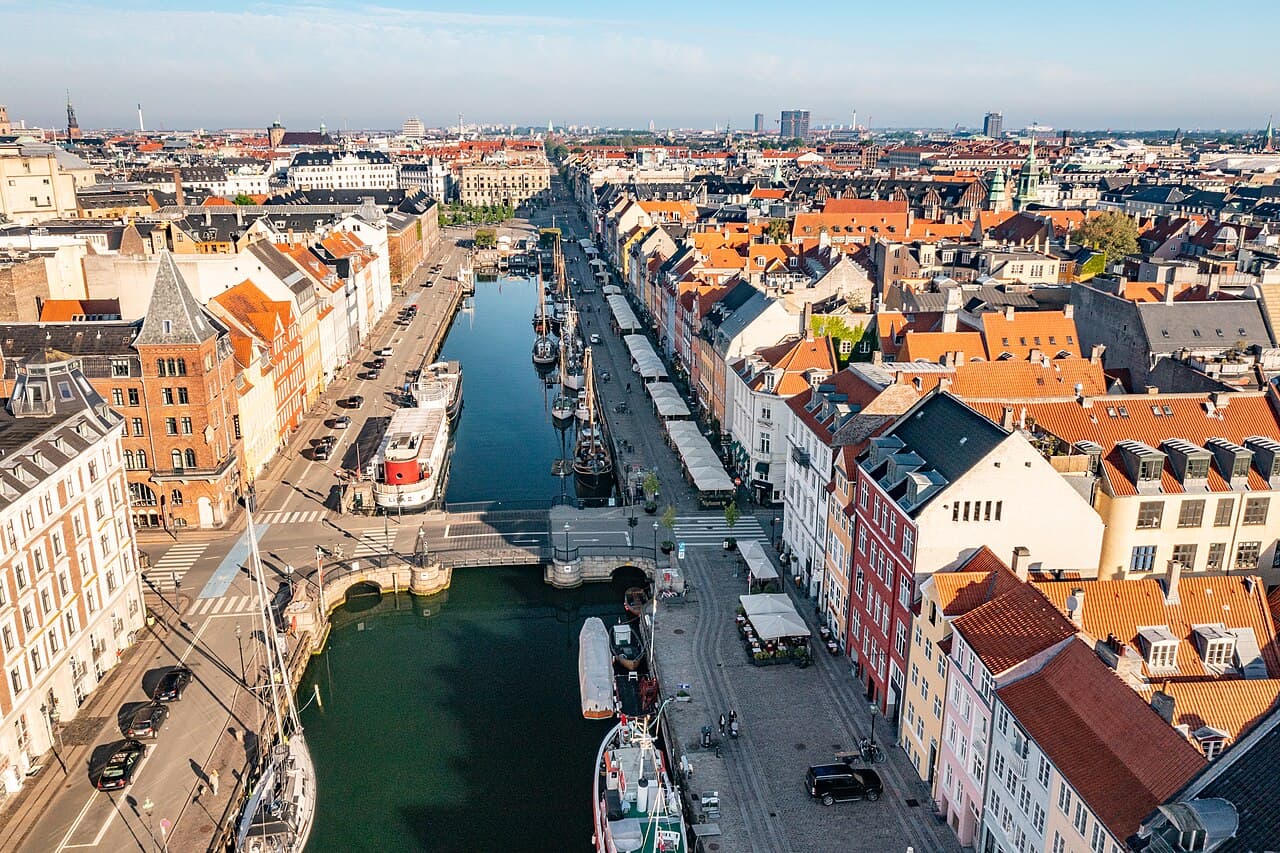
.jpg%2F1280px-Nyhavn_17-5%252C_Copenhagen_2018_(41842067514).jpg&w=3840&q=75) The seventeenth-century harbour of Nyhavn in Copenhagen, dug in the 1670s and long the home of sailors and, at number 67, the writer Hans Christian Andersen. CC BY 2.0, via Wikimedia Commons.
Denmark is a small, flat, sea-girt country at the base of the Scandinavian peninsula, made up of the Jutland peninsula, which carries Denmark's only land border with Germany, and an archipelago of around 400 named islands, of which Zealand and Funen are the largest. Nowhere is far from the coast, and no point rises higher than Møllehøj in eastern Jutland at just 171 metres. The landscape is a legacy of the last Ice Age: low moraine hills, heathland, beech woods and a shifting coastline of dunes, fjords and tidal flats. With about six million people across roughly 43,000 square kilometres, Denmark is densely settled but rarely crowded, and the bicycle, the wind turbine and the welfare state have become its unofficial emblems.
Politically, Denmark is a constitutional monarchy and one of the oldest continuous kingdoms in the world, its royal line traced back to Gorm the Old in the tenth century. The current sovereign is King Frederik X, who acceded on 14 January 2024 after his mother, Queen Margrethe II, became the first Danish monarch in nearly nine hundred years to abdicate voluntarily. Real power rests with the Folketing, the 179-seat parliament that has governed under a written constitution since the June Constitution of 1849. Denmark is more than the country most people picture: through the Rigsfællesskabet, the Danish Realm, it is joined in a single kingdom with the self-governing Faroe Islands and Greenland, so that the state stretches from the North Sea to the Arctic. It has been a member of the European Union since 1973, while keeping its own currency, the krone.
Copenhagen. The capital grew from a fishing village that Bishop Absalon fortified in 1167, and its very name, København, means "merchants' harbour." Today it is the seat of the monarchy at Christiansborg and Amalienborg, and a city that wears its memory openly: the Assistens Cemetery in Nørrebro is both a public park and the resting place of Hans Christian Andersen, Søren Kierkegaard and Niels Bohr, while the Marble Church and the eighteenth-century Frederiksstaden quarter frame the royal district. The pastel gables of Nyhavn and the harbour bathing that now fills its once-industrial waters show a city that has repeatedly reinvented itself without erasing its past.
Aarhus. Denmark's second city, on the east coast of Jutland, began as the Viking settlement of Aros. It keeps that long memory in Den Gamle By, one of the world's first open-air museums of urban history, and in the Moesgaard Museum, whose most haunting exhibit is the Grauballe Man, an Iron Age body preserved so completely in a bog that his fingerprints can still be read. The ARoS art museum and its rainbow rooftop walkway have made the city a modern cultural capital.
Odense. The main city of Funen and the birthplace of Hans Christian Andersen in 1805, Odense builds much of its identity around the fairy-tale writer, with a museum quarter devoted to him. Its name means "Odin's sanctuary," a reminder of the pre-Christian worship once centred there, and the Nonnebakken ring fortress beneath the modern city is one of Harald Bluetooth's Viking strongholds.
Roskilde. For centuries the royal and ecclesiastical capital of Denmark, Roskilde holds the brick Gothic cathedral that has been the burial church of Danish monarchs since the fifteenth century. On its fjord, the Viking Ship Museum displays the five Skuldelev ships, deliberately sunk around 1070 to block the channel and raised by archaeologists in 1962. Each summer the city hosts one of Northern Europe's largest music festivals.
Ribe. In southwest Jutland, Ribe is generally reckoned the oldest town in Denmark and in Scandinavia, a trading place since around the year 700. Its cathedral, cobbled lanes and the storks that nest on its rooftops make it a living museum of the medieval north, and its Viking market recalls the merchants who first gave it life.
Denmark's deep past is written into its soil and its bogs. Bronze Age farmers buried their dead in oak coffins under earthen mounds, leaving behind the Egtved Girl and the extraordinary Trundholm Sun Chariot, a gilded bronze disc drawn by a horse, cast around 1400 BC. Iron Age communities left the bog bodies, among them the Tollund Man, whose calm, tanned face survived two thousand years in a Jutland peat bog. From the eighth century the Danes entered history as Vikings, raiding, trading and settling from the North Atlantic to the rivers of Russia, ruling the Danelaw in England and, under Cnut the Great in the eleventh century, holding a North Sea empire of Denmark, England and Norway. It was in this age that Gorm the Old and his son Harald Bluetooth united the kingdom and, at Jelling around 965, recorded its Christian conversion in stone.
The medieval and early modern centuries bound Denmark to its neighbours and then pared it back. Queen Margaret I forged the Kalmar Union of 1397, joining Denmark, Norway and Sweden under a single crown, an arrangement Denmark dominated until Sweden broke away in 1523. The Reformation reached Denmark in 1536, when Christian III made the Lutheran church the state religion, dissolved the monasteries and, in the same reforming spirit, set the church to keeping records of its people. Absolute monarchy was established in 1660 and lasted until the peaceful adoption of the 1849 constitution. The nineteenth century was an age of loss and consolidation: Denmark was forced to cede Norway in 1814, and in 1864 it was defeated by Prussia and Austria and lost the duchies of Schleswig and Holstein, a national trauma centred on the battle of Dybbøl that shrank the country to something close to its present borders. The twentieth century brought German occupation from 1940 to 1945, the celebrated rescue of nearly all of Denmark's Jews in October 1943, liberation in May 1945, and the building of the comprehensive welfare state that still defines Danish society.
The seventeenth-century harbour of Nyhavn in Copenhagen, dug in the 1670s and long the home of sailors and, at number 67, the writer Hans Christian Andersen. CC BY 2.0, via Wikimedia Commons.
Denmark is a small, flat, sea-girt country at the base of the Scandinavian peninsula, made up of the Jutland peninsula, which carries Denmark's only land border with Germany, and an archipelago of around 400 named islands, of which Zealand and Funen are the largest. Nowhere is far from the coast, and no point rises higher than Møllehøj in eastern Jutland at just 171 metres. The landscape is a legacy of the last Ice Age: low moraine hills, heathland, beech woods and a shifting coastline of dunes, fjords and tidal flats. With about six million people across roughly 43,000 square kilometres, Denmark is densely settled but rarely crowded, and the bicycle, the wind turbine and the welfare state have become its unofficial emblems.
Politically, Denmark is a constitutional monarchy and one of the oldest continuous kingdoms in the world, its royal line traced back to Gorm the Old in the tenth century. The current sovereign is King Frederik X, who acceded on 14 January 2024 after his mother, Queen Margrethe II, became the first Danish monarch in nearly nine hundred years to abdicate voluntarily. Real power rests with the Folketing, the 179-seat parliament that has governed under a written constitution since the June Constitution of 1849. Denmark is more than the country most people picture: through the Rigsfællesskabet, the Danish Realm, it is joined in a single kingdom with the self-governing Faroe Islands and Greenland, so that the state stretches from the North Sea to the Arctic. It has been a member of the European Union since 1973, while keeping its own currency, the krone.
Copenhagen. The capital grew from a fishing village that Bishop Absalon fortified in 1167, and its very name, København, means "merchants' harbour." Today it is the seat of the monarchy at Christiansborg and Amalienborg, and a city that wears its memory openly: the Assistens Cemetery in Nørrebro is both a public park and the resting place of Hans Christian Andersen, Søren Kierkegaard and Niels Bohr, while the Marble Church and the eighteenth-century Frederiksstaden quarter frame the royal district. The pastel gables of Nyhavn and the harbour bathing that now fills its once-industrial waters show a city that has repeatedly reinvented itself without erasing its past.
Aarhus. Denmark's second city, on the east coast of Jutland, began as the Viking settlement of Aros. It keeps that long memory in Den Gamle By, one of the world's first open-air museums of urban history, and in the Moesgaard Museum, whose most haunting exhibit is the Grauballe Man, an Iron Age body preserved so completely in a bog that his fingerprints can still be read. The ARoS art museum and its rainbow rooftop walkway have made the city a modern cultural capital.
Odense. The main city of Funen and the birthplace of Hans Christian Andersen in 1805, Odense builds much of its identity around the fairy-tale writer, with a museum quarter devoted to him. Its name means "Odin's sanctuary," a reminder of the pre-Christian worship once centred there, and the Nonnebakken ring fortress beneath the modern city is one of Harald Bluetooth's Viking strongholds.
Roskilde. For centuries the royal and ecclesiastical capital of Denmark, Roskilde holds the brick Gothic cathedral that has been the burial church of Danish monarchs since the fifteenth century. On its fjord, the Viking Ship Museum displays the five Skuldelev ships, deliberately sunk around 1070 to block the channel and raised by archaeologists in 1962. Each summer the city hosts one of Northern Europe's largest music festivals.
Ribe. In southwest Jutland, Ribe is generally reckoned the oldest town in Denmark and in Scandinavia, a trading place since around the year 700. Its cathedral, cobbled lanes and the storks that nest on its rooftops make it a living museum of the medieval north, and its Viking market recalls the merchants who first gave it life.
Denmark's deep past is written into its soil and its bogs. Bronze Age farmers buried their dead in oak coffins under earthen mounds, leaving behind the Egtved Girl and the extraordinary Trundholm Sun Chariot, a gilded bronze disc drawn by a horse, cast around 1400 BC. Iron Age communities left the bog bodies, among them the Tollund Man, whose calm, tanned face survived two thousand years in a Jutland peat bog. From the eighth century the Danes entered history as Vikings, raiding, trading and settling from the North Atlantic to the rivers of Russia, ruling the Danelaw in England and, under Cnut the Great in the eleventh century, holding a North Sea empire of Denmark, England and Norway. It was in this age that Gorm the Old and his son Harald Bluetooth united the kingdom and, at Jelling around 965, recorded its Christian conversion in stone.
The medieval and early modern centuries bound Denmark to its neighbours and then pared it back. Queen Margaret I forged the Kalmar Union of 1397, joining Denmark, Norway and Sweden under a single crown, an arrangement Denmark dominated until Sweden broke away in 1523. The Reformation reached Denmark in 1536, when Christian III made the Lutheran church the state religion, dissolved the monasteries and, in the same reforming spirit, set the church to keeping records of its people. Absolute monarchy was established in 1660 and lasted until the peaceful adoption of the 1849 constitution. The nineteenth century was an age of loss and consolidation: Denmark was forced to cede Norway in 1814, and in 1864 it was defeated by Prussia and Austria and lost the duchies of Schleswig and Holstein, a national trauma centred on the battle of Dybbøl that shrank the country to something close to its present borders. The twentieth century brought German occupation from 1940 to 1945, the celebrated rescue of nearly all of Denmark's Jews in October 1943, liberation in May 1945, and the building of the comprehensive welfare state that still defines Danish society.
 "View from Kronborg Rampart" by Christoffer Wilhelm Eckersberg, the father of the Danish Golden Age of painting, looking out over the Øresund from Hamlet's castle at Elsinore. Public domain, via Wikimedia Commons.
The name Denmark joins two old elements: "Dan," the name of the people, and "mark," a march or borderland, the wooded frontier zone that once separated the Danes from their southern neighbours. The word appears in its earliest native form, "tanmaurk," carved into the great Jelling stone in the tenth century, which makes Denmark one of the few countries that can point to the physical object on which its name was first written down. Danish itself is a North Germanic language of the East Norse branch, closely related to Swedish and Norwegian; a Dane, a Swede and a Norwegian can often read one another's newspapers, though spoken Danish, with its softened consonants and the catch in the throat known as the stød, is notoriously hard for outsiders to follow.
The map of Denmark is a record of settlement in miniature. Village names ending in "-by," "-toft," "-lev," "-inge" and "-sted" mark successive layers of habitation reaching back to the Iron Age and the Viking period, and the same "-by" ending, carried by Danish settlers, still dots the map of northern and eastern England. Within the wider realm, Denmark is home to several languages: standard Danish, the recognised German minority of South Jutland near the border, and, across the sea, Faroese, a descendant of Old Norse spoken in the Faroe Islands, and Greenlandic, or Kalaallisut, an Inuit language of the Eskimo-Aleut family that is the official language of Greenland. The story of the Danish language is thus also the story of a small kingdom that once reached far beyond its present shores.
If one word has come to stand for Danish culture abroad it is hygge, the sense of warm, unhurried, candlelit companionship that Danes cultivate through the long dark winters, though Danes themselves treat it as ordinary life rather than a philosophy. More concretely, Denmark has shaped the modern world through design. The clean functional lines of Danish Modern furniture by Arne Jacobsen, Hans Wegner and Kaare Klint, the lamps of Poul Henningsen, the silver of Georg Jensen and, above all, the plastic brick that the Christiansen family began making in the Jutland town of Billund in the 1930s under the name LEGO, from the Danish "leg godt," play well, have carried a distinctly Danish idea of the well-made everyday object around the globe.
The table is central to Danish identity: open-faced smørrebrød on dense rye bread, herring and aquavit, roast pork and the Christmas goose, and the New Nordic cuisine that René Redzepi's Copenhagen restaurant Noma built on foraging and the northern seasons. The literary inheritance runs from Ludvig Holberg through Hans Christian Andersen's fairy tales and Kierkegaard's philosophy to Karen Blixen, who wrote Out of Africa at her house at Rungstedlund. In painting, the Danish Golden Age of the early nineteenth century and the later Skagen colony gave the country a luminous national art, while Carl Nielsen gave it a symphonic voice and the Dogme 95 movement of Lars von Trier and Thomas Vinterberg renewed its cinema. The calendar keeps older rhythms too: bonfires and the burning of a straw witch on Sankt Hans Aften at midsummer, the costumed barrel-beating of Fastelavn, and the long family julefrokost of the Christmas season.
"View from Kronborg Rampart" by Christoffer Wilhelm Eckersberg, the father of the Danish Golden Age of painting, looking out over the Øresund from Hamlet's castle at Elsinore. Public domain, via Wikimedia Commons.
The name Denmark joins two old elements: "Dan," the name of the people, and "mark," a march or borderland, the wooded frontier zone that once separated the Danes from their southern neighbours. The word appears in its earliest native form, "tanmaurk," carved into the great Jelling stone in the tenth century, which makes Denmark one of the few countries that can point to the physical object on which its name was first written down. Danish itself is a North Germanic language of the East Norse branch, closely related to Swedish and Norwegian; a Dane, a Swede and a Norwegian can often read one another's newspapers, though spoken Danish, with its softened consonants and the catch in the throat known as the stød, is notoriously hard for outsiders to follow.
The map of Denmark is a record of settlement in miniature. Village names ending in "-by," "-toft," "-lev," "-inge" and "-sted" mark successive layers of habitation reaching back to the Iron Age and the Viking period, and the same "-by" ending, carried by Danish settlers, still dots the map of northern and eastern England. Within the wider realm, Denmark is home to several languages: standard Danish, the recognised German minority of South Jutland near the border, and, across the sea, Faroese, a descendant of Old Norse spoken in the Faroe Islands, and Greenlandic, or Kalaallisut, an Inuit language of the Eskimo-Aleut family that is the official language of Greenland. The story of the Danish language is thus also the story of a small kingdom that once reached far beyond its present shores.
If one word has come to stand for Danish culture abroad it is hygge, the sense of warm, unhurried, candlelit companionship that Danes cultivate through the long dark winters, though Danes themselves treat it as ordinary life rather than a philosophy. More concretely, Denmark has shaped the modern world through design. The clean functional lines of Danish Modern furniture by Arne Jacobsen, Hans Wegner and Kaare Klint, the lamps of Poul Henningsen, the silver of Georg Jensen and, above all, the plastic brick that the Christiansen family began making in the Jutland town of Billund in the 1930s under the name LEGO, from the Danish "leg godt," play well, have carried a distinctly Danish idea of the well-made everyday object around the globe.
The table is central to Danish identity: open-faced smørrebrød on dense rye bread, herring and aquavit, roast pork and the Christmas goose, and the New Nordic cuisine that René Redzepi's Copenhagen restaurant Noma built on foraging and the northern seasons. The literary inheritance runs from Ludvig Holberg through Hans Christian Andersen's fairy tales and Kierkegaard's philosophy to Karen Blixen, who wrote Out of Africa at her house at Rungstedlund. In painting, the Danish Golden Age of the early nineteenth century and the later Skagen colony gave the country a luminous national art, while Carl Nielsen gave it a symphonic voice and the Dogme 95 movement of Lars von Trier and Thomas Vinterberg renewed its cinema. The calendar keeps older rhythms too: bonfires and the burning of a straw witch on Sankt Hans Aften at midsummer, the costumed barrel-beating of Fastelavn, and the long family julefrokost of the Christmas season.
 "Summer Evening on Skagen's Beach" (1899) by Peder Severin Krøyer, whose paintings of the northern light made the fishing town of Skagen a lasting emblem of Danish art. Public domain, via Wikimedia Commons.
Denmark's established church is the Evangelical Lutheran Church of Denmark, the Folkekirke or "people's church," to which the monarch must belong and of which around seven in ten Danes remain members, even as active belief has become the exception rather than the rule. Christianity arrived in stages from the ninth century and was made official at Jelling; the Reformation of 1536 turned the country Lutheran and dissolved its monasteries. The physical heritage of that faith is remarkable for so small a country: nearly two thousand whitewashed medieval parish churches, many with Romanesque cores and Gothic frescoes, stand at the centre of their villages, still owned and used by the church and still surrounded by their churchyards. The hymns of the nineteenth-century pastor, poet and reformer N. F. S. Grundtvig remain in daily use, and his vision of a warm, popular Christianity shaped the whole national culture.
Religious practice today is largely a matter of the great passages of life. Most Danes are baptised and confirmed, marry and are buried in the church, and fill it at Christmas, while attending little in between; the country is at once thoroughly Lutheran in its heritage and among the most secular in the world, with a fast-growing share reporting no religion. The largest minority faith is Islam, at roughly five per cent of the population, alongside Catholic, free-church and other communities. Older, stranger devotion lingers at the edges: the holy springs and votive customs of the Middle Ages, the round tower of Trinitatis in Copenhagen, and the great memory-sites of Jelling and Roskilde, where the sacred and the national have long been the same thing.
Denmark's memory of ordinary people rests, as in much of Protestant Europe, on the parish register. Danish clergy were keeping church books of baptisms, marriages and burials from the early seventeenth century, and a royal order of 1645–46 made them compulsory nationwide; combined with the population censuses, the folketællinger, taken from 1787 onward, they give Denmark a long and unusually complete record of its people, now the foundation of one of the country's most popular pastimes. Danish funerals are overwhelmingly Lutheran and, today, overwhelmingly followed by cremation; Danish even keeps two distinct words, begravelse for a burial and bisættelse for a service ending in cremation. The dead are then remembered in the churchyard, which in Denmark is often as much a garden as a graveyard. Copenhagen's Assistens Cemetery, laid out in 1760, is the clearest example, a leafy park where families picnic among the graves of the famous dead, and where the culture of the leased, carefully tended grave plot, weeded and planted with seasonal flowers, is on full display.
The calendar carries the work of mourning. All Saints' Day, Allehelgen, on the first Sunday of November, has been quietly revived across Denmark as a day to remember the year's dead: churches read aloud the names of those buried in the parish since the last All Saints, and families light candles at the graves as dusk falls. At Christmas, too, the cemeteries glow, as relatives set spruce, wreaths and candles on the graves of parents and grandparents. National remembrance keeps its own dates. The 1864 defeat at Dybbøl is fixed in memory by the old windmill on Dybbøl Banke, a national symbol above the trench lines, while the peaceful return of North Schleswig to Denmark after a 1920 plebiscite, the Genforening or reunification, is commemorated as the moment the wound of 1864 partly healed.
"Summer Evening on Skagen's Beach" (1899) by Peder Severin Krøyer, whose paintings of the northern light made the fishing town of Skagen a lasting emblem of Danish art. Public domain, via Wikimedia Commons.
Denmark's established church is the Evangelical Lutheran Church of Denmark, the Folkekirke or "people's church," to which the monarch must belong and of which around seven in ten Danes remain members, even as active belief has become the exception rather than the rule. Christianity arrived in stages from the ninth century and was made official at Jelling; the Reformation of 1536 turned the country Lutheran and dissolved its monasteries. The physical heritage of that faith is remarkable for so small a country: nearly two thousand whitewashed medieval parish churches, many with Romanesque cores and Gothic frescoes, stand at the centre of their villages, still owned and used by the church and still surrounded by their churchyards. The hymns of the nineteenth-century pastor, poet and reformer N. F. S. Grundtvig remain in daily use, and his vision of a warm, popular Christianity shaped the whole national culture.
Religious practice today is largely a matter of the great passages of life. Most Danes are baptised and confirmed, marry and are buried in the church, and fill it at Christmas, while attending little in between; the country is at once thoroughly Lutheran in its heritage and among the most secular in the world, with a fast-growing share reporting no religion. The largest minority faith is Islam, at roughly five per cent of the population, alongside Catholic, free-church and other communities. Older, stranger devotion lingers at the edges: the holy springs and votive customs of the Middle Ages, the round tower of Trinitatis in Copenhagen, and the great memory-sites of Jelling and Roskilde, where the sacred and the national have long been the same thing.
Denmark's memory of ordinary people rests, as in much of Protestant Europe, on the parish register. Danish clergy were keeping church books of baptisms, marriages and burials from the early seventeenth century, and a royal order of 1645–46 made them compulsory nationwide; combined with the population censuses, the folketællinger, taken from 1787 onward, they give Denmark a long and unusually complete record of its people, now the foundation of one of the country's most popular pastimes. Danish funerals are overwhelmingly Lutheran and, today, overwhelmingly followed by cremation; Danish even keeps two distinct words, begravelse for a burial and bisættelse for a service ending in cremation. The dead are then remembered in the churchyard, which in Denmark is often as much a garden as a graveyard. Copenhagen's Assistens Cemetery, laid out in 1760, is the clearest example, a leafy park where families picnic among the graves of the famous dead, and where the culture of the leased, carefully tended grave plot, weeded and planted with seasonal flowers, is on full display.
The calendar carries the work of mourning. All Saints' Day, Allehelgen, on the first Sunday of November, has been quietly revived across Denmark as a day to remember the year's dead: churches read aloud the names of those buried in the parish since the last All Saints, and families light candles at the graves as dusk falls. At Christmas, too, the cemeteries glow, as relatives set spruce, wreaths and candles on the graves of parents and grandparents. National remembrance keeps its own dates. The 1864 defeat at Dybbøl is fixed in memory by the old windmill on Dybbøl Banke, a national symbol above the trench lines, while the peaceful return of North Schleswig to Denmark after a 1920 plebiscite, the Genforening or reunification, is commemorated as the moment the wound of 1864 partly healed.
 "A Funeral" (1891) by Anna Ancher, one of the Skagen painters, showing a mourning procession in the fishing town where she was born. Public domain, via Wikimedia Commons.
The twentieth century's wars gave Denmark its most solemn places of memory. At Ryvangen on the edge of Copenhagen, the Mindelunden memorial park holds the graves of resistance fighters executed by the German occupiers and the empty markers of those whose bodies were never returned; it is here that the official wreath-laying takes place each 4 May, the same evening that candles appear in windows across the country. The rescue of the Danish Jews in October 1943, when fishermen and ordinary citizens ferried some 7,200 people across the Øresund to safety in neutral Sweden, is remembered as a rare bright chapter of the occupation and is honoured at Yad Vashem and in Denmark alike. Denmark's older dead are memorialised in the landscape itself: some 250 Viking-age runestones, many of them raised explicitly in memory of a named relative, and more than twenty thousand protected prehistoric burial mounds scattered across fields and forests, so that in Denmark the dead are quite literally underfoot. The modern state continues the tradition, honouring soldiers killed in international missions with a national monument at the Kastellet, unveiled in 2011, and with the Armed Forces Flag Day held every 5 September.
Denmark's records are centralised, old and free, which is a rare combination. The National Archives publish the parish registers and the census returns through Arkivalieronline at no charge, and the volunteer-built Dansk Demografisk Database has transcribed a large share of the censuses so they can be searched by name rather than read page by page.
Parish registers were required from 1646 and survive widely from the eighteenth century. From 1814 every parish kept two copies in different hands and different buildings, one by the minister and one by the parish clerk, which is why Danish record loss is comparatively rare: fire took one copy and left the other.
The censuses, the folketællinger, begin in 1787 and are unusually rich for their date, naming every person in the household with age, occupation and marital status. The 1787 return is one of the earliest complete nominal censuses of any European country.
The Danish difficulty is the same as the Swedish and Norwegian one. Patronymics were the norm until a law of 1828 pushed fixed surnames, and in a country where a great many men were called Hans Jensen the way to identify the right one is the place and the household, not the name. Danish research is done by parish, and the first job is always to work out which parish.
Denmark has one of the oldest heritage traditions in the world. The National Museum in Copenhagen traces its origins to a royal commission for the preservation of antiquities founded in 1807, and it was here that Christian Jürgensen Thomsen devised the Three-Age System of Stone, Bronze and Iron ages that organised prehistory for the whole discipline of archaeology, and that Jens Jacob Worsaae pioneered scientific excavation. Today the state's Agency for Culture and Palaces, the Slots- og Kulturstyrelsen, administers a system of listed buildings, some nine thousand of them, and of protected ancient monuments, from burial mounds to runestones, safeguarded under conservation law since the early twentieth century. Open-air museums such as Frilandsmuseet north of Copenhagen preserve rural buildings moved from across the kingdom.
Denmark's UNESCO World Heritage Sites map the national story with precision. The Jelling mounds, runestones and church were inscribed in 1994, Roskilde Cathedral, the royal necropolis, in 1995, and Kronborg, the Renaissance castle at Elsinore known to the world as Hamlet's Elsinore, in 2000. To these have been added the fossil-rich cliffs of Stevns Klint, the tidal Wadden Sea shared with Germany and the Netherlands, the tidy Moravian settlement of Christiansfeld, the royal Par Force hunting landscape of North Zealand, and, in September 2023, the five Viking-Age ring fortresses of Harald Bluetooth, including Trelleborg and Aggersborg, whose uniform geometry testifies to the reach of the tenth-century Danish state. Beyond mainland Denmark, the realm's Greenlandic sites, the Ilulissat Icefjord and the Norse and Inuit farming landscapes of Kujataa and Aasivissuit-Nipisat, extend the country's heritage into the Arctic.
The digitisation of Denmark's records has turned genealogy into a mass pursuit. The Danish National Archives, Rigsarkivet, has put its core sources online through Arkivalieronline, a free service offering scanned church books, the population censuses from 1787 to 1940, probate records and military levying rolls, images that volunteers of the Danish Demographic Database have transcribed and indexed name by name so that a family can be followed back through three centuries from a laptop. Newspaper heritage has moved online too: Mediestream, run by the Royal Danish Library, has digitised many millions of pages of Danish newspapers, restoring the obituaries and local reports in which ordinary lives were recorded.
The material and monumental heritage is being mapped in parallel. "Fund og Fortidsminder," the national database of archaeological finds and ancient monuments, records the location and status of tens of thousands of sites, from Bronze Age mounds to medieval churches, while the DigDag project reconstructs the changing administrative geography of the kingdom so that historical records can be tied to place. The academic portal danmarkshistorien.dk, run by Aarhus University, offers a reliable, sourced account of the national past to any reader, and the Royal Danish Library's digitised manuscripts and its Archive for Danish Literature make the country's written heritage, from medieval codices to modern poets, openly available. Together these projects have made Denmark's archive one of the most accessible in Europe.
Danish design and architecture have a fresh global champion in Bjarke Ingels and his firm BIG, whose buildings rise from Copenhagen to New York, while the "Nordic Noir" television dramas The Killing and Borgen carried the country's landscapes, politics and mood to audiences worldwide and helped define a whole international genre. New Nordic cuisine reshaped fine dining, and LEGO, with its films, theme parks and games, remains one of the most recognised brands on earth. Danish musicians and the enduring appeal of hygge keep the country disproportionately visible.
Beneath the soft power lie live debates about memory and belonging. Immigration and integration have been among the most contested issues in Danish politics for a generation, forcing a country proud of its homogeneity to argue about what Danishness means. Within the realm, Greenland and the Faroe Islands press for greater autonomy and a fuller reckoning with the colonial past, and Denmark has begun to confront that history directly, including debates over the display and return of cultural objects. The country that so carefully preserves its runestones and church books is increasingly being asked whose heritage those records represent, and how a modern, plural Denmark should remember a past that was not always gentle.
The night the Jews were ferried out. In early October 1943, warned that the occupying Germans planned to round up Denmark's Jews, ordinary Danes, fishermen, doctors, clergy and neighbours, hid their Jewish compatriots and carried some 7,200 of them by boat across the Øresund to safety in Sweden, so that the overwhelming majority survived the war. The rescue is preserved in memory as a model of civic courage, honoured at Yad Vashem and told and retold in Danish schools.
The ships raised from the fjord. In 1962 archaeologists built a coffer-dam in Roskilde Fjord and recovered the five Skuldelev ships, Viking vessels deliberately scuttled around 1070 to defend the town. Painstakingly conserved and reconstructed, they became the heart of the Viking Ship Museum, and in 2007 a full-scale replica, the Sea Stallion, sailed from Roskilde to Dublin, turning archaeology into a living experiment in Viking seafaring.
The stones under glass. The two Jelling runestones, exposed for a thousand years to Danish weather, were by the twenty-first century visibly eroding. In 2011 they were enclosed in climate-controlled glass casings on the spot where they stand, a careful compromise that keeps the country's "baptismal certificate" in its original place while protecting the carving for future generations.
An archive opened to all. The Danish National Archives' Arkivalieronline, built up over the past two decades and offered free of charge, has placed the country's church books and censuses within reach of anyone, and the volunteer transcribers of the Danish Demographic Database have indexed them, making Danish genealogy one of the most democratic and widely practised in the world.
A wound partly healed. In 1920, after a plebiscite drew a new border, North Schleswig returned to Denmark, reversing part of the loss of 1864. The Genforening is still marked with festivals and monuments, and its centenary in 2020 reaffirmed a rare thing in European history: a contested border settled peacefully, by a vote, and remembered as a reconciliation rather than a conquest.
"A Funeral" (1891) by Anna Ancher, one of the Skagen painters, showing a mourning procession in the fishing town where she was born. Public domain, via Wikimedia Commons.
The twentieth century's wars gave Denmark its most solemn places of memory. At Ryvangen on the edge of Copenhagen, the Mindelunden memorial park holds the graves of resistance fighters executed by the German occupiers and the empty markers of those whose bodies were never returned; it is here that the official wreath-laying takes place each 4 May, the same evening that candles appear in windows across the country. The rescue of the Danish Jews in October 1943, when fishermen and ordinary citizens ferried some 7,200 people across the Øresund to safety in neutral Sweden, is remembered as a rare bright chapter of the occupation and is honoured at Yad Vashem and in Denmark alike. Denmark's older dead are memorialised in the landscape itself: some 250 Viking-age runestones, many of them raised explicitly in memory of a named relative, and more than twenty thousand protected prehistoric burial mounds scattered across fields and forests, so that in Denmark the dead are quite literally underfoot. The modern state continues the tradition, honouring soldiers killed in international missions with a national monument at the Kastellet, unveiled in 2011, and with the Armed Forces Flag Day held every 5 September.
Denmark's records are centralised, old and free, which is a rare combination. The National Archives publish the parish registers and the census returns through Arkivalieronline at no charge, and the volunteer-built Dansk Demografisk Database has transcribed a large share of the censuses so they can be searched by name rather than read page by page.
Parish registers were required from 1646 and survive widely from the eighteenth century. From 1814 every parish kept two copies in different hands and different buildings, one by the minister and one by the parish clerk, which is why Danish record loss is comparatively rare: fire took one copy and left the other.
The censuses, the folketællinger, begin in 1787 and are unusually rich for their date, naming every person in the household with age, occupation and marital status. The 1787 return is one of the earliest complete nominal censuses of any European country.
The Danish difficulty is the same as the Swedish and Norwegian one. Patronymics were the norm until a law of 1828 pushed fixed surnames, and in a country where a great many men were called Hans Jensen the way to identify the right one is the place and the household, not the name. Danish research is done by parish, and the first job is always to work out which parish.
Denmark has one of the oldest heritage traditions in the world. The National Museum in Copenhagen traces its origins to a royal commission for the preservation of antiquities founded in 1807, and it was here that Christian Jürgensen Thomsen devised the Three-Age System of Stone, Bronze and Iron ages that organised prehistory for the whole discipline of archaeology, and that Jens Jacob Worsaae pioneered scientific excavation. Today the state's Agency for Culture and Palaces, the Slots- og Kulturstyrelsen, administers a system of listed buildings, some nine thousand of them, and of protected ancient monuments, from burial mounds to runestones, safeguarded under conservation law since the early twentieth century. Open-air museums such as Frilandsmuseet north of Copenhagen preserve rural buildings moved from across the kingdom.
Denmark's UNESCO World Heritage Sites map the national story with precision. The Jelling mounds, runestones and church were inscribed in 1994, Roskilde Cathedral, the royal necropolis, in 1995, and Kronborg, the Renaissance castle at Elsinore known to the world as Hamlet's Elsinore, in 2000. To these have been added the fossil-rich cliffs of Stevns Klint, the tidal Wadden Sea shared with Germany and the Netherlands, the tidy Moravian settlement of Christiansfeld, the royal Par Force hunting landscape of North Zealand, and, in September 2023, the five Viking-Age ring fortresses of Harald Bluetooth, including Trelleborg and Aggersborg, whose uniform geometry testifies to the reach of the tenth-century Danish state. Beyond mainland Denmark, the realm's Greenlandic sites, the Ilulissat Icefjord and the Norse and Inuit farming landscapes of Kujataa and Aasivissuit-Nipisat, extend the country's heritage into the Arctic.
The digitisation of Denmark's records has turned genealogy into a mass pursuit. The Danish National Archives, Rigsarkivet, has put its core sources online through Arkivalieronline, a free service offering scanned church books, the population censuses from 1787 to 1940, probate records and military levying rolls, images that volunteers of the Danish Demographic Database have transcribed and indexed name by name so that a family can be followed back through three centuries from a laptop. Newspaper heritage has moved online too: Mediestream, run by the Royal Danish Library, has digitised many millions of pages of Danish newspapers, restoring the obituaries and local reports in which ordinary lives were recorded.
The material and monumental heritage is being mapped in parallel. "Fund og Fortidsminder," the national database of archaeological finds and ancient monuments, records the location and status of tens of thousands of sites, from Bronze Age mounds to medieval churches, while the DigDag project reconstructs the changing administrative geography of the kingdom so that historical records can be tied to place. The academic portal danmarkshistorien.dk, run by Aarhus University, offers a reliable, sourced account of the national past to any reader, and the Royal Danish Library's digitised manuscripts and its Archive for Danish Literature make the country's written heritage, from medieval codices to modern poets, openly available. Together these projects have made Denmark's archive one of the most accessible in Europe.
Danish design and architecture have a fresh global champion in Bjarke Ingels and his firm BIG, whose buildings rise from Copenhagen to New York, while the "Nordic Noir" television dramas The Killing and Borgen carried the country's landscapes, politics and mood to audiences worldwide and helped define a whole international genre. New Nordic cuisine reshaped fine dining, and LEGO, with its films, theme parks and games, remains one of the most recognised brands on earth. Danish musicians and the enduring appeal of hygge keep the country disproportionately visible.
Beneath the soft power lie live debates about memory and belonging. Immigration and integration have been among the most contested issues in Danish politics for a generation, forcing a country proud of its homogeneity to argue about what Danishness means. Within the realm, Greenland and the Faroe Islands press for greater autonomy and a fuller reckoning with the colonial past, and Denmark has begun to confront that history directly, including debates over the display and return of cultural objects. The country that so carefully preserves its runestones and church books is increasingly being asked whose heritage those records represent, and how a modern, plural Denmark should remember a past that was not always gentle.
The night the Jews were ferried out. In early October 1943, warned that the occupying Germans planned to round up Denmark's Jews, ordinary Danes, fishermen, doctors, clergy and neighbours, hid their Jewish compatriots and carried some 7,200 of them by boat across the Øresund to safety in Sweden, so that the overwhelming majority survived the war. The rescue is preserved in memory as a model of civic courage, honoured at Yad Vashem and told and retold in Danish schools.
The ships raised from the fjord. In 1962 archaeologists built a coffer-dam in Roskilde Fjord and recovered the five Skuldelev ships, Viking vessels deliberately scuttled around 1070 to defend the town. Painstakingly conserved and reconstructed, they became the heart of the Viking Ship Museum, and in 2007 a full-scale replica, the Sea Stallion, sailed from Roskilde to Dublin, turning archaeology into a living experiment in Viking seafaring.
The stones under glass. The two Jelling runestones, exposed for a thousand years to Danish weather, were by the twenty-first century visibly eroding. In 2011 they were enclosed in climate-controlled glass casings on the spot where they stand, a careful compromise that keeps the country's "baptismal certificate" in its original place while protecting the carving for future generations.
An archive opened to all. The Danish National Archives' Arkivalieronline, built up over the past two decades and offered free of charge, has placed the country's church books and censuses within reach of anyone, and the volunteer transcribers of the Danish Demographic Database have indexed them, making Danish genealogy one of the most democratic and widely practised in the world.
A wound partly healed. In 1920, after a plebiscite drew a new border, North Schleswig returned to Denmark, reversing part of the loss of 1864. The Genforening is still marked with festivals and monuments, and its centenary in 2020 reaffirmed a rare thing in European history: a contested border settled peacefully, by a vote, and remembered as a reconciliation rather than a conquest.
National Overview
Notable Cities
Historical Foundations
Linguistic and Etymological Roots
Cultural Identity
Religion and Spirituality
Remembrance and Mourning Traditions
Tracing a Family in Denmark
Heritage Preservation Efforts
Digital Heritage
Contemporary Cultural Influences
Success Stories
References and resources
- UNESCO World Heritage Centre, Denmark, the state-party page listing Jelling, Roskilde, Kronborg, the Viking ring fortresses and Denmark's other inscribed sites.
- Nationalmuseet, The National Museum of Denmark, the country's central museum, birthplace of the Three-Age System and keeper of the bog bodies and Sun Chariot.
- Rigsarkivet, Arkivalieronline, the Danish National Archives, whose free service offers church books, censuses and probate records online.
- Slots- og Kulturstyrelsen, Agency for Culture and Palaces, the body administering Denmark's listed buildings and protected ancient monuments.
- The Danish Monarchy, Kongehuset, the official site of the royal house, from Gorm the Old to King Frederik X.
- Viking Ship Museum, Roskilde, home of the five Skuldelev ships and of experimental Viking seafaring.
- danmarkshistorien.dk, Aarhus University, a sourced, scholarly account of Danish history for the general reader.
- Mindelunden i Ryvangen, the memorial park for the Danish resistance fighters of the Second World War.
- Encyclopaedia Britannica, Denmark, geography, history and political background.