Heritage · Country
Saint Barthelemy Culture and Heritage
France handed this island to Sweden in 1784 in exchange for trading rights in Gothenburg, and Sweden kept it until 1878, which is why a French Caribbean capital is called Gustavia. This is a guide to Saint Barthélemy's heritage, from the Swedish archive and the bell tower of 1799 to the quichenotte bonnets of Corossol.Written to last.
By Confinity Heritage Editorial · Updated 2026-08-17 · 8-minute readQuiet tools, kept out of the way.
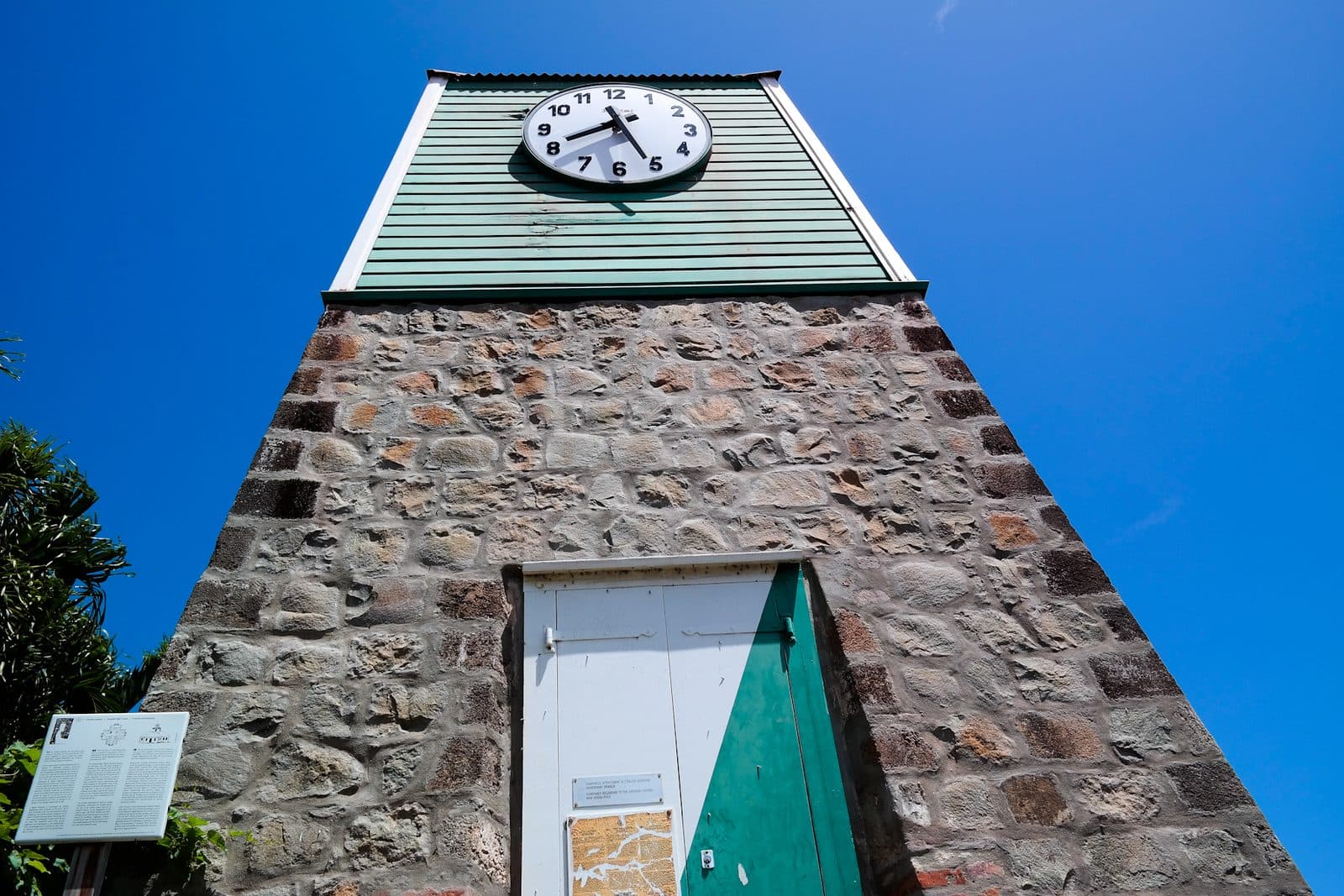
The capital of this French island is called Gustavia, after Gustav III of Sweden. The streets around the harbour still carry the grid a Swedish surveyor laid out, a stone bell tower of 1799 stands above the town with a clock added in 1931, three Swedish crowns sit on the collectivity's arms beside the French lilies and the Maltese cross, and the entire administrative archive of the island between 1785 and 1878 is in Swedish. No other place in the Caribbean has that particular inheritance, because no other place was ever Swedish.
Saint Barthélemy is small, dry and steep, was never rich in the way its neighbours were, and has for the last seventy years been one of the most expensive pieces of ground in the western hemisphere. Underneath the airport traffic and the villa market there is a population descended from seventeenth-century Norman, Breton and Poitevin settlers who kept their own French for three hundred years, buried their dead in family vaults at the water's edge, and wore a stiff white bonnet to gather firewood.
Saint Barthélemy covers roughly 21 square kilometres of dry volcanic hill about 30 kilometres south-east of Saint Martin, with a scatter of offshore islets and no permanent stream. The 2023 count was about 10,600 people (Wikipedia). Water comes from cisterns and a desalination plant, and that constraint shaped the island's settlement, its agriculture and the size of its population for three centuries.
Politically it is a collectivité d'outre-mer of France under article 74 of the constitution, created on 15 July 2007 when it left Guadeloupe, which had run it since 1878. Unlike Saint Martin, which separated at the same moment, Saint Barthélemy went on in 2012 to leave the European Union's outermost-region status and become an overseas country and territory, so European law no longer applies here in the way it does thirty kilometres north. The collectivity levies its own taxes, the euro is the currency, French is official, and the population is largely Catholic with an old Anglican minority.
Gustavia. The only town, wrapped around a deep natural harbour on the leeward coast, and the one place on the island that was planned rather than grown. The Swedes renamed it from Le Carénage between late 1786 and early 1787, laid out streets on a grid, walled the harbour and built in stone. What survives from that period is the bell tower above rue Lubin Brin, the shells of the forts on the hills, warehouse buildings along the quay, and the Wall House at the head of the harbour.
 Gustavia is named for a king of Sweden, which held the island from 1784 to 1878, and the Swedish street names and warehouse plots are still there under a French administration. Photograph by Mattes, CC BY 2.0 DE, via Wikimedia Commons.
Lorient. On the windward side, and the oldest French settlement on the island, founded in 1648 by colonists sent from Saint Kitts. Its church and cemetery lie behind the beach, with the sea on one side of the cemetery wall.
Corossol. A fishing village in a cove north of Gustavia, where the island's Norman-derived speech, its straw plaiting from latanier palm leaves and its women's headdress survived longest. Boats are still drawn up on the beach.
Flamands, Colombier, Saint-Jean and Public. Flamands and Colombier at the western end are the other leeward villages of the old settler families, Colombier reached on foot or by a track. Saint-Jean holds the airstrip, and Public is the fishing quarter beside Gustavia.
Arawakan-speaking people from the mainland used the island, which they called Ouanalao, though the absence of fresh water makes long settlement unlikely; Columbus sighted it in 1493 and named it for his brother Bartolomeo. French colonists arrived from Saint Kitts in 1648 and settled at Lorient. The Knights of Malta held the island between 1651 and 1665, which is why a Maltese cross sits on the arms to this day (Wikipedia). A Carib raid wiped out the first settlement in 1656, and the island was resettled at the end of the 1650s by families from the western provinces of France, mostly Normandy, Brittany and Poitou.
What those families found was thin soil, no water and no room. Sugar could not be grown at scale, so the island never developed the plantation economy of Guadeloupe or Saint Kitts, and the enslaved population it held was correspondingly smaller, working in salt, cotton, fishing, provision grounds and domestic service. The result is a demographic history unlike almost any other island in the region: a white peasantry farming and fishing for itself in the villages, alongside a smaller population of African descent concentrated around the town.
Then came the trade. In 1784 Louis XVI ceded the island to Gustav III of Sweden in exchange for warehousing and trading rights at Gothenburg, and Sweden took possession in March 1785. It declared the harbour a free port, renamed the town Gustavia, chartered the Swedish West India Company in 1786, and watched a village of a few hundred become a wartime entrepôt of several thousand, prospering through the American and Napoleonic wars on the business of neutral shipping.
That business included the traffic in human beings, and the point should be put plainly. The Swedish West India Company operated out of Gustavia from 1786 to 1805 and was the principal vehicle of Swedish participation in the Atlantic slave trade (Wikipedia). The free port existed to move cargo without duty, enslaved Africans were among that cargo, the crown took its revenue from the arrangement, and Swedish law here regulated slavery for sixty years. Sweden made the slave trade illegal in 1813 under the Treaty of Stockholm with Britain, but slavery itself continued until the state had raised the money to compensate owners, and the enslaved population was freed on 9 October 1847. Sweden's Caribbean colony is often described as an oddity; it was a slave colony, briefly and profitably.
The boom did not survive the peace. Trade collapsed after 1815, a hurricane in August 1837 wrecked much of Gustavia, and by the 1870s the island was a cost to the Swedish treasury. In October 1877 the government put the question to the islanders: of 351 who voted, all but one chose France (Wikipedia). A treaty was signed on 10 August 1877, France paid 320,000 francs and took on the pensions of the Swedish officials, and the transfer took effect on 16 March 1878. Saint Barthélemy was then attached to Guadeloupe, where it stayed for 129 years.
French is the language of the collectivity, but the island carries several varieties at once, and their distribution follows the ridge that divides it. In the leeward parishes, Sous le Vent, taking in Corossol, Flamands, Colombier, Public and Anse des Cayes, older people speak Saint Barth Patois, a French dialect descended from the popular French of the seventeenth and eighteenth centuries with vocabulary from Norman, Breton and Poitevin sailors and some borrowing from the English of the neighbouring islands; a count in the 1990s put the speakers at between five and seven hundred, mostly elderly (Wikipedia). In the windward parishes, Au Vent, where more people of African descent lived, the vernacular is Saint Barth Creole, a different system with a different history. Standard French occupies the centre of the island, and an English inherited from the free-port years lingered in Gustavia.
That four-way split on twenty-one square kilometres is unusual enough that linguists study the island as a case of how isolation preserves variation. Islanders have always traced their ancestry to Normandy in particular, and while research suggests the settlers came from the western French provinces more broadly, the Norman vocabulary in the patois is real.
The place names come from three regimes. Ouanalao is the indigenous name, kept as the motto on the arms. Gustavia, Gustav III's town, sits beside Fort Gustav, Fort Karl and Fort Oscar, all Swedish royal names. Lorient, Colombier, Flamands, Corossol, Anse des Cayes and Grand Cul-de-Sac are French, and carénage, the harbour's first name, is simply the place where you careen a ship.
The identity people here defend is the village one. Families are known by name and quarter, the older generation can place any islander within a few households, and the annual round of fêtes des quartiers, each village keeping its own patron saint's day with a mass, a meal and a dance, still organises the calendar alongside the island feast of Saint Barthélemy on 24 August. Carnival runs to the French Antillean pattern and ends with the burning of Vaval on Ash Wednesday.
The most distinctive material tradition belongs to the women of Corossol and Flamands. Straw was plaited from the dried leaves of the latanier palm into hats, baskets and mats, an export trade in the nineteenth century and a household craft still practised by a handful of women. From the same workshop tradition came the quichenotte, sometimes called a calèche, a large stiff white bonnet that projected well forward of the face and came in two constructions, one of sewn plaited braids and one stiffened with thin wooden rods sewn into the fabric. It kept the sun off and kept the face from being scratched by the firewood women carried on their heads, and its name is usually explained as a Norman rendering of "kiss me not". It was ordinary dress within living memory and is now worn on feast days and kept in the museum.
The kitchen is Creole with a French base and a fishing island's supply: accras, court-bouillon, conch, lobster, boudin and johnny cakes carried over from the English islands.
The island is Roman Catholic, and has been since the first settlers, with the parish church of Our Lady of the Assumption in Gustavia dating from 1829 and the older church at Lorient serving the windward side. Village saints' days, First Communions and funerals are the occasions on which the whole of a quarter still turns out.
The Anglican presence is Swedish in origin. The free port drew merchants and sailors of every denomination, and the Swedish authorities built a church of Sophia Magdalena, named for the queen and inaugurated in July 1787, that served Lutherans, Anglicans, Catholics and Methodists alike. It was wrecked in the hurricane of 1837 and pulled down twenty years later, but the community persisted, and St Bartholomew's Anglican church was built in Gustavia in 1855 and is still in use. The bell tower on the hill belongs to the same story: raised in 1799 at the expense of the Swedish judge Anders Bergstedt to replace the church's own belfry, it rang the town to service and, according to the plaque beneath it, twice a day at six and eight so people could keep track of the hour.
Burial here is above ground and in the family. Saint Barth cemeteries are dense grids of rendered vaults, white or tiled, each holding several generations and added to as the need arises, with the name of the household on the front and photographs and ceramic plaques fixed to the slab. The cemetery at Lorient, immediately behind the beach with the sea audible over the wall, is the oldest and the one most islanders mean when they talk about going to visit; Gustavia, Public and Colombier have their own.
A death still moves through the village rather than an office: the body is watched, neighbours come to the house, the funeral mass fills the church, and the procession walks. What binds the year together is 1 November. In the days before All Saints families come with paint, cement and brushes to clean and repair the vaults, and on the evening itself the cemeteries are lit with candles set along every ledge, the Lorient graves burning above the sand while people stand among them and talk. The following day belongs to the dead themselves.
The other act of remembrance is genealogical and unusually easy here. With a population that stayed small and largely endogamous for three centuries, most old families can name their line back to the seventeenth-century resettlement, and the surnames on the vaults are the same handful repeated: Gréaux, Magras, Questel, Laplace, Bernier, Aubin, Lédée.
Saint-Barthélemy's records include a Swedish century, which is unexpected in the Caribbean.
France settled the island in 1648, sold it to Sweden in 1784, and bought it back in 1878. So for ninety-four years this was Sweden's only colony in the Americas, Gustavia was its free port, and the administration kept records in Swedish. Those are held in the Swedish National Archives in Stockholm and have been digitised, which means a Saint-Barth family's nineteenth-century record may be in Stockholm rather than in Paris or Basse-Terre.
Under Swedish rule the island prospered as a neutral trading port during the wars, and slavery continued; Sweden abolished it in its colony in 1847, a year before France did in hers. The Swedish slave registers and the emancipation records name individuals.
French civil registration applies before 1784 and after 1878, filed under Guadeloupe until Saint-Barthélemy became a separate collectivity in 2007. Catholic parish registers carry the earlier vital events.
The white Saint-Barth population, descended largely from Norman and Breton settlers, remained unusually distinct, with its own French dialect, patois, spoken in the leeward villages, and a Norman-derived one in the windward ones. Both are declining.
The Anglican and Swedish Lutheran registers, the salt pond workers, and the emigration to Saint Thomas and later to the United States complete the picture.
The Wall House is the collectivity's museum. Built during the Swedish period, most likely between 1791 and 1801, on the harbour front at La Pointe, it lost its roof to fire during the earthquake of 8 February 1843 and stood as a ruin for a century and a half before being rebuilt in 1993, a new structure raised inside the old exterior walls, as the territorial museum with the public library above (Xavier David). Its displays run from Ouanalao through the French settlement, the Swedish century and the fishing and straw-working economy to the present, holding costume, tools, photographs and documents rather than fine art.
The built heritage above the town is Swedish military. Fort Gustav on the ridge north of the harbour keeps its walls, its powder magazine and its view; Fort Karl on the southern headland is a ruin on protected coastal land managed by the Conservatoire du littoral; Fort Oscar, the third of the harbour defences, is in use by the gendarmerie. The bell tower was listed as a historic monument in 1995, and the Swedish warehouses and the town grid are protected under the collectivity's own planning rules, the operative instrument now that the island governs its own urbanism.
The Territorial Archives hold the modern administrative record, while the Swedish record was carried away when the flag changed. The Fonds suédois de Saint-Barthélemy, the entire output of the Swedish administration between 1785 and 1878, has been held for more than a century at the Archives nationales d'outre-mer in Aix-en-Provence, which is a considerable distance from the island whose life it documents.
That distance has now been closed by scanning. Uppsala University Library, working with the French archives, has digitised the whole Swedish fonds: 327 volumes and roughly 176,000 images of correspondence, court records, port registers, censuses and slave registers, published online with finding aids in English, French and Swedish through the Swedish Caribbean Colonialism project (Uppsala University Library). For a Saint Barth family, or for anyone tracing a person enslaved on the island, the practical effect is that a Gustavia court entry of 1810 can be read from Gustavia.
Around it sit the French colonial series. The Archives nationales d'outre-mer publish digitised civil registers for the colonies, and Saint Barthélemy's post-1878 records appear there within the Guadeloupe series, because that is how the island was administered until 2007 (ANOM). Manioc, the digital library of the Université des Antilles, carries scanned Antillean books, periodicals and images. Between the Swedish fonds and the French registers, the documentary history of a small island is now more accessible online than that of many larger ones.
The modern island begins in 1957, when David Rockefeller bought the point at Colombier and built a house on it. A small circle of wealthy visitors followed through the 1960s, the airstrip at Saint-Jean was improved and paved in the 1970s, electricity reached the whole island in the 1980s, and Saint Barthélemy became one of the most exclusive resort destinations anywhere, receiving on the order of 200,000 visitors a year against a resident population of about ten thousand. Rockefeller's estate sold in 2022 for a figure reported at 136 million dollars, a record for a private property in the region.
The effects are structural. Land that families farmed or left fallow is worth more than any use they could put it to, which has drawn a steady sale of ancestral parcels and made worker housing the collectivity's hardest problem; construction, hospitality and services employ most of the workforce and draw seasonal labour from Saint Martin, Guadeloupe, Portugal and metropolitan France; and the villages that kept the patois have been rebuilt around villas. Strict planning limits, a cap on cruise passengers and a policy of no large hotels have kept the island low-rise, and none of that alters the price of a house in Corossol.
Hurricane Irma crossed on 6 September 2017 as a category five storm and damaged a very large share of the island's buildings, boats and infrastructure. Reconstruction was fast by regional standards and largely financed by the collectivity itself, and the Cour des comptes, auditing both territories in 2021, found Saint-Barthélemy essentially rebuilt while its neighbour was not (Soualiga Post). The disparity measures what fiscal autonomy and a wealthy tax base can buy, and it is why two collectivities separated on the same day in 2007 now look so different.
The Swedish archive came back digitally. All 327 volumes of the Fonds suédois, held in Aix-en-Provence since the transfer, have been scanned into roughly 176,000 images and published free online with multilingual finding aids.
A ruin became the museum. The Wall House stood roofless from 1843 until 1993 and now holds the territorial museum and the public library on the Gustavia harbour front.
The Swedish town is still legible. The harbour grid, the bell tower of 1799, listed in 1995, and the three forts survive inside a working town rather than as a reconstruction.
A craft and a costume were kept. Latanier straw plaiting and the quichenotte bonnet passed out of daily use but were recorded, taught and preserved in Corossol and in the museum instead of disappearing.
Gustavia is named for a king of Sweden, which held the island from 1784 to 1878, and the Swedish street names and warehouse plots are still there under a French administration. Photograph by Mattes, CC BY 2.0 DE, via Wikimedia Commons.
Lorient. On the windward side, and the oldest French settlement on the island, founded in 1648 by colonists sent from Saint Kitts. Its church and cemetery lie behind the beach, with the sea on one side of the cemetery wall.
Corossol. A fishing village in a cove north of Gustavia, where the island's Norman-derived speech, its straw plaiting from latanier palm leaves and its women's headdress survived longest. Boats are still drawn up on the beach.
Flamands, Colombier, Saint-Jean and Public. Flamands and Colombier at the western end are the other leeward villages of the old settler families, Colombier reached on foot or by a track. Saint-Jean holds the airstrip, and Public is the fishing quarter beside Gustavia.
Arawakan-speaking people from the mainland used the island, which they called Ouanalao, though the absence of fresh water makes long settlement unlikely; Columbus sighted it in 1493 and named it for his brother Bartolomeo. French colonists arrived from Saint Kitts in 1648 and settled at Lorient. The Knights of Malta held the island between 1651 and 1665, which is why a Maltese cross sits on the arms to this day (Wikipedia). A Carib raid wiped out the first settlement in 1656, and the island was resettled at the end of the 1650s by families from the western provinces of France, mostly Normandy, Brittany and Poitou.
What those families found was thin soil, no water and no room. Sugar could not be grown at scale, so the island never developed the plantation economy of Guadeloupe or Saint Kitts, and the enslaved population it held was correspondingly smaller, working in salt, cotton, fishing, provision grounds and domestic service. The result is a demographic history unlike almost any other island in the region: a white peasantry farming and fishing for itself in the villages, alongside a smaller population of African descent concentrated around the town.
Then came the trade. In 1784 Louis XVI ceded the island to Gustav III of Sweden in exchange for warehousing and trading rights at Gothenburg, and Sweden took possession in March 1785. It declared the harbour a free port, renamed the town Gustavia, chartered the Swedish West India Company in 1786, and watched a village of a few hundred become a wartime entrepôt of several thousand, prospering through the American and Napoleonic wars on the business of neutral shipping.
That business included the traffic in human beings, and the point should be put plainly. The Swedish West India Company operated out of Gustavia from 1786 to 1805 and was the principal vehicle of Swedish participation in the Atlantic slave trade (Wikipedia). The free port existed to move cargo without duty, enslaved Africans were among that cargo, the crown took its revenue from the arrangement, and Swedish law here regulated slavery for sixty years. Sweden made the slave trade illegal in 1813 under the Treaty of Stockholm with Britain, but slavery itself continued until the state had raised the money to compensate owners, and the enslaved population was freed on 9 October 1847. Sweden's Caribbean colony is often described as an oddity; it was a slave colony, briefly and profitably.
The boom did not survive the peace. Trade collapsed after 1815, a hurricane in August 1837 wrecked much of Gustavia, and by the 1870s the island was a cost to the Swedish treasury. In October 1877 the government put the question to the islanders: of 351 who voted, all but one chose France (Wikipedia). A treaty was signed on 10 August 1877, France paid 320,000 francs and took on the pensions of the Swedish officials, and the transfer took effect on 16 March 1878. Saint Barthélemy was then attached to Guadeloupe, where it stayed for 129 years.
French is the language of the collectivity, but the island carries several varieties at once, and their distribution follows the ridge that divides it. In the leeward parishes, Sous le Vent, taking in Corossol, Flamands, Colombier, Public and Anse des Cayes, older people speak Saint Barth Patois, a French dialect descended from the popular French of the seventeenth and eighteenth centuries with vocabulary from Norman, Breton and Poitevin sailors and some borrowing from the English of the neighbouring islands; a count in the 1990s put the speakers at between five and seven hundred, mostly elderly (Wikipedia). In the windward parishes, Au Vent, where more people of African descent lived, the vernacular is Saint Barth Creole, a different system with a different history. Standard French occupies the centre of the island, and an English inherited from the free-port years lingered in Gustavia.
That four-way split on twenty-one square kilometres is unusual enough that linguists study the island as a case of how isolation preserves variation. Islanders have always traced their ancestry to Normandy in particular, and while research suggests the settlers came from the western French provinces more broadly, the Norman vocabulary in the patois is real.
The place names come from three regimes. Ouanalao is the indigenous name, kept as the motto on the arms. Gustavia, Gustav III's town, sits beside Fort Gustav, Fort Karl and Fort Oscar, all Swedish royal names. Lorient, Colombier, Flamands, Corossol, Anse des Cayes and Grand Cul-de-Sac are French, and carénage, the harbour's first name, is simply the place where you careen a ship.
The identity people here defend is the village one. Families are known by name and quarter, the older generation can place any islander within a few households, and the annual round of fêtes des quartiers, each village keeping its own patron saint's day with a mass, a meal and a dance, still organises the calendar alongside the island feast of Saint Barthélemy on 24 August. Carnival runs to the French Antillean pattern and ends with the burning of Vaval on Ash Wednesday.
The most distinctive material tradition belongs to the women of Corossol and Flamands. Straw was plaited from the dried leaves of the latanier palm into hats, baskets and mats, an export trade in the nineteenth century and a household craft still practised by a handful of women. From the same workshop tradition came the quichenotte, sometimes called a calèche, a large stiff white bonnet that projected well forward of the face and came in two constructions, one of sewn plaited braids and one stiffened with thin wooden rods sewn into the fabric. It kept the sun off and kept the face from being scratched by the firewood women carried on their heads, and its name is usually explained as a Norman rendering of "kiss me not". It was ordinary dress within living memory and is now worn on feast days and kept in the museum.
The kitchen is Creole with a French base and a fishing island's supply: accras, court-bouillon, conch, lobster, boudin and johnny cakes carried over from the English islands.
The island is Roman Catholic, and has been since the first settlers, with the parish church of Our Lady of the Assumption in Gustavia dating from 1829 and the older church at Lorient serving the windward side. Village saints' days, First Communions and funerals are the occasions on which the whole of a quarter still turns out.
The Anglican presence is Swedish in origin. The free port drew merchants and sailors of every denomination, and the Swedish authorities built a church of Sophia Magdalena, named for the queen and inaugurated in July 1787, that served Lutherans, Anglicans, Catholics and Methodists alike. It was wrecked in the hurricane of 1837 and pulled down twenty years later, but the community persisted, and St Bartholomew's Anglican church was built in Gustavia in 1855 and is still in use. The bell tower on the hill belongs to the same story: raised in 1799 at the expense of the Swedish judge Anders Bergstedt to replace the church's own belfry, it rang the town to service and, according to the plaque beneath it, twice a day at six and eight so people could keep track of the hour.
Burial here is above ground and in the family. Saint Barth cemeteries are dense grids of rendered vaults, white or tiled, each holding several generations and added to as the need arises, with the name of the household on the front and photographs and ceramic plaques fixed to the slab. The cemetery at Lorient, immediately behind the beach with the sea audible over the wall, is the oldest and the one most islanders mean when they talk about going to visit; Gustavia, Public and Colombier have their own.
A death still moves through the village rather than an office: the body is watched, neighbours come to the house, the funeral mass fills the church, and the procession walks. What binds the year together is 1 November. In the days before All Saints families come with paint, cement and brushes to clean and repair the vaults, and on the evening itself the cemeteries are lit with candles set along every ledge, the Lorient graves burning above the sand while people stand among them and talk. The following day belongs to the dead themselves.
The other act of remembrance is genealogical and unusually easy here. With a population that stayed small and largely endogamous for three centuries, most old families can name their line back to the seventeenth-century resettlement, and the surnames on the vaults are the same handful repeated: Gréaux, Magras, Questel, Laplace, Bernier, Aubin, Lédée.
Saint-Barthélemy's records include a Swedish century, which is unexpected in the Caribbean.
France settled the island in 1648, sold it to Sweden in 1784, and bought it back in 1878. So for ninety-four years this was Sweden's only colony in the Americas, Gustavia was its free port, and the administration kept records in Swedish. Those are held in the Swedish National Archives in Stockholm and have been digitised, which means a Saint-Barth family's nineteenth-century record may be in Stockholm rather than in Paris or Basse-Terre.
Under Swedish rule the island prospered as a neutral trading port during the wars, and slavery continued; Sweden abolished it in its colony in 1847, a year before France did in hers. The Swedish slave registers and the emancipation records name individuals.
French civil registration applies before 1784 and after 1878, filed under Guadeloupe until Saint-Barthélemy became a separate collectivity in 2007. Catholic parish registers carry the earlier vital events.
The white Saint-Barth population, descended largely from Norman and Breton settlers, remained unusually distinct, with its own French dialect, patois, spoken in the leeward villages, and a Norman-derived one in the windward ones. Both are declining.
The Anglican and Swedish Lutheran registers, the salt pond workers, and the emigration to Saint Thomas and later to the United States complete the picture.
The Wall House is the collectivity's museum. Built during the Swedish period, most likely between 1791 and 1801, on the harbour front at La Pointe, it lost its roof to fire during the earthquake of 8 February 1843 and stood as a ruin for a century and a half before being rebuilt in 1993, a new structure raised inside the old exterior walls, as the territorial museum with the public library above (Xavier David). Its displays run from Ouanalao through the French settlement, the Swedish century and the fishing and straw-working economy to the present, holding costume, tools, photographs and documents rather than fine art.
The built heritage above the town is Swedish military. Fort Gustav on the ridge north of the harbour keeps its walls, its powder magazine and its view; Fort Karl on the southern headland is a ruin on protected coastal land managed by the Conservatoire du littoral; Fort Oscar, the third of the harbour defences, is in use by the gendarmerie. The bell tower was listed as a historic monument in 1995, and the Swedish warehouses and the town grid are protected under the collectivity's own planning rules, the operative instrument now that the island governs its own urbanism.
The Territorial Archives hold the modern administrative record, while the Swedish record was carried away when the flag changed. The Fonds suédois de Saint-Barthélemy, the entire output of the Swedish administration between 1785 and 1878, has been held for more than a century at the Archives nationales d'outre-mer in Aix-en-Provence, which is a considerable distance from the island whose life it documents.
That distance has now been closed by scanning. Uppsala University Library, working with the French archives, has digitised the whole Swedish fonds: 327 volumes and roughly 176,000 images of correspondence, court records, port registers, censuses and slave registers, published online with finding aids in English, French and Swedish through the Swedish Caribbean Colonialism project (Uppsala University Library). For a Saint Barth family, or for anyone tracing a person enslaved on the island, the practical effect is that a Gustavia court entry of 1810 can be read from Gustavia.
Around it sit the French colonial series. The Archives nationales d'outre-mer publish digitised civil registers for the colonies, and Saint Barthélemy's post-1878 records appear there within the Guadeloupe series, because that is how the island was administered until 2007 (ANOM). Manioc, the digital library of the Université des Antilles, carries scanned Antillean books, periodicals and images. Between the Swedish fonds and the French registers, the documentary history of a small island is now more accessible online than that of many larger ones.
The modern island begins in 1957, when David Rockefeller bought the point at Colombier and built a house on it. A small circle of wealthy visitors followed through the 1960s, the airstrip at Saint-Jean was improved and paved in the 1970s, electricity reached the whole island in the 1980s, and Saint Barthélemy became one of the most exclusive resort destinations anywhere, receiving on the order of 200,000 visitors a year against a resident population of about ten thousand. Rockefeller's estate sold in 2022 for a figure reported at 136 million dollars, a record for a private property in the region.
The effects are structural. Land that families farmed or left fallow is worth more than any use they could put it to, which has drawn a steady sale of ancestral parcels and made worker housing the collectivity's hardest problem; construction, hospitality and services employ most of the workforce and draw seasonal labour from Saint Martin, Guadeloupe, Portugal and metropolitan France; and the villages that kept the patois have been rebuilt around villas. Strict planning limits, a cap on cruise passengers and a policy of no large hotels have kept the island low-rise, and none of that alters the price of a house in Corossol.
Hurricane Irma crossed on 6 September 2017 as a category five storm and damaged a very large share of the island's buildings, boats and infrastructure. Reconstruction was fast by regional standards and largely financed by the collectivity itself, and the Cour des comptes, auditing both territories in 2021, found Saint-Barthélemy essentially rebuilt while its neighbour was not (Soualiga Post). The disparity measures what fiscal autonomy and a wealthy tax base can buy, and it is why two collectivities separated on the same day in 2007 now look so different.
The Swedish archive came back digitally. All 327 volumes of the Fonds suédois, held in Aix-en-Provence since the transfer, have been scanned into roughly 176,000 images and published free online with multilingual finding aids.
A ruin became the museum. The Wall House stood roofless from 1843 until 1993 and now holds the territorial museum and the public library on the Gustavia harbour front.
The Swedish town is still legible. The harbour grid, the bell tower of 1799, listed in 1995, and the three forts survive inside a working town rather than as a reconstruction.
A craft and a costume were kept. Latanier straw plaiting and the quichenotte bonnet passed out of daily use but were recorded, taught and preserved in Corossol and in the museum instead of disappearing.
National Overview
Notable Cities
Historical Foundations
Linguistic and Etymological Roots
Cultural Identity
Religion and Spirituality
Remembrance and Mourning Traditions
Tracing a Family in Saint Barthelemy
Heritage Preservation Efforts
Digital Heritage
Contemporary Cultural Influences
Success Stories
References and resources
- Saint Barthélemy, Wikipedia: area, population, the Swedish period and the 2007 collectivity.
- 1877 Saint Barthélemy status referendum, Wikipedia: the vote of October 1877 and the transfer of 1878.
- Swedish West India Company, Wikipedia: the company at Gustavia and Sweden's slave trade.
- Saint-Barthélemy French, Wikipedia: the patois, the creole and their distribution between Sous le Vent and Au Vent.
- Swedish Caribbean Colonialism, Uppsala University Library: the digitised Fonds suédois de Saint Barthélemy, 1785 to 1878.
- Musées de Saint-Barth, Wall House: the building and the territorial museum.
- Flag and coat of arms of Saint Barthélemy, Wikipedia: the Maltese cross, the Swedish crowns and the Ouanalao motto.
- Soualiga Post, the Cour des comptes on post-Irma reconstruction: the 2021 audit of both collectivities.
- ANOM, colonial civil registers: the French registers within the Guadeloupe series.