Heritage · Country
Finland Culture and Heritage
On Christmas Eve the snowbound cemeteries of Finland fill with tens of thousands of candles, and in nearly every parish churchyard a plot of identical granite marks the soldiers carried home from two wars. A guide to Finland's heritage, its lakes and forests, and how the Finns keep faith with their dead.Written to last.
By Confinity Heritage Editorial · 2026-07-11 · 8-minute readQuiet tools, kept out of the way.
On the afternoon of Christmas Eve, in the deep dark of the Finnish midwinter, families across the country walk out to the cemetery to light candles on the graves of their dead. By nightfall the snow between the headstones glitters with thousands of small flames, and from the air a Finnish graveyard on 24 December looks like a field of fallen stars. It is one of the most widely kept customs in the country, older Finns say it makes the dead part of Christmas, and it turns the coldest, darkest evening of the year into an act of collective remembrance repeated in every town and village.
Finland's memory is also carved into its churchyards in a more sombre form. In nearly every one of the country's parishes stands a sankarihauta, a "heroes' grave," a plot of matching granite crosses where the local men killed in the wars against the Soviet Union between 1939 and 1944 were brought home and buried among their own, a practice almost unique to Finland.
 "Landscape from Koli" by Eero Järnefelt, one of the painters who made the view over Lake Pielinen the emblem of the Finnish national landscape. Public domain, via Wikimedia Commons.
Finland is a large, thinly peopled country in the far north of Europe, stretching from the Baltic shore up across the Arctic Circle into Lapland, and sharing long borders with Sweden, Norway and Russia. It is a land shaped by water and trees: roughly three-quarters of its 338,000 square kilometres are forested, and it holds, by the usual count, some 188,000 lakes, which is why the Finns call their country the land of a thousand lakes and rather understate the case. The last Ice Age ground the landscape flat and scattered it with lakes, islands and glacial ridges, and the land is still slowly rising out of the sea along the western coast. Winters are long and dark, summers brief and luminous, and in the far north the sun neither sets in high summer nor rises in the depths of winter.
Finland is a republic of about 5.6 million people, one of the least densely populated countries in the European Union, with more than a million of them gathered in the Helsinki capital region. It is a semi-presidential democracy: the 200-seat parliament, the Eduskunta, holds legislative power, while the head of state is the President of the Republic, an office held since 2024 by Alexander Stubb, with particular authority over foreign policy. Finland was among the first countries to grant women full political rights, in 1906, and it has built one of the world's most admired systems of education and social welfare. Long neutral, it joined the European Union in 1995, adopted the euro, and in 2023 abandoned decades of military non-alignment to become a member of NATO. In the north, the indigenous Sámi people have their own parliament, the Sámediggi, established in 1996, and a recognised homeland in Lapland.
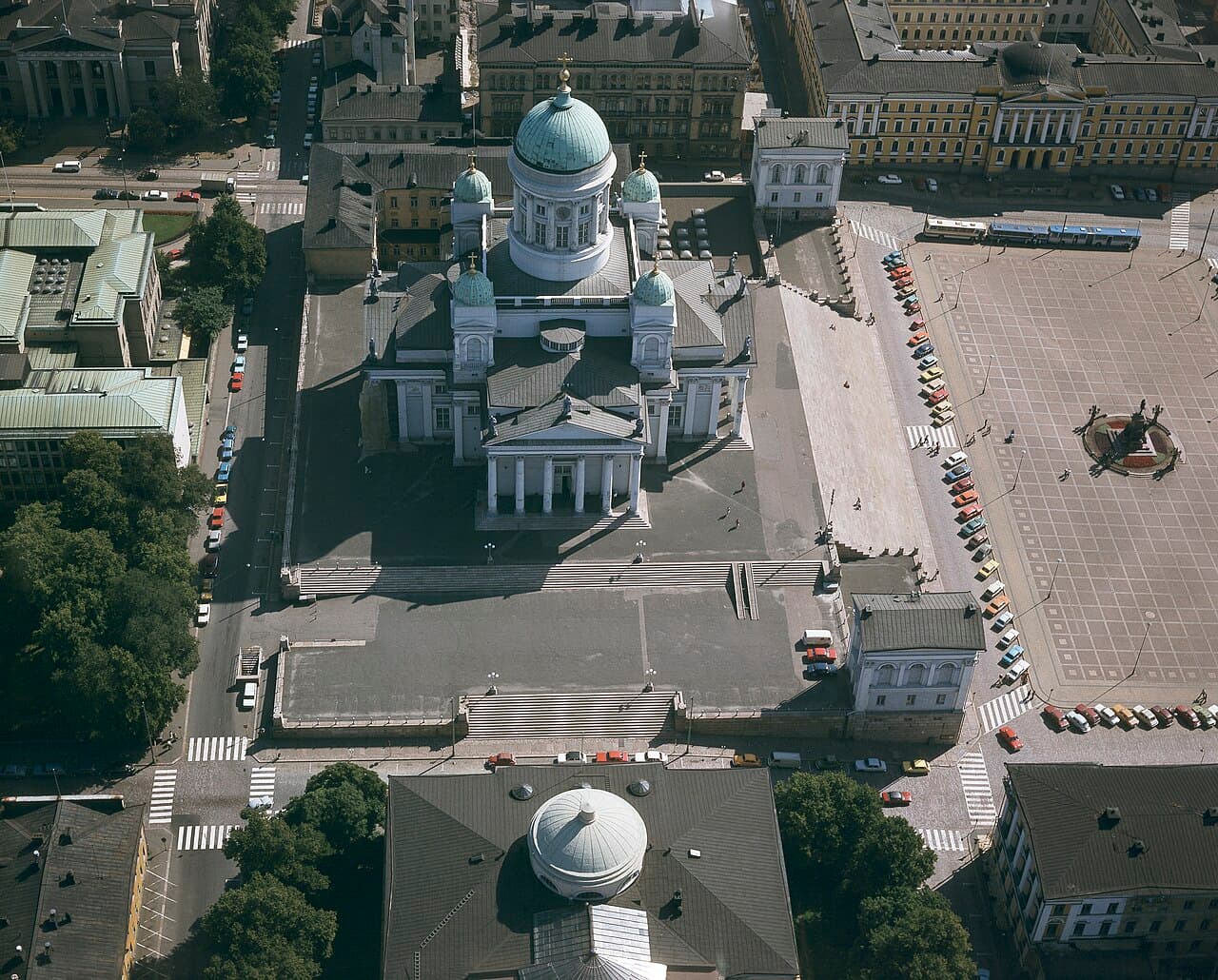
Helsinki. Founded by the Swedish king Gustav Vasa in 1550 and made the capital in 1812, after Finland passed to Russia, Helsinki was rebuilt in gleaming neoclassical stone to a plan by Carl Ludvig Engel, whose white Lutheran cathedral crowns the Senate Square at the city's heart. It is a capital of the sea, scattered across peninsulas and islands, and its memory sites range from the fortress island of Suomenlinna to the Hietaniemi cemetery, where presidents, marshals and artists lie, and the National Museum, which tells the Finnish story from the Stone Age to independence.
"Landscape from Koli" by Eero Järnefelt, one of the painters who made the view over Lake Pielinen the emblem of the Finnish national landscape. Public domain, via Wikimedia Commons.
Finland is a large, thinly peopled country in the far north of Europe, stretching from the Baltic shore up across the Arctic Circle into Lapland, and sharing long borders with Sweden, Norway and Russia. It is a land shaped by water and trees: roughly three-quarters of its 338,000 square kilometres are forested, and it holds, by the usual count, some 188,000 lakes, which is why the Finns call their country the land of a thousand lakes and rather understate the case. The last Ice Age ground the landscape flat and scattered it with lakes, islands and glacial ridges, and the land is still slowly rising out of the sea along the western coast. Winters are long and dark, summers brief and luminous, and in the far north the sun neither sets in high summer nor rises in the depths of winter.
Finland is a republic of about 5.6 million people, one of the least densely populated countries in the European Union, with more than a million of them gathered in the Helsinki capital region. It is a semi-presidential democracy: the 200-seat parliament, the Eduskunta, holds legislative power, while the head of state is the President of the Republic, an office held since 2024 by Alexander Stubb, with particular authority over foreign policy. Finland was among the first countries to grant women full political rights, in 1906, and it has built one of the world's most admired systems of education and social welfare. Long neutral, it joined the European Union in 1995, adopted the euro, and in 2023 abandoned decades of military non-alignment to become a member of NATO. In the north, the indigenous Sámi people have their own parliament, the Sámediggi, established in 1996, and a recognised homeland in Lapland.
Helsinki. Founded by the Swedish king Gustav Vasa in 1550 and made the capital in 1812, after Finland passed to Russia, Helsinki was rebuilt in gleaming neoclassical stone to a plan by Carl Ludvig Engel, whose white Lutheran cathedral crowns the Senate Square at the city's heart. It is a capital of the sea, scattered across peninsulas and islands, and its memory sites range from the fortress island of Suomenlinna to the Hietaniemi cemetery, where presidents, marshals and artists lie, and the National Museum, which tells the Finnish story from the Stone Age to independence.
_by_Daniel_Nyblin.jpg%2F1280px-South_Harbour_in_Helsinki%252C_Finland_(1893)_by_Daniel_Nyblin.jpg&w=3840&q=75) The South Harbour and market square of Helsinki, photographed in 1893 by Daniel Nyblin. Public domain, via Wikimedia Commons.
Turku. The oldest city in Finland and its capital until 1812, Turku on the southwest coast was the country's medieval and ecclesiastical centre. Its cathedral, consecrated in 1300, is the mother church of Finnish Lutheranism and the burial place of bishops, queens and soldiers, and its castle guards the mouth of the Aura River. The city is the seat of Finland's oldest learning and, each year, the place from which "Christmas Peace" is proclaimed to the nation.
Tampere. The great industrial city of the inland lakes, Tampere grew up around the rapids of the Tammerkoski, its red-brick cotton and paper mills once the engine of Finnish industry. It carries a heavy memory: it was the scene of the bloodiest battle of the 1918 civil war, and the world's only museum devoted to Lenin long stood in the hall where he and Stalin first met. Today its mills house museums, galleries and a thriving cultural life.
Rovaniemi. The capital of Lapland, on the Arctic Circle, Rovaniemi was burned almost to the ground by retreating German forces in 1944 and rebuilt to a plan by the architect Alvar Aalto in the shape, it is said, of a reindeer's head. It is the gateway to the Sámi north and, in its tourism guise, the official hometown of Santa Claus.
Rauma. On the west coast, Rauma preserves the largest surviving wooden old town in the Nordic countries, a dense weave of painted timber houses, workshops and lanes inscribed as a World Heritage Site. Its inhabitants still speak a distinctive dialect, and its lace-making tradition recalls the town's long maritime prosperity.
People have lived in Finland since the ice retreated some eleven thousand years ago, hunting, fishing and, in the Bronze Age, raising the stone burial cairns that still crown the coastal hills, among them the World Heritage cairn field of Sammallahdenmäki. For most of recorded history Finland was the eastern half of the Kingdom of Sweden, drawn into the Western church and the Swedish crown from the twelfth and thirteenth centuries, its coasts settled by Swedish speakers and its administration conducted in Swedish. The Reformation reached it in the sixteenth century, and it was then that Mikael Agricola, the "father of literary Finnish," translated the New Testament and in doing so created the written form of the Finnish language.
The modern nation was born out of empire. In 1809 Sweden ceded Finland to Russia, and for the next century it existed as an autonomous Grand Duchy under the tsar, keeping its own laws, currency and, increasingly, a sense of itself as a nation, expressed through the National Romantic movement in art, music and letters. When the Russian Empire collapsed, Finland declared independence on 6 December 1917, only to fall almost at once into a bitter civil war in 1918 between socialist "Reds" and conservative "Whites." Independence was then defended in two savage wars against the Soviet Union: the Winter War of 1939–40, when a vastly outnumbered Finland held off the Red Army through a brutal winter, and the Continuation War of 1941–44. Finland survived as a democracy, ceded territory including much of Karelia, resettled more than 400,000 evacuees, and paid heavy war reparations, then rebuilt itself in the post-war decades into a prosperous Nordic welfare state that turned, in a single generation, from a poor agrarian country into a leader in education and technology.
Finnish is one of the reasons the country feels distinct: it belongs not to the Indo-European family of most of Europe but to the Finno-Ugric branch of the Uralic languages, whose closest relatives are Estonian across the gulf and, far more distantly, Hungarian. It is a language of long words built from suffixes, with fifteen grammatical cases and no grammatical gender, and it was shaped into a literary tongue by Agricola's Reformation Bible and, later, by the nineteenth-century scholars who made it the language of a nation. The origin of the name "Suomi," the Finnish word for Finland, is still debated among linguists, variously connected to words for "land," "scale" or a Baltic term, while "Finland" itself is the name Finland's Germanic neighbours gave to the Finns.
Finland is officially bilingual. Alongside Finnish, Swedish is a national language, spoken as a first language by around five per cent of the population, chiefly along the south and west coasts and in the autonomous, Swedish-speaking Åland Islands, so that towns carry two names and public life runs in two tongues. In the far north, the Sámi languages, Northern, Inari and Skolt Sámi, are spoken by the indigenous Sámi and have official status in their homeland, though all are endangered and the subject of active revitalisation. The layering of these languages across the map, Finnish inland, Swedish on the coast, Sámi in the fells, is itself a record of the country's long, shared history.
At the centre of Finnish life stands the sauna, so ordinary that Finns scarcely think of it as culture at all: there are more saunas in Finland than cars, and the ritual of the hot room, the whisk of birch leaves and the plunge into a cold lake is woven through birth, work, hospitality and grief alike. In 2020 UNESCO added Finnish sauna bathing to its list of the intangible cultural heritage of humanity. Nearly as central is the idea of sisu, a stubborn, quiet endurance in the face of hardship that Finns regard as a national trait, and which they trace to the wars and the winters.
Finnish art and design carry the country's name abroad. The National Romantic painters, above all Akseli Gallen-Kallela, gave visual form to the national poem and the northern landscape; Jean Sibelius composed the tone poem Finlandia and a body of symphonic music that became the sound of the nation; and the architect Alvar Aalto and the designers of Marimekko, Iittala and Arabia made a spare, humane Finnish modernism famous the world over. In literature the line runs from Elias Lönnrot's compiled poem and Aleksis Kivi's Seven Brothers, the first great novel in Finnish, to Tove Jansson's Moomins, beloved far beyond Finland. The calendar keeps its own festivals: the bonfires and white nights of Juhannus at midsummer, the crayfish parties of late summer, Vappu on the first of May, and the ubiquitous rye bread, salmon soup and cinnamon rolls of the Finnish table.
The South Harbour and market square of Helsinki, photographed in 1893 by Daniel Nyblin. Public domain, via Wikimedia Commons.
Turku. The oldest city in Finland and its capital until 1812, Turku on the southwest coast was the country's medieval and ecclesiastical centre. Its cathedral, consecrated in 1300, is the mother church of Finnish Lutheranism and the burial place of bishops, queens and soldiers, and its castle guards the mouth of the Aura River. The city is the seat of Finland's oldest learning and, each year, the place from which "Christmas Peace" is proclaimed to the nation.
Tampere. The great industrial city of the inland lakes, Tampere grew up around the rapids of the Tammerkoski, its red-brick cotton and paper mills once the engine of Finnish industry. It carries a heavy memory: it was the scene of the bloodiest battle of the 1918 civil war, and the world's only museum devoted to Lenin long stood in the hall where he and Stalin first met. Today its mills house museums, galleries and a thriving cultural life.
Rovaniemi. The capital of Lapland, on the Arctic Circle, Rovaniemi was burned almost to the ground by retreating German forces in 1944 and rebuilt to a plan by the architect Alvar Aalto in the shape, it is said, of a reindeer's head. It is the gateway to the Sámi north and, in its tourism guise, the official hometown of Santa Claus.
Rauma. On the west coast, Rauma preserves the largest surviving wooden old town in the Nordic countries, a dense weave of painted timber houses, workshops and lanes inscribed as a World Heritage Site. Its inhabitants still speak a distinctive dialect, and its lace-making tradition recalls the town's long maritime prosperity.
People have lived in Finland since the ice retreated some eleven thousand years ago, hunting, fishing and, in the Bronze Age, raising the stone burial cairns that still crown the coastal hills, among them the World Heritage cairn field of Sammallahdenmäki. For most of recorded history Finland was the eastern half of the Kingdom of Sweden, drawn into the Western church and the Swedish crown from the twelfth and thirteenth centuries, its coasts settled by Swedish speakers and its administration conducted in Swedish. The Reformation reached it in the sixteenth century, and it was then that Mikael Agricola, the "father of literary Finnish," translated the New Testament and in doing so created the written form of the Finnish language.
The modern nation was born out of empire. In 1809 Sweden ceded Finland to Russia, and for the next century it existed as an autonomous Grand Duchy under the tsar, keeping its own laws, currency and, increasingly, a sense of itself as a nation, expressed through the National Romantic movement in art, music and letters. When the Russian Empire collapsed, Finland declared independence on 6 December 1917, only to fall almost at once into a bitter civil war in 1918 between socialist "Reds" and conservative "Whites." Independence was then defended in two savage wars against the Soviet Union: the Winter War of 1939–40, when a vastly outnumbered Finland held off the Red Army through a brutal winter, and the Continuation War of 1941–44. Finland survived as a democracy, ceded territory including much of Karelia, resettled more than 400,000 evacuees, and paid heavy war reparations, then rebuilt itself in the post-war decades into a prosperous Nordic welfare state that turned, in a single generation, from a poor agrarian country into a leader in education and technology.
Finnish is one of the reasons the country feels distinct: it belongs not to the Indo-European family of most of Europe but to the Finno-Ugric branch of the Uralic languages, whose closest relatives are Estonian across the gulf and, far more distantly, Hungarian. It is a language of long words built from suffixes, with fifteen grammatical cases and no grammatical gender, and it was shaped into a literary tongue by Agricola's Reformation Bible and, later, by the nineteenth-century scholars who made it the language of a nation. The origin of the name "Suomi," the Finnish word for Finland, is still debated among linguists, variously connected to words for "land," "scale" or a Baltic term, while "Finland" itself is the name Finland's Germanic neighbours gave to the Finns.
Finland is officially bilingual. Alongside Finnish, Swedish is a national language, spoken as a first language by around five per cent of the population, chiefly along the south and west coasts and in the autonomous, Swedish-speaking Åland Islands, so that towns carry two names and public life runs in two tongues. In the far north, the Sámi languages, Northern, Inari and Skolt Sámi, are spoken by the indigenous Sámi and have official status in their homeland, though all are endangered and the subject of active revitalisation. The layering of these languages across the map, Finnish inland, Swedish on the coast, Sámi in the fells, is itself a record of the country's long, shared history.
At the centre of Finnish life stands the sauna, so ordinary that Finns scarcely think of it as culture at all: there are more saunas in Finland than cars, and the ritual of the hot room, the whisk of birch leaves and the plunge into a cold lake is woven through birth, work, hospitality and grief alike. In 2020 UNESCO added Finnish sauna bathing to its list of the intangible cultural heritage of humanity. Nearly as central is the idea of sisu, a stubborn, quiet endurance in the face of hardship that Finns regard as a national trait, and which they trace to the wars and the winters.
Finnish art and design carry the country's name abroad. The National Romantic painters, above all Akseli Gallen-Kallela, gave visual form to the national poem and the northern landscape; Jean Sibelius composed the tone poem Finlandia and a body of symphonic music that became the sound of the nation; and the architect Alvar Aalto and the designers of Marimekko, Iittala and Arabia made a spare, humane Finnish modernism famous the world over. In literature the line runs from Elias Lönnrot's compiled poem and Aleksis Kivi's Seven Brothers, the first great novel in Finnish, to Tove Jansson's Moomins, beloved far beyond Finland. The calendar keeps its own festivals: the bonfires and white nights of Juhannus at midsummer, the crayfish parties of late summer, Vappu on the first of May, and the ubiquitous rye bread, salmon soup and cinnamon rolls of the Finnish table.
 "The Defence of the Sampo" (1896) by Akseli Gallen-Kallela, depicting the hero Väinämöinen defending the magical mill of the Kalevala, Finland's national poem. Public domain, via Wikimedia Commons.
Finland is a Lutheran country with an unusual second church. The Evangelical Lutheran Church of Finland, established during the Swedish Reformation, remains the largest religious community, with about 62 per cent of Finns as members in 2024, though the figure has been falling steadily and active churchgoing is low; it is a folk church, present at baptism, confirmation, marriage and above all death, more than a weekly habit. Its medieval stone churches and grey wooden country churches, some, like Petäjävesi, masterpieces of log construction, are among the country's oldest surviving buildings. Alongside it stands the Finnish Orthodox Church, a legacy of the eastern, Karelian half of the country and of Russian rule, which enjoys a status as a second national church that is rare in the Western world, and which keeps alive the icon-painting, chant and monastic tradition of the East at the New Valamo monastery in eastern Finland.
Beneath both churches lies an older layer. Before Christianity the Finns and their neighbours held an animist worldview of forest spirits, sacred groves and a shamanic reverence for the natural world, a mythology preserved in the songs later gathered into the Kalevala, with its creator-sage Väinämöinen and its underworld of Tuonela. Traces survive in place names, folk custom and the deep Finnish attachment to forest and lake as something close to sacred. The Sámi of the north kept their own pre-Christian religion, centred on sacred sites called sieidi, longer still. Today Finland is increasingly secular and plural, with growing communities of the non-religious and, through immigration, of Muslims and others, but the Lutheran and Orthodox calendars still frame the national year.
"The Defence of the Sampo" (1896) by Akseli Gallen-Kallela, depicting the hero Väinämöinen defending the magical mill of the Kalevala, Finland's national poem. Public domain, via Wikimedia Commons.
Finland is a Lutheran country with an unusual second church. The Evangelical Lutheran Church of Finland, established during the Swedish Reformation, remains the largest religious community, with about 62 per cent of Finns as members in 2024, though the figure has been falling steadily and active churchgoing is low; it is a folk church, present at baptism, confirmation, marriage and above all death, more than a weekly habit. Its medieval stone churches and grey wooden country churches, some, like Petäjävesi, masterpieces of log construction, are among the country's oldest surviving buildings. Alongside it stands the Finnish Orthodox Church, a legacy of the eastern, Karelian half of the country and of Russian rule, which enjoys a status as a second national church that is rare in the Western world, and which keeps alive the icon-painting, chant and monastic tradition of the East at the New Valamo monastery in eastern Finland.
Beneath both churches lies an older layer. Before Christianity the Finns and their neighbours held an animist worldview of forest spirits, sacred groves and a shamanic reverence for the natural world, a mythology preserved in the songs later gathered into the Kalevala, with its creator-sage Väinämöinen and its underworld of Tuonela. Traces survive in place names, folk custom and the deep Finnish attachment to forest and lake as something close to sacred. The Sámi of the north kept their own pre-Christian religion, centred on sacred sites called sieidi, longer still. Today Finland is increasingly secular and plural, with growing communities of the non-religious and, through immigration, of Muslims and others, but the Lutheran and Orthodox calendars still frame the national year.
.jpg%2F1280px-Turku_Cathedral_-_Turku_-_Finland-2_(36171623921).jpg&w=3840&q=75) Turku Cathedral, consecrated in 1300, the mother church of Finnish Lutheranism and the burial place of bishops and Queen Karin Månsdotter. CC BY 2.0, via Wikimedia Commons.
Finnish remembrance is quiet, disciplined and closely tied to the churchyard. Death in Finland is overwhelmingly marked by a Lutheran or Orthodox funeral, followed increasingly by cremation, and by burial in a family or parish grave that relatives tend and visit through the year. The most visible expression of Finnish mourning is the candle: on Christmas Eve, and again on All Saints' Day, the Saturday between 31 October and 6 November, families walk to the cemetery at dusk and light candles at the graves of their dead, so that whole graveyards glow in the snow and the dark. The custom is very widely kept, crossing the line between the religious and the simply human, and it has become one of the defining images of the Finnish year.
The country's deepest wound and its deepest ritual both come from war. When Finland fought the Soviet Union between 1939 and 1944, it made an extraordinary commitment: the bodies of fallen soldiers were, wherever possible, carried back from the front to be buried in their home parishes rather than in mass graves near the fighting. As a result, almost every Finnish churchyard has its sankarihauta, its heroes' grave, a plot of identical stones where the local dead of the Winter and Continuation Wars lie together, often around a central memorial and the graves of the Unknown Soldier. On the third Sunday of May, Kaatuneiden muistopäivä, the Commemoration Day of the Fallen, wreaths are laid at these plots in every community in the land, a national act of mourning repeated at village scale across the whole country.
Independence Day, 6 December, is likewise a day of remembrance more than celebration. In the darkness of early winter Finns place two blue-and-white candles in their windows, a custom with roots in the struggle for nationhood, and students carry torches in procession to the Hietaniemi cemetery in Helsinki to honour the war dead at the grave of Marshal Mannerheim and the field of fallen soldiers, while the president receives the nation's notables at the Presidential Palace in a ball watched by millions on television. The memory of Karelia, the region lost to the Soviet Union, is carried by the more than 400,000 people evacuated from it and their descendants, who keep its dialect, food and Orthodox faith alive across Finland. Older dead are remembered too, in the Bronze Age cairns of the coast and the Orthodox grave-visiting customs of the east, so that in Finland, as in few other places, the map of memory runs from prehistoric stone to the candlelit snow of last winter.
Before Christmas absorbed it, the Finnish year ended at Kekri, kept when the harvest was in and the animals brought down. The dead were expected at the table, a sauna was heated for them, and a place was laid; masked visitors went from house to house demanding food. The festival was pushed aside by the church calendar and has been revived in recent decades, first by folklorists and then by people who simply wanted the year to end somewhere other than at Christmas.
Finland inherited the best parish record-keeping law in Europe and then kept using it.
Under Swedish rule the church was required from 1686 to examine every parishioner on their reading and their catechism, household by household, and to record the result. The rippikirja, the communion book, is therefore a rolling register of who lived in each house, updated year after year with births, marriages, deaths, arrivals and departures, and Finnish families can often be followed through the same book for a century. Moving certificates, issued when a person changed parish and recorded at both ends, make it possible to follow them across the country without losing the thread.
The HisKi database, built by the Genealogical Society of Finland, indexes millions of parish entries and is free, and the National Archives publish digitised images alongside it.
Two twentieth-century movements are in every Karelian family's record. Finland ceded Karelia to the Soviet Union in 1940 and again in 1944, and around 420,000 people, more than a tenth of the population, were evacuated and resettled across the rest of the country. Their parish registers came with them, so Karelian records survive in Finland even though the parishes do not.
And the war dead are documented individually. The national database records each of the roughly 94,000 Finns killed in the Winter and Continuation Wars, with the place of death and the churchyard where they are buried, because almost all of them were carried home.
Finland's heritage is looked after by a dense network of national institutions. The Finnish Heritage Agency, the Museovirasto, oversees archaeology, the protection of built heritage and the great collections of the National Museum of Finland in Helsinki, whose National Romantic building is itself a monument to the era of independence. Antiquities have been protected by law since the nineteenth century, and Finland maintains one of the most active museum sectors in Europe relative to its size, from the open-air museum of Seurasaari, where old farm and church buildings from across the country were reassembled on an island in Helsinki, to hundreds of local and specialist museums.
Finland's seven UNESCO World Heritage Sites are modest in number but tell the national story well. The sea fortress of Suomenlinna off Helsinki, begun under Swedish rule in 1748, and the wooden old town of Rauma were both inscribed in 1991; the log-built Petäjävesi Old Church followed in 1994, and the Verla groundwood and board mill, a preserved industrial site, in 1996. The Bronze Age burial cairns of Sammallahdenmäki, inscribed in 1999, protect a landscape of death more than three thousand years old, while the Kvarken Archipelago, shared with Sweden's High Coast, and the Struve Geodetic Arc, a chain of survey points running through ten countries, extend Finland's heritage into the natural and the scientific. The country's intangible heritage is recognised too, with sauna bathing and Kaustinen fiddle-playing on the UNESCO lists, reflecting a preservation culture that values living practice as much as old stone.
Finland has digitised its records at a scale that makes it a genealogist's country. The National Archives of Finland, the Kansallisarkisto, has scanned enormous quantities of parish registers, court records and historical documents, made available through its Astia and Digitaaliarkisto services, so that the Lutheran and Orthodox church books that record births, marriages and deaths going back to the seventeenth century can be read online. The volunteer-run Genealogical Society of Finland has built HisKi, a searchable database transcribing millions of parish register entries, and continues to index the country's records name by name.
Digital access reaches well beyond family history. Finna, the national discovery service, gathers the digitised collections of Finnish libraries, archives and museums into a single searchable portal running to millions of images, objects and documents, while the National Library's digitised newspaper and periodical collection has opened centuries of the Finnish and Swedish-language press to anyone with an internet connection. The Kalevala and the vast archive of Finnish folk poetry from which Lönnrot drew it have been digitised by the Finnish Literature Society, whose folklore archive is among the largest collections of oral tradition in the world, and specialist projects preserve the songs, dialects and testimonies of Karelia and of the Sámi north. For a country that built its nationhood on gathered songs and written records, this digital turn is a natural continuation of an old instinct.
Finland's contemporary culture reaches far beyond its borders. Its architecture and design remain global reference points, from Aalto's buildings and furniture to the patterns of Marimekko; its classical music tradition produces conductors and composers admired worldwide; and, more surprisingly, it has become a heartland of heavy metal, with bands such as Nightwish and HIM giving the country one of the highest concentrations of metal groups on earth. Finnish cinema, above all the deadpan films of Aki Kaurismäki, and Finnish games, from Angry Birds to the studios that followed, have carried a distinctly Finnish sensibility to worldwide audiences, while the country's repeated ranking as the happiest in the world has become a cultural export in itself.
The deeper currents concern memory and identity. The lost Karelia, the wars and the evacuation remain living subjects in Finnish literature, film and family life, and the reckoning with the treatment of the Sámi, including debates over land rights, cultural appropriation and the return of Sámi human remains and objects from museums, has become one of the country's most serious conversations about heritage and justice. Finland's decision to join NATO in 2023, after generations of neutrality, reopened questions about the nation's history and its place in the world. A country that spent the twentieth century defending its independence now debates, in public and with characteristic seriousness, what that independence has meant and to whom its heritage belongs.
The soldiers brought home. Finland's decision during the Winter and Continuation Wars to carry its fallen back to their home parishes for burial created the sankarihauta, the heroes' graves found in almost every churchyard in the country. Maintained ever since and honoured each May, they turned a national catastrophe into a distributed, intimate landscape of memory unlike anything in the rest of Europe, and remain among the most cared-for graves in Finland.
A fortress saved from the sea. Suomenlinna, the great sea fortress off Helsinki, might have crumbled after two centuries of military use; instead it was handed to civilian administration in 1973, restored, repopulated as a living neighbourhood and inscribed as a World Heritage Site in 1991. It now welcomes close to a million visitors a year while several hundred people make it their home, a model of a monument kept alive rather than embalmed.
The songs that made a nation. In 1835, and in an expanded edition in 1849, the country doctor Elias Lönnrot published the Kalevala, a poem he assembled from oral folk poetry he had collected on long journeys through the eastern backwoods. The book gave the Finns a mythology, a literary language and a sense of nationhood, inspired Sibelius and Gallen-Kallela, and remains, digitised and studied worldwide, the foundation stone of Finnish culture.
An archive opened to the nation. The National Archives of Finland and the volunteers of the Genealogical Society have between them put the country's parish registers and their transcriptions online, so that Finns can trace their families back through three centuries of Lutheran and Orthodox record-keeping, making Finnish genealogy one of the most accessible and widely practised in the world.
A language recognised in the north. After a long history of assimilation, the Sámi languages of northern Finland have gained official status in the Sámi homeland, their own parliament since 1996, and a growing body of teaching, broadcasting and publishing, so that Inari Sámi, once spoken by only a few hundred people, is being taught to children again in an effort to pull it back from the edge.
Turku Cathedral, consecrated in 1300, the mother church of Finnish Lutheranism and the burial place of bishops and Queen Karin Månsdotter. CC BY 2.0, via Wikimedia Commons.
Finnish remembrance is quiet, disciplined and closely tied to the churchyard. Death in Finland is overwhelmingly marked by a Lutheran or Orthodox funeral, followed increasingly by cremation, and by burial in a family or parish grave that relatives tend and visit through the year. The most visible expression of Finnish mourning is the candle: on Christmas Eve, and again on All Saints' Day, the Saturday between 31 October and 6 November, families walk to the cemetery at dusk and light candles at the graves of their dead, so that whole graveyards glow in the snow and the dark. The custom is very widely kept, crossing the line between the religious and the simply human, and it has become one of the defining images of the Finnish year.
The country's deepest wound and its deepest ritual both come from war. When Finland fought the Soviet Union between 1939 and 1944, it made an extraordinary commitment: the bodies of fallen soldiers were, wherever possible, carried back from the front to be buried in their home parishes rather than in mass graves near the fighting. As a result, almost every Finnish churchyard has its sankarihauta, its heroes' grave, a plot of identical stones where the local dead of the Winter and Continuation Wars lie together, often around a central memorial and the graves of the Unknown Soldier. On the third Sunday of May, Kaatuneiden muistopäivä, the Commemoration Day of the Fallen, wreaths are laid at these plots in every community in the land, a national act of mourning repeated at village scale across the whole country.
Independence Day, 6 December, is likewise a day of remembrance more than celebration. In the darkness of early winter Finns place two blue-and-white candles in their windows, a custom with roots in the struggle for nationhood, and students carry torches in procession to the Hietaniemi cemetery in Helsinki to honour the war dead at the grave of Marshal Mannerheim and the field of fallen soldiers, while the president receives the nation's notables at the Presidential Palace in a ball watched by millions on television. The memory of Karelia, the region lost to the Soviet Union, is carried by the more than 400,000 people evacuated from it and their descendants, who keep its dialect, food and Orthodox faith alive across Finland. Older dead are remembered too, in the Bronze Age cairns of the coast and the Orthodox grave-visiting customs of the east, so that in Finland, as in few other places, the map of memory runs from prehistoric stone to the candlelit snow of last winter.
Before Christmas absorbed it, the Finnish year ended at Kekri, kept when the harvest was in and the animals brought down. The dead were expected at the table, a sauna was heated for them, and a place was laid; masked visitors went from house to house demanding food. The festival was pushed aside by the church calendar and has been revived in recent decades, first by folklorists and then by people who simply wanted the year to end somewhere other than at Christmas.
Finland inherited the best parish record-keeping law in Europe and then kept using it.
Under Swedish rule the church was required from 1686 to examine every parishioner on their reading and their catechism, household by household, and to record the result. The rippikirja, the communion book, is therefore a rolling register of who lived in each house, updated year after year with births, marriages, deaths, arrivals and departures, and Finnish families can often be followed through the same book for a century. Moving certificates, issued when a person changed parish and recorded at both ends, make it possible to follow them across the country without losing the thread.
The HisKi database, built by the Genealogical Society of Finland, indexes millions of parish entries and is free, and the National Archives publish digitised images alongside it.
Two twentieth-century movements are in every Karelian family's record. Finland ceded Karelia to the Soviet Union in 1940 and again in 1944, and around 420,000 people, more than a tenth of the population, were evacuated and resettled across the rest of the country. Their parish registers came with them, so Karelian records survive in Finland even though the parishes do not.
And the war dead are documented individually. The national database records each of the roughly 94,000 Finns killed in the Winter and Continuation Wars, with the place of death and the churchyard where they are buried, because almost all of them were carried home.
Finland's heritage is looked after by a dense network of national institutions. The Finnish Heritage Agency, the Museovirasto, oversees archaeology, the protection of built heritage and the great collections of the National Museum of Finland in Helsinki, whose National Romantic building is itself a monument to the era of independence. Antiquities have been protected by law since the nineteenth century, and Finland maintains one of the most active museum sectors in Europe relative to its size, from the open-air museum of Seurasaari, where old farm and church buildings from across the country were reassembled on an island in Helsinki, to hundreds of local and specialist museums.
Finland's seven UNESCO World Heritage Sites are modest in number but tell the national story well. The sea fortress of Suomenlinna off Helsinki, begun under Swedish rule in 1748, and the wooden old town of Rauma were both inscribed in 1991; the log-built Petäjävesi Old Church followed in 1994, and the Verla groundwood and board mill, a preserved industrial site, in 1996. The Bronze Age burial cairns of Sammallahdenmäki, inscribed in 1999, protect a landscape of death more than three thousand years old, while the Kvarken Archipelago, shared with Sweden's High Coast, and the Struve Geodetic Arc, a chain of survey points running through ten countries, extend Finland's heritage into the natural and the scientific. The country's intangible heritage is recognised too, with sauna bathing and Kaustinen fiddle-playing on the UNESCO lists, reflecting a preservation culture that values living practice as much as old stone.
Finland has digitised its records at a scale that makes it a genealogist's country. The National Archives of Finland, the Kansallisarkisto, has scanned enormous quantities of parish registers, court records and historical documents, made available through its Astia and Digitaaliarkisto services, so that the Lutheran and Orthodox church books that record births, marriages and deaths going back to the seventeenth century can be read online. The volunteer-run Genealogical Society of Finland has built HisKi, a searchable database transcribing millions of parish register entries, and continues to index the country's records name by name.
Digital access reaches well beyond family history. Finna, the national discovery service, gathers the digitised collections of Finnish libraries, archives and museums into a single searchable portal running to millions of images, objects and documents, while the National Library's digitised newspaper and periodical collection has opened centuries of the Finnish and Swedish-language press to anyone with an internet connection. The Kalevala and the vast archive of Finnish folk poetry from which Lönnrot drew it have been digitised by the Finnish Literature Society, whose folklore archive is among the largest collections of oral tradition in the world, and specialist projects preserve the songs, dialects and testimonies of Karelia and of the Sámi north. For a country that built its nationhood on gathered songs and written records, this digital turn is a natural continuation of an old instinct.
Finland's contemporary culture reaches far beyond its borders. Its architecture and design remain global reference points, from Aalto's buildings and furniture to the patterns of Marimekko; its classical music tradition produces conductors and composers admired worldwide; and, more surprisingly, it has become a heartland of heavy metal, with bands such as Nightwish and HIM giving the country one of the highest concentrations of metal groups on earth. Finnish cinema, above all the deadpan films of Aki Kaurismäki, and Finnish games, from Angry Birds to the studios that followed, have carried a distinctly Finnish sensibility to worldwide audiences, while the country's repeated ranking as the happiest in the world has become a cultural export in itself.
The deeper currents concern memory and identity. The lost Karelia, the wars and the evacuation remain living subjects in Finnish literature, film and family life, and the reckoning with the treatment of the Sámi, including debates over land rights, cultural appropriation and the return of Sámi human remains and objects from museums, has become one of the country's most serious conversations about heritage and justice. Finland's decision to join NATO in 2023, after generations of neutrality, reopened questions about the nation's history and its place in the world. A country that spent the twentieth century defending its independence now debates, in public and with characteristic seriousness, what that independence has meant and to whom its heritage belongs.
The soldiers brought home. Finland's decision during the Winter and Continuation Wars to carry its fallen back to their home parishes for burial created the sankarihauta, the heroes' graves found in almost every churchyard in the country. Maintained ever since and honoured each May, they turned a national catastrophe into a distributed, intimate landscape of memory unlike anything in the rest of Europe, and remain among the most cared-for graves in Finland.
A fortress saved from the sea. Suomenlinna, the great sea fortress off Helsinki, might have crumbled after two centuries of military use; instead it was handed to civilian administration in 1973, restored, repopulated as a living neighbourhood and inscribed as a World Heritage Site in 1991. It now welcomes close to a million visitors a year while several hundred people make it their home, a model of a monument kept alive rather than embalmed.
The songs that made a nation. In 1835, and in an expanded edition in 1849, the country doctor Elias Lönnrot published the Kalevala, a poem he assembled from oral folk poetry he had collected on long journeys through the eastern backwoods. The book gave the Finns a mythology, a literary language and a sense of nationhood, inspired Sibelius and Gallen-Kallela, and remains, digitised and studied worldwide, the foundation stone of Finnish culture.
An archive opened to the nation. The National Archives of Finland and the volunteers of the Genealogical Society have between them put the country's parish registers and their transcriptions online, so that Finns can trace their families back through three centuries of Lutheran and Orthodox record-keeping, making Finnish genealogy one of the most accessible and widely practised in the world.
A language recognised in the north. After a long history of assimilation, the Sámi languages of northern Finland have gained official status in the Sámi homeland, their own parliament since 1996, and a growing body of teaching, broadcasting and publishing, so that Inari Sámi, once spoken by only a few hundred people, is being taught to children again in an effort to pull it back from the edge.
National Overview
Notable Cities
Historical Foundations
Linguistic and Etymological Roots
Cultural Identity
Religion and Spirituality
Remembrance and Mourning Traditions
Tracing a Family in Finland
Heritage Preservation Efforts
Digital Heritage
Contemporary Cultural Influences
Success Stories
References and resources
- UNESCO World Heritage Centre, Finland, the state-party page covering Suomenlinna, Rauma, Sammallahdenmäki and Finland's other inscribed sites.
- National Museum of Finland, the central museum of Finnish history, from the Stone Age to independence.
- Finnish Heritage Agency, Museovirasto, the national body for archaeology, built heritage and museum collections.
- National Archives of Finland, Kansallisarkisto, the digitised parish registers, court records and historical documents of Finland.
- Finna.fi, the national portal aggregating the digitised collections of Finnish libraries, archives and museums.
- Finnish Literature Society, SKS, publisher of the Kalevala and keeper of one of the world's largest folklore archives.
- Evangelical Lutheran Church of Finland, the country's largest church, with membership figures and the framework of Finnish religious life.
- Suomenlinna, the World Heritage sea fortress and living community off Helsinki.
- Encyclopaedia Britannica, Finland, geography, history and society.