Heritage · Country
Sapmi Culture and Heritage
Sápmi is a homeland on no political map, running across northern Norway, Sweden, Finland and the Kola Peninsula. This is a guide to its languages, museums and sacred places, and to the work of bringing home drums taken to be burned and ancestors dug up for racial science.Written to last.
By Confinity Heritage Editorial · Updated 2026-08-17 · 8-minute readQuiet tools, kept out of the way.
Sápmi is a homeland that appears on no political map. It runs across the top of Norway, Sweden and Finland and eastward into Russia's Kola Peninsula, and the people whose country it is, the Sámi, are recognised as the only Indigenous people within the European Union. There are elected Sámi parliaments in three states, a flag, an anthem and a national day, and there is no Sámi state, because most Sámi politics has never asked for one. What it asks for is rights, land and language.
That distinction shapes almost everything about how heritage works here. Church officers burned the drums Sámi religious specialists used, and roughly seventy survive anywhere on earth, nearly all in museums far to the south. Anatomists and racial biologists opened Sámi graves for skulls from the middle of the nineteenth century into the twentieth, and the reburials that have followed are recent, incomplete, and in places disputed among Sámi themselves.
Sápmi covers several hundred thousand square kilometres of mountain, forest, tundra and coast across four countries. Nobody can say precisely how many Sámi there are, because Norway, Sweden and Finland do not record ethnicity in their censuses, and the figures usually cited run from about 50,000 to 100,000, with roughly half in Norway, fewer in Sweden, around 10,000 in Finland and about 2,000 on the Kola Peninsula.
Three states have elected Sámi parliaments: Norway's opened in 1989, Sweden's in 1993 and Finland's in 1996. Their powers are consultative. They manage grants, language and cultural policy and must be consulted on decisions affecting Sámi interests, but they cannot legislate and hold no veto over land use. Russia has no equivalent body. Norway ratified ILO Convention 169 in 1990, the first state to do so; Sweden and Finland have not. The Sámi flag dates from 1986, and 6 February marks the first pan-Sámi congress, held at Trondheim in 1917.
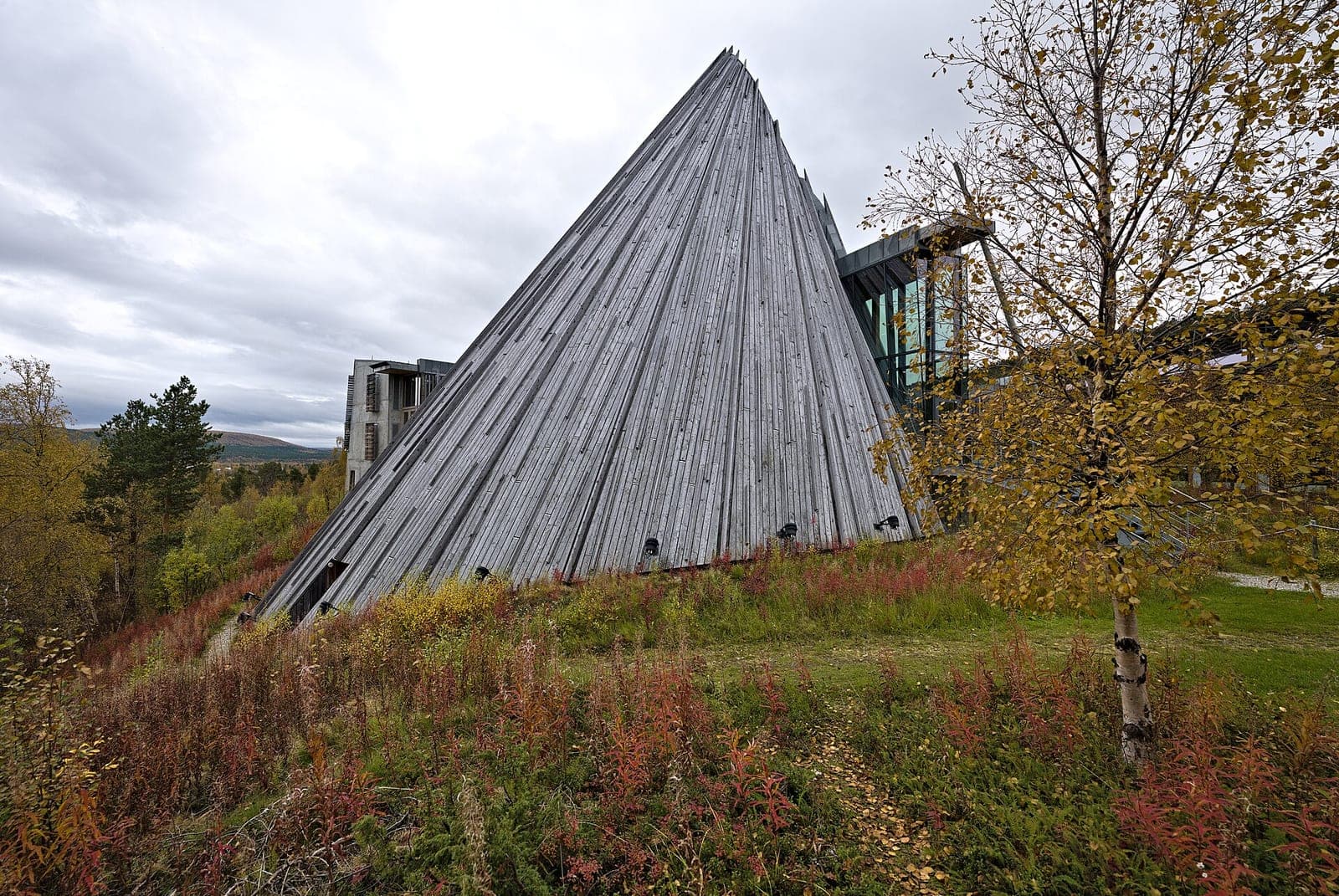
Kárášjohka (Karasjok). Seat of the Sámi Parliament of Norway, whose building opened in 2000 with a plenary hall built as a timber cone in the shape of a lávvu, and of RiddoDuottarMuseat, the Sámi collections museum.
Guovdageaidnu (Kautokeino). The largest reindeer-herding municipality in Norway, home to Sámi allaskuvla, the Beaivváš Sámi national theatre and the Sámi Archives. Easter week brings reindeer racing, weddings and the Sámi Grand Prix.
Jåhkåmåhkke (Jokkmokk). Just above the Arctic Circle in Sweden, Jokkmokk has held a winter market in the first week of February since 1605, and it houses Ájtte, the mountain and Sámi museum.
Anár (Inari). Seat of the Sámi Parliament of Finland and of the Siida museum, with the Skolt Sámi Orthodox community northeast at Sevettijärvi.
The ancestors of the Sámi were hunting, fishing and gathering peoples of the far north, organised in the siida, a community that held its own lands and waters and moved between them by season. Wild reindeer were hunted for millennia before many groups turned to herding tame animals, a shift that gathered pace from the sixteenth century. Sámi lands were taxed by more than one crown at once, sometimes by Denmark-Norway, Sweden and Novgorod at the same time.
Borders then cut the country up. The Lapp Codicil of 1751 guaranteed Sámi the right to cross the new Sweden-Norway line with their herds and is sometimes called the Sámi Magna Carta. The frontier between Norway and Finland closed in 1852 and that between Sweden and Finland in 1889, severing migration routes herding depended on; from 1919, Swedish authorities forcibly moved northern herding families hundreds of kilometres south into other Sámi districts.
Mining, forestry and hydropower followed, from the silver at Nasafjäll in the 1630s, where Sámi were compelled to haul ore by reindeer, to the iron of Kiruna. Alongside it came assimilation. In Norway, fornorsking ran from about 1850 through the school instruction of 1898 making Norwegian the sole language of teaching, boarding schools that took children far from home, and a land act of 1902 barring anyone who could not speak Norwegian and register a Norwegian name from buying land in Finnmark, a provision not repealed until 1965. Sweden ran a separate and lesser schooling for herding children under the doctrine that a Lapp should remain a Lapp, and in 1922 founded the State Institute for Racial Biology at Uppsala, the first of its kind anywhere. Finland assimilated through Finnish-only schooling.
The Sámi languages belong to the Uralic family, distant kin of Finnish and Estonian and intelligible with neither. Nine are still spoken, and some counts say ten: South, Ume, Pite, Lule and North Sámi in the west, Inari, Skolt, Kildin and Ter in the east. Neighbouring languages shade into one another, while the ones at either end of the chain differ about as much as English and German.
The numbers vary sharply. North Sámi has somewhere between 20,000 and 30,000 speakers and accounts for the great majority of all Sámi speech; Lule Sámi has two to three thousand; South, Inari and Skolt Sámi a few hundred each; Ume and Pite Sámi fewer than twenty apiece. Ter Sámi was down to two speakers by 2011, and Akkala Sámi lost its last speaker in 2003. Kemi Sámi, once spoken across the Finnish interior, died out in the nineteenth century, leaving word lists and two joik texts written down by a curious clergyman. UNESCO classes every surviving Sámi language as endangered, several critically so.
Nine written standards exist, and North Sámi has used one common orthography since 1979. The word Sápmi carries three meanings at once, the land, the people and the language, and a Sámi person is a sápmelaš. The exonyms Lapp and Lapland cling to maps and product names and are avoided by most Sámi. Revival is possible even at the bottom of the scale: Inari Sámi had perhaps three hundred mostly elderly speakers when Anarâškielâ servi opened a language nest in 1997, and it now has children who grew up in it.
Only about a tenth of Sámi herd reindeer, yet herding shapes the law and much of the identity. The siida remains the working unit, a group of herders and households sharing pasture, calf-marking and the long moves between winter forest and summer mountain. In Norway and Sweden the right to herd is reserved to Sámi; in Finland it isn't, and any resident of the herding area may keep reindeer, which changes the politics of land on that side of the border.
 A lavvu can be struck and carried, which is the whole point of it, and photographs like this one were taken in the same decades that Nordic states were measuring Sami skulls. Photograph by Granbergs Nya Aktiebolag, public domain, via Wikimedia Commons.
The lávvu is the portable conical tent of poles and cloth that can be raised in an hour and struck as fast, still used at calf-marking and on the fells; the goahti is its settled cousin, a curved-pole frame turfed over for a season or a lifetime. Duodji is Sámi craft made to be used: knives, birch-root baskets, the guksi cup carved from a burl, pewter-thread embroidery. The gákti, the coat, tells anyone who can read it where the wearer comes from and often whether they're married.
Joik is the form outsiders most often misread. A joik is not a song about a person, a wolf or a mountain. It's a way of calling the thing itself into the room, which is why Sámi say that you joik someone rather than joik about them, and the distinction is the whole point of the form rather than a poetic flourish. A joik may have no fixed beginning or end, a person may be given a personal joik by others and carry it for life, and families hold joiks for their own dead. The church condemned the practice as heathen and sinful, and in some school districts it was forbidden well into the second half of the twentieth century.
Older Sámi belief read the land as populated with power. A sieidi was a stone or wooden figure of unusual shape at a fishing place, a pass or a hunting ground, given offerings of fat, blood, antler or coin in exchange for luck. A bassevárri was a holy mountain, approached with care and sometimes not approached at all. The noaidi moved between worlds with the help of a drum, a shallow frame of wood covered in reindeer hide and painted with figures, read by watching a brass ring travel across the surface.
Christian missions reached the coasts in the medieval period and pushed inland in force in the seventeenth century, with witchcraft trials across the northern parishes. From 1609 the use of drums was punishable in Denmark-Norway, and Thomas von Westen's mission from 1716 gathered them by the hundred for destruction. Lars Levi Læstadius, a Swedish priest of Sámi descent, began a revival at Karesuando in the 1840s that spread across northern Sápmi and remains strong; it preached in Sámi and Finnish, which helped the languages survive, while condemning joik. Læstadian ferment fed the Kautokeino rising of 1852, after which two men were beheaded.
King Harald V of Norway apologised on the state's behalf at the opening of the Sámi Parliament in 1997, and the Church of Sweden made a formal apology at Uppsala in November 2021.
Before churchyards, Sámi buried their dead close to where the siida lived and travelled: in scree slopes, under stone, in birch bark or a hollowed log, with a knife or a cup or a set of skis laid beside the body. Sites were often unmarked, and their locations were carried in family memory. After Christianisation the parish churchyard could be many days away, so a body might be kept through the frozen months in a cold store or on a raised platform until the ground thawed and the family could travel with it. The sacred places were never graveyards, but they belong to the same understanding: that certain ground holds power, that it is owed offerings and restraint, and that the distance between the living and those before them is short and local.
Then there are the drums. Around seventy-one survive anywhere in the world, out of many hundreds, because missionaries and courts collected them for burning and because roughly seventy of those kept for study went up in the great fire of Copenhagen in 1728. The survivors sit in museums in Copenhagen, Stockholm, Leipzig and Rome, and Sámi museums have asked for them for decades. In January 2022 the Danish culture ministry transferred ownership of the drum seized from Anders Poulsen at his sorcery trial in 1691 to RiddoDuottarMuseat in Kárášjohka, the first Sámi cultural object returned from abroad to Sápmi. Poulsen, then about a hundred years old, was killed by an axe blow before his sentence was carried out. Most of the other drums remain where they were taken.
Hardest of all is what was done to the graves. From the middle of the nineteenth century, anatomists and then racial biologists took Sámi skulls for collections built on the idea that the shape of a head marked a race. Anders Retzius assembled such a collection at the Karolinska Institute in Stockholm and his son Gustaf enlarged it; Karl Emil Schreiner in Oslo used Sámi skeletons for work concluding that the Sámi were a lesser and infantile type; the racial biology institute at Uppsala measured and photographed the living while the dead supplied the bones. Nobody asked permission. In 1915 a party working for anatomists at Uppsala dug the old churchyard at Rounala, north of Karesuando, and removed eighteen skulls, and in the same year the remains of ninety-four people were taken from the Skolt Sámi burial ground at Neiden in Norway for what became the Schreiner Collection. In several districts families knew exactly whose graves had been emptied.
Some of it has gone back into the ground. The ninety-four from Neiden were reburied at Skoltebyen in September 2011, in individual coffins beneath a single mound, over the objections of Skolt Sámi who said they had not been properly consulted and that a communal mound was not their practice. In August 2019, twenty-five people whose skulls had been taken from the old Sámi churchyard at Lycksele in the 1950s were reburied at Gammplatsen, the largest single reburial of Sámi remains in Sweden, and the culture minister used the occasion to announce talks on a truth commission. In January 2023 the Swedish government cleared Uppsala University to hand the eighteen Rounala skulls to the Sámi Parliament for reburial, and where they should lie and who decides have proved hard to settle, because the community they came from no longer exists in the same form.
Uppsala still holds the remains of around three dozen people thought to be Sámi. At the Karolinska Institute a fire destroyed most of its Sámi crania in 1892, and an inventory begun in 2015 turned up a Sámi woman from Malå whose remains were repatriated in 2024. The heads of the two men executed after the Kautokeino rising sat in the anatomical collection in Oslo for well over a century and were returned for burial in the 1990s. The work is unfinished, and some of the sharpest disagreements about it are among Sámi rather than between Sámi and states.
Ordinary mourning now runs along Læstadian and Lutheran lines in the west and Orthodox lines among the Skolts, with unaccompanied hymn singing, the gákti worn to the graveside, and food afterwards for everyone who came. Joik at funerals has returned after generations of absence, and where it is sung a person's own joik is given back to them a last time.
Sámi genealogy is written into land, and the states that wrote it down did so in order to take the land away.
Sámi families belong to a siida, a community with defined grazing and fishing territory, and to reindeer-herding units within it, and descent determines rights. Norway, Sweden, Finland and Russia each recorded this in their own way and for their own purposes: Swedish and Norwegian tax registers of the Lapp villages from the seventeenth century name heads of household and their herds, and those are the earliest systematic Sámi records. Church registers followed the missionaries.
The registers are also the record of what was done. Norway and Sweden pursued policies of assimilation for a century, banning the language in schools and, in Sweden, running a state institute of racial biology that photographed and measured Sámi people and dug up Sámi graves for skulls. The files of that institute exist and name individuals, and the repatriation of remains from museum collections has been going on for three decades. Drums confiscated by missionaries and burned or sent to Copenhagen are in the same category.
Modern Sámi identity is registered voluntarily in the electoral rolls of the Sámi parliaments in the three Nordic countries, which require a connection to the language within a stated number of generations, and the criteria are argued about because they determine who counts.
The joik, the personal song made for a specific person, is the oldest Sámi record: not a song about someone but a song that is them.
Laponia, inscribed by UNESCO in 1996, covers 9,400 square kilometres of Swedish mountain and forest and was listed as a mixed site partly because Sámi reindeer herding continues there as a living seasonal practice. Since 2011 it has been managed by Laponiatjuottjudus, a board with a Sámi majority, itself the outcome of a long argument about who should govern a protected landscape people still work in. The rock art at Alta, inscribed in 1985, carries several thousand carvings.
Ájtte at Jokkmokk holds the Swedish mountain and Sámi collections; Siida at Anár reopened after rebuilding in 2022 and was named European Museum of the Year in 2024; RiddoDuottarMuseat cares for the Norwegian collections and now for Poulsen's drum. Two large returns changed what those museums hold. Bååstede, South Sámi for the return, agreed in 2012 between Norsk Folkemuseum, the Museum of Cultural History and the Sámi Parliament, moved ownership of 1,639 objects to six Sámi museums in 2019. In August 2021 Finland approved the transfer of about 2,200 objects from the National Museum to Siida.
Language technology has done more for the small Sámi languages than almost anything else. Giellatekno and Divvun at UiT The Arctic University of Norway build dictionaries, spellcheckers, keyboards and machine translation for every written Sámi language and release the work openly, which is how a language with a few hundred speakers acquires tools no commercial vendor would ever build for it.
Elsewhere the record is being pulled back together across the institutions that scattered it. The surviving drums have been photographed and catalogued so the whole corpus can be studied at once while the objects stay in different countries. The Sámi Parliament in Norway keeps the register of Sámi place names, and NRK Sápmi, SVT Sápmi and Yle Sápmi broadcast daily in Sámi.
Land is where the arguments are. On 11 October 2021 the Supreme Court of Norway held unanimously that the licences for the Storheia and Roan wind farms on the Fosen peninsula were invalid, because 151 turbines built on winter pasture violated the reindeer herders' right to enjoy their own culture under Article 27 of the International Covenant on Civil and Political Rights. The turbines kept turning. In February and March 2023, five hundred days after the judgment, Sámi and Norwegian activists blocked the entrances of government ministries in Oslo until the government apologised for the continuing breach; settlements followed with the southern herding group in December 2023 and the northern group in March 2024, providing compensation, extra winter pasture and a say in operations, with the turbines staying. In Sweden the Gállok iron ore concession was granted in 2022 over Sámi objections.
The truth commissions have reported or are reporting. Norway's, chaired by Dagfinn Høybråten, delivered a 700-page account of Norwegianisation to the Storting on 1 June 2023, drawing on more than 760 personal testimonies. Finland's, which lost members to resignations in 2022, handed over its final report on 4 December 2025. Sweden's, appointed in 2021, has been through three chairs and nine resignations and is due to report on 1 October 2026.
Culture travels further than the politics. Mari Boine brought joik into international music from the 1980s, and Sofia Jannok and Ella Marie Hætta Isaksen carry it now. Amanda Kernell's Sameblod, released in 2016, put the nomad schools in front of a Nordic audience.
Alta changed the politics. Between 1979 and 1981, protests against damming the Alta-Kautokeino river drew thousands to the construction road at Stilla, and seven Sámi hunger-struck in a lávvu outside the Norwegian parliament in October 1979. The dam was built. The political consequences were the Sámi Rights Committee, the Sámi Act of 1987 and the opening of the Sámi Parliament in 1989.
Collections came home. Bååstede moved 1,639 objects into Sámi museum ownership in 2019, Finland transferred about 2,200 to Siida in 2021, and Denmark gave up ownership of Anders Poulsen's drum in January 2022.
Inari Sámi came back. A language nest opened in 1997 produced children who speak a language expected to end with their grandparents.
A lavvu can be struck and carried, which is the whole point of it, and photographs like this one were taken in the same decades that Nordic states were measuring Sami skulls. Photograph by Granbergs Nya Aktiebolag, public domain, via Wikimedia Commons.
The lávvu is the portable conical tent of poles and cloth that can be raised in an hour and struck as fast, still used at calf-marking and on the fells; the goahti is its settled cousin, a curved-pole frame turfed over for a season or a lifetime. Duodji is Sámi craft made to be used: knives, birch-root baskets, the guksi cup carved from a burl, pewter-thread embroidery. The gákti, the coat, tells anyone who can read it where the wearer comes from and often whether they're married.
Joik is the form outsiders most often misread. A joik is not a song about a person, a wolf or a mountain. It's a way of calling the thing itself into the room, which is why Sámi say that you joik someone rather than joik about them, and the distinction is the whole point of the form rather than a poetic flourish. A joik may have no fixed beginning or end, a person may be given a personal joik by others and carry it for life, and families hold joiks for their own dead. The church condemned the practice as heathen and sinful, and in some school districts it was forbidden well into the second half of the twentieth century.
Older Sámi belief read the land as populated with power. A sieidi was a stone or wooden figure of unusual shape at a fishing place, a pass or a hunting ground, given offerings of fat, blood, antler or coin in exchange for luck. A bassevárri was a holy mountain, approached with care and sometimes not approached at all. The noaidi moved between worlds with the help of a drum, a shallow frame of wood covered in reindeer hide and painted with figures, read by watching a brass ring travel across the surface.
Christian missions reached the coasts in the medieval period and pushed inland in force in the seventeenth century, with witchcraft trials across the northern parishes. From 1609 the use of drums was punishable in Denmark-Norway, and Thomas von Westen's mission from 1716 gathered them by the hundred for destruction. Lars Levi Læstadius, a Swedish priest of Sámi descent, began a revival at Karesuando in the 1840s that spread across northern Sápmi and remains strong; it preached in Sámi and Finnish, which helped the languages survive, while condemning joik. Læstadian ferment fed the Kautokeino rising of 1852, after which two men were beheaded.
King Harald V of Norway apologised on the state's behalf at the opening of the Sámi Parliament in 1997, and the Church of Sweden made a formal apology at Uppsala in November 2021.
Before churchyards, Sámi buried their dead close to where the siida lived and travelled: in scree slopes, under stone, in birch bark or a hollowed log, with a knife or a cup or a set of skis laid beside the body. Sites were often unmarked, and their locations were carried in family memory. After Christianisation the parish churchyard could be many days away, so a body might be kept through the frozen months in a cold store or on a raised platform until the ground thawed and the family could travel with it. The sacred places were never graveyards, but they belong to the same understanding: that certain ground holds power, that it is owed offerings and restraint, and that the distance between the living and those before them is short and local.
Then there are the drums. Around seventy-one survive anywhere in the world, out of many hundreds, because missionaries and courts collected them for burning and because roughly seventy of those kept for study went up in the great fire of Copenhagen in 1728. The survivors sit in museums in Copenhagen, Stockholm, Leipzig and Rome, and Sámi museums have asked for them for decades. In January 2022 the Danish culture ministry transferred ownership of the drum seized from Anders Poulsen at his sorcery trial in 1691 to RiddoDuottarMuseat in Kárášjohka, the first Sámi cultural object returned from abroad to Sápmi. Poulsen, then about a hundred years old, was killed by an axe blow before his sentence was carried out. Most of the other drums remain where they were taken.
Hardest of all is what was done to the graves. From the middle of the nineteenth century, anatomists and then racial biologists took Sámi skulls for collections built on the idea that the shape of a head marked a race. Anders Retzius assembled such a collection at the Karolinska Institute in Stockholm and his son Gustaf enlarged it; Karl Emil Schreiner in Oslo used Sámi skeletons for work concluding that the Sámi were a lesser and infantile type; the racial biology institute at Uppsala measured and photographed the living while the dead supplied the bones. Nobody asked permission. In 1915 a party working for anatomists at Uppsala dug the old churchyard at Rounala, north of Karesuando, and removed eighteen skulls, and in the same year the remains of ninety-four people were taken from the Skolt Sámi burial ground at Neiden in Norway for what became the Schreiner Collection. In several districts families knew exactly whose graves had been emptied.
Some of it has gone back into the ground. The ninety-four from Neiden were reburied at Skoltebyen in September 2011, in individual coffins beneath a single mound, over the objections of Skolt Sámi who said they had not been properly consulted and that a communal mound was not their practice. In August 2019, twenty-five people whose skulls had been taken from the old Sámi churchyard at Lycksele in the 1950s were reburied at Gammplatsen, the largest single reburial of Sámi remains in Sweden, and the culture minister used the occasion to announce talks on a truth commission. In January 2023 the Swedish government cleared Uppsala University to hand the eighteen Rounala skulls to the Sámi Parliament for reburial, and where they should lie and who decides have proved hard to settle, because the community they came from no longer exists in the same form.
Uppsala still holds the remains of around three dozen people thought to be Sámi. At the Karolinska Institute a fire destroyed most of its Sámi crania in 1892, and an inventory begun in 2015 turned up a Sámi woman from Malå whose remains were repatriated in 2024. The heads of the two men executed after the Kautokeino rising sat in the anatomical collection in Oslo for well over a century and were returned for burial in the 1990s. The work is unfinished, and some of the sharpest disagreements about it are among Sámi rather than between Sámi and states.
Ordinary mourning now runs along Læstadian and Lutheran lines in the west and Orthodox lines among the Skolts, with unaccompanied hymn singing, the gákti worn to the graveside, and food afterwards for everyone who came. Joik at funerals has returned after generations of absence, and where it is sung a person's own joik is given back to them a last time.
Sámi genealogy is written into land, and the states that wrote it down did so in order to take the land away.
Sámi families belong to a siida, a community with defined grazing and fishing territory, and to reindeer-herding units within it, and descent determines rights. Norway, Sweden, Finland and Russia each recorded this in their own way and for their own purposes: Swedish and Norwegian tax registers of the Lapp villages from the seventeenth century name heads of household and their herds, and those are the earliest systematic Sámi records. Church registers followed the missionaries.
The registers are also the record of what was done. Norway and Sweden pursued policies of assimilation for a century, banning the language in schools and, in Sweden, running a state institute of racial biology that photographed and measured Sámi people and dug up Sámi graves for skulls. The files of that institute exist and name individuals, and the repatriation of remains from museum collections has been going on for three decades. Drums confiscated by missionaries and burned or sent to Copenhagen are in the same category.
Modern Sámi identity is registered voluntarily in the electoral rolls of the Sámi parliaments in the three Nordic countries, which require a connection to the language within a stated number of generations, and the criteria are argued about because they determine who counts.
The joik, the personal song made for a specific person, is the oldest Sámi record: not a song about someone but a song that is them.
Laponia, inscribed by UNESCO in 1996, covers 9,400 square kilometres of Swedish mountain and forest and was listed as a mixed site partly because Sámi reindeer herding continues there as a living seasonal practice. Since 2011 it has been managed by Laponiatjuottjudus, a board with a Sámi majority, itself the outcome of a long argument about who should govern a protected landscape people still work in. The rock art at Alta, inscribed in 1985, carries several thousand carvings.
Ájtte at Jokkmokk holds the Swedish mountain and Sámi collections; Siida at Anár reopened after rebuilding in 2022 and was named European Museum of the Year in 2024; RiddoDuottarMuseat cares for the Norwegian collections and now for Poulsen's drum. Two large returns changed what those museums hold. Bååstede, South Sámi for the return, agreed in 2012 between Norsk Folkemuseum, the Museum of Cultural History and the Sámi Parliament, moved ownership of 1,639 objects to six Sámi museums in 2019. In August 2021 Finland approved the transfer of about 2,200 objects from the National Museum to Siida.
Language technology has done more for the small Sámi languages than almost anything else. Giellatekno and Divvun at UiT The Arctic University of Norway build dictionaries, spellcheckers, keyboards and machine translation for every written Sámi language and release the work openly, which is how a language with a few hundred speakers acquires tools no commercial vendor would ever build for it.
Elsewhere the record is being pulled back together across the institutions that scattered it. The surviving drums have been photographed and catalogued so the whole corpus can be studied at once while the objects stay in different countries. The Sámi Parliament in Norway keeps the register of Sámi place names, and NRK Sápmi, SVT Sápmi and Yle Sápmi broadcast daily in Sámi.
Land is where the arguments are. On 11 October 2021 the Supreme Court of Norway held unanimously that the licences for the Storheia and Roan wind farms on the Fosen peninsula were invalid, because 151 turbines built on winter pasture violated the reindeer herders' right to enjoy their own culture under Article 27 of the International Covenant on Civil and Political Rights. The turbines kept turning. In February and March 2023, five hundred days after the judgment, Sámi and Norwegian activists blocked the entrances of government ministries in Oslo until the government apologised for the continuing breach; settlements followed with the southern herding group in December 2023 and the northern group in March 2024, providing compensation, extra winter pasture and a say in operations, with the turbines staying. In Sweden the Gállok iron ore concession was granted in 2022 over Sámi objections.
The truth commissions have reported or are reporting. Norway's, chaired by Dagfinn Høybråten, delivered a 700-page account of Norwegianisation to the Storting on 1 June 2023, drawing on more than 760 personal testimonies. Finland's, which lost members to resignations in 2022, handed over its final report on 4 December 2025. Sweden's, appointed in 2021, has been through three chairs and nine resignations and is due to report on 1 October 2026.
Culture travels further than the politics. Mari Boine brought joik into international music from the 1980s, and Sofia Jannok and Ella Marie Hætta Isaksen carry it now. Amanda Kernell's Sameblod, released in 2016, put the nomad schools in front of a Nordic audience.
Alta changed the politics. Between 1979 and 1981, protests against damming the Alta-Kautokeino river drew thousands to the construction road at Stilla, and seven Sámi hunger-struck in a lávvu outside the Norwegian parliament in October 1979. The dam was built. The political consequences were the Sámi Rights Committee, the Sámi Act of 1987 and the opening of the Sámi Parliament in 1989.
Collections came home. Bååstede moved 1,639 objects into Sámi museum ownership in 2019, Finland transferred about 2,200 to Siida in 2021, and Denmark gave up ownership of Anders Poulsen's drum in January 2022.
Inari Sámi came back. A language nest opened in 1997 produced children who speak a language expected to end with their grandparents.
National Overview
Notable Cities
Historical Foundations
Linguistic and Etymological Roots
Cultural Identity
Religion and Spirituality
Remembrance and Mourning Traditions
Tracing a Family in Sapmi
Heritage Preservation Efforts
Digital Heritage
Contemporary Cultural Influences
Success Stories
References and resources
- Sámi Parliament of Norway: the elected body at Kárášjohka, 1989.
- Sámi Parliament of Finland: established 1996.
- UNESCO, Laponian Area: mixed World Heritage, 1996.
- UNESCO, Rock Art of Alta: carvings inscribed 1985.
- Truth and Reconciliation Commission, Storting: Norway's 2023 report.
- Truth and Reconciliation Commission Concerning the Sámi People, Finland: the Finnish commission.
- Uppsala University, human remains: the Rounala skulls and repatriation.
- Karolinska Institutet, the Retzius legacy: the craniometric collection.
- RiddoDuottarMuseat: the Kárášjohka museums and the returned drum.
- Sámi Museum Siida: Inari, and the 2021 repatriation.
- Divvun, UiT: open language technology.