Heritage · Country
Laos Culture and Heritage
Before dawn in Luang Prabang, a line of saffron-robed monks receives rice from kneeling townspeople, a rite unbroken for six centuries. From the golden stupa of Pha That Luang to the mystery of the Plain of Jars, Laos keeps a memory shaped by Theravada Buddhism, the old kingdom of a million elephants and the peoples of its highlands.Written to last.
By Confinity Heritage Editorial · Updated 2026-07-31 · 8-minute readQuiet tools, kept out of the way.
Laos is the only landlocked country in mainland Southeast Asia, a mountainous, river-threaded land where the Mekong runs for hundreds of kilometres along its western edge and gathers the towns, temples and rice fields of the lowland Lao. It is a country measured less by its cities than by its monasteries: the wat is the school, the festival ground and the resting place of the dead, and in Luang Prabang the day still begins with the tak bat, the dawn procession in which more than two hundred saffron-robed monks walk the streets to receive rice from kneeling townspeople, a rite kept since the fourteenth century (UNESCO).
That devotion rests on a long inheritance. In 1353 the prince Fa Ngum united the Lao principalities into the kingdom of Lan Xang, "the land of a million elephants and the white parasol", which for more than three centuries shaped the language, faith and self-image of the Lao (Wikipedia). Around the lowland majority live dozens of highland peoples, among them the Khmu, Hmong and Akha, each with its own language and its own way of tending the ancestors. Across the eastern uplands the land also carries the marks of the war of 1964–1973, when Laos was among the most heavily bombed places on earth, and the clearing of that ordnance is now tied to the care of its heritage.
Laos, officially the Lao People's Democratic Republic, is a landlocked nation of about 7.5 million people across roughly 236,800 square kilometres of northern and central mainland Southeast Asia. It borders China and Myanmar to the north, Vietnam to the east, Cambodia to the south and Thailand to the west, the last frontier marked for much of its length by the Mekong River, the artery of Lao farming and trade (Wikipedia). The land is largely upland, and most of the population and the historic towns gather on the fertile Mekong plain.
Its people are among the most varied in the region. The lowland Lao make up a little over half the population, followed by the Khmu at around eleven per cent and the Hmong at around nine, with more than forty further groups officially recognised (Wikipedia). Since the 1960s these peoples have often been grouped by elevation into three broad families: the Lao Loum of the valleys, the Lao Theung of the mid slopes and the Lao Sung of the high mountains (Facts and Details). Lao is the official language, Theravada Buddhism the faith of roughly two-thirds of the people alongside widespread animist belief, and the kip the national currency. Vientiane, on the Mekong, is the capital and largest city.
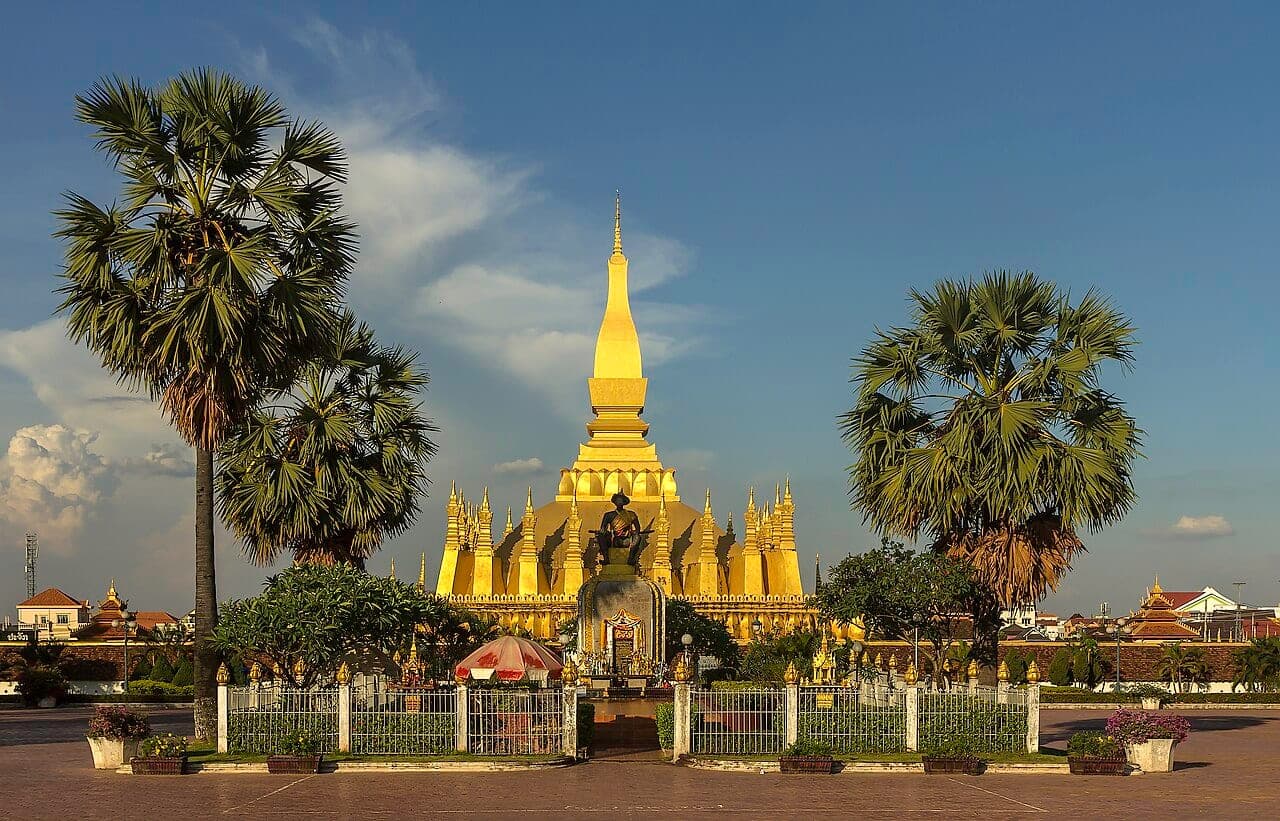
Vientiane. The capital sits on a bend of the Mekong facing Thailand. Its centre holds Pha That Luang, the golden stupa that is the country's national symbol, first raised in legend over an ancient relic and rebuilt in its present form after King Setthathirath moved the capital here from Luang Prabang and commissioned the monument in 1566 (Asia King Travel). Sacked by a Siamese army in 1828 and left in ruins for decades, the stupa was restored under French administration from 1900 and today carries some 500 kilograms of gold leaf; it appears on the national seal and the currency. Nearby stand Haw Phra Kaew and Wat Sisaket, with its thousands of Buddha images.
Luang Prabang. The former royal capital, set on a peninsula between the Mekong and the Nam Khan, was inscribed on the UNESCO World Heritage List in 1995 for the way its monasteries and colonial buildings blend traditional Lao temple architecture with nineteenth- and twentieth-century French construction (UNESCO). Its finest monastery, Wat Xieng Thong, was built in the sixteenth century under Setthathirath and shows the classic Luang Prabang form, a low sweeping roof over gilded walls. Above the town rises Mount Phousi, and each dawn the tak bat alms procession moves through its streets.
Pakse. The largest town of the south, at the meeting of the Mekong and the Xe Don, grew under the French as a provincial and trading centre and keeps rows of colonial shophouses. It is the gateway to Champasak and the Khmer temple of Vat Phou, and to the cool Bolaven Plateau, the heart of Lao coffee growing.
Savannakhet. The country's second city lies on the Mekong opposite Mukdahan in Thailand and on the road east to Vietnam, a position that made it a colonial trading hub with one of the best-preserved French streetscapes in Laos (Wikipedia). Outside the town the venerated stupa of That Ing Hang draws pilgrims from across the region.
Long before the Lao kingdoms, the middle Mekong lay within reach of two older civilisations. Mon peoples of the Dvaravati culture carried Buddhism up the river valleys in the first millennium, and from the south the Khmer empire built at Champasak the temple of Vat Phou, a sanctuary of Shiva whose oldest structures reach back to the era before Angkor (UNESCO).
The Lao state proper begins in 1353, when Fa Ngum, raised in exile at the Khmer court, returned to found the kingdom of Lan Xang with its capital at Muang Sua, later Luang Prabang (Wikipedia). For over three centuries it was one of the larger realms of Southeast Asia. King Setthathirath moved the capital to Vientiane in 1560 for its more defensible position on the Mekong and raised the great stupa there (Vientiane history). After the reign of Sourigna Vongsa the kingdom fractured in 1707 into three states: Luang Prabang in the north, Vientiane in the centre and Champasak in the south. Over the following century all three fell increasingly under Siamese control, and a failed revolt led to the Siamese sack of Vientiane in 1828.
France drew the Lao lands into its Indochina in 1893, joining the separate territories under a single protectorate and fixing the final "s" of the name by which the country is known in the West (Wikipedia). Laos gained full independence in 1953 as a constitutional monarchy under the house of Luang Prabang. The decades that followed were shadowed by the wider conflict in Indochina. From 1964 to 1973 Laos was heavily bombed, becoming by common reckoning the most heavily bombed country per capita in history, with a large share of the ordnance left unexploded (Lao National Tourism); the consequences for its land and heritage are set out below. The kingdom ended in December 1975, when the Lao People's Democratic Republic was established, the form the state keeps today.
Lao belongs to the Tai branch of the Kra-Dai (Tai-Kadai) language family, kin to Thai and to the Tai tongues of southern China and northern Vietnam, and like them it is tonal (Wikipedia). It is written in the Lao script, an abugida descended, like Thai, from the Khmer adaptation of a southern Indian model, and its religious and learned vocabulary draws heavily on Pali and Sanskrit carried by Buddhism.
The country's name comes from the Lao people themselves, whose ancestors moved south from what is now southern China over the early second millennium. The singular usage would be "Lao"; the plural "Laos" was fixed by French administrators in 1893 to cover the several former kingdoms they had gathered into one protectorate (Wikipedia). The old royal name, Lan Xang Hom Khao, translates as "the land of a million elephants and the white parasol", the elephant a symbol of martial and royal power and the white parasol a mark of sovereignty (Wikipedia). Alongside Lao, the country's minorities speak dozens of Austroasiatic tongues, such as Khmu, and Hmong-Mien and Tibeto-Burman languages in the high country.
Lao material culture is expressed most fully in cloth. Women across the country weave silk and cotton on frame looms, and the finest pieces use continuous supplementary weft, a brocade method in which extra threads are worked row by row into patterns of the naga, the water serpent of Mekong belief (The Textile Atlas). The wrapped skirt, the sinh, with its patterned hem, remains everyday and ceremonial dress. Sound belongs to the khene, a bamboo mouth organ that is the national instrument, whose breathy chords accompany lam, also called mor lam, a sung poetry of paired, improvising voices; khaen music was inscribed on UNESCO's Representative List of the Intangible Cultural Heritage of Humanity in 2017 (UNESCO). At the table, glutinous "sticky" rice, khao niaw, is the staple, rolled by hand and dipped into dishes such as laap, a minced-meat salad sharp with lime and herbs, tam mak hoong, the green-papaya salad, and or lam, a bittersweet stew of the north. The year turns on the water-blessings of Boun Pi Mai, the Lao New Year in April, and the great religious fair of Boun That Luang in Vientiane.
Theravada Buddhism has been central to Lao life since the days of Lan Xang, and the wat remains the heart of most communities. Boys and men have traditionally ordained for a period as novices or monks, earning merit for their families, and the monastery keeps the calendar of observance. Beneath and around this Buddhism runs an older animism. Many lowland Lao hold that each person carries thirty-two khwan, soul components that may wander and unsettle their owner, and the baci or sou khwan ceremony calls them home: an elder recites blessings while white cotton threads are tied around the wrists to bind the spirits in place, a rite performed at weddings, welcomes, recoveries and departures (Facts and Details). Guardian and ancestral spirits, the phi, receive offerings at household and village shrines, and among the highland peoples, the Hmong, Khmu, Akha and others, animist practice and ancestor veneration remain the primary religious life, tended by ritual specialists and shamans.
 Wat Mai in Luang Prabang, a town whose monks still walk the streets at dawn collecting alms. Photograph by Basile Morin, CC BY-SA 4.0, via Wikimedia Commons.
Lao Buddhism approaches death as a passage governed by merit. When someone dies, the body is washed, dressed and watched over at home while monks chant, and after several days it is cremated at the wat, the family earning merit that is dedicated to the departed to ease the next rebirth (True Indochina). Memorial ceremonies gather relatives again after a set number of days and, in a major observance, one hundred days after the death, when food and gifts are offered to monks and the merit transferred by name to the dead. Ashes are commonly enshrined in a small stupa, a that, within the monastery grounds, so that the dead rest at the temple among the living.
Wat Mai in Luang Prabang, a town whose monks still walk the streets at dawn collecting alms. Photograph by Basile Morin, CC BY-SA 4.0, via Wikimedia Commons.
Lao Buddhism approaches death as a passage governed by merit. When someone dies, the body is washed, dressed and watched over at home while monks chant, and after several days it is cremated at the wat, the family earning merit that is dedicated to the departed to ease the next rebirth (True Indochina). Memorial ceremonies gather relatives again after a set number of days and, in a major observance, one hundred days after the death, when food and gifts are offered to monks and the merit transferred by name to the dead. Ashes are commonly enshrined in a small stupa, a that, within the monastery grounds, so that the dead rest at the temple among the living.
 The jars are Iron Age funerary vessels, and the fields around them were among the most heavily bombed places on earth, so clearing unexploded ordnance came before archaeology. Photograph by Jakub Halun, CC BY-SA 4.0, via Wikimedia Commons.
Two festivals in the rains open a season for the ancestors. At Boun Khao Padap Din, held near the tenth full moon, families bring offerings to the wat for their deceased, holding that the boundary to the other world is briefly thin; a fortnight later Boun Khao Salak completes the cycle, when baskets of food and everyday goods are prepared with the names of the dead and given to monks who draw the names by lot and dedicate the merit (Wat Lao Buddhovath). Water is poured to the earth as the blessing is spoken, carrying merit to the ancestors. These customs join the Buddhist logic of merit to the older conviction that the dead remain present and dependent on the care of their kin.
Lao family records are Buddhist before they are governmental, and the wat is where to start.
Village monasteries kept the community's records: palm-leaf manuscripts, temple chronicles, and the lists of the dead read at Boun Khao Padap Din, when families make offerings for ancestors who have no one to feed them. Ordination records name the men of a village, because most Lao men were monks at some point in their lives. Much of that manuscript material has been catalogued and microfilmed by a preservation programme that has worked through thousands of temple collections, and it is one of the better documented bodies of Southeast Asian manuscripts.
The French kept a civil register here from the 1890s that recorded some people well and most not at all, and its files sit in Vientiane and at Aix-en-Provence. The royal court at Luang Prabang kept its own chronicles and genealogies until 1975.
Then the war and what followed. The bombing between 1964 and 1973 made Laos the most heavily bombed country per head in history and emptied whole districts. After 1975 several hundred thousand people left, particularly Hmong who had fought alongside the Americans, and were documented in Thai refugee camps and then in the resettlement files of the United States, France and Australia. For a large part of the Lao diaspora the camp registration card is the earliest surviving family document.
Hmong genealogy runs by clan, of which there are eighteen, and the clan determines marriage, obligation and who conducts the funeral.
Laos holds three UNESCO World Heritage Sites, and each marks a different layer of its past. The town of Luang Prabang, listed in 1995, is protected as a whole for the way its monasteries and colonial buildings sit within a living Buddhist townscape (UNESCO). Vat Phou and the Champasak cultural landscape, listed in 2001, preserve a planned Khmer sacred geography more than a thousand years old, laid out along an axis from mountain to river (UNESCO). The Megalithic Jar Sites in Xiengkhuang, the Plain of Jars, listed in 2019, hold more than two thousand carved stone jars of an Iron Age funerary culture that used them between roughly 500 BCE and 500 CE (UNESCO).
Preservation here is bound up with a hazard few countries face. Much of the east, including parts of the Plain of Jars, remains contaminated with unexploded ordnance from the war of 1964–1973, and clearing it is a precondition for study and safe visiting. Of the many jar fields, only a small number have been opened to the public, cleared of ordnance by the Mines Advisory Group, while the rest stay closed (MAG). Organisations such as MAG, the national UXO Lao programme and the COPE rehabilitation centre in Vientiane carry out clearance, survivor support and public education, and their visitor centres in Vientiane, Luang Prabang and Phonsavan have themselves become places where this recent history is explained.
The most sustained Lao digital effort has been the rescue of its written memory. Lao literature was recorded for centuries on palm-leaf and mulberry-paper manuscripts kept in monasteries and easily lost to climate and neglect. From the late 1980s a national programme surveyed hundreds of wats and preserved tens of thousands of texts, and in 2007 the National Library of Laos began digitising the microfilmed results into the Digital Library of Lao Manuscripts, launched in 2010 to make the country's literary heritage freely readable online (Digital Library of Lao Manuscripts).
The Plain of Jars has drawn a second kind of digital work. Because unexploded ordnance makes many sites dangerous to enter, archaeologists from Monash University and the Australian National University, with Lao colleagues, have used drone-mounted lidar and photogrammetry to build detailed three-dimensional and virtual-reality models of the jar fields, allowing survey and public access to continue from a safe distance (Monash University).
Lao culture today moves between preservation and quiet reinvention, and its clearest new voice is in film: Mattie Do, born in the United States to Lao parents and working in Vientiane, became the country's first female director, and her ghost drama premiered at the Venice Film Festival in 2019, while an earlier film became the first from Laos put forward for the Academy Awards (Wikipedia). Lao music travels through a large diaspora in Thailand, France, Australia and the United States, where mor lam and the khene keep their audiences, while enterprises such as Ock Pop Tok in Luang Prabang have carried Lao weaving to new markets and trained a fresh generation of weavers (The Textile Atlas). The old festivals, from the New Year to the That Luang fair, remain the largest gatherings of the Lao year.
A whole town saved. The 1995 inscription of Luang Prabang made the former royal capital one of the best-conserved historic towns in Southeast Asia, its monasteries maintained and its dawn alms-round still walked (UNESCO).
Reading the palm leaves again. The National Library's manuscript programmes, from the surveys of the late twentieth century to the online Digital Library of Lao Manuscripts, preserved and opened tens of thousands of monastic texts that might otherwise have decayed unread (Digital Library of Lao Manuscripts).
The jars recognised despite the bombs. The Plain of Jars was inscribed as World Heritage in 2019, and pairing ordnance clearance with drone and lidar survey has let one of Asia's most enigmatic sites be studied in safety (UNESCO).
Weaving as a livelihood. Lao textile enterprises have rebuilt supplementary-weft silk weaving as both an art and an income, carrying the naga patterns of the Mekong into contemporary design (The Textile Atlas).
The jars are Iron Age funerary vessels, and the fields around them were among the most heavily bombed places on earth, so clearing unexploded ordnance came before archaeology. Photograph by Jakub Halun, CC BY-SA 4.0, via Wikimedia Commons.
Two festivals in the rains open a season for the ancestors. At Boun Khao Padap Din, held near the tenth full moon, families bring offerings to the wat for their deceased, holding that the boundary to the other world is briefly thin; a fortnight later Boun Khao Salak completes the cycle, when baskets of food and everyday goods are prepared with the names of the dead and given to monks who draw the names by lot and dedicate the merit (Wat Lao Buddhovath). Water is poured to the earth as the blessing is spoken, carrying merit to the ancestors. These customs join the Buddhist logic of merit to the older conviction that the dead remain present and dependent on the care of their kin.
Lao family records are Buddhist before they are governmental, and the wat is where to start.
Village monasteries kept the community's records: palm-leaf manuscripts, temple chronicles, and the lists of the dead read at Boun Khao Padap Din, when families make offerings for ancestors who have no one to feed them. Ordination records name the men of a village, because most Lao men were monks at some point in their lives. Much of that manuscript material has been catalogued and microfilmed by a preservation programme that has worked through thousands of temple collections, and it is one of the better documented bodies of Southeast Asian manuscripts.
The French kept a civil register here from the 1890s that recorded some people well and most not at all, and its files sit in Vientiane and at Aix-en-Provence. The royal court at Luang Prabang kept its own chronicles and genealogies until 1975.
Then the war and what followed. The bombing between 1964 and 1973 made Laos the most heavily bombed country per head in history and emptied whole districts. After 1975 several hundred thousand people left, particularly Hmong who had fought alongside the Americans, and were documented in Thai refugee camps and then in the resettlement files of the United States, France and Australia. For a large part of the Lao diaspora the camp registration card is the earliest surviving family document.
Hmong genealogy runs by clan, of which there are eighteen, and the clan determines marriage, obligation and who conducts the funeral.
Laos holds three UNESCO World Heritage Sites, and each marks a different layer of its past. The town of Luang Prabang, listed in 1995, is protected as a whole for the way its monasteries and colonial buildings sit within a living Buddhist townscape (UNESCO). Vat Phou and the Champasak cultural landscape, listed in 2001, preserve a planned Khmer sacred geography more than a thousand years old, laid out along an axis from mountain to river (UNESCO). The Megalithic Jar Sites in Xiengkhuang, the Plain of Jars, listed in 2019, hold more than two thousand carved stone jars of an Iron Age funerary culture that used them between roughly 500 BCE and 500 CE (UNESCO).
Preservation here is bound up with a hazard few countries face. Much of the east, including parts of the Plain of Jars, remains contaminated with unexploded ordnance from the war of 1964–1973, and clearing it is a precondition for study and safe visiting. Of the many jar fields, only a small number have been opened to the public, cleared of ordnance by the Mines Advisory Group, while the rest stay closed (MAG). Organisations such as MAG, the national UXO Lao programme and the COPE rehabilitation centre in Vientiane carry out clearance, survivor support and public education, and their visitor centres in Vientiane, Luang Prabang and Phonsavan have themselves become places where this recent history is explained.
The most sustained Lao digital effort has been the rescue of its written memory. Lao literature was recorded for centuries on palm-leaf and mulberry-paper manuscripts kept in monasteries and easily lost to climate and neglect. From the late 1980s a national programme surveyed hundreds of wats and preserved tens of thousands of texts, and in 2007 the National Library of Laos began digitising the microfilmed results into the Digital Library of Lao Manuscripts, launched in 2010 to make the country's literary heritage freely readable online (Digital Library of Lao Manuscripts).
The Plain of Jars has drawn a second kind of digital work. Because unexploded ordnance makes many sites dangerous to enter, archaeologists from Monash University and the Australian National University, with Lao colleagues, have used drone-mounted lidar and photogrammetry to build detailed three-dimensional and virtual-reality models of the jar fields, allowing survey and public access to continue from a safe distance (Monash University).
Lao culture today moves between preservation and quiet reinvention, and its clearest new voice is in film: Mattie Do, born in the United States to Lao parents and working in Vientiane, became the country's first female director, and her ghost drama premiered at the Venice Film Festival in 2019, while an earlier film became the first from Laos put forward for the Academy Awards (Wikipedia). Lao music travels through a large diaspora in Thailand, France, Australia and the United States, where mor lam and the khene keep their audiences, while enterprises such as Ock Pop Tok in Luang Prabang have carried Lao weaving to new markets and trained a fresh generation of weavers (The Textile Atlas). The old festivals, from the New Year to the That Luang fair, remain the largest gatherings of the Lao year.
A whole town saved. The 1995 inscription of Luang Prabang made the former royal capital one of the best-conserved historic towns in Southeast Asia, its monasteries maintained and its dawn alms-round still walked (UNESCO).
Reading the palm leaves again. The National Library's manuscript programmes, from the surveys of the late twentieth century to the online Digital Library of Lao Manuscripts, preserved and opened tens of thousands of monastic texts that might otherwise have decayed unread (Digital Library of Lao Manuscripts).
The jars recognised despite the bombs. The Plain of Jars was inscribed as World Heritage in 2019, and pairing ordnance clearance with drone and lidar survey has let one of Asia's most enigmatic sites be studied in safety (UNESCO).
Weaving as a livelihood. Lao textile enterprises have rebuilt supplementary-weft silk weaving as both an art and an income, carrying the naga patterns of the Mekong into contemporary design (The Textile Atlas).
National Overview
Notable Cities
Historical Foundations
Linguistic and Etymological Roots
Cultural Identity
Religion and Spirituality
Remembrance and Mourning Traditions
Tracing a Family in Laos
Heritage Preservation Efforts
Digital Heritage
Contemporary Cultural Influences
Success Stories
References and resources
- UNESCO World Heritage Centre: Town of Luang Prabang. The 1995 inscription of the royal capital and its monasteries.
- UNESCO World Heritage Centre: Vat Phou and the Champasak Cultural Landscape. The Khmer sacred landscape listed in 2001.
- UNESCO World Heritage Centre: Megalithic Jar Sites in Xiengkhuang, Plain of Jars. The Iron Age jar fields inscribed in 2019.
- UNESCO Intangible Cultural Heritage: Khaen music of the Lao people. The national mouth organ, inscribed in 2017.
- Wikipedia: Laos. Geography, demography, language and history.
- Lao National Tourism: The Secret War. The bombing of 1964–1973 and its legacy.
- MAG (Mines Advisory Group): Laos visitor centres. Ordnance clearance and public education.
- Digital Library of Lao Manuscripts. The National Library's manuscript digitisation project.
- The Textile Atlas: Ock Pop Tok, Laos. Lao silk weaving and its revival.