Heritage · Country
Nagaland Culture and Heritage
In the hills of India's far north-east, sixteen and more Naga peoples each keep their own language, bury their dead beside their houses under carved stone, and are now asking Oxford to send home the ancestors whose skulls were carried off a century ago. A guide to Naga heritage and remembrance.Written to last.
By Confinity Heritage Editorial · Updated 2026-08-17 · 8-minute readQuiet tools, kept out of the way.
In the summer of 2020 the Pitt Rivers Museum in Oxford took roughly 120 human remains off public display. Among them were Naga trophy heads, carried out of the hills of north-east India by British officers and collectors a century earlier. Since 2021 a Naga-led project has been working tribe by tribe on whether those ancestors should come home and what would have to happen first. The communities being asked include descendants of people who took heads and of people whose heads were taken.
Nagaland is a state of the Indian union, created in 1963, and one of the few places in Asia where almost everyone is Baptist. Its people are not one people: sixteen or more recognised tribes, each with its own language, dress and territory, held together by an Assamese-based creole and by a political claim that has never been settled.
Nagaland covers 16,579 square kilometres of hill country in India's north-east, bordered by Assam, Arunachal Pradesh, Manipur and, on its eastern edge, Myanmar. The 2011 census counted 1,978,502 residents; the capital is Kohima and the largest town is Dimapur, on the state's one patch of plain. English has been the official language since 1967, and 87.93 per cent of the population recorded themselves as Christian in 2011, most of them Baptist (Wikipedia).
Nagaland became the sixteenth state of the Indian union on 1 December 1963, on unusual terms. Article 371A of the constitution, written for Nagaland, provides that no act of the Indian parliament applies in the state on Naga customary law and procedure, on justice administered according to it, or on the ownership and transfer of land and its resources, unless the state assembly decides otherwise. In practice that keeps land with villages and clans rather than the state, and gives the village council a legal standing with few parallels elsewhere in India.
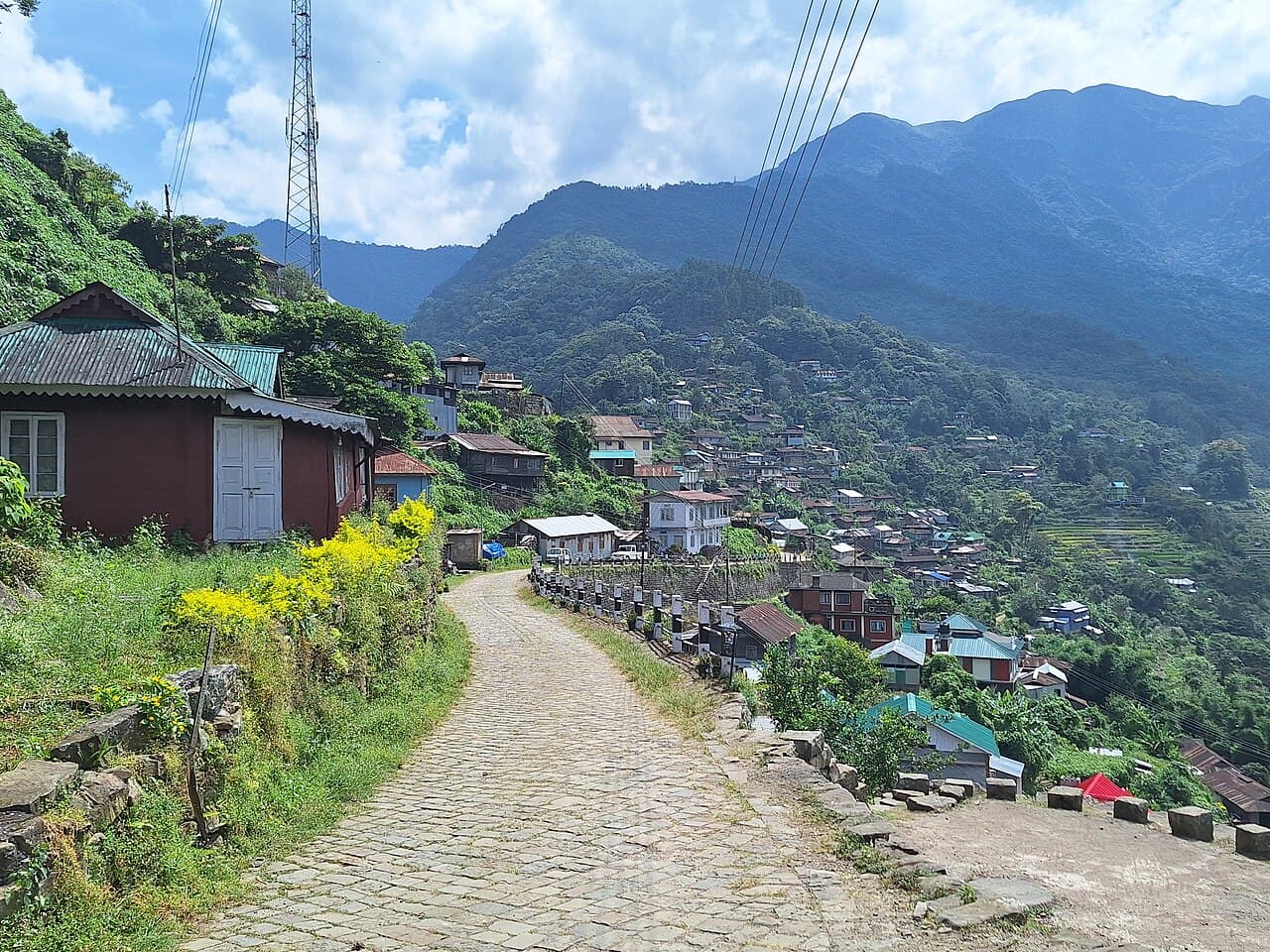
Kohima. The capital sits on a ridge at about 1,500 metres, below the Angami village of the same name. It holds the state museum, the Kohima War Cemetery and, ten kilometres away at Kisama, the Naga Heritage Village where the Hornbill Festival is held each December.
Dimapur. The commercial centre and the state's only railhead, Dimapur lies on the Assam plain. Its Kachari ruins, a field of carved monoliths left by the Dimasa kingdom before the Ahom conquest, are protected by the Archaeological Survey of India.
Mokokchung and Mon. Mokokchung is the town of the Ao, the first Naga people to convert; the mission centre at Impur has been a Baptist headquarters since 1894. Mon is the Konyak district town, and its villages, among them Longwa, sit astride the border with Myanmar.
Khonoma. An Angami village of terraced rice fields west of Kohima, Khonoma held out against British columns in 1879 and 1880 and later banned hunting and logging across its own forest.
The Naga hills were not a state before the colonial period. They were a landscape of autonomous villages, some of a few hundred people and some of several thousand, each governed by a council of elders or clan heads, making war and peace on its own account and holding its land in common. Anthropologists have called them village republics, and the phrase is closer to accurate than most colonial shorthand for the region.
British administration arrived by stages from the 1830s, met sustained Angami resistance, and constituted the Naga Hills District of Assam in 1881. The First World War pulled two thousand Nagas into a labour corps in France, and the men who returned formed the Naga Club in 1918; in 1929 it asked the Simon Commission that the Nagas decide their own future when the British left. In 1944 the Japanese advance into India stopped at Kohima, where fighting around the deputy commissioner's tennis court became one of the hardest engagements of the Burma campaign.
The political dispute that followed has not ended. The Naga National Council declared independence on 14 August 1947, the day before India's own, and in May 1951 organised a plebiscite which it said returned 99.9 per cent support for independence; the Government of India rejected the exercise and the claim (Wikipedia). Elections were boycotted and a long insurgency followed. Statehood in 1963 satisfied some and not others. The Shillong Accord of 11 November 1975 split the movement, and in 1980 the National Socialist Council of Nagaland formed against it, later dividing into factions. A ceasefire with the NSCN faction led by Isak Chishi Swu and Thuingaleng Muivah took effect on 1 August 1997 and has been extended since, and on 3 August 2015 the two sides signed a framework agreement in New Delhi described as the basis for a settlement. More than a decade on, no final agreement has been concluded, and the parties remain apart on a separate Naga flag and constitution.
The Armed Forces (Special Powers) Act of 1958, first enacted for the Naga Hills, gives soldiers operating in areas declared disturbed the power to search, arrest and use lethal force, with prosecution needing the central government's sanction. On 4 and 5 December 2021 soldiers near Oting village in Mon district killed six coal miners returning home in a pickup truck, apparently mistaking them for insurgents, and killed further villagers in the confrontation that followed; fourteen civilians and one soldier died (Human Rights Watch). A state police investigation named the soldiers, the Nagaland assembly demanded the act's withdrawal, and the Ministry of Defence declined sanction to prosecute. From 1 April 2022 the central government removed the disturbed-area designation from fifteen police stations across seven districts; the act stays in force elsewhere in the state. This page reports the sequence, attributes the claims, and takes no position.
The Naga languages belong to the Tibeto-Burman branch of Sino-Tibetan, and there are dozens of them. Ao, Angami, Sumi (formerly written Sema), Lotha, Konyak, Chakhesang, Chang, Phom and Zeliang are among those spoken in Nagaland, and a speaker of one usually cannot understand a speaker of another. That is the practical reason for Nagamese, a creole built on Assamese vocabulary with Naga grammar underneath, which grew up in the markets of the plains and is now the everyday language between tribes.
English does the formal work. It was adopted as the official language in 1967 and is the medium of school, court and government, which makes Nagaland unusual among Indian states in having no Indian language in that role. Most Naga languages were first written down by Baptist missionaries in Roman script to translate scripture, so today's orthographies were shaped by the mission as much as by speakers.
The word Naga has no agreed origin. Proposals include the Sanskrit nagna, naked, the Assamese noga for hill people, and a Burmese term for people with pierced ears; none comes from a Naga language. It was applied from outside and later taken up from inside, and it now carries a political meaning reaching into Manipur, Assam, Arunachal Pradesh and Myanmar.
The institution at the centre of the old village was the morung, the young men's house, which boys entered at adolescence and left at marriage, sleeping, working and learning under older members. It was the school in a society without writing: songs, genealogies, oral history, the rules of the village and the skills of woodcarving, weapon-making and warfare were transmitted inside it. It was also the barracks, since the morung stood at the approaches to the village and its members were its guard, and it housed the log drum, carved from a single tree trunk and beaten with wooden batons to call the village to work, to festival, to alarm and to mourning. Girls had parallel dormitories in many tribes. The morung declined under Christian teaching, which discouraged it, and state schooling, which took over its work.
 Naga house fronts carried carved evidence of what the household had done, in a society where standing had to be earned publicly and shown. Photograph by JyotiPN, CC BY-SA 4.0, via Wikimedia Commons.
Cloth carries status here. Naga shawls and body-cloths are woven on the loin loom in patterns fixed by tribe, and among several peoples a design could be worn only by a man who had earned it, through success in raiding or by hosting the feasts of merit, a graded series of public feasts at which a man and his wife gave away accumulated wealth and received the right to certain patterns, to carved house horns and to erect a standing stone. The Ao tsungkotepsu, with its band of painted figures, reads as a record of deeds.
Headhunting was part of this world and should be described in its own terms. Raiding parties took the heads of enemies from other villages, and the head was understood to hold a life-force that could be brought home for the good of the village, bringing fertility to the fields, health to the people and prestige to the taker, who then wore the ornaments and tattoos his success entitled him to. Heads were kept at the morung or on stone platforms, and the practice was also defence and deterrence between settlements with no common authority above them. British administration suppressed it from the late nineteenth century, Christian conversion removed its religious rationale, and it had largely ended by the middle of the twentieth century. Elderly Konyak men with the facial tattoos of head-takers were living in Mon district within recent memory.
Since 2000 the state has staged the Hornbill Festival at Kisama outside Kohima each December, where every recognised tribe keeps a morung and performs its dances, songs and games across ten days (Wikipedia). It is honest to call it two things at once: it has brought young Nagas back to crafts, songs and log-drum pulling that were falling out of use, and it is a government event built for visitors, in which practices that belonged to a season and a village are performed on a schedule for an audience. Naga writers have said both plainly.
Nagaland is one of the most Christian places in Asia and the most Baptist state anywhere by proportion. The mission came from the American Baptists, though the first opening was made by an Assamese: Godhula Rufus Brown went into the Ao country ahead of the missionary Edwin W. Clark, and the first church on Naga soil was formed at Molungkimong in December 1872 with fifteen baptisms. Clark followed, reduced the Ao language to writing and compiled its first dictionary. Conversion spread unevenly, fastest among the Ao and slowest in the far north-east; the Nagaland Baptist Church Council, formed in 1937, is the largest institution in the state after the government and has repeatedly mediated in the political conflict.
What the mission displaced was a set of related religions with a supreme creator, a populated spirit world and a calendar of gennas, days on which work was forbidden and the village closed, with ritual life running through the agricultural year and the feasts of merit. Much of that has gone, and much of what remains survives as festival rather than practice, though the older calendar shows through in the tribal festivals the state recognises as holidays: Sekrenyi of the Angami, Moatsu of the Ao, Aoleang of the Konyak, Tuluni of the Sumi.
A Naga funeral today is a Christian one. The body is kept at home while the village and the church come through, there is a service, and burial follows within a day or two, often in a village cemetery and in many places on the family's own land close to the house, so that the dead stay inside the settlement. Graves are built up in concrete and faced with a slab carrying the name, the dates, a verse and often a photograph, and families repaint and re-letter them. The log drum was beaten at a death in the old order; in some villages the church bell has taken over that office.
Underneath the Christian surface is an older habit of marking a life in stone. Men who completed the feasts of merit earned the right to drag a monolith from the forest and set it up at the village approach, an act performed by the whole community and remembered in song, and these stones still line the entries to Angami, Chakhesang and Ao villages. The modern inscribed gravestone is the descendant of that practice, and the two stand side by side.
Two other kinds of memory are carried here. The Kohima War Cemetery, on Garrison Hill where the 1944 fighting was heaviest, holds more than 1,400 Commonwealth graves in terraces, the tennis court of the old bungalow marked out in stone; its memorial carries the lines usually attributed to John Maxwell Edmonds, which end "For your tomorrow, we gave our today." Oting village and Mon district have observed 4 December each year since 2021 for the fourteen civilians killed there.
The largest unfinished piece of Naga remembrance is elsewhere. British collectors, administrators and anthropologists removed Naga human remains from the hills over decades, and the Pitt Rivers Museum in Oxford holds the largest such collection anywhere: 219 catalogued items listed as Naga human remains, of which 41 are ancestral human remains and 178 are objects containing or possibly containing human hair. The museum took them off display in 2020 and has worked with descendant communities since (Pitt Rivers Museum). The response has been organised from Nagaland rather than Oxford. The Forum for Naga Reconciliation began seeking consent from the tribal hohos, the apex body of each tribe, in November 2020, and in 2021 founded Recover, Restore and Decolonise, a project of research, translation and village-level consultation on whether the ancestors should be brought back and what rites, place and custodianship would be required if they were (RRaD). In June 2025 a delegation of hoho leaders, elders and RRaD members spent a week at the Pitt Rivers to begin the formal process (Museums Association). The work is led by Nagas and is deliberately slow, because a village that receives an ancestor has to know how to receive one.
Naga genealogy is held by the village, and the village is the political unit that matters.
There are sixteen or more recognised Naga peoples, each with its own language, and descent is traced through the clan and the khel, the village ward. Village republics governed themselves before the British arrived and in large part still do, and the record of who belongs is held by the village council. Land is community land, so lineage is title here as it is across Melanesia and the Pacific.
The written record starts with the American Baptist mission, which arrived in the 1870s and converted almost the whole population within a century, so Baptist church registers are the earliest systematic vital records for Naga families. British administrative files, including the tour diaries of political officers, are in Kohima, Delhi and London.
Naga families historically buried their dead beside the house, under carved stone, and the memorial stones and the log drums record status and deeds.
The open file is the return of ancestors. The Pitt Rivers Museum in Oxford holds a large collection of Naga human remains, including trophy skulls taken during the colonial period, and Naga scholars and the Recover Restore and Decolonise initiative have been working with the museum on repatriation. It is an unusual case of a community asking for its dead back and being met halfway.
The other absence is the conflict since 1947, in which villages were burned and grouped, and which has never been formally accounted for.
The Nagaland State Museum in Kohima holds the state collections of textiles, ornaments, weapons, log drums and ceremonial objects, tribe by tribe. The Naga Heritage Village at Kisama keeps full-scale morungs built by each tribe to its own pattern, and is the only place most visitors will see the buildings at all. The Kachari ruins at Dimapur are protected by the Archaeological Survey of India, the war cemetery by the Commonwealth War Graves Commission.
Article 371A is itself a preservation instrument, since it keeps customary law and communal land outside the reach of ordinary central legislation and leaves village councils with real authority over both. Craft protection has taken a legal route too, through geographical-indication registrations including the Chakhesang shawl and the king chilli.
The fullest photographic record of Naga life before the middle of the twentieth century sits in Britain, which is both useful and awkward. The Naga Videodisc, assembled at Cambridge in the late 1980s under Alan Macfarlane, gathered around 7,000 black-and-white photographs, 1,200 images of artefacts, more than 6,000 pages of text including tour diaries and fieldnotes, and 236 film clips; the obsolete disc was converted into an online database published through Digital Himalaya (Digital Himalaya). The Pitt Rivers publishes its Naga catalogue online, which is how the counts of human remains in its care became public.
Naga institutions have begun building their own record. The RRaD site publishes research and translations into Naga languages so that the repatriation discussion can be held in the languages of the people deciding it. The Highland Institute in Kohima runs oral history, language documentation and archaeology with Naga researchers, and the state's newspapers, notably the Morung Express, whose name is not accidental, keep a searchable public record.
Nagaland has a music scene out of proportion to its size, built on church choral training and supported by a state music policy since 2006, and Naga performers are a steady presence in Indian rock, gospel and folk-fusion. Naga food, smoked pork with fermented soybean and the heat of the king chilli, has reached restaurants across India, and the Hornbill Festival draws visitors from across the country each December.
The state's textiles have travelled less happily. Shawl and body-cloth designs, several of them tribe-specific and traditionally earned rather than bought, have been copied into commercial fashion by producers with no connection to the communities, and Naga weavers and writers have pressed for recognition and control, which is part of what the geographical-indication filings are for. The same question sits behind the repatriation work: who has the right to speak for a Naga object, and who decides what happens to it.
The ancestors have a process. The repatriation discussion between Naga communities and the Pitt Rivers is one of the few in which the descendant community set the pace, defined the consultation and did the groundwork in its own languages before anything moved. Nothing has been returned yet, by design.
A village closed its own forest. Khonoma banned hunting and logging on village land in 1998 by decision of its council, and its Tragopan Sanctuary is now a reference case for community-owned conservation in India.
The falcons stopped being shot. Around Doyang reservoir in Wokha district, tens of thousands of migrating Amur falcons were netted and sold each autumn until 2012. Village councils in Pangti and neighbouring settlements banned the hunt, former hunters became guards, and within a year the killing had effectively stopped.
Against that, the political settlement remains unmade after more than a quarter century of talks, the disturbed-area designation still applies in parts of the state, and the families of the fourteen killed at Oting have seen no prosecution.
Naga house fronts carried carved evidence of what the household had done, in a society where standing had to be earned publicly and shown. Photograph by JyotiPN, CC BY-SA 4.0, via Wikimedia Commons.
Cloth carries status here. Naga shawls and body-cloths are woven on the loin loom in patterns fixed by tribe, and among several peoples a design could be worn only by a man who had earned it, through success in raiding or by hosting the feasts of merit, a graded series of public feasts at which a man and his wife gave away accumulated wealth and received the right to certain patterns, to carved house horns and to erect a standing stone. The Ao tsungkotepsu, with its band of painted figures, reads as a record of deeds.
Headhunting was part of this world and should be described in its own terms. Raiding parties took the heads of enemies from other villages, and the head was understood to hold a life-force that could be brought home for the good of the village, bringing fertility to the fields, health to the people and prestige to the taker, who then wore the ornaments and tattoos his success entitled him to. Heads were kept at the morung or on stone platforms, and the practice was also defence and deterrence between settlements with no common authority above them. British administration suppressed it from the late nineteenth century, Christian conversion removed its religious rationale, and it had largely ended by the middle of the twentieth century. Elderly Konyak men with the facial tattoos of head-takers were living in Mon district within recent memory.
Since 2000 the state has staged the Hornbill Festival at Kisama outside Kohima each December, where every recognised tribe keeps a morung and performs its dances, songs and games across ten days (Wikipedia). It is honest to call it two things at once: it has brought young Nagas back to crafts, songs and log-drum pulling that were falling out of use, and it is a government event built for visitors, in which practices that belonged to a season and a village are performed on a schedule for an audience. Naga writers have said both plainly.
Nagaland is one of the most Christian places in Asia and the most Baptist state anywhere by proportion. The mission came from the American Baptists, though the first opening was made by an Assamese: Godhula Rufus Brown went into the Ao country ahead of the missionary Edwin W. Clark, and the first church on Naga soil was formed at Molungkimong in December 1872 with fifteen baptisms. Clark followed, reduced the Ao language to writing and compiled its first dictionary. Conversion spread unevenly, fastest among the Ao and slowest in the far north-east; the Nagaland Baptist Church Council, formed in 1937, is the largest institution in the state after the government and has repeatedly mediated in the political conflict.
What the mission displaced was a set of related religions with a supreme creator, a populated spirit world and a calendar of gennas, days on which work was forbidden and the village closed, with ritual life running through the agricultural year and the feasts of merit. Much of that has gone, and much of what remains survives as festival rather than practice, though the older calendar shows through in the tribal festivals the state recognises as holidays: Sekrenyi of the Angami, Moatsu of the Ao, Aoleang of the Konyak, Tuluni of the Sumi.
A Naga funeral today is a Christian one. The body is kept at home while the village and the church come through, there is a service, and burial follows within a day or two, often in a village cemetery and in many places on the family's own land close to the house, so that the dead stay inside the settlement. Graves are built up in concrete and faced with a slab carrying the name, the dates, a verse and often a photograph, and families repaint and re-letter them. The log drum was beaten at a death in the old order; in some villages the church bell has taken over that office.
Underneath the Christian surface is an older habit of marking a life in stone. Men who completed the feasts of merit earned the right to drag a monolith from the forest and set it up at the village approach, an act performed by the whole community and remembered in song, and these stones still line the entries to Angami, Chakhesang and Ao villages. The modern inscribed gravestone is the descendant of that practice, and the two stand side by side.
Two other kinds of memory are carried here. The Kohima War Cemetery, on Garrison Hill where the 1944 fighting was heaviest, holds more than 1,400 Commonwealth graves in terraces, the tennis court of the old bungalow marked out in stone; its memorial carries the lines usually attributed to John Maxwell Edmonds, which end "For your tomorrow, we gave our today." Oting village and Mon district have observed 4 December each year since 2021 for the fourteen civilians killed there.
The largest unfinished piece of Naga remembrance is elsewhere. British collectors, administrators and anthropologists removed Naga human remains from the hills over decades, and the Pitt Rivers Museum in Oxford holds the largest such collection anywhere: 219 catalogued items listed as Naga human remains, of which 41 are ancestral human remains and 178 are objects containing or possibly containing human hair. The museum took them off display in 2020 and has worked with descendant communities since (Pitt Rivers Museum). The response has been organised from Nagaland rather than Oxford. The Forum for Naga Reconciliation began seeking consent from the tribal hohos, the apex body of each tribe, in November 2020, and in 2021 founded Recover, Restore and Decolonise, a project of research, translation and village-level consultation on whether the ancestors should be brought back and what rites, place and custodianship would be required if they were (RRaD). In June 2025 a delegation of hoho leaders, elders and RRaD members spent a week at the Pitt Rivers to begin the formal process (Museums Association). The work is led by Nagas and is deliberately slow, because a village that receives an ancestor has to know how to receive one.
Naga genealogy is held by the village, and the village is the political unit that matters.
There are sixteen or more recognised Naga peoples, each with its own language, and descent is traced through the clan and the khel, the village ward. Village republics governed themselves before the British arrived and in large part still do, and the record of who belongs is held by the village council. Land is community land, so lineage is title here as it is across Melanesia and the Pacific.
The written record starts with the American Baptist mission, which arrived in the 1870s and converted almost the whole population within a century, so Baptist church registers are the earliest systematic vital records for Naga families. British administrative files, including the tour diaries of political officers, are in Kohima, Delhi and London.
Naga families historically buried their dead beside the house, under carved stone, and the memorial stones and the log drums record status and deeds.
The open file is the return of ancestors. The Pitt Rivers Museum in Oxford holds a large collection of Naga human remains, including trophy skulls taken during the colonial period, and Naga scholars and the Recover Restore and Decolonise initiative have been working with the museum on repatriation. It is an unusual case of a community asking for its dead back and being met halfway.
The other absence is the conflict since 1947, in which villages were burned and grouped, and which has never been formally accounted for.
The Nagaland State Museum in Kohima holds the state collections of textiles, ornaments, weapons, log drums and ceremonial objects, tribe by tribe. The Naga Heritage Village at Kisama keeps full-scale morungs built by each tribe to its own pattern, and is the only place most visitors will see the buildings at all. The Kachari ruins at Dimapur are protected by the Archaeological Survey of India, the war cemetery by the Commonwealth War Graves Commission.
Article 371A is itself a preservation instrument, since it keeps customary law and communal land outside the reach of ordinary central legislation and leaves village councils with real authority over both. Craft protection has taken a legal route too, through geographical-indication registrations including the Chakhesang shawl and the king chilli.
The fullest photographic record of Naga life before the middle of the twentieth century sits in Britain, which is both useful and awkward. The Naga Videodisc, assembled at Cambridge in the late 1980s under Alan Macfarlane, gathered around 7,000 black-and-white photographs, 1,200 images of artefacts, more than 6,000 pages of text including tour diaries and fieldnotes, and 236 film clips; the obsolete disc was converted into an online database published through Digital Himalaya (Digital Himalaya). The Pitt Rivers publishes its Naga catalogue online, which is how the counts of human remains in its care became public.
Naga institutions have begun building their own record. The RRaD site publishes research and translations into Naga languages so that the repatriation discussion can be held in the languages of the people deciding it. The Highland Institute in Kohima runs oral history, language documentation and archaeology with Naga researchers, and the state's newspapers, notably the Morung Express, whose name is not accidental, keep a searchable public record.
Nagaland has a music scene out of proportion to its size, built on church choral training and supported by a state music policy since 2006, and Naga performers are a steady presence in Indian rock, gospel and folk-fusion. Naga food, smoked pork with fermented soybean and the heat of the king chilli, has reached restaurants across India, and the Hornbill Festival draws visitors from across the country each December.
The state's textiles have travelled less happily. Shawl and body-cloth designs, several of them tribe-specific and traditionally earned rather than bought, have been copied into commercial fashion by producers with no connection to the communities, and Naga weavers and writers have pressed for recognition and control, which is part of what the geographical-indication filings are for. The same question sits behind the repatriation work: who has the right to speak for a Naga object, and who decides what happens to it.
The ancestors have a process. The repatriation discussion between Naga communities and the Pitt Rivers is one of the few in which the descendant community set the pace, defined the consultation and did the groundwork in its own languages before anything moved. Nothing has been returned yet, by design.
A village closed its own forest. Khonoma banned hunting and logging on village land in 1998 by decision of its council, and its Tragopan Sanctuary is now a reference case for community-owned conservation in India.
The falcons stopped being shot. Around Doyang reservoir in Wokha district, tens of thousands of migrating Amur falcons were netted and sold each autumn until 2012. Village councils in Pangti and neighbouring settlements banned the hunt, former hunters became guards, and within a year the killing had effectively stopped.
Against that, the political settlement remains unmade after more than a quarter century of talks, the disturbed-area designation still applies in parts of the state, and the families of the fourteen killed at Oting have seen no prosecution.
National Overview
Notable Cities
Historical Foundations
Linguistic and Etymological Roots
Cultural Identity
Religion and Spirituality
Remembrance and Mourning Traditions
Tracing a Family in Nagaland
Heritage Preservation Efforts
Digital Heritage
Contemporary Cultural Influences
Success Stories
References and resources
- Nagaland, Wikipedia: statehood and demography.
- Naga National Council, Wikipedia.
- Human Rights Watch, Army Kills 14 Civilians in Nagaland: the Oting killings.
- Armed Forces (Special Powers) Act, Wikipedia.
- Pitt Rivers Museum, Critical Changes: the 2020 removal from display.
- Recover, Restore and Decolonise: the Naga-led repatriation work.
- Museums Association, Pitt Rivers begins repatriation: the June 2025 delegation.
- Digital Himalaya, Naga collection.
- Encyclopaedia Britannica, Nagaland.