Heritage · Country
Thailand Culture and Heritage
From the dawn-lit spire of Wat Arun to the floating lights of Loy Krathong, Thailand keeps the memory of Sukhothai, Ayutthaya and the Bangkok kings. A guide to its Theravada heritage, its standing as the one Southeast Asian land never colonized, and the merit-making rites by which Thai families care for their dead.Written to last.
By Confinity Heritage Editorial · Updated 2026-07-31 · 8-minute readQuiet tools, kept out of the way.
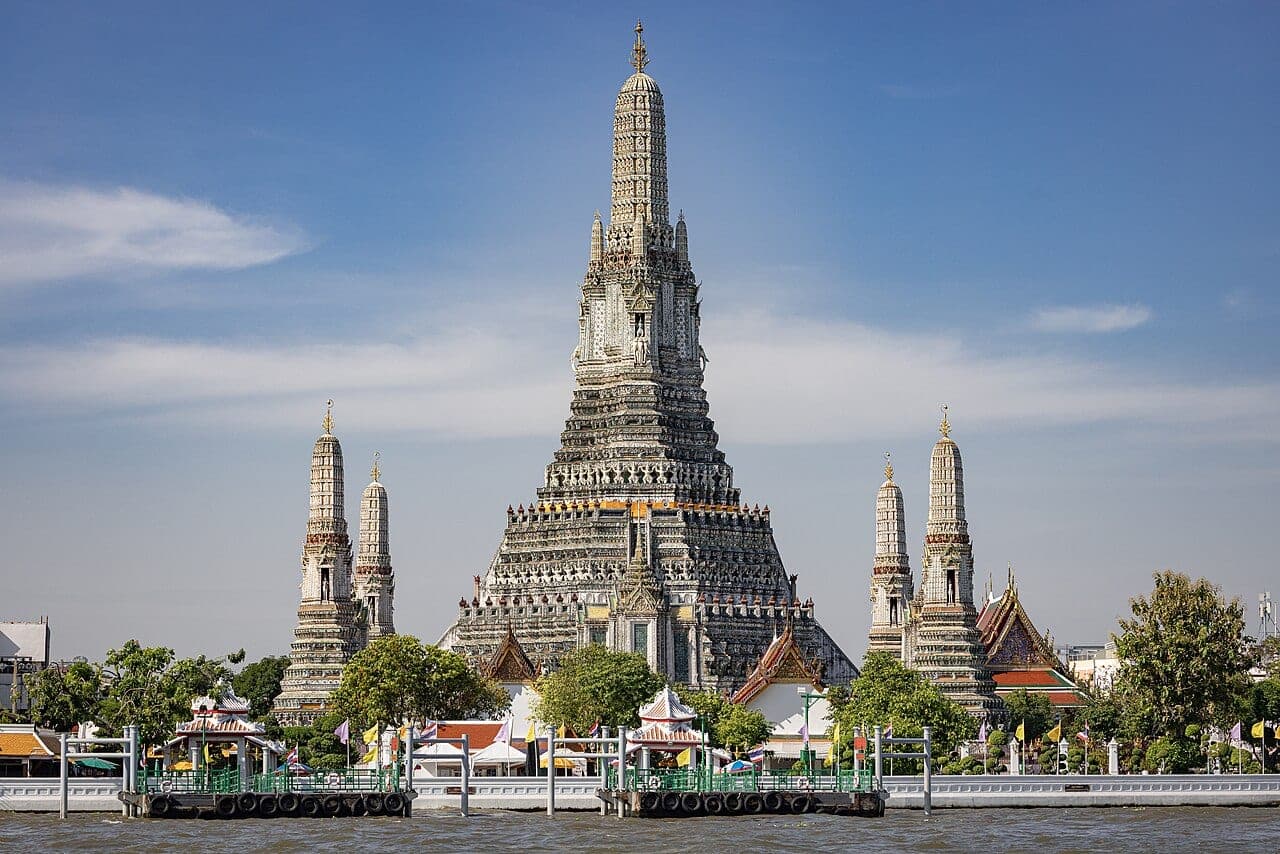
At the heart of almost every Thai settlement, from the capital on the Chao Phraya to the smallest northeastern village, sits a wat: a walled compound of gilded roofs and chanting halls, monks in saffron collecting alms at dawn, and a cluster of small white stupas where the ashes of the dead rest among the living. More than nine in ten Thais are Theravada Buddhists, and the faith sets the rhythm of ordinary life. Around this centre Thailand has gathered one of Asia's deepest inheritances of art and remembrance, carried through three great capitals and never broken by foreign conquest.
That continuity is the country's rarest possession. Alone among the nations of Southeast Asia, Siam was never colonized by a European power, and its throne, its script and its Buddhist institutions run in an unbroken line from the thirteenth-century kingdom of Sukhothai to the present day. The same continuity governs how Thais treat their dead: the body is cremated, the ashes kept close at the family temple, and the living go on making merit for the departed for years afterward, so that death becomes a long, tended relationship.
Thailand occupies about 513,120 square kilometres at the centre of mainland Southeast Asia, bordered by Myanmar, Laos across the Mekong, Cambodia and Malaysia. The land falls into four regions: the northern highlands, crowned by Doi Inthanon at 2,565 metres; the central plains watered by the Chao Phraya River, the rice bowl and seat of every Thai capital; the dry Khorat Plateau, known as Isan, in the northeast; and the long southern peninsula reaching toward the Malay world. Its population is roughly 66 million.
Thailand is a constitutional monarchy, governed since 1782 under the Chakri dynasty, with Bangkok as its capital and largest city; the currency is the baht and the official language is Thai. About 93 per cent of the population are Buddhists, almost entirely of the Theravada school, while Islam accounts for roughly 5 per cent, concentrated among the ethnic Malay communities of the far south, alongside smaller Christian, Hindu and Sikh minorities.
Bangkok. Founded in 1782 by Rama I on the Chao Phraya, the capital is known to Thais as Krung Thep, a short form of a famously long ceremonial name. Its royal island holds the Grand Palace and Wat Phra Kaew, temple of the Emerald Buddha, alongside Wat Pho and, across the river, Wat Arun.
Chiang Mai. Founded in 1296 by King Mangrai as capital of the Lanna kingdom, its name means simply "new city." Ringed by old walls and a moat, it keeps a distinct northern culture and the hillside sanctuary of Wat Phra That Doi Suthep.
Ayutthaya. Capital of the Siamese kingdom from 1351 to 1767, it was once among the largest cities on earth, a river island of temples trading with China, Persia and Europe. Burned by a Burmese army in 1767, its towers and stone Buddhas survive as a foremost archaeological landscape.
Sukhothai. The first independent Thai capital, established in 1238, its name rendered "dawn of happiness." Its historical park preserves the lotus-bud stupas and serene walking Buddhas of the style Thai art regards as its classical age.
Nakhon Si Thammarat. An old power of the southern peninsula and early gateway for Theravada Buddhism from Sri Lanka, centred on Wat Phra Mahathat, whose bell-shaped chedi is among the most venerated reliquaries in the Thai south.
Tai-speaking peoples had settled the northern valleys for centuries when, in 1238, the ruler remembered as Si Inthrathit established Sukhothai as an independent kingdom. Under King Ram Khamhaeng (reigned about 1279 to 1298) it reached its widest extent, and tradition credits him with the Thai script; the stone inscription conventionally dated to 1292 is taken as the earliest evidence of Thai writing. He also brought Theravada monks from the south to root the faith that has defined the country since. Sukhothai declined through the fourteenth century and was absorbed by its rival Ayutthaya by 1438.
 Ayutthaya was one of the largest cities in the world before it was sacked in 1767, and it was never rebuilt. Photograph by Gary Todd, CC0, via Wikimedia Commons.
Founded in 1351 by King Ramathibodi I, the Ayutthaya kingdom grew over four centuries into one of Asia's wealthiest states, a river-island capital that European visitors ranked with Ming China and that traded with China, Persia and Europe. After a long war with Burma, Ayutthaya fell and was destroyed in 1767, ending a kingdom of 33 kings.
From the ruin, the general Taksin rebuilt Siamese power and reigned from a new capital at Thonburi between 1767 and 1782. In 1782 his successor, remembered as Rama I, moved the seat of government across the river and consecrated the city pillar of Bangkok, founding the Rattanakosin kingdom and the Chakri dynasty that reigns today; the Grand Palace and Wat Phra Kaew were completed by 1784. As Britain absorbed Burma and France took Indochina, King Mongkut (Rama IV) opened the country to treaty commerce through the Bowring Treaty of 1855, and his son Chulalongkorn (Rama V, reigned 1868 to 1910) carried out sweeping administrative and legal reforms. Through diplomacy and the ceding of some outlying territories, Siam kept its sovereignty as a buffer between the two empires and became the only Southeast Asian country never brought under colonial rule. In 1932 a bloodless change of government transformed the absolute monarchy into a constitutional one, and the country was officially renamed Thailand in 1939.
Thai belongs to the Tai branch of the Kra-Dai (Tai-Kadai) family, unrelated to the Austroasiatic tongues of its neighbours, and it is tonal: standard central Thai distinguishes five tones, so that a single syllable carries different meanings according to pitch. The Thai script, written without spaces between words, was devised in the Sukhothai era from Old Khmer letters, themselves descended from the Pallava writing of southern India, and it keeps a specialised royal vocabulary and a monastic vocabulary drawn from Pali, the scriptural language of Theravada Buddhism.
The country's name records its self-understanding. "Thai" is widely glossed as "free," so that Prathet Thai and the everyday Muang Thai carry the sense of "land of the free," a reading tied to the nation's uncolonized history. The older name Siam, long used by outsiders, gave way to Thailand as the official designation in 1939; the country briefly returned to Siam in 1945 before readopting Thailand in 1949. The regions also speak related tongues, including Isan in the northeast, akin to Lao, and Patani Malay in the far south.
Thai social life turns on courtesy and hierarchy. The wai, the palms-together greeting whose height signals respect, opens every meeting; deference to elders, teachers and monks runs deep; and the ideal of sanuk, of finding lightness in shared activity, softens the formality. Silk weaving, gilded lacquer and temple craft carry a long tradition, and the classical stage preserves the masked dance-drama khon, whose episodes of the Ramakien, the Thai Ramayana, also line the painted galleries of Wat Phra Kaew.
The Thai table is built on rice and a balance of sour, sweet, salty and hot, from tom yam soup to som tam salad and the country's many curries, and the food is one of Thailand's best-loved exports. Muay Thai, the eight-limbed martial art, is both national sport and ritual. Above all, the year is marked by Buddhist festival: Songkran, the traditional new year of mid-April, when the pouring and splashing of water expresses cleansing and blessing and families pay respect to elders and ancestors; and Loy Krathong, on the November full moon, when people float small lamps of banana leaf, flowers and candles on the rivers to honour the water and let the past year's misfortunes drift away.
Theravada Buddhism has been the faith of the Thai majority since the Sukhothai era, and the wat remains the centre of community life: a school, a festival ground, a place of counsel and the resting place of the dead. Many men still ordain as monks for a period, often a single rains retreat, earning merit for themselves and their parents, and lay life is organised around tham bun, the making of merit through giving and observance. The monarchy holds a revered place in this order as the traditional patron and protector of Buddhism in the kingdom.
Ayutthaya was one of the largest cities in the world before it was sacked in 1767, and it was never rebuilt. Photograph by Gary Todd, CC0, via Wikimedia Commons.
Founded in 1351 by King Ramathibodi I, the Ayutthaya kingdom grew over four centuries into one of Asia's wealthiest states, a river-island capital that European visitors ranked with Ming China and that traded with China, Persia and Europe. After a long war with Burma, Ayutthaya fell and was destroyed in 1767, ending a kingdom of 33 kings.
From the ruin, the general Taksin rebuilt Siamese power and reigned from a new capital at Thonburi between 1767 and 1782. In 1782 his successor, remembered as Rama I, moved the seat of government across the river and consecrated the city pillar of Bangkok, founding the Rattanakosin kingdom and the Chakri dynasty that reigns today; the Grand Palace and Wat Phra Kaew were completed by 1784. As Britain absorbed Burma and France took Indochina, King Mongkut (Rama IV) opened the country to treaty commerce through the Bowring Treaty of 1855, and his son Chulalongkorn (Rama V, reigned 1868 to 1910) carried out sweeping administrative and legal reforms. Through diplomacy and the ceding of some outlying territories, Siam kept its sovereignty as a buffer between the two empires and became the only Southeast Asian country never brought under colonial rule. In 1932 a bloodless change of government transformed the absolute monarchy into a constitutional one, and the country was officially renamed Thailand in 1939.
Thai belongs to the Tai branch of the Kra-Dai (Tai-Kadai) family, unrelated to the Austroasiatic tongues of its neighbours, and it is tonal: standard central Thai distinguishes five tones, so that a single syllable carries different meanings according to pitch. The Thai script, written without spaces between words, was devised in the Sukhothai era from Old Khmer letters, themselves descended from the Pallava writing of southern India, and it keeps a specialised royal vocabulary and a monastic vocabulary drawn from Pali, the scriptural language of Theravada Buddhism.
The country's name records its self-understanding. "Thai" is widely glossed as "free," so that Prathet Thai and the everyday Muang Thai carry the sense of "land of the free," a reading tied to the nation's uncolonized history. The older name Siam, long used by outsiders, gave way to Thailand as the official designation in 1939; the country briefly returned to Siam in 1945 before readopting Thailand in 1949. The regions also speak related tongues, including Isan in the northeast, akin to Lao, and Patani Malay in the far south.
Thai social life turns on courtesy and hierarchy. The wai, the palms-together greeting whose height signals respect, opens every meeting; deference to elders, teachers and monks runs deep; and the ideal of sanuk, of finding lightness in shared activity, softens the formality. Silk weaving, gilded lacquer and temple craft carry a long tradition, and the classical stage preserves the masked dance-drama khon, whose episodes of the Ramakien, the Thai Ramayana, also line the painted galleries of Wat Phra Kaew.
The Thai table is built on rice and a balance of sour, sweet, salty and hot, from tom yam soup to som tam salad and the country's many curries, and the food is one of Thailand's best-loved exports. Muay Thai, the eight-limbed martial art, is both national sport and ritual. Above all, the year is marked by Buddhist festival: Songkran, the traditional new year of mid-April, when the pouring and splashing of water expresses cleansing and blessing and families pay respect to elders and ancestors; and Loy Krathong, on the November full moon, when people float small lamps of banana leaf, flowers and candles on the rivers to honour the water and let the past year's misfortunes drift away.
Theravada Buddhism has been the faith of the Thai majority since the Sukhothai era, and the wat remains the centre of community life: a school, a festival ground, a place of counsel and the resting place of the dead. Many men still ordain as monks for a period, often a single rains retreat, earning merit for themselves and their parents, and lay life is organised around tham bun, the making of merit through giving and observance. The monarchy holds a revered place in this order as the traditional patron and protector of Buddhism in the kingdom.
 Sukhothai, where the Thai script and the walking Buddha both take their classic form. Photograph by Gary Todd, public domain, via Wikimedia Commons.
Beneath and beside the Buddhist layer runs an older stratum of belief. Outside homes and shops stand spirit houses, the san phra phum, miniature shrines that give the guardian spirit of the land a dwelling of its own and receive daily offerings of flowers, incense and food, while Brahmanic rites of Indian origin survive in the court and in ceremonies of state. In the four southernmost provinces of Pattani, Yala, Narathiwat and Satun, Islam is the faith of the ethnic Malay majority, alongside small Christian, Hindu and Sikh communities in the cities.
Thai Buddhism treats death as a passage eased by merit, and the family as the ones who ease it. Soon after death, relatives and guests perform the bathing rite, rod nam sop, gently pouring scented water over one hand of the deceased in a gesture of farewell and forgiveness. The body is then kept in a coffin for a wake of several nights, usually three, five or seven, during which monks chant passages of the Abhidhamma; a central act of merit is the offering of bangsukun cloth, robes presented to the monks on behalf of the departed, so that grief is turned into a gift. Mourning is worn in white.
Cremation is the ordinary end. It takes place at the temple crematorium, the men, whose tapering form recalls Mount Meru, the axis of the Buddhist cosmos; mourners may carry the coffin around the pyre three times before the fire is lit, and the cremation is sometimes deferred for 100 days or longer while the body rests at the wat. Afterward a portion of the ashes is enshrined in a small family stupa at the temple, so that the dead remain within the compound where the living come to pray. Merit-making does not end there: families gather again at 7 days, at 50 and 100 days, and on the anniversaries that follow, formally transferring the merit they earn, an act called uthit suan kuson, in the belief that it supports the departed on their onward path.
The royal cremation follows the same logic on the grandest scale. For the passing of a monarch, artisans raise a phra meru mas, a towering ceremonial pyre modelled on Mount Meru and adorned with sculpted deities and mythical beings from Buddhist and Brahmanic cosmology. The most recent was built for the cremation of King Bhumibol Adulyadej (Rama IX) at Sanam Luang in Bangkok in late October 2017, when a vast gathering of mourners in black paid their respects and the rites followed long-standing Buddhist and court tradition. Whether for a king or a villager, Thai remembrance rests on one conviction: that the living can still act on behalf of the dead, and that to make merit for them is an enduring form of love.
In the northeast, the Isan calendar keeps Boon Para Wate, a merit festival at which a village hears the whole of the Vessantara Jataka read aloud in a single day. The merit generated is directed to the dead, and the reading is arranged so that the story finishes before the day does, because to leave it unfinished would be to leave the transfer incomplete.
The larger of the country's two ancestral seasons is Sat Thai, kept in the waning fortnight of the tenth lunar month, when the hungry dead are held to be released for fifteen days. In the south, and above all at Nakhon Si Thammarat, families build offering baskets containing five sweets that stand for clothing, transport, ornament, entertainment and building materials, set them on a raised platform at the temple, and then let the congregation rush it once the monks have finished chanting.
Every Thai surname is unique to one family, and that is not an accident of history but a policy.
Thailand had no surnames until the Surname Act of 1913, when Rama VI required every family to adopt one and required that no two families share it. New names were registered and checked against the existing list, so a Thai surname identifies a specific family in a way that almost no other country's does. The consequence for research is that a rare Thai surname is close to a search key, and the consequence for the culture is that Thai surnames are often long, invented, Sanskritised constructions, which is why Thais address each other by first name.
The state's record is the tabien baan, the house registration book, which lists every person registered at an address with their relationships and is held by the household. It works as the practical civil register, and it is required for almost every transaction.
Temple records are the older layer. Wats kept lists of ordinations, cremations and donations, and the practice of storing ashes in the temple wall means a family's dead are physically located and named.
For the Chinese Thai population, who are a substantial share of the urban middle class, the record is doubled: a Thai surname adopted after 1913, often deliberately unrecognisable, and a Chinese surname and ancestral county that the family may still know. The clan associations in Bangkok hold the second one.
Thailand's cultural sites are safeguarded chiefly by the Fine Arts Department within the Ministry of Culture. The country holds seven UNESCO World Heritage Sites. Three cultural inscriptions came in quick succession: the Historic Town of Sukhothai and Associated Historic Towns in 1991, the Historic City of Ayutthaya in 1991, and the Ban Chiang Archaeological Site in 1992, the last a northeastern village whose burials, painted red-on-buff pottery and early metalworking, dating from roughly 1500 BCE, revealed one of the oldest agricultural and bronze-using cultures of Southeast Asia. In 2023 the Ancient Town of Si Thep became the newest cultural listing, alongside natural sites at Thungyai-Huai Kha Khaeng, Dong Phayayen-Khao Yai and Kaeng Krachan.
Living traditions are guarded as well. UNESCO has inscribed several elements of Thai intangible heritage: khon masked dance-drama in 2018, nuad Thai traditional massage in 2019, the nora dance-drama of the south in 2021, and Songkran, the traditional new year festival, in 2023. The restoration of the Sukhothai and Ayutthaya historical parks keeps these places both as scholarship and as sites of active worship.
Thailand has moved much of its heritage record online. The Fine Arts Department has built digital catalogues of historic sites, museums, libraries and archives, while the Princess Maha Chakri Sirindhorn Anthropology Centre, established in 1992, aggregates over one hundred thousand items across its databases and Culturio platform; National Library and monastery projects have also digitised fragile palm-leaf manuscripts, the traditional medium of Thai Buddhist texts.
The ancient capitals are being captured in three dimensions. A collaboration between the heritage-technology organisation CyArk, Google Arts & Culture, the Fine Arts Department and UNESCO Bangkok has laser-scanned the monuments of Ayutthaya, producing precise records that document the ruins against future loss and let people anywhere explore them online.
Thai culture reaches far beyond its borders. Thai cuisine is among the most recognisable in the world, and Muay Thai is practised in gyms on every continent. Thai cinema has drawn international acclaim, most strikingly when Apichatpong Weerasethakul won the Palme d'Or at Cannes in 2010 for a film steeped in Buddhist ideas of memory and rebirth, and a national "soft power" strategy now promotes Thai food, film, fashion, festivals and Muay Thai across Asia and beyond.
At home, this momentum grows from tradition rather than replacing it: contemporary artists draw on Buddhist iconography and temple mural styles, and the festivals of Songkran and Loy Krathong, now magnets for visitors, remain first of all acts of devotion and family reunion.
A crown and a faith unbroken. Through the era of European empire, Siam kept its sovereignty and, with it, the continuity of its monarchy, script and Buddhist institutions, a line from Sukhothai to the present that few nations can claim.
Festivals recognised by the world. Between 2018 and 2023, UNESCO inscribed khon, nuad Thai, nora and Songkran as intangible heritage, honouring traditions that pass from teacher to pupil and from one generation of families to the next.
Ancient capitals restored as living parks. Conservation turned the ruined royal cities of Sukhothai and Ayutthaya, both inscribed by UNESCO in 1991, into protected historical parks that serve scholarship, pilgrimage and national memory at once.
A prehistoric culture rescued from obscurity. After a chance discovery in 1966 drew attention to Ban Chiang, excavation and protection preserved a Bronze Age society once unknown to history, and its painted pottery is now an emblem of the northeast.
Sukhothai, where the Thai script and the walking Buddha both take their classic form. Photograph by Gary Todd, public domain, via Wikimedia Commons.
Beneath and beside the Buddhist layer runs an older stratum of belief. Outside homes and shops stand spirit houses, the san phra phum, miniature shrines that give the guardian spirit of the land a dwelling of its own and receive daily offerings of flowers, incense and food, while Brahmanic rites of Indian origin survive in the court and in ceremonies of state. In the four southernmost provinces of Pattani, Yala, Narathiwat and Satun, Islam is the faith of the ethnic Malay majority, alongside small Christian, Hindu and Sikh communities in the cities.
Thai Buddhism treats death as a passage eased by merit, and the family as the ones who ease it. Soon after death, relatives and guests perform the bathing rite, rod nam sop, gently pouring scented water over one hand of the deceased in a gesture of farewell and forgiveness. The body is then kept in a coffin for a wake of several nights, usually three, five or seven, during which monks chant passages of the Abhidhamma; a central act of merit is the offering of bangsukun cloth, robes presented to the monks on behalf of the departed, so that grief is turned into a gift. Mourning is worn in white.
Cremation is the ordinary end. It takes place at the temple crematorium, the men, whose tapering form recalls Mount Meru, the axis of the Buddhist cosmos; mourners may carry the coffin around the pyre three times before the fire is lit, and the cremation is sometimes deferred for 100 days or longer while the body rests at the wat. Afterward a portion of the ashes is enshrined in a small family stupa at the temple, so that the dead remain within the compound where the living come to pray. Merit-making does not end there: families gather again at 7 days, at 50 and 100 days, and on the anniversaries that follow, formally transferring the merit they earn, an act called uthit suan kuson, in the belief that it supports the departed on their onward path.
The royal cremation follows the same logic on the grandest scale. For the passing of a monarch, artisans raise a phra meru mas, a towering ceremonial pyre modelled on Mount Meru and adorned with sculpted deities and mythical beings from Buddhist and Brahmanic cosmology. The most recent was built for the cremation of King Bhumibol Adulyadej (Rama IX) at Sanam Luang in Bangkok in late October 2017, when a vast gathering of mourners in black paid their respects and the rites followed long-standing Buddhist and court tradition. Whether for a king or a villager, Thai remembrance rests on one conviction: that the living can still act on behalf of the dead, and that to make merit for them is an enduring form of love.
In the northeast, the Isan calendar keeps Boon Para Wate, a merit festival at which a village hears the whole of the Vessantara Jataka read aloud in a single day. The merit generated is directed to the dead, and the reading is arranged so that the story finishes before the day does, because to leave it unfinished would be to leave the transfer incomplete.
The larger of the country's two ancestral seasons is Sat Thai, kept in the waning fortnight of the tenth lunar month, when the hungry dead are held to be released for fifteen days. In the south, and above all at Nakhon Si Thammarat, families build offering baskets containing five sweets that stand for clothing, transport, ornament, entertainment and building materials, set them on a raised platform at the temple, and then let the congregation rush it once the monks have finished chanting.
Every Thai surname is unique to one family, and that is not an accident of history but a policy.
Thailand had no surnames until the Surname Act of 1913, when Rama VI required every family to adopt one and required that no two families share it. New names were registered and checked against the existing list, so a Thai surname identifies a specific family in a way that almost no other country's does. The consequence for research is that a rare Thai surname is close to a search key, and the consequence for the culture is that Thai surnames are often long, invented, Sanskritised constructions, which is why Thais address each other by first name.
The state's record is the tabien baan, the house registration book, which lists every person registered at an address with their relationships and is held by the household. It works as the practical civil register, and it is required for almost every transaction.
Temple records are the older layer. Wats kept lists of ordinations, cremations and donations, and the practice of storing ashes in the temple wall means a family's dead are physically located and named.
For the Chinese Thai population, who are a substantial share of the urban middle class, the record is doubled: a Thai surname adopted after 1913, often deliberately unrecognisable, and a Chinese surname and ancestral county that the family may still know. The clan associations in Bangkok hold the second one.
Thailand's cultural sites are safeguarded chiefly by the Fine Arts Department within the Ministry of Culture. The country holds seven UNESCO World Heritage Sites. Three cultural inscriptions came in quick succession: the Historic Town of Sukhothai and Associated Historic Towns in 1991, the Historic City of Ayutthaya in 1991, and the Ban Chiang Archaeological Site in 1992, the last a northeastern village whose burials, painted red-on-buff pottery and early metalworking, dating from roughly 1500 BCE, revealed one of the oldest agricultural and bronze-using cultures of Southeast Asia. In 2023 the Ancient Town of Si Thep became the newest cultural listing, alongside natural sites at Thungyai-Huai Kha Khaeng, Dong Phayayen-Khao Yai and Kaeng Krachan.
Living traditions are guarded as well. UNESCO has inscribed several elements of Thai intangible heritage: khon masked dance-drama in 2018, nuad Thai traditional massage in 2019, the nora dance-drama of the south in 2021, and Songkran, the traditional new year festival, in 2023. The restoration of the Sukhothai and Ayutthaya historical parks keeps these places both as scholarship and as sites of active worship.
Thailand has moved much of its heritage record online. The Fine Arts Department has built digital catalogues of historic sites, museums, libraries and archives, while the Princess Maha Chakri Sirindhorn Anthropology Centre, established in 1992, aggregates over one hundred thousand items across its databases and Culturio platform; National Library and monastery projects have also digitised fragile palm-leaf manuscripts, the traditional medium of Thai Buddhist texts.
The ancient capitals are being captured in three dimensions. A collaboration between the heritage-technology organisation CyArk, Google Arts & Culture, the Fine Arts Department and UNESCO Bangkok has laser-scanned the monuments of Ayutthaya, producing precise records that document the ruins against future loss and let people anywhere explore them online.
Thai culture reaches far beyond its borders. Thai cuisine is among the most recognisable in the world, and Muay Thai is practised in gyms on every continent. Thai cinema has drawn international acclaim, most strikingly when Apichatpong Weerasethakul won the Palme d'Or at Cannes in 2010 for a film steeped in Buddhist ideas of memory and rebirth, and a national "soft power" strategy now promotes Thai food, film, fashion, festivals and Muay Thai across Asia and beyond.
At home, this momentum grows from tradition rather than replacing it: contemporary artists draw on Buddhist iconography and temple mural styles, and the festivals of Songkran and Loy Krathong, now magnets for visitors, remain first of all acts of devotion and family reunion.
A crown and a faith unbroken. Through the era of European empire, Siam kept its sovereignty and, with it, the continuity of its monarchy, script and Buddhist institutions, a line from Sukhothai to the present that few nations can claim.
Festivals recognised by the world. Between 2018 and 2023, UNESCO inscribed khon, nuad Thai, nora and Songkran as intangible heritage, honouring traditions that pass from teacher to pupil and from one generation of families to the next.
Ancient capitals restored as living parks. Conservation turned the ruined royal cities of Sukhothai and Ayutthaya, both inscribed by UNESCO in 1991, into protected historical parks that serve scholarship, pilgrimage and national memory at once.
A prehistoric culture rescued from obscurity. After a chance discovery in 1966 drew attention to Ban Chiang, excavation and protection preserved a Bronze Age society once unknown to history, and its painted pottery is now an emblem of the northeast.
National Overview
Notable Cities
Historical Foundations
Linguistic and Etymological Roots
Cultural Identity
Religion and Spirituality
Remembrance and Mourning Traditions
Tracing a Family in Thailand
Heritage Preservation Efforts
Digital Heritage
Contemporary Cultural Influences
Success Stories
References and resources
- UNESCO World Heritage Centre - Historic Town of Sukhothai and Associated Historic Towns - the first Thai capital, inscribed 1991.
- UNESCO World Heritage Centre - Historic City of Ayutthaya - the ruined second capital, inscribed 1991.
- UNESCO World Heritage Centre - Ban Chiang Archaeological Site - the Bronze Age village inscribed 1992.
- UNESCO Intangible Cultural Heritage - Songkran in Thailand - the traditional new year, inscribed 2023.
- Encyclopaedia Britannica - Thailand - geography, history and society.
- Wikipedia - Thai funeral - cremation, merit-making and Buddhist mourning rites.
- Princess Maha Chakri Sirindhorn Anthropology Centre - Thailand's principal digital anthropology archive.