Heritage · Country
Bangladesh Culture and Heritage
Shaped by the largest river delta on earth and one of South Asia's oldest literary languages, Bangladesh carries the memory of ancient Buddhist monasteries, Sultanate mosques, and two movements that made a nation. This is a guide to Bengali heritage, the martyrs of 1952 and 1971, and the poets, archivists and communities who keep their names.Written to last.
By Confinity Heritage Editorial · Updated 2026-07-31 · 8-minute readQuiet tools, kept out of the way.
Bangladesh occupies the largest river delta on earth, the plain where the Ganges, the Brahmaputra and the Meghna braid together and empty into the Bay of Bengal. It is a country made of water, rice and monsoon, and of the Bangla language, spoken by more than 230 million people and one of the oldest continuously written tongues of South Asia. That language carries a literary inheritance of unusual depth: the songs of Rabindranath Tagore, the first non-European to win the Nobel Prize in Literature, the defiant verse of Kazi Nazrul Islam, the national poet, and the mystic Baul minstrels who have sung across the delta for centuries.
Two dates sit at the centre of national memory, and both are anniversaries of loss. On 21 February 1952 police fired on students in Dhaka who were demanding that Bangla be a state language; the day is now marked worldwide as International Mother Language Day. Between March and December 1971 a war of independence took the lives of a great many people before the country was born.
Bangladesh covers 148,460 square kilometres, bordered by India along most of its frontier, by Myanmar in the south-east, and by the Bay of Bengal to the south. Nearly all of it is low, flat and alluvial, built and rebuilt each year by the silt of three rivers, the Padma (the Ganges), the Jamuna (the Brahmaputra) and the Meghna. Only the hills of the south-east break the level of the plain. The delta gives the country great fertility and equally great exposure to flood and cyclone, a balance that has shaped its settlement and its faith for millennia (Encyclopaedia Britannica).
The 2022 census counted about 169.8 million people, with more recent estimates near 175 million, making Bangladesh one of the most densely populated countries in the world (Wikipedia). The great majority are ethnic Bengalis who speak Bangla, alongside Indigenous peoples such as the Chakma, Marma and Santal. The country is a unitary parliamentary republic and the currency is the taka. By religion, the 2022 census recorded about 91 per cent Muslim, roughly 8 per cent Hindu, and small Buddhist and Christian minorities. Dhaka, on the Buriganga River, is the capital and one of the largest cities on the planet.
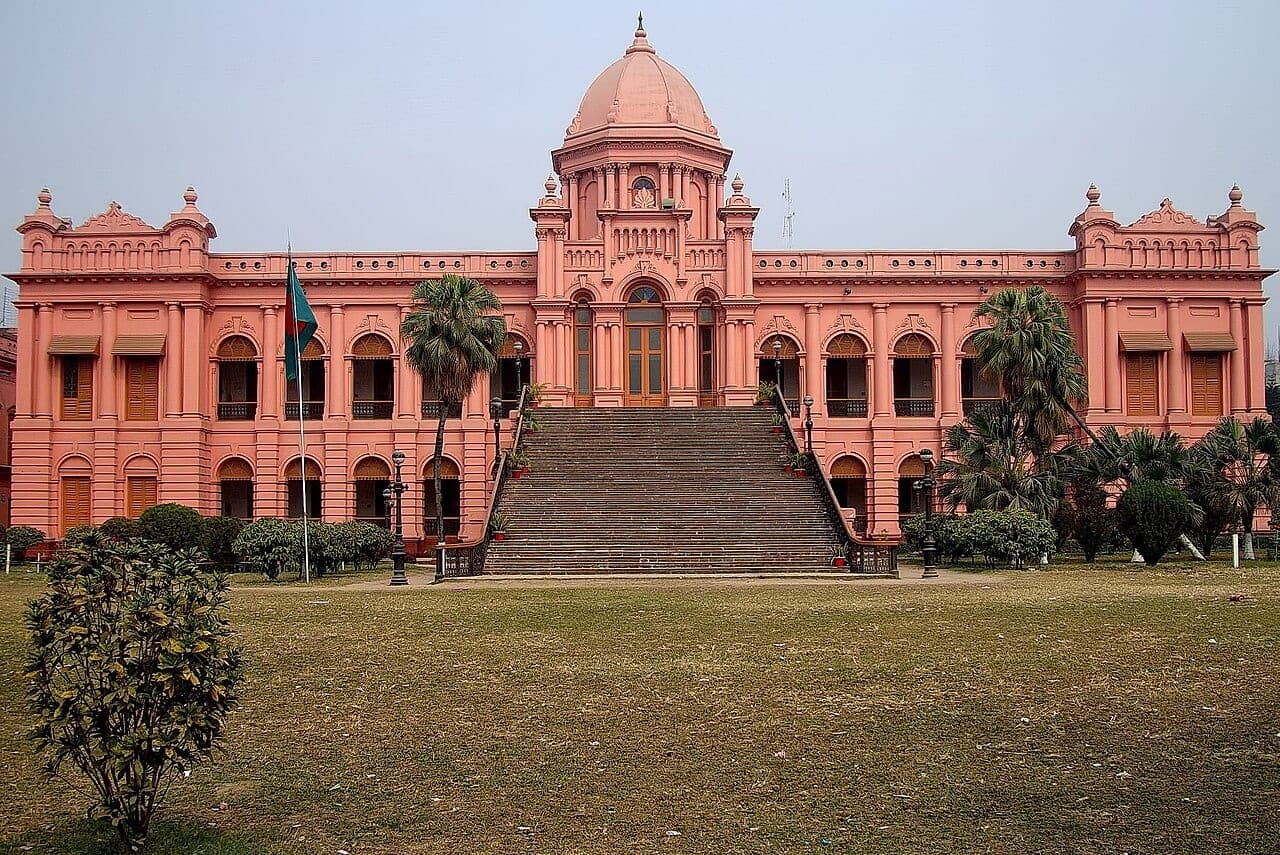
Dhaka. The capital rose to prominence under the Mughals, who made it a provincial seat and, in 1610, renamed it Jahangirnagar. Its river frontage in the old city holds the pink Indo-Saracenic palace of Ahsan Manzil, built between 1859 and 1872 as the residence of the Nawab of Dhaka and now a museum, along with the seventeenth-century Lalbagh Fort and the domed mosques of the Sultanate and Mughal centuries. Around them spreads a metropolis of some ten million people, the heart of the country's government and its garment industry.
Chittagong (Chattogram). The principal seaport has been a trading city for over a thousand years, known to Arab, Chinese and Portuguese mariners. It is the gateway to the Chittagong Hill Tracts and to the Barua Buddhist communities of the south-east.
Khulna and Bagerhat. Khulna, in the south-west, is the base for visiting the Sundarbans and the nearby Historic Mosque City of Bagerhat, the fifteenth-century settlement founded in the delta forest.
Rajshahi. The city on the Padma is a centre of silk, of the Varendra Research Museum, and of the archaeological country around Paharpur and Mahasthangarh.
Sylhet. In the north-east, a region of tea gardens and wetlands, Sylhet is a centre of Sufi devotion built around the shrine of the fourteenth-century saint Shah Jalal, and the ancestral home of much of the Bangladeshi diaspora in Britain.
The delta's recorded past reaches back to ancient kingdoms such as Vanga, Gauda and Pundravardhana, whose capital at Mahasthangarh is the earliest known urban site in the country, occupied from about the third century BCE. From the eighth century the Buddhist Pala Empire (roughly 750–1120), founded by Gopala, ruled Bengal and much of the eastern subcontinent; the Palas were the last major Buddhist imperial power in India and the patrons of great monastic universities, including the Somapura Mahavihara at Paharpur (Wikipedia). The Hindu Sena dynasty followed in the eleventh and twelfth centuries before Turkic Muslim armies reached Bengal around 1204.
 Somapura Mahavihara at Paharpur, an eighth-century monastery that housed hundreds of monks and was known as far away as Tibet. Photograph by Mahenur, CC BY-SA 4.0, via Wikimedia Commons.
An independent Bengal Sultanate emerged in 1352 under Shamsuddin Ilyas Shah, whose successors styled themselves Shah of Bangalah and gave the region a distinct Indo-Persian and Bengali Muslim culture; it survived until 1576, when the province was absorbed into the Mughal Empire. Under the Mughals, Bengal became the wealthiest province of the empire, with Dhaka as its capital for much of the seventeenth century. Company rule began after the Battle of Plassey in 1757, and the East India Company's extraction of Bengal's wealth accompanied the collapse of its textile economy and, in 1943, a famine that killed roughly three million people.
When British India was partitioned in 1947, Bengal was divided on religious lines: the Muslim-majority east became East Bengal, later East Pakistan, joined to a West Pakistan more than a thousand miles away. The union was unequal from the start. The Bengali Language Movement of 1952 was the first great protest against it, insisting that Bangla share the status of Urdu. Grievance deepened through the 1960s, and after the Awami League led by Sheikh Mujibur Rahman won a national majority in the 1970 election and was denied power, the confrontation became a war. The Liberation War ran from March to December 1971 and ended in independence.
Bangla, or Bengali, is an Indo-Aryan language descended from Sanskrit through the Prakrits, written in its own script and enriched over centuries by Persian, Arabic and, later, English vocabulary. It is among the most spoken languages in the world and the vehicle of a literature that runs from the medieval Charyapada and Mangal-Kavya poems to the modern age of Tagore and Nazrul. The name of the country is transparent in the language itself: Bangla for the land and people of Bengal, and the suffix desh, "land" or "country", together meaning the land of Bengal (Wikipedia).
No episode binds language to nationhood more tightly than the movement of 1952. When the government of Pakistan moved to make Urdu the sole state language, students and citizens in Dhaka resisted. On 21 February, defying a ban on assembly, demonstrators were fired upon near Dhaka University, and several were killed, among them Rafiq, Salam, Barkat, Jabbar and Shafiur, names still recited each year (Wikipedia). Bangla was granted co-official status in 1956. On 17 November 1999 UNESCO proclaimed 21 February International Mother Language Day, so that a Bengali sacrifice for the mother tongue is now observed for endangered languages everywhere (UNESCO).
Bengali culture turns on the word, the song and the shared table. The literary year is punctuated by Ekushey, the February book fair held in memory of the language martyrs, and by Pahela Baishakh, the Bengali New Year in mid-April, greeted with white-and-red dress, sweets and the masked processions of Mangal Shobhajatra. The songs of the Bauls and the repertoires of Rabindra Sangeet and Nazrul Geeti remain living parts of daily life rather than museum pieces.
The craft traditions of the delta are equally distinctive. Jamdani, the supplementary-weft muslin woven near Dhaka, descends from the cloth that once dressed Mughal courts, while the Nakshi Kantha is an embroidered quilt made from worn fabric, stitched with village motifs. Bengali cuisine is built on rice and freshwater fish, above all the hilsa, with mustard, the five-spice panch phoron, and a range of milk-based sweets such as roshogolla and mishti doi.
Islam, followed by about nine in ten Bangladeshis, is overwhelmingly Sunni and has been shaped in the delta by centuries of Sufi teaching. The shrines of saints such as Shah Jalal in Sylhet and Khan Jahan Ali in Bagerhat remain places of pilgrimage, and the festivals of Eid al-Fitr and Eid al-Adha are the largest of the year. Hindu Bengalis, the country's principal minority, keep a devotional calendar centred on Durga Puja, the autumn worship of the goddess, along with the festivals of Kali and Saraswati.
Somapura Mahavihara at Paharpur, an eighth-century monastery that housed hundreds of monks and was known as far away as Tibet. Photograph by Mahenur, CC BY-SA 4.0, via Wikimedia Commons.
An independent Bengal Sultanate emerged in 1352 under Shamsuddin Ilyas Shah, whose successors styled themselves Shah of Bangalah and gave the region a distinct Indo-Persian and Bengali Muslim culture; it survived until 1576, when the province was absorbed into the Mughal Empire. Under the Mughals, Bengal became the wealthiest province of the empire, with Dhaka as its capital for much of the seventeenth century. Company rule began after the Battle of Plassey in 1757, and the East India Company's extraction of Bengal's wealth accompanied the collapse of its textile economy and, in 1943, a famine that killed roughly three million people.
When British India was partitioned in 1947, Bengal was divided on religious lines: the Muslim-majority east became East Bengal, later East Pakistan, joined to a West Pakistan more than a thousand miles away. The union was unequal from the start. The Bengali Language Movement of 1952 was the first great protest against it, insisting that Bangla share the status of Urdu. Grievance deepened through the 1960s, and after the Awami League led by Sheikh Mujibur Rahman won a national majority in the 1970 election and was denied power, the confrontation became a war. The Liberation War ran from March to December 1971 and ended in independence.
Bangla, or Bengali, is an Indo-Aryan language descended from Sanskrit through the Prakrits, written in its own script and enriched over centuries by Persian, Arabic and, later, English vocabulary. It is among the most spoken languages in the world and the vehicle of a literature that runs from the medieval Charyapada and Mangal-Kavya poems to the modern age of Tagore and Nazrul. The name of the country is transparent in the language itself: Bangla for the land and people of Bengal, and the suffix desh, "land" or "country", together meaning the land of Bengal (Wikipedia).
No episode binds language to nationhood more tightly than the movement of 1952. When the government of Pakistan moved to make Urdu the sole state language, students and citizens in Dhaka resisted. On 21 February, defying a ban on assembly, demonstrators were fired upon near Dhaka University, and several were killed, among them Rafiq, Salam, Barkat, Jabbar and Shafiur, names still recited each year (Wikipedia). Bangla was granted co-official status in 1956. On 17 November 1999 UNESCO proclaimed 21 February International Mother Language Day, so that a Bengali sacrifice for the mother tongue is now observed for endangered languages everywhere (UNESCO).
Bengali culture turns on the word, the song and the shared table. The literary year is punctuated by Ekushey, the February book fair held in memory of the language martyrs, and by Pahela Baishakh, the Bengali New Year in mid-April, greeted with white-and-red dress, sweets and the masked processions of Mangal Shobhajatra. The songs of the Bauls and the repertoires of Rabindra Sangeet and Nazrul Geeti remain living parts of daily life rather than museum pieces.
The craft traditions of the delta are equally distinctive. Jamdani, the supplementary-weft muslin woven near Dhaka, descends from the cloth that once dressed Mughal courts, while the Nakshi Kantha is an embroidered quilt made from worn fabric, stitched with village motifs. Bengali cuisine is built on rice and freshwater fish, above all the hilsa, with mustard, the five-spice panch phoron, and a range of milk-based sweets such as roshogolla and mishti doi.
Islam, followed by about nine in ten Bangladeshis, is overwhelmingly Sunni and has been shaped in the delta by centuries of Sufi teaching. The shrines of saints such as Shah Jalal in Sylhet and Khan Jahan Ali in Bagerhat remain places of pilgrimage, and the festivals of Eid al-Fitr and Eid al-Adha are the largest of the year. Hindu Bengalis, the country's principal minority, keep a devotional calendar centred on Durga Puja, the autumn worship of the goddess, along with the festivals of Kali and Saraswati.
 The Shat Gombuj mosque at Bagerhat, built in the fifteenth century by a saint-general who cleared the mangrove and dug the tanks the town still drinks from. Photograph by Belayet Hossain, CC BY 3.0, via Wikimedia Commons.
Buddhism, once the imperial faith of the Palas, survives among the Barua community of Chittagong and among Indigenous peoples of the hill tracts, keeping Theravada practice and the memory of the delta's monastic age. Across these divisions runs the syncretic current of the Bauls, wandering minstrels whose songs draw on both Sufi Islam and Hindu Vaishnava devotion and refuse the boundaries of caste and creed. Their greatest figure, the nineteenth-century mystic Fakir Lalon Shah (about 1774–1890), composed hundreds of songs still sung at his shrine in Kushtia, and Baul song has been recognised by UNESCO as intangible heritage of humanity (UNESCO).
The events of 1971 are held with sober care. After the Awami League was denied the power its 1970 majority had earned, the Pakistani army launched Operation Searchlight on 25 March 1971, and Sheikh Mujibur Rahman declared independence in the early hours of 26 March. The nine months that followed brought mass killings, systematic sexual violence, and the flight of some ten million refugees into India; on 14 December, days before the end, Bengali intellectuals were rounded up and murdered, a day now marked as Martyred Intellectuals Day. Estimates of the total dead vary widely, from official figures near three million to scholarly estimates in the hundreds of thousands, and the range itself reflects how much remains uncounted (Wikipedia). India entered the war in early December, and Pakistani forces in the east surrendered in Dhaka on 16 December 1971, now observed as Victory Day.
These losses are gathered into stone. The Shaheed Minar in Dhaka, first raised by students in 1952 and rebuilt after independence, is the focus of the barefoot procession every 21 February. At Savar, north-west of the capital, the National Martyrs' Memorial (Jatiyo Sriti Soudho), designed by Syed Mainul Hossain and built between 1978 and 1982, rises in seven pairs of triangular planes marking the milestones from 1952 to 1971. Alongside these civic rites run the funerary customs of the delta's communities. In Muslim practice the body is washed, wrapped in a plain white shroud and buried soon after the janaza prayer, without cremation, with gatherings of remembrance and Quran recitation on later days. In Hindu Bengali practice the dead are cremated in the antyeshti rite, the eldest son or a close male relative leading, followed by a mourning period and the shraddha offerings that ease the passage of the departed. Both traditions turn the private fact of death into an act the whole family performs together.
Bangladesh has never had a comprehensive historical civil register, and the records that do the work here were made for land and for war.
Land is the deep archive. The Permanent Settlement of 1793 and the surveys that followed produced the khatian, the record of rights, listing who held which plot and under whom, revised periodically through the twentieth century. Because inheritance divides land among heirs, a khatian series across several revisions is a family tree in the form of a property register, and it is the document Bangladeshi families most often use to establish descent. Mutation records, which register a transfer after a death, effectively function as death records.
Muslim marriages are registered by the kazi, who keeps a register, and those books are the closest thing to a vital record for most of the population. Christian and Hindu communities kept their own.
The colonial administrative record for East Bengal is largely in Kolkata and London, and the Partition of 1947 and the war of 1971 each destroyed and displaced records as well as people.
1971 is the defining absence. Estimates of the dead range enormously and the state has never produced a name-by-name list, so families who lost people in the war often have no document at all. The Liberation War Museum in Dhaka has spent decades collecting testimony, photographs and personal papers from families precisely to build the record that was never made, and it collects from schoolchildren interviewing their own grandparents.
Bangladesh holds three UNESCO World Heritage sites, and each marks a different layer of the delta's past. The Ruins of the Buddhist Vihara at Paharpur, inscribed in 1985, preserve the Somapura Mahavihara, the eighth-century monastery built by the Pala king Dharmapala; its quadrangle of 177 monastic cells around a central cruciform stupa, spread over some eleven hectares, made it one of the largest Buddhist monasteries south of the Himalayas (UNESCO). The Historic Mosque City of Bagerhat, inscribed the same year, preserves the fifteenth-century settlement founded by the saint-general Khan Jahan Ali; its Sixty Dome Mosque (Shait Gumbad), despite its name, is roofed by dozens of domes carried on sixty stone pillars, and ranks among the finest Muslim monuments in South Asia (UNESCO).
The third site is natural. The Sundarbans, inscribed in 1997, is the largest mangrove forest in the world, covering roughly ten thousand square kilometres across the Bengal delta, of which about 6,000 square kilometres lie in Bangladesh; it shelters the Royal Bengal tiger and forms a natural sea wall against the cyclones of the bay (UNESCO). The Department of Archaeology also maintains Mahasthangarh, Lalbagh Fort and Ahsan Manzil, while Bagerhat and Paharpur are cared for under UNESCO conservation programmes.
Much of the country's recent memory work has been documentary. The Liberation War Museum in Dhaka, founded on 22 March 1996, holds more than 21,000 artefacts along with photographs, testimony and records recovered from mass graves, and has built a digital archive so the evidence of 1971 can be studied rather than lost (Liberation War Museum). The address that Sheikh Mujibur Rahman gave on 7 March 1971 at the Ramna Race Course, calling for struggle and independence before a crowd of about a million, was inscribed on UNESCO's Memory of the World Register in 2017 (UNESCO). Banglapedia, the national encyclopaedia published by the Asiatic Society of Bangladesh, is freely available online, while the Bangla Academy, founded in 1955 out of the language movement, publishes and digitises Bengali literature and scholarship.
Modern Bangladeshi culture carries its memory outward. Bengali cinema, from the art films of the 1970s to the popular Dhallywood industry, keeps the language central to daily life, while Bangladeshi writers have reached a global readership. The diaspora extends this culture across the world, with large communities in the United Kingdom, the United States and the Gulf. In Britain the community, much of it with roots in Sylhet, has shaped the restaurant trade and a British-Bengali literature; wherever it has settled, the Shaheed Minar has been rebuilt in miniature, and 21 February is observed far from the delta.
A day for the world's mother tongues. The sacrifice of 1952 became a global observance when UNESCO named 21 February International Mother Language Day, turning a Bengali cause into a defence of linguistic rights everywhere.
The delta's heritage recognised. Within a single decade Bangladesh secured three UNESCO World Heritage listings: a Buddhist monastic university, a Sultanate mosque city and the greatest mangrove forest on earth, kept under active conservation since.
A living intangible heritage. Baul song, Jamdani weaving, the New Year procession of Mangal Shobhajatra, Shital Pati mat-weaving and the painted rickshaws of Dhaka have all been inscribed on UNESCO's intangible-heritage lists, honouring practices still carried on by working craftspeople (UNESCO).
The record preserved. Through the Liberation War Museum and the Memory of the World inscription of the 7 March speech, the testimony of 1971 has been gathered, digitised and made public, so a war now passing out of living memory can be studied from its sources.
The Shat Gombuj mosque at Bagerhat, built in the fifteenth century by a saint-general who cleared the mangrove and dug the tanks the town still drinks from. Photograph by Belayet Hossain, CC BY 3.0, via Wikimedia Commons.
Buddhism, once the imperial faith of the Palas, survives among the Barua community of Chittagong and among Indigenous peoples of the hill tracts, keeping Theravada practice and the memory of the delta's monastic age. Across these divisions runs the syncretic current of the Bauls, wandering minstrels whose songs draw on both Sufi Islam and Hindu Vaishnava devotion and refuse the boundaries of caste and creed. Their greatest figure, the nineteenth-century mystic Fakir Lalon Shah (about 1774–1890), composed hundreds of songs still sung at his shrine in Kushtia, and Baul song has been recognised by UNESCO as intangible heritage of humanity (UNESCO).
The events of 1971 are held with sober care. After the Awami League was denied the power its 1970 majority had earned, the Pakistani army launched Operation Searchlight on 25 March 1971, and Sheikh Mujibur Rahman declared independence in the early hours of 26 March. The nine months that followed brought mass killings, systematic sexual violence, and the flight of some ten million refugees into India; on 14 December, days before the end, Bengali intellectuals were rounded up and murdered, a day now marked as Martyred Intellectuals Day. Estimates of the total dead vary widely, from official figures near three million to scholarly estimates in the hundreds of thousands, and the range itself reflects how much remains uncounted (Wikipedia). India entered the war in early December, and Pakistani forces in the east surrendered in Dhaka on 16 December 1971, now observed as Victory Day.
These losses are gathered into stone. The Shaheed Minar in Dhaka, first raised by students in 1952 and rebuilt after independence, is the focus of the barefoot procession every 21 February. At Savar, north-west of the capital, the National Martyrs' Memorial (Jatiyo Sriti Soudho), designed by Syed Mainul Hossain and built between 1978 and 1982, rises in seven pairs of triangular planes marking the milestones from 1952 to 1971. Alongside these civic rites run the funerary customs of the delta's communities. In Muslim practice the body is washed, wrapped in a plain white shroud and buried soon after the janaza prayer, without cremation, with gatherings of remembrance and Quran recitation on later days. In Hindu Bengali practice the dead are cremated in the antyeshti rite, the eldest son or a close male relative leading, followed by a mourning period and the shraddha offerings that ease the passage of the departed. Both traditions turn the private fact of death into an act the whole family performs together.
Bangladesh has never had a comprehensive historical civil register, and the records that do the work here were made for land and for war.
Land is the deep archive. The Permanent Settlement of 1793 and the surveys that followed produced the khatian, the record of rights, listing who held which plot and under whom, revised periodically through the twentieth century. Because inheritance divides land among heirs, a khatian series across several revisions is a family tree in the form of a property register, and it is the document Bangladeshi families most often use to establish descent. Mutation records, which register a transfer after a death, effectively function as death records.
Muslim marriages are registered by the kazi, who keeps a register, and those books are the closest thing to a vital record for most of the population. Christian and Hindu communities kept their own.
The colonial administrative record for East Bengal is largely in Kolkata and London, and the Partition of 1947 and the war of 1971 each destroyed and displaced records as well as people.
1971 is the defining absence. Estimates of the dead range enormously and the state has never produced a name-by-name list, so families who lost people in the war often have no document at all. The Liberation War Museum in Dhaka has spent decades collecting testimony, photographs and personal papers from families precisely to build the record that was never made, and it collects from schoolchildren interviewing their own grandparents.
Bangladesh holds three UNESCO World Heritage sites, and each marks a different layer of the delta's past. The Ruins of the Buddhist Vihara at Paharpur, inscribed in 1985, preserve the Somapura Mahavihara, the eighth-century monastery built by the Pala king Dharmapala; its quadrangle of 177 monastic cells around a central cruciform stupa, spread over some eleven hectares, made it one of the largest Buddhist monasteries south of the Himalayas (UNESCO). The Historic Mosque City of Bagerhat, inscribed the same year, preserves the fifteenth-century settlement founded by the saint-general Khan Jahan Ali; its Sixty Dome Mosque (Shait Gumbad), despite its name, is roofed by dozens of domes carried on sixty stone pillars, and ranks among the finest Muslim monuments in South Asia (UNESCO).
The third site is natural. The Sundarbans, inscribed in 1997, is the largest mangrove forest in the world, covering roughly ten thousand square kilometres across the Bengal delta, of which about 6,000 square kilometres lie in Bangladesh; it shelters the Royal Bengal tiger and forms a natural sea wall against the cyclones of the bay (UNESCO). The Department of Archaeology also maintains Mahasthangarh, Lalbagh Fort and Ahsan Manzil, while Bagerhat and Paharpur are cared for under UNESCO conservation programmes.
Much of the country's recent memory work has been documentary. The Liberation War Museum in Dhaka, founded on 22 March 1996, holds more than 21,000 artefacts along with photographs, testimony and records recovered from mass graves, and has built a digital archive so the evidence of 1971 can be studied rather than lost (Liberation War Museum). The address that Sheikh Mujibur Rahman gave on 7 March 1971 at the Ramna Race Course, calling for struggle and independence before a crowd of about a million, was inscribed on UNESCO's Memory of the World Register in 2017 (UNESCO). Banglapedia, the national encyclopaedia published by the Asiatic Society of Bangladesh, is freely available online, while the Bangla Academy, founded in 1955 out of the language movement, publishes and digitises Bengali literature and scholarship.
Modern Bangladeshi culture carries its memory outward. Bengali cinema, from the art films of the 1970s to the popular Dhallywood industry, keeps the language central to daily life, while Bangladeshi writers have reached a global readership. The diaspora extends this culture across the world, with large communities in the United Kingdom, the United States and the Gulf. In Britain the community, much of it with roots in Sylhet, has shaped the restaurant trade and a British-Bengali literature; wherever it has settled, the Shaheed Minar has been rebuilt in miniature, and 21 February is observed far from the delta.
A day for the world's mother tongues. The sacrifice of 1952 became a global observance when UNESCO named 21 February International Mother Language Day, turning a Bengali cause into a defence of linguistic rights everywhere.
The delta's heritage recognised. Within a single decade Bangladesh secured three UNESCO World Heritage listings: a Buddhist monastic university, a Sultanate mosque city and the greatest mangrove forest on earth, kept under active conservation since.
A living intangible heritage. Baul song, Jamdani weaving, the New Year procession of Mangal Shobhajatra, Shital Pati mat-weaving and the painted rickshaws of Dhaka have all been inscribed on UNESCO's intangible-heritage lists, honouring practices still carried on by working craftspeople (UNESCO).
The record preserved. Through the Liberation War Museum and the Memory of the World inscription of the 7 March speech, the testimony of 1971 has been gathered, digitised and made public, so a war now passing out of living memory can be studied from its sources.
National Overview
Notable Cities
Historical Foundations
Linguistic and Etymological Roots
Cultural Identity
Religion and Spirituality
Remembrance and Mourning Traditions
Tracing a Family in Bangladesh
Heritage Preservation Efforts
Digital Heritage
Contemporary Cultural Influences
Success Stories
References and resources
- Encyclopaedia Britannica: Bangladesh. Geography, population, government and history.
- UNESCO World Heritage Centre: Ruins of the Buddhist Vihara at Paharpur. The Somapura Mahavihara, inscribed 1985.
- UNESCO World Heritage Centre: Historic Mosque City of Bagerhat. The fifteenth-century city and its Sixty Dome Mosque.
- UNESCO World Heritage Centre: The Sundarbans. The largest mangrove forest in the world, inscribed 1997.
- UNESCO: International Mother Language Day. The 1999 proclamation honouring the 1952 language movement.
- UNESCO Intangible Cultural Heritage: Bangladesh. Baul songs, Jamdani, Mangal Shobhajatra, Shital Pati and rickshaw painting.
- UNESCO Memory of the World: the 7 March 1971 speech. The address that preceded the Liberation War.
- Wikipedia: Bangladesh Liberation War. A sourced account of the 1971 war and its casualties.
- Liberation War Museum, Dhaka. Collections, testimony and digital archive of 1971.
- Banglapedia. The national encyclopaedia of Bangladesh.