Heritage · Country
Sri Lanka Culture and Heritage
On an island the ancients called Serendib, a fig tree grown from the Buddha's own Bodhi has been tended by hand for more than two thousand years, and a single tooth relic still decides where the sacred capital stands. This is a guide to Sri Lanka's Buddhist and Hindu heritage, its Sinhalese and Tamil peoples, and the customs by which the island remembers its dead.Written to last.
By Confinity Heritage Editorial · Updated 2026-07-31 · 8-minute readQuiet tools, kept out of the way.
Sri Lanka is an island a little larger than Ireland, set in the Indian Ocean off the southern tip of India, and for more than two millennia it has been the southern anchor of Buddhist civilisation. Greek geographers called it Taprobane, Arab traders Serendib, and Europeans Ceylon, the name under which its cinnamon and later its tea reached the world. Its ancient kings were hydraulic engineers who turned the dry northern plain into a network of reservoirs, raised brick stupas among the tallest structures of the pre-modern world, and painted a rock two hundred metres high with court beauties whose colours have held for fifteen centuries.
That inheritance is braided with the memory of loss. The island is home to the Sinhalese Buddhist majority and to Tamil Hindus, Muslim Moors and Christians, communities whose recent history was marked by a civil war that ran from 1983 to 2009 and by the Indian Ocean tsunami of 2004.
Sri Lanka covers about 65,600 square kilometres, a pear-shaped island separated from India by the narrow Palk Strait. Its terrain rises from a broad coastal and northern lowland, much of it the ancient dry zone of tank-fed rice farming, to a cool central massif whose highest point, Pidurutalagala, reaches 2,524 metres; the highland grows the tea that carries the island's colonial name abroad (Britannica).
The 2024 census counted about 21.8 million people (Wikipedia). The Sinhalese make up roughly three-quarters of the population; Sri Lankan Tamils about 11 per cent, concentrated in the north and east; Sri Lankan Moors, mostly Muslim, some 9 per cent; and Indian-origin Tamils, descended from plantation labour, about 4 per cent. Around 70 per cent are Buddhist, 13 per cent Hindu, 10 per cent Muslim and 7 per cent Christian. The republic keeps two capitals in practice: Colombo, the commercial heart and largest city, and neighbouring Sri Jayawardenepura Kotte, the seat of parliament.
Colombo. The principal port grew from a harbour prized in turn by Arab, Portuguese, Dutch and British traders. Its centre mixes colonial arcades in the old Fort quarter, the covered lanes of the Pettah bazaar, and temples, mosques and churches side by side; the National Museum, founded in 1877, holds the regalia of the last king of Kandy.
Kandy. Set in the central hills around an artificial lake, Kandy was the seat of the last independent Sinhalese kingdom and remains the ceremonial capital. Its Temple of the Sacred Tooth Relic is the foremost shrine of Sri Lankan Buddhism, and each year the Esala Perahera fills the streets with caparisoned elephants, dancers and drummers.
Anuradhapura. The first great capital, occupied for over a thousand years, spreads across the north-central plain as a sacred city of colossal brick dagobas and vast reservoirs, gathered around the Jaya Sri Maha Bodhi, the oldest historically documented tree on earth.
Jaffna. The cultural capital of the Sri Lankan Tamils, on the northern peninsula, is a centre of Shaivite Hinduism and Tamil scholarship. Heavily damaged in the civil war, the city has been steadily rebuilding.
Galle. On the southern coast, Galle keeps the best-preserved European sea fort in Asia, a Dutch-walled town of the 1660s laid over Portuguese foundations.
Sinhalese tradition, recorded in the fifth-century chronicle the Mahavamsa, dates the island's civilisation to the legendary Prince Vijaya around the sixth century BCE. The decisive event came in the third century BCE, when the monk Mahinda, son of the Indian emperor Ashoka, met King Devanampiya Tissa at Mihintale and converted him to Buddhism (EBSCO). From that meeting grew Anuradhapura's Mahavihara, the orthodox home of Theravada Buddhism, and the planting of the Jaya Sri Maha Bodhi, a sapling of the tree at Bodh Gaya under which the Buddha reached enlightenment. Anuradhapura ruled for over a millennium, its monks committing the Pali canon to writing and its engineers building reservoirs unmatched in the ancient world.
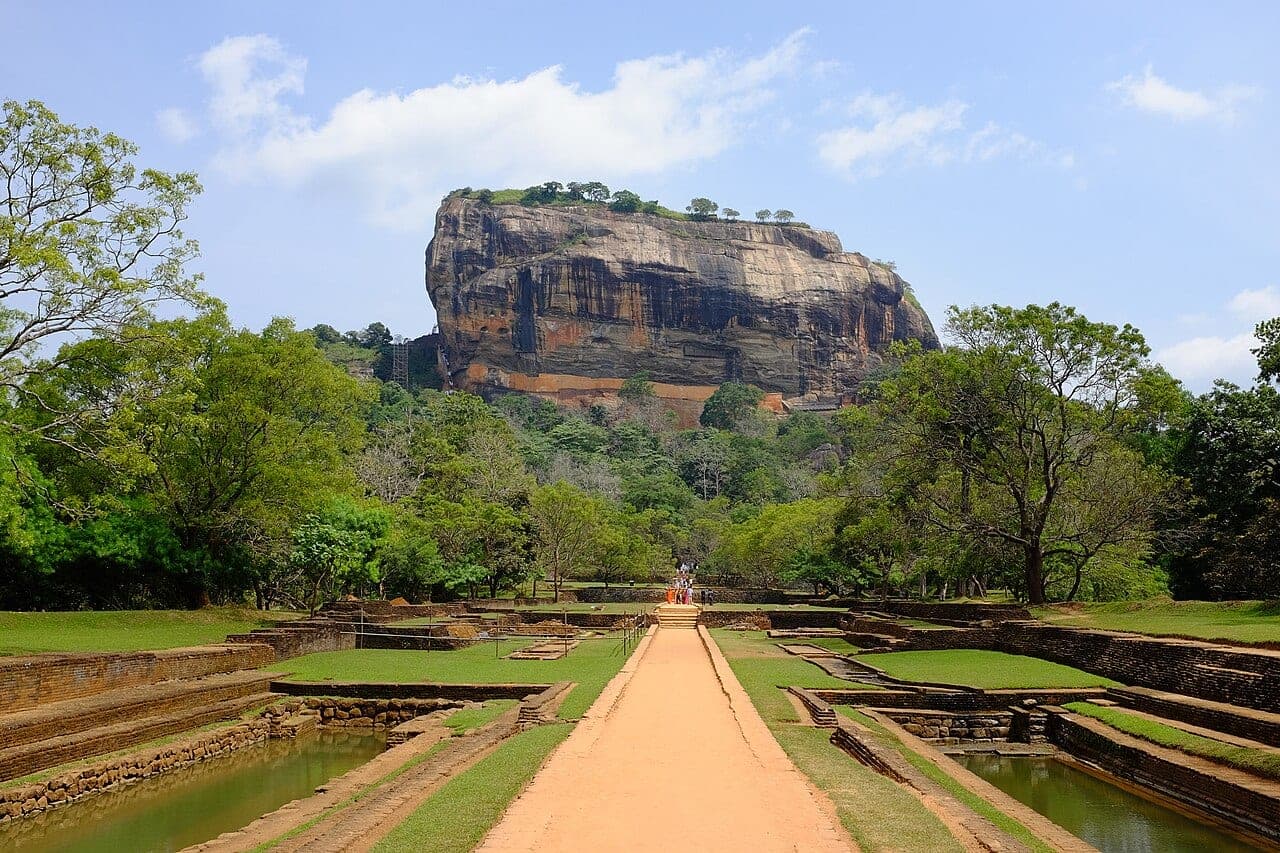
 Sigiriya, where a fifth-century king built his palace on top of a two-hundred-metre rock, reached by a stair through the paws of a brick lion. Photograph by Tlbatt, CC BY-SA 4.0, via Wikimedia Commons.
In the fifth century CE, King Kashyapa moved the court to Sigiriya, raising a palace on a granite monolith some two hundred metres high, approached through water gardens and past a gateway once shaped like a colossal lion (UNESCO). Its frescoes and polished "mirror wall" survive as masterpieces of early Asian art. After invasions from South India, the capital shifted to Polonnaruwa, which reached its height under Parakramabahu I (reigned 1153 to 1186); he enlarged the vast reservoir known as the Sea of Parakrama and left the rock-cut Buddhas of the Gal Vihara.
By the sixteenth century the mountain kingdom of Kandy had become the guardian of Sinhalese sovereignty and of the sacred Tooth Relic, possession of which was held to confer the right to rule (Britannica). The coasts passed through three colonial layers: the Portuguese, who arrived in 1505 and seized the cinnamon trade; the Dutch, who ousted them by 1658 and governed until 1796; and the British, who took the coast in 1796 and in 1815 persuaded the Kandyan chiefs to sign the convention that ended the last kingdom. Independence came peacefully in 1948 as the Dominion of Ceylon, and in 1972 the country became a republic and took the name Sri Lanka.
The decades after independence were shadowed by tension between the Sinhalese majority and the Tamil minority over language, education and representation. A civil war between the government and the Liberation Tigers of Tamil Eelam, who sought a separate Tamil state in the north and east, ran from 1983 to 2009. It followed communal riots in July 1983 and ended with the military defeat of the Tigers in May 2009. United Nations estimates place the dead between eighty thousand and one hundred thousand, with heavy civilian loss, and grave abuses have been alleged against parties on more than one side. The island continues to work through questions of accountability, reconciliation and memory.
Sri Lanka's two national languages come from different families. Sinhala, spoken by the majority, is the southernmost of the Indo-Aryan languages, distant kin to Hindi and Sanskrit, shaped by long contact with Tamil and Pali and written in a rounded script descended from ancient Brahmi. Tamil, the language of the island's Tamils and Moors, belongs to the Dravidian family and is one of the world's oldest living classical languages, with a literature reaching back more than two thousand years. English, inherited from the British period, serves as a link language across communities.
The island's names record its layered past. "Sri Lanka" comes from Sanskrit, in which Lanka is the island of the Ramayana and the honorific shri means resplendent or venerable, so the modern name reads roughly as "the resplendent island." The name Ceylon descends through Portuguese Ceilao and Dutch Ceylan from Sinhala words for the island of the Sinhala people; the same root reached Arabic as Serendib, which later gave English "serendipity," while to Greek and Roman geographers it was Taprobane.
Sri Lankan culture turns on the rhythms of temple, field and family. The best-known performing tradition is Kandyan dance, the highland style of energetic leaps and spins accompanied by the double-headed geta bera drum; it is matched by the low-country dance of the southern coast, with its carved masks used in healing and exorcism ceremonies. The mask carvers of Ambalangoda, the lacquer and batik workers, the brass casters and the gem cutters of Ratnapura sustain crafts of long standing, and the island's sapphires have been prized since the days of the Silk Road.
The kitchen is built on rice and coconut, tempered with spices traded for centuries. A typical meal is rice with an array of curries and the relish called sambol, eaten with hoppers, the bowl-shaped rice-flour pancakes, string hoppers, and the chopped-roti dish kottu. Cinnamon, native to the island, drew the first European fleets. Above all there is tea: after a blight destroyed the coffee plantations in 1869, the Scottish planter James Taylor laid out the first commercial tea at Loolecondera near Kandy in 1867, and within a generation the grocer Thomas Lipton was shipping Ceylon tea to the world (History of Ceylon Tea).
Theravada Buddhism has been the faith of the Sinhalese majority since the third century BCE, and the temple and its monks remain the centre of village life and of a calendar whose full-moon Poya days are public holidays. The great dagobas of Anuradhapura, the sacred Bodhi tree and the Tooth Relic at Kandy make the island one of the most important pilgrimage landscapes in the Buddhist world, and older layers of ritual survive alongside the canon, including offerings to the guardian deities of village and field.
Sigiriya, where a fifth-century king built his palace on top of a two-hundred-metre rock, reached by a stair through the paws of a brick lion. Photograph by Tlbatt, CC BY-SA 4.0, via Wikimedia Commons.
In the fifth century CE, King Kashyapa moved the court to Sigiriya, raising a palace on a granite monolith some two hundred metres high, approached through water gardens and past a gateway once shaped like a colossal lion (UNESCO). Its frescoes and polished "mirror wall" survive as masterpieces of early Asian art. After invasions from South India, the capital shifted to Polonnaruwa, which reached its height under Parakramabahu I (reigned 1153 to 1186); he enlarged the vast reservoir known as the Sea of Parakrama and left the rock-cut Buddhas of the Gal Vihara.
By the sixteenth century the mountain kingdom of Kandy had become the guardian of Sinhalese sovereignty and of the sacred Tooth Relic, possession of which was held to confer the right to rule (Britannica). The coasts passed through three colonial layers: the Portuguese, who arrived in 1505 and seized the cinnamon trade; the Dutch, who ousted them by 1658 and governed until 1796; and the British, who took the coast in 1796 and in 1815 persuaded the Kandyan chiefs to sign the convention that ended the last kingdom. Independence came peacefully in 1948 as the Dominion of Ceylon, and in 1972 the country became a republic and took the name Sri Lanka.
The decades after independence were shadowed by tension between the Sinhalese majority and the Tamil minority over language, education and representation. A civil war between the government and the Liberation Tigers of Tamil Eelam, who sought a separate Tamil state in the north and east, ran from 1983 to 2009. It followed communal riots in July 1983 and ended with the military defeat of the Tigers in May 2009. United Nations estimates place the dead between eighty thousand and one hundred thousand, with heavy civilian loss, and grave abuses have been alleged against parties on more than one side. The island continues to work through questions of accountability, reconciliation and memory.
Sri Lanka's two national languages come from different families. Sinhala, spoken by the majority, is the southernmost of the Indo-Aryan languages, distant kin to Hindi and Sanskrit, shaped by long contact with Tamil and Pali and written in a rounded script descended from ancient Brahmi. Tamil, the language of the island's Tamils and Moors, belongs to the Dravidian family and is one of the world's oldest living classical languages, with a literature reaching back more than two thousand years. English, inherited from the British period, serves as a link language across communities.
The island's names record its layered past. "Sri Lanka" comes from Sanskrit, in which Lanka is the island of the Ramayana and the honorific shri means resplendent or venerable, so the modern name reads roughly as "the resplendent island." The name Ceylon descends through Portuguese Ceilao and Dutch Ceylan from Sinhala words for the island of the Sinhala people; the same root reached Arabic as Serendib, which later gave English "serendipity," while to Greek and Roman geographers it was Taprobane.
Sri Lankan culture turns on the rhythms of temple, field and family. The best-known performing tradition is Kandyan dance, the highland style of energetic leaps and spins accompanied by the double-headed geta bera drum; it is matched by the low-country dance of the southern coast, with its carved masks used in healing and exorcism ceremonies. The mask carvers of Ambalangoda, the lacquer and batik workers, the brass casters and the gem cutters of Ratnapura sustain crafts of long standing, and the island's sapphires have been prized since the days of the Silk Road.
The kitchen is built on rice and coconut, tempered with spices traded for centuries. A typical meal is rice with an array of curries and the relish called sambol, eaten with hoppers, the bowl-shaped rice-flour pancakes, string hoppers, and the chopped-roti dish kottu. Cinnamon, native to the island, drew the first European fleets. Above all there is tea: after a blight destroyed the coffee plantations in 1869, the Scottish planter James Taylor laid out the first commercial tea at Loolecondera near Kandy in 1867, and within a generation the grocer Thomas Lipton was shipping Ceylon tea to the world (History of Ceylon Tea).
Theravada Buddhism has been the faith of the Sinhalese majority since the third century BCE, and the temple and its monks remain the centre of village life and of a calendar whose full-moon Poya days are public holidays. The great dagobas of Anuradhapura, the sacred Bodhi tree and the Tooth Relic at Kandy make the island one of the most important pilgrimage landscapes in the Buddhist world, and older layers of ritual survive alongside the canon, including offerings to the guardian deities of village and field.
 The Ruwanweliseya at Anuradhapura was raised in the second century BC and has been continuously venerated ever since. Photograph by Anandajoti Bhikkhu, CC BY-SA 4.0, via Wikimedia Commons.
Hinduism, in its Tamil Shaivite form, is the second faith, its towering gopuram temples rising over Jaffna and the east, from the Nallur Kandaswamy shrine to the ancient Koneswaram temple at Trincomalee. Islam arrived with Arab and later South Indian traders, and the Moor communities of the coasts keep centuries-old mosques; Christianity, brought by the Portuguese and continued under Dutch and British rule, is strongest among coastal fishing communities and includes the Marian shrine at Madhu. Some sacred places are shared: Adam's Peak, the mountain the Sinhalese call Sri Pada, bears a summit footprint venerated at once by Buddhists as the Buddha's, by Hindus as Shiva's, and by Muslims and Christians as Adam's, and pilgrims of every faith climb it together through the night.
Buddhist funerary custom treats death as a passage whose merit can be shaped by the living. When a person dies, the body is kept at home while relatives gather; the colour of mourning is white, and white cloth and flags mark the house. Before the cremation, monks are offered a length of new cloth in the rite called mataka-vastra-puja, a gesture that recalls the shrouds early monks once salvaged for their robes and turns the moment of loss into an act of giving (Wisdom Library). In the days that follow comes the mataka-bana, a sermon preached for the benefit of the deceased, and then the central act of almsgiving, dana, offered to the monastic community on the seventh day, again at three months and once more at the year's end. The merit of each offering is formally transferred to the dead, poured out as water from one vessel to another.
Hindu Tamil families follow the rites of antyesti, the "last sacrifice," in which the body is cremated, ideally within a day, so that it may return to the elements. The chief mourner, traditionally the eldest son, leads the ceremonies while priests recite the prayers and rice-ball offerings called pinda sustain the departed soul on its journey; a period of observance follows over the weeks after death, closing with a memorial gathering. Both traditions place the family at the centre of mourning, and both understand remembrance as something owed and repeated rather than done once.
Sri Lanka also carries two collective griefs. The tsunami of 26 December 2004 killed more than thirty thousand people on the island's coasts within minutes, among them the passengers of a crowded train swept from the tracks near Peraliya, now marked by memorials and a statue given by Japanese Buddhists (Britannica). And the long civil war left the north and east scarred with loss, its dead remembered in different, sometimes contested, ways by different communities. Efforts to acknowledge that suffering, to trace the missing, and to let all who mourn do so with dignity remain part of the island's unfinished work.
Sri Lanka has a colonial record of a quality that surprises people, and the reason is Dutch bureaucracy.
The tombos are the great source. Dutch administrators in the seventeenth and eighteenth centuries compiled land registers, the land tombos, and population registers, the head tombos, which list families village by village with names, ages, castes and relationships. They are among the most detailed records of an Asian population made by any European power, and they survive in the Sri Lanka National Archives. For families in the coastal districts they reach back three centuries.
Portuguese records precede them and are thinner; British administration from 1796 added civil registration, which became general in the nineteenth century and is held by the Registrar General.
The Dutch Burgher Union, founded in 1908, compiled and published genealogies of the Eurasian families descended from Dutch and Portuguese settlers, and that body of work is unusually complete for a community of its size.
Buddhist temple records, the Kandyan land grants called sannas, and the caste and service tenure registers of the interior carry the Sinhala record, and Tamil families in the north and east appear in temple, church and land documents.
The war between 1983 and 2009 displaced hundreds of thousands and left tens of thousands missing, and the Office on Missing Persons established in 2016 holds what record exists. Families in the north still carry photographs to commissions, which is a form of genealogy nobody wants to practise.
Sri Lanka holds eight UNESCO World Heritage Sites, six cultural and two natural, an unusually dense concentration for its size (UNESCO). The three ancient royal cities of Anuradhapura, Polonnaruwa and Sigiriya were inscribed together in 1982; the Sacred City of Kandy and the Old Town of Galle in 1988; and the Golden Temple of Dambulla, whose cave shrines hold painted ceilings and more than a hundred Buddha images, in 1991. On the natural side, the Sinharaja Forest Reserve, the last major stretch of primary lowland rainforest, was inscribed in 1988, and the Central Highlands, comprising the Peak Wilderness, Horton Plains and the Knuckles range, in 2010 (UNESCO). Much of the cultural work is coordinated through the Cultural Triangle programme, run with the Department of Archaeology and the Central Cultural Fund, while conservation of the Sigiriya and Dambulla paintings continues under specialist teams.
Sri Lanka's documentary heritage is steadily moving online. The Department of National Archives and the island's temple libraries hold tens of thousands of ola, the palm-leaf manuscripts on which the Pali canon, medical texts and chronicles were inscribed with a stylus, and digitisation projects are working to stabilise and open these fragile collections. For the Tamil-speaking communities, the Noolaham Foundation has built one of South Asia's largest community digital libraries, preserving books, periodicals and records at risk during and after the war (Noolaham Foundation). The Sigiriya frescoes and other sites now feature in online collections and surveys that support scholarship and restoration.
Sri Lanka reaches the wider world through its writers above all. Michael Ondaatje, born in Colombo, won acclaim for The English Patient and returned to the island in Running in the Family and Anil's Ghost; Romesh Gunesekera and Shyam Selvadurai brought island stories to a global readership; and in 2022 Shehan Karunatilaka won the Booker Prize for The Seven Moons of Maali Almeida, a novel that faces the civil war through the eyes of its dead. Cinema has its own tradition, opened by Lester James Peries with the 1956 film Rekava, while the Portuguese-descended dance music called baila sets the tempo of celebrations. Nothing unites the island quite like cricket, and the 1996 World Cup victory remains a point of pride across every community; a large diaspora keeps temple, kovil, mosque and church alive far from home.
The oldest tended tree on earth. The Jaya Sri Maha Bodhi at Anuradhapura, planted in the third century BCE from a branch of the Bodh Gaya tree, has been guarded and watered without interruption for more than two thousand three hundred years, the longest continuous act of horticultural devotion known anywhere.
Buried cities recovered. The overgrown royal capitals of Anuradhapura and Polonnaruwa were surveyed, cleared and conserved from the nineteenth century onward, and are now living centres of pilgrimage, study and craft training.
Tea from the ashes of coffee. When blight destroyed the coffee estates in 1869, planters replanted the highlands with tea, an industry that made Ceylon a household word and still anchors the highland economy.
A rainforest and a highland saved. The Sinharaja rainforest, once slated for logging, was protected and inscribed as World Heritage in 1988, and the Central Highlands followed in 2010, safeguarding endemic plants, birds and the leopard.
The Ruwanweliseya at Anuradhapura was raised in the second century BC and has been continuously venerated ever since. Photograph by Anandajoti Bhikkhu, CC BY-SA 4.0, via Wikimedia Commons.
Hinduism, in its Tamil Shaivite form, is the second faith, its towering gopuram temples rising over Jaffna and the east, from the Nallur Kandaswamy shrine to the ancient Koneswaram temple at Trincomalee. Islam arrived with Arab and later South Indian traders, and the Moor communities of the coasts keep centuries-old mosques; Christianity, brought by the Portuguese and continued under Dutch and British rule, is strongest among coastal fishing communities and includes the Marian shrine at Madhu. Some sacred places are shared: Adam's Peak, the mountain the Sinhalese call Sri Pada, bears a summit footprint venerated at once by Buddhists as the Buddha's, by Hindus as Shiva's, and by Muslims and Christians as Adam's, and pilgrims of every faith climb it together through the night.
Buddhist funerary custom treats death as a passage whose merit can be shaped by the living. When a person dies, the body is kept at home while relatives gather; the colour of mourning is white, and white cloth and flags mark the house. Before the cremation, monks are offered a length of new cloth in the rite called mataka-vastra-puja, a gesture that recalls the shrouds early monks once salvaged for their robes and turns the moment of loss into an act of giving (Wisdom Library). In the days that follow comes the mataka-bana, a sermon preached for the benefit of the deceased, and then the central act of almsgiving, dana, offered to the monastic community on the seventh day, again at three months and once more at the year's end. The merit of each offering is formally transferred to the dead, poured out as water from one vessel to another.
Hindu Tamil families follow the rites of antyesti, the "last sacrifice," in which the body is cremated, ideally within a day, so that it may return to the elements. The chief mourner, traditionally the eldest son, leads the ceremonies while priests recite the prayers and rice-ball offerings called pinda sustain the departed soul on its journey; a period of observance follows over the weeks after death, closing with a memorial gathering. Both traditions place the family at the centre of mourning, and both understand remembrance as something owed and repeated rather than done once.
Sri Lanka also carries two collective griefs. The tsunami of 26 December 2004 killed more than thirty thousand people on the island's coasts within minutes, among them the passengers of a crowded train swept from the tracks near Peraliya, now marked by memorials and a statue given by Japanese Buddhists (Britannica). And the long civil war left the north and east scarred with loss, its dead remembered in different, sometimes contested, ways by different communities. Efforts to acknowledge that suffering, to trace the missing, and to let all who mourn do so with dignity remain part of the island's unfinished work.
Sri Lanka has a colonial record of a quality that surprises people, and the reason is Dutch bureaucracy.
The tombos are the great source. Dutch administrators in the seventeenth and eighteenth centuries compiled land registers, the land tombos, and population registers, the head tombos, which list families village by village with names, ages, castes and relationships. They are among the most detailed records of an Asian population made by any European power, and they survive in the Sri Lanka National Archives. For families in the coastal districts they reach back three centuries.
Portuguese records precede them and are thinner; British administration from 1796 added civil registration, which became general in the nineteenth century and is held by the Registrar General.
The Dutch Burgher Union, founded in 1908, compiled and published genealogies of the Eurasian families descended from Dutch and Portuguese settlers, and that body of work is unusually complete for a community of its size.
Buddhist temple records, the Kandyan land grants called sannas, and the caste and service tenure registers of the interior carry the Sinhala record, and Tamil families in the north and east appear in temple, church and land documents.
The war between 1983 and 2009 displaced hundreds of thousands and left tens of thousands missing, and the Office on Missing Persons established in 2016 holds what record exists. Families in the north still carry photographs to commissions, which is a form of genealogy nobody wants to practise.
Sri Lanka holds eight UNESCO World Heritage Sites, six cultural and two natural, an unusually dense concentration for its size (UNESCO). The three ancient royal cities of Anuradhapura, Polonnaruwa and Sigiriya were inscribed together in 1982; the Sacred City of Kandy and the Old Town of Galle in 1988; and the Golden Temple of Dambulla, whose cave shrines hold painted ceilings and more than a hundred Buddha images, in 1991. On the natural side, the Sinharaja Forest Reserve, the last major stretch of primary lowland rainforest, was inscribed in 1988, and the Central Highlands, comprising the Peak Wilderness, Horton Plains and the Knuckles range, in 2010 (UNESCO). Much of the cultural work is coordinated through the Cultural Triangle programme, run with the Department of Archaeology and the Central Cultural Fund, while conservation of the Sigiriya and Dambulla paintings continues under specialist teams.
Sri Lanka's documentary heritage is steadily moving online. The Department of National Archives and the island's temple libraries hold tens of thousands of ola, the palm-leaf manuscripts on which the Pali canon, medical texts and chronicles were inscribed with a stylus, and digitisation projects are working to stabilise and open these fragile collections. For the Tamil-speaking communities, the Noolaham Foundation has built one of South Asia's largest community digital libraries, preserving books, periodicals and records at risk during and after the war (Noolaham Foundation). The Sigiriya frescoes and other sites now feature in online collections and surveys that support scholarship and restoration.
Sri Lanka reaches the wider world through its writers above all. Michael Ondaatje, born in Colombo, won acclaim for The English Patient and returned to the island in Running in the Family and Anil's Ghost; Romesh Gunesekera and Shyam Selvadurai brought island stories to a global readership; and in 2022 Shehan Karunatilaka won the Booker Prize for The Seven Moons of Maali Almeida, a novel that faces the civil war through the eyes of its dead. Cinema has its own tradition, opened by Lester James Peries with the 1956 film Rekava, while the Portuguese-descended dance music called baila sets the tempo of celebrations. Nothing unites the island quite like cricket, and the 1996 World Cup victory remains a point of pride across every community; a large diaspora keeps temple, kovil, mosque and church alive far from home.
The oldest tended tree on earth. The Jaya Sri Maha Bodhi at Anuradhapura, planted in the third century BCE from a branch of the Bodh Gaya tree, has been guarded and watered without interruption for more than two thousand three hundred years, the longest continuous act of horticultural devotion known anywhere.
Buried cities recovered. The overgrown royal capitals of Anuradhapura and Polonnaruwa were surveyed, cleared and conserved from the nineteenth century onward, and are now living centres of pilgrimage, study and craft training.
Tea from the ashes of coffee. When blight destroyed the coffee estates in 1869, planters replanted the highlands with tea, an industry that made Ceylon a household word and still anchors the highland economy.
A rainforest and a highland saved. The Sinharaja rainforest, once slated for logging, was protected and inscribed as World Heritage in 1988, and the Central Highlands followed in 2010, safeguarding endemic plants, birds and the leopard.
National Overview
Notable Cities
Historical Foundations
Linguistic and Etymological Roots
Cultural Identity
Religion and Spirituality
Remembrance and Mourning Traditions
Tracing a Family in Sri Lanka
Heritage Preservation Efforts
Digital Heritage
Contemporary Cultural Influences
Success Stories
References and resources
- Encyclopaedia Britannica: Sri Lanka. Geography, peoples, history and the colonial periods.
- UNESCO World Heritage Centre: Sri Lanka. The island's eight inscribed sites.
- UNESCO World Heritage Centre: Ancient City of Sigiriya. The fifth-century rock fortress of King Kashyapa.
- UNESCO World Heritage Centre: Central Highlands of Sri Lanka. The Peak Wilderness, Horton Plains and Knuckles range.
- Wikipedia: Sri Lanka. Overview, demographics and modern history.
- Sri Dalada Maligawa: Kandy Esala Perahera. The Sacred Tooth Relic and its procession.
- History of Ceylon Tea: James Taylor. The origins of the island's tea industry.
- Britannica: Indian Ocean tsunami of 2004. The disaster and its aftermath.
- Noolaham Foundation. The Tamil and Muslim community digital library.