Heritage · Country
Mali Culture and Heritage
Mali is the inland archive of West Africa, where the empires of Ghana, Mali and Songhai grew rich on Saharan gold and where Timbuktu became a byword for the pursuit of learning. This is a country that keeps its memory in materials that must be renewed to survive: mud walls replastered each year, epics recited across eight centuries, and manuscripts carried to safety in rice sacks.Written to last.
By Confinity Heritage Editorial · Updated 2026-07-31 · 8-minute readQuiet tools, kept out of the way.
Mali is the great inland archive of West Africa, the country where the Niger River curves north toward the Sahara and where three of the largest states the medieval world produced, Ghana, Mali and Songhai, rose in turn on the gold and salt that crossed the desert. From the earthen walls of Djenné to the manuscript libraries of Timbuktu, from the sandstone cliffs of the Dogon to the sung genealogies of the griots, the nation carries a longer continuous account of itself than almost anywhere on the continent.
That account is rarely kept in stone. Mali remembers in materials that have to be renewed to endure: a mosque of earth replastered by an entire town each spring, an epic recited from memory for eight hundred years, a cloth dyed in river mud and worn to mark a death.
Mali is a landlocked country at the centre of West Africa, one of the largest states on the continent at roughly 1.24 million square kilometres, bordered by Algeria, Niger, Burkina Faso, Côte d'Ivoire, Guinea, Senegal and Mauritania. Its geography runs in bands: true Sahara across the northern two-thirds, the semi-arid Sahel through the middle, and wetter Sudanian savanna in the south where most people live. The thread that binds these zones is the Niger River, which enters from Guinea, passes Bamako, spreads into the wetlands of the Inner Niger Delta around Mopti, and brushes Timbuktu before turning south at Gao. For the interior's fishers, herders and farmers, its annual flood is the calendar.
The population is roughly 22 million and young, with a median age under seventeen. Malian society is deeply layered: the Bambara (Bamanan) are the largest group, alongside the Fulani (Peul), Soninke, Songhai, Malinke, Dogon, Senufo, Bozo river-fishers, and, across the northern deserts, Tuareg and Moor communities. The great majority of Malians are Muslim, with small Christian and traditional-religion minorities (Britannica). Gold and cotton anchor the economy, and Mali remains one of Africa's leading gold producers, an echo of the trade that made its medieval kings famous.
Bamako. The capital sits on the Niger in the country's southwest and is home to well over two million people, one of Africa's fastest-growing cities. Its name is usually glossed from Bambara as "crocodile river," and the crocodile remains its emblem. Bamako holds the national museum, the university, and a music and photography scene of international standing.
Timbuktu. For centuries a caravan city on the Saharan edge and a centre of Islamic scholarship, Timbuktu holds the medieval mosques of Djinguereber, Sankore and Sidi Yahia and the libraries that preserved hundreds of thousands of manuscripts. Its scholarly history is treated on the companion landmark and university pages.
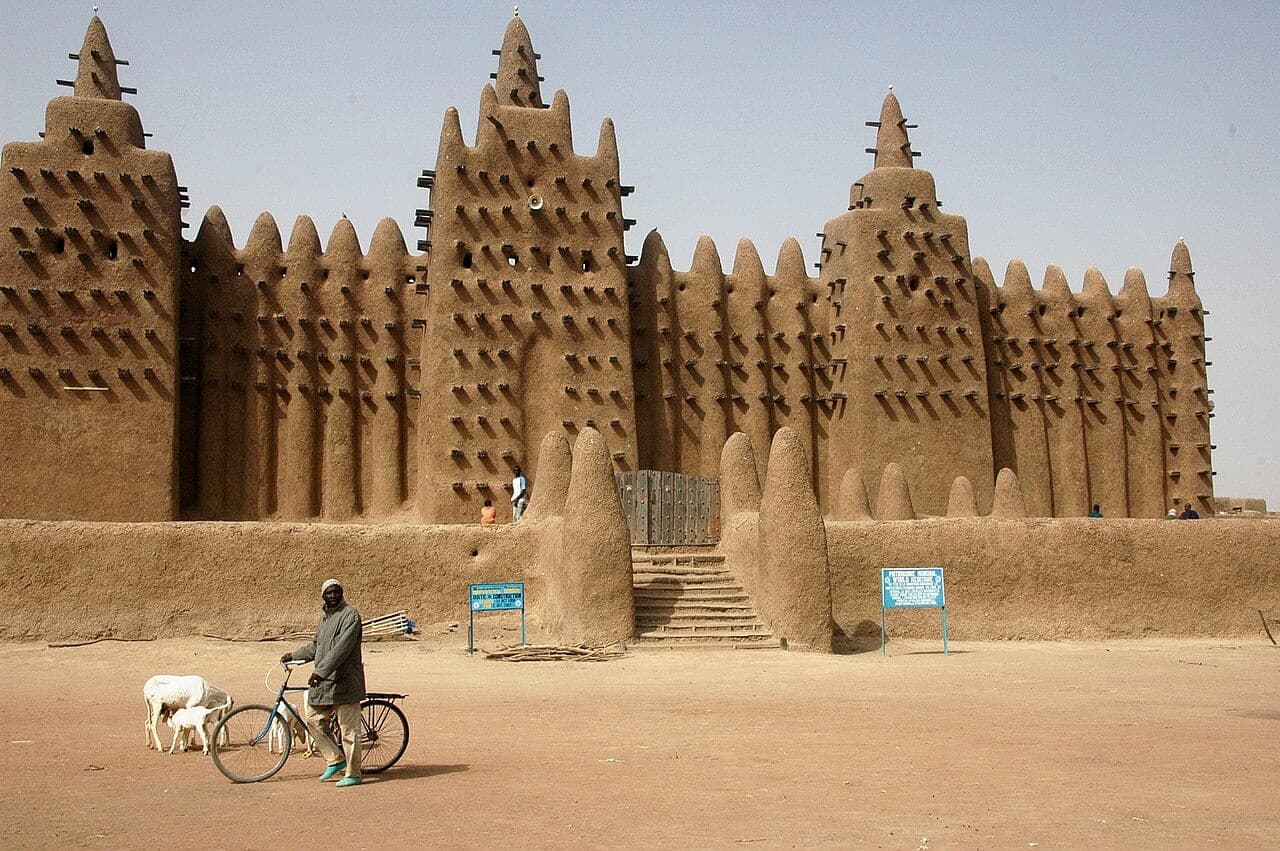
Djenné. Upriver on the Bani, Djenné is one of the oldest known towns in sub-Saharan Africa; the nearby site of Djenné-Djeno was settled well before the Common Era. The living town is famous for the Great Mosque, the largest mud-brick building in the world.
Gao. On the Niger's eastern bend, Gao was the capital of the Songhai Empire and holds the Tomb of Askia, the pyramidal earthen monument raised for Askia Muhammad I at the end of the fifteenth century.
Mopti. Where the Niger and Bani meet, Mopti grew into the river port of the interior, gateway to the Inner Delta and the Dogon country beyond.
The first of the region's great powers was the Ghana Empire, known to its Soninke rulers as Wagadu, which emerged by the eighth or ninth century across what is now southeastern Mauritania, western Mali and eastern Senegal. Its wealth came from brokering between the gold fields of the south and the salt carried by Berber caravans from the north; the eleventh-century geographer al-Bakri described its capital, usually identified with Koumbi Saleh, as two linked towns, one royal and one for Muslim merchants (Britannica).
 Timbuktu, whose libraries held tens of thousands of manuscripts and whose families smuggled them out in rice sacks when the city fell in 2012. Photograph by the UNESCO Bureau of Mali, CC BY-SA 3.0 IGO, via Wikimedia Commons.
The Mali Empire that gave the modern country its name rose in the thirteenth century, when Sundiata Keita united the Mandinka clans after defeating Sumanguru Kanté of Sosso at the Battle of Kirina, traditionally dated to about 1235. The assembly that followed proclaimed the Kurukan Fuga, or Manden Charter, an oral constitution still recited by griots today. Mali's most celebrated ruler, Mansa Musa, reigned from about 1312 to 1337, and his pilgrimage to Mecca in 1324 became legendary: he travelled with a procession numbered in the tens of thousands and gave away so much gold in Cairo that its price is said to have fallen for years afterward (National Geographic). The pilgrimage placed Mali on the maps of the Islamic and European worlds and helped make Timbuktu a centre of learning.
As Mali weakened, the Songhai Empire rose from Gao to become the largest of the three, reaching its peak under Askia Muhammad I (Askia the Great), who made Islam the official faith of the state. The empire fell in 1591, when a Saadian Moroccan army under Judar Pasha crossed the desert and defeated the far larger forces of Askia Ishaq II at the Battle of Tondibi, its firearms deciding the day; Gao was sacked and the unified Sahelian order broke apart (Britannica). For six centuries these empires had governed the trans-Saharan exchange of gold, salt and books, the last making Timbuktu a market for manuscripts as much as for goods.
After the invasion the region fragmented, and in the nineteenth century it was drawn into France's West African empire as the colony of French Sudan. Independence came on 20 June 1960, first within a short-lived Mali Federation with Senegal and then as the Republic of Mali. The decades since have seen one-party rule, democratic opening in the 1990s, and, more recently, insecurity and political upheaval in the north and centre; that instability, noted here only in outline, has at times placed the nation's heritage sites at direct risk.
French, inherited from the colonial period, is Mali's official language and the medium of government and formal education. In daily life the country is multilingual: Bamanankan (Bambara), a Mande language, serves as the lingua franca understood by a large majority, and Mali recognises more than a dozen national languages, among them Fulfulde (Fula), Songhai, Soninke, the several Dogon languages, Senufo, Bozo, and Tamasheq, the Tuareg language, still written in the ancient Tifinagh script of the desert.
The name Mali comes from the Manding heartland of the founding empire. In Mandinka it is generally understood to mean something close to "the place where the king dwells," a sense tied to Manden, the region straddling present-day Mali and Guinea from which Sundiata's confederation grew (Kurukan Fuga, Wikipedia). When French Sudan chose a name for independence in 1960, it reached back past the colonial label to the medieval empire, binding the modern republic to the memory of Mansa Musa.
At the centre of Malian cultural memory is the Epic of Sundiata, the story of the empire's founder, kept alive not on parchment but in the mouths of griots, the hereditary bards and historians known in Mande languages as jeli (plural jeliw). A griot is a genealogist, oral historian, praise-singer and musician at once, entrusted with the lineages and deeds of families and kings.
Music is the most travelled expression of that tradition. The kora, a twenty-one-string harp-lute built from a large calabash covered in cowhide, is the signature griot instrument, and the late Toumani Diabaté, born into a Bamako griot family, brought its solo repertoire to concert halls worldwide and won Grammy recognition for his recordings with the desert-blues guitarist Ali Farka Touré (NPR). Alongside them stand Salif Keita, a descendant of the imperial Keita line, and singers such as Oumou Sangaré. The balafon, a wooden xylophone, carries its own deep history: the Sosso-Bala, an ancestral balafon associated with Sumanguru Kanté and guarded at Niagassola, is honoured as a founding relic of the Mande world.
Malian identity is also worn and eaten. Bogolanfini, the Bamana "mud cloth," is woven in strips by men and then patterned by women using plant dyes and fermented, iron-rich mud from the Niger and Bani riverbeds; each design carries meaning, and the cloth has long marked passages of life from initiation to death. At the table, staples of rice and millet appear as tô, a millet porridge, and tigadèguèna, the peanut sauce known across the region as maafé, often served with capitaine, the prized Nile perch of the river. Green tea, brewed strong and poured in three successive rounds, punctuates every act of hospitality.
The great majority of Malians are Muslim, and the faith arrived early, carried south along the trade routes and adopted by the imperial courts of Mali and Songhai. Malian Islam has historically been shaped by Sufi brotherhoods, chiefly the Tijaniyya and Qadiriyya orders, and by a strong culture of scholarship and of veneration for local saints, whose tombs became places of pilgrimage. Timbuktu's mausoleums of learned men are the most famous expression of this.
Older cosmologies endure alongside Islam, most strikingly among the Dogon of the Bandiagara cliffs. Dogon religion centres on Amma, the creator, and on the Nommo, primordial beings sent to bring order to the world; its astronomy, tied to the star Sirius and marked by the Sigui ceremony held only once every sixty years, has fascinated ethnographers for a century (Cultures of West Africa). Among the Bamana and neighbouring peoples, initiation societies such as the Komo preserve their own ritual knowledge. In much of the country, Islamic practice and inherited belief coexist within the same communities rather than in opposition.
For most Malians, death is met through Islamic funerary custom. The body is washed, wrapped in a plain white shroud, and buried as soon as possible, ideally before the next sunset, laid on its side to face Mecca. The funeral prayer, salat al-janazah, is offered by the gathered community, and burial is followed by three days in which relatives, neighbours and friends visit the bereaved household to give condolences, recite the Quran, and share food. Alms in the name of the dead, and continued prayer at intervals afterward, extend remembrance beyond the grave, and the widow observes the customary period of iddah.
Among the Dogon, the culminating rite of mourning is the dama, a masked ceremony held some time after a death, once the community has gathered the resources for it. Dancers of the awa masking society perform in carved and dyed masks, among them the towering kanaga with its arms raised to sky and earth and the multi-storey sirige, in a series of dances meant to escort the spirit, or nyama, of the deceased safely from the village to the realm of the ancestors and so bring mourning to a close (UNESCO). The dama is at once a farewell, a lifting of danger from the living, and an affirmation of the community's continuity.
Underlying both traditions is the work of oral memory. Where a griot keeps a family's genealogy and a village its founding narrative, remembrance is a spoken inheritance renewed at every naming, marriage and death, and the dead remain present in the recited chain of names that links the living to the ancestors.
Mali's most valuable records were carried out of Timbuktu in rice sacks.
The manuscripts of Timbuktu are not a public collection. They are family libraries, held privately across generations by the scholarly households of the city, and they contain law, astronomy, medicine, poetry, correspondence and, importantly here, genealogies and records of family property and marriage. When armed groups took the north in 2012 and began burning what they found, librarians and families moved several hundred thousand manuscripts out of the city by road and river to Bamako, in trunks, sacks and footlockers, in an evacuation that took months and was kept secret while it was happening. Most survived. Conserving them in a humid southern climate has been the problem ever since.
The griot tradition carries the oral genealogy, as in Senegal and Guinea, and the jeli families are the recognised keepers of lineage.
The written state record is French colonial and thin, split between Bamako and Aix-en-Provence, with civil registration incomplete for much of the twentieth century.
The other Malian archive is the mosque itself. Djenné's great mosque is replastered every year by the whole town, and the guild of masons that leads it holds its knowledge as a family inheritance. The record there is not a document; it is the continuity of the people who know how to rebuild the thing, which is the older and in some ways the more reliable form of preservation.
Mali holds four UNESCO World Heritage Sites, all cultural: the Old Towns of Djenné and Timbuktu, both inscribed in 1988; the Cliff of Bandiagara (Land of the Dogons), a mixed cultural and natural landscape inscribed in 1989; and the Tomb of Askia at Gao, inscribed in 2004. Three of the four have at various points been placed on the List of World Heritage in Danger, reflecting the strain of conflict and environmental pressure on fragile earthen architecture (UNESCO World Heritage Centre).
Timbuktu, whose libraries held tens of thousands of manuscripts and whose families smuggled them out in rice sacks when the city fell in 2012. Photograph by the UNESCO Bureau of Mali, CC BY-SA 3.0 IGO, via Wikimedia Commons.
The Mali Empire that gave the modern country its name rose in the thirteenth century, when Sundiata Keita united the Mandinka clans after defeating Sumanguru Kanté of Sosso at the Battle of Kirina, traditionally dated to about 1235. The assembly that followed proclaimed the Kurukan Fuga, or Manden Charter, an oral constitution still recited by griots today. Mali's most celebrated ruler, Mansa Musa, reigned from about 1312 to 1337, and his pilgrimage to Mecca in 1324 became legendary: he travelled with a procession numbered in the tens of thousands and gave away so much gold in Cairo that its price is said to have fallen for years afterward (National Geographic). The pilgrimage placed Mali on the maps of the Islamic and European worlds and helped make Timbuktu a centre of learning.
As Mali weakened, the Songhai Empire rose from Gao to become the largest of the three, reaching its peak under Askia Muhammad I (Askia the Great), who made Islam the official faith of the state. The empire fell in 1591, when a Saadian Moroccan army under Judar Pasha crossed the desert and defeated the far larger forces of Askia Ishaq II at the Battle of Tondibi, its firearms deciding the day; Gao was sacked and the unified Sahelian order broke apart (Britannica). For six centuries these empires had governed the trans-Saharan exchange of gold, salt and books, the last making Timbuktu a market for manuscripts as much as for goods.
After the invasion the region fragmented, and in the nineteenth century it was drawn into France's West African empire as the colony of French Sudan. Independence came on 20 June 1960, first within a short-lived Mali Federation with Senegal and then as the Republic of Mali. The decades since have seen one-party rule, democratic opening in the 1990s, and, more recently, insecurity and political upheaval in the north and centre; that instability, noted here only in outline, has at times placed the nation's heritage sites at direct risk.
French, inherited from the colonial period, is Mali's official language and the medium of government and formal education. In daily life the country is multilingual: Bamanankan (Bambara), a Mande language, serves as the lingua franca understood by a large majority, and Mali recognises more than a dozen national languages, among them Fulfulde (Fula), Songhai, Soninke, the several Dogon languages, Senufo, Bozo, and Tamasheq, the Tuareg language, still written in the ancient Tifinagh script of the desert.
The name Mali comes from the Manding heartland of the founding empire. In Mandinka it is generally understood to mean something close to "the place where the king dwells," a sense tied to Manden, the region straddling present-day Mali and Guinea from which Sundiata's confederation grew (Kurukan Fuga, Wikipedia). When French Sudan chose a name for independence in 1960, it reached back past the colonial label to the medieval empire, binding the modern republic to the memory of Mansa Musa.
At the centre of Malian cultural memory is the Epic of Sundiata, the story of the empire's founder, kept alive not on parchment but in the mouths of griots, the hereditary bards and historians known in Mande languages as jeli (plural jeliw). A griot is a genealogist, oral historian, praise-singer and musician at once, entrusted with the lineages and deeds of families and kings.
Music is the most travelled expression of that tradition. The kora, a twenty-one-string harp-lute built from a large calabash covered in cowhide, is the signature griot instrument, and the late Toumani Diabaté, born into a Bamako griot family, brought its solo repertoire to concert halls worldwide and won Grammy recognition for his recordings with the desert-blues guitarist Ali Farka Touré (NPR). Alongside them stand Salif Keita, a descendant of the imperial Keita line, and singers such as Oumou Sangaré. The balafon, a wooden xylophone, carries its own deep history: the Sosso-Bala, an ancestral balafon associated with Sumanguru Kanté and guarded at Niagassola, is honoured as a founding relic of the Mande world.
Malian identity is also worn and eaten. Bogolanfini, the Bamana "mud cloth," is woven in strips by men and then patterned by women using plant dyes and fermented, iron-rich mud from the Niger and Bani riverbeds; each design carries meaning, and the cloth has long marked passages of life from initiation to death. At the table, staples of rice and millet appear as tô, a millet porridge, and tigadèguèna, the peanut sauce known across the region as maafé, often served with capitaine, the prized Nile perch of the river. Green tea, brewed strong and poured in three successive rounds, punctuates every act of hospitality.
The great majority of Malians are Muslim, and the faith arrived early, carried south along the trade routes and adopted by the imperial courts of Mali and Songhai. Malian Islam has historically been shaped by Sufi brotherhoods, chiefly the Tijaniyya and Qadiriyya orders, and by a strong culture of scholarship and of veneration for local saints, whose tombs became places of pilgrimage. Timbuktu's mausoleums of learned men are the most famous expression of this.
Older cosmologies endure alongside Islam, most strikingly among the Dogon of the Bandiagara cliffs. Dogon religion centres on Amma, the creator, and on the Nommo, primordial beings sent to bring order to the world; its astronomy, tied to the star Sirius and marked by the Sigui ceremony held only once every sixty years, has fascinated ethnographers for a century (Cultures of West Africa). Among the Bamana and neighbouring peoples, initiation societies such as the Komo preserve their own ritual knowledge. In much of the country, Islamic practice and inherited belief coexist within the same communities rather than in opposition.
For most Malians, death is met through Islamic funerary custom. The body is washed, wrapped in a plain white shroud, and buried as soon as possible, ideally before the next sunset, laid on its side to face Mecca. The funeral prayer, salat al-janazah, is offered by the gathered community, and burial is followed by three days in which relatives, neighbours and friends visit the bereaved household to give condolences, recite the Quran, and share food. Alms in the name of the dead, and continued prayer at intervals afterward, extend remembrance beyond the grave, and the widow observes the customary period of iddah.
Among the Dogon, the culminating rite of mourning is the dama, a masked ceremony held some time after a death, once the community has gathered the resources for it. Dancers of the awa masking society perform in carved and dyed masks, among them the towering kanaga with its arms raised to sky and earth and the multi-storey sirige, in a series of dances meant to escort the spirit, or nyama, of the deceased safely from the village to the realm of the ancestors and so bring mourning to a close (UNESCO). The dama is at once a farewell, a lifting of danger from the living, and an affirmation of the community's continuity.
Underlying both traditions is the work of oral memory. Where a griot keeps a family's genealogy and a village its founding narrative, remembrance is a spoken inheritance renewed at every naming, marriage and death, and the dead remain present in the recited chain of names that links the living to the ancestors.
Mali's most valuable records were carried out of Timbuktu in rice sacks.
The manuscripts of Timbuktu are not a public collection. They are family libraries, held privately across generations by the scholarly households of the city, and they contain law, astronomy, medicine, poetry, correspondence and, importantly here, genealogies and records of family property and marriage. When armed groups took the north in 2012 and began burning what they found, librarians and families moved several hundred thousand manuscripts out of the city by road and river to Bamako, in trunks, sacks and footlockers, in an evacuation that took months and was kept secret while it was happening. Most survived. Conserving them in a humid southern climate has been the problem ever since.
The griot tradition carries the oral genealogy, as in Senegal and Guinea, and the jeli families are the recognised keepers of lineage.
The written state record is French colonial and thin, split between Bamako and Aix-en-Provence, with civil registration incomplete for much of the twentieth century.
The other Malian archive is the mosque itself. Djenné's great mosque is replastered every year by the whole town, and the guild of masons that leads it holds its knowledge as a family inheritance. The record there is not a document; it is the continuity of the people who know how to rebuild the thing, which is the older and in some ways the more reliable form of preservation.
Mali holds four UNESCO World Heritage Sites, all cultural: the Old Towns of Djenné and Timbuktu, both inscribed in 1988; the Cliff of Bandiagara (Land of the Dogons), a mixed cultural and natural landscape inscribed in 1989; and the Tomb of Askia at Gao, inscribed in 2004. Three of the four have at various points been placed on the List of World Heritage in Danger, reflecting the strain of conflict and environmental pressure on fragile earthen architecture (UNESCO World Heritage Centre).
 The Great Mosque of Djenne is replastered by the whole town once a year. The largest mud-brick building in the world survives because thousands of people turn up to smear it with fresh banco. Photograph by Ralf Steinberger, CC BY 2.0, via Wikimedia Commons.
The country's most distinctive conservation practice is not restoration but renewal. The Great Mosque of Djenné, the largest mud-brick building on earth, is replastered in its entirety every year in the crépissage, a communal festival held before the rains in which men climb the projecting toron beams to press fresh banco onto the walls while women and children carry mud and water and the masons of the barey ton guild direct the work (Smarthistory). The mosque survives precisely because the whole town rebuilds it together each year.
Mali's intangible heritage is equally alive on UNESCO's lists, including the Manden Charter, the septennial re-roofing of the Kamablon sacred house at Kangaba, the Sanké mon fishing rite, and the Yaaral and Degal cattle crossings.
Timbuktu's manuscript collections have become a centre of digital preservation. SAVAMA-DCI, the association of Timbuktu libraries that led the physical rescue of the manuscripts, has since partnered with the Hill Museum and Manuscript Library in the United States to photograph and catalogue tens of thousands of the surviving texts, work that also draws on the Tombouctou Manuscripts Project at the University of Cape Town and the British Library's Endangered Archives Programme. In 2020 Google Arts and Culture launched "Mali Magic," bringing thousands of Timbuktu manuscripts, together with digital records of monuments and music, to a global audience. Bamako's celebrated studio photography, the black-and-white portraiture of Seydou Keïta and Malick Sidibé, now circulates through digitised archives worldwide.
Modern Mali exerts an influence out of proportion to its economic weight, above all through music. Malian artists are fixtures of the international stage, from the Grammy-winning collaborations of Toumani Diabaté and Ali Farka Touré to the desert rock of northern groups and the songs of Oumou Sangaré, Amadou and Mariam, and Fatoumata Diawara. The Festival au Désert, once held in the dunes near Timbuktu, drew audiences from around the world before insecurity forced it into exile. Malian cinema carries weight too: Souleymane Cissé's 1987 film Yeelen won acclaim at Cannes, and Abderrahmane Sissako's 2014 film Timbuktu was nominated for an Academy Award. Bamako also hosts the Rencontres de Bamako, the leading biennial of African photography, and a large diaspora across France, West Africa and North America returns these currents, amplified, to home.
The great manuscript rescue. As armed groups occupied northern Mali in 2012, librarians and families led by Abdel Kader Haidara and organised through SAVAMA-DCI moved the endangered manuscripts of Timbuktu south to Bamako, carrying them in rice sacks, on donkey carts, by motorcycle and by boat down the Niger. Hundreds of thousands of documents were brought to safety, and after more than a decade in the capital the collections have begun returning home (PBS NewsHour).
Justice for cultural destruction. In 2016 the International Criminal Court convicted Ahmad al-Faqi al-Mahdi for directing the destruction of Timbuktu's mausoleums and mosque doors, the first ICC case to treat the deliberate wrecking of cultural heritage as a war crime, and ordered reparations to the community (UNESCO).
Timbuktu rebuilt. Working with UNESCO and international partners, local masons reconstructed the fourteen mausoleums destroyed during the occupation using traditional earthen techniques, completing the work in 2015 and restoring the damaged mosques of the World Heritage city.
A griot tradition abroad. Toumani Diabaté carried an instrument and an art older than the Mali Empire into concert halls across the world, proving that the griot's craft could speak to global audiences without ceasing to be itself, and passing the calling to a new generation.
The Great Mosque of Djenne is replastered by the whole town once a year. The largest mud-brick building in the world survives because thousands of people turn up to smear it with fresh banco. Photograph by Ralf Steinberger, CC BY 2.0, via Wikimedia Commons.
The country's most distinctive conservation practice is not restoration but renewal. The Great Mosque of Djenné, the largest mud-brick building on earth, is replastered in its entirety every year in the crépissage, a communal festival held before the rains in which men climb the projecting toron beams to press fresh banco onto the walls while women and children carry mud and water and the masons of the barey ton guild direct the work (Smarthistory). The mosque survives precisely because the whole town rebuilds it together each year.
Mali's intangible heritage is equally alive on UNESCO's lists, including the Manden Charter, the septennial re-roofing of the Kamablon sacred house at Kangaba, the Sanké mon fishing rite, and the Yaaral and Degal cattle crossings.
Timbuktu's manuscript collections have become a centre of digital preservation. SAVAMA-DCI, the association of Timbuktu libraries that led the physical rescue of the manuscripts, has since partnered with the Hill Museum and Manuscript Library in the United States to photograph and catalogue tens of thousands of the surviving texts, work that also draws on the Tombouctou Manuscripts Project at the University of Cape Town and the British Library's Endangered Archives Programme. In 2020 Google Arts and Culture launched "Mali Magic," bringing thousands of Timbuktu manuscripts, together with digital records of monuments and music, to a global audience. Bamako's celebrated studio photography, the black-and-white portraiture of Seydou Keïta and Malick Sidibé, now circulates through digitised archives worldwide.
Modern Mali exerts an influence out of proportion to its economic weight, above all through music. Malian artists are fixtures of the international stage, from the Grammy-winning collaborations of Toumani Diabaté and Ali Farka Touré to the desert rock of northern groups and the songs of Oumou Sangaré, Amadou and Mariam, and Fatoumata Diawara. The Festival au Désert, once held in the dunes near Timbuktu, drew audiences from around the world before insecurity forced it into exile. Malian cinema carries weight too: Souleymane Cissé's 1987 film Yeelen won acclaim at Cannes, and Abderrahmane Sissako's 2014 film Timbuktu was nominated for an Academy Award. Bamako also hosts the Rencontres de Bamako, the leading biennial of African photography, and a large diaspora across France, West Africa and North America returns these currents, amplified, to home.
The great manuscript rescue. As armed groups occupied northern Mali in 2012, librarians and families led by Abdel Kader Haidara and organised through SAVAMA-DCI moved the endangered manuscripts of Timbuktu south to Bamako, carrying them in rice sacks, on donkey carts, by motorcycle and by boat down the Niger. Hundreds of thousands of documents were brought to safety, and after more than a decade in the capital the collections have begun returning home (PBS NewsHour).
Justice for cultural destruction. In 2016 the International Criminal Court convicted Ahmad al-Faqi al-Mahdi for directing the destruction of Timbuktu's mausoleums and mosque doors, the first ICC case to treat the deliberate wrecking of cultural heritage as a war crime, and ordered reparations to the community (UNESCO).
Timbuktu rebuilt. Working with UNESCO and international partners, local masons reconstructed the fourteen mausoleums destroyed during the occupation using traditional earthen techniques, completing the work in 2015 and restoring the damaged mosques of the World Heritage city.
A griot tradition abroad. Toumani Diabaté carried an instrument and an art older than the Mali Empire into concert halls across the world, proving that the griot's craft could speak to global audiences without ceasing to be itself, and passing the calling to a new generation.
National Overview
Notable Cities
Historical Foundations
Linguistic and Etymological Roots
Cultural Identity
Religion and Spirituality
Remembrance and Mourning Traditions
Tracing a Family in Mali
Heritage Preservation Efforts
Digital Heritage
Contemporary Cultural Influences
Success Stories
References and resources
- UNESCO World Heritage Centre, Mali: the four World Heritage sites and their status.
- UNESCO World Heritage Centre, Timbuktu: the mosques, mausoleums and manuscript city.
- UNESCO World Heritage Centre, Cliff of Bandiagara (Land of the Dogons): the escarpment, Dogon architecture and the dama.
- UNESCO World Heritage Centre, Tomb of Askia: the Songhai monument at Gao.
- UNESCO Intangible Cultural Heritage, Mali: the Manden Charter, Kamablon and Sanké mon.
- Encyclopaedia Britannica, Mali: geography, peoples and history.
- Encyclopaedia Britannica, Songhai Empire: the empire of Gao and its fall.
- National Geographic, The Mali Empire: Sundiata, Mansa Musa and the gold trade.
- Smarthistory, Great Mosque of Djenné: the mud-brick mosque and the crépissage.
- PBS NewsHour, Timbuktu's manuscripts return home: the rescue and return of the manuscripts.