Heritage · Country
Mauritania Culture and Heritage
In the desert towns of Chinguetti and Ouadane, family libraries still guard manuscripts copied on gazelle skin a thousand years ago, while the tidal flats of the Banc d'Arguin shelter millions of migrating birds each winter. This is a guide to Mauritania's caravan cities, its Moorish and Afro-Mauritanian peoples, and the customs that carry memory across the Sahara.Written to last.
By Confinity Heritage Editorial · Updated 2026-07-31 · 8-minute readQuiet tools, kept out of the way.
Mauritania lies where the Arab Maghreb meets Black Africa and where the Sahara runs down to the Atlantic. For a thousand years its desert towns were staging posts on the caravan routes that carried gold, salt, dates and books between the Mediterranean world and the empires of the Sahel. In the fortified towns of Ouadane, Chinguetti, Tichitt and Oualata, families still keep libraries of handwritten manuscripts, some copied on gazelle skin, that preserve centuries of Islamic law, astronomy, poetry and grammar (Al Jazeera). Off the coast, the shallow tidal flats of the Banc d'Arguin gather millions of migrating birds each winter, one of the largest concentrations of wading birds anywhere (UNESCO).
This is a country that has kept its memory in fragile materials: in parchment guarded against sand and heat, in oral genealogies recited across generations, in the songs of hereditary musicians, and in the mud-brick walls of caravan cities that the dunes are slowly reclaiming. Its people include the Moors, both the Bidhan and the Haratin, and the Afro-Mauritanian communities of the southern river country, the Halpulaar, the Soninke and the Wolof. Their shared inheritance also carries a difficult past, including a long practice of hereditary slavery whose legacy endures, which this guide sets out plainly.
The Islamic Republic of Mauritania covers about 1,030,000 square kilometres of north-west Africa, bordered by Western Sahara to the north-west, Algeria to the north-east, Mali to the east and south-east, and Senegal to the south-west, where the Senegal River forms the frontier (Britannica). It is home to roughly 4.9 million people, most of them in the capital, Nouakchott, and along the southern river valley. More than three-quarters of the territory is desert or semi-desert, and the sandstone plateaus of the Adrar and the Tagant rise from the plains, cut by palm-filled oases and caravan towns.
Mauritania is a bridge between two worlds. Among the Moors of the north, life and language belong to the Arab-Berber Sahara; to the south, along the farmland strip called the Chemama, live the Afro-Mauritanian peoples whose ties reach into Senegal and Mali. Islam is the religion of essentially the whole population and gives the state its name. Arabic is the national language, the ouguiya the currency, and the modern economy rests on iron ore from the north, on one of the world's most productive fishing grounds, and lately on offshore gas. Two sites carry UNESCO World Heritage status: the desert ksour and the Banc d'Arguin.
Nouakchott. Little more than a coastal village when it was chosen as capital at independence in 1960, Nouakchott was built almost from nothing to govern the new republic (Britannica). It has since grown to roughly a million people, swollen by the droughts of the 1970s and 1980s that drove nomads off the land, and holds the National Museum with its archaeological and ethnographic collections, the central market, and the harbours where the Atlantic fishing boats come in.
Nouadhibou. The second city sits on a peninsula in the far north-west, shared with Western Sahara. It is the country's main port, the terminus of the iron-ore railway that runs some 700 kilometres from the mines at Zouérat, and a centre of the fishing industry.
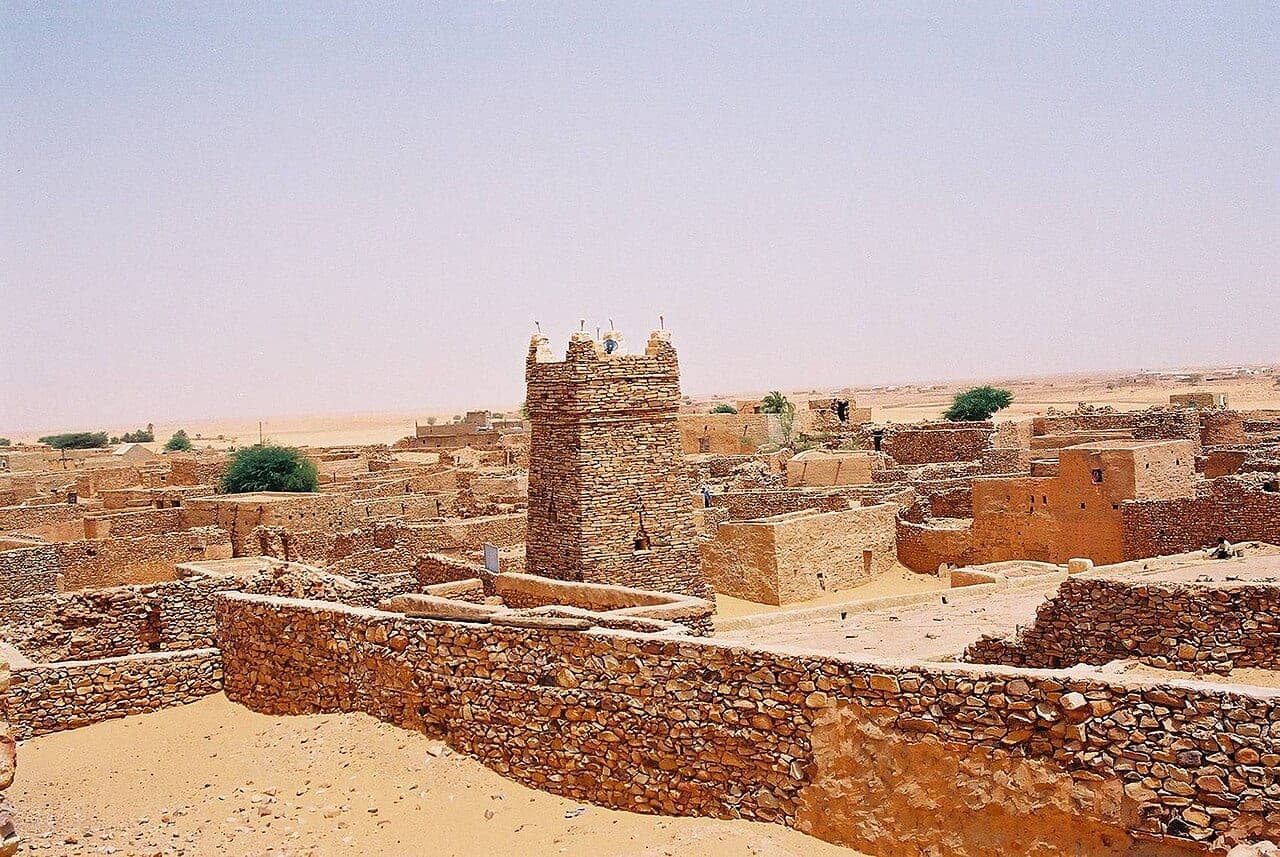
Chinguetti. Founded as a caravan centre in the medieval period, Chinguetti became one of the principal seats of learning in the western Sahara and is remembered in Mauritanian tradition as a holy city of Islam (Wikipedia). Its old quarter, with a stone Friday mosque whose square minaret is among the oldest still in use in the region, holds the family libraries for which the town is famous, and sand has buried parts of it as residents abandon houses to the dunes.
Atar. The main town of the Adrar plateau and the usual gateway to the desert interior, Atar has an old quarter, a historic mosque and a market, and serves as the base for journeys to Chinguetti, Ouadane and the Guelb er Richat, a vast circular formation in the desert to the east, visible from orbit.
The Sahara was not always desert. When it was open grassland during the wetter Holocene, herders and farmers settled along the escarpment of Dhar Tichitt in the south, building drystone villages from about 2000 BC (Wikipedia). With stone enclosures, funerary monuments and fields of pearl millet, these are among the oldest stone-built towns in West Africa, built by peoples thought ancestral to the Soninke and possibly to the region's first great state.
That state was the Ghana Empire, known to its people as Wagadu, whose heartland lay partly in what is now south-eastern Mauritania. From roughly the eighth century its Soninke rulers grew wealthy by taxing the trans-Saharan trade, exchanging West African gold for Saharan salt at desert markets such as Awdaghust and at the capital identified with the ruins of Koumbi Saleh. The Sanhaja Berbers of the western Sahara, camel-herding nomads, held the northern end of these routes, and Islam travelled them with the merchants before it came with armies (Britannica).
In the eleventh century a reform movement took shape among the Sanhaja under the teacher Abdallah ibn Yasin, whose followers, the Almoravids, spread a strict Sunni Islam by force of arms from the western Sahara, founding Marrakesh in 1062, crossing into Spain by 1086, and pressing south against the declining Ghana Empire (Britannica). They left Sunni Islam of the Maliki school as the enduring faith of the region.
The desert towns reached their height in the centuries that followed. The ksour of Ouadane, Chinguetti, Tichitt and Oualata developed between the twelfth and sixteenth centuries to serve the caravan route along the western edge of the Sahara, growing into centres of trade and Islamic culture (UNESCO). Each gathered around a mosque with a square stone minaret, its dry-stone houses crowded along narrow lanes within a wall, and its scholars taught law, theology, grammar, mathematics and astronomy while building the manuscript collections that gave Chinguetti its later name, the Sorbonne of the Sahara.
From the thirteenth century, Arab groups known as the Beni Hassan migrated into the region and gradually gained the upper hand, a shift settled by the Char Bouba war of 1644–1674. Afterwards the Hassani warrior tribes held power, the Zawaya tribes served as religious scholars, and the Arabic dialect called Hassaniya became the common Moorish tongue (Britannica). By the eighteenth century the country was organised into emirates, among them Trarza, Brakna, Tagant and Adrar. Society in this period rested in part on hereditary slavery: enslaved people and their descendants, most of Black African origin and known as Haratin when freed, formed a subordinate class within Moorish society, and a trade in enslaved people ran alongside that in gold and salt.
France extended its control from the south in the early twentieth century, drawing the emirates into a colony that became part of French West Africa (Wikipedia). Mauritania became independent on 28 November 1960 under Moktar Ould Daddah, its first president, who chose Nouakchott as the site of a new capital. The legacy of slavery outlasted independence: French decrees, the 1961 constitution and a formal decree in 1981 each declared the practice ended, and Mauritania is often called the last country to abolish slavery in law, with a further law in 2007 making it a crime (Britannica). In practice, hereditary servitude and its effects have proved hard to remove, and Mauritanian activists, many of them Haratin, continue to press for genuine emancipation. The subject remains among the most serious in the country's public life.
The name Mauritania comes from the ancient kingdom of Mauretania, which Greek and Roman writers named after the Mauri, the Berbers they called Moors; that classical kingdom lay far to the north, in what is now Morocco and Algeria, and France applied the name to a territory the ancients never governed (Wikipedia).
Arabic is the official language, and the everyday speech of the Moors is Hassaniya, an Arabic dialect carrying Berber vocabulary that spread with the Beni Hassan. Alongside it, the country recognises as national languages the tongues of the Afro-Mauritanian south: Pulaar, the speech of the Halpulaar; Soninke, the language of the descendants of the Ghana Empire; and Wolof. French, from the colonial period, is still widely used in administration, business and education, and the balance among these languages has at times been politically charged.
The clearest emblem of Mauritanian culture is the manuscript. In the family libraries of Chinguetti and Ouadane, thousands of handwritten works survive, on law, Qur'anic science, medicine, astronomy and poetry, the oldest reaching back around a thousand years, preserved by dry desert air and hereditary custodians (Al Jazeera).
Moorish music is a court and desert art carried by the iggawen, a caste of hereditary musicians who preserved genealogy, history and praise poetry (Wikipedia). Its central instruments are the tidinit, a four-stringed lute played by men, and the ardin, a harp played by women, often joined by the tbal drum (Wikipedia). It is organised into modes and into three "ways", the white, the black and the spotted, through which a performance moves.
Nomadic life shaped the material culture of the Moors. The khaima, the tent of woven wool or hair, was the mobile home of the desert, and the camel the measure of wealth and the means of trade. Even as most Mauritanians have settled, the tent remains a sign of hospitality. At the table, hospitality centres on green tea brewed strong and poured in three rounds, on camel and goat milk sometimes sweetened as the drink called zrig, and on dishes such as thieboudienne, the fish and rice dish of the coast and river south, and mechoui, whole roast lamb served at feasts.
Almost every Mauritanian is a Sunni Muslim of the Maliki school, and Islam frames law, learning and daily life. Religious life has long been coloured by Sufism, and two brotherhoods are especially strong: the Qadiriyya, the older order associated with Islamic learning, and the Tijaniyya, a missionary order widespread across West Africa (Britannica). Their lodges and lineages crossed tribal lines and helped knit a shared religious identity.
The scholarly tradition of the Zawaya tribes built a distinctive religious culture around the mahadra, the desert school in which a teacher instructs students in the Qur'an, law and the Arabic sciences, often in a tent or a simple compound. Some still active, these schools trained generations of scholars and copyists and sustained the manuscript libraries, giving Mauritania its name as a land of a million poets and scholars.
Mauritanian funerals follow Islamic practice, plainly and without delay. The body is washed by relatives of the same sex, wrapped in a plain white shroud, and prayed over in the funeral prayer, the salat al-janazah, before burial on the day of death or the day after. The dead are laid facing Mecca in a simple grave, marked without ostentation in keeping with a tradition that discourages elaborate tombs. Mourning is communal: the family receives condolences over several days, neighbours provide food to the bereaved household, and the Qur'an is recited for the departed.
Beyond the funeral, Mauritanian remembrance carries an unusual written and genealogical depth. Families preserve the nasab, the recorded chain of descent, and can often recite ancestry across many generations, while scholarly lineages guard the manuscripts, teaching licences and correspondence of their forebears as both spiritual and family inheritance. To keep a grandfather's copied Qur'an safe against the sand is here an act of remembrance as much as of scholarship. Charity in the name of the dead, and prayers at the graveside on the mornings of the two Eids, complete a pattern of memory that binds the living to their ancestors.
Mauritanian family records are held in family libraries in the desert, and the most consequential recent record is about who was owned by whom.
Chinguetti, Ouadane, Tichitt and Oualata, the four ksour inscribed by UNESCO, were caravan towns and centres of Islamic learning, and their manuscript collections are privately owned by the families that assembled them. Those libraries hold law, grammar, astronomy and correspondence, and they hold genealogies: the zawaya scholarly lineages and the shurfa families claiming descent from the Prophet documented themselves carefully because status depended on it. Conservation is difficult, funding is scarce, and the towns are being encroached on by sand.
Hassaniya Arabic society is stratified by descent, into warrior, scholarly, tributary and enslaved categories, and the categories were inherited.
That is the recent record's subject. Mauritania abolished slavery in 1981, the last country in the world to do so, and criminalised it only in 2007. The Haratine, descendants of enslaved people, are a large part of the population, and establishing their status, their land and their civil documentation has been the work of anti-slavery organisations whose leaders have been repeatedly imprisoned.
The other absence is 1989 to 1991, when tens of thousands of black Mauritanians, Pulaar, Soninke and Wolof, were expelled to Senegal and Mali and stripped of documents. Many returned after 2007 and had to prove a nationality the state had taken from them.
Mauritania's two World Heritage sites protect very different inheritances. The Ancient Ksour of Ouadane, Chinguetti, Tichitt and Oualata were inscribed in 1996 as surviving examples of the caravan towns that carried Saharan trade and Islamic learning (UNESCO). The Banc d'Arguin National Park, established in 1976 and inscribed in 1989, protects a stretch of coast and shallow water that is one of the world's most important wintering grounds for migratory shorebirds, sheltering more than two million birds and supporting the traditional Imraguen fishing communities of the shore (UNESCO).
 Chinguetti's manuscripts are held by families rather than by a state institution, in a town the desert is steadily burying. Photograph by Ondrej Havelka, CC BY-SA 4.0, via Wikimedia Commons.
Both sites face real threats. The desert towns are pressed by advancing sand, by the drift of population to the cities, and by the fragility of their earthen buildings, while the manuscript libraries suffer from heat, flash-flood humidity, and the difficulty of caring for old paper in a poor, remote region (UNESCO). The National Foundation for the Safeguarding of the Ancient Cities, created in the 1990s, works to conserve the built fabric of the ksour, while the Mauritanian Institute for Scientific Research and the National Museum in Nouakchott hold and study manuscripts and antiquities. In 2024 UNESCO supported thirteen family libraries with equipment and storage to help custodians protect some six thousand documents against the climate.
Digitisation has become central to the survival of these fragile, remote collections. The OMAR database, built with the German universities of Freiburg and Tübingen, has made more than two thousand five hundred Mauritanian Arabic manuscripts, well over a hundred thousand pages in all, available in digital form, scanned from microfilm whose originals are held at the Mauritanian Institute for Scientific Research (University of Illinois). The British Library's Endangered Archives Programme has funded projects to photograph private collections before they are lost, and the Hill Museum and Manuscript Library has imaged family holdings with Mauritanian partners and made catalogues available to scholars far from the desert (HMML). This work opens a body of West African Islamic scholarship long known only to the families who kept it.
Mauritanian culture reaches beyond the country through its music and its cinema. Singers rooted in the iggawen tradition, among them Noura Mint Seymali and Malouma, have brought Moorish music to international stages while drawing on the ardin and the old modes, and the late Dimi Mint Abba remains the country's best-known voice abroad. The film-maker Abderrahmane Sissako, raised in Mauritania and Mali, has carried the moral world of the Sahara into international cinema.
Within the country, heritage and identity remain contested. The relationship between the Arab-Berber north and the Afro-Mauritanian south, the question of language, and above all the legacy of slavery are debated in politics, activism and the arts, where writers and campaigners increasingly treat that legacy, and the memory of those it harmed, as material for public reckoning rather than silence.
The desert libraries endure. Against sand, heat and poverty, families in Chinguetti and Ouadane have kept manuscript collections intact for centuries, and recent UNESCO support has equipped thirteen libraries to protect thousands of documents (UNESCO).
A body of scholarship goes online. The OMAR project has digitised more than two thousand five hundred Mauritanian manuscripts, opening a major archive of West African Islamic learning to researchers everywhere (University of Illinois).
A bird sanctuary of global importance is protected. The Banc d'Arguin shelters more than two million migrating birds each year and sustains the Imraguen fishing communities, protected as a national park since 1976 and a World Heritage site since 1989 (UNESCO).
Mauritanian cinema reaches the world. Abderrahmane Sissako's Timbuktu carried a Mauritanian voice into world cinema and earned an Academy Award nomination.
Chinguetti's manuscripts are held by families rather than by a state institution, in a town the desert is steadily burying. Photograph by Ondrej Havelka, CC BY-SA 4.0, via Wikimedia Commons.
Both sites face real threats. The desert towns are pressed by advancing sand, by the drift of population to the cities, and by the fragility of their earthen buildings, while the manuscript libraries suffer from heat, flash-flood humidity, and the difficulty of caring for old paper in a poor, remote region (UNESCO). The National Foundation for the Safeguarding of the Ancient Cities, created in the 1990s, works to conserve the built fabric of the ksour, while the Mauritanian Institute for Scientific Research and the National Museum in Nouakchott hold and study manuscripts and antiquities. In 2024 UNESCO supported thirteen family libraries with equipment and storage to help custodians protect some six thousand documents against the climate.
Digitisation has become central to the survival of these fragile, remote collections. The OMAR database, built with the German universities of Freiburg and Tübingen, has made more than two thousand five hundred Mauritanian Arabic manuscripts, well over a hundred thousand pages in all, available in digital form, scanned from microfilm whose originals are held at the Mauritanian Institute for Scientific Research (University of Illinois). The British Library's Endangered Archives Programme has funded projects to photograph private collections before they are lost, and the Hill Museum and Manuscript Library has imaged family holdings with Mauritanian partners and made catalogues available to scholars far from the desert (HMML). This work opens a body of West African Islamic scholarship long known only to the families who kept it.
Mauritanian culture reaches beyond the country through its music and its cinema. Singers rooted in the iggawen tradition, among them Noura Mint Seymali and Malouma, have brought Moorish music to international stages while drawing on the ardin and the old modes, and the late Dimi Mint Abba remains the country's best-known voice abroad. The film-maker Abderrahmane Sissako, raised in Mauritania and Mali, has carried the moral world of the Sahara into international cinema.
Within the country, heritage and identity remain contested. The relationship between the Arab-Berber north and the Afro-Mauritanian south, the question of language, and above all the legacy of slavery are debated in politics, activism and the arts, where writers and campaigners increasingly treat that legacy, and the memory of those it harmed, as material for public reckoning rather than silence.
The desert libraries endure. Against sand, heat and poverty, families in Chinguetti and Ouadane have kept manuscript collections intact for centuries, and recent UNESCO support has equipped thirteen libraries to protect thousands of documents (UNESCO).
A body of scholarship goes online. The OMAR project has digitised more than two thousand five hundred Mauritanian manuscripts, opening a major archive of West African Islamic learning to researchers everywhere (University of Illinois).
A bird sanctuary of global importance is protected. The Banc d'Arguin shelters more than two million migrating birds each year and sustains the Imraguen fishing communities, protected as a national park since 1976 and a World Heritage site since 1989 (UNESCO).
Mauritanian cinema reaches the world. Abderrahmane Sissako's Timbuktu carried a Mauritanian voice into world cinema and earned an Academy Award nomination.
National Overview
Notable Cities
Historical Foundations
Linguistic and Etymological Roots
Cultural Identity
Religion and Spirituality
Remembrance and Mourning Traditions
Tracing a Family in Mauritania
Heritage Preservation Efforts
Digital Heritage
Contemporary Cultural Influences
Success Stories
References and resources
- Encyclopaedia Britannica: Mauritania
- Encyclopaedia Britannica: Mauritania, History
- UNESCO World Heritage Centre: Ancient Ksour of Ouadane, Chinguetti, Tichitt and Oualata
- UNESCO World Heritage Centre: Banc d'Arguin National Park
- UNESCO: Safeguarding and Enhancing the Protection of the Desert Libraries of Mauritania
- Al Jazeera: The man guarding Mauritania's rare Islamic books
- Wikipedia: Chinguetti
- Wikipedia: Dhar Tichitt
- Wikipedia: Music of Mauritania
- Wikipedia: Ardin (harp)
- Wikipedia: Moktar Ould Daddah
- Wikipedia: Mauretania
- Hill Museum and Manuscript Library: Mauritania
- University of Illinois Library: West African Arabic Manuscripts