Heritage · University
The University of Sankoré — a library kept by families
At Timbuktu's Sankoré Madrasah, scholarship was a family trade and books were heirlooms. When war came in 2012, the descendants of those scholarly families smuggled hundreds of thousands of manuscripts to safety — one of the great memory rescues of modern times.Written to last.
By Confinity Heritage Editorial · 2026-07-10 · 8-minute readQuiet tools, kept out of the way.
In much of the world, Timbuktu is a synonym for nowhere, the far edge of the map. This is one of history's better jokes, because for centuries Timbuktu was precisely the opposite: a crossroads city on the southern rim of the Sahara where the camel caravans met the Niger River, and where the most valuable cargo, by some contemporary accounts, was neither gold nor salt but books. At the centre of that world stood the Sankoré mosque and the constellation of scholars around it, remembered today as the University of Sankoré, and behind it, in hundreds of private houses, the libraries that families would keep, hide, and hand down for five hundred years.
The Sankoré mosque was founded in the fourteenth century, its endowment credited by tradition to a wealthy Mandinka woman of the city. Timbuktu was then rising within the Mali Empire, and the emperor Mansa Musa, whose gold-laden pilgrimage to Mecca in 1324 carried his name far beyond Africa, patronised the city's mosques and brought scholars and architects home with him. Sankoré grew into one of three great teaching mosques, alongside Djinguereber and Sidi Yahia, that together anchored the city's intellectual life. In the sixteenth century the qadi al-Aqib ibn Mahmud rebuilt Sankoré's sanctuary, giving its courtyard, tradition holds, the dimensions of the Kaaba itself.
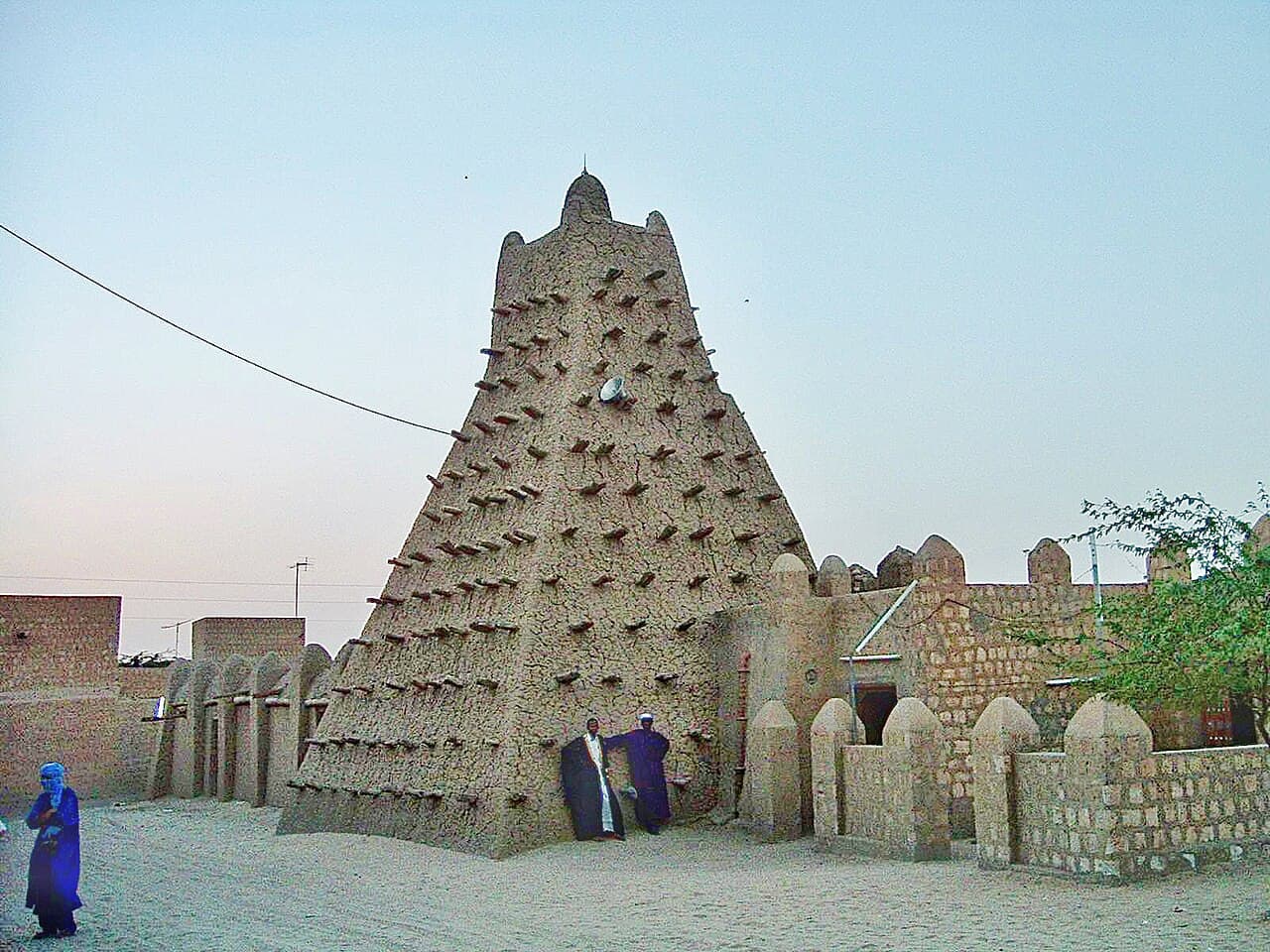
 Sankore is a mosque, and the university was the scholars who taught in and around it. There was no campus to photograph then and there is none now. Photograph by Anne and David, public domain, via Wikimedia Commons.
Calling Sankoré a university is both apt and misleading. It had no campus and no central administration, and it awarded nothing a European would have recognised as a degree. Learning worked through chains of personal transmission: a student sat with a master, often in the mosque, often in the master's own courtyard, worked through the classical curriculum of Qur'anic sciences, law, grammar, rhetoric, logic, astronomy, and medicine, and received an ijazah, a licence naming the teachers through whom the knowledge had passed. Scholarship was, quite literally, genealogical. It ran in families, was recorded as lineage, and was inseparable from the family libraries that supported it.
The city's golden age came in the fifteenth and sixteenth centuries under the Songhai Empire, above all during the reign of Askia Muhammad, when Timbuktu's scholarly population numbered, by some estimates, in the thousands and drew students and books from across the Sahara and beyond. The traveller Leo Africanus, visiting around 1510, reported manuscripts among the most profitable goods in the city's markets. Timbuktu's greatest scholar, Ahmad Baba al-Timbukti, born in 1556, wrote dozens of works that are still studied. His fate also marks the turn of the tide: after Moroccan forces broke Songhai power at the Battle of Tondibi in 1591, Ahmad Baba was deported to Marrakesh, his library confiscated and scattered. The city's political importance faded. Its books went indoors.
What survived the empires was the household library. Across Timbuktu and the wider Niger bend, manuscripts, works of law and theology, treatises on astronomy and mathematics, medical formularies, poetry, correspondence, contracts, and market records, written mostly in Arabic and also in African languages in Arabic script, were kept as family property and family duty. Estimates of the region's holdings run to several hundred thousand manuscripts. Some libraries carry their lineages in their names: the Mamma Haidara Memorial Library, the Fondo Kati with its roots among refugees from al-Andalus, the Al-Wangari and Imam Essayouti collections. Through drought, conquest, and colonial-era collecting, families protected their books the way families protect anything precious and portable, in wooden chests, in back rooms, walled up, buried, dispersed among relatives, and above all not talked about.
The modern world slowly took notice. Mali's state manuscript centre, the Ahmed Baba Institute, was founded in 1973 to collect and conserve manuscripts, and in 1988 UNESCO inscribed Timbuktu, the three great mosques, including Sankoré, and sixteen mausoleums of the city's saints, on the World Heritage List. Scholars began cataloguing what the families held, and the libraries opened cautiously to researchers. Then, in 2012, the oldest instinct of the manuscript families, hide the books, became a matter of life and death.
In the spring of 2012, armed Islamist groups seized northern Mali and occupied Timbuktu. UNESCO moved the city onto the List of World Heritage in Danger that June. The occupiers, enforcing their own reading of Islam, took pickaxes to the city's heritage: fourteen of the sixteen inscribed mausoleums were destroyed. The manuscripts, hundreds of thousands of pages of exactly the pluralist, scholarly Islam the occupiers rejected, were an obvious target.
What followed was a rescue organised largely by the families themselves. Abdel Kader Haidara, heir to the Mamma Haidara library and founder, in 1996, of SAVAMA-DCI, an association of Timbuktu's family libraries, coordinated a clandestine evacuation with the city's other librarians and hundreds of helpers. Manuscripts were packed by night into metal footlockers, moved house to house, then smuggled out of the occupied city by donkey cart and four-wheel drive, and down the Niger River by boat, past checkpoints manned by militants and, further south, nervous government soldiers. Couriers carried them a few trunks at a time to Bamako, Mali's capital, where families and volunteers stored them in spare rooms across the city. Funding came quietly from international foundations and donors. By the time French and Malian forces retook Timbuktu in January 2013, the great majority of the city's manuscripts, a figure commonly put at around 350,000, had been carried to safety. Retreating fighters burned what they found at the Ahmed Baba Institute: 4,203 manuscripts were lost there, a grievous but astonishingly small fraction of the whole.
Accountability followed, imperfectly but historically. In September 2016 the International Criminal Court convicted Ahmad al-Faqi al-Mahdi for directing the attacks on Timbuktu's mausoleums and mosques, the court's first case treating the destruction of cultural heritage as a war crime in its own right. The mausoleums themselves were rebuilt by local masons using traditional techniques, and consecrated anew in 2015.
The rescue saved the manuscripts; it did not end their danger. Most remain in exile in Bamako, where the humid climate of the south is far harsher on paper and leather than the desert air they were made for, and where conservation depends on grant cycles rather than guarantees. Northern Mali remains insecure, and Timbuktu remains on the World Heritage in Danger list; the conditions for a full homecoming do not yet exist. The keepers themselves are ageing, and the transmission of responsibility to a generation scattered by conflict is not automatic. And the oldest risk never went away: a family library survives only as long as some member of the family decides, again, that it must.
The answer has been to copy as well as to conserve. Since 2013, SAVAMA-DCI and the Hill Museum & Manuscript Library have run digitisation studios in Bamako staffed by trained Malian technicians; the project has produced millions of images representing roughly 300,000 manuscripts, with catalogues opening online to scholars everywhere. In 2022, a collaboration with Google Arts and Culture placed tens of thousands of pages from the Mamma Haidara library online for the public. Other efforts, the Tombouctou Manuscripts Project at the University of Cape Town, conservation training, and archival-quality boxing of the physical volumes, proceed alongside. The books that were once hidden from the world are now, deliberately, being multiplied into it, so that no single fire, flood, or war can ever again threaten the whole.
Sankoré's story is the purest case on record of family memory as infrastructure. No state kept Timbuktu's learning safe across five centuries, states, mostly, were the hazard. What kept it was the household: the chest in the back room, the inherited duty, the name on the ijazah linking a grandchild to a grandparent's teacher. And when catastrophe came, it was those same families who carried hundreds of thousands of manuscripts down the river in trunks. Confinity is built on the belief the librarians of Timbuktu proved in 2012: that a family which treats its memory as an inheritance, tended and handed on, can carry it through anything, and that the wise keeper makes copies before the smoke is on the horizon.
Sankore is a mosque, and the university was the scholars who taught in and around it. There was no campus to photograph then and there is none now. Photograph by Anne and David, public domain, via Wikimedia Commons.
Calling Sankoré a university is both apt and misleading. It had no campus and no central administration, and it awarded nothing a European would have recognised as a degree. Learning worked through chains of personal transmission: a student sat with a master, often in the mosque, often in the master's own courtyard, worked through the classical curriculum of Qur'anic sciences, law, grammar, rhetoric, logic, astronomy, and medicine, and received an ijazah, a licence naming the teachers through whom the knowledge had passed. Scholarship was, quite literally, genealogical. It ran in families, was recorded as lineage, and was inseparable from the family libraries that supported it.
The city's golden age came in the fifteenth and sixteenth centuries under the Songhai Empire, above all during the reign of Askia Muhammad, when Timbuktu's scholarly population numbered, by some estimates, in the thousands and drew students and books from across the Sahara and beyond. The traveller Leo Africanus, visiting around 1510, reported manuscripts among the most profitable goods in the city's markets. Timbuktu's greatest scholar, Ahmad Baba al-Timbukti, born in 1556, wrote dozens of works that are still studied. His fate also marks the turn of the tide: after Moroccan forces broke Songhai power at the Battle of Tondibi in 1591, Ahmad Baba was deported to Marrakesh, his library confiscated and scattered. The city's political importance faded. Its books went indoors.
What survived the empires was the household library. Across Timbuktu and the wider Niger bend, manuscripts, works of law and theology, treatises on astronomy and mathematics, medical formularies, poetry, correspondence, contracts, and market records, written mostly in Arabic and also in African languages in Arabic script, were kept as family property and family duty. Estimates of the region's holdings run to several hundred thousand manuscripts. Some libraries carry their lineages in their names: the Mamma Haidara Memorial Library, the Fondo Kati with its roots among refugees from al-Andalus, the Al-Wangari and Imam Essayouti collections. Through drought, conquest, and colonial-era collecting, families protected their books the way families protect anything precious and portable, in wooden chests, in back rooms, walled up, buried, dispersed among relatives, and above all not talked about.
The modern world slowly took notice. Mali's state manuscript centre, the Ahmed Baba Institute, was founded in 1973 to collect and conserve manuscripts, and in 1988 UNESCO inscribed Timbuktu, the three great mosques, including Sankoré, and sixteen mausoleums of the city's saints, on the World Heritage List. Scholars began cataloguing what the families held, and the libraries opened cautiously to researchers. Then, in 2012, the oldest instinct of the manuscript families, hide the books, became a matter of life and death.
In the spring of 2012, armed Islamist groups seized northern Mali and occupied Timbuktu. UNESCO moved the city onto the List of World Heritage in Danger that June. The occupiers, enforcing their own reading of Islam, took pickaxes to the city's heritage: fourteen of the sixteen inscribed mausoleums were destroyed. The manuscripts, hundreds of thousands of pages of exactly the pluralist, scholarly Islam the occupiers rejected, were an obvious target.
What followed was a rescue organised largely by the families themselves. Abdel Kader Haidara, heir to the Mamma Haidara library and founder, in 1996, of SAVAMA-DCI, an association of Timbuktu's family libraries, coordinated a clandestine evacuation with the city's other librarians and hundreds of helpers. Manuscripts were packed by night into metal footlockers, moved house to house, then smuggled out of the occupied city by donkey cart and four-wheel drive, and down the Niger River by boat, past checkpoints manned by militants and, further south, nervous government soldiers. Couriers carried them a few trunks at a time to Bamako, Mali's capital, where families and volunteers stored them in spare rooms across the city. Funding came quietly from international foundations and donors. By the time French and Malian forces retook Timbuktu in January 2013, the great majority of the city's manuscripts, a figure commonly put at around 350,000, had been carried to safety. Retreating fighters burned what they found at the Ahmed Baba Institute: 4,203 manuscripts were lost there, a grievous but astonishingly small fraction of the whole.
Accountability followed, imperfectly but historically. In September 2016 the International Criminal Court convicted Ahmad al-Faqi al-Mahdi for directing the attacks on Timbuktu's mausoleums and mosques, the court's first case treating the destruction of cultural heritage as a war crime in its own right. The mausoleums themselves were rebuilt by local masons using traditional techniques, and consecrated anew in 2015.
The rescue saved the manuscripts; it did not end their danger. Most remain in exile in Bamako, where the humid climate of the south is far harsher on paper and leather than the desert air they were made for, and where conservation depends on grant cycles rather than guarantees. Northern Mali remains insecure, and Timbuktu remains on the World Heritage in Danger list; the conditions for a full homecoming do not yet exist. The keepers themselves are ageing, and the transmission of responsibility to a generation scattered by conflict is not automatic. And the oldest risk never went away: a family library survives only as long as some member of the family decides, again, that it must.
The answer has been to copy as well as to conserve. Since 2013, SAVAMA-DCI and the Hill Museum & Manuscript Library have run digitisation studios in Bamako staffed by trained Malian technicians; the project has produced millions of images representing roughly 300,000 manuscripts, with catalogues opening online to scholars everywhere. In 2022, a collaboration with Google Arts and Culture placed tens of thousands of pages from the Mamma Haidara library online for the public. Other efforts, the Tombouctou Manuscripts Project at the University of Cape Town, conservation training, and archival-quality boxing of the physical volumes, proceed alongside. The books that were once hidden from the world are now, deliberately, being multiplied into it, so that no single fire, flood, or war can ever again threaten the whole.
Sankoré's story is the purest case on record of family memory as infrastructure. No state kept Timbuktu's learning safe across five centuries, states, mostly, were the hazard. What kept it was the household: the chest in the back room, the inherited duty, the name on the ijazah linking a grandchild to a grandparent's teacher. And when catastrophe came, it was those same families who carried hundreds of thousands of manuscripts down the river in trunks. Confinity is built on the belief the librarians of Timbuktu proved in 2012: that a family which treats its memory as an inheritance, tended and handed on, can carry it through anything, and that the wise keeper makes copies before the smoke is on the horizon.
A university without walls
Libraries kept in families
2012: the occupation and the rescue
What is at risk
The keeping now
What Sankoré teaches about keeping
References and resources
- UNESCO World Heritage Centre, Timbuktu
- UNESCO World Heritage Centre, Heritage sites in northern Mali placed on List of World Heritage in Danger (2012)
- National Geographic, The Brave Sage of Timbuktu: Abdel Kader Haidara
- Hill Museum & Manuscript Library, Global operations: Mali
- International Criminal Court, The Prosecutor v. Ahmad Al Faqi Al Mahdi
- Tombouctou Manuscripts Project, University of Cape Town
- The Conversation, Timbuktu manuscripts placed online are only a sliver of West Africa's ancient archive
- UNESCO, Reconstruction of the destroyed mausoleums of Timbuktu