Heritage · Landmark
Timbuktu: City of Manuscripts and Saharan Scholarship
For two centuries Timbuktu drew scholars and merchants across the Sahara, its libraries holding hundreds of thousands of handwritten books on law, astronomy, and medicine. When armed groups occupied the city in 2012, residents smuggled the manuscripts to safety even as the shrines were destroyed, and the monuments were later rebuilt by the families who had always kept them.Written to last.
By Confinity Heritage Editorial · Updated 2026-07-31 · 7-minute readQuiet tools, kept out of the way.
Timbuktu sits on the southern edge of the Sahara, a few kilometres north of the Niger River in what is now the Tombouctou Region of Mali. For much of the world the name has come to mean the ends of the earth, a byword for somewhere impossibly far away. That reputation obscures what the city actually was: for several centuries one of the most connected places in Africa, a meeting point where caravans crossing the desert traded salt for gold, and where scholars copied, taught from, and argued over books that arrived along the same routes.
What Timbuktu kept, above everything, was writing. In the libraries of its families and its schools lie hundreds of thousands of handwritten manuscripts, some of them seven centuries old, covering law, astronomy, medicine, mathematics, poetry, and the history of the region itself. The city is a UNESCO World Heritage Site, recognised in 1988 for three great earthen mosques and the sixteen mausoleums of its saints. It is also a place that has had to defend its inheritance, most recently in 2012, when armed occupation put both the shrines and the manuscripts in danger and forced the people who had always cared for them to hide their books and, later, to rebuild their monuments by hand.
Timbuktu began as a seasonal camp. By the early twelfth century it had become a permanent settlement, established, tradition holds, by Tuareg nomads around a well kept by a woman whose name, Buktu, may survive in the city's own. Its position made it valuable. Set where the Sahara meets the Sahel, it linked the desert caravan roads to the Niger, which carried goods on into West Africa. Gold from the forests to the south moved north through Timbuktu, while slabs of salt cut at the desert mines of Taghaza and, later, Taoudenni came south to be exchanged, weight against weight in some periods with gold.
In the fourteenth century the city was drawn into the Mali Empire, then among the wealthiest states in the world. Its ruler Mansa Musa passed through on his celebrated pilgrimage to Mecca in 1324, distributing so much gold along the way that its value reportedly fell in the markets of Cairo. On his return he brought scholars and craftsmen, among them the architect Abu Ishaq al-Sahili, and under his patronage the Djinguereber Mosque was built in 1327.
Two centuries later Timbuktu reached its height under the Songhai Empire, which took the city in 1468 and, under Askia Muhammad, who came to power in 1493, governed it as a centre of administration, faith, and learning. By the sixteenth century the schools attached to its mosques are estimated to have drawn some 25,000 students to a city of perhaps 100,000 people, and books were among its most valuable imports.
The golden age ended by conquest. In 1591 a Moroccan army equipped with firearms crossed the desert and defeated the Songhai at the Battle of Tondibi, and Timbuktu was occupied the following year. In 1593 the occupiers arrested the city's scholars on suspicion of disloyalty and deported many, including the jurist Ahmad Baba, to Marrakesh. As Atlantic sea routes drew trade toward the coast, the trans-Saharan roads lost their primacy and the city slowly declined. French forces took Timbuktu in the 1890s, and it became part of independent Mali in 1960.
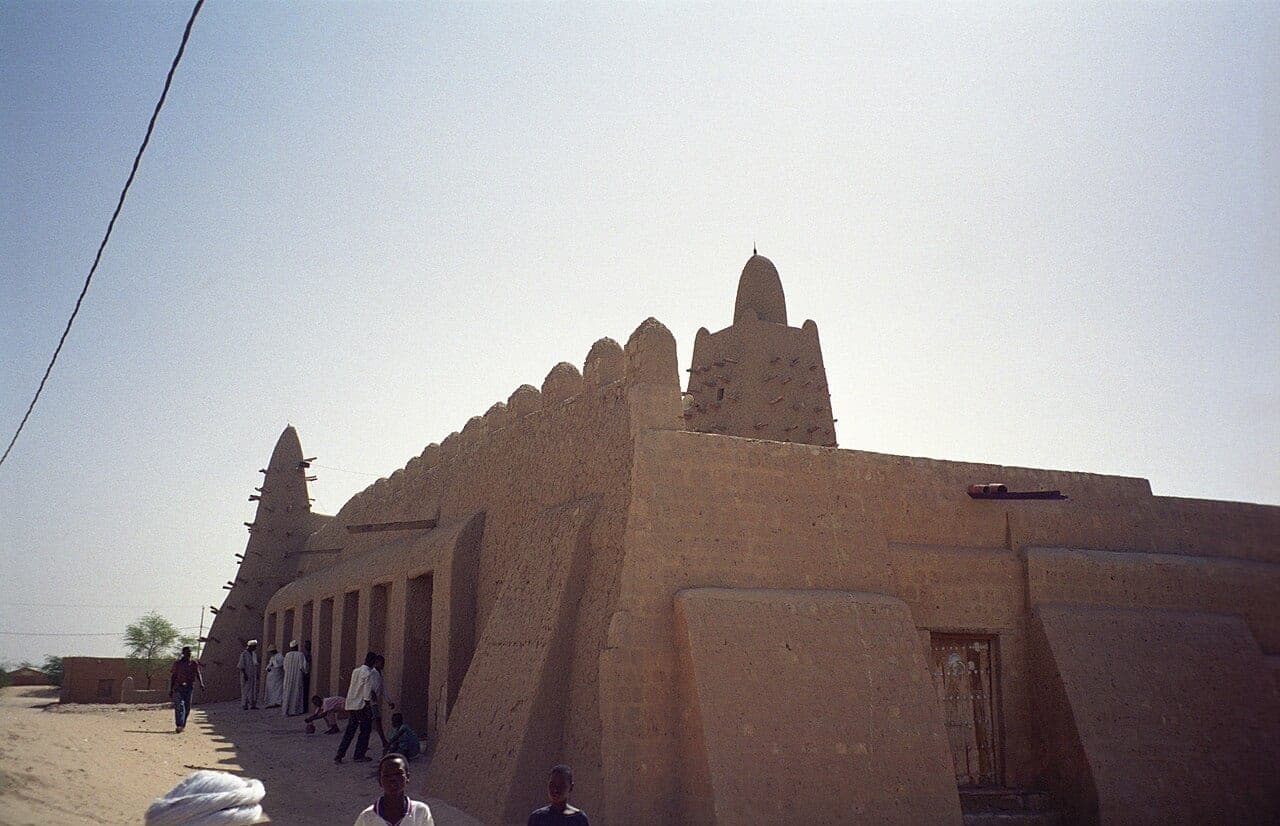
Three earthen mosques anchor the old city, each built in the mud-brick style of the western Sahel, with timber beams left protruding from the walls to serve as permanent scaffolding for the replastering the buildings need after every rainy season.
 Djinguereber was built in 1327 of mud brick, and the timbers projecting from the walls are permanent scaffolding: the surface has to be replastered by hand every year. Photograph by upyernoz, CC BY 2.0, via Wikimedia Commons.
Djinguereber, the oldest, dates to 1327 and remains Timbuktu's principal mosque, a low, buttressed structure of mud and wood able to hold a congregation of thousands. Sankore, built in the fourteenth or fifteenth century and rebuilt between 1578 and 1582 by the imam al-Aqib to the dimensions of the Kaaba, gave its name to a tradition of teaching often called the University of Sankore. It was less a single institution than a network of independent scholars who gathered students around them in the mosque and in their own houses, granting certificates as pupils mastered particular texts. Sidi Yahya, completed around 1400, is named for one of its early imams; one of its doors was, by local belief, meant to stay shut until the last days, and its forced opening in 2012 was felt in the city as an omen.
The manuscripts are the other half of the inheritance. Written mostly in Arabic, and some in African languages using Arabic script, they range in date from the late thirteenth century to the early twentieth and survive in their hundreds of thousands, scattered across private family collections and a handful of institutions such as the Ahmed Baba Institute and the Mamma Haidara Commemorative Library. Their subjects are wide: Islamic law and theology, but also astronomy, mathematics, medicine, logic, grammar, commerce, music, and poetry, alongside correspondence, contracts, and the great regional chronicles known as the Tarikh al-Sudan and the Tarikh al-Fattash, which record the history of the Songhai state. Together they are evidence, in the region's own hand, of a written African intellectual life reaching back centuries.
The manuscripts and the mosques were products of the same economy. Trade paid for scholarship, and scholarship travelled on trade. Timbuktu's wealth rested on two commodities that the desert made precious. Gold came from the goldfields of the south and was carried north across the Sahara toward the Mediterranean and beyond; salt, essential and scarce in the Sahel, came south in great slabs from desert mines, quarried and hauled by camel caravan. The city itself produced little of either. Its value lay in being the place where the two met, along with the taxes, lodging, and services a trading centre provides.
Books moved along the same routes, and in Timbuktu they became a trade of their own. The sixteenth-century writer Leo Africanus, who visited the city, recorded that manuscripts brought from North Africa sold for more profit than almost any other goods. Scholars were among the most respected residents, and families measured their standing partly by their libraries. Copying was a profession, and a scholar's collection was inheritable property, passed down and, in hard times, hidden rather than sold. The best known of these scholars, Ahmad Baba, wrote dozens of works on law and other subjects and became, after his deportation, a symbol of the learning the conquest had scattered. The habit his generation established, of a family keeping its books across generations, is what allowed so much to survive into the present.
In the spring of 2012 a rebellion in northern Mali, joined by armed Islamist groups, drove the national army from the region, and Timbuktu fell under the control of fighters who regarded the veneration of saints as idolatry. Between roughly June and July of that year they set about destroying the mausoleums of the city's holy men, breaking apart fourteen of the sixteen shrines protected under the World Heritage listing, damaging the mosques, and forcing open the sealed door of Sidi Yahya. At the Ahmed Baba Institute, some 4,200 manuscripts were burned. UNESCO condemned the destruction and, in 2012, placed Timbuktu on its List of World Heritage in Danger.
The response of the city's residents became the other side of the story. As the occupation took hold, a group of librarians and manuscript owners, coordinated by Abdel Kader Haidara through the local association SAVAMA-DCI, quietly moved the collections out of reach. Packed into metal footlockers and carried by road and by boat down the Niger, an estimated 350,000 manuscripts were smuggled from Timbuktu to Bamako, the capital, over several months, past checkpoints and through territory still held by armed groups. The great majority of the written record survived.
A French-led military intervention retook Timbuktu in early 2013. In the years that followed, UNESCO and Malian craftsmen rebuilt the shrines using the traditional materials and methods they had always used, the clay-and-straw render known as banco and the local alhor stone, with old photographs and the memory of elders guiding the work. Fourteen mausoleums were reconstructed and reconsecrated by 2016, and the door of Sidi Yahya was repaired.
The destruction also produced a legal reckoning. One of the men involved, Ahmad al-Faqi al-Mahdi, was surrendered to the International Criminal Court, which in September 2016 convicted him of the war crime of intentionally attacking historic and religious buildings and sentenced him to nine years in prison. It was the first time the court had tried a case built solely on the destruction of cultural heritage, and the first in which a defendant admitted guilt. The following year he was ordered to pay 2.7 million euros in reparations for the harm done to the community.
Timbuktu remains difficult and, for most visitors, unsafe to reach. Northern Mali has experienced continuing conflict and insecurity since 2012, and many governments advise against all travel to the region; the World Heritage site has stayed on the List of World Heritage in Danger. Anyone considering a visit should check current government travel advice and local conditions carefully before making any plans.
For now, much of Timbuktu can be reached from a distance. Tens of thousands of its manuscripts have been photographed and catalogued, and digitised collections are available online through partnerships between the Malian libraries and institutions abroad, allowing pages that once sat in locked chests to be read anywhere. The mosques and rebuilt mausoleums stand again in the old city, cared for, as they have been for centuries, by the families and imams who live around them.
Djinguereber was built in 1327 of mud brick, and the timbers projecting from the walls are permanent scaffolding: the surface has to be replastered by hand every year. Photograph by upyernoz, CC BY 2.0, via Wikimedia Commons.
Djinguereber, the oldest, dates to 1327 and remains Timbuktu's principal mosque, a low, buttressed structure of mud and wood able to hold a congregation of thousands. Sankore, built in the fourteenth or fifteenth century and rebuilt between 1578 and 1582 by the imam al-Aqib to the dimensions of the Kaaba, gave its name to a tradition of teaching often called the University of Sankore. It was less a single institution than a network of independent scholars who gathered students around them in the mosque and in their own houses, granting certificates as pupils mastered particular texts. Sidi Yahya, completed around 1400, is named for one of its early imams; one of its doors was, by local belief, meant to stay shut until the last days, and its forced opening in 2012 was felt in the city as an omen.
The manuscripts are the other half of the inheritance. Written mostly in Arabic, and some in African languages using Arabic script, they range in date from the late thirteenth century to the early twentieth and survive in their hundreds of thousands, scattered across private family collections and a handful of institutions such as the Ahmed Baba Institute and the Mamma Haidara Commemorative Library. Their subjects are wide: Islamic law and theology, but also astronomy, mathematics, medicine, logic, grammar, commerce, music, and poetry, alongside correspondence, contracts, and the great regional chronicles known as the Tarikh al-Sudan and the Tarikh al-Fattash, which record the history of the Songhai state. Together they are evidence, in the region's own hand, of a written African intellectual life reaching back centuries.
The manuscripts and the mosques were products of the same economy. Trade paid for scholarship, and scholarship travelled on trade. Timbuktu's wealth rested on two commodities that the desert made precious. Gold came from the goldfields of the south and was carried north across the Sahara toward the Mediterranean and beyond; salt, essential and scarce in the Sahel, came south in great slabs from desert mines, quarried and hauled by camel caravan. The city itself produced little of either. Its value lay in being the place where the two met, along with the taxes, lodging, and services a trading centre provides.
Books moved along the same routes, and in Timbuktu they became a trade of their own. The sixteenth-century writer Leo Africanus, who visited the city, recorded that manuscripts brought from North Africa sold for more profit than almost any other goods. Scholars were among the most respected residents, and families measured their standing partly by their libraries. Copying was a profession, and a scholar's collection was inheritable property, passed down and, in hard times, hidden rather than sold. The best known of these scholars, Ahmad Baba, wrote dozens of works on law and other subjects and became, after his deportation, a symbol of the learning the conquest had scattered. The habit his generation established, of a family keeping its books across generations, is what allowed so much to survive into the present.
In the spring of 2012 a rebellion in northern Mali, joined by armed Islamist groups, drove the national army from the region, and Timbuktu fell under the control of fighters who regarded the veneration of saints as idolatry. Between roughly June and July of that year they set about destroying the mausoleums of the city's holy men, breaking apart fourteen of the sixteen shrines protected under the World Heritage listing, damaging the mosques, and forcing open the sealed door of Sidi Yahya. At the Ahmed Baba Institute, some 4,200 manuscripts were burned. UNESCO condemned the destruction and, in 2012, placed Timbuktu on its List of World Heritage in Danger.
The response of the city's residents became the other side of the story. As the occupation took hold, a group of librarians and manuscript owners, coordinated by Abdel Kader Haidara through the local association SAVAMA-DCI, quietly moved the collections out of reach. Packed into metal footlockers and carried by road and by boat down the Niger, an estimated 350,000 manuscripts were smuggled from Timbuktu to Bamako, the capital, over several months, past checkpoints and through territory still held by armed groups. The great majority of the written record survived.
A French-led military intervention retook Timbuktu in early 2013. In the years that followed, UNESCO and Malian craftsmen rebuilt the shrines using the traditional materials and methods they had always used, the clay-and-straw render known as banco and the local alhor stone, with old photographs and the memory of elders guiding the work. Fourteen mausoleums were reconstructed and reconsecrated by 2016, and the door of Sidi Yahya was repaired.
The destruction also produced a legal reckoning. One of the men involved, Ahmad al-Faqi al-Mahdi, was surrendered to the International Criminal Court, which in September 2016 convicted him of the war crime of intentionally attacking historic and religious buildings and sentenced him to nine years in prison. It was the first time the court had tried a case built solely on the destruction of cultural heritage, and the first in which a defendant admitted guilt. The following year he was ordered to pay 2.7 million euros in reparations for the harm done to the community.
Timbuktu remains difficult and, for most visitors, unsafe to reach. Northern Mali has experienced continuing conflict and insecurity since 2012, and many governments advise against all travel to the region; the World Heritage site has stayed on the List of World Heritage in Danger. Anyone considering a visit should check current government travel advice and local conditions carefully before making any plans.
For now, much of Timbuktu can be reached from a distance. Tens of thousands of its manuscripts have been photographed and catalogued, and digitised collections are available online through partnerships between the Malian libraries and institutions abroad, allowing pages that once sat in locked chests to be read anywhere. The mosques and rebuilt mausoleums stand again in the old city, cared for, as they have been for centuries, by the families and imams who live around them.
History
The mosques and the manuscripts