Heritage · Country
Algeria Culture and Heritage
Algeria holds the memory of Amazigh kingdoms, Roman cities preserved by Saharan sand, and a war of independence that reshaped the modern world. This guide traces how Algerians keep that inheritance alive, from prehistoric rock art to the martyrs of the revolution.Written to last.
By Confinity Heritage Editorial · Updated 2026-07-31 · 8-minute readQuiet tools, kept out of the way.
Algeria is the largest country in Africa, and most of it is desert. Beyond the narrow Mediterranean coast where nearly all its people live, the land climbs through the Tell Atlas to the Saharan Atlas and the desert beyond, which covers more than four fifths of the territory. That geography holds one of the deepest human records anywhere: painted rock shelters in the far south reaching back some twelve thousand years, Amazigh (Berber) kingdoms older than Rome, Roman cities so complete that visitors walk their streets today, Islamic and Ottoman quarters layered over earlier stone, and the monuments of one of the twentieth century's defining anti-colonial wars.
Memory sits at the centre of Algerian identity. The country counts its modern era from 1 November 1954, when a small revolutionary movement launched the struggle that ended 132 years of French rule, and it honours its dead as chouhada, martyrs, in street names, textbooks and a towering monument above the capital.
Algeria occupies a central place in the Maghreb, bordered by Tunisia and Libya to the east, Niger and Mali to the south, Mauritania and the Western Sahara to the south-west, and Morocco to the west, with a long Mediterranean coastline to the north. Since the separation of South Sudan it has been the largest country on the continent, though roughly nine tenths of its area is Saharan and thinly peopled. Its 45 million people live mostly in the fertile north, above all in Algiers and the centres of Oran, Constantine and Annaba (Britannica).
The republic won independence from France in 1962. Arabic and Tamazight are both official languages, the latter recognised in the constitution in 2016, and Islam is the state religion of almost the whole population. Distinct regions give it texture, from the Kabylie mountains and the Aurès massif to the Mozabite towns of the M'Zab valley and the Tuareg lands of the Hoggar, while oil and gas, found in the Sahara in the 1950s, dominate the economy, and the currency is the dinar.
Algiers. The capital rises in white tiers above its bay, and its historic core, the Casbah, is a UNESCO World Heritage site: a dense Ottoman-era medina of stepped lanes, courtyard houses and mosques below the citadel from which the deys ruled. Algiers gave the country its name and remains its heart.
 The Kalaa of Beni Hammad, a fortified capital abandoned in the twelfth century and never built over. Photograph by R hakka, CC BY-SA 4.0, via Wikimedia Commons.
Oran. The great western port, watched over by the Spanish-built fort of Santa Cruz, is the birthplace of Raï music and long open to Andalusian, Ottoman and French currents.
Constantine. Built on a rocky plateau split by the gorge of the Rhummel and linked by bridges, it was Cirta, a capital of ancient Numidia, and later a centre of Arab-Andalusian learning and malouf music.
Tlemcen. Near the Moroccan border, it was the seat of the Zayyanid dynasty and a jewel of Islamic art, with Almoravid, Almohad and Andalusian mosques and madrasas, and its Gharnati music preserves the repertoire of medieval Iberia.
Annaba. The coastal city stands beside ancient Hippo Regius, where Saint Augustine served as bishop in the early fifth century; the modern basilica bearing his name looks down on the Roman ruins.
Ghardaia. The principal town of the M'Zab valley, it anchors five fortified hilltop settlements founded by the Ibadi community around the eleventh century, an architecture of community living that influenced modern designers such as Le Corbusier.
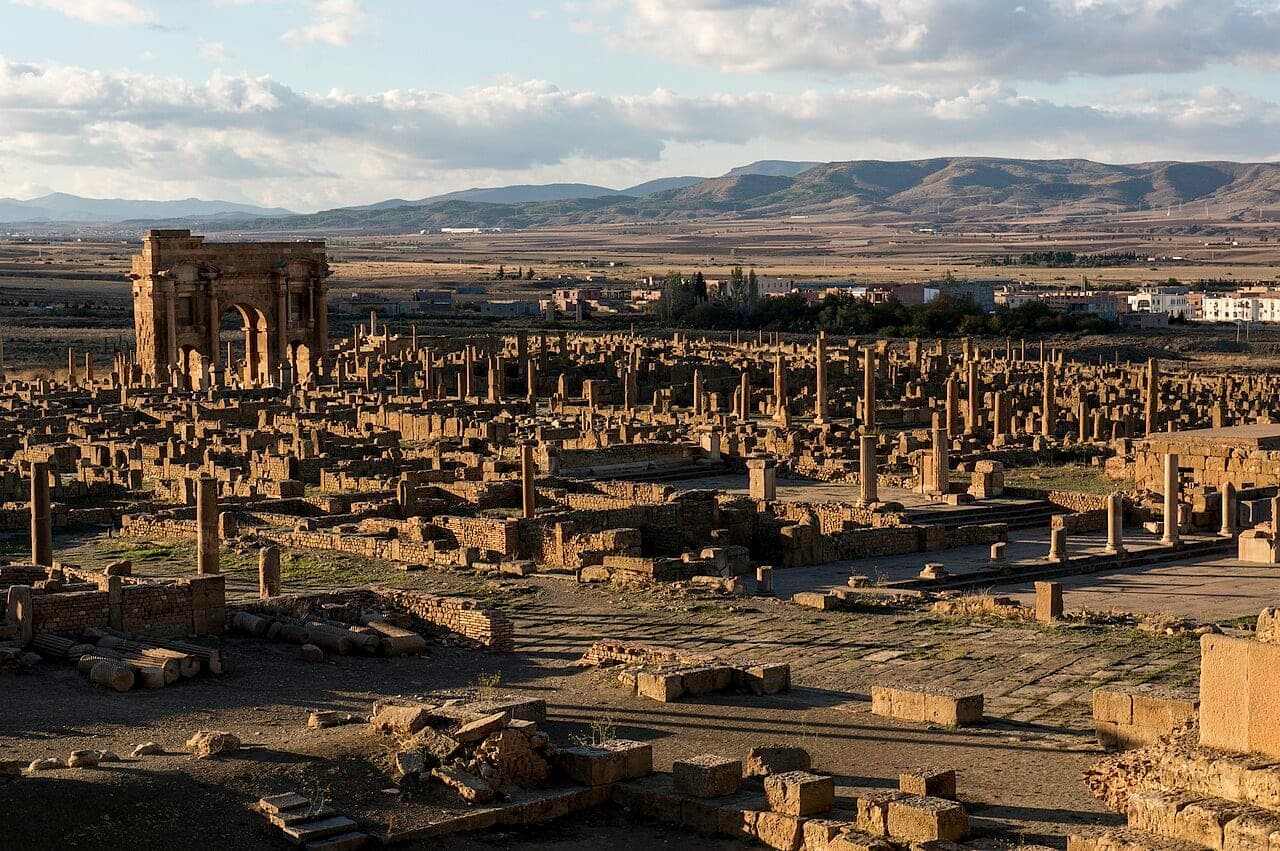
The oldest layer of Algerian history is Amazigh. The indigenous Berber peoples organised the kingdom of Numidia, unified under Massinissa around 202 BCE before Rome absorbed the region. The Romans left some of the best-preserved cities in the Mediterranean: Timgad, laid out on a grid by the emperor Trajan around 100 CE and later buried by protecting sand; Djemila, ancient Cuicul, adapted to a mountain site; and Tipaza, a Punic post that became a Roman colony (UNESCO). This was a Christian land too: Saint Augustine of Hippo, a leading thinker of the early Church, was born at Thagaste (modern Souk Ahras) in 354 CE and died at Hippo in 430 as the Vandals besieged the city.
The Kalaa of Beni Hammad, a fortified capital abandoned in the twelfth century and never built over. Photograph by R hakka, CC BY-SA 4.0, via Wikimedia Commons.
Oran. The great western port, watched over by the Spanish-built fort of Santa Cruz, is the birthplace of Raï music and long open to Andalusian, Ottoman and French currents.
Constantine. Built on a rocky plateau split by the gorge of the Rhummel and linked by bridges, it was Cirta, a capital of ancient Numidia, and later a centre of Arab-Andalusian learning and malouf music.
Tlemcen. Near the Moroccan border, it was the seat of the Zayyanid dynasty and a jewel of Islamic art, with Almoravid, Almohad and Andalusian mosques and madrasas, and its Gharnati music preserves the repertoire of medieval Iberia.
Annaba. The coastal city stands beside ancient Hippo Regius, where Saint Augustine served as bishop in the early fifth century; the modern basilica bearing his name looks down on the Roman ruins.
Ghardaia. The principal town of the M'Zab valley, it anchors five fortified hilltop settlements founded by the Ibadi community around the eleventh century, an architecture of community living that influenced modern designers such as Le Corbusier.
The oldest layer of Algerian history is Amazigh. The indigenous Berber peoples organised the kingdom of Numidia, unified under Massinissa around 202 BCE before Rome absorbed the region. The Romans left some of the best-preserved cities in the Mediterranean: Timgad, laid out on a grid by the emperor Trajan around 100 CE and later buried by protecting sand; Djemila, ancient Cuicul, adapted to a mountain site; and Tipaza, a Punic post that became a Roman colony (UNESCO). This was a Christian land too: Saint Augustine of Hippo, a leading thinker of the early Church, was born at Thagaste (modern Souk Ahras) in 354 CE and died at Hippo in 430 as the Vandals besieged the city.
 Timgad was founded as a grid for retired legionaries around AD 100, buried by sand for centuries, and dug out almost complete. Photograph by LBM1948, CC BY-SA 4.0, via Wikimedia Commons.
Arab armies carried Islam into North Africa in the seventh century, and the Amazigh population gradually adopted the faith while Arabic spread alongside the Berber languages. Dynasties followed, from the Ibadi Rustamids and the Fatimids to the Almoravids, Almohads and Zayyanids. The Hammadids left a striking monument in Al Qal'a of Beni Hammad, founded in 1007 and abandoned by the mid twelfth century, whose ruins preserve the plan of a fortified medieval Muslim capital (UNESCO).
In the early sixteenth century, as Spain seized coastal towns, the people of Algiers called on the Ottoman corsairs Aruj and Hayreddin Barbarossa, and by 1516 the region passed under Ottoman suzerainty. For roughly three centuries the Regency of Algiers was a semi-autonomous province, governed latterly by deys and known for its corsairing fleets.
France invaded in 1830 on a diplomatic pretext, and what began as a punitive expedition became a conquest lasting 132 years. Resistance was long and costly, led in the west from 1832 to 1847 by the Emir Abdelkader, a national symbol of principled struggle. Colonisation brought large-scale European settlement, the expropriation of land, and a legal order that placed the Muslim majority under an inferior status. Grievances hardened into revolt after the killing of civilians at Setif and Guelma on 8 May 1945.
On 1 November 1954 the National Liberation Front (FLN) launched the War of Independence. The conflict was brutal on both sides, marked by guerrilla warfare, the urban campaign known as the Battle of Algiers, mass internment and the widespread use of torture. Its human cost remains disputed: Algerian sources cite around 1.5 million dead, while many French historians put the figure lower, often between 300,000 and 400,000 (Britannica). The Evian Accords of March 1962 ended the fighting, and after a referendum Algeria became independent on 5 July 1962, a date set on the anniversary of the French entry in 1830.
Independent Algeria became a single-party socialist state under the FLN, led first by Ahmed Ben Bella and then Houari Boumediene, with oil and gas funding development. A political opening in the late 1980s gave way to a decade of internal conflict in the 1990s, sometimes called the Black Decade, after elections were cancelled in early 1992; the violence subsided around the turn of the century under a policy of civil reconciliation, and in 2019 the peaceful Hirak movement led to the resignation of President Abdelaziz Bouteflika.
Algeria is a country of layered languages. Modern Standard Arabic serves government, media and formal writing, while everyday speech is Algerian Arabic, or Darja, enriched by Amazigh, Turkish, French and Spanish borrowings. Tamazight, the Berber language, is spoken in several varieties: Kabyle in the mountains east of Algiers, Chaoui in the Aurès, Mozabite in the M'Zab, and Tamahaq among the Tuareg of the south. Long marginalised, it was recognised as a national language in 2002 and an official one in 2016, and its ancient Tifinagh script has returned to signs and schoolbooks (Minority Rights Group). French holds no official status but remains widely used in administration, higher education and business, a legacy of the colonial period.
The country's name comes from its capital. Algiers is al-Jaza'ir in Arabic, "the islands", a reference to islets once lying off the city, joined to the shore in the sixteenth century; the fuller medieval name was Jaza'ir Bani Mazghanna, "the islands of the Banu Mazghanna" (Wiktionary). Under Ottoman rule the city's name spread to the whole territory, and the French Algerie passed into English as Algeria; in Tamazight the country is Dzayer, an echo of the same root.
Music expresses much of Algeria's character. Raï grew around Oran from the poetry of rural bards and the frank songs of singers such as Cheikha Rimitti, then reached a global audience in the 1980s and 1990s through Cheb Khaled and Cheb Mami; its name means "opinion", and it speaks openly of love, hardship and desire. Chaabi, meaning "popular", emerged in the Casbah of Algiers around El Hadj M'Hamed El Anka, while the classical Andalusian tradition survives in three schools: the san'a of Algiers, the gharnati of Tlemcen and the malouf of Constantine. Kabyle song, carried by Idir and Lounis Ait Menguellet, gave the Amazigh cause a lyrical voice.
Craft traditions run deep: Amazigh weavers make carpets and kilims with geometric patterns, the silversmiths of Beni Yenni set enamel and coral in jewellery, and workshops produce pottery, copperwork and leather. Couscous is the national dish and a shared symbol of the region, inscribed on UNESCO's list of intangible heritage in 2020 as a tradition held in common with Algeria's neighbours (UNESCO). Chorba, tajines, stuffed vegetables and grilled merguez fill festive tables, and tea, coffee and dates mark hospitality.
The great majority of Algerians are Sunni Muslims of the Maliki school, and Islam frames family and public life. A distinctive Ibadi community, the Mozabites, lives in the M'Zab valley, preserving a separate and older strand of Islamic practice. Religious life has long carried a strong Sufi colour: brotherhoods such as the Rahmaniyya and Qadiriyya spread learning through their zawiyas, or lodges, and the Tijaniyya order was founded by Ahmad al-Tijani at Ain Madhi in the eighteenth century. Local saints, or marabouts, are venerated at shrines across the country.
Algeria also held one of North Africa's oldest Jewish communities, present since antiquity in Constantine, Algiers, Oran and Ghardaia. The Cremieux Decree of 1870 granted French citizenship to most Algerian Jews, and the community emigrated almost entirely around independence in 1962, chiefly to France; their synagogues and cemeteries remain part of the country's inheritance. A small Christian presence continues, and the seven Trappist monks of Tibhirine, killed in 1996 and later beatified, are remembered by many Algerians as figures of shared faith.
Algerian mourning follows Islamic practice, which favours simplicity and speed. The body is washed by relatives of the same sex, wrapped in a plain white shroud, and carried to the mosque or graveside for the funeral prayer, usually on the day of death; burial is in the earth, the deceased laid on the right side facing Mecca beneath a modest marker. What follows is the condolence period, when the family opens its home to visitors, neighbours bring food so the bereaved need not cook, and the Qur'an is recited under the refrain that all belong to God and to Him return. A widow observes the waiting period, the iddah, of four months and ten days, and in many regions gatherings on the third and fortieth days keep the dead present in family life.
Above these private rites sits a powerful national remembrance of the independence struggle. The dead of the war are honoured as chouhada, and their memory shapes the calendar: 1 November, Revolution Day, and 5 July, Independence Day, are the central commemorations. In Algiers the Maqam Echahid, a concrete monument of three great palm fronds sheltering an eternal flame, was raised in 1982 for the twentieth anniversary of independence, and the El Alia cemetery holds the graves of heroes from Emir Abdelkader to the leaders of the revolution (Wikipedia).
Amazigh custom adds its own textures of memory and renewal. Communities practise tiwizi, mutual aid that surrounds a grieving family with labour and support, and women's laments preserve the names and deeds of the dead in oral form. Yennayer, the Amazigh new year of 12 January and a national holiday since 2018, honours ancestry through shared meals and custom passed to children.
Algerian family names were assigned by a colonial administration, and the date is 23 March 1882.
The civil status law of that year required every Algerian to be registered under a fixed surname. Officials working through villages recorded names in French transliteration, cut Arabic and Amazigh naming conventions down to two words, and in many cases invented surnames outright, sometimes carelessly and sometimes with contempt. The traditional system, in which a person was named through a chain of fathers and a lineage, was deliberately broken, because the point of the exercise was to make individuals legible for taxation, conscription and the transfer of collectively held land into individual title. Algerians are still applying to change names they were given then.
The practical consequence is that the Algerian record splits at 1882. After it, the état civil is continuous and usable. Before it, a family has to be traced through the lineage rather than the surname, and the sources are different: the registers of zawiyas and mosque foundations, land and water rights records, and the genealogies of tribal and religious families.
The colonial archive itself is split between Algeria and France. The Archives nationales d'outre-mer at Aix-en-Provence hold a very large part of the administrative record of French Algeria, including the état civil for Europeans, and the question of what should be returned is an active dispute between the two governments rather than a settled one.
Algeria has seven UNESCO World Heritage sites, inscribed between 1980 and 1992 (UNESCO). Al Qal'a of Beni Hammad, the ruined Hammadid capital, was listed first, in 1980. The great year was 1982, when the Roman cities of Timgad, Djemila and Tipaza, the M'Zab valley, and the vast rock-art landscape of Tassili n'Ajjer were all inscribed. Tassili, a mixed cultural and natural site on a Saharan plateau, holds more than fifteen thousand paintings and engravings, some around twelve thousand years old, that chronicle the region's shift from green savannah to desert (UNESCO). The Casbah of Algiers completed the group in 1992.
Guardianship rests with the Ministry of Culture and specialist bodies for cultural property, supported by national museums such as the Bardo. Preservation is not without strain: the Casbah, a living quarter as well as a monument, has suffered the collapse of old houses and the pressures of a crowded city, while the remoteness of Tassili both protects its art and complicates its care. Beyond built heritage, Algeria has safeguarded living traditions, winning recognition for the ahellil chant of Gourara, the Imzad music of the Tuareg, and, most prominently, Raï.
Distance and scale have made digital tools central to safeguarding Algerian heritage. The remoteness of the Saharan sites has encouraged photographic and three-dimensional documentation, and regional projects that use satellite imagery to monitor threatened archaeology across North Africa include Algerian sites in open databases. Museums and cultural agencies have begun to digitise collections and offer virtual access to Roman cities few visitors can reach.
A distinctive strand of Algerian digital memory concerns the colonial archive itself. A large body of records from the French period is held in France, and access has long been a matter of national feeling; in 2022 the two governments established a joint commission of historians to work towards opening and digitising them. Alongside official efforts, diaspora communities and volunteer groups use social media to gather photographs, oral testimony and family records of the independence era, assembling an archive of a generation whose memory is passing.
Algeria's writers hold a large place in world letters. Kateb Yacine's novel Nedjma and the works of Mohammed Dib and Mouloud Feraoun shaped a francophone literature of anti-colonial conscience, while Assia Djebar, chronicler of Algerian women's lives, became in 2005 the first writer from the Maghreb elected to the Academie francaise. Frantz Fanon, who worked in Algeria and joined its cause, wrote The Wretched of the Earth, a text that influenced liberation movements worldwide, and in 2024 Kamel Daoud won the Prix Goncourt for Houris, a novel set in the violence of the 1990s.
Cinema carried the story further: The Battle of Algiers, filmed in the city in 1966, became one of the most studied political films ever made, and Chronicle of the Years of Fire won the Palme d'Or in 1975. Music has travelled furthest, as Raï crossed the Mediterranean with the Algerian diaspora in France and artists such as Khaled, Rachid Taha and Souad Massi reshaped it for international audiences. That diaspora keeps Algerian culture and memory active far beyond the country's borders.
Raï wins world recognition. In 2022 UNESCO inscribed Raï, the popular folk song of Algeria, on its Representative List of the Intangible Cultural Heritage of Humanity, an honour for a music once treated with suspicion at home (UNESCO).
The Amazigh revival. Tamazight became an official language in 2016, and Yennayer, the Amazigh new year, a national holiday in 2018, formal recognition of a heritage that predates every later layer of Algerian history.
The martyrs return. In July 2020 France returned the skulls of 24 nineteenth-century Algerian resistance fighters, held for more than a century in a Paris museum, and Algeria buried them at the El Alia cemetery on the anniversary of independence (France 24).
Couscous safeguarded. The 2020 UNESCO inscription of couscous, jointly proposed by Algeria and its neighbours, recognised a daily tradition as heritage and cooperation across the Maghreb.
Timgad was founded as a grid for retired legionaries around AD 100, buried by sand for centuries, and dug out almost complete. Photograph by LBM1948, CC BY-SA 4.0, via Wikimedia Commons.
Arab armies carried Islam into North Africa in the seventh century, and the Amazigh population gradually adopted the faith while Arabic spread alongside the Berber languages. Dynasties followed, from the Ibadi Rustamids and the Fatimids to the Almoravids, Almohads and Zayyanids. The Hammadids left a striking monument in Al Qal'a of Beni Hammad, founded in 1007 and abandoned by the mid twelfth century, whose ruins preserve the plan of a fortified medieval Muslim capital (UNESCO).
In the early sixteenth century, as Spain seized coastal towns, the people of Algiers called on the Ottoman corsairs Aruj and Hayreddin Barbarossa, and by 1516 the region passed under Ottoman suzerainty. For roughly three centuries the Regency of Algiers was a semi-autonomous province, governed latterly by deys and known for its corsairing fleets.
France invaded in 1830 on a diplomatic pretext, and what began as a punitive expedition became a conquest lasting 132 years. Resistance was long and costly, led in the west from 1832 to 1847 by the Emir Abdelkader, a national symbol of principled struggle. Colonisation brought large-scale European settlement, the expropriation of land, and a legal order that placed the Muslim majority under an inferior status. Grievances hardened into revolt after the killing of civilians at Setif and Guelma on 8 May 1945.
On 1 November 1954 the National Liberation Front (FLN) launched the War of Independence. The conflict was brutal on both sides, marked by guerrilla warfare, the urban campaign known as the Battle of Algiers, mass internment and the widespread use of torture. Its human cost remains disputed: Algerian sources cite around 1.5 million dead, while many French historians put the figure lower, often between 300,000 and 400,000 (Britannica). The Evian Accords of March 1962 ended the fighting, and after a referendum Algeria became independent on 5 July 1962, a date set on the anniversary of the French entry in 1830.
Independent Algeria became a single-party socialist state under the FLN, led first by Ahmed Ben Bella and then Houari Boumediene, with oil and gas funding development. A political opening in the late 1980s gave way to a decade of internal conflict in the 1990s, sometimes called the Black Decade, after elections were cancelled in early 1992; the violence subsided around the turn of the century under a policy of civil reconciliation, and in 2019 the peaceful Hirak movement led to the resignation of President Abdelaziz Bouteflika.
Algeria is a country of layered languages. Modern Standard Arabic serves government, media and formal writing, while everyday speech is Algerian Arabic, or Darja, enriched by Amazigh, Turkish, French and Spanish borrowings. Tamazight, the Berber language, is spoken in several varieties: Kabyle in the mountains east of Algiers, Chaoui in the Aurès, Mozabite in the M'Zab, and Tamahaq among the Tuareg of the south. Long marginalised, it was recognised as a national language in 2002 and an official one in 2016, and its ancient Tifinagh script has returned to signs and schoolbooks (Minority Rights Group). French holds no official status but remains widely used in administration, higher education and business, a legacy of the colonial period.
The country's name comes from its capital. Algiers is al-Jaza'ir in Arabic, "the islands", a reference to islets once lying off the city, joined to the shore in the sixteenth century; the fuller medieval name was Jaza'ir Bani Mazghanna, "the islands of the Banu Mazghanna" (Wiktionary). Under Ottoman rule the city's name spread to the whole territory, and the French Algerie passed into English as Algeria; in Tamazight the country is Dzayer, an echo of the same root.
Music expresses much of Algeria's character. Raï grew around Oran from the poetry of rural bards and the frank songs of singers such as Cheikha Rimitti, then reached a global audience in the 1980s and 1990s through Cheb Khaled and Cheb Mami; its name means "opinion", and it speaks openly of love, hardship and desire. Chaabi, meaning "popular", emerged in the Casbah of Algiers around El Hadj M'Hamed El Anka, while the classical Andalusian tradition survives in three schools: the san'a of Algiers, the gharnati of Tlemcen and the malouf of Constantine. Kabyle song, carried by Idir and Lounis Ait Menguellet, gave the Amazigh cause a lyrical voice.
Craft traditions run deep: Amazigh weavers make carpets and kilims with geometric patterns, the silversmiths of Beni Yenni set enamel and coral in jewellery, and workshops produce pottery, copperwork and leather. Couscous is the national dish and a shared symbol of the region, inscribed on UNESCO's list of intangible heritage in 2020 as a tradition held in common with Algeria's neighbours (UNESCO). Chorba, tajines, stuffed vegetables and grilled merguez fill festive tables, and tea, coffee and dates mark hospitality.
The great majority of Algerians are Sunni Muslims of the Maliki school, and Islam frames family and public life. A distinctive Ibadi community, the Mozabites, lives in the M'Zab valley, preserving a separate and older strand of Islamic practice. Religious life has long carried a strong Sufi colour: brotherhoods such as the Rahmaniyya and Qadiriyya spread learning through their zawiyas, or lodges, and the Tijaniyya order was founded by Ahmad al-Tijani at Ain Madhi in the eighteenth century. Local saints, or marabouts, are venerated at shrines across the country.
Algeria also held one of North Africa's oldest Jewish communities, present since antiquity in Constantine, Algiers, Oran and Ghardaia. The Cremieux Decree of 1870 granted French citizenship to most Algerian Jews, and the community emigrated almost entirely around independence in 1962, chiefly to France; their synagogues and cemeteries remain part of the country's inheritance. A small Christian presence continues, and the seven Trappist monks of Tibhirine, killed in 1996 and later beatified, are remembered by many Algerians as figures of shared faith.
Algerian mourning follows Islamic practice, which favours simplicity and speed. The body is washed by relatives of the same sex, wrapped in a plain white shroud, and carried to the mosque or graveside for the funeral prayer, usually on the day of death; burial is in the earth, the deceased laid on the right side facing Mecca beneath a modest marker. What follows is the condolence period, when the family opens its home to visitors, neighbours bring food so the bereaved need not cook, and the Qur'an is recited under the refrain that all belong to God and to Him return. A widow observes the waiting period, the iddah, of four months and ten days, and in many regions gatherings on the third and fortieth days keep the dead present in family life.
Above these private rites sits a powerful national remembrance of the independence struggle. The dead of the war are honoured as chouhada, and their memory shapes the calendar: 1 November, Revolution Day, and 5 July, Independence Day, are the central commemorations. In Algiers the Maqam Echahid, a concrete monument of three great palm fronds sheltering an eternal flame, was raised in 1982 for the twentieth anniversary of independence, and the El Alia cemetery holds the graves of heroes from Emir Abdelkader to the leaders of the revolution (Wikipedia).
Amazigh custom adds its own textures of memory and renewal. Communities practise tiwizi, mutual aid that surrounds a grieving family with labour and support, and women's laments preserve the names and deeds of the dead in oral form. Yennayer, the Amazigh new year of 12 January and a national holiday since 2018, honours ancestry through shared meals and custom passed to children.
Algerian family names were assigned by a colonial administration, and the date is 23 March 1882.
The civil status law of that year required every Algerian to be registered under a fixed surname. Officials working through villages recorded names in French transliteration, cut Arabic and Amazigh naming conventions down to two words, and in many cases invented surnames outright, sometimes carelessly and sometimes with contempt. The traditional system, in which a person was named through a chain of fathers and a lineage, was deliberately broken, because the point of the exercise was to make individuals legible for taxation, conscription and the transfer of collectively held land into individual title. Algerians are still applying to change names they were given then.
The practical consequence is that the Algerian record splits at 1882. After it, the état civil is continuous and usable. Before it, a family has to be traced through the lineage rather than the surname, and the sources are different: the registers of zawiyas and mosque foundations, land and water rights records, and the genealogies of tribal and religious families.
The colonial archive itself is split between Algeria and France. The Archives nationales d'outre-mer at Aix-en-Provence hold a very large part of the administrative record of French Algeria, including the état civil for Europeans, and the question of what should be returned is an active dispute between the two governments rather than a settled one.
Algeria has seven UNESCO World Heritage sites, inscribed between 1980 and 1992 (UNESCO). Al Qal'a of Beni Hammad, the ruined Hammadid capital, was listed first, in 1980. The great year was 1982, when the Roman cities of Timgad, Djemila and Tipaza, the M'Zab valley, and the vast rock-art landscape of Tassili n'Ajjer were all inscribed. Tassili, a mixed cultural and natural site on a Saharan plateau, holds more than fifteen thousand paintings and engravings, some around twelve thousand years old, that chronicle the region's shift from green savannah to desert (UNESCO). The Casbah of Algiers completed the group in 1992.
Guardianship rests with the Ministry of Culture and specialist bodies for cultural property, supported by national museums such as the Bardo. Preservation is not without strain: the Casbah, a living quarter as well as a monument, has suffered the collapse of old houses and the pressures of a crowded city, while the remoteness of Tassili both protects its art and complicates its care. Beyond built heritage, Algeria has safeguarded living traditions, winning recognition for the ahellil chant of Gourara, the Imzad music of the Tuareg, and, most prominently, Raï.
Distance and scale have made digital tools central to safeguarding Algerian heritage. The remoteness of the Saharan sites has encouraged photographic and three-dimensional documentation, and regional projects that use satellite imagery to monitor threatened archaeology across North Africa include Algerian sites in open databases. Museums and cultural agencies have begun to digitise collections and offer virtual access to Roman cities few visitors can reach.
A distinctive strand of Algerian digital memory concerns the colonial archive itself. A large body of records from the French period is held in France, and access has long been a matter of national feeling; in 2022 the two governments established a joint commission of historians to work towards opening and digitising them. Alongside official efforts, diaspora communities and volunteer groups use social media to gather photographs, oral testimony and family records of the independence era, assembling an archive of a generation whose memory is passing.
Algeria's writers hold a large place in world letters. Kateb Yacine's novel Nedjma and the works of Mohammed Dib and Mouloud Feraoun shaped a francophone literature of anti-colonial conscience, while Assia Djebar, chronicler of Algerian women's lives, became in 2005 the first writer from the Maghreb elected to the Academie francaise. Frantz Fanon, who worked in Algeria and joined its cause, wrote The Wretched of the Earth, a text that influenced liberation movements worldwide, and in 2024 Kamel Daoud won the Prix Goncourt for Houris, a novel set in the violence of the 1990s.
Cinema carried the story further: The Battle of Algiers, filmed in the city in 1966, became one of the most studied political films ever made, and Chronicle of the Years of Fire won the Palme d'Or in 1975. Music has travelled furthest, as Raï crossed the Mediterranean with the Algerian diaspora in France and artists such as Khaled, Rachid Taha and Souad Massi reshaped it for international audiences. That diaspora keeps Algerian culture and memory active far beyond the country's borders.
Raï wins world recognition. In 2022 UNESCO inscribed Raï, the popular folk song of Algeria, on its Representative List of the Intangible Cultural Heritage of Humanity, an honour for a music once treated with suspicion at home (UNESCO).
The Amazigh revival. Tamazight became an official language in 2016, and Yennayer, the Amazigh new year, a national holiday in 2018, formal recognition of a heritage that predates every later layer of Algerian history.
The martyrs return. In July 2020 France returned the skulls of 24 nineteenth-century Algerian resistance fighters, held for more than a century in a Paris museum, and Algeria buried them at the El Alia cemetery on the anniversary of independence (France 24).
Couscous safeguarded. The 2020 UNESCO inscription of couscous, jointly proposed by Algeria and its neighbours, recognised a daily tradition as heritage and cooperation across the Maghreb.
National Overview
Notable Cities
Historical Foundations
Linguistic and Etymological Roots
Cultural Identity
Religion and Spirituality
Remembrance and Mourning Traditions
Tracing a Family in Algeria
Heritage Preservation Efforts
Digital Heritage
Contemporary Cultural Influences
Success Stories
References and resources
- UNESCO World Heritage Centre: Algeria state party page
- UNESCO World Heritage Centre: Tassili n'Ajjer
- UNESCO World Heritage Centre: Al Qal'a of Beni Hammad
- UNESCO World Heritage Centre: Kasbah of Algiers
- UNESCO Intangible Cultural Heritage: Rai, popular folk song of Algeria
- UNESCO Intangible Cultural Heritage: couscous
- Encyclopaedia Britannica: Algeria
- Encyclopaedia Britannica: Algerian War
- Minority Rights Group: Amazigh in Algeria
- France 24: Algeria buries repatriated skulls of resistance fighters (2020)