Heritage · Country
Niger Culture and Heritage
Niger reaches from the tallest mud-brick minaret on Earth at Agadez across the Ténéré sands, where a lone acacia once guided caravans and Stone Age families were buried beside a vanished lake. This guide follows the country's Saharan and Sahelian heritage, from Songhai and Kanem-Bornu to Tuareg silver, the Cure Salée and one of the great green comebacks of the drylands.Written to last.
By Confinity Heritage Editorial · Updated 2026-07-31 · 8-minute readQuiet tools, kept out of the way.
Few countries hold as much of the Sahara's memory as Niger. Landlocked at the meeting of desert and Sahel, it keeps the record of a green Sahara in the fossil lakebeds of the Ténéré, where families were buried more than seven thousand years ago, and the record of a far deeper past in the dinosaur beds of Gadoufaoua. In the north rises Agadez, the old sultanate city and gateway to the Aïr mountains, whose Grand Mosque carries a minaret of mud brick that is the tallest earthen structure of its kind. Between desert and river live the peoples who made the country: Hausa, Zarma-Songhai, Tuareg, Fulani, Kanuri and Toubou.
That inheritance is carried lightly and under pressure. Niger is among the youngest and lowest-income countries in the world, and parts of it have known drought, displacement and insecurity in recent years. Yet its heritage is neither sealed nor still. Caravans still cross the salt roads, the Cure Salée still gathers herders at the season's turn, and across the farmlands of the south one of the largest re-greening efforts on the planet has brought trees and harvests back to land once written off as lost.
The Republic of the Niger is the largest country in West Africa, covering roughly 1.27 million square kilometres, of which more than four fifths is Saharan desert. It is landlocked, bordered by Algeria and Libya to the north, Chad to the east, Nigeria and Benin to the south, and Burkina Faso and Mali to the west. The land tilts from the sand seas of the Ténéré and the volcanic Aïr massif in the north down to the Sahelian farming belt and the thread of the Niger River in the far south-west, which gives the country both its lifeline and its name.
Its people, numbering around twenty-six million, are among the youngest on Earth, with one of the world's highest birth rates, and most live in the southern strip where rain still falls. The capital is Niamey, on the banks of the Niger. French is the official language, a legacy of colonial rule, while Hausa, Zarma-Songhai, Tamashek, Fulfulde, Kanuri, Arabic and Toubou are recognised national languages. The currency is the West African CFA franc, and close to the whole population is Muslim.
Niamey. The capital sits on the Niger River in the country's south-west and grew from a small fishing settlement into the seat of government after the French moved the colonial capital here from Zinder in 1926. It holds the National Museum of Niger, the Grand Mosque and one of the Sahel's great markets, and it is the centre of Zarma-Songhai cultural life.
Zinder. For much of the nineteenth century Zinder was the most powerful city in the region as capital of the Sultanate of Damagaram, founded around 1731 by Kanuri aristocrats out of the declining Kanem-Bornu Empire. Its walled Birni quarter, sultan's palace and great mosque recall a commercial hub that linked Libya to northern Nigeria. It served as the first colonial capital until 1926.
Maradi. The commercial heart of the Hausa south and a hub of the groundnut and livestock trades, Maradi sits close to the Nigerian border and moves goods and people constantly between the two countries. It is also a centre of the farmland restoration that has reshaped southern Niger.
Agadez. The gateway to the Sahara and the Aïr, Agadez was capital of the Tuareg Sultanate of Aïr and a hinge of trans-Saharan trade in salt, dates and gold. Its old town of earthen houses and its towering mosque minaret earned it inscription as a UNESCO World Heritage Site in 2013.
Human life here is older than the desert. During the African Humid Period the Sahara was green, holding lakes and rivers, and at Gobero in the Ténéré the palaeontologist Paul Sereno uncovered in 2000 the largest known Stone Age graveyard in the Sahara. Its burials record two successive peoples: the Kiffian, tall hunter-fishers of about 10,000 to 8,000 years ago, and the later Tenerian herders of roughly 7,000 to 4,500 years ago, among them a woman laid to rest hand in hand with two children. Far older still are the dinosaur beds of Gadoufaoua, whose Elrhaz Formation yielded Nigersaurus taqueti with its five hundred teeth, the sail-backed Ouranosaurus, and the giant crocodile Sarcosuchus imperator.
In historical times the southern lands were shaped by the Hausa city-states and by two great empires that reached in from the sides: the Songhai Empire, whose sixteenth-century power flowed up the Niger from Gao, and the Kanem-Bornu Empire around Lake Chad, whose influence spread across the east. In the north the Tuareg Sultanate of Aïr formed in the fifteenth century around Agadez, drawing caravans across the sand and helping carry Islam, which had arrived along the trade routes, deeper into the Sahel.
France pushed into the region at the end of the nineteenth century, and the notorious Voulet-Chanoine expedition of 1899 left a trail of massacres that shocked even Paris. Resistance was real and costly: the Kaocen revolt of 1916 to 1917 saw Tuareg fighters besiege the French garrison at Agadez before being crushed. Niger became a territory of French West Africa and won independence on 3 August 1960 under its first president, Hamani Diori. The decades since have brought military coups, a return to multiparty politics, and Tuareg rebellions in the 1990s and again in 2007 to 2009. In recent years the country has seen further political change and security challenges in some border areas.
The country's name comes from the Niger River, and the river's name is older than any colonial map. It probably derives from a Tuareg or wider Berber phrase along the lines of egerew n-igerewen, understood as "river of rivers" or "great river," later reshaped by the Latin word niger, meaning black. Both Niger and neighbouring Nigeria take their names from the same waterway.
French remains the official language of administration and schooling, but daily life runs in the national tongues. Hausa is the most widely spoken and serves as a lingua franca across the south and the markets; Zarma-Songhai dominates the south-west around Niamey; Tamashek, written in the ancient Tifinagh script, belongs to the Tuareg of the north; Fulfulde is spoken by the Fulani herders across the Sahel; Kanuri is heard in the east around Zinder and Diffa; and Toubou dialects reach into the far desert north-east. Arabic is used in religious learning and among some communities, giving the country a spread of language families rare even for West Africa.
Nigerien identity is built on the desert, the river and the herd. In Agadez the earthen architecture of the old town, plastered and re-plastered by hand each year, is a craft in itself, and the Tuareg who trade there are famous metalworkers. Their silversmiths hammer the Agadez cross, or croix d'Agadez, one of a family of regional pendants passed from parent to child, alongside takoba swords, amulets and leather. Tuareg men wear the indigo tagelmust, the veil that gave them the old name of the "blue people."
The pastoral calendar produces the country's signature gatherings. The Cure Salée, the salt cure, draws Tuareg and Wodaabe herders each September to the salt flats near In-Gall to water their animals and renew ties across communities. Its most celebrated moment is the Gerewol of the Wodaabe Fulani, in which young men paint their faces, whiten their teeth and dance the Yaake for hours so that women may choose the most beautiful among them. Hausa griots and Zarma praise singers keep long lineages of music and oral history, while the food of Niger runs to millet and sorghum staples such as tuwo and fura, spiced dried kilishi beef, rice dishes of the river country, and green tea poured in three rounds.
Islam reached Niger along the trans-Saharan trade routes and is today the faith of almost the entire population, most following the Sunni tradition of the Maliki school. The Sufi brotherhoods, above all the Tijaniyya and the Qadiriyya, shape much of religious life, and Agadez, Zinder and other towns have long been centres of Quranic scholarship and pilgrimage.
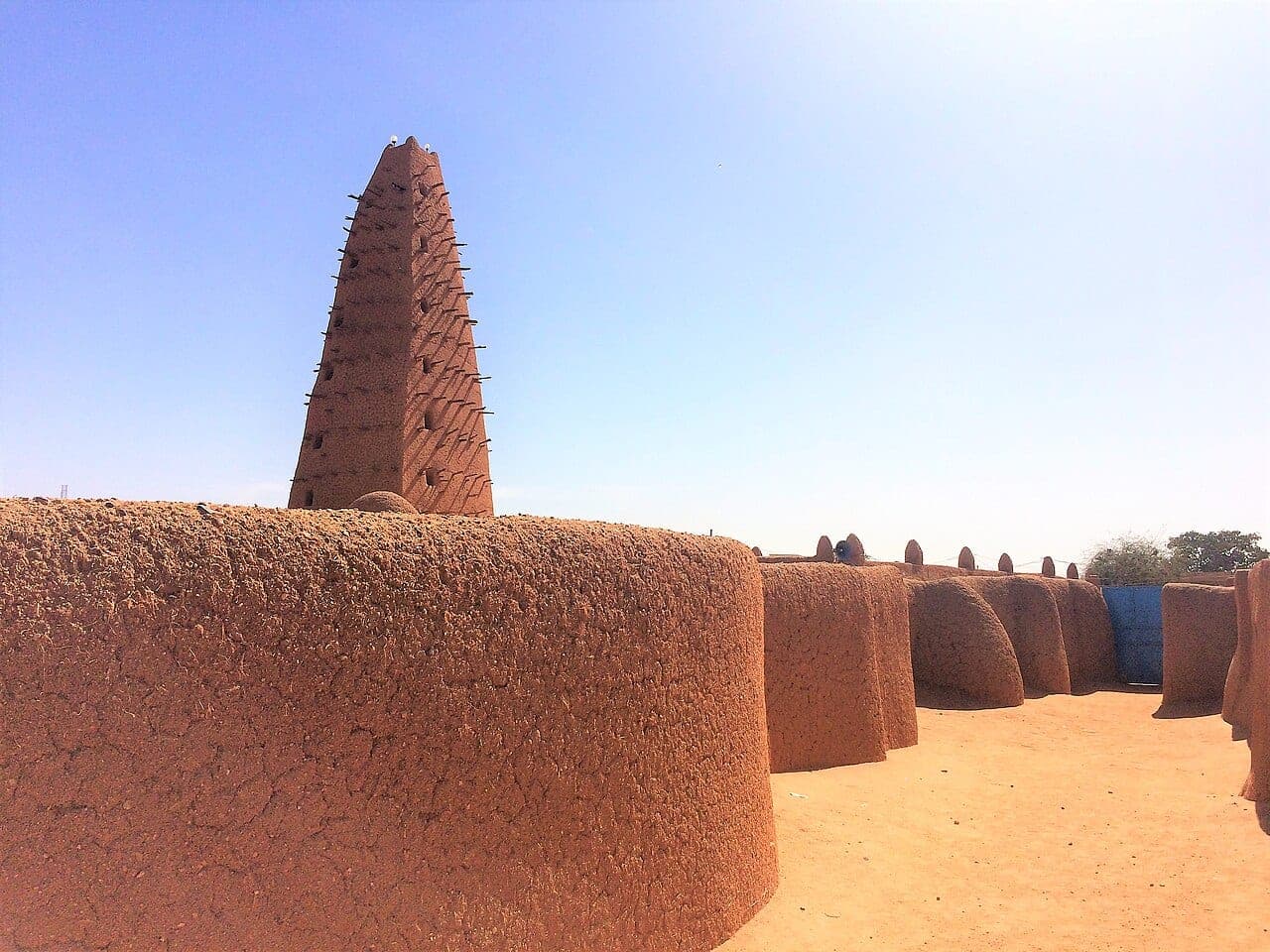
 The minaret at Agadez is the tallest mud-brick structure in the world, and its projecting timbers are the permanent scaffolding for the replastering it needs. Photograph by Aminucrus, CC BY-SA 4.0, via Wikimedia Commons.
Belief here is woven with older custom rather than sealed off from it. Among the Hausa the Bori spirit tradition, with its healers and possession rites, persists alongside the mosque, and naming ceremonies, harvest observances and protective charms carry pre-Islamic memory into daily practice. Small Christian congregations and communities keeping traditional beliefs make up the remainder. The result is a devout country where the call to prayer and the herder's seasonal rhythms are heard together.
Death in Niger is met quickly and communally, in keeping with Islamic practice. The body is washed by relatives of the same sex, wrapped in a plain white shroud and buried within a day, laid on its right side facing Mecca beneath a simple grave. The funeral prayer, the Salat al-Janazah, is offered at the mosque or graveside, and the family then keeps a condolence period of about three days in which neighbours bring food, recite the Quran and repeat that the dead return to God. A widow observes the waiting period, the iddah, of four months and ten days.
The most haunting monument to memory in Niger marks no grave at all. For some three centuries a single acacia, the Tree of Ténéré, grew alone in the sand and served caravans as the only landmark for hundreds of kilometres in every direction, so revered that drivers steered wide of it. In 1973 a truck struck and killed it; its remains were carried to the National Museum in Niamey, and a spare metal sculpture now stands where it grew, keeping the memory of the loneliest tree on Earth. Alongside Islamic rites, traditional remembrance survives in the work of griots, who hold the names and deeds of ancestors in spoken verse, and in family observances that honour the departed across generations.
Niger's family record is oral, Islamic and, in the north, kept in libraries that nobody has fully catalogued.
Hausa, Zarma, Kanuri, Tuareg, Fulani and Toubou communities each keep descent in their own way, recited and tied to land, herds and office. The sultanates of Agadez, Zinder and Damagaram maintained courts with documented successions, and the Sultan of Agadez still sits in a palace beside a minaret of mud and timber that has stood since the sixteenth century.
The Islamic manuscript tradition here is substantial and understudied. Scholarly families in Agadez, Zinder and the Aïr kept Arabic and Ajami manuscripts, including chronicles, legal opinions and family records, and much of it remains in private hands.
A French civil register existed from the 1890s and touched only a small share of the population; what there is sits in Niamey and at Aix-en-Provence. Civil registration is still incomplete, particularly among nomadic communities, and campaigns to register adults retrospectively have run for years.
The Tuareg rebellions of the 1990s and 2000s, and the insecurity across the Sahel since, have displaced large numbers and made record-keeping harder rather than easier.
The oldest record in the country is not human writing at all: the rock art of the Aïr and the Ténéré, and the Gobero burial site in the Ténéré desert, where people were buried beside a lake that dried five thousand years ago, one woman holding two children by the hand.
Niger holds three UNESCO World Heritage sites. The Historic Centre of Agadez, inscribed in 2013, protects the old earthen town and its Grand Mosque, whose minaret of some twenty-seven metres is the tallest mud-brick structure of its kind. The Aïr and Ténéré Natural Reserves, inscribed in 1991, form one of the largest protected areas in Africa, spanning the volcanic Aïr and the sands of the Ténéré; the reserve has remained on the List of World Heritage in Danger since 1992 because of instability and pressure on its wildlife. The W-Arly-Pendjari Complex, first inscribed as the W National Park of Niger in 1996 and extended across Benin and Burkina Faso in 2017, guards the most important stretch of savannah and its elephants in West Africa.
The country's central institution of memory is the National Museum of Niger in Niamey, the Musée National Boubou Hama, founded in 1959. Set in a park, it gathers ethnographic and archaeological collections, dinosaur fossils from Gadoufaoua, craft cooperatives and the mausoleum of the Tree of Ténéré, making it both a scientific record and a place of national feeling.
Because so much of Niger's past lies in remote desert, digital tools have become central to keeping and sharing it. The palaeontological record of Gadoufaoua and the Gobero burials has been documented, imaged and published online by the research programme built around Paul Sereno's expeditions, which has produced open scientific reconstructions of Nigersaurus and made the science of the green Sahara reachable far beyond the field. Satellite monitoring supports the state-of-conservation reporting on the Aïr and Ténéré reserves, where ground missions are hard to mount, and museum and university partners have worked to digitise fossils, artefacts and photographs. Nigerien voices in the diaspora and at home increasingly use social platforms to circulate images of Agadez architecture, Tuareg craft and family history, assembling a shared record that no single institution could hold alone.
Niger's most far-reaching cultural export is the guitar music of the desert. Rooted in Tuareg experience, the sound known abroad as desert blues has carried players such as Bombino and Mdou Moctar from encampments and small towns to concert halls and festival stages across the world, their rolling, hypnotic playing threading Saharan modes through the electric guitar. The band Etran Finatawa blends Tuareg and Wodaabe traditions with modern instruments, while dance groups such as Tal National fill halls across the Sahel with Hausa and Zarma rhythms. This music, at once ancient and current, has done more than any monument to place Niger on the wider cultural map.
The clearest good-news story in modern Niger is written on the land itself. Across the farming regions of Maradi and Zinder, farmers have led one of the largest environmental recoveries anywhere by protecting and pruning the trees that sprout naturally in their fields, a practice known as farmer-managed natural regeneration and spread from the 1980s with the encouragement of the agronomist Tony Rinaudo. Faidherbia and other trees returned in their millions, sheltering soil, feeding livestock and lifting millet yields, and by recent estimates more than five million hectares of once-bare Sahel are greener than they were a generation ago. Achieved largely by ordinary farmers rather than grand schemes, this re-greening now anchors the wider Great Green Wall effort and offers a working answer to the spread of the desert. It is a reminder that in Niger, heritage is not only kept in museums but grown, season by season, out of the ground.
The minaret at Agadez is the tallest mud-brick structure in the world, and its projecting timbers are the permanent scaffolding for the replastering it needs. Photograph by Aminucrus, CC BY-SA 4.0, via Wikimedia Commons.
Belief here is woven with older custom rather than sealed off from it. Among the Hausa the Bori spirit tradition, with its healers and possession rites, persists alongside the mosque, and naming ceremonies, harvest observances and protective charms carry pre-Islamic memory into daily practice. Small Christian congregations and communities keeping traditional beliefs make up the remainder. The result is a devout country where the call to prayer and the herder's seasonal rhythms are heard together.
Death in Niger is met quickly and communally, in keeping with Islamic practice. The body is washed by relatives of the same sex, wrapped in a plain white shroud and buried within a day, laid on its right side facing Mecca beneath a simple grave. The funeral prayer, the Salat al-Janazah, is offered at the mosque or graveside, and the family then keeps a condolence period of about three days in which neighbours bring food, recite the Quran and repeat that the dead return to God. A widow observes the waiting period, the iddah, of four months and ten days.
The most haunting monument to memory in Niger marks no grave at all. For some three centuries a single acacia, the Tree of Ténéré, grew alone in the sand and served caravans as the only landmark for hundreds of kilometres in every direction, so revered that drivers steered wide of it. In 1973 a truck struck and killed it; its remains were carried to the National Museum in Niamey, and a spare metal sculpture now stands where it grew, keeping the memory of the loneliest tree on Earth. Alongside Islamic rites, traditional remembrance survives in the work of griots, who hold the names and deeds of ancestors in spoken verse, and in family observances that honour the departed across generations.
Niger's family record is oral, Islamic and, in the north, kept in libraries that nobody has fully catalogued.
Hausa, Zarma, Kanuri, Tuareg, Fulani and Toubou communities each keep descent in their own way, recited and tied to land, herds and office. The sultanates of Agadez, Zinder and Damagaram maintained courts with documented successions, and the Sultan of Agadez still sits in a palace beside a minaret of mud and timber that has stood since the sixteenth century.
The Islamic manuscript tradition here is substantial and understudied. Scholarly families in Agadez, Zinder and the Aïr kept Arabic and Ajami manuscripts, including chronicles, legal opinions and family records, and much of it remains in private hands.
A French civil register existed from the 1890s and touched only a small share of the population; what there is sits in Niamey and at Aix-en-Provence. Civil registration is still incomplete, particularly among nomadic communities, and campaigns to register adults retrospectively have run for years.
The Tuareg rebellions of the 1990s and 2000s, and the insecurity across the Sahel since, have displaced large numbers and made record-keeping harder rather than easier.
The oldest record in the country is not human writing at all: the rock art of the Aïr and the Ténéré, and the Gobero burial site in the Ténéré desert, where people were buried beside a lake that dried five thousand years ago, one woman holding two children by the hand.
Niger holds three UNESCO World Heritage sites. The Historic Centre of Agadez, inscribed in 2013, protects the old earthen town and its Grand Mosque, whose minaret of some twenty-seven metres is the tallest mud-brick structure of its kind. The Aïr and Ténéré Natural Reserves, inscribed in 1991, form one of the largest protected areas in Africa, spanning the volcanic Aïr and the sands of the Ténéré; the reserve has remained on the List of World Heritage in Danger since 1992 because of instability and pressure on its wildlife. The W-Arly-Pendjari Complex, first inscribed as the W National Park of Niger in 1996 and extended across Benin and Burkina Faso in 2017, guards the most important stretch of savannah and its elephants in West Africa.
The country's central institution of memory is the National Museum of Niger in Niamey, the Musée National Boubou Hama, founded in 1959. Set in a park, it gathers ethnographic and archaeological collections, dinosaur fossils from Gadoufaoua, craft cooperatives and the mausoleum of the Tree of Ténéré, making it both a scientific record and a place of national feeling.
Because so much of Niger's past lies in remote desert, digital tools have become central to keeping and sharing it. The palaeontological record of Gadoufaoua and the Gobero burials has been documented, imaged and published online by the research programme built around Paul Sereno's expeditions, which has produced open scientific reconstructions of Nigersaurus and made the science of the green Sahara reachable far beyond the field. Satellite monitoring supports the state-of-conservation reporting on the Aïr and Ténéré reserves, where ground missions are hard to mount, and museum and university partners have worked to digitise fossils, artefacts and photographs. Nigerien voices in the diaspora and at home increasingly use social platforms to circulate images of Agadez architecture, Tuareg craft and family history, assembling a shared record that no single institution could hold alone.
Niger's most far-reaching cultural export is the guitar music of the desert. Rooted in Tuareg experience, the sound known abroad as desert blues has carried players such as Bombino and Mdou Moctar from encampments and small towns to concert halls and festival stages across the world, their rolling, hypnotic playing threading Saharan modes through the electric guitar. The band Etran Finatawa blends Tuareg and Wodaabe traditions with modern instruments, while dance groups such as Tal National fill halls across the Sahel with Hausa and Zarma rhythms. This music, at once ancient and current, has done more than any monument to place Niger on the wider cultural map.
The clearest good-news story in modern Niger is written on the land itself. Across the farming regions of Maradi and Zinder, farmers have led one of the largest environmental recoveries anywhere by protecting and pruning the trees that sprout naturally in their fields, a practice known as farmer-managed natural regeneration and spread from the 1980s with the encouragement of the agronomist Tony Rinaudo. Faidherbia and other trees returned in their millions, sheltering soil, feeding livestock and lifting millet yields, and by recent estimates more than five million hectares of once-bare Sahel are greener than they were a generation ago. Achieved largely by ordinary farmers rather than grand schemes, this re-greening now anchors the wider Great Green Wall effort and offers a working answer to the spread of the desert. It is a reminder that in Niger, heritage is not only kept in museums but grown, season by season, out of the ground.
National Overview
Notable Cities
Historical Foundations
Linguistic and Etymological Roots
Cultural Identity
Religion and Spirituality
Remembrance and Mourning Traditions
Tracing a Family in Niger
Heritage Preservation Efforts
Digital Heritage
Contemporary Cultural Influences
Success Stories
References and resources
- UNESCO World Heritage Centre: Historic Centre of Agadez
- UNESCO World Heritage Centre: Aïr and Ténéré Natural Reserves
- UNESCO World Heritage Centre: W-Arly-Pendjari Complex
- Encyclopaedia Britannica: Niger
- Encyclopaedia Britannica: History of Niger
- Wikipedia: Gobero and the Green Sahara burials
- Wikipedia: Nigersaurus and the Gadoufaoua fossil beds
- Wikipedia: Sultanate of Damagaram
- Wikipedia: Cure Salée and the Wodaabe Gerewol
- Wikipedia: Tree of Ténéré
- Wikipedia: Musée National Boubou Hama (National Museum of Niger)
- World Agroforestry: Re-greening the Sahel