Heritage · Country
Burkina Faso Culture and Heritage
Burkina Faso keeps its memory in laterite and in movement: the thousand-year stone walls of Loropéni raised on the trans-Saharan gold trade, the banco mosque of Bobo-Dioulasso, and the mask societies who dance the dead across to the ancestors. A guide to the country's heritage and the people who keep it.Written to last.
By Confinity Heritage Editorial · Updated 2026-07-31 · 8-minute readQuiet tools, kept out of the way.
In the far south-west of Burkina Faso, near the point where the country meets Côte d'Ivoire, Ghana and Togo, a rectangle of laterite walls rises from the bush to roughly six metres. The Ruins of Loropéni are the best preserved of about a hundred stone-walled enclosures scattered across the goldfields of the region, and dating has shown the settlement to be at least a thousand years old. Built and held by the Lohron or Koulango, who controlled the gold trade when it reached its height between the fourteenth and seventeenth centuries, the fortress guarded a link in the trans-Saharan routes that carried West African gold north toward the Mediterranean. In 2009 it became the first place in Burkina Faso inscribed on the UNESCO World Heritage List.
Burkina Faso's other great inheritance is not built but danced. Across the centre and west of the country the Bwa, Bobo, Nuna, Lobi, Gurunsi, Mossi and other peoples carry masks of wood, leaf and fibre that appear at the great funerals, escorting the dead across to the community of ancestors. The country's very name, adopted in 1984, means the land of upright or honest people, and its heritage is held less in monuments than in living observance: the mask that dances a farmer into the ground, the bendré drum reserved for the Mogho Naba, the balafon tuned to a scale older than any border.
Burkina Faso is a landlocked country at the heart of West Africa, sharing borders with six states: Mali to the north and west, Niger to the east, and Benin, Togo, Ghana and Côte d'Ivoire to the south. Its territory lies within the Sahel and Sudanian savanna, where a single rainy season governs the farming year. Its population of roughly 23 million is among the region's largest, and the capital, Ouagadougou, is its political and creative centre, with Bobo-Dioulasso the industrial hub of the west, according to Encyclopaedia Britannica.
The people belong to more than sixty ethnic communities. The Mossi, concentrated on the central plateau, form close to half the population; the Fulani (Fulbe) herders, the Bobo and Dyula of the west, the Lobi and Gurunsi of the south, the Senufo and the Gurmantché make up much of the rest. French is the official language, while Mooré, Dyula and Fulfulde are the everyday languages of trade and neighbourhood. The currency is the West African CFA franc. Burkina Faso holds three UNESCO World Heritage sites and a calendar of festivals that carry its heritage far beyond its museums.
Ouagadougou. The Mossi capital and the seat of the Mogho Naba, "Ouaga" is a metropolis of over two million. It holds the National Museum of Burkina Faso, the Moro-Naba palace where the weekly Nab-Yôoré ceremony is still performed, and the bronze-casters' quarter of Niongsin, whose lost-wax foundries earned the city a place on UNESCO's Creative Cities Network for Crafts and Folk Art in 2017. Every two years it becomes the capital of African cinema during FESPACO.
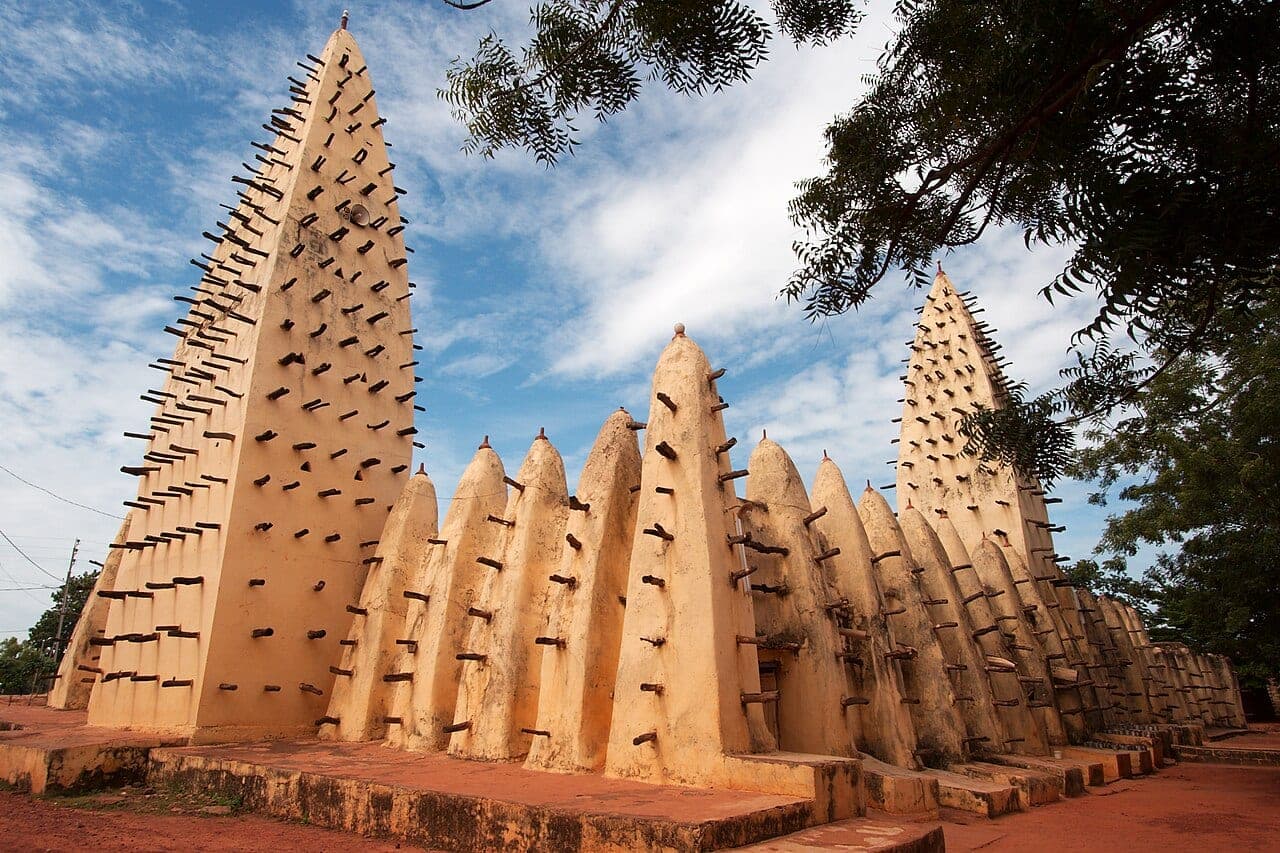
Bobo-Dioulasso. Founded as Sya at a crossing of trade routes, the western city takes its later name from the Bobo and Dyula peoples who met there. Its historic core, the old quarter of Kibidwe, preserves earthen houses and narrow lanes, and at its heart stands the Grand Mosque, raised around 1880 in banco (sun-dried mud) with projecting wooden beams, among the largest works of Sudano-Sahelian architecture in the country.
Koudougou. The third city and a railway town on the line to Abidjan, Koudougou is a market centre for the Gurunsi country, home to one of Burkina Faso's public universities and to the annual Nuits Atypiques festival of music and craft.
Banfora. Capital of the Cascades in the wetter south-west, Banfora is the gateway to the Karfiguéla waterfalls on the Komoé, the eroded sandstone towers of the Sindou Peaks, and the limestone Dômes de Fabédougou, its surrounding plain of sugar cane and fruit among the most productive in the country.
Human industry here is ancient. At Douroula, in the centre-west, iron smelting has been dated to the eighth century BCE, among the earliest evidence of iron production anywhere in Africa, and by around 500 BCE the technology had spread across the region. Centuries later, in the south-west goldfields, the Lohron raised the laterite enclosures of Loropéni and its neighbours to guard the gold that fed the trans-Saharan trade, abandoning the site in the early nineteenth century as coastal shipping drew the commerce away.
 The ruins at Loropeni are the best preserved of a group of stone enclosures tied to the gold trade, and the people who built them are not securely identified. Photograph by Rik Schuiling, CC BY-SA 4.0, via Wikimedia Commons.
The defining polity of the central plateau was the Mossi. By tradition the founders arrived between the eleventh and thirteenth centuries as horse-borne warriors and, joining with earlier inhabitants, built a set of kingdoms, chief among them Ouagadougou, Yatenga, Tenkodogo and Fada N'Gourma. At the apex stood the Mogho Naaba, the ruler of Ouagadougou, described as king of all the Mossi world, governing through titled ministers and regional chiefs, as Britannica records. To the south and west, the Gurunsi, Bobo and Lobi lived in societies without kings, ordered instead by lineage, earth-priests and initiation.
French forces reached the plateau in the 1890s; the Mogho Naba Wobgho resisted before Ouagadougou fell in 1896, and the Mossi lands were absorbed into French West Africa. The colony of Upper Volta was formed in 1919, dissolved in 1932, and reconstituted in 1947. Independence came on 5 August 1960 under Maurice Yaméogo. After years of instability, a young army captain, Thomas Sankara, took power in 1983 and, in 1984, renamed the country Burkina Faso, the land of upright people. His government pressed campaigns for vaccination, literacy, tree-planting and women's rights until he was killed in a coup on 15 October 1987. A long presidency ended in a popular uprising in 2014, and since the middle of the following decade the country has faced a security crisis in the Sahel and further changes of government, noted here only in outline.
French is the language of the state, but the spoken life of Burkina Faso runs through its African languages. Mooré, the tongue of the Mossi, is the most widely spoken; Dyula (Jula) serves as the trade language of the west and south-west; and Fulfulde carries the world of the Fulani herders. More than sixty languages are used across the country, from Gurunsi and Lobiri to Bissa and Senufo.
The nation's name is itself a small parliament of languages. "Burkina" is a Mooré word for upright, honest or incorruptible people; "Faso" is the Dyula word for fatherland or homeland; and the demonym "Burkinabè", used for the citizens, takes its final syllable from Fulfulde, so that the people are named by borrowing from three of their own languages at once. Coined in 1984, the compound was designed to belong to no single group.
Burkina Faso is one of the great centres of African mask art. The Bwa are known for towering plank masks, the nwantantay, painted in geometric red, white and black; their oldest masks were of leaves and fibre for the Do initiation society. The Nuna and Nunuma, subgroups of the Gurunsi, carve brightly painted animal masks; the Bobo dance great butterfly and helmet masks; and the Mossi carry tall antelope and figure masks at funerals. The Lobi keep no masks at all, but carve bateba, standing figures for household and village shrines, some of them "sad" figures whose task is to mourn.
Alongside carving, the country is famous for bronze: in Ouagadougou's foundries the lost-wax method produces figures shattered free of their clay moulds one by one. Music runs on the balafon, the wooden xylophone with calabash resonators whose Senufo and Sambla traditions are inscribed by UNESCO, and on the bendré gourd drum. The country hosts two of Africa's largest cultural gatherings in Ouagadougou, FESPACO for film and the SIAO craft fair. At the table, the staple is tô, a millet or sorghum porridge eaten with sauces of leaf, okra or groundnut, alongside riz gras, grilled brochettes and the millet beer dolo.
Burkina Faso is a country of several faiths living closely together. According to national figures reported in surveys of religion in Burkina Faso, around six in ten citizens are Muslim, roughly a quarter to three in ten are Christian, chiefly Roman Catholic with a growing Protestant presence, and close to one in ten follow African traditional religion. Islam arrived along the Dyula trade routes and with Fulani communities; Christianity came with nineteenth and twentieth-century missions, above all the Catholic White Fathers. Interfaith families are common, and shared festivals and marriages are a point of pride.
Beneath and alongside the mosque and the church, older understandings endure. Mossi tradition honours a creator, Wende, approached through the earth and the ancestors; Bwa religion centres on the god Do and the spirits of the wild, made present in the leaf mask; and Lobi households live under the guidance of the thila, invisible protective spirits who speak through diviners and require the carving of a new bateba when they wish it. Earth-priests and diviners remain part of ordinary life, and many Burkinabè see no contradiction in keeping more than one of these worlds at once.
In much of Burkina Faso the funeral is the largest ceremony a community holds. Among the mask peoples, death is a passage that ritual must guide, and the masks intervene in the uncertain interval when the dead are neither wholly gone nor arrived among the ancestors. A first burial returns the body to the earth; later, often after the harvest, a second and greater observance releases the spirit fully. Among the Bobo the grand funerals gather scattered kin for days of masked dance, drumming and feasting that honour the dead and renew the unity of the living. Among the Mossi the warba dance and the bendré drum sound at funerals as at enthronements, and elders pass into the body of ancestors who watch over their descendants. The Lobi carve bateba whose sorrowing faces mourn on the family's behalf.
Muslim and Christian rites are woven through these observances. Muslim families bury their dead swiftly, washed and shrouded, with prayer and a mourning period marked by visits and almsgiving; Christian families hold a funeral service, a vigil of hymns and a burial in consecrated ground, often followed by a memorial gathering weeks later. Across faiths the pattern is the same in spirit: the whole neighbourhood arrives with food, money and labour, the loss is carried in common, and the dead are given a continuing place rather than left behind. Remembrance is treated less as a single day than as a standing relationship.
Burkinabè family records are held by the naam and by the griots, and the state's are thin.
The Mossi kingdoms have governed the central plateau since the fifteenth century, and the Moro Naba in Ouagadougou remains the paramount ruler with a court, a succession and a hierarchy of chiefs beneath him. Naam is the authority that passes through that structure, and the dynastic record is recited by court historians and drummers. The Friday morning Nab-basga ceremony, in which the Moro Naba performs a departure he never makes, has been enacted continuously for centuries.
The griots, the bendre drummers among the Mossi, hold the genealogies of families as well as of rulers.
The French registered births and deaths here from the 1890s, thoroughly for some people and hardly at all for most, and the files are split between Ouagadougou and Aix-en-Provence. The territory was dissolved into its neighbours between 1932 and 1947, so records of that period are filed under Côte d'Ivoire, Mali and Niger.
Civil registration remains incomplete, and a substantial share of Burkinabè have no birth certificate, which affects schooling and voting.
Two other records. The stone ruins of Loropéni, inscribed by UNESCO, are a thousand years old and nobody is certain who built them. And the mask societies of the Bwa, Nuna and Bobo dance the dead across to the ancestors, which is the function a funeral register performs elsewhere.
Burkina Faso's formal heritage rests on three UNESCO World Heritage sites. The Ruins of Loropéni were inscribed in 2009 as the country's first listing; the Ancient Ferrous Metallurgy Sites, five clusters of furnaces and slag at Douroula, Tiwêga, Yamané, Kindibo and Békuy, were added in 2019 for their record of early African iron-making; and the transboundary W-Arly-Pendjari Complex, shared with Benin and Niger, was recognised in 2017 as a natural site holding West Africa's largest elephant population and its most important stretch of savanna. The balafon traditions of the Senufo are inscribed on UNESCO's list of intangible heritage.
Institutions carry the everyday work. The National Museum of Burkina Faso in Ouagadougou holds masks, textiles and regalia, while the private Musée de Manega, north-west of the capital, was built by the lawyer, poet and griot Titinga Frédéric Pacéré (1943–2024) to gather the ritual objects and oral traditions of the country's peoples. Every two years the town of Dédougou hosts FESTIMA, the international festival of masks and the arts founded in 1996 by an association formed to protect the mask traditions themselves. Insecurity in parts of the country has made the protection of sites and collections harder in recent years.
Burkina Faso's digital record is growing from several directions. FESPACO maintains a film library and archive in Ouagadougou that increasingly works to preserve and digitise African cinema. Major museum collections abroad, among them the Metropolitan Museum of Art, publish high-resolution images and provenance notes that let students study Bwa plank masks and Lobi bateba without handling fragile originals.
Closer to home, national and university efforts document languages and oral literature, from Mooré praise poetry to the recorded work of griots such as Pacéré. Informally, young Burkinabè have turned social media into a folk record, where balafon performances, mask festivals and family ceremonies circulate widely, and diaspora communities in Côte d'Ivoire, France and beyond keep customs current.
Burkina Faso's largest cultural export is cinema. Since 1969, FESPACO, the Pan-African Film and Television Festival of Ouagadougou, has become the most important gathering of African film, held every two years and open only to films by African makers. Its top prize, the Étalon d'Or de Yennenga, is named for the legendary Mossi ancestress of the kingdoms, and directors including Gaston Kaboré and the late Idrissa Ouédraogo have carried the country's storytelling to festivals across the world.
In a country that has known repeated hardship, the biennial return of FESPACO and the mask festivals of the west remain fixed points of pride, drawing visitors and journalists from across Africa and beyond.
A festival that outgrew a week. What began in 1969 as a single African cinema week in Ouagadougou has run for more than half a century to become the continent's foremost film festival.
The first inscription, and then a second. After Loropéni entered the World Heritage List in 2009, Burkina Faso secured a second cultural listing in 2019 for its ancient iron-smelting sites, placing one of Africa's oldest metallurgical traditions on the global map.
A private museum for a whole nation. At Manega, Titinga Frédéric Pacéré assembled masks, funerary objects and oral traditions from across the country in a museum meant to let the world know its many peoples, an archive kept in the community it serves.
Masks kept dancing. The Dédougou mask festival, founded to protect the tradition, has since 1996 brought together mask societies from Burkina Faso and neighbouring countries, keeping a living art in practice rather than behind glass.
The ruins at Loropeni are the best preserved of a group of stone enclosures tied to the gold trade, and the people who built them are not securely identified. Photograph by Rik Schuiling, CC BY-SA 4.0, via Wikimedia Commons.
The defining polity of the central plateau was the Mossi. By tradition the founders arrived between the eleventh and thirteenth centuries as horse-borne warriors and, joining with earlier inhabitants, built a set of kingdoms, chief among them Ouagadougou, Yatenga, Tenkodogo and Fada N'Gourma. At the apex stood the Mogho Naaba, the ruler of Ouagadougou, described as king of all the Mossi world, governing through titled ministers and regional chiefs, as Britannica records. To the south and west, the Gurunsi, Bobo and Lobi lived in societies without kings, ordered instead by lineage, earth-priests and initiation.
French forces reached the plateau in the 1890s; the Mogho Naba Wobgho resisted before Ouagadougou fell in 1896, and the Mossi lands were absorbed into French West Africa. The colony of Upper Volta was formed in 1919, dissolved in 1932, and reconstituted in 1947. Independence came on 5 August 1960 under Maurice Yaméogo. After years of instability, a young army captain, Thomas Sankara, took power in 1983 and, in 1984, renamed the country Burkina Faso, the land of upright people. His government pressed campaigns for vaccination, literacy, tree-planting and women's rights until he was killed in a coup on 15 October 1987. A long presidency ended in a popular uprising in 2014, and since the middle of the following decade the country has faced a security crisis in the Sahel and further changes of government, noted here only in outline.
French is the language of the state, but the spoken life of Burkina Faso runs through its African languages. Mooré, the tongue of the Mossi, is the most widely spoken; Dyula (Jula) serves as the trade language of the west and south-west; and Fulfulde carries the world of the Fulani herders. More than sixty languages are used across the country, from Gurunsi and Lobiri to Bissa and Senufo.
The nation's name is itself a small parliament of languages. "Burkina" is a Mooré word for upright, honest or incorruptible people; "Faso" is the Dyula word for fatherland or homeland; and the demonym "Burkinabè", used for the citizens, takes its final syllable from Fulfulde, so that the people are named by borrowing from three of their own languages at once. Coined in 1984, the compound was designed to belong to no single group.
Burkina Faso is one of the great centres of African mask art. The Bwa are known for towering plank masks, the nwantantay, painted in geometric red, white and black; their oldest masks were of leaves and fibre for the Do initiation society. The Nuna and Nunuma, subgroups of the Gurunsi, carve brightly painted animal masks; the Bobo dance great butterfly and helmet masks; and the Mossi carry tall antelope and figure masks at funerals. The Lobi keep no masks at all, but carve bateba, standing figures for household and village shrines, some of them "sad" figures whose task is to mourn.
Alongside carving, the country is famous for bronze: in Ouagadougou's foundries the lost-wax method produces figures shattered free of their clay moulds one by one. Music runs on the balafon, the wooden xylophone with calabash resonators whose Senufo and Sambla traditions are inscribed by UNESCO, and on the bendré gourd drum. The country hosts two of Africa's largest cultural gatherings in Ouagadougou, FESPACO for film and the SIAO craft fair. At the table, the staple is tô, a millet or sorghum porridge eaten with sauces of leaf, okra or groundnut, alongside riz gras, grilled brochettes and the millet beer dolo.
Burkina Faso is a country of several faiths living closely together. According to national figures reported in surveys of religion in Burkina Faso, around six in ten citizens are Muslim, roughly a quarter to three in ten are Christian, chiefly Roman Catholic with a growing Protestant presence, and close to one in ten follow African traditional religion. Islam arrived along the Dyula trade routes and with Fulani communities; Christianity came with nineteenth and twentieth-century missions, above all the Catholic White Fathers. Interfaith families are common, and shared festivals and marriages are a point of pride.
Beneath and alongside the mosque and the church, older understandings endure. Mossi tradition honours a creator, Wende, approached through the earth and the ancestors; Bwa religion centres on the god Do and the spirits of the wild, made present in the leaf mask; and Lobi households live under the guidance of the thila, invisible protective spirits who speak through diviners and require the carving of a new bateba when they wish it. Earth-priests and diviners remain part of ordinary life, and many Burkinabè see no contradiction in keeping more than one of these worlds at once.
In much of Burkina Faso the funeral is the largest ceremony a community holds. Among the mask peoples, death is a passage that ritual must guide, and the masks intervene in the uncertain interval when the dead are neither wholly gone nor arrived among the ancestors. A first burial returns the body to the earth; later, often after the harvest, a second and greater observance releases the spirit fully. Among the Bobo the grand funerals gather scattered kin for days of masked dance, drumming and feasting that honour the dead and renew the unity of the living. Among the Mossi the warba dance and the bendré drum sound at funerals as at enthronements, and elders pass into the body of ancestors who watch over their descendants. The Lobi carve bateba whose sorrowing faces mourn on the family's behalf.
Muslim and Christian rites are woven through these observances. Muslim families bury their dead swiftly, washed and shrouded, with prayer and a mourning period marked by visits and almsgiving; Christian families hold a funeral service, a vigil of hymns and a burial in consecrated ground, often followed by a memorial gathering weeks later. Across faiths the pattern is the same in spirit: the whole neighbourhood arrives with food, money and labour, the loss is carried in common, and the dead are given a continuing place rather than left behind. Remembrance is treated less as a single day than as a standing relationship.
Burkinabè family records are held by the naam and by the griots, and the state's are thin.
The Mossi kingdoms have governed the central plateau since the fifteenth century, and the Moro Naba in Ouagadougou remains the paramount ruler with a court, a succession and a hierarchy of chiefs beneath him. Naam is the authority that passes through that structure, and the dynastic record is recited by court historians and drummers. The Friday morning Nab-basga ceremony, in which the Moro Naba performs a departure he never makes, has been enacted continuously for centuries.
The griots, the bendre drummers among the Mossi, hold the genealogies of families as well as of rulers.
The French registered births and deaths here from the 1890s, thoroughly for some people and hardly at all for most, and the files are split between Ouagadougou and Aix-en-Provence. The territory was dissolved into its neighbours between 1932 and 1947, so records of that period are filed under Côte d'Ivoire, Mali and Niger.
Civil registration remains incomplete, and a substantial share of Burkinabè have no birth certificate, which affects schooling and voting.
Two other records. The stone ruins of Loropéni, inscribed by UNESCO, are a thousand years old and nobody is certain who built them. And the mask societies of the Bwa, Nuna and Bobo dance the dead across to the ancestors, which is the function a funeral register performs elsewhere.
Burkina Faso's formal heritage rests on three UNESCO World Heritage sites. The Ruins of Loropéni were inscribed in 2009 as the country's first listing; the Ancient Ferrous Metallurgy Sites, five clusters of furnaces and slag at Douroula, Tiwêga, Yamané, Kindibo and Békuy, were added in 2019 for their record of early African iron-making; and the transboundary W-Arly-Pendjari Complex, shared with Benin and Niger, was recognised in 2017 as a natural site holding West Africa's largest elephant population and its most important stretch of savanna. The balafon traditions of the Senufo are inscribed on UNESCO's list of intangible heritage.
Institutions carry the everyday work. The National Museum of Burkina Faso in Ouagadougou holds masks, textiles and regalia, while the private Musée de Manega, north-west of the capital, was built by the lawyer, poet and griot Titinga Frédéric Pacéré (1943–2024) to gather the ritual objects and oral traditions of the country's peoples. Every two years the town of Dédougou hosts FESTIMA, the international festival of masks and the arts founded in 1996 by an association formed to protect the mask traditions themselves. Insecurity in parts of the country has made the protection of sites and collections harder in recent years.
Burkina Faso's digital record is growing from several directions. FESPACO maintains a film library and archive in Ouagadougou that increasingly works to preserve and digitise African cinema. Major museum collections abroad, among them the Metropolitan Museum of Art, publish high-resolution images and provenance notes that let students study Bwa plank masks and Lobi bateba without handling fragile originals.
Closer to home, national and university efforts document languages and oral literature, from Mooré praise poetry to the recorded work of griots such as Pacéré. Informally, young Burkinabè have turned social media into a folk record, where balafon performances, mask festivals and family ceremonies circulate widely, and diaspora communities in Côte d'Ivoire, France and beyond keep customs current.
Burkina Faso's largest cultural export is cinema. Since 1969, FESPACO, the Pan-African Film and Television Festival of Ouagadougou, has become the most important gathering of African film, held every two years and open only to films by African makers. Its top prize, the Étalon d'Or de Yennenga, is named for the legendary Mossi ancestress of the kingdoms, and directors including Gaston Kaboré and the late Idrissa Ouédraogo have carried the country's storytelling to festivals across the world.
In a country that has known repeated hardship, the biennial return of FESPACO and the mask festivals of the west remain fixed points of pride, drawing visitors and journalists from across Africa and beyond.
A festival that outgrew a week. What began in 1969 as a single African cinema week in Ouagadougou has run for more than half a century to become the continent's foremost film festival.
The first inscription, and then a second. After Loropéni entered the World Heritage List in 2009, Burkina Faso secured a second cultural listing in 2019 for its ancient iron-smelting sites, placing one of Africa's oldest metallurgical traditions on the global map.
A private museum for a whole nation. At Manega, Titinga Frédéric Pacéré assembled masks, funerary objects and oral traditions from across the country in a museum meant to let the world know its many peoples, an archive kept in the community it serves.
Masks kept dancing. The Dédougou mask festival, founded to protect the tradition, has since 1996 brought together mask societies from Burkina Faso and neighbouring countries, keeping a living art in practice rather than behind glass.
National Overview
Notable Cities
Historical Foundations
Linguistic and Etymological Roots
Cultural Identity
Religion and Spirituality
Remembrance and Mourning Traditions
Tracing a Family in Burkina Faso
Heritage Preservation Efforts
Digital Heritage
Contemporary Cultural Influences
Success Stories
References and resources
- UNESCO World Heritage Centre: Ruins of Loropéni. Inscription record for the best-preserved stone enclosure of the goldfields.
- UNESCO World Heritage Centre: Ancient Ferrous Metallurgy Sites of Burkina Faso. The five iron-smelting clusters inscribed in 2019.
- UNESCO World Heritage Centre: W-Arly-Pendjari Complex. The transboundary savanna site shared with Benin and Niger.
- UNESCO Intangible Cultural Heritage: Balafon of the Senufo communities. The xylophone tradition of Mali, Burkina Faso and Côte d'Ivoire.
- UNESCO Creative Cities Network: Ouagadougou. The capital's designation for crafts and folk art.
- Encyclopaedia Britannica: Burkina Faso. Geography, peoples, history and political background.
- Encyclopaedia Britannica: Mossi states. The plateau kingdoms and the Mogho Naaba.
- Encyclopaedia Britannica: Thomas Sankara. The 1983–1987 government and the 1984 renaming.
- The Metropolitan Museum of Art: Plank Mask (Nwantantay), Bwa peoples. Documentation of Burkinabè mask art.
- Panafrican Film and Television Festival of Ouagadougou (FESPACO). History of the pan-African film festival since 1969.
- Musée de Manega. The private museum of Burkinabè heritage founded by Titinga Frédéric Pacéré.