Heritage · Country
Italy Culture and Heritage
Italy holds 62 World Heritage sites, more than any other country, and a culture of memory that runs from Dante's tomb to Sicily's gifts from the dead. A guide to the peninsula's heritage, its mourning traditions and the institutions that keep the world's largest artistic inheritance alive.Written to last.
By Confinity Heritage Editorial · 2026-07-10 · 8-minute readQuiet tools, kept out of the way.
No country carries more of the world's officially recognised heritage than Italy. Its 62 World Heritage sites, the most of any nation on earth, run from Etruscan tombs and Greek temples through Roman cities frozen by Vesuvius to the Renaissance centres of Florence and Venice, and in December 2025 UNESCO added something no country had achieved before: Italian cuisine, inscribed in its entirety as intangible heritage of humanity. Yet the official lists only hint at how Italians actually live with the past, in ten thousand town squares where the church, the bell tower and the war memorial still organise belonging.
Italy is also a country with a distinctive genius for remembrance. It built cemeteries as open-air museums, keeps a hall of fame for its illustrious dead in Milan, sends children letters and marzipan fruit from their dead grandparents each November, and pastes funeral notices on village walls so that no death passes unannounced.
Italy thrusts its boot-shaped peninsula from the Alps deep into the central Mediterranean, flanked by the great islands of Sicily and Sardinia. Just over 301,000 square kilometres in area, it is a country of mountains, the Alpine arc in the north and the Apennine spine running its whole length, softened by the fertile Po Valley and a coastline of some 7,600 kilometres. Two independent states survive inside its borders as reminders of the peninsula's fragmented past: the Republic of San Marino, and Vatican City in the heart of Rome.
Around 59 million people live in Italy's twenty regions, with Rome, Milan and Naples the largest cities. The population is among the oldest in the world, and roughly five million foreign residents now call the country home, the newest layer in a very old story of migration in both directions. Italy was a founding member of the European Economic Community in 1957 and uses the euro. Its regions retain fierce identities, distinct kitchens, dialects and calendars of saints, which is why Italians often say their true homeland is the paese, the home town, before the nation. The republic itself is young, dating from the referendum of 1946, but the civilisation it stewards is among the oldest continuously creative in the world.
Rome. The Eternal City has been a capital three times over: of an empire that ruled the Mediterranean world, of the Catholic Church, and of the modern Italian state since 1871. Founded, legend says, by Romulus in 753 BC, it holds the Colosseum, the Pantheon with its two-thousand-year-old concrete dome, the Forum, and layer upon layer of church, palace and fountain; its historic centre is a World Heritage site, and Vatican City within it holds St Peter's Basilica and Michelangelo's Sistine Chapel. Rome's Verano cemetery and the pyramid-shadowed Non-Catholic Cemetery, resting place of Keats and Shelley, belong to its quieter monumental heritage.
Florence. The cradle of the Renaissance banked, built and painted its way to immortality under the Medici. Brunelleschi's dome still crowns the skyline, the Uffizi holds Botticelli and Leonardo, and the church of Santa Croce serves as the national pantheon, sheltering the tombs of Michelangelo, Galileo, Machiavelli and Rossini. Each Easter the city detonates the Scoppio del Carro, a cartload of fireworks ignited by a mechanical dove, a ritual of good harvest kept for centuries.
Venice. The improbable republic built on a lagoon ruled the eastern Mediterranean's trade for centuries as the Serenissima. Its canals, palaces and St Mark's golden basilica form a World Heritage site now defended against rising water by the MOSE barriers, first raised in 2020, and against its own popularity by measures such as the ban on large cruise ships from the historic basin and Europe's first day-visitor access fee. The Carnival, revived in 1979, fills February with masks descended from the republic's theatre of anonymity, and burial on the cypress island of San Michele remains one of the most evocative farewells in Europe.
Milan. Italy's economic capital pairs the great Gothic Duomo and Leonardo da Vinci's Last Supper with the world's fashion week and the Salone del Mobile design fair. It also keeps one of Italy's most remarkable institutions of remembrance: the Cimitero Monumentale, opened in 1866, whose entrance hall, the Famedio or "temple of fame", holds the tomb of the novelist Alessandro Manzoni and the inscribed names of the citizens Milan judges worthy of permanent memory. With Cortina d'Ampezzo, Milan hosted the 2026 Winter Olympics.
Naples. Founded by Greek colonists as Neapolis, the "new city", Naples is the metropolis of the Italian south, seat of kings for centuries and guardian of an unbroken popular culture of song, theatre and street devotion. Its historic centre is a World Heritage site; Pompeii and Herculaneum lie under Vesuvius nearby; and its gift to the world's table, the pizza, was consecrated in 1889 when Raffaele Esposito baked the tricolour Margherita for Queen Margherita of Savoy. Three times a year the city crowds its cathedral to watch the dried blood of its patron San Gennaro liquefy, an act of collective memory as much as faith.
Palermo. Sicily's capital layers Phoenician, Roman, Arab and Norman inheritances; its Arab-Norman churches and palaces, golden with mosaics, were inscribed by UNESCO in 2015. Palermo is the home of the opera dei pupi, the chivalric puppet theatre, and of the Capuchin catacombs, where thousands of mummified Palermitans in their Sunday clothes testify to a Sicilian familiarity with the dead that outsiders find startling and Sicilians find natural.
Before Rome there were the Etruscans, whose painted tombs at Tarquinia and Cerveteri are themselves World Heritage sites, and the Greeks of the south, whose temples at Paestum and Agrigento outshine most in Greece. Rome, founded by tradition in 753 BC and a republic from 509 BC, absorbed them all and then the Mediterranean: by the second century AD the peninsula sat at the centre of an empire stretching from Britain to Mesopotamia, and its law, language, roads and architecture became Europe's common inheritance. The Western Empire's fall in 476 opened centuries of fragmentation, Lombard duchies, Byzantine outposts, papal lands, and from that fragmentation grew Italy's characteristic form: the city-state. Venice, Genoa, Pisa and Amalfi ruled the seas; Florence, Siena and Bologna, with Europe's first university (1088), ruled banking and learning.
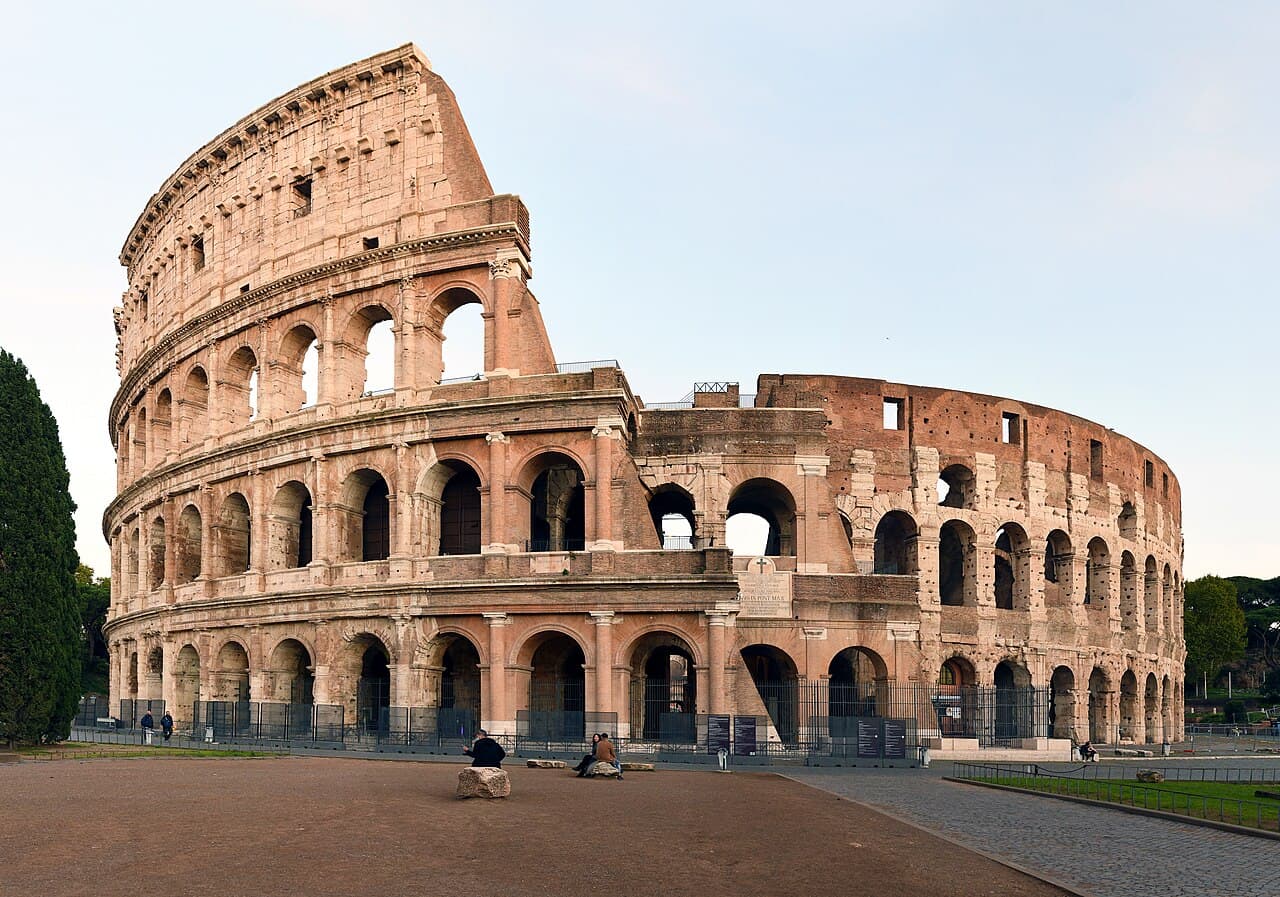
 The Colosseum, finished in AD 80 and still the largest amphitheatre ever built. Photograph by Acediscovery, CC BY 4.0, via Wikimedia Commons.
Out of the communes came the Renaissance, the fourteenth-to-sixteenth-century rebirth of classical learning and artistic ambition, funded by patrons such as the Medici and accelerated by Greek scholars arriving after Constantinople's fall in 1453. Leonardo, Michelangelo and Raphael redefined what art could do while Machiavelli redefined politics. Centuries of foreign domination followed, Spanish, then Austrian, until the nineteenth-century Risorgimento, driven by Cavour's diplomacy, Garibaldi's expeditions and Mazzini's ideas, unified the peninsula under Victor Emmanuel II in 1861; Rome fell to Italian troops and became the capital in 1871. The twentieth century brought the trauma of the First World War's Alpine front, two decades of Fascist dictatorship under Mussolini, catastrophic war, armed resistance, and, in the referendum of 2 June 1946, in which Italian women voted for the first time nationally, the choice of a republic. Post-war Italy rebuilt itself into a founding member of the European project and one of the world's largest economies.
The name "Italia" is older than Rome's dominance of the peninsula. The most accepted derivation traces it to the Oscan Víteliú, "land of young cattle", cognate with the Latin vitulus, a calf, fitting for the herding peoples of the ancient south; Greek writers first applied "Italia" to the toe of the peninsula and gradually stretched it northward. The language, meanwhile, is Latin's most direct heir, and its standard form is a monument to literature: modern Italian rests on the fourteenth-century Tuscan of Dante's Divine Comedy, Petrarch's sonnets and Boccaccio's Decameron, chosen as the model of cultivated writing centuries before any Italian state existed.
That literary standard was, for most of history, almost nobody's mother tongue. At unification in 1861, on the classic estimate, only around one Italian in forty spoke the national language, and even generous counts put it below one in ten; everyone else spoke the regional languages usually called dialects, from Venetian and Piedmontese to Neapolitan and Sicilian, each with its own literature and song. Schooling, conscription, migration and above all television made Italian universal within a century, but the older tongues persist alongside it, and a 1999 law formally protects twelve historical linguistic minorities, among them Sardinian, spoken by perhaps a million people and the most conservative of all Romance languages; Friulian in the north-east; the Germanic speech of South Tyrol; Arbëresh, the Albanian of fifteenth-century refugees; and Griko, the Greek still heard in a few villages of the far south, a living echo of Magna Graecia. UNESCO classifies several of these as endangered, and regional governments now fund the teaching their predecessors once discouraged.
The first fact of Italian identity is that it is local. Campanilismo, loyalty to one's own campanile or bell tower, names the fierce attachment to town, dialect, patron saint and kitchen that precedes any national feeling; the year's most passionate rivalries are between neighbourhoods, as in Siena's Palio, the bareback horse race run twice each summer since the Middle Ages by the city's seventeen contrade, each with its own museum, church and baptismal font. The family remains the load-bearing wall of social life, its great institution the long Sunday lunch, and the daily rituals of the aperitivo and the evening passeggiata keep the piazza working as the living room of the community.
Food is identity made edible, and it is deliberately historical: hundreds of local products carry protected designations, every town honours its own pasta shape or festival dish, and UNESCO has recognised in turn the Mediterranean diet, the art of the Neapolitan pizzaiuolo (2017), truffle hunting (2021) and finally, in December 2025, Italian cuisine as a whole, the world's first national cuisine inscribed in its entirety, cited for the way cooking binds families and communities together. Music runs just as deep. Opera was born in Florence around 1600, found its first public opera house in Venice in 1637, and conquered the world through Verdi and Puccini; the craft of violin-making in Cremona, home of Stradivari, was inscribed by UNESCO in 2012, and the practice of opera singing itself followed in 2023. Italy's twentieth-century gifts, cinema, industrial design and fashion, extend the same conviction that beauty is a civic duty, summed up in the phrase "Made in Italy".
Catholicism has shaped Italy more than any other single force. Rome is the seat of the papacy, and Vatican City, the world's smallest state, governs a church of well over a billion members; the Lateran agreements, revised in 1984, ended Catholicism's status as state religion while acknowledging its part in Italian life. A large majority of Italians still identify as Catholic, though regular practice is far lower, and the rhythm of the year remains liturgical: every town keeps the feast of its patron saint with processions, fireworks and food, from Naples' San Gennaro to the flower-carpeted streets of Corpus Domini. Italy's patron saints, Francis of Assisi and Catherine of Siena, embody the tradition's two poles, poverty and fearless speech.
The sacred landscape is dense beyond counting: Assisi, Padua, Loreto and the Turin shroud draw pilgrims by the million, and UNESCO's list of celebrations of great shoulder-borne processional structures (2013) protects the festivals in which whole towns carry towering wooden machines through the streets, as at Nola and Viterbo. Older strata persist inside the Catholic frame, in southern tarantella rituals and harvest feasts. Italy is also home to the oldest Jewish community in Europe, present in Rome for over two thousand years, to the Waldensian Protestant church in its Alpine valleys, and, through recent migration, to significant Muslim, Orthodox Christian, Buddhist and Hindu communities, making the peninsula once again what it was in antiquity, a crossroads of faiths.
Italian mourning begins in public. In small towns and across the south, a death is announced by manifesti funebri, black-bordered posters pasted on walls and notice boards giving the name, the family and the funeral hour, so that the whole community is informed and expected; the church bell tolls the campana a morto, and neighbours keep the veglia, the wake at home or in the hospital chapel, praying the rosary through the night. The funeral Mass follows within days, and in the villages the whole town walks behind the hearse. Mourning dress has softened from the era when widows wore black for years, but the etiquette of condolence, the visit, the food brought to the house, the anniversary Mass announced in the same wall posters, remains binding. In the deep south this culture once included professional lamenters, the prefiche, whose ritual weeping the anthropologist Ernesto de Martino documented in Lucania in the 1950s as the last survival of a practice reaching back to the ancient world.
The Colosseum, finished in AD 80 and still the largest amphitheatre ever built. Photograph by Acediscovery, CC BY 4.0, via Wikimedia Commons.
Out of the communes came the Renaissance, the fourteenth-to-sixteenth-century rebirth of classical learning and artistic ambition, funded by patrons such as the Medici and accelerated by Greek scholars arriving after Constantinople's fall in 1453. Leonardo, Michelangelo and Raphael redefined what art could do while Machiavelli redefined politics. Centuries of foreign domination followed, Spanish, then Austrian, until the nineteenth-century Risorgimento, driven by Cavour's diplomacy, Garibaldi's expeditions and Mazzini's ideas, unified the peninsula under Victor Emmanuel II in 1861; Rome fell to Italian troops and became the capital in 1871. The twentieth century brought the trauma of the First World War's Alpine front, two decades of Fascist dictatorship under Mussolini, catastrophic war, armed resistance, and, in the referendum of 2 June 1946, in which Italian women voted for the first time nationally, the choice of a republic. Post-war Italy rebuilt itself into a founding member of the European project and one of the world's largest economies.
The name "Italia" is older than Rome's dominance of the peninsula. The most accepted derivation traces it to the Oscan Víteliú, "land of young cattle", cognate with the Latin vitulus, a calf, fitting for the herding peoples of the ancient south; Greek writers first applied "Italia" to the toe of the peninsula and gradually stretched it northward. The language, meanwhile, is Latin's most direct heir, and its standard form is a monument to literature: modern Italian rests on the fourteenth-century Tuscan of Dante's Divine Comedy, Petrarch's sonnets and Boccaccio's Decameron, chosen as the model of cultivated writing centuries before any Italian state existed.
That literary standard was, for most of history, almost nobody's mother tongue. At unification in 1861, on the classic estimate, only around one Italian in forty spoke the national language, and even generous counts put it below one in ten; everyone else spoke the regional languages usually called dialects, from Venetian and Piedmontese to Neapolitan and Sicilian, each with its own literature and song. Schooling, conscription, migration and above all television made Italian universal within a century, but the older tongues persist alongside it, and a 1999 law formally protects twelve historical linguistic minorities, among them Sardinian, spoken by perhaps a million people and the most conservative of all Romance languages; Friulian in the north-east; the Germanic speech of South Tyrol; Arbëresh, the Albanian of fifteenth-century refugees; and Griko, the Greek still heard in a few villages of the far south, a living echo of Magna Graecia. UNESCO classifies several of these as endangered, and regional governments now fund the teaching their predecessors once discouraged.
The first fact of Italian identity is that it is local. Campanilismo, loyalty to one's own campanile or bell tower, names the fierce attachment to town, dialect, patron saint and kitchen that precedes any national feeling; the year's most passionate rivalries are between neighbourhoods, as in Siena's Palio, the bareback horse race run twice each summer since the Middle Ages by the city's seventeen contrade, each with its own museum, church and baptismal font. The family remains the load-bearing wall of social life, its great institution the long Sunday lunch, and the daily rituals of the aperitivo and the evening passeggiata keep the piazza working as the living room of the community.
Food is identity made edible, and it is deliberately historical: hundreds of local products carry protected designations, every town honours its own pasta shape or festival dish, and UNESCO has recognised in turn the Mediterranean diet, the art of the Neapolitan pizzaiuolo (2017), truffle hunting (2021) and finally, in December 2025, Italian cuisine as a whole, the world's first national cuisine inscribed in its entirety, cited for the way cooking binds families and communities together. Music runs just as deep. Opera was born in Florence around 1600, found its first public opera house in Venice in 1637, and conquered the world through Verdi and Puccini; the craft of violin-making in Cremona, home of Stradivari, was inscribed by UNESCO in 2012, and the practice of opera singing itself followed in 2023. Italy's twentieth-century gifts, cinema, industrial design and fashion, extend the same conviction that beauty is a civic duty, summed up in the phrase "Made in Italy".
Catholicism has shaped Italy more than any other single force. Rome is the seat of the papacy, and Vatican City, the world's smallest state, governs a church of well over a billion members; the Lateran agreements, revised in 1984, ended Catholicism's status as state religion while acknowledging its part in Italian life. A large majority of Italians still identify as Catholic, though regular practice is far lower, and the rhythm of the year remains liturgical: every town keeps the feast of its patron saint with processions, fireworks and food, from Naples' San Gennaro to the flower-carpeted streets of Corpus Domini. Italy's patron saints, Francis of Assisi and Catherine of Siena, embody the tradition's two poles, poverty and fearless speech.
The sacred landscape is dense beyond counting: Assisi, Padua, Loreto and the Turin shroud draw pilgrims by the million, and UNESCO's list of celebrations of great shoulder-borne processional structures (2013) protects the festivals in which whole towns carry towering wooden machines through the streets, as at Nola and Viterbo. Older strata persist inside the Catholic frame, in southern tarantella rituals and harvest feasts. Italy is also home to the oldest Jewish community in Europe, present in Rome for over two thousand years, to the Waldensian Protestant church in its Alpine valleys, and, through recent migration, to significant Muslim, Orthodox Christian, Buddhist and Hindu communities, making the peninsula once again what it was in antiquity, a crossroads of faiths.
Italian mourning begins in public. In small towns and across the south, a death is announced by manifesti funebri, black-bordered posters pasted on walls and notice boards giving the name, the family and the funeral hour, so that the whole community is informed and expected; the church bell tolls the campana a morto, and neighbours keep the veglia, the wake at home or in the hospital chapel, praying the rosary through the night. The funeral Mass follows within days, and in the villages the whole town walks behind the hearse. Mourning dress has softened from the era when widows wore black for years, but the etiquette of condolence, the visit, the food brought to the house, the anniversary Mass announced in the same wall posters, remains binding. In the deep south this culture once included professional lamenters, the prefiche, whose ritual weeping the anthropologist Ernesto de Martino documented in Lucania in the 1950s as the last survival of a practice reaching back to the ancient world.
 A family tomb in Milan's Cimitero Monumentale, where households commissioned sculpture rather than headstones. Photograph by Pierre Andre Leclercq, CC BY-SA 4.0, via Wikimedia Commons.
The great festival of memory is the beginning of November. On All Saints' Day and above all on 2 November, Il Giorno dei Morti, Italy goes to its cemeteries: families wash the marble, light lamps and lay chrysanthemums, the flower so bound to the dead that no Italian would ever offer it as a gift. Every region bakes remembrance into sweets with unblinking names, the ossa dei morti, "bones of the dead", pane dei morti, fave dei morti. Sicily keeps the tenderest version: there, the dead themselves bring presents. On the night before the feast, deceased grandparents and relatives are said to visit and leave gifts and sweets for children who have been good and have prayed for them, marzipan fruit called frutta di martorana, sugar puppets, toys, sometimes answering letters the children have written to them. Generations of Sicilians thus met death first as generosity, and the custom, older in the island than any imported Halloween, is now consciously defended as heritage.
Italy also built remembrance in marble on a scale no other country matched. The Napoleonic edict that moved burials outside city walls provoked Ugo Foscolo's great poem Dei Sepolcri (1807), a defence of tombs as the hearth of civic memory, and the century that followed took him at his word: Genoa's Staglieno, opened in 1851 across a hillside square kilometre, became an open-air museum of astonishing realist sculpture, mourners in carved lace and beloved bread-sellers in bronze, while Milan's Cimitero Monumentale gathered the city's history into sculpture and crowned it with the Famedio, where civic commissions still deliberate each year over which names deserve inscription among the city's honoured dead. Florence's Santa Croce serves the nation the same way; Dante, exiled in life, lies instead at Ravenna, where Florence, in perpetual apology, still supplies the olive oil that burns in the lamp at his tomb.
The twentieth century added the memory of war and persecution. After the First World War almost every Italian commune, however small, raised a monumento ai caduti listing its fallen sons, and in 1921 a grieving Trieste mother, Maria Bergamas, chose one unidentifiable soldier from eleven coffins at Aquileia; his burial at the Altare della Patria in Rome as the Milite Ignoto, the Unknown Soldier, gave the nation a shared grave for its 650,000 dead, honoured ever since by an eternal flame. Since 2000 the republic has kept 27 January as the Giorno della Memoria for the victims of the Holocaust and Italy's own racial laws, and thousands of pietre d'inciampo, brass "stumbling stones", now stud the pavements of Rome, Milan and other cities before the doors of the deported, small monuments met at foot level, one name at a time.
Italy is two record systems with a seam running across the middle of the country. In the south, under Napoleonic rule, civil registration of births, marriages and deaths began in 1809. In the centre and north it waited for unification and began in 1866. If your family came from Naples or Sicily you have half a century more of state records than a family from Lombardy.
The state archives have put those registers online at Portale Antenati, run by the national archives administration, and it is free. What you find there are photographs of the register pages, in the clerk's handwriting, in the formula the law required: the hour of the birth, the father's occupation, the two witnesses and whether they could sign their names.
Before civil registration the Catholic Church kept the record, and it kept it thoroughly. The Council of Trent required parishes to register baptisms and marriages from 1563, and burials followed, so a well-preserved Italian parish can carry a family back four hundred years. Access is at the discretion of the diocese, and practice varies enormously between one and the next.
The other Italian archive is the one the emigrants made. Between 1876 and 1976 something like twenty-six million people left, and the paperwork of that departure sits in ship manifests, arrival records and naturalisation files in the countries they reached, which is why so much Italian genealogy is done from Buenos Aires, New York and Melbourne rather than from Italy.
Italy effectively invented state heritage protection, and its constitution (Article 9) makes safeguarding the landscape and the historical and artistic patrimony a founding duty of the republic. The Ministry of Culture administers the system under the Cultural Heritage and Landscape Code of 2004, through regional superintendencies whose approval governs everything from excavation to rooftop renovation. The scale of the task is unique: 62 World Heritage sites, thousands of museums and libraries, and, by common estimate, a larger share of the world's significant art than any other country. Italy also pioneered the policing of that inheritance: the Carabinieri Command for the Protection of Cultural Heritage, founded in 1969 as the world's first specialised art-crime unit, runs the largest database of stolen art anywhere and has recovered treasures from Etruscan gold to the Euphronios krater, returned by New York's Metropolitan Museum in 2008.
Restoration is an Italian science. Florence's Opificio delle Pietre Dure, founded by the Medici in 1588 as a workshop of semi-precious stone inlay, evolved into one of the world's leading conservation institutes and, with Rome's Istituto Centrale per il Restauro (1939), trains restorers through celebrated state schools; the discipline's modern methods were forged in the emergency of the 1966 Arno flood, when volunteer "mud angels" from around the world pulled manuscripts and panel paintings from the silt. Civil society matches the state: the FAI (Fondo per l'Ambiente Italiano), founded in 1975 on the model of the National Trust, restores and opens historic places, and its spring open days draw crowds in the hundreds of thousands. Intangible heritage has its own guardian in Slow Food, born in 1986 in Bra, Piedmont, from Carlo Petrini's revolt against fast food: its Ark of Taste catalogues thousands of endangered foods worldwide and its presidia keep small producers, and the landscapes and memories behind them, in business. And at Pompeii, the EU-funded Great Pompeii Project turned a site once famous for collapses into a model of stabilisation, maintenance and new excavation.
The Vatican Apostolic Library is carrying one of the world's great manuscript collections onto the open web: its DigiVatLib platform, begun in 2010, is working through some 80,000 codices, from Virgil's earliest surviving manuscripts to Renaissance treatises, published free in high resolution under the IIIF standard so scholars can compare pages across the world's libraries. The Uffizi has done the same for sculpture, partnering with Indiana University to scan its ancient marbles in three dimensions and publishing hundreds of interactive models online since 2018. National portals knit the rest together: Internet Culturale aggregates the digitised holdings of Italian libraries, and the ministry's digital library programme is systematically imaging archives and museum collections.
For families, the most quietly moving project is the Portale Antenati, the "Ancestors Portal" of the State Archives, which has digitised tens of millions of pages of civil registers, births, marriages and deaths reaching back to the Napoleonic era. It exists above all for the descendants of the great emigration: from Buenos Aires to Brooklyn to Melbourne, people whose great-grandparents left with cardboard suitcases can now read the handwriting that recorded their ancestors' lives, village by village. Museums add virtual access at the other end of the telescope, with online tours of Venice, Pompeii and the Vatican Museums bringing sites under visitor pressure to screens everywhere.
Italy's modern culture still sets global agendas. Its cinema, from Rossellini's neorealism through Fellini to Paolo Sorrentino's The Great Beauty, which took the foreign-language Oscar (2014), circles obsessively around memory and time, and the Venice Film Festival, founded in 1932, is the world's oldest. Its literature counts six Nobel laureates, from Pirandello to Dario Fo, and in Elena Ferrante's Neapolitan novels it produced this century's most translated portrait of an Italian city. Umberto Eco made a medievalist a global bestseller; Primo Levi's testimony from Auschwitz remains one of the essential books of remembrance. In music, the opera houses endure while Måneskin's 2021 Eurovision victory took Italian rock to the top of world charts, and Italian fashion and design, Milan's twin engines, continue to define how much of the planet dresses and furnishes itself.
The Italian diaspora multiplies all of this: tens of millions of people worldwide, by some estimates as many as eighty million, claim Italian descent, and their feast days, saint processions and Sunday sauces are acts of remembrance as much as appetite. Heritage travel, citizenship applications through ancestral lines and the genealogical boom around the Antenati portal have turned that sentiment into a permanent bridge, while regional associations from Toronto to São Paulo maintain the campanilismo of villages their members have never seen.
A cuisine becomes heritage of humanity. In December 2025, after a candidacy stressing the Sunday table, the nonna teaching pasta to grandchildren and food as the language of family memory, UNESCO inscribed Italian cuisine on its Representative List, the first time an entire national cuisine received the recognition.
The puppets that refused to die. Sicily's opera dei pupi, the chivalric puppet theatre of Palermo and Catania, was collapsing with its audiences in the 1970s when the Pasqualino family and fellow enthusiasts built a museum and network around the surviving puppeteer dynasties. Proclaimed a UNESCO masterpiece in 2001 and inscribed in 2008, the tradition now trains new pupari and performs to full houses.
From the mud of 1966 to a global school. The Florence flood that drowned libraries and altarpieces also created modern conservation: the campaigns that saved Cimabue's crucifix and, after five decades of work by the Opificio delle Pietre Dure, returned Vasari's Last Supper to Santa Croce in 2016, trained the restorers the whole world now consults.
The art detectives. The Carabinieri art squad, the first police unit anywhere dedicated to cultural property, has spent over half a century tracking looted antiquities and stolen masterpieces, building the world's largest stolen-art database and bringing home works from the Euphronios krater to Caravaggio-era canvases, a national promise that what is taken will be pursued.
A family tomb in Milan's Cimitero Monumentale, where households commissioned sculpture rather than headstones. Photograph by Pierre Andre Leclercq, CC BY-SA 4.0, via Wikimedia Commons.
The great festival of memory is the beginning of November. On All Saints' Day and above all on 2 November, Il Giorno dei Morti, Italy goes to its cemeteries: families wash the marble, light lamps and lay chrysanthemums, the flower so bound to the dead that no Italian would ever offer it as a gift. Every region bakes remembrance into sweets with unblinking names, the ossa dei morti, "bones of the dead", pane dei morti, fave dei morti. Sicily keeps the tenderest version: there, the dead themselves bring presents. On the night before the feast, deceased grandparents and relatives are said to visit and leave gifts and sweets for children who have been good and have prayed for them, marzipan fruit called frutta di martorana, sugar puppets, toys, sometimes answering letters the children have written to them. Generations of Sicilians thus met death first as generosity, and the custom, older in the island than any imported Halloween, is now consciously defended as heritage.
Italy also built remembrance in marble on a scale no other country matched. The Napoleonic edict that moved burials outside city walls provoked Ugo Foscolo's great poem Dei Sepolcri (1807), a defence of tombs as the hearth of civic memory, and the century that followed took him at his word: Genoa's Staglieno, opened in 1851 across a hillside square kilometre, became an open-air museum of astonishing realist sculpture, mourners in carved lace and beloved bread-sellers in bronze, while Milan's Cimitero Monumentale gathered the city's history into sculpture and crowned it with the Famedio, where civic commissions still deliberate each year over which names deserve inscription among the city's honoured dead. Florence's Santa Croce serves the nation the same way; Dante, exiled in life, lies instead at Ravenna, where Florence, in perpetual apology, still supplies the olive oil that burns in the lamp at his tomb.
The twentieth century added the memory of war and persecution. After the First World War almost every Italian commune, however small, raised a monumento ai caduti listing its fallen sons, and in 1921 a grieving Trieste mother, Maria Bergamas, chose one unidentifiable soldier from eleven coffins at Aquileia; his burial at the Altare della Patria in Rome as the Milite Ignoto, the Unknown Soldier, gave the nation a shared grave for its 650,000 dead, honoured ever since by an eternal flame. Since 2000 the republic has kept 27 January as the Giorno della Memoria for the victims of the Holocaust and Italy's own racial laws, and thousands of pietre d'inciampo, brass "stumbling stones", now stud the pavements of Rome, Milan and other cities before the doors of the deported, small monuments met at foot level, one name at a time.
Italy is two record systems with a seam running across the middle of the country. In the south, under Napoleonic rule, civil registration of births, marriages and deaths began in 1809. In the centre and north it waited for unification and began in 1866. If your family came from Naples or Sicily you have half a century more of state records than a family from Lombardy.
The state archives have put those registers online at Portale Antenati, run by the national archives administration, and it is free. What you find there are photographs of the register pages, in the clerk's handwriting, in the formula the law required: the hour of the birth, the father's occupation, the two witnesses and whether they could sign their names.
Before civil registration the Catholic Church kept the record, and it kept it thoroughly. The Council of Trent required parishes to register baptisms and marriages from 1563, and burials followed, so a well-preserved Italian parish can carry a family back four hundred years. Access is at the discretion of the diocese, and practice varies enormously between one and the next.
The other Italian archive is the one the emigrants made. Between 1876 and 1976 something like twenty-six million people left, and the paperwork of that departure sits in ship manifests, arrival records and naturalisation files in the countries they reached, which is why so much Italian genealogy is done from Buenos Aires, New York and Melbourne rather than from Italy.
Italy effectively invented state heritage protection, and its constitution (Article 9) makes safeguarding the landscape and the historical and artistic patrimony a founding duty of the republic. The Ministry of Culture administers the system under the Cultural Heritage and Landscape Code of 2004, through regional superintendencies whose approval governs everything from excavation to rooftop renovation. The scale of the task is unique: 62 World Heritage sites, thousands of museums and libraries, and, by common estimate, a larger share of the world's significant art than any other country. Italy also pioneered the policing of that inheritance: the Carabinieri Command for the Protection of Cultural Heritage, founded in 1969 as the world's first specialised art-crime unit, runs the largest database of stolen art anywhere and has recovered treasures from Etruscan gold to the Euphronios krater, returned by New York's Metropolitan Museum in 2008.
Restoration is an Italian science. Florence's Opificio delle Pietre Dure, founded by the Medici in 1588 as a workshop of semi-precious stone inlay, evolved into one of the world's leading conservation institutes and, with Rome's Istituto Centrale per il Restauro (1939), trains restorers through celebrated state schools; the discipline's modern methods were forged in the emergency of the 1966 Arno flood, when volunteer "mud angels" from around the world pulled manuscripts and panel paintings from the silt. Civil society matches the state: the FAI (Fondo per l'Ambiente Italiano), founded in 1975 on the model of the National Trust, restores and opens historic places, and its spring open days draw crowds in the hundreds of thousands. Intangible heritage has its own guardian in Slow Food, born in 1986 in Bra, Piedmont, from Carlo Petrini's revolt against fast food: its Ark of Taste catalogues thousands of endangered foods worldwide and its presidia keep small producers, and the landscapes and memories behind them, in business. And at Pompeii, the EU-funded Great Pompeii Project turned a site once famous for collapses into a model of stabilisation, maintenance and new excavation.
The Vatican Apostolic Library is carrying one of the world's great manuscript collections onto the open web: its DigiVatLib platform, begun in 2010, is working through some 80,000 codices, from Virgil's earliest surviving manuscripts to Renaissance treatises, published free in high resolution under the IIIF standard so scholars can compare pages across the world's libraries. The Uffizi has done the same for sculpture, partnering with Indiana University to scan its ancient marbles in three dimensions and publishing hundreds of interactive models online since 2018. National portals knit the rest together: Internet Culturale aggregates the digitised holdings of Italian libraries, and the ministry's digital library programme is systematically imaging archives and museum collections.
For families, the most quietly moving project is the Portale Antenati, the "Ancestors Portal" of the State Archives, which has digitised tens of millions of pages of civil registers, births, marriages and deaths reaching back to the Napoleonic era. It exists above all for the descendants of the great emigration: from Buenos Aires to Brooklyn to Melbourne, people whose great-grandparents left with cardboard suitcases can now read the handwriting that recorded their ancestors' lives, village by village. Museums add virtual access at the other end of the telescope, with online tours of Venice, Pompeii and the Vatican Museums bringing sites under visitor pressure to screens everywhere.
Italy's modern culture still sets global agendas. Its cinema, from Rossellini's neorealism through Fellini to Paolo Sorrentino's The Great Beauty, which took the foreign-language Oscar (2014), circles obsessively around memory and time, and the Venice Film Festival, founded in 1932, is the world's oldest. Its literature counts six Nobel laureates, from Pirandello to Dario Fo, and in Elena Ferrante's Neapolitan novels it produced this century's most translated portrait of an Italian city. Umberto Eco made a medievalist a global bestseller; Primo Levi's testimony from Auschwitz remains one of the essential books of remembrance. In music, the opera houses endure while Måneskin's 2021 Eurovision victory took Italian rock to the top of world charts, and Italian fashion and design, Milan's twin engines, continue to define how much of the planet dresses and furnishes itself.
The Italian diaspora multiplies all of this: tens of millions of people worldwide, by some estimates as many as eighty million, claim Italian descent, and their feast days, saint processions and Sunday sauces are acts of remembrance as much as appetite. Heritage travel, citizenship applications through ancestral lines and the genealogical boom around the Antenati portal have turned that sentiment into a permanent bridge, while regional associations from Toronto to São Paulo maintain the campanilismo of villages their members have never seen.
A cuisine becomes heritage of humanity. In December 2025, after a candidacy stressing the Sunday table, the nonna teaching pasta to grandchildren and food as the language of family memory, UNESCO inscribed Italian cuisine on its Representative List, the first time an entire national cuisine received the recognition.
The puppets that refused to die. Sicily's opera dei pupi, the chivalric puppet theatre of Palermo and Catania, was collapsing with its audiences in the 1970s when the Pasqualino family and fellow enthusiasts built a museum and network around the surviving puppeteer dynasties. Proclaimed a UNESCO masterpiece in 2001 and inscribed in 2008, the tradition now trains new pupari and performs to full houses.
From the mud of 1966 to a global school. The Florence flood that drowned libraries and altarpieces also created modern conservation: the campaigns that saved Cimabue's crucifix and, after five decades of work by the Opificio delle Pietre Dure, returned Vasari's Last Supper to Santa Croce in 2016, trained the restorers the whole world now consults.
The art detectives. The Carabinieri art squad, the first police unit anywhere dedicated to cultural property, has spent over half a century tracking looted antiquities and stolen masterpieces, building the world's largest stolen-art database and bringing home works from the Euphronios krater to Caravaggio-era canvases, a national promise that what is taken will be pursued.
National Overview
Notable Cities
Historical Foundations
Linguistic and Etymological Roots
Cultural Identity
Religion and Spirituality
Remembrance and Mourning Traditions
Tracing a Family in Italy
Heritage Preservation Efforts
Digital Heritage
Contemporary Cultural Influences
Success Stories
References and resources
- UNESCO World Heritage Centre, Italy, state-party page for all 61 Italian World Heritage sites.
- UNESCO Intangible Cultural Heritage, Italian cooking, the December 2025 inscription.
- UNESCO Intangible Cultural Heritage, Opera dei Pupi, Sicilian puppet theatre, the 2008 inscription and safeguarding history.
- DigiVatLib, the Vatican Library's digital collections, tens of thousands of manuscripts online in high resolution.
- Indiana University and the Uffizi, 3D digitisation of the sculpture collection, the joint scanning project.
- Portale Antenati, the State Archives' ancestors portal, digitised civil registers for family history research.
- Visit Genoa, Monumental Cemetery of Staglieno, the great sculptural cemetery of the nineteenth century.
- Comune di Milano, the Famedio at the Cimitero Monumentale, Milan's hall of honoured memory.
- Slow Food International, the movement founded in Piedmont in 1986, with the Ark of Taste catalogue.
- Encyclopaedia Britannica, Italy, geography, history and political background.