Heritage · Country
San Marino Culture and Heritage
On a limestone crag ringed entirely by Italy, San Marino has governed itself as a republic since the Middle Ages, tracing its origin to a fourth-century stonemason who asked only to be left free. Its Three Towers, twice-yearly regents and long archive of stamps and coins keep a small nation's memory in stone, paper and metal.Written to last.
By Confinity Heritage Editorial · Updated 2026-07-31 · 8-minute readQuiet tools, kept out of the way.
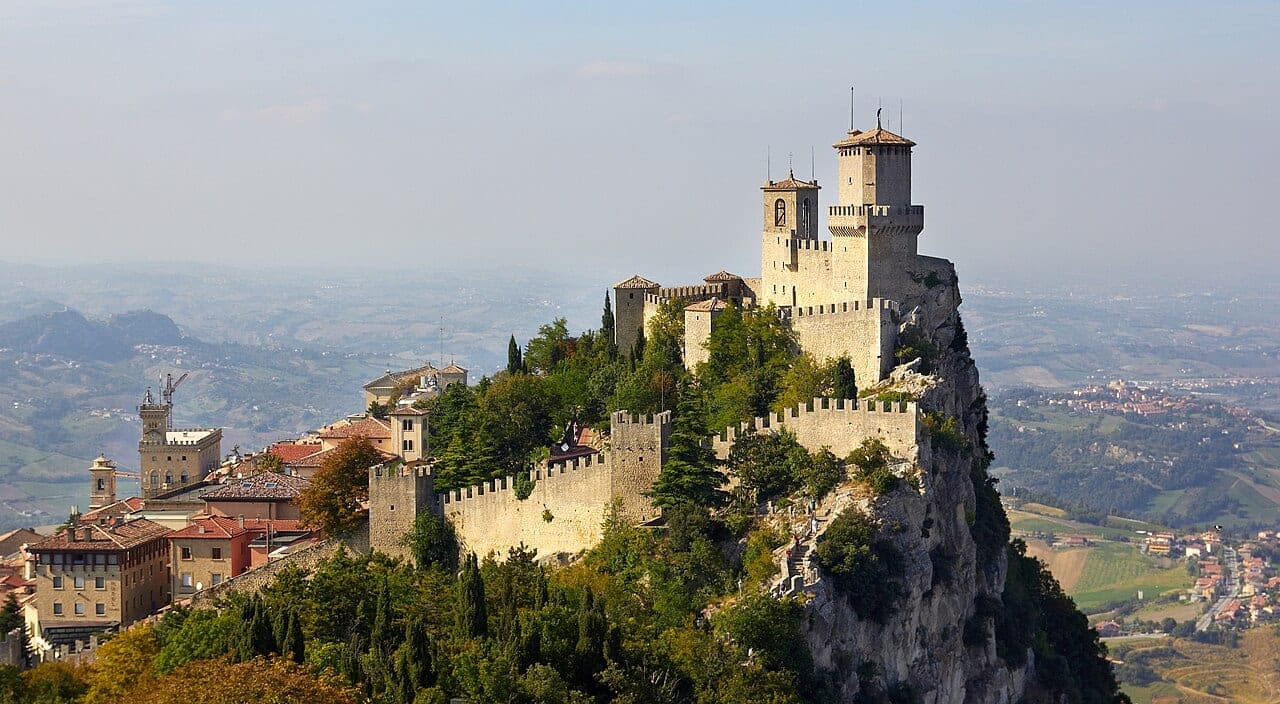
A single limestone mountain rises from the plain near the Adriatic coast, and on its ridgeline three fortress towers keep watch as they have for the better part of a thousand years. This is Monte Titano, and the country it crowns, the Republic of San Marino, is barely 61 square kilometres of Apennine slope wrapped entirely by Italy, home to some 34,000 people. It also holds one of the longest continuous claims to self-government on earth, presenting itself as the oldest surviving republic and the oldest constitutional state, with a foundation story reaching back, by tradition, to the year 301 and a Christian stonemason named Marinus who climbed the mountain to be left in peace (Encyclopaedia Britannica).
San Marino is a country that keeps its memory in durable things. It keeps it in stone, in the walls, gates and towers of a hill town that UNESCO enrolled in 2008 for the continuity of a free republic since the medieval period. It keeps it in ceremony, in the twice-yearly investiture of two heads of state, the Captains Regent, an office first filled in 1243 and never abandoned since. It keeps it in paper and metal, in the postage stamps and coins that carry the small nation's image across the world. And it keeps it, as most Sammarinese families still do, in the Catholic rituals of the wake, the Requiem and the November visit to the graves.
San Marino occupies a spur of the Apennines where the region of Emilia-Romagna meets the Marche, close enough to the coast that the towers look out toward Rimini and the sea. Its highest point, the summit of Monte Titano, reaches 749 metres, and the historic capital sits along the crest just below it. The republic is one of the world's smallest sovereign states, yet it prints its own stamps, mints its own coins and answers to its own thousand-year constitution.
Government here is deliberately antique and deliberately shared. Two Captains Regent, drawn from opposing sides of the sixty-member Grand and General Council, serve together as heads of state for six months only, a rotation designed so that no single person can hold power for long (sanmarinosite.com). The office descends from the consuls of the Roman Republic and has run without a break since the thirteenth century. Modern San Marino joined the United Nations in 1992 and the Council of Europe in 1988, uses the euro under agreement with Italy and the European Union, and lives largely from tourism, banking, light manufacturing and the sale of its stamps and collector coins.
The City of San Marino. The capital, called simply the City, clings to the western slope and crest of Monte Titano and holds only a few thousand permanent residents, though millions of visitors pass through it. Within its walls lie the Palazzo Pubblico, the seat of government; the Basilica di San Marino; the Piazza della Libertà with its marble Statue of Liberty of 1876; and the ridge path linking the Three Towers. The whole of this centre, with the eastern flank of the mountain, forms the UNESCO property.
Borgo Maggiore. Set on a shelf directly below the capital, Borgo Maggiore is the old market town of the republic, its weekly market recorded for centuries and its arcaded square still the commercial heart of the mountain. A funicular railway, opened in 1959, carries passengers up the cliff to the City in a couple of minutes. The town also holds a modern sanctuary church designed by the Italian architect Giovanni Michelucci, a rare piece of twentieth-century architecture among the medieval stone.
Serravalle. Down on the lower ground toward the Italian frontier, Serravalle is the republic's most populous municipality and its commercial and industrial engine, home to something over ten thousand people. It keeps a restored Malatesta-era castle at its core and hosts the national stadium, the venue for the San Marino football team and for many of the country's larger events.
Domagnano. A quiet hill village north of the capital, Domagnano gave its name to one of the most important archaeological finds ever made in the republic. The Domagnano Treasure, a hoard of Ostrogothic gold jewellery of the late fifth and early sixth centuries, was unearthed there in the late nineteenth century and is famous above all for a pair of matching eagle brooches worked in gold, garnet and glass paste. The pieces are now dispersed among the British Museum in London, the Germanisches Nationalmuseum in Nuremberg and other collections (British Museum, Domagnano Treasure).
The founding story is preserved in a tenth-century text, the Vita Sancti Marini, and it is a story of refuge. Marinus, by tradition a stonemason from the Dalmatian island of Rab, fled the persecutions of the emperor Diocletian and settled on Monte Titano around the year 301, gathering a small Christian community that grew into a self-governing commune. His reputed dying words, "Relinquo vos liberos ab utroque homine," meaning "I leave you free from both men," were understood to place the little state beyond the reach of both Pope and Emperor. Historians treat the phrase as a later invention, useful precisely because it gave a small republic a saint's authority for its independence (Saint Marinus, Wikipedia).
 San Marino claims to be the oldest surviving republic in the world, and its heritage listing is for the continuity of the institution as much as for the towers. Photograph by Max Ryazanov, CC BY-SA 3.0, via Wikimedia Commons.
Whatever its origin, the commune endured. Government by an assembly of family heads, the Arengo, gave way in 1243 to the first pair of Captains Regent, and the community codified its life in a series of statutes that were gathered in 1600 into the Leges Statutae, a body of law that remains at the base of the constitution today (Britannica). Survival was never guaranteed. The Malatesta lords of Rimini pressed on its borders; Cesare Borgia briefly held it in 1503; and in 1739 a papal cardinal, Giulio Alberoni, occupied the republic outright, only for Pope Clement XII to restore its liberty within months, a rescue the Sammarinese still commemorate.
The nineteenth and twentieth centuries tested that liberty again. During the wars of Italian unification, San Marino sheltered the revolutionary Giuseppe Garibaldi and his followers as they retreated in 1849, and in 1861 it made the United States president Abraham Lincoln an honorary citizen; Lincoln replied that the republic proved a government founded on such principles could be lasting. The country stayed neutral in both World Wars, and in the second it took in an estimated hundred thousand refugees, many times its own population, before being bombed and briefly drawn into the fighting as the front passed over it in 1944. It emerged intact, and the ancient rhythm of the regency continues to this day.
The official language of the republic is Italian, and it is the language of law, school and government. Alongside it lives an older speech, a local form of Romagnol, itself part of the Emilian-Romagnol group of northern Italy. This Sammarinese dialect, close to the speech of neighbouring Rimini and the Romagna countryside, was for centuries the everyday tongue of the mountain; today it is heard mainly among older residents and is counted among Europe's vulnerable regional languages, cherished in songs, proverbs and local theatre.
The country's name is itself an act of remembrance. San Marino means, quite simply, Saint Marinus, the deacon and stonemason of the founding legend, and the people call themselves Sammarinese after him. Few nations wear the memory of a single founder so plainly in their name, and fewer still carry that name unbroken across seventeen centuries of maps and treaties.
The image of the republic is fixed by its skyline. The Three Towers of Monte Titano, each on its own summit, appear on the flag, the coat of arms and nearly every coin. The oldest, the Guaita or First Tower, was raised in the eleventh century and once held prisoners; the Cesta or Second Tower crowns the highest peak and houses the Museum of Ancient Weapons, with more than a thousand pieces of arms and armour; the Montale, the smallest and Third Tower, remains a private landmark closed to visitors (Three Towers of San Marino). Around these towers the country stages its medieval past each summer, with flag-throwers, drummers, heralds and costumed processions filling the stone streets.
Central to that pageantry is the crossbow. San Marino keeps a Crossbow Corps as a ceremonial part of its armed forces, and the Federazione Sammarinese Balestrieri, formed in 1966, carries on a competition that reaches back to 1537. Every year on 3 September, teams representing the nine municipalities gather in the Cava dei Balestrieri, the Crossbowmen's Quarry below the towers, to shoot the historic Palio in full medieval dress (sanmarinosite.com).
Two smaller crafts carry the republic's name furthest of all. San Marino issued its first postage stamps on 1 August 1877, bearing the national arms, and its stamps and euro collector coins are prized by philatelists and numismatists everywhere, with a dedicated Stamp and Coin Museum in the capital (Visit San Marino, philately and numismatics). At the table, identity is edible: the layered wafer-and-chocolate Torta Tre Monti is shaped and named for the three peaks; the flatbread piadina and the rustic bustrengo pudding come straight from Romagna's country kitchens; and the hillsides yield Sangiovese and Ribolla wines.
San Marino is overwhelmingly Roman Catholic, and its faith and its statehood share a single origin in the person of Saint Marinus. The republic forms part of the diocese of San Marino-Montefeltro, and while Catholicism is not formally established as a state church, its calendar of feasts still shapes the civic year, above all the great day of the founder in early September. Wayside shrines, the small parish churches of the nine municipalities and the pilgrim paths of the surrounding Montefeltro country all attest to a devotion woven through daily life.
The spiritual centre of the country is the Basilica di San Marino, a neoclassical church built between 1826 and 1838 to the designs of the Bolognese architect Achille Serra, on the site of the ancient parish church, the Pieve, that had stood there since late antiquity (Basilica di San Marino). Its portico of Corinthian columns opens onto the Piazzale Domus Plebis, and inside, a statue of the saint by Adamo Tadolini, a pupil of Canova, presides over the altar beneath which the relics of Marinus are kept.
Sammarinese mourning follows the Catholic pattern of the surrounding Romagna, and it begins in the community. A death is marked by the tolling of the parish bell and, as in the Italian countryside, by black-bordered notices posted where neighbours will read them, giving the name of the dead and the hour of the funeral. Family and friends keep the wake and pray the rosary before the Requiem Mass, after which the coffin is carried to the cemetery of the deceased's municipality; a Mass on the seventh day and on the anniversary keeps the memory active in the years that follow.
The national season of the dead is the beginning of November. On All Saints' Day and All Souls' Day, on the first and second of the month, families go up to the cemeteries to clean the graves, light lamps and lay chrysanthemums, the flower reserved almost everywhere in this region for the dead. And once a year the whole republic remembers its first citizen. The feast of Saint Marinus on 3 September is both a religious solemnity and the national day, marking the traditional founding of the state; the relics in the basilica are honoured, a civic procession forms, and the crossbowmen shoot their Palio, so that the memory of one fourth-century death becomes the yearly celebration of a nation's life.
San Marino claims to be the oldest surviving republic in the world, and it has the paperwork to argue about it.
The state archive holds acts of the Grand and General Council running from the medieval period, along with statutes, land registers and the notarial records that are, as in Malta and Italy, the richest genealogical source: a Sammarinese will or dowry contract names the parties and their families precisely. Parish registers begin after the Council of Trent in the sixteenth century, and civil registration follows the Italian model.
The population has always been small, a few thousand for most of its history, so the families are few and the connections between them are well known. Sammarinese citizenship is inherited and is not easy to acquire otherwise, so the register of citizens is effectively a closed genealogy maintained across centuries, including the substantial community abroad, in Italy, the United States, Argentina and France, who retain it.
Two episodes give the archive its character. In 1849 the republic sheltered Garibaldi and his followers as Austrian and papal forces closed in, and the records of that fortnight are the founding document of San Marino's self-image as a refuge. And in 1944, a country of fifteen thousand people took in more than a hundred thousand refugees from the fighting in Italy, registered them, and fed them. The lists of who was sheltered are held in San Marino and are consulted by Italian families rather than Sammarinese ones.
The republic's crowning act of preservation was recognised in 2008, when UNESCO inscribed the San Marino Historic Centre and Mount Titano on the World Heritage List. The property covers about 55 hectares of core area within a buffer zone of some 167 hectares, and it was listed under criterion three for its exceptional witness to a small republic that has kept its institutions and its independence, in the same buildings, since the Middle Ages (UNESCO World Heritage Centre, site 1245). The inscribed area gathers the fortification towers, walls, gates and bastions, the neoclassical basilica, the fourteenth- and sixteenth-century convents, the eighteenth-century Titano Theatre and the Palazzo Pubblico, the government seat built between 1884 and 1894 to designs by the Roman architect Francesco Azzurri.
Care of this inheritance falls to the state's cultural institutes and its network of public museums. The State Museum gathers the republic's archaeology and art, including reconstructions that recall the lost Domagnano Treasure; the Cesta tower holds the Museum of Ancient Weapons; and the Stamp and Coin Museum preserves the philatelic and numismatic record from 1877 to the present. The Guardia di Rocca, the ceremonial fortress guard, keeps the changing of the watch in summer, a piece of living heritage as much as ritual.
For so small a country, the digital footprint of San Marino's heritage is growing steadily. The official tourism and cultural portals publish guides to the towers, museums and festivals, and the state postal and numismatic services maintain online catalogues that let collectors trace every issue of stamp and coin since the nineteenth century (Visit San Marino). Because so much Sammarinese heritage sits abroad, digitisation matters especially: images and scholarship on the dispersed Domagnano brooches now allow the treasure to be studied together online even though its pieces are held in different countries.
The digital record also serves the diaspora. A substantial community of Sammarinese descent lives in Italy, France, the United States and Argentina, and as the republic's civil and parish registers are progressively imaged and published, the memory held in old records of birth, marriage and death becomes reachable from anywhere those families settled.
San Marino punches far above its size on the international stage of culture and sport. It has competed at the Eurovision Song Contest since 2008, giving one of Europe's smallest nations a recurring place on the continent's most-watched broadcast. It fields teams at the Olympic Games, and at the Tokyo Games of 2020 it became the least populous nation ever to win Olympic medals, taking three across shooting and wrestling.
Tourism remains the great modern current, with the towers, the shops and the medieval festivals drawing millions each year up the mountain road from Rimini. The republic has learned to present its antiquity as its chief attraction, while its status as an independent European microstate gives it a diplomatic visibility, in the Council of Europe and the United Nations, out of all proportion to its population.
A free republic recognised by the world. The 2008 UNESCO inscription honoured not a single building but the survival of self-government, in one place and one set of institutions, from the Middle Ages to the present day.
Medals against the odds. At the Tokyo 2020 Olympics, San Marino became the least populous country ever to reach the podium, winning bronze and silver in trap shooting and a bronze in wrestling.
A crossbow tradition kept alive. The Palio dei Balestrieri, shot in the Crossbowmen's Quarry every 3 September, has been maintained since 1537 and formalised by the national crossbow federation, so that a medieval skill survives as a living civic rite.
A scattered treasure recovered in study. Though the Ostrogothic gold of the Domagnano Treasure left the republic long ago for museums across Europe, scholarship and reconstruction have brought its eagle brooches back into San Marino's story.
San Marino claims to be the oldest surviving republic in the world, and its heritage listing is for the continuity of the institution as much as for the towers. Photograph by Max Ryazanov, CC BY-SA 3.0, via Wikimedia Commons.
Whatever its origin, the commune endured. Government by an assembly of family heads, the Arengo, gave way in 1243 to the first pair of Captains Regent, and the community codified its life in a series of statutes that were gathered in 1600 into the Leges Statutae, a body of law that remains at the base of the constitution today (Britannica). Survival was never guaranteed. The Malatesta lords of Rimini pressed on its borders; Cesare Borgia briefly held it in 1503; and in 1739 a papal cardinal, Giulio Alberoni, occupied the republic outright, only for Pope Clement XII to restore its liberty within months, a rescue the Sammarinese still commemorate.
The nineteenth and twentieth centuries tested that liberty again. During the wars of Italian unification, San Marino sheltered the revolutionary Giuseppe Garibaldi and his followers as they retreated in 1849, and in 1861 it made the United States president Abraham Lincoln an honorary citizen; Lincoln replied that the republic proved a government founded on such principles could be lasting. The country stayed neutral in both World Wars, and in the second it took in an estimated hundred thousand refugees, many times its own population, before being bombed and briefly drawn into the fighting as the front passed over it in 1944. It emerged intact, and the ancient rhythm of the regency continues to this day.
The official language of the republic is Italian, and it is the language of law, school and government. Alongside it lives an older speech, a local form of Romagnol, itself part of the Emilian-Romagnol group of northern Italy. This Sammarinese dialect, close to the speech of neighbouring Rimini and the Romagna countryside, was for centuries the everyday tongue of the mountain; today it is heard mainly among older residents and is counted among Europe's vulnerable regional languages, cherished in songs, proverbs and local theatre.
The country's name is itself an act of remembrance. San Marino means, quite simply, Saint Marinus, the deacon and stonemason of the founding legend, and the people call themselves Sammarinese after him. Few nations wear the memory of a single founder so plainly in their name, and fewer still carry that name unbroken across seventeen centuries of maps and treaties.
The image of the republic is fixed by its skyline. The Three Towers of Monte Titano, each on its own summit, appear on the flag, the coat of arms and nearly every coin. The oldest, the Guaita or First Tower, was raised in the eleventh century and once held prisoners; the Cesta or Second Tower crowns the highest peak and houses the Museum of Ancient Weapons, with more than a thousand pieces of arms and armour; the Montale, the smallest and Third Tower, remains a private landmark closed to visitors (Three Towers of San Marino). Around these towers the country stages its medieval past each summer, with flag-throwers, drummers, heralds and costumed processions filling the stone streets.
Central to that pageantry is the crossbow. San Marino keeps a Crossbow Corps as a ceremonial part of its armed forces, and the Federazione Sammarinese Balestrieri, formed in 1966, carries on a competition that reaches back to 1537. Every year on 3 September, teams representing the nine municipalities gather in the Cava dei Balestrieri, the Crossbowmen's Quarry below the towers, to shoot the historic Palio in full medieval dress (sanmarinosite.com).
Two smaller crafts carry the republic's name furthest of all. San Marino issued its first postage stamps on 1 August 1877, bearing the national arms, and its stamps and euro collector coins are prized by philatelists and numismatists everywhere, with a dedicated Stamp and Coin Museum in the capital (Visit San Marino, philately and numismatics). At the table, identity is edible: the layered wafer-and-chocolate Torta Tre Monti is shaped and named for the three peaks; the flatbread piadina and the rustic bustrengo pudding come straight from Romagna's country kitchens; and the hillsides yield Sangiovese and Ribolla wines.
San Marino is overwhelmingly Roman Catholic, and its faith and its statehood share a single origin in the person of Saint Marinus. The republic forms part of the diocese of San Marino-Montefeltro, and while Catholicism is not formally established as a state church, its calendar of feasts still shapes the civic year, above all the great day of the founder in early September. Wayside shrines, the small parish churches of the nine municipalities and the pilgrim paths of the surrounding Montefeltro country all attest to a devotion woven through daily life.
The spiritual centre of the country is the Basilica di San Marino, a neoclassical church built between 1826 and 1838 to the designs of the Bolognese architect Achille Serra, on the site of the ancient parish church, the Pieve, that had stood there since late antiquity (Basilica di San Marino). Its portico of Corinthian columns opens onto the Piazzale Domus Plebis, and inside, a statue of the saint by Adamo Tadolini, a pupil of Canova, presides over the altar beneath which the relics of Marinus are kept.
Sammarinese mourning follows the Catholic pattern of the surrounding Romagna, and it begins in the community. A death is marked by the tolling of the parish bell and, as in the Italian countryside, by black-bordered notices posted where neighbours will read them, giving the name of the dead and the hour of the funeral. Family and friends keep the wake and pray the rosary before the Requiem Mass, after which the coffin is carried to the cemetery of the deceased's municipality; a Mass on the seventh day and on the anniversary keeps the memory active in the years that follow.
The national season of the dead is the beginning of November. On All Saints' Day and All Souls' Day, on the first and second of the month, families go up to the cemeteries to clean the graves, light lamps and lay chrysanthemums, the flower reserved almost everywhere in this region for the dead. And once a year the whole republic remembers its first citizen. The feast of Saint Marinus on 3 September is both a religious solemnity and the national day, marking the traditional founding of the state; the relics in the basilica are honoured, a civic procession forms, and the crossbowmen shoot their Palio, so that the memory of one fourth-century death becomes the yearly celebration of a nation's life.
San Marino claims to be the oldest surviving republic in the world, and it has the paperwork to argue about it.
The state archive holds acts of the Grand and General Council running from the medieval period, along with statutes, land registers and the notarial records that are, as in Malta and Italy, the richest genealogical source: a Sammarinese will or dowry contract names the parties and their families precisely. Parish registers begin after the Council of Trent in the sixteenth century, and civil registration follows the Italian model.
The population has always been small, a few thousand for most of its history, so the families are few and the connections between them are well known. Sammarinese citizenship is inherited and is not easy to acquire otherwise, so the register of citizens is effectively a closed genealogy maintained across centuries, including the substantial community abroad, in Italy, the United States, Argentina and France, who retain it.
Two episodes give the archive its character. In 1849 the republic sheltered Garibaldi and his followers as Austrian and papal forces closed in, and the records of that fortnight are the founding document of San Marino's self-image as a refuge. And in 1944, a country of fifteen thousand people took in more than a hundred thousand refugees from the fighting in Italy, registered them, and fed them. The lists of who was sheltered are held in San Marino and are consulted by Italian families rather than Sammarinese ones.
The republic's crowning act of preservation was recognised in 2008, when UNESCO inscribed the San Marino Historic Centre and Mount Titano on the World Heritage List. The property covers about 55 hectares of core area within a buffer zone of some 167 hectares, and it was listed under criterion three for its exceptional witness to a small republic that has kept its institutions and its independence, in the same buildings, since the Middle Ages (UNESCO World Heritage Centre, site 1245). The inscribed area gathers the fortification towers, walls, gates and bastions, the neoclassical basilica, the fourteenth- and sixteenth-century convents, the eighteenth-century Titano Theatre and the Palazzo Pubblico, the government seat built between 1884 and 1894 to designs by the Roman architect Francesco Azzurri.
Care of this inheritance falls to the state's cultural institutes and its network of public museums. The State Museum gathers the republic's archaeology and art, including reconstructions that recall the lost Domagnano Treasure; the Cesta tower holds the Museum of Ancient Weapons; and the Stamp and Coin Museum preserves the philatelic and numismatic record from 1877 to the present. The Guardia di Rocca, the ceremonial fortress guard, keeps the changing of the watch in summer, a piece of living heritage as much as ritual.
For so small a country, the digital footprint of San Marino's heritage is growing steadily. The official tourism and cultural portals publish guides to the towers, museums and festivals, and the state postal and numismatic services maintain online catalogues that let collectors trace every issue of stamp and coin since the nineteenth century (Visit San Marino). Because so much Sammarinese heritage sits abroad, digitisation matters especially: images and scholarship on the dispersed Domagnano brooches now allow the treasure to be studied together online even though its pieces are held in different countries.
The digital record also serves the diaspora. A substantial community of Sammarinese descent lives in Italy, France, the United States and Argentina, and as the republic's civil and parish registers are progressively imaged and published, the memory held in old records of birth, marriage and death becomes reachable from anywhere those families settled.
San Marino punches far above its size on the international stage of culture and sport. It has competed at the Eurovision Song Contest since 2008, giving one of Europe's smallest nations a recurring place on the continent's most-watched broadcast. It fields teams at the Olympic Games, and at the Tokyo Games of 2020 it became the least populous nation ever to win Olympic medals, taking three across shooting and wrestling.
Tourism remains the great modern current, with the towers, the shops and the medieval festivals drawing millions each year up the mountain road from Rimini. The republic has learned to present its antiquity as its chief attraction, while its status as an independent European microstate gives it a diplomatic visibility, in the Council of Europe and the United Nations, out of all proportion to its population.
A free republic recognised by the world. The 2008 UNESCO inscription honoured not a single building but the survival of self-government, in one place and one set of institutions, from the Middle Ages to the present day.
Medals against the odds. At the Tokyo 2020 Olympics, San Marino became the least populous country ever to reach the podium, winning bronze and silver in trap shooting and a bronze in wrestling.
A crossbow tradition kept alive. The Palio dei Balestrieri, shot in the Crossbowmen's Quarry every 3 September, has been maintained since 1537 and formalised by the national crossbow federation, so that a medieval skill survives as a living civic rite.
A scattered treasure recovered in study. Though the Ostrogothic gold of the Domagnano Treasure left the republic long ago for museums across Europe, scholarship and reconstruction have brought its eagle brooches back into San Marino's story.
National Overview
Notable Cities
Historical Foundations
Linguistic and Etymological Roots
Cultural Identity
Religion and Spirituality
Remembrance and Mourning Traditions
Tracing a Family in San Marino
Heritage Preservation Efforts
Digital Heritage
Contemporary Cultural Influences
Success Stories
References and resources
- UNESCO World Heritage Centre: San Marino Historic Centre and Mount Titano. The 2008 inscription, criteria and property boundaries.
- Encyclopaedia Britannica: San Marino. Geography, history and government of the republic.
- Wikipedia: San Marino. Overview of the state, its founding legend and institutions.
- Wikipedia: Saint Marinus. The founder's life, legend and reputed last words.
- Wikipedia: Three Towers of San Marino. The Guaita, Cesta and Montale towers of Monte Titano.
- Wikipedia: Basilica di San Marino. The neoclassical basilica and the relics of the saint.
- Wikipedia: Domagnano Treasure. The Ostrogothic gold hoard and its dispersal to European museums.
- Captains Regent of San Marino, sanmarinosite.com. The twice-yearly heads of state and their history.
- Crossbowmen's Quarry, sanmarinosite.com. The Palio dei Balestrieri and the crossbow tradition.
- Philately and Numismatics, Visit San Marino. The republic's stamps and coins.