Heritage · Country
Vatican City Culture and Heritage
The world's smallest sovereign state holds the tomb of an apostle, Michelangelo's ceiling and Bernini's embracing colonnade within an area smaller than many city parks. This is a guide to Vatican City as a place of art, faith and the enduring rites by which the Catholic Church remembers its dead.Written to last.
By Confinity Heritage Editorial · Updated 2026-07-31 · 8-minute readQuiet tools, kept out of the way.
Vatican City is the smallest sovereign state on earth, a walled enclave of roughly 44 hectares set inside the city of Rome, governed by the Bishop of Rome and inhabited by fewer than a thousand people. It is also the governmental and spiritual centre of the Roman Catholic Church, a communion of well over a billion members, so a territory smaller than many public parks carries a weight of authority, art and memory far beyond its size. Within its short perimeter stand the basilica raised over the tomb of Saint Peter, the chapel where Michelangelo painted the ceiling and altar wall, the palace from which the popes govern, and a library and archive holding centuries of the documentary record of Europe.
The whole of Vatican City is a single UNESCO World Heritage site, the only entry on that list to cover an entire state, and the Holy See shares a second, extraterritorial site with Italy that gathers the great papal basilicas of Rome. This profile treats the city-state as a place of heritage rather than doctrine: its precincts and their art, the history that built them, and the customs of remembrance that give the Vatican its character, from the tombs of the popes beneath the basilica floor to the conclave that follows a pope's death and the canonisation by which the Church keeps the memory of its saints.
Vatican City occupies a low rise on the right bank of the Tiber that the Romans called the Vatican Hill, wholly surrounded by the Italian capital. Its area of about 44 hectares, roughly 0.44 square kilometres, makes it the smallest independent state in the world by both territory and population; residents number fewer than 800, and citizenship, granted by office rather than birth, is held by only a few hundred people (Britannica). In places the border is marked by nothing more than a change in the paving.
A distinction sits at the heart of Vatican affairs. The Holy See is the sovereign jurisdiction of the pope and the central government of the Catholic Church; it keeps diplomatic relations with more than 180 states and holds permanent observer status at the United Nations. Vatican City State, created in 1929, is the territory that gives that sovereignty a home and guarantees the pope's independence from any other power. The pope is head of state, delegating in practice to a Pontifical Commission and a Governorate. The state issues its own stamps, coins and passports and funds itself through the Vatican Museums, publishing and donations rather than taxation.
Vatican City is a single settlement rather than a country of towns, so its geography is best read as a set of precincts, each with its own function.
Saint Peter's Basilica and Square. The basilica is the ceremonial heart of the state and one of the largest churches ever built, raised over the traditional grave of Saint Peter. Before it opens the great oval of Saint Peter's Square, framed by the colonnade Gian Lorenzo Bernini designed between 1656 and 1667: four rows of Tuscan columns, 284 in all, crowned by 140 statues of saints and reaching out, in his own image, like arms embracing the faithful (St Peter's Square). At its centre stands an Egyptian obelisk brought to Rome under Caligula.
The Vatican Museums. Along the northern edge run the galleries the popes have filled with art for five centuries, ending at the Sistine Chapel. Covered in a companion profile, they appear here as part of the city's cultural identity rather than for their holdings.
The Apostolic Palace. The pope's residence and working seat holds the papal apartments, the Secretariat of State, the Raphael Rooms, the Sistine Chapel and the Vatican Apostolic Library. Its windows over the square are the setting for the Sunday Angelus and the first appearance of a new pope.
The Vatican Gardens. More than half the territory is laid to gardens of parterres, fountains and groves, among which stand the Governorate, the state radio, the older domes of the Vatican Observatory and the Teutonic College.
The Vatican began as a burial ground. Saint Peter, counted by Catholic tradition as the first Bishop of Rome, is held to have been martyred on the Vatican Hill around the year 64 and buried in a nearby necropolis. In the early fourth century, after Constantine granted toleration to Christianity, he raised a vast basilica over the presumed grave, and Old Saint Peter's stood for more than a thousand years as a goal of pilgrims (Britannica).
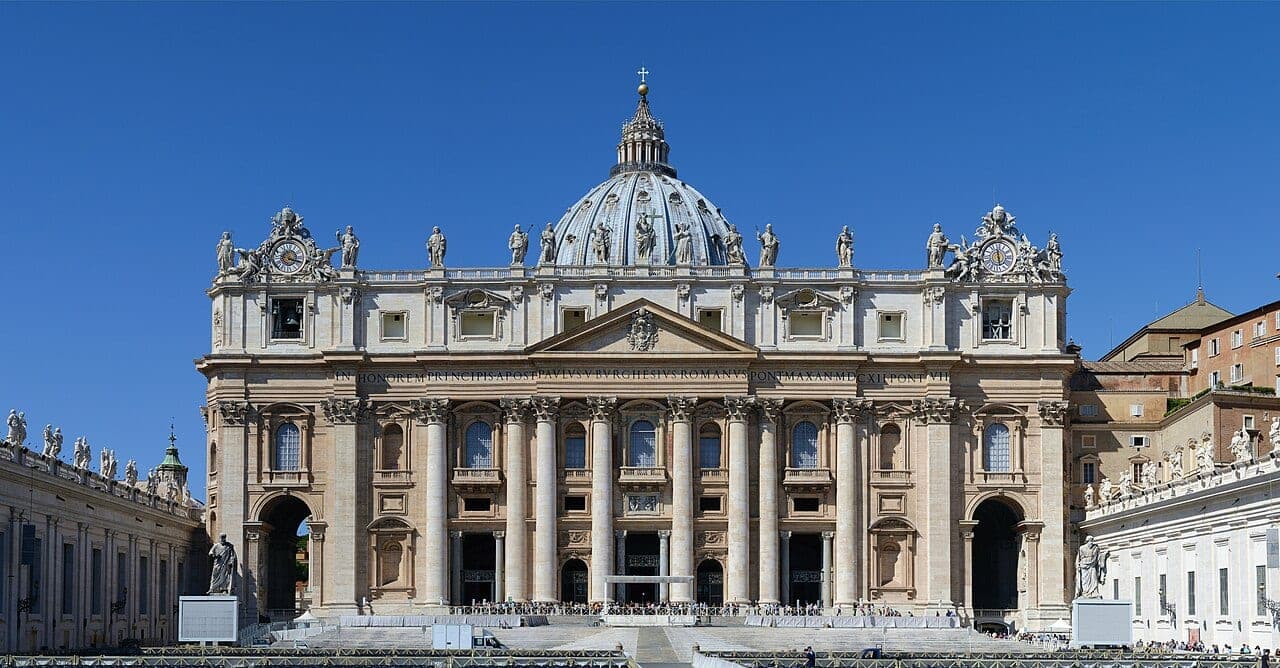
Through the medieval centuries the popes became temporal rulers as well as spiritual ones. From the eighth century the Papal States spread across central Italy, governed by the papacy until the nineteenth, though the popes resided for much of the fourteenth century at Avignon. The ambitions of the Renaissance papacy set the rebuilding of the failing basilica in motion. In 1506 Julius II laid the foundation stone of a new Saint Peter's to a design by Bramante; over the next century Raphael, Antonio da Sangallo the Younger and, from 1546, Michelangelo shaped the work, the last designing the great dome. Carlo Maderno extended the nave and built the facade, and the basilica was consecrated in 1626. Bernini then finished the interior with the bronze baldachin over the papal altar and enclosed the square with his colonnade.
The modern state was born of a rupture. When a newly unified Italy captured Rome in 1870 and absorbed it, the Papal States ceased to exist, and successive popes withdrew into the Vatican as self-styled prisoners. This standoff, the Roman Question, lasted almost sixty years, ending on 11 February 1929 with the Lateran Treaty between the Holy See and Italy, which created the independent Vatican City State and settled the Church's status (Vatican News). The century that followed brought the reforming Second Vatican Council of 1962 to 1965 and the Vatican's rise as a diplomatic voice.
The Vatican lives in two languages. Latin remains the official language of the Holy See, the tongue of its most solemn documents and its liturgy, kept current by a dedicated academy. Italian is the everyday working language of the city-state, used in its laws, courts and signs, while the Swiss Guard drills in German. Because the papacy draws officials from every continent, the Vatican's corridors are a meeting place of many tongues over that Latin and Italian core.
The name is older than the Church. The rise was the Mons Vaticanus and the marshy ground beside it the Ager Vaticanus, terms used long before a basilica stood there. Ancient writers linked the name to the Latin vates, a seer, and vaticinium, a prophecy, suggesting a district once known for oracular pronouncements, though a derivation from an older Etruscan settlement is also proposed. Either way the association with prophecy predates Peter, and the word travelled from a Roman hillside to become, in most languages, a synonym for the papacy.
The Vatican's cultural identity is inseparable from the art it commissioned and preserves. The Sistine Chapel, built for Sixtus IV between 1473 and 1481, carries on its ceiling the cycle Michelangelo painted between 1508 and 1512 and, on the altar wall, the Last Judgment he added between 1536 and 1541, images so widely reproduced they have become shorthand for the Renaissance. Nearby, the Raphael Rooms preserve the frescoes Raphael and his workshop made from 1508, among them the School of Athens. These works belong to the world's imagination, yet remain, first of all, the decoration of a working church and residence.
Sound matters as much as sight. The Sistine Chapel Choir, the pope's own choir, dates its formal origin to the late fifteenth century and ranks among the oldest musical institutions in the world; Palestrina served as its master in the later sixteenth century (Sistine Chapel Choir). The Pontifical Swiss Guard, founded in 1506, gives the state its most recognisable emblem in the striped blue, red and yellow of its Renaissance-style uniform; its recruits, all Catholic Swiss citizens, are sworn in each 6 May in memory of the guards who died defending Clement VII in the sack of Rome in 1527. Over all of this runs the liturgical calendar, the year of feasts that orders Vatican time.
The Vatican exists to be the seat of the Catholic Church and the residence of its head. Catholic teaching holds the pope to be the successor of Saint Peter, to whom, in the Gospel account, Christ entrusted a special care of the Church, and it is this Petrine claim that makes the hill of Peter's grave the natural centre of the papacy. From the Apostolic Palace the pope governs through the Roman Curia, the offices that administer the worldwide Church, ordain its bishops and coordinate its charitable and diplomatic work.
 St Peter's took about 120 years and a dozen architects, and it stands over a necropolis in which a grave venerated as Peter's has been excavated. Photograph by Bely Medved, CC BY-SA 2.0, via Wikimedia Commons.
Daily life in the state is ordered around worship. Saint Peter's Basilica is one of the holiest shrines in Catholicism, and the pope's audiences and Sunday addresses draw crowds into the square through much of the year. The Holy See also hosts dialogue with other Christian churches and with other faiths, and its words on peace and poverty reach far beyond the Catholic world. This profile records that centrality with respect, without adjudicating matters of belief.
Few places have so developed a culture of remembering their dead as the Vatican, where the death of a pope sets one of the world's most closely watched sequences of mourning in motion. On a pontiff's death the sede vacante, the vacancy of the see, begins; the cardinal chamberlain certifies the death, the ring of office is defaced so it cannot be misused, and the Church enters nine days of mourning, the novemdiales, while the body lies in state in Saint Peter's Basilica. The funeral rites, revised in recent years toward simplicity, present the pope not as a prince but as a pastor.
Most popes are buried in the Vatican Grottoes, the crypt beneath the basilica floor, between the church above and the ancient necropolis below (Vatican Grottoes). Among chapels and tombs of many ages lie dozens of pontiffs; Benedict XVI was laid there in 2023 in the tomb that had earlier held John Paul II. Deeper still is the Vatican Necropolis, the row of Roman mausolea excavated between 1939 and 1949 under Pius XII, which brought to light the grave venerated since antiquity as Saint Peter's and the bones of an elderly man later announced as the apostle's. Not every pope now chooses the grottoes: Francis was buried in 2025 at Santa Maria Maggiore, outside the walls, a departure noted because the custom it set aside was so old.
When a pope dies the cardinals gather for the conclave, the sealed election held in the Sistine Chapel, whose result is announced to the square by the colour of smoke from a chimney, black for an inconclusive ballot, white for a new pope. Alongside the remembrance of popes runs that of the saints: canonisation, by which a person's holiness is examined and declared, ends in a ceremony in Saint Peter's Square and often in the veneration of relics, the preserved remains or belongings of the holy dead. The Vatican keeps its own burial ground too, the Campo Santo Teutonico, the German and Flemish cemetery beside the basilica, one of the oldest German institutions in Rome, where by tradition the soil was carried from Jerusalem.
The Vatican holds one of the greatest archives in the world and almost no genealogy of its own citizens, and both facts follow from what it is.
The Vatican Apostolic Archive contains the papacy's records across more than a thousand years: correspondence with rulers, the acts of the curia, the registers of petitions and dispensations. For family history the most useful series are the dispensation records, because a marriage between cousins required papal permission and the application had to set out the relationship in detail, so an ordinary family in a Spanish or Italian village can appear in Rome with its pedigree attached. The Archive of the Congregation for the Doctrine of the Faith, which holds the Inquisition records, contains genealogical investigations of great depth for the same reason.
The parish of St Peter's keeps registers for the people who live in the city state, and the Swiss Guard has kept its own records since 1506.
Citizenship here is unlike anywhere else: it is held by function, not by birth or descent. A person is a citizen of Vatican City while they hold an office or serve the Holy See, and it lapses when the role ends. Children born to citizens do not inherit it. So the Vatican is a state with a population of a few hundred and no genealogy, sitting on top of the deepest ecclesiastical archive in Europe, which documents everybody else's.
The entire city-state was inscribed on the UNESCO World Heritage List in 1984, a listing without parallel because it covers a whole country, cited for a concentration of masterpieces, from Saint Peter's and the Sistine Chapel to the palaces and gardens, that has shaped Western art since the sixteenth century (UNESCO). A second, extraterritorial site, shared with Italy and inscribed in 1980 and extended in 1990, protects the historic centre of Rome and the properties of the Holy See beyond the walls, among them the papal basilicas of Saint John Lateran, Santa Maria Maggiore and Saint Paul Outside the Walls (UNESCO).
Behind these listings sits a permanent machinery of care. The Fabbrica di San Pietro, charged with the fabric of the basilica since the sixteenth century, maintains the church and its dome, while the Vatican Museums run conservation laboratories whose stone, paint and textile restorers work continuously; the cleaning of the Sistine Chapel between 1980 and 1994 remains the most famous campaign. The Library and the Apostolic Archive preserve fragile manuscripts and records through climate control, careful handling and, increasingly, digitisation.
The most ambitious of the Vatican's preservation projects is now a digital one. The Vatican Apostolic Library, founded by Sixtus IV in 1475, holds some 75,000 to 80,000 manuscripts along with more than a million printed books, and through its DigiVatLib platform it is photographing its manuscripts page by page and publishing them free online in high resolution (DigiVatLib). Using the shared IIIF standard, the images let a scholar anywhere compare pages once held apart in a collection that few readers could ever consult.
The archive beside it has changed its name as well as its medium. In 2019 Pope Francis renamed the institution long called the Vatican Secret Archive as the Vatican Apostolic Archive, noting that the word "secret", which had only ever meant the pope's private records, had come to be misunderstood (Vatican News). Digitisation of parts of its holdings, with online museum tours and a virtual walkthrough of the Sistine Chapel, reaches audiences that could never travel to Rome.
For so small a place the Vatican keeps a large presence in contemporary culture. The election of a pope, the Christmas and Easter blessings from the balcony of Saint Peter's, and the Jubilee years that call millions of pilgrims to Rome, most recently the Holy Year of 2025, are broadcast worldwide, and the imagery of the basilica, the square and the conclave recurs in film, fiction and journalism. The Vatican Observatory, among the oldest astronomical institutions in the world, lends the state a scientific voice, while Vatican Radio carries the pope's words in dozens of languages.
That visibility has brought scrutiny. Like other large and ancient institutions the Catholic Church has faced serious criticism in recent decades, including over the abuse of minors and questions of financial governance, which the Holy See has addressed through inquiries, reforms and public apology. A heritage profile can note these debates without resolving them; what it records is that the Vatican remains one of the most closely watched cultural actors in the world.
The tomb beneath the altar. The excavations begun under Pius XII in 1939 threaded a series of Roman mausolea directly beneath the high altar, confirming that the basilica had been built over an early Christian shrine and bringing to light the grave venerated for centuries as Saint Peter's, among the most careful archaeological undertakings of the twentieth century.
A library opened to the world. Through DigiVatLib the Vatican Apostolic Library has begun placing tens of thousands of manuscripts online in free, high-resolution images, turning a collection once open only to a few into a resource for everyone and setting a standard other historic libraries have followed.
The Sistine Chapel restored. The cleaning of 1980 to 1994 lifted centuries of candle smoke and old varnish from Michelangelo's ceiling and Last Judgment, recovering colours so much brighter than the world had known that the work reshaped understanding of the painter, while the chapel went on serving as a place of prayer and election.
A city-state made whole. The Lateran Treaty of 1929 resolved the Roman Question that had left the popes without a country for almost sixty years, creating a small neutral state that carried its heritage safely through the upheavals of the century.
St Peter's took about 120 years and a dozen architects, and it stands over a necropolis in which a grave venerated as Peter's has been excavated. Photograph by Bely Medved, CC BY-SA 2.0, via Wikimedia Commons.
Daily life in the state is ordered around worship. Saint Peter's Basilica is one of the holiest shrines in Catholicism, and the pope's audiences and Sunday addresses draw crowds into the square through much of the year. The Holy See also hosts dialogue with other Christian churches and with other faiths, and its words on peace and poverty reach far beyond the Catholic world. This profile records that centrality with respect, without adjudicating matters of belief.
Few places have so developed a culture of remembering their dead as the Vatican, where the death of a pope sets one of the world's most closely watched sequences of mourning in motion. On a pontiff's death the sede vacante, the vacancy of the see, begins; the cardinal chamberlain certifies the death, the ring of office is defaced so it cannot be misused, and the Church enters nine days of mourning, the novemdiales, while the body lies in state in Saint Peter's Basilica. The funeral rites, revised in recent years toward simplicity, present the pope not as a prince but as a pastor.
Most popes are buried in the Vatican Grottoes, the crypt beneath the basilica floor, between the church above and the ancient necropolis below (Vatican Grottoes). Among chapels and tombs of many ages lie dozens of pontiffs; Benedict XVI was laid there in 2023 in the tomb that had earlier held John Paul II. Deeper still is the Vatican Necropolis, the row of Roman mausolea excavated between 1939 and 1949 under Pius XII, which brought to light the grave venerated since antiquity as Saint Peter's and the bones of an elderly man later announced as the apostle's. Not every pope now chooses the grottoes: Francis was buried in 2025 at Santa Maria Maggiore, outside the walls, a departure noted because the custom it set aside was so old.
When a pope dies the cardinals gather for the conclave, the sealed election held in the Sistine Chapel, whose result is announced to the square by the colour of smoke from a chimney, black for an inconclusive ballot, white for a new pope. Alongside the remembrance of popes runs that of the saints: canonisation, by which a person's holiness is examined and declared, ends in a ceremony in Saint Peter's Square and often in the veneration of relics, the preserved remains or belongings of the holy dead. The Vatican keeps its own burial ground too, the Campo Santo Teutonico, the German and Flemish cemetery beside the basilica, one of the oldest German institutions in Rome, where by tradition the soil was carried from Jerusalem.
The Vatican holds one of the greatest archives in the world and almost no genealogy of its own citizens, and both facts follow from what it is.
The Vatican Apostolic Archive contains the papacy's records across more than a thousand years: correspondence with rulers, the acts of the curia, the registers of petitions and dispensations. For family history the most useful series are the dispensation records, because a marriage between cousins required papal permission and the application had to set out the relationship in detail, so an ordinary family in a Spanish or Italian village can appear in Rome with its pedigree attached. The Archive of the Congregation for the Doctrine of the Faith, which holds the Inquisition records, contains genealogical investigations of great depth for the same reason.
The parish of St Peter's keeps registers for the people who live in the city state, and the Swiss Guard has kept its own records since 1506.
Citizenship here is unlike anywhere else: it is held by function, not by birth or descent. A person is a citizen of Vatican City while they hold an office or serve the Holy See, and it lapses when the role ends. Children born to citizens do not inherit it. So the Vatican is a state with a population of a few hundred and no genealogy, sitting on top of the deepest ecclesiastical archive in Europe, which documents everybody else's.
The entire city-state was inscribed on the UNESCO World Heritage List in 1984, a listing without parallel because it covers a whole country, cited for a concentration of masterpieces, from Saint Peter's and the Sistine Chapel to the palaces and gardens, that has shaped Western art since the sixteenth century (UNESCO). A second, extraterritorial site, shared with Italy and inscribed in 1980 and extended in 1990, protects the historic centre of Rome and the properties of the Holy See beyond the walls, among them the papal basilicas of Saint John Lateran, Santa Maria Maggiore and Saint Paul Outside the Walls (UNESCO).
Behind these listings sits a permanent machinery of care. The Fabbrica di San Pietro, charged with the fabric of the basilica since the sixteenth century, maintains the church and its dome, while the Vatican Museums run conservation laboratories whose stone, paint and textile restorers work continuously; the cleaning of the Sistine Chapel between 1980 and 1994 remains the most famous campaign. The Library and the Apostolic Archive preserve fragile manuscripts and records through climate control, careful handling and, increasingly, digitisation.
The most ambitious of the Vatican's preservation projects is now a digital one. The Vatican Apostolic Library, founded by Sixtus IV in 1475, holds some 75,000 to 80,000 manuscripts along with more than a million printed books, and through its DigiVatLib platform it is photographing its manuscripts page by page and publishing them free online in high resolution (DigiVatLib). Using the shared IIIF standard, the images let a scholar anywhere compare pages once held apart in a collection that few readers could ever consult.
The archive beside it has changed its name as well as its medium. In 2019 Pope Francis renamed the institution long called the Vatican Secret Archive as the Vatican Apostolic Archive, noting that the word "secret", which had only ever meant the pope's private records, had come to be misunderstood (Vatican News). Digitisation of parts of its holdings, with online museum tours and a virtual walkthrough of the Sistine Chapel, reaches audiences that could never travel to Rome.
For so small a place the Vatican keeps a large presence in contemporary culture. The election of a pope, the Christmas and Easter blessings from the balcony of Saint Peter's, and the Jubilee years that call millions of pilgrims to Rome, most recently the Holy Year of 2025, are broadcast worldwide, and the imagery of the basilica, the square and the conclave recurs in film, fiction and journalism. The Vatican Observatory, among the oldest astronomical institutions in the world, lends the state a scientific voice, while Vatican Radio carries the pope's words in dozens of languages.
That visibility has brought scrutiny. Like other large and ancient institutions the Catholic Church has faced serious criticism in recent decades, including over the abuse of minors and questions of financial governance, which the Holy See has addressed through inquiries, reforms and public apology. A heritage profile can note these debates without resolving them; what it records is that the Vatican remains one of the most closely watched cultural actors in the world.
The tomb beneath the altar. The excavations begun under Pius XII in 1939 threaded a series of Roman mausolea directly beneath the high altar, confirming that the basilica had been built over an early Christian shrine and bringing to light the grave venerated for centuries as Saint Peter's, among the most careful archaeological undertakings of the twentieth century.
A library opened to the world. Through DigiVatLib the Vatican Apostolic Library has begun placing tens of thousands of manuscripts online in free, high-resolution images, turning a collection once open only to a few into a resource for everyone and setting a standard other historic libraries have followed.
The Sistine Chapel restored. The cleaning of 1980 to 1994 lifted centuries of candle smoke and old varnish from Michelangelo's ceiling and Last Judgment, recovering colours so much brighter than the world had known that the work reshaped understanding of the painter, while the chapel went on serving as a place of prayer and election.
A city-state made whole. The Lateran Treaty of 1929 resolved the Roman Question that had left the popes without a country for almost sixty years, creating a small neutral state that carried its heritage safely through the upheavals of the century.
National Overview
Notable Cities
Historical Foundations
Linguistic and Etymological Roots
Cultural Identity
Religion and Spirituality
Remembrance and Mourning Traditions
Tracing a Family in Vatican City
Heritage Preservation Efforts
Digital Heritage
Contemporary Cultural Influences
Success Stories
References and resources
- UNESCO World Heritage Centre, Vatican City: the 1984 inscription of the entire state.
- UNESCO World Heritage Centre, Historic Centre of Rome and the extraterritorial properties of the Holy See: the shared site including the papal basilicas.
- Encyclopaedia Britannica, Vatican City: geography, government and the Holy See.
- Encyclopaedia Britannica, Saint Peter's Basilica: the building history from Constantine to Bernini.
- Vatican News, the Lateran Treaty: the 1929 founding of the state.
- DigiVatLib, the Vatican Library's digital collections: manuscripts published free online in high resolution.
- Vatican News, the renaming of the Vatican Apostolic Archive: the 2019 change from "Secret" to "Apostolic".
- Pontifical Swiss Guard, official profile: the corps founded in 1506.
- Fabbrica di San Pietro, the Vatican Grottoes: the crypt and the tombs of the popes.