Heritage · Landmark
Pompeii: History, the Eruption and Visitor Guide
The Roman town near Naples buried by Vesuvius in 79 AD and preserved under ash, rediscovered from 1748. UNESCO World Heritage Site (1997).Written to last.
By Confinity Heritage Editorial · Updated 2026-07-31 · 7-minute readQuiet tools, kept out of the way.
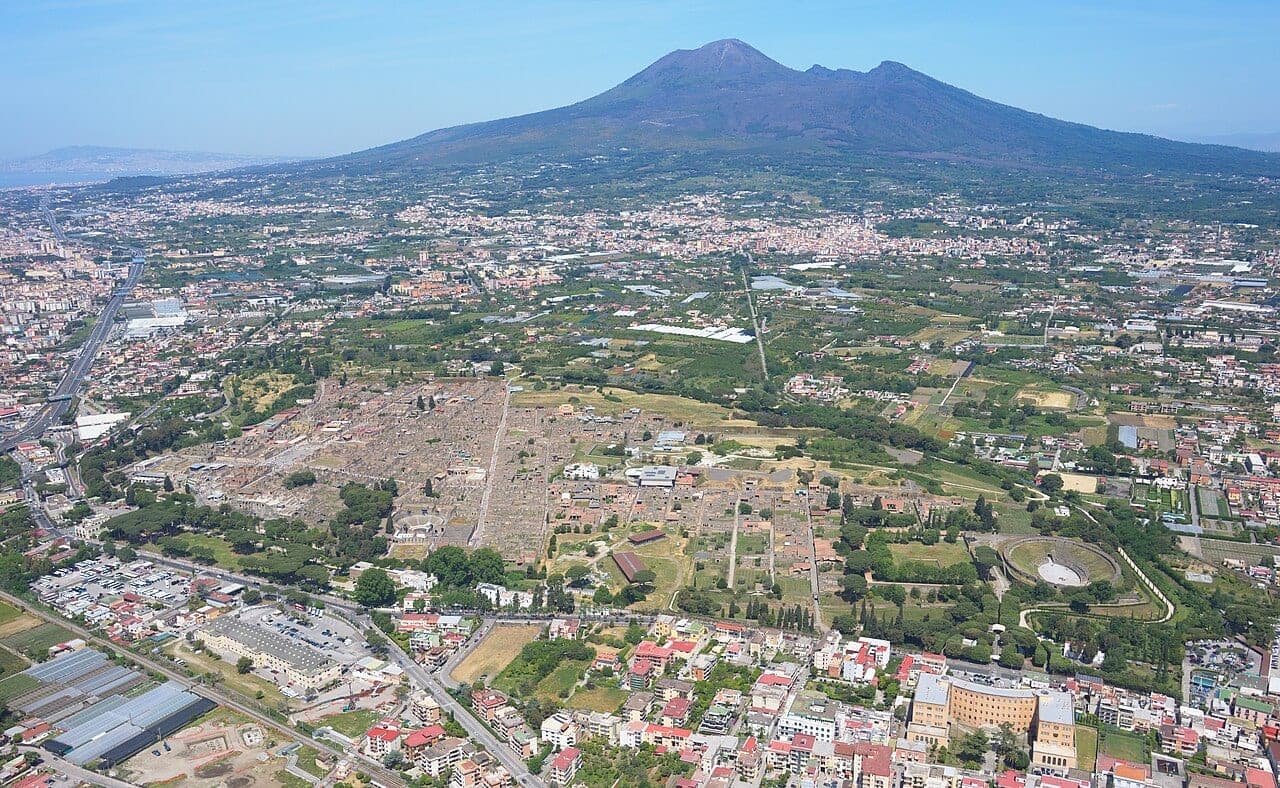
Pompeii was a Roman town on the Bay of Naples in Campania, southern Italy, buried under volcanic ash and pumice when Mount Vesuvius erupted in 79 AD. The disaster killed many of its inhabitants, yet the same ash also sealed its streets, houses, shops, and public buildings almost as they were on the day of the eruption. Forgotten for centuries and rediscovered from 1748, Pompeii is now one of the most important archaeological sites in the world, inscribed as a UNESCO World Heritage Site in 1997 alongside nearby Herculaneum and Torre Annunziata.
The site was settled long before it became Roman. Its name is thought to derive from the Oscan word pompe, meaning five, and the earliest town grew up among the Italic peoples of the region from around the sixth century BC. By the later fifth century BC the area had come under Samnite control, which shaped much of the street plan and many older houses that survive today. Pompeii was drawn into Rome's orbit during the Social War, when Sulla besieged it in 89 BC, and became a Roman colony around 80 BC.
As a Roman town, Pompeii was a modest but prosperous port and market centre of perhaps 11,000–15,000 people, living on wine, olive oil, garum (a fermented fish sauce), and trade through the bay. Its streets reveal the ordinary texture of Roman life: bakeries, bars with counters set into the pavement, laundries, public baths, a forum, two theatres, and an amphitheatre. On 5 February 62 AD (some sources give 63 AD) a powerful earthquake struck the region, and repairs were still under way seventeen years later when Vesuvius erupted.
In 79 AD Mount Vesuvius erupted with catastrophic force. The traditional date, 24 August, comes from a manuscript of Pliny the Younger's letters, but it is now widely questioned. Autumnal evidence in the ruins, including carbonised pomegranates and chestnuts, sealed jars of fermenting wine, and a charcoal inscription apparently dated to mid-October, has led many researchers to favour an autumn eruption, with 24–25 October 79 AD proposed by a multidisciplinary study. The question remains open, and some scholars still defend the summer date.
 The forum, with the mountain behind it. Nothing in the Roman record suggests the townspeople knew Vesuvius was a volcano. Photograph by Adam Harangozo, CC BY-SA 4.0, via Wikimedia Commons.
Our fullest account comes from Pliny the Younger, who watched from Misenum across the bay and later described the eruption in two letters to the historian Tacitus. His uncle, the naturalist Pliny the Elder, sailed towards the coast to help those in danger and died in the attempt; in his honour, volcanologists still call this kind of towering, ash-laden eruption Plinian.
The eruption came in phases. First a vast column of ash and pumice rose into the sky and fell back over Pompeii, collapsing roofs under its weight. In the following hours, pyroclastic surges, fast-moving clouds of superheated gas and volcanic matter, swept over the town and killed those who had stayed or could not leave. The number who died cannot be known with certainty. Around 1,100 bodies have been recovered within Pompeii; many inhabitants appear to have fled in the early stages, but the loss of life across the region was grave.
Pompeii lay buried and largely forgotten for more than 1,500 years. Systematic exploration began under the Bourbon rulers of Naples, first at Herculaneum in 1738 and then at Pompeii from 1748. Early digging was closer to treasure hunting than archaeology, but grew more methodical over the following century.
The turning point came with Giuseppe Fiorelli, who directed the excavations from 1863. He imposed careful recording and a system of dividing the town into regions and blocks that is still used today, and is best remembered for a simple, sobering technique: where a body had decayed inside the hardened ash it left a cavity, and by pouring liquid plaster into these voids he recovered casts of the victims in their final positions. The casts, showing people and animals at the moment of death, remain among the most affecting objects at the site. With the standing buildings and their contents, they make Pompeii an unusually complete record of everyday Roman life.
The rediscovery of Pompeii reshaped how Europe understood the classical past. Its wall paintings and recovered objects fed the Neoclassical taste of the eighteenth and nineteenth centuries, influencing art, interior design, and fashion, and the site helped turn antiquarianism into the modern discipline of archaeology. It entered the popular imagination through works such as Edward Bulwer-Lytton's novel The Last Days of Pompeii. For scholars it offers a snapshot of a Roman community frozen at a single moment, with few equals anywhere.
Pompeii lies just south-east of Naples and is straightforward to reach: the Circumvesuviana railway linking Naples and Sorrento stops at Pompei Scavi, a short walk from the main entrance. The area is very large, the ancient city covering roughly 66 hectares with around two-thirds now uncovered, so seeing the highlights takes several hours and the whole site can fill a day. Notable buildings include the Forum, the Amphitheatre, the House of the Faun, and the Villa of the Mysteries with its famous frescoes. The site is managed by the Parco Archeologico di Pompei, whose official website gives current hours, prices, and itineraries. Comfortable shoes, water, and sun protection are sensible, as the streets are uneven and shade is limited.
Preserving Pompeii is a continual challenge. Once exposed, ancient walls and frescoes become vulnerable to rain, sun, vegetation, and heavy visitor numbers. Decades of uneven maintenance led to serious deterioration, brought to public attention by the 2010 collapse of the Schola Armatorum, the so-called House of the Gladiators, which prompted warnings from UNESCO. In response, the Great Pompeii Project, a major conservation programme backed by the European Union, was launched to stabilise structures, improve drainage, and document the site. The work has reduced the risk of further collapse and reopened areas long closed to the public, though conserving so vast a site will need sustained funding and care.
The forum, with the mountain behind it. Nothing in the Roman record suggests the townspeople knew Vesuvius was a volcano. Photograph by Adam Harangozo, CC BY-SA 4.0, via Wikimedia Commons.
Our fullest account comes from Pliny the Younger, who watched from Misenum across the bay and later described the eruption in two letters to the historian Tacitus. His uncle, the naturalist Pliny the Elder, sailed towards the coast to help those in danger and died in the attempt; in his honour, volcanologists still call this kind of towering, ash-laden eruption Plinian.
The eruption came in phases. First a vast column of ash and pumice rose into the sky and fell back over Pompeii, collapsing roofs under its weight. In the following hours, pyroclastic surges, fast-moving clouds of superheated gas and volcanic matter, swept over the town and killed those who had stayed or could not leave. The number who died cannot be known with certainty. Around 1,100 bodies have been recovered within Pompeii; many inhabitants appear to have fled in the early stages, but the loss of life across the region was grave.
Pompeii lay buried and largely forgotten for more than 1,500 years. Systematic exploration began under the Bourbon rulers of Naples, first at Herculaneum in 1738 and then at Pompeii from 1748. Early digging was closer to treasure hunting than archaeology, but grew more methodical over the following century.
The turning point came with Giuseppe Fiorelli, who directed the excavations from 1863. He imposed careful recording and a system of dividing the town into regions and blocks that is still used today, and is best remembered for a simple, sobering technique: where a body had decayed inside the hardened ash it left a cavity, and by pouring liquid plaster into these voids he recovered casts of the victims in their final positions. The casts, showing people and animals at the moment of death, remain among the most affecting objects at the site. With the standing buildings and their contents, they make Pompeii an unusually complete record of everyday Roman life.
The rediscovery of Pompeii reshaped how Europe understood the classical past. Its wall paintings and recovered objects fed the Neoclassical taste of the eighteenth and nineteenth centuries, influencing art, interior design, and fashion, and the site helped turn antiquarianism into the modern discipline of archaeology. It entered the popular imagination through works such as Edward Bulwer-Lytton's novel The Last Days of Pompeii. For scholars it offers a snapshot of a Roman community frozen at a single moment, with few equals anywhere.
Pompeii lies just south-east of Naples and is straightforward to reach: the Circumvesuviana railway linking Naples and Sorrento stops at Pompei Scavi, a short walk from the main entrance. The area is very large, the ancient city covering roughly 66 hectares with around two-thirds now uncovered, so seeing the highlights takes several hours and the whole site can fill a day. Notable buildings include the Forum, the Amphitheatre, the House of the Faun, and the Villa of the Mysteries with its famous frescoes. The site is managed by the Parco Archeologico di Pompei, whose official website gives current hours, prices, and itineraries. Comfortable shoes, water, and sun protection are sensible, as the streets are uneven and shade is limited.
Preserving Pompeii is a continual challenge. Once exposed, ancient walls and frescoes become vulnerable to rain, sun, vegetation, and heavy visitor numbers. Decades of uneven maintenance led to serious deterioration, brought to public attention by the 2010 collapse of the Schola Armatorum, the so-called House of the Gladiators, which prompted warnings from UNESCO. In response, the Great Pompeii Project, a major conservation programme backed by the European Union, was launched to stabilise structures, improve drainage, and document the site. The work has reduced the risk of further collapse and reopened areas long closed to the public, though conserving so vast a site will need sustained funding and care.
History
The eruption