Heritage · Country
Sardinia Culture and Heritage
Around seven thousand Bronze Age stone towers still stand on Sardinia, built by a people who left no writing, and the island speaks the Romance language closest to Latin. This is a guide to Sardinian heritage, its prehistoric tombs and its long, careful customs around the dying and the dead.Written to last.
By Confinity Heritage Editorial · Updated 2026-08-17 · 8-minute readQuiet tools, kept out of the way.
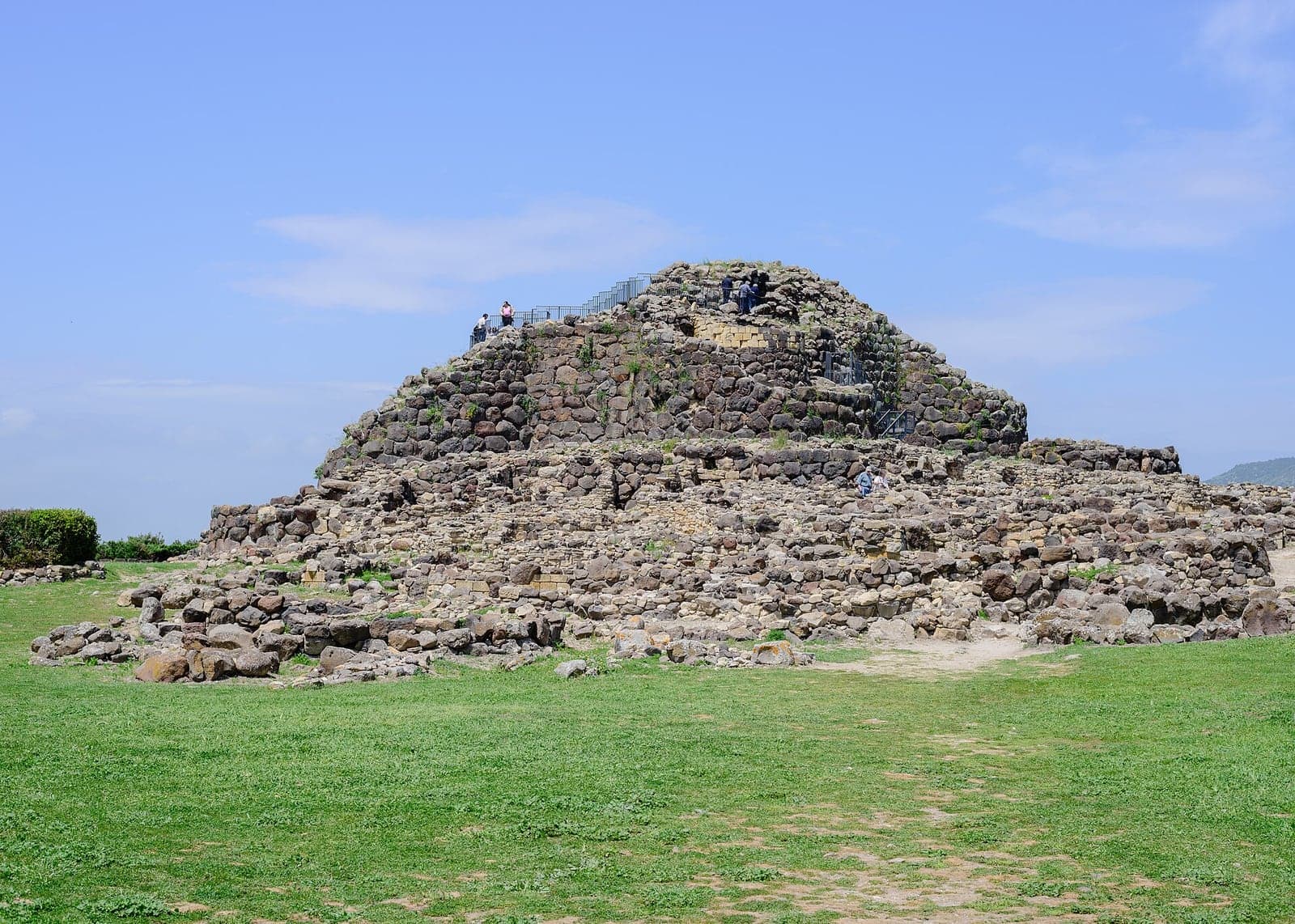
Start with the towers. Somewhere around seven thousand nuraghi survive on Sardinia, cones of dry-laid stone raised between roughly 1800 and 1100 BC by people who left no writing at all, and in places you can see three or four from a single hilltop. They are not ruins in the ordinary sense. Su Nuraxi at Barumini, inscribed by UNESCO in 1997, still has its central tower standing three storeys high with a corbelled chamber inside, and the village that grew up around its base is laid out at your feet.
Almost everything distinctive about the island follows from the same condition: distance. Sardinia lies far enough offshore, and its interior is rough enough, that people, words and customs arrived slowly and then stayed. The language here is generally judged the most conservative of the Romance family and the closest to spoken Latin; the carnival masks of the Barbagia look older than anything comparable in western Europe; and the practices around dying and mourning, including some that make uncomfortable reading, held on into living memory.
Sardinia is the second largest island in the Mediterranean and an autonomous region of Italy, about 24,100 square kilometres with roughly 1.5 million inhabitants, governed from Cagliari (Britannica). Its special statute dates from February 1948, and it grants the region wide powers over local government, culture and land. The island is geologically old and worn down rather than folded up, a country of granite uplands, limestone tablelands and long empty valleys, rising to Punta La Marmora at 1,834 metres in the Gennargentu massif at the centre of the Barbagia. Population density is among the lowest in Italy and thins sharply once you leave the coasts. Italian is the state language, Sardinian and four other historical tongues are recognised by law, and the coastline that now carries an international tourist industry was for most of history the emptiest part of the island, because it was where raiders arrived.
Cagliari. The capital sits above a southern bay with salt lagoons full of flamingos on either side. Its Castello quarter is a walled Pisan citadel of white limestone with two thirteenth-century towers, and below it lie the Roman amphitheatre and the Museo Archeologico Nazionale, which holds the finest collection of nuragic bronzes. Each 1 May the city sends its patron out on the longest religious procession in Italy.
Sassari. The second city, in the north-west, has its own language, a university with sixteenth-century origins, and the Cavalcata Sarda each May, when costume groups from across the island parade in the clothes of their villages.
Nuoro. Small, high and set under Monte Ortobene, Nuoro is the cultural capital of the interior and the home town of Grazia Deledda, who won the Nobel Prize in Literature in 1926 (NobelPrize.org). Its Museo del Costume holds the island's ethnographic collections, and its province covers most of the Barbagia.
Alghero. On the north-west coast, Alghero was emptied of its inhabitants after a revolt and repopulated with Catalan settlers from 1354, and the result is a Catalan-speaking city on an Italian island, with street signs in two languages and a dialect, alguerès, still taught locally (Wikipedia).
Barumini and Cabras. Two small towns carry more weight than their size suggests: Barumini for Su Nuraxi, and Cabras for the museum that holds the Mont'e Prama statues, the largest stone figures made anywhere in the western Mediterranean before the Greeks.
The nuragic civilisation is the island's foundation and one of the more remarkable prehistoric cultures of Europe. From about 1800 BC its builders raised the nuraghi, at first single towers and later forts with courtyards and outworks, alongside two other kinds of monument: the giants' tombs, long collective burials with a curved forecourt of standing slabs, and the sacred wells, of which the finest, Santa Cristina at Paulilatino, has a staircase of trachyte blocks cut so precisely that the joints are barely visible (Wikipedia). Their sanctuaries have produced hundreds of small bronze figures, the bronzetti, showing archers, wrestlers, chiefs with staffs, mothers holding dead sons, and a musician playing a triple pipe still played today (Wikipedia).
 Sardinia has some seven thousand nuraghi and no written record from the people who built them, so the towers are the only substantial thing that civilisation left to be read. Photograph by Norbert Nagel, CC BY-SA 3.0, via Wikimedia Commons.
Phoenicians founded ports at Nora, Tharros and Sulky from the ninth century BC, Carthage took the coasts from the sixth, and Rome annexed the island in 238 BC and held it for seven centuries without ever controlling the mountains, which it called Barbaria, the name the Barbagia still carries. After the Vandals and a long Byzantine period, contact with Constantinople thinned, and Sardinia did something unusual: it governed itself. From around the tenth century four independent kingdoms, the Giudicati of Cagliari, Torres, Gallura and Arborea, ran the island under judges whose authority an assembly confirmed and who legislated in Sardinian (Wikipedia). The most consequential of their rulers was Eleanor of Arborea, who around 1392 promulgated the Carta de Logu, a code covering criminal law, property and rural offences, written in Sardinian and later extended to the whole island; it stayed in force until 1827 (Wikipedia).
Pisa and Genoa pressed in from the twelfth century, the Crown of Aragon invaded in 1323, and Arborea held out for nearly a hundred years before falling in 1420. Spanish rule followed, then transfer to the House of Savoy in 1720, which made the Savoyard dukes kings of Sardinia and eventually, by way of the Risorgimento, kings of Italy. The nineteenth century brought enclosure laws that broke up common grazing land, deep poverty and the mines of the south-west; the twentieth brought malaria eradication after 1945, the autonomy statute of 1948 and coastal tourism.
Sardinian, sardu, is a Romance language in its own right and is widely described as the most conservative of the family, the one that has drifted least from spoken Latin (Wikipedia). The textbook illustration is that Latin centum, "hundred", stayed as kentu or chentu with a hard initial consonant where Italian softened it to cento, and that Latin domus survives as domo or domu for house where the rest of the Romance world moved to casa. Two written traditions exist, Logudorese in the centre and north and Campidanese in the south, and the region promotes a common written standard for administrative use.
The island's linguistic map is more crowded still. Sassarese and Gallurese in the north are transitional varieties closer to Corsican than to Sardinian; Alghero speaks Catalan because of the resettlement of 1354; and Carloforte and Calasetta, on two islands off the south-west, speak Tabarchino, a Ligurian dialect brought by coral fishers who had lived for two centuries on Tabarka off Tunisia before settling here in 1738 (Wikipedia). Regional law 26 of 1997 recognised all of these, national law 482 of 1999 placed Sardinian and Algherese Catalan among Italy's protected linguistic minorities, and a further regional law in 2018 set out a general language policy. Recognition has not reversed the decline: UNESCO's atlas classifies Sardinian as definitely endangered, since most speakers are older and transmission to children has largely stopped in the towns.
Sardinian music is unlike anything else in Italy. The cantu a tenore is sung by four men in a close circle, a solo voice over three others producing a guttural, harmonically fixed accompaniment; UNESCO proclaimed it in 2005 and inscribed it on the Representative List of intangible heritage (UNESCO). The launeddas is a triple clarinet of cane, three pipes played at once with circular breathing so the sound never stops, and one of the nuragic bronzes shows a player holding the same instrument roughly three thousand years ago (Wikipedia).
The masks are older-looking still. At Mamoiada the Mamuthones come out on 17 January for the feast of Sant'Antonio Abate and again at carnival, in black sheepskins and dark wooden masks, carrying up to thirty kilograms of cowbells and moving in two lines with a heavy synchronised jump, while the Issohadores in red jackets and white masks throw a rope over people in the crowd (Wikipedia). Ottana has its own version with ox masks, the Boes and Merdules. Nobody can prove what these rituals originally meant, and the interpretations, from cattle cults to a procession of the dead, are all modern.
The food is pastoral and patient. Pane carasau, the paper-thin twice-baked bread also called carta da musica, was made to keep for months while shepherds were away from home; su filindeu, the "threads of God", is a pasta of hand-pulled strands laid in three layers, made by a handful of women in Nuoro and served in broth to pilgrims who walk to the sanctuary of San Francesco di Lula (Wikipedia). Add pecorino, myrtle liqueur, suckling pig roasted over juniper and the Cannonau reds of the interior, and you have the diet often cited in studies of the island's unusual number of centenarians (Wikipedia).
Sardinia is Catholic, and its most distinctive religious institution is the country sanctuary. Across the island, isolated churches are ringed by cumbessias or muristenes, rows of small stone rooms where families from the surrounding villages live for the days of a novena, cooking, sleeping and keeping the feast together in a temporary village that assembles once a year and empties again.
The largest event is the Festa di Sant'Efisio. Every 1 May since the seventeenth century, Cagliari has sent the statue of its patron out of the city on an ox-drawn cart, escorted by mounted militia and thousands of people in the dress of their own villages, walking about seventy kilometres over four days to Nora, where the saint was executed, and back (Wikipedia). The origin is a vow made during the plague of the 1650s, and the city has kept it annually ever since. Older strata sit underneath. The sacred wells were built around water and the movement of light, the domus de janas are named for the janas, fairy or witch women said to have lived in them, and blessings, evil-eye rituals and the village healer's medicine persisted alongside the parish well into the twentieth century.
The oldest Sardinian graves are cut into rock. More than 3,500 domus de janas, "houses of the fairies", were hollowed out of rock faces from the fourth millennium BC onward as chambered tombs laid out like houses, some with pillars, carved roof beams, bull horns in relief and traces of red ochre, and in July 2025 UNESCO inscribed them under the title Funerary Tradition in the Prehistory of Sardinia (UNESCO). The nuragic giants' tombs that followed them were collective, with a forecourt where the living stood before a low opening into the chamber of the dead.
In the historic period, mourning was work done by women. The attittadoras, professional mourners called to the house, improvised the attitidu over the body, a sung lament that named the dead person, recounted their life and addressed them directly, sometimes while beating the breast or tearing at the hair, and folklorists and photographers recorded the practice into the twentieth century (Wikipedia). Related customs framed the event: mirrors covered, the fire put out, food brought by neighbours because the bereaved household could not cook, and a year or more of black worn by the widow.
One figure from this tradition needs stating carefully. Sardinian folklore holds that certain villages had an accabadora, sa femina accabadora, a woman called to the house of someone dying in prolonged pain who ended their suffering, and museums in Luras and elsewhere display a wooden mallet said to have been used. Whether any such role actually existed is contested. Historians point to a near-total absence of contemporary documentation, and many anthropologists read the figure as a legend giving shape to fears and duties around the deathbed; a smaller group treats a handful of reported twentieth-century cases as evidence that some women did perform what their communities regarded as a merciful ending (Atlas Obscura). Michela Murgia's prize-winning novel Accabadora (2009) put the figure in front of a large audience and sharpened the argument. It is best described as what it demonstrably is: a persistent and widely believed piece of Sardinian folklore about the ethics of dying, whose historical basis remains unproven.
The living calendar keeps its own appointment with the dead. On the night of 31 October and through 1 and 2 November, children in southern Sardinia go door to door for Is Animeddas, "the little souls", asking an offering for the dead and receiving nuts, dried fruit and sweets in return for prayers; elsewhere the custom is called su mortu mortu or su prugadoriu (L'Unione Sarda). In many households the table was left set overnight, with bread, water and a lit lamp, on the understanding that the family's own dead would come back to eat.
Sardinia has a set of records nobody else in the Mediterranean can match, and the reason is a Spanish census taken for tax.
Parish registers begin in the sixteenth century, and civil registration in 1866 as elsewhere in unified Italy, with the state archives publishing scans free through the Antenati portal.
What is distinctive is the depth of the demographic record and what has been done with it. Sardinian villages in the interior were unusually endogamous and stable for centuries, and the parish registers of some of them are complete enough that researchers have reconstructed entire populations across three or four hundred years. That work is why Sardinia became one of the most studied populations in human genetics, and why the Ogliastra villages, with their exceptional longevity, are among the best genealogically documented communities anywhere in the world.
The Aragonese and Spanish administration from 1323 to 1720 left notarial and feudal records in Catalan and Castilian, and Alghero still speaks a form of Catalan.
The older Sardinian record is not written. The nuraghi, seven thousand stone towers, and the domus de janas rock-cut tombs, are the built memory of a Bronze Age society that left no legible documents, and the tombe dei giganti were collective burials for lineages whose names nobody knows.
The emigration is recent and internal as well as external: to the mainland, to Germany, and out of the interior villages that are now emptying.
Two World Heritage listings anchor the island's archaeology. Su Nuraxi was inscribed in 1997 as the outstanding example of nuragic building, excavated between 1950 and 1955 by Giovanni Lilliu, whose work there established the chronology of the whole civilisation (UNESCO). The domus de janas followed in July 2025, after a nomination prepared over several years by a network of municipalities rather than one site authority.
Ethnography has its own institution. The Istituto Superiore Regionale Etnografico in Nuoro, founded in 1972, runs the Museo del Costume along with archives of recorded song, film and oral testimony, and it exists because the island decided early that its intangible inheritance had to be collected while its bearers were alive. The Fondazione Mont'e Prama, created in 2021, now manages the giants and the excavation site together. In the south-west, the exhausted lead, zinc and coal workings of the Sulcis and Iglesiente have become a protected mining landscape of shafts, villages and machine halls, described by its managers as the first geomineral park recognised by UNESCO, in 1998 (Parco Geominerario della Sardegna).
The Sardegna Digital Library, online since 2008, is the region's central collection, gathering tens of thousands of photographs, thousands of audio recordings, video and a large body of digitised publications about the island, free to consult (Wikipedia). Because so much of Sardinian culture is oral, the audio holdings matter as much as the texts: songs, tenore recordings, dialect interviews and funeral laments that would otherwise exist only in memory.
Archaeology has been mapped by volunteers. The Nurnet foundation, with the CRS4 research centre, built an open geoportal plotting nuraghi, domus de janas, sacred wells and giants' tombs across the island, adding sites reported by local people and publishing the data for anyone to reuse (Nurnet). Language has followed: the region has published dictionaries, a spellchecker and translation tools for Sardinian, and the Carta de Logu, the Mont'e Prama statues and the Cagliari museum collections are all now accessible in digital form.
The dominant social fact of modern Sardinia is emptying. The coasts and Cagliari have grown while the interior has lost its young people to the mainland and abroad, and dozens of Barbagia villages now have more houses than households, some selling properties for a euro to anyone who will restore and live in them. The mining towns of the Sulcis collapsed a generation earlier.
The interior also carries a harder memory. Balentia, roughly the reputation for courage and self-reliance that a man was expected to earn, ran alongside a long tradition of stock theft, feud and, from the 1960s to the 1990s, kidnapping for ransom in the Barbagia. That period is over, and it is argued about locally as heritage rather than news, in books, films and displays that treat banditry as a symptom of poverty and absent government.
What travels outward is the music and the writing. Grazia Deledda's novels of Nuoro remain the island's literary calling card, Michela Murgia brought Sardinian subjects to a wide Italian readership before her death in 2023, and the trumpeter Paolo Fresu and groups such as the Tenores di Bitti have carried Sardinian sound into jazz and world music. Tourism stays concentrated on a coastline that fills in August and empties in October, and the argument on the island is about how much of the interior's heritage can be shared without being flattened.
The giants put back together. After a farmer's plough turned up fragments at Cabras in 1974, excavation recovered more than five thousand pieces of monumental limestone sculpture, and between 2007 and 2011 conservators at Li Punti near Sassari reassembled around two dozen statues of archers, boxers and warriors along with models of nuraghi, using only reversible methods (National Geographic). They are the earliest large stone statues in the western Mediterranean, and the museum at Cabras now shows them together.
Rock-cut tombs recognised as a tradition. The July 2025 inscription of the domus de janas protected a funerary practice spread across dozens of communes, which had to agree a shared management plan before UNESCO would consider the nomination.
A song form that outlived its economy. The cantu a tenore was tied to a pastoral world that has largely gone, and UNESCO recognition in 2005 was followed by teaching groups, festivals and recordings that brought younger singers into the four-voice choirs.
Mines turned into memory. The closed workings of the Sulcis and Iglesiente, which employed and injured tens of thousands of Sardinians, were saved from demolition and reorganised as a protected industrial landscape, with museums run partly by the men who worked underground.
Sardinia has some seven thousand nuraghi and no written record from the people who built them, so the towers are the only substantial thing that civilisation left to be read. Photograph by Norbert Nagel, CC BY-SA 3.0, via Wikimedia Commons.
Phoenicians founded ports at Nora, Tharros and Sulky from the ninth century BC, Carthage took the coasts from the sixth, and Rome annexed the island in 238 BC and held it for seven centuries without ever controlling the mountains, which it called Barbaria, the name the Barbagia still carries. After the Vandals and a long Byzantine period, contact with Constantinople thinned, and Sardinia did something unusual: it governed itself. From around the tenth century four independent kingdoms, the Giudicati of Cagliari, Torres, Gallura and Arborea, ran the island under judges whose authority an assembly confirmed and who legislated in Sardinian (Wikipedia). The most consequential of their rulers was Eleanor of Arborea, who around 1392 promulgated the Carta de Logu, a code covering criminal law, property and rural offences, written in Sardinian and later extended to the whole island; it stayed in force until 1827 (Wikipedia).
Pisa and Genoa pressed in from the twelfth century, the Crown of Aragon invaded in 1323, and Arborea held out for nearly a hundred years before falling in 1420. Spanish rule followed, then transfer to the House of Savoy in 1720, which made the Savoyard dukes kings of Sardinia and eventually, by way of the Risorgimento, kings of Italy. The nineteenth century brought enclosure laws that broke up common grazing land, deep poverty and the mines of the south-west; the twentieth brought malaria eradication after 1945, the autonomy statute of 1948 and coastal tourism.
Sardinian, sardu, is a Romance language in its own right and is widely described as the most conservative of the family, the one that has drifted least from spoken Latin (Wikipedia). The textbook illustration is that Latin centum, "hundred", stayed as kentu or chentu with a hard initial consonant where Italian softened it to cento, and that Latin domus survives as domo or domu for house where the rest of the Romance world moved to casa. Two written traditions exist, Logudorese in the centre and north and Campidanese in the south, and the region promotes a common written standard for administrative use.
The island's linguistic map is more crowded still. Sassarese and Gallurese in the north are transitional varieties closer to Corsican than to Sardinian; Alghero speaks Catalan because of the resettlement of 1354; and Carloforte and Calasetta, on two islands off the south-west, speak Tabarchino, a Ligurian dialect brought by coral fishers who had lived for two centuries on Tabarka off Tunisia before settling here in 1738 (Wikipedia). Regional law 26 of 1997 recognised all of these, national law 482 of 1999 placed Sardinian and Algherese Catalan among Italy's protected linguistic minorities, and a further regional law in 2018 set out a general language policy. Recognition has not reversed the decline: UNESCO's atlas classifies Sardinian as definitely endangered, since most speakers are older and transmission to children has largely stopped in the towns.
Sardinian music is unlike anything else in Italy. The cantu a tenore is sung by four men in a close circle, a solo voice over three others producing a guttural, harmonically fixed accompaniment; UNESCO proclaimed it in 2005 and inscribed it on the Representative List of intangible heritage (UNESCO). The launeddas is a triple clarinet of cane, three pipes played at once with circular breathing so the sound never stops, and one of the nuragic bronzes shows a player holding the same instrument roughly three thousand years ago (Wikipedia).
The masks are older-looking still. At Mamoiada the Mamuthones come out on 17 January for the feast of Sant'Antonio Abate and again at carnival, in black sheepskins and dark wooden masks, carrying up to thirty kilograms of cowbells and moving in two lines with a heavy synchronised jump, while the Issohadores in red jackets and white masks throw a rope over people in the crowd (Wikipedia). Ottana has its own version with ox masks, the Boes and Merdules. Nobody can prove what these rituals originally meant, and the interpretations, from cattle cults to a procession of the dead, are all modern.
The food is pastoral and patient. Pane carasau, the paper-thin twice-baked bread also called carta da musica, was made to keep for months while shepherds were away from home; su filindeu, the "threads of God", is a pasta of hand-pulled strands laid in three layers, made by a handful of women in Nuoro and served in broth to pilgrims who walk to the sanctuary of San Francesco di Lula (Wikipedia). Add pecorino, myrtle liqueur, suckling pig roasted over juniper and the Cannonau reds of the interior, and you have the diet often cited in studies of the island's unusual number of centenarians (Wikipedia).
Sardinia is Catholic, and its most distinctive religious institution is the country sanctuary. Across the island, isolated churches are ringed by cumbessias or muristenes, rows of small stone rooms where families from the surrounding villages live for the days of a novena, cooking, sleeping and keeping the feast together in a temporary village that assembles once a year and empties again.
The largest event is the Festa di Sant'Efisio. Every 1 May since the seventeenth century, Cagliari has sent the statue of its patron out of the city on an ox-drawn cart, escorted by mounted militia and thousands of people in the dress of their own villages, walking about seventy kilometres over four days to Nora, where the saint was executed, and back (Wikipedia). The origin is a vow made during the plague of the 1650s, and the city has kept it annually ever since. Older strata sit underneath. The sacred wells were built around water and the movement of light, the domus de janas are named for the janas, fairy or witch women said to have lived in them, and blessings, evil-eye rituals and the village healer's medicine persisted alongside the parish well into the twentieth century.
The oldest Sardinian graves are cut into rock. More than 3,500 domus de janas, "houses of the fairies", were hollowed out of rock faces from the fourth millennium BC onward as chambered tombs laid out like houses, some with pillars, carved roof beams, bull horns in relief and traces of red ochre, and in July 2025 UNESCO inscribed them under the title Funerary Tradition in the Prehistory of Sardinia (UNESCO). The nuragic giants' tombs that followed them were collective, with a forecourt where the living stood before a low opening into the chamber of the dead.
In the historic period, mourning was work done by women. The attittadoras, professional mourners called to the house, improvised the attitidu over the body, a sung lament that named the dead person, recounted their life and addressed them directly, sometimes while beating the breast or tearing at the hair, and folklorists and photographers recorded the practice into the twentieth century (Wikipedia). Related customs framed the event: mirrors covered, the fire put out, food brought by neighbours because the bereaved household could not cook, and a year or more of black worn by the widow.
One figure from this tradition needs stating carefully. Sardinian folklore holds that certain villages had an accabadora, sa femina accabadora, a woman called to the house of someone dying in prolonged pain who ended their suffering, and museums in Luras and elsewhere display a wooden mallet said to have been used. Whether any such role actually existed is contested. Historians point to a near-total absence of contemporary documentation, and many anthropologists read the figure as a legend giving shape to fears and duties around the deathbed; a smaller group treats a handful of reported twentieth-century cases as evidence that some women did perform what their communities regarded as a merciful ending (Atlas Obscura). Michela Murgia's prize-winning novel Accabadora (2009) put the figure in front of a large audience and sharpened the argument. It is best described as what it demonstrably is: a persistent and widely believed piece of Sardinian folklore about the ethics of dying, whose historical basis remains unproven.
The living calendar keeps its own appointment with the dead. On the night of 31 October and through 1 and 2 November, children in southern Sardinia go door to door for Is Animeddas, "the little souls", asking an offering for the dead and receiving nuts, dried fruit and sweets in return for prayers; elsewhere the custom is called su mortu mortu or su prugadoriu (L'Unione Sarda). In many households the table was left set overnight, with bread, water and a lit lamp, on the understanding that the family's own dead would come back to eat.
Sardinia has a set of records nobody else in the Mediterranean can match, and the reason is a Spanish census taken for tax.
Parish registers begin in the sixteenth century, and civil registration in 1866 as elsewhere in unified Italy, with the state archives publishing scans free through the Antenati portal.
What is distinctive is the depth of the demographic record and what has been done with it. Sardinian villages in the interior were unusually endogamous and stable for centuries, and the parish registers of some of them are complete enough that researchers have reconstructed entire populations across three or four hundred years. That work is why Sardinia became one of the most studied populations in human genetics, and why the Ogliastra villages, with their exceptional longevity, are among the best genealogically documented communities anywhere in the world.
The Aragonese and Spanish administration from 1323 to 1720 left notarial and feudal records in Catalan and Castilian, and Alghero still speaks a form of Catalan.
The older Sardinian record is not written. The nuraghi, seven thousand stone towers, and the domus de janas rock-cut tombs, are the built memory of a Bronze Age society that left no legible documents, and the tombe dei giganti were collective burials for lineages whose names nobody knows.
The emigration is recent and internal as well as external: to the mainland, to Germany, and out of the interior villages that are now emptying.
Two World Heritage listings anchor the island's archaeology. Su Nuraxi was inscribed in 1997 as the outstanding example of nuragic building, excavated between 1950 and 1955 by Giovanni Lilliu, whose work there established the chronology of the whole civilisation (UNESCO). The domus de janas followed in July 2025, after a nomination prepared over several years by a network of municipalities rather than one site authority.
Ethnography has its own institution. The Istituto Superiore Regionale Etnografico in Nuoro, founded in 1972, runs the Museo del Costume along with archives of recorded song, film and oral testimony, and it exists because the island decided early that its intangible inheritance had to be collected while its bearers were alive. The Fondazione Mont'e Prama, created in 2021, now manages the giants and the excavation site together. In the south-west, the exhausted lead, zinc and coal workings of the Sulcis and Iglesiente have become a protected mining landscape of shafts, villages and machine halls, described by its managers as the first geomineral park recognised by UNESCO, in 1998 (Parco Geominerario della Sardegna).
The Sardegna Digital Library, online since 2008, is the region's central collection, gathering tens of thousands of photographs, thousands of audio recordings, video and a large body of digitised publications about the island, free to consult (Wikipedia). Because so much of Sardinian culture is oral, the audio holdings matter as much as the texts: songs, tenore recordings, dialect interviews and funeral laments that would otherwise exist only in memory.
Archaeology has been mapped by volunteers. The Nurnet foundation, with the CRS4 research centre, built an open geoportal plotting nuraghi, domus de janas, sacred wells and giants' tombs across the island, adding sites reported by local people and publishing the data for anyone to reuse (Nurnet). Language has followed: the region has published dictionaries, a spellchecker and translation tools for Sardinian, and the Carta de Logu, the Mont'e Prama statues and the Cagliari museum collections are all now accessible in digital form.
The dominant social fact of modern Sardinia is emptying. The coasts and Cagliari have grown while the interior has lost its young people to the mainland and abroad, and dozens of Barbagia villages now have more houses than households, some selling properties for a euro to anyone who will restore and live in them. The mining towns of the Sulcis collapsed a generation earlier.
The interior also carries a harder memory. Balentia, roughly the reputation for courage and self-reliance that a man was expected to earn, ran alongside a long tradition of stock theft, feud and, from the 1960s to the 1990s, kidnapping for ransom in the Barbagia. That period is over, and it is argued about locally as heritage rather than news, in books, films and displays that treat banditry as a symptom of poverty and absent government.
What travels outward is the music and the writing. Grazia Deledda's novels of Nuoro remain the island's literary calling card, Michela Murgia brought Sardinian subjects to a wide Italian readership before her death in 2023, and the trumpeter Paolo Fresu and groups such as the Tenores di Bitti have carried Sardinian sound into jazz and world music. Tourism stays concentrated on a coastline that fills in August and empties in October, and the argument on the island is about how much of the interior's heritage can be shared without being flattened.
The giants put back together. After a farmer's plough turned up fragments at Cabras in 1974, excavation recovered more than five thousand pieces of monumental limestone sculpture, and between 2007 and 2011 conservators at Li Punti near Sassari reassembled around two dozen statues of archers, boxers and warriors along with models of nuraghi, using only reversible methods (National Geographic). They are the earliest large stone statues in the western Mediterranean, and the museum at Cabras now shows them together.
Rock-cut tombs recognised as a tradition. The July 2025 inscription of the domus de janas protected a funerary practice spread across dozens of communes, which had to agree a shared management plan before UNESCO would consider the nomination.
A song form that outlived its economy. The cantu a tenore was tied to a pastoral world that has largely gone, and UNESCO recognition in 2005 was followed by teaching groups, festivals and recordings that brought younger singers into the four-voice choirs.
Mines turned into memory. The closed workings of the Sulcis and Iglesiente, which employed and injured tens of thousands of Sardinians, were saved from demolition and reorganised as a protected industrial landscape, with museums run partly by the men who worked underground.
National Overview
Notable Cities
Historical Foundations
Linguistic and Etymological Roots
Cultural Identity
Religion and Spirituality
Remembrance and Mourning Traditions
Tracing a Family in Sardinia
Heritage Preservation Efforts
Digital Heritage
Contemporary Cultural Influences
Success Stories
References and resources
- UNESCO, Su Nuraxi di Barumini: the 1997 inscription of the nuragic complex.
- UNESCO, Funerary Tradition in the Prehistory of Sardinia: the domus de janas, 2025.
- UNESCO Intangible Cultural Heritage, Canto a tenore: the four-voice pastoral singing.
- Encyclopaedia Britannica, Sardinia: geography and history.
- Wikipedia, Nuraghe: the towers, their dating and numbers.
- Wikipedia, Sardinian language: classification, varieties, legal status and endangerment.
- Wikipedia, Carta de Logu: Eleanor of Arborea's law code.
- Atlas Obscura, the accabadora of Sardinia: the folklore and the argument about its historical basis.
- L'Unione Sarda, Is Animeddas and su mortu mortu: the island's November customs for the dead.
- Sardegna Digital Library: the regional multimedia collection.
- Nurnet, the network of nuraghi: the open map of Sardinian prehistoric sites.
- NobelPrize.org, Grazia Deledda: the Nuoro novelist's 1926 prize.