Heritage · Country
Sicily Culture and Heritage
One chapel in Palermo carries Byzantine mosaics under an Arabic honeycomb ceiling inside a Norman king's building, which is Sicily's history compressed into a single room. This is a guide to the island's Greek temples, Arab-Norman churches, Baroque towns and its unusually direct habits of remembering the dead.Written to last.
By Confinity Heritage Editorial · Updated 2026-08-17 · 8-minute readQuiet tools, kept out of the way.
Sicily's case can be made inside one room. The Cappella Palatina, the chapel Roger II raised inside the royal palace at Palermo in the 1130s, sets Byzantine mosaics lettered in Greek above an Arabic inscription, under a wooden ceiling of honeycombed niches, the muqarnas form, painted by Muslim craftsmen for a Norman king whose chancery issued documents in Latin, Greek and Arabic. None of that was a compromise between parties. It's simply what a court looked like on an island where three civilisations had arrived and none of them had gone away.
The same logic runs across the whole island. A Greek temple at Syracuse became a Christian cathedral and kept its columns inside the wall; a mosque at Palermo became a cathedral and kept a Quranic verse carved on a column of its porch; towns flattened by the earthquake of 1693 were rebuilt in a Baroque so confident that UNESCO now protects eight of them together. Sicilians inherited the habit of building on what was already there, and they apply it to their dead as well, in a calendar of feasts, gifts and visits that treats the departed as members of the household who happen to be elsewhere.
Sicily is the largest island in the Mediterranean and an autonomous region of Italy, about 25,800 square kilometres in area with roughly 4.7 million inhabitants, governed from Palermo (Britannica). It received its special statute on 15 May 1946, before the Italian republic itself existed, and that statute gave it powers over its own cultural heritage no ordinary Italian region holds. The land is mostly hill and mountain, with a fertile eastern plain under Etna, the highest active volcano in Europe at around 3,400 metres and a summit that changes height with every serious eruption. The island sits in the narrows between Tunisia and the Italian mainland, roughly 145 kilometres from Africa, which is the fact behind almost everything else here. Italian is the language of administration and schooling, Sicilian is spoken alongside it by millions, and the population has been shaped for a century and a half by departure as much as by arrival.
Palermo. Founded by Phoenicians, capital of the Islamic emirate and then of the Norman kingdom, Palermo holds the densest concentration of the island's fused inheritance. Nine monuments in and near the city were inscribed by UNESCO in 2015 as Arab-Norman Palermo with the cathedrals of Cefalù and Monreale, among them the Cappella Palatina, the red-domed San Giovanni degli Eremiti, the Zisa pleasure palace with its Arabic name and cooled fountain hall, and the cathedral itself, raised on the site of a mosque that had been raised on a basilica (UNESCO). The Ballarò and Vucciria markets still cry their goods in Sicilian, the Teatro Massimo is one of the largest opera houses in Europe, and the Capuchin catacombs hold the city's most unusual monument to its own dead.
Catania. Rebuilt in black lava stone after Etna's eruption of 1669 and the earthquake of 1693, Catania is the island's second city, laid out in wide straight streets by architects who assumed the ground would move again. Its patron, Saint Agatha, is honoured each February in one of Europe's largest religious feasts.
Syracuse. For centuries one of the greatest cities of the Greek world, rival to Athens and home to Archimedes, Syracuse keeps a theatre cut into the rock that still stages classical drama each summer and a cathedral whose walls are the Doric columns of a fifth-century temple of Athena, walled in rather than pulled down. The city and the rock-cut necropolis of Pantalica were inscribed together in 2005 (UNESCO).
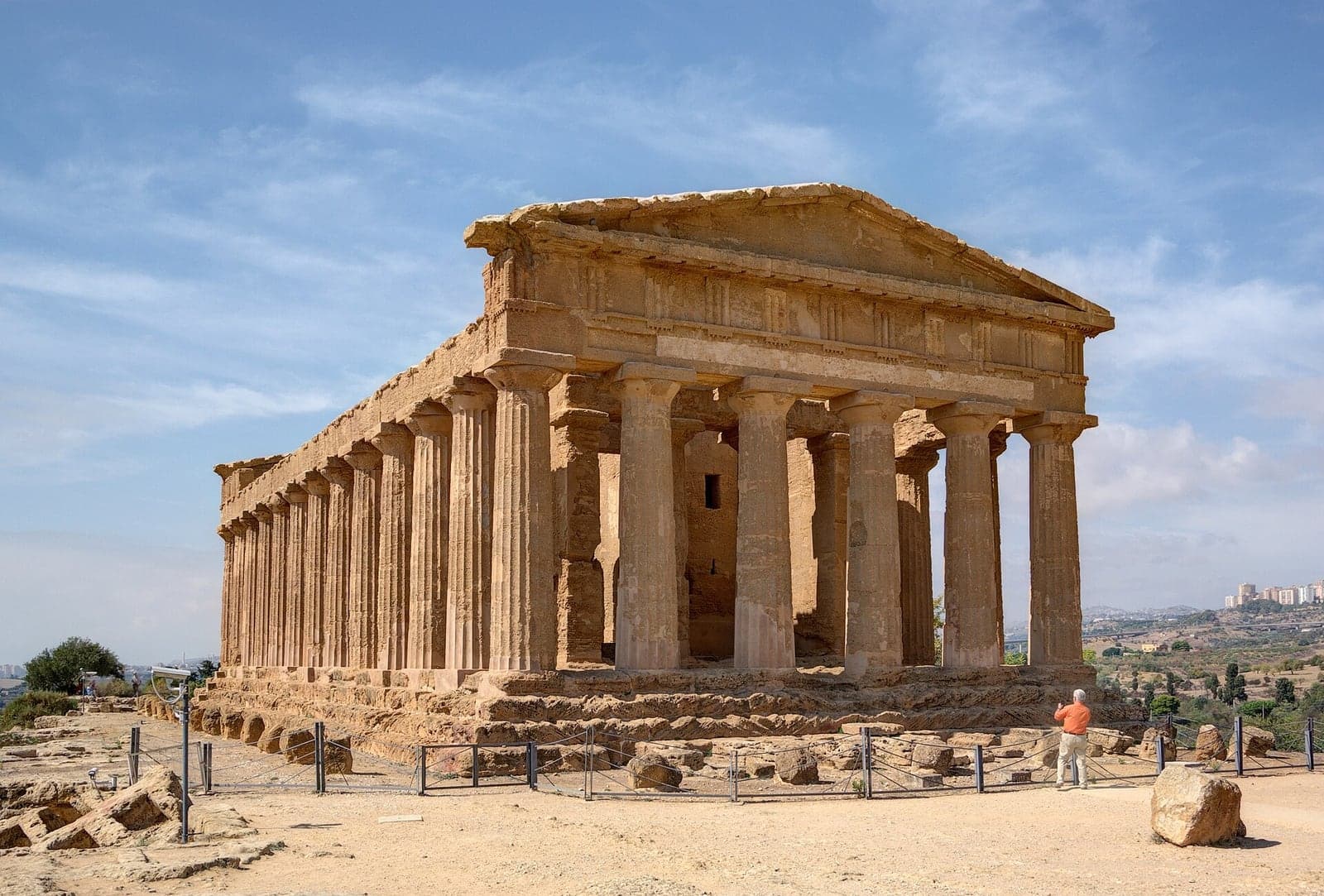
Agrigento. The Greek Akragas, founded around 580 BC, left a ridge of temples above the sea that has no equal outside Greece. The Temple of Concordia survives almost complete because it was converted into a Christian church in the sixth century AD, which is layering doing conservation work by accident (UNESCO).
Noto, Ragusa and the Val di Noto. Eight towns in the south-east, destroyed by the earthquake of 11 January 1693 and rebuilt on a scale their surviving populations could barely afford, form a single World Heritage listing of late Baroque urbanism (UNESCO). Noto's honey-coloured limestone and Ragusa Ibla's stairways are the result.
Before the Greeks there were three peoples: the Sicani in the west, the Sicels in the east, who gave the island its name, and the Elymians of Segesta and Erice, who claimed descent from Troy. Greek colonists arrived from the eighth century BC and built Syracuse, Akragas, Selinunte, Gela and Naxos, while Carthage held the western ports, and the two fought over the island for three hundred years until Rome took it in 241 BC and made it the republic's first province and its granary. The Roman centuries left the Villa Romana del Casale near Piazza Armerina, a fourth-century country house whose floors carry some 3,500 square metres of mosaic (UNESCO).
 Agrigento's temples are better preserved than almost anything left in Greece itself, partly because one of them was converted into a church and kept in use. Photograph by Ludvig14, CC BY-SA 4.0, via Wikimedia Commons.
Byzantine rule followed, and then, from the landing at Mazara in 827, the Emirate of Sicily (Wikipedia). Two and a half centuries of Muslim government changed the island permanently: citrus, sugar cane, rice, cotton, hard-wheat pasta traditions, and above all irrigation, the qanat tunnels under Palermo and the gebbie reservoirs still used in orchards today. When the Normans under Roger I took the island between 1061 and 1091 they inherited an Arabic-speaking, largely Muslim population, and Roger II, crowned king in 1130, chose to govern it rather than erase it, which is why his chapel looks the way it does (Wikipedia).
The Swabian emperor Frederick II, king of Sicily from childhood, kept his court at Palermo. After his line ended, Angevin rule provoked the rising of the Sicilian Vespers at Easter 1282, which began outside a church in Palermo and ended with the crown passing to Aragon (Britannica). Then came four centuries in the Spanish orbit under viceroys, the 1693 earthquake and the Baroque rebuilding, Bourbon rule from Naples, and the landing of Garibaldi and the Thousand at Marsala on 11 May 1860, which delivered the island to the new Italian kingdom and disappointed most of the peasants who had joined him (Britannica).
Sicilian, sicilianu, is a Romance language of the extreme south, spoken by several million people on the island and in the emigrant communities and classified as vulnerable in UNESCO's atlas of endangered languages (Wikipedia). Its vocabulary is a record of who governed. Arabic left zàgara for orange blossom, gèbbia for the irrigation tank in an orchard and giuggiulena for sesame; Norman French left accattari, to buy, and racina for grapes; Catalan left addunarisi, to notice; Greek is older and deeper, surviving in words like babbaluciu, the snail eaten at the feast of Santa Rosalia. A regional law of 2011 encourages the teaching of Sicilian language, literature and history in the island's schools, though implementation has been uneven and no single spelling standard is agreed.
The literary claim is larger than the island. At Frederick II's court in the first half of the thirteenth century, notaries and officials writing in a polished Sicilian produced the first substantial body of Italian lyric poetry, and one of them, Giacomo da Lentini, is credited with inventing the sonnet (Britannica). Dante treated their work as the beginning of Italian verse. The island's name comes from the Sicels, Sikeloi in Greek, while the older Greek name Trinacria, "three-cornered", survives on the regional flag as the three-legged triskelion with the head of Medusa at its centre.
The chivalric puppet theatre, the opera dei pupi, is the island's signature performing art, with armoured knights from the Carolingian cycle fighting through episodes that families followed night after night; UNESCO inscribed it in 2008 (UNESCO). The same stories were painted on the panels of the carretto siciliano, the decorated cart, and sung by cantastorie in market squares. Sicilian writing has an unusual density for a population this size: Giovanni Verga's rural realism, Luigi Pirandello's plays and his Nobel Prize of 1934, Salvatore Quasimodo's poetry and his Nobel of 1959, Tomasi di Lampedusa's The Leopard, Leonardo Sciascia's essays on power, and Andrea Camilleri's Montalbano novels, written in an Italian shot through with Sicilian.
The kitchen is another archive. Couscous is standard in Trapani, a direct inheritance from North Africa, and the cannolo, the cassata and the almond paste of frutta martorana all rest on sugar and citrus that arrived with the emirate. Sfincione, panelle and caponata form a cuisine that has kept its poor origins visible, and wine follows the same pattern, from Marsala, made for the British market from the eighteenth century, to the mountain reds now grown on Etna's terraces.
Sicily is overwhelmingly Catholic, and the year runs on patron saints. The Festino di Santa Rosalia in Palermo, held from 10 to 15 July with its climax on the night of 14 July, commemorates the finding of the saint's bones on Monte Pellegrino in 1624 and the end of the plague that followed their procession through the city; the four hundredth Festino was celebrated in 2024 (Il Festino di Santa Rosalia). Catania's feast of Sant'Agata, from 3 to 5 February, pulls the silver fercolo of the saint through the streets for two days and nights behind towering candelore, and draws crowds counted in the hundreds of thousands (Wikipedia). Holy Week brings hooded confraternities out in Trapani, Enna and Caltanissetta in processions that last through the night.
Agrigento's temples are better preserved than almost anything left in Greece itself, partly because one of them was converted into a church and kept in use. Photograph by Ludvig14, CC BY-SA 4.0, via Wikimedia Commons.
Byzantine rule followed, and then, from the landing at Mazara in 827, the Emirate of Sicily (Wikipedia). Two and a half centuries of Muslim government changed the island permanently: citrus, sugar cane, rice, cotton, hard-wheat pasta traditions, and above all irrigation, the qanat tunnels under Palermo and the gebbie reservoirs still used in orchards today. When the Normans under Roger I took the island between 1061 and 1091 they inherited an Arabic-speaking, largely Muslim population, and Roger II, crowned king in 1130, chose to govern it rather than erase it, which is why his chapel looks the way it does (Wikipedia).
The Swabian emperor Frederick II, king of Sicily from childhood, kept his court at Palermo. After his line ended, Angevin rule provoked the rising of the Sicilian Vespers at Easter 1282, which began outside a church in Palermo and ended with the crown passing to Aragon (Britannica). Then came four centuries in the Spanish orbit under viceroys, the 1693 earthquake and the Baroque rebuilding, Bourbon rule from Naples, and the landing of Garibaldi and the Thousand at Marsala on 11 May 1860, which delivered the island to the new Italian kingdom and disappointed most of the peasants who had joined him (Britannica).
Sicilian, sicilianu, is a Romance language of the extreme south, spoken by several million people on the island and in the emigrant communities and classified as vulnerable in UNESCO's atlas of endangered languages (Wikipedia). Its vocabulary is a record of who governed. Arabic left zàgara for orange blossom, gèbbia for the irrigation tank in an orchard and giuggiulena for sesame; Norman French left accattari, to buy, and racina for grapes; Catalan left addunarisi, to notice; Greek is older and deeper, surviving in words like babbaluciu, the snail eaten at the feast of Santa Rosalia. A regional law of 2011 encourages the teaching of Sicilian language, literature and history in the island's schools, though implementation has been uneven and no single spelling standard is agreed.
The literary claim is larger than the island. At Frederick II's court in the first half of the thirteenth century, notaries and officials writing in a polished Sicilian produced the first substantial body of Italian lyric poetry, and one of them, Giacomo da Lentini, is credited with inventing the sonnet (Britannica). Dante treated their work as the beginning of Italian verse. The island's name comes from the Sicels, Sikeloi in Greek, while the older Greek name Trinacria, "three-cornered", survives on the regional flag as the three-legged triskelion with the head of Medusa at its centre.
The chivalric puppet theatre, the opera dei pupi, is the island's signature performing art, with armoured knights from the Carolingian cycle fighting through episodes that families followed night after night; UNESCO inscribed it in 2008 (UNESCO). The same stories were painted on the panels of the carretto siciliano, the decorated cart, and sung by cantastorie in market squares. Sicilian writing has an unusual density for a population this size: Giovanni Verga's rural realism, Luigi Pirandello's plays and his Nobel Prize of 1934, Salvatore Quasimodo's poetry and his Nobel of 1959, Tomasi di Lampedusa's The Leopard, Leonardo Sciascia's essays on power, and Andrea Camilleri's Montalbano novels, written in an Italian shot through with Sicilian.
The kitchen is another archive. Couscous is standard in Trapani, a direct inheritance from North Africa, and the cannolo, the cassata and the almond paste of frutta martorana all rest on sugar and citrus that arrived with the emirate. Sfincione, panelle and caponata form a cuisine that has kept its poor origins visible, and wine follows the same pattern, from Marsala, made for the British market from the eighteenth century, to the mountain reds now grown on Etna's terraces.
Sicily is overwhelmingly Catholic, and the year runs on patron saints. The Festino di Santa Rosalia in Palermo, held from 10 to 15 July with its climax on the night of 14 July, commemorates the finding of the saint's bones on Monte Pellegrino in 1624 and the end of the plague that followed their procession through the city; the four hundredth Festino was celebrated in 2024 (Il Festino di Santa Rosalia). Catania's feast of Sant'Agata, from 3 to 5 February, pulls the silver fercolo of the saint through the streets for two days and nights behind towering candelore, and draws crowds counted in the hundreds of thousands (Wikipedia). Holy Week brings hooded confraternities out in Trapani, Enna and Caltanissetta in processions that last through the night.
 Monreale was built for a Norman king by Greek mosaicists in a kingdom administered partly in Arabic, which is the whole of Sicilian history in one building. Photograph by Livioandronico2013, CC BY-SA 4.0, via Wikimedia Commons.
Older and other layers survive alongside. Piana degli Albanesi and a few neighbouring towns were settled by Albanian refugees in the fifteenth century and still keep the Byzantine rite, in Greek and Albanian, under a Catholic eparchy of their own. Syracuse has a medieval Jewish quarter with a mikveh cut deep into the rock, from the community expelled in 1492. Mosque foundations under cathedrals and temple columns inside church walls make the island's sacred buildings physically stratified in a way few places match.
The gentlest Sicilian custom is also the strangest to outsiders. On the night before 2 November, the Giorno dei Morti, the dead of the family are said to come back and leave presents for children who have behaved and who have prayed for them: sugar puppets called pupi di zuccaru, marzipan fruit shaped and painted to look real, biscuits, small toys, sometimes a pair of new shoes, hidden around the house so the children must hunt for them in the morning. The marzipan is called frutta martorana after the Palermo convent where nuns are said to have first made it (Wikipedia). Families then go to the cemetery together, and children learn the day as an exchange: the dead give, and the living remember. Sicilians have defended the custom against imported Halloween, and several towns now fund it as heritage.
Palermo also keeps one of the most unusual burial places in Europe. From 1599, when the Capuchin friars found that bodies placed in a crypt under their church dried rather than decayed, the friars began preparing their own dead, and later the city's clergy, professionals and gentry at their families' request, laying them out in corridors organised by rank, trade, sex and age. The dead were dressed in their own clothes, sometimes changed by relatives on later visits, and laid in niches where the living could come and stand with them. Something like eight thousand people are there, of whom about 1,250 survive as mummified bodies rather than skeletons; the last admitted was Rosalia Lombardo, a two-year-old girl embalmed in 1920 (Wikipedia). The site is a scientific and ethical subject as much as a visitor attraction: since 2007 the Sicily Mummy Project has studied the bodies non-invasively for evidence of diet, disease and embalming technique, and researchers have opened a serious debate about whether the remains of children should be shown at all (Smithsonian Magazine).
The ordinary observances are quieter. Death notices go up on walls so that a whole town learns at once, the rosary is said in the house across several evenings, neighbours cook for the bereaved, and the anniversary Mass is announced the same way. Cassata and the other festival sweets carry a long association with the days of the dead, and the calendar keeps returning families to the same graves.
Sicilian records are among the oldest and best in Italy, which surprises people who expect the opposite.
Parish registers begin after the Council of Trent, from the 1560s and 1570s in many parishes, and survive well. Civil registration under Napoleonic rule began here in 1820 rather than 1866, because Sicily was part of the Kingdom of the Two Sicilies, which adopted the French system early; so Sicilian families have four and a half decades more state record than families in Lombardy or Tuscany. Those registers are digitised on the state archives' Antenati portal and are free.
The notarial archives are the deep layer, running from the medieval period in Palermo and Messina.
Emigration is the largest fact in the modern record. Something like a million and a half Sicilians left between 1880 and 1930, chiefly for the United States, Argentina and later northern Europe, and the ship manifests, naturalisation files and parish records of New York, New Orleans and Buenos Aires document them in detail. Many Sicilian-American families can find the comune of origin on a manifest and then read the register online.
Two catastrophes are in the record: the Messina earthquake of 1908, which killed something over sixty thousand people in minutes and destroyed the city's archives along with the city, and the bombing of 1943.
The older layers, Greek, Roman, Arab, Norman, Aragonese, are in the place names and the surnames rather than in any register.
The 1946 statute gave Sicily its own competence over cultural property, so the island runs its own superintendencies rather than answering to Rome, an arrangement unique among Italian regions that has drawn credit for local knowledge and criticism for underfunding. Seven World Heritage listings sit on or around the island: the Arab-Norman monuments, Agrigento, Villa Romana del Casale, the Val di Noto, Syracuse and Pantalica, the Aeolian Islands and Mount Etna, the last inscribed in 2013 for its two thousand years of documented eruption history (UNESCO).
Conservation work has concentrated on the mosaic sites, where a campaign at Piazza Armerina replaced a leaking 1950s shelter and stabilised the floors, and on the Baroque towns, where the earthquake of 1990 and the collapse of Noto cathedral's dome in 1996 took a decade to repair. The puppet theatre was rescued by a museum: the Museo internazionale delle marionette Antonio Pasqualino in Palermo gathered the puppets, scripts and stages of the dying dynasties and now trains new puppeteers (Museo delle Marionette). At the catacombs, a scientific curator now directs climate monitoring, controlled access and documented interventions.
The most ambitious digital project on the island is epigraphic. I.Sicily, run from Oxford in partnership with the Regione Siciliana, is building an open digital corpus of every inscription from ancient Sicily, in Greek, Latin, Punic, Oscan and Hebrew, with texts, images and 3D models linked to the museums that hold the stones (I.Sicily). Because so many of those inscriptions are funerary, the corpus is also a database of how Sicilians named and mourned their dead across a thousand years.
Regional programmes cover sound and film. Arca dei Suoni collects and publishes recordings of Sicilian speech, song and oral testimony contributed by communities and schools, and the Filmoteca Regionale Siciliana preserves and digitises film connected to the island (Arca dei Suoni). For families, the largest resource is the state archives' digitised civil registers, which matter more here than in most regions because the descendants of Sicilian emigrants are spread across the Americas and Australia, and the municipal record is often the only surviving thread back to a village.
Sicily's most consequential modern export has been its people. Between the 1880s and the 1970s several million left, first for the United States, Argentina and Brazil, then for Germany, Belgium and northern Italy, and the feast days and dialect words of Sicilian neighbourhoods in Brooklyn, Buenos Aires and Melbourne are the result. Depopulation continues inland, where towns have sold houses for a euro to anyone who will restore them.
Organised crime belongs in the record and is best stated plainly. Cosa Nostra grew in western Sicily in the nineteenth century and reached its most violent phase in the 1980s and early 1990s. The Maxi Trial of 1986 to 1987, built on the evidence of the magistrates Giovanni Falcone and Paolo Borsellino, convicted hundreds of members and broke the pretence that the organisation did not exist (Wikipedia). Both men were murdered in 1992, Falcone with his wife Francesca Morvillo and three police officers by a bomb under the motorway at Capaci on 23 May, Borsellino with five officers in Via D'Amelio on 19 July. What followed matters more. An obelisk now marks the motorway at Capaci, the tree outside Falcone's flat in Palermo is covered year-round in notes left by schoolchildren, and the anniversaries are kept as civic occasions across the island (Fondazione Falcone).
The island's image abroad is carried by film and fiction: Visconti's The Leopard, Tornatore's Cinema Paradiso, and the Montalbano series shot among the Baroque towns of the south-east. Tourism has grown quickly enough to strain Taormina, Ortigia and the Aeolian Islands, and the argument about how much of it the heritage can absorb is now permanent in Sicilian public life.
A fused inheritance recognised as one thing. The 2015 inscription of Arab-Norman Palermo with Cefalù and Monreale did something unusual: rather than protecting a single style, it recognised the meeting of Byzantine, Islamic and Latin cultures as the achievement itself, and tied nine buildings across three towns into one managed site.
Towns rebuilt twice. The Val di Noto was rebuilt after 1693 and repaired again after the 1990 earthquake and the collapse of Noto cathedral's dome in 1996, a ten-year reconstruction completed in 2007 that used the original quarries and traditional stonecutting rather than concrete.
Shopkeepers who stopped paying. Addiopizzo began in 2004 when young Palermitans papered the city with stickers reading that a people who pay protection money is a people without dignity. It grew into a register of businesses that refuse to pay and consumers who choose them, backed by legal support for those who report extortion (Addiopizzo).
The dead studied with care. The Capuchin catacombs have moved from an unsupervised curiosity to a monitored conservation site, with the Sicily Mummy Project applying radiography and isotope analysis since 2007 and an open professional debate about the ethics of exhibiting the youngest of the dead.
Monreale was built for a Norman king by Greek mosaicists in a kingdom administered partly in Arabic, which is the whole of Sicilian history in one building. Photograph by Livioandronico2013, CC BY-SA 4.0, via Wikimedia Commons.
Older and other layers survive alongside. Piana degli Albanesi and a few neighbouring towns were settled by Albanian refugees in the fifteenth century and still keep the Byzantine rite, in Greek and Albanian, under a Catholic eparchy of their own. Syracuse has a medieval Jewish quarter with a mikveh cut deep into the rock, from the community expelled in 1492. Mosque foundations under cathedrals and temple columns inside church walls make the island's sacred buildings physically stratified in a way few places match.
The gentlest Sicilian custom is also the strangest to outsiders. On the night before 2 November, the Giorno dei Morti, the dead of the family are said to come back and leave presents for children who have behaved and who have prayed for them: sugar puppets called pupi di zuccaru, marzipan fruit shaped and painted to look real, biscuits, small toys, sometimes a pair of new shoes, hidden around the house so the children must hunt for them in the morning. The marzipan is called frutta martorana after the Palermo convent where nuns are said to have first made it (Wikipedia). Families then go to the cemetery together, and children learn the day as an exchange: the dead give, and the living remember. Sicilians have defended the custom against imported Halloween, and several towns now fund it as heritage.
Palermo also keeps one of the most unusual burial places in Europe. From 1599, when the Capuchin friars found that bodies placed in a crypt under their church dried rather than decayed, the friars began preparing their own dead, and later the city's clergy, professionals and gentry at their families' request, laying them out in corridors organised by rank, trade, sex and age. The dead were dressed in their own clothes, sometimes changed by relatives on later visits, and laid in niches where the living could come and stand with them. Something like eight thousand people are there, of whom about 1,250 survive as mummified bodies rather than skeletons; the last admitted was Rosalia Lombardo, a two-year-old girl embalmed in 1920 (Wikipedia). The site is a scientific and ethical subject as much as a visitor attraction: since 2007 the Sicily Mummy Project has studied the bodies non-invasively for evidence of diet, disease and embalming technique, and researchers have opened a serious debate about whether the remains of children should be shown at all (Smithsonian Magazine).
The ordinary observances are quieter. Death notices go up on walls so that a whole town learns at once, the rosary is said in the house across several evenings, neighbours cook for the bereaved, and the anniversary Mass is announced the same way. Cassata and the other festival sweets carry a long association with the days of the dead, and the calendar keeps returning families to the same graves.
Sicilian records are among the oldest and best in Italy, which surprises people who expect the opposite.
Parish registers begin after the Council of Trent, from the 1560s and 1570s in many parishes, and survive well. Civil registration under Napoleonic rule began here in 1820 rather than 1866, because Sicily was part of the Kingdom of the Two Sicilies, which adopted the French system early; so Sicilian families have four and a half decades more state record than families in Lombardy or Tuscany. Those registers are digitised on the state archives' Antenati portal and are free.
The notarial archives are the deep layer, running from the medieval period in Palermo and Messina.
Emigration is the largest fact in the modern record. Something like a million and a half Sicilians left between 1880 and 1930, chiefly for the United States, Argentina and later northern Europe, and the ship manifests, naturalisation files and parish records of New York, New Orleans and Buenos Aires document them in detail. Many Sicilian-American families can find the comune of origin on a manifest and then read the register online.
Two catastrophes are in the record: the Messina earthquake of 1908, which killed something over sixty thousand people in minutes and destroyed the city's archives along with the city, and the bombing of 1943.
The older layers, Greek, Roman, Arab, Norman, Aragonese, are in the place names and the surnames rather than in any register.
The 1946 statute gave Sicily its own competence over cultural property, so the island runs its own superintendencies rather than answering to Rome, an arrangement unique among Italian regions that has drawn credit for local knowledge and criticism for underfunding. Seven World Heritage listings sit on or around the island: the Arab-Norman monuments, Agrigento, Villa Romana del Casale, the Val di Noto, Syracuse and Pantalica, the Aeolian Islands and Mount Etna, the last inscribed in 2013 for its two thousand years of documented eruption history (UNESCO).
Conservation work has concentrated on the mosaic sites, where a campaign at Piazza Armerina replaced a leaking 1950s shelter and stabilised the floors, and on the Baroque towns, where the earthquake of 1990 and the collapse of Noto cathedral's dome in 1996 took a decade to repair. The puppet theatre was rescued by a museum: the Museo internazionale delle marionette Antonio Pasqualino in Palermo gathered the puppets, scripts and stages of the dying dynasties and now trains new puppeteers (Museo delle Marionette). At the catacombs, a scientific curator now directs climate monitoring, controlled access and documented interventions.
The most ambitious digital project on the island is epigraphic. I.Sicily, run from Oxford in partnership with the Regione Siciliana, is building an open digital corpus of every inscription from ancient Sicily, in Greek, Latin, Punic, Oscan and Hebrew, with texts, images and 3D models linked to the museums that hold the stones (I.Sicily). Because so many of those inscriptions are funerary, the corpus is also a database of how Sicilians named and mourned their dead across a thousand years.
Regional programmes cover sound and film. Arca dei Suoni collects and publishes recordings of Sicilian speech, song and oral testimony contributed by communities and schools, and the Filmoteca Regionale Siciliana preserves and digitises film connected to the island (Arca dei Suoni). For families, the largest resource is the state archives' digitised civil registers, which matter more here than in most regions because the descendants of Sicilian emigrants are spread across the Americas and Australia, and the municipal record is often the only surviving thread back to a village.
Sicily's most consequential modern export has been its people. Between the 1880s and the 1970s several million left, first for the United States, Argentina and Brazil, then for Germany, Belgium and northern Italy, and the feast days and dialect words of Sicilian neighbourhoods in Brooklyn, Buenos Aires and Melbourne are the result. Depopulation continues inland, where towns have sold houses for a euro to anyone who will restore them.
Organised crime belongs in the record and is best stated plainly. Cosa Nostra grew in western Sicily in the nineteenth century and reached its most violent phase in the 1980s and early 1990s. The Maxi Trial of 1986 to 1987, built on the evidence of the magistrates Giovanni Falcone and Paolo Borsellino, convicted hundreds of members and broke the pretence that the organisation did not exist (Wikipedia). Both men were murdered in 1992, Falcone with his wife Francesca Morvillo and three police officers by a bomb under the motorway at Capaci on 23 May, Borsellino with five officers in Via D'Amelio on 19 July. What followed matters more. An obelisk now marks the motorway at Capaci, the tree outside Falcone's flat in Palermo is covered year-round in notes left by schoolchildren, and the anniversaries are kept as civic occasions across the island (Fondazione Falcone).
The island's image abroad is carried by film and fiction: Visconti's The Leopard, Tornatore's Cinema Paradiso, and the Montalbano series shot among the Baroque towns of the south-east. Tourism has grown quickly enough to strain Taormina, Ortigia and the Aeolian Islands, and the argument about how much of it the heritage can absorb is now permanent in Sicilian public life.
A fused inheritance recognised as one thing. The 2015 inscription of Arab-Norman Palermo with Cefalù and Monreale did something unusual: rather than protecting a single style, it recognised the meeting of Byzantine, Islamic and Latin cultures as the achievement itself, and tied nine buildings across three towns into one managed site.
Towns rebuilt twice. The Val di Noto was rebuilt after 1693 and repaired again after the 1990 earthquake and the collapse of Noto cathedral's dome in 1996, a ten-year reconstruction completed in 2007 that used the original quarries and traditional stonecutting rather than concrete.
Shopkeepers who stopped paying. Addiopizzo began in 2004 when young Palermitans papered the city with stickers reading that a people who pay protection money is a people without dignity. It grew into a register of businesses that refuse to pay and consumers who choose them, backed by legal support for those who report extortion (Addiopizzo).
The dead studied with care. The Capuchin catacombs have moved from an unsupervised curiosity to a monitored conservation site, with the Sicily Mummy Project applying radiography and isotope analysis since 2007 and an open professional debate about the ethics of exhibiting the youngest of the dead.
National Overview
Notable Cities
Historical Foundations
Linguistic and Etymological Roots
Cultural Identity
Religion and Spirituality
Remembrance and Mourning Traditions
Tracing a Family in Sicily
Heritage Preservation Efforts
Digital Heritage
Contemporary Cultural Influences
Success Stories
References and resources
- UNESCO, Arab-Norman Palermo, Cefalù and Monreale: the 2015 inscription and its nine monuments.
- UNESCO, Archaeological Area of Agrigento: the Greek temple ridge of ancient Akragas.
- UNESCO, Late Baroque Towns of the Val di Noto: eight towns rebuilt after 1693.
- UNESCO Intangible Cultural Heritage, Opera dei Pupi: the Sicilian puppet theatre and its safeguarding.
- Encyclopaedia Britannica, Sicily: geography, administration and history.
- Encyclopaedia Britannica, Sicilian school: Frederick II's court poets and the sonnet.
- Wikipedia, Sicilian language: classification, loanwords, speaker numbers and legal status.
- Wikipedia, Capuchin catacombs of Palermo: the site's history and numbers.
- Smithsonian Magazine, the Sicilian child mummies: non-invasive study of the catacombs' youngest remains.
- I.Sicily, corpus of Sicilian inscriptions: open epigraphic data for the ancient island.
- Fondazione Giovanni e Francesca Falcone: the anniversaries and the schools programme.
- Addiopizzo: the consumer and business movement against protection payments.