Heritage · Landmark
Leaning Tower of Pisa: History, Tilt & Restoration
The campanile of Pisa Cathedral began tilting before its third storey was finished, and medieval builders spent nearly two centuries trying to correct a lean they could not stop. A ten-year rescue completed in 2001 pulled the tower back from the edge of collapse while keeping the tilt that made it famous.Written to last.
By Confinity Heritage Editorial · Updated 2026-07-31 · 7-minute readQuiet tools, kept out of the way.
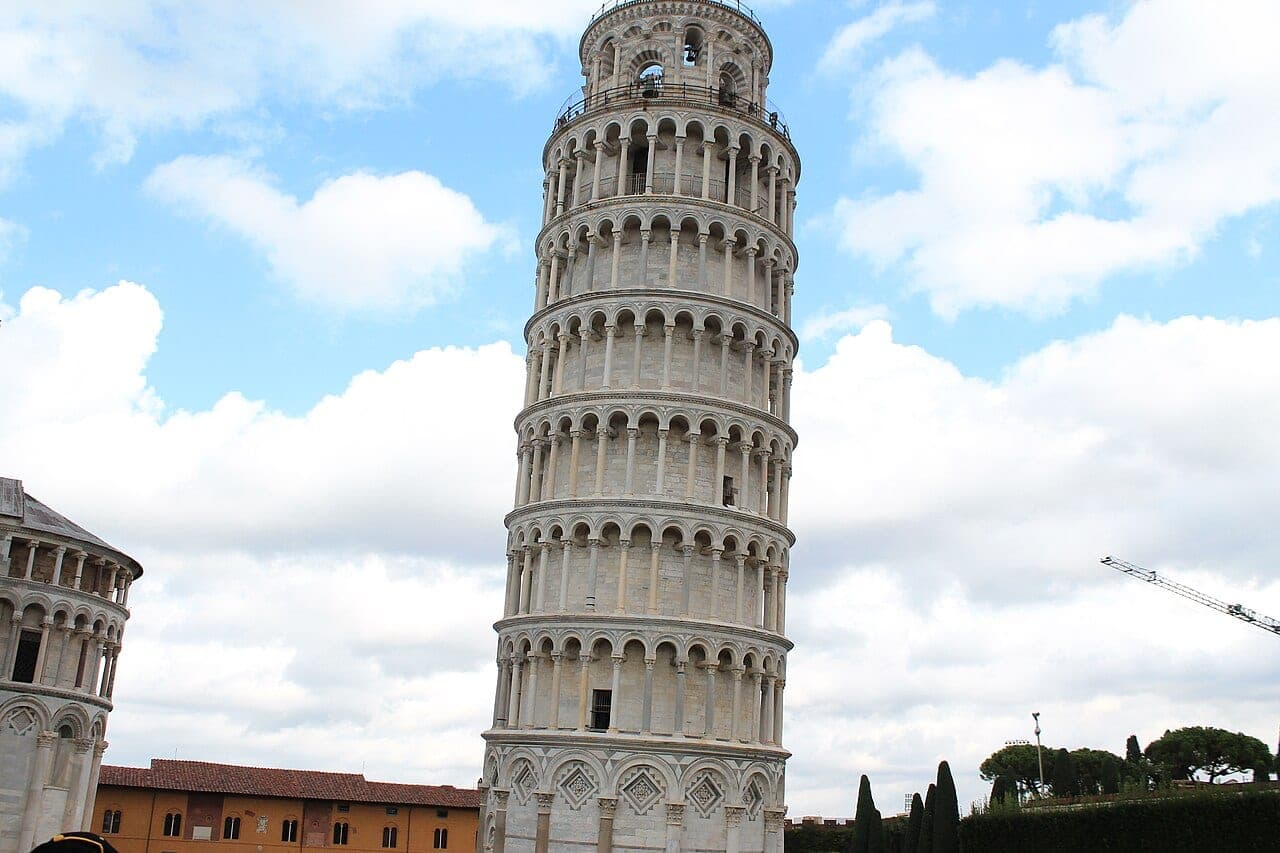
The Leaning Tower of Pisa, in Italian the Torre di Pisa, is the freestanding bell tower, or campanile, of Pisa Cathedral in Tuscany, Italy. It was never meant to lean. The tilt that made it one of the most recognisable buildings on earth is an accident of engineering, the result of raising a heavy marble tower on soft ground that began to give way before the third storey was finished. What might have been a routine medieval campanile instead became a nearly two-century struggle between builders and the earth beneath them, and later a landmark case in the modern science of ground engineering.
The tower is the youngest of the four great monuments on the Piazza del Duomo, the walled green in the north of Pisa also known as the Piazza dei Miracoli, the Field of Miracles. Alongside the cathedral, the baptistery, and the Camposanto burial ground, it was inscribed as a UNESCO World Heritage Site in 1987. Rising to about 57 metres and leaning today at close to four degrees from vertical, it draws millions of visitors a year to a structure that engineers spent the 1990s persuading not to fall.
Construction began on 9 August 1173. The design has traditionally been attributed to Bonanno Pisano, though a study published in 2001 points instead to Diotisalvi, the architect of the nearby baptistery. Work in white and grey marble rose quickly at first, but by 1178, with only the third of the tower's storeys standing, the ground on the south side had settled and the structure had already begun to tilt. Building stopped.
The halt lasted almost a century. Pisa, then a powerful maritime republic, was drawn repeatedly into war with its rivals Genoa, Lucca, and Florence, and the resources and attention needed to continue the tower were absent. The interruption, however unwanted, may have saved the building. It gave the underlying soil a long period to consolidate and gain strength, so that when work resumed the foundations were far less likely to fail outright.
Building began again around 1272 under Giovanni di Simone, who added several further storeys. Work stopped a second time after 1284, when Pisa's fleet was destroyed by Genoa at the Battle of Meloria, a defeat that ended the republic's naval power and its capacity for large projects. The tower was finally topped out with its bell chamber around 1372, the work usually credited to Tommaso di Andrea Pisano. From first stone to last, nearly two hundred years had passed, and the building carried the marks of that long, broken effort in its very shape.
The cause of the lean lies not in the masonry but in the ground. The tower sits on a shallow foundation only about three metres deep, laid on a soft mixture of clay, fine sand, and shells. This subsoil is weak and unevenly compressible, and it could not bear the concentrated weight of the tower evenly. As the structure rose during the first building phase, one side sank further than the other and the tower began to tip, a movement that started during construction rather than long afterwards.
Medieval builders were acutely aware of the problem, and they tried to correct for it as they went. When work resumed in the thirteenth century, the upper storeys were built with one side slightly taller than the other, so that each new level was raised a little more on the sinking southern flank in an attempt to bring the top back toward vertical. The result is that the tower is not straight even along its own axis: it curves gently, like a shallow banana, as generations of masons chased a moving target. Their compensation is one reason the tower still stands, but it could not stop the underlying settlement, and the lean continued to grow slowly across the centuries that followed.
The tower's fame also attracted a scientific legend. Galileo Galilei, born in Pisa in 1564, is said to have dropped two balls of different masses from the top to show that they fall at the same rate, disproving the ancient belief that heavier objects fall faster. The story should be treated as legend. Its only source is a biography written by Galileo's pupil Vincenzo Viviani in 1654, long after the supposed event, and most historians regard it as apocryphal or, at most, a thought experiment.
The tower is a cylinder in the Pisan Romanesque style, faced in pale marble and wrapped in tiers of columns. At the base a ring of blind arcading sets the pattern; above it rise six storeys of open loggias, their slender colonnades encircling the shaft and casting deep bands of shadow, before the smaller bell chamber caps the top. The composition echoes the arcaded facade of the cathedral it serves, tying the campanile visually to the rest of the piazza.
 The tower is the cathedral bell tower, and the cathedral leans slightly too. The whole square is built on the same soft ground. Photograph by John Samuel, CC BY-SA 4.0, via Wikimedia Commons.
It is a substantial structure. The tower rises about 55.86 metres on its low side and 56.67 metres on the high side, weighs on the order of 14,500 tonnes, and is climbed by a spiral staircase of nearly three hundred steps winding up inside the hollow shaft. The bell chamber at the summit holds seven bells, one for each note of the musical major scale; the largest, called L'Assunta, was cast in the seventeenth century. For much of the twentieth century the bells were rarely rung for fear that the vibration might add to the strain on the leaning structure.
As the campanile of the cathedral, the tower is one part of a deliberate ensemble. The Piazza del Duomo gathers the cathedral, begun in 1063, the circular baptistery, the tower, and the Camposanto Monumentale, the arcaded cemetery, on a broad lawn set slightly apart from the medieval city. UNESCO describes the group as a masterpiece of medieval architecture whose forms influenced monumental art in Italy for centuries. The tower, the last of the four to be built and the most flawed, has become the emblem of the whole.
By the late twentieth century the lean had reached a point that alarmed engineers. The tilt was increasing by a small amount each year, and the sudden collapse of a medieval tower in nearby Pavia in 1989 sharpened the fear that Pisa's could fail without warning. In January 1990 the Italian authorities closed the tower to the public and convened an international committee to save it.
The rescue took more than a decade and proceeded in careful stages. As an immediate measure, engineers cast a concrete ring around the base and loaded it with lead ingots, several hundred tonnes in all, stacked on the north side to counterbalance the overhanging south and halt the tilt while a permanent solution was found. The lasting fix was a technique called soil extraction, or underexcavation, carried out between 1999 and 2001: small quantities of soil were drawn out from beneath the raised north side of the foundation through angled bores, so that the tower settled very slightly back toward vertical under its own weight.
The correction was deliberately modest. Pulling the tower fully upright would have destroyed the character that makes it famous, so the aim was only to make it safe. The works reduced the overhang at the top by about 45 centimetres, roughly half a degree, returning the tower to about the position it had held in the early nineteenth century and leaving it leaning at close to 3.97 degrees, with the summit displaced about 3.9 metres from the vertical. The tower reopened on 15 December 2001, and engineers judged it stable for at least two hundred years. Monitoring in the years since has found the lean holding steady and even easing by a few millimetres, a sign that the intervention worked.
The Leaning Tower stands at the north edge of Pisa on the Piazza del Duomo, a short walk or bus ride from the city's central station and about an hour by train from Florence. The surrounding piazza, its lawns and its monuments, is open to walk through freely; climbing the tower itself requires a timed ticket, best booked in advance through the official site of the Opera della Primaziale Pisana, the body that manages the monuments.
Numbers on the climb are limited and young children are not admitted, both because the staircase is steep and narrow and to control the load inside the shaft. The ascent of nearly three hundred marble steps is uneven, and the tilt is genuinely disorienting underfoot, seeming to pull one way and then the other as the stair spirals around. Combined tickets cover the cathedral, the baptistery, the Camposanto, and the associated museums, and most visitors set aside at least half a day to take in the piazza as a whole rather than the tower alone. Opening hours run late in the summer months, so it is worth checking the official site before travelling.
The tower is the cathedral bell tower, and the cathedral leans slightly too. The whole square is built on the same soft ground. Photograph by John Samuel, CC BY-SA 4.0, via Wikimedia Commons.
It is a substantial structure. The tower rises about 55.86 metres on its low side and 56.67 metres on the high side, weighs on the order of 14,500 tonnes, and is climbed by a spiral staircase of nearly three hundred steps winding up inside the hollow shaft. The bell chamber at the summit holds seven bells, one for each note of the musical major scale; the largest, called L'Assunta, was cast in the seventeenth century. For much of the twentieth century the bells were rarely rung for fear that the vibration might add to the strain on the leaning structure.
As the campanile of the cathedral, the tower is one part of a deliberate ensemble. The Piazza del Duomo gathers the cathedral, begun in 1063, the circular baptistery, the tower, and the Camposanto Monumentale, the arcaded cemetery, on a broad lawn set slightly apart from the medieval city. UNESCO describes the group as a masterpiece of medieval architecture whose forms influenced monumental art in Italy for centuries. The tower, the last of the four to be built and the most flawed, has become the emblem of the whole.
By the late twentieth century the lean had reached a point that alarmed engineers. The tilt was increasing by a small amount each year, and the sudden collapse of a medieval tower in nearby Pavia in 1989 sharpened the fear that Pisa's could fail without warning. In January 1990 the Italian authorities closed the tower to the public and convened an international committee to save it.
The rescue took more than a decade and proceeded in careful stages. As an immediate measure, engineers cast a concrete ring around the base and loaded it with lead ingots, several hundred tonnes in all, stacked on the north side to counterbalance the overhanging south and halt the tilt while a permanent solution was found. The lasting fix was a technique called soil extraction, or underexcavation, carried out between 1999 and 2001: small quantities of soil were drawn out from beneath the raised north side of the foundation through angled bores, so that the tower settled very slightly back toward vertical under its own weight.
The correction was deliberately modest. Pulling the tower fully upright would have destroyed the character that makes it famous, so the aim was only to make it safe. The works reduced the overhang at the top by about 45 centimetres, roughly half a degree, returning the tower to about the position it had held in the early nineteenth century and leaving it leaning at close to 3.97 degrees, with the summit displaced about 3.9 metres from the vertical. The tower reopened on 15 December 2001, and engineers judged it stable for at least two hundred years. Monitoring in the years since has found the lean holding steady and even easing by a few millimetres, a sign that the intervention worked.
The Leaning Tower stands at the north edge of Pisa on the Piazza del Duomo, a short walk or bus ride from the city's central station and about an hour by train from Florence. The surrounding piazza, its lawns and its monuments, is open to walk through freely; climbing the tower itself requires a timed ticket, best booked in advance through the official site of the Opera della Primaziale Pisana, the body that manages the monuments.
Numbers on the climb are limited and young children are not admitted, both because the staircase is steep and narrow and to control the load inside the shaft. The ascent of nearly three hundred marble steps is uneven, and the tilt is genuinely disorienting underfoot, seeming to pull one way and then the other as the stair spirals around. Combined tickets cover the cathedral, the baptistery, the Camposanto, and the associated museums, and most visitors set aside at least half a day to take in the piazza as a whole rather than the tower alone. Opening hours run late in the summer months, so it is worth checking the official site before travelling.
History
The tilt
Architecture
Stabilization and preservation
Visiting
References and resources
- Opera della Primaziale Pisana, official site: the managing body's pages on the tower, the piazza, hours, and ticketing.
- UNESCO World Heritage Centre: Piazza del Duomo, Pisa: the 1987 inscription and the site's statement of significance.
- Ministero della Cultura: Piazza del Duomo, Pisa: the Italian heritage authority's account of the monuments and their outstanding universal value.
- Encyclopaedia Britannica: Leaning Tower of Pisa: overview of the tower's construction, lean, and stabilisation.
- Institution of Civil Engineers: Stabilising the Leaning Tower of Pisa: the engineering account of the 1990 to 2001 rescue.
- Wikipedia: Leaning Tower of Pisa: detailed history, dimensions, bells, and restoration with sources.