Heritage · Landmark
The Colosseum: History, Attractions & Visitor Guide
The Colosseum is the largest amphitheatre ever built, begun by Vespasian around 72 AD and inaugurated by Titus with a hundred days of games.Written to last.
By Confinity Heritage Editorial · Updated 2026-07-20 · 7-minute readQuiet tools, kept out of the way.
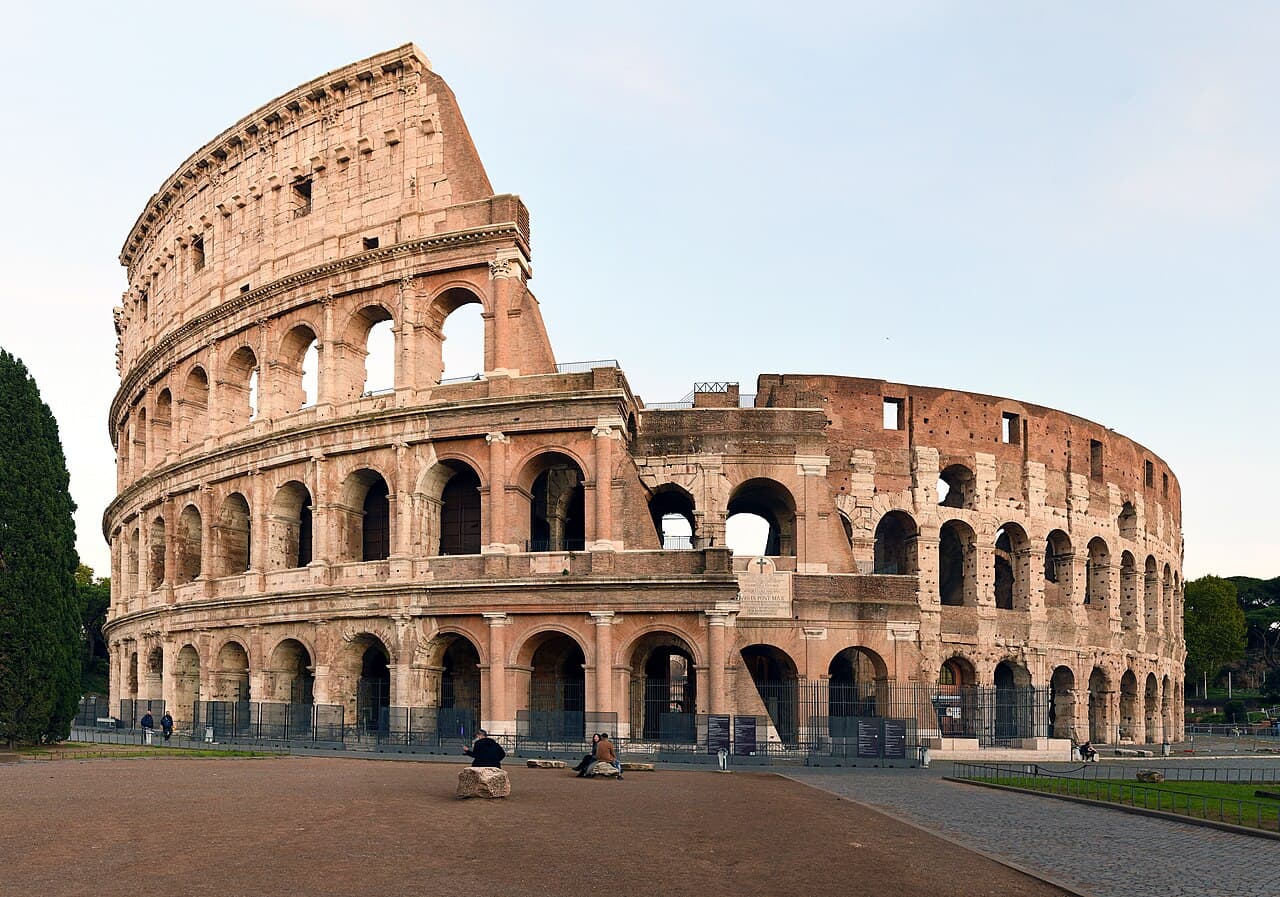
The Colosseum, known in antiquity as the Flavian Amphitheatre (Latin Amphitheatrum Flavium), is a vast elliptical arena in the centre of Rome and the largest amphitheatre ever built. Commissioned by the emperor Vespasian around 72 AD and inaugurated by his son Titus in 80 AD, it could hold somewhere between 50,000 and 80,000 spectators, who came to watch gladiatorial combat, staged animal hunts, and public executions. Nearly two thousand years later it remains the defining image of imperial Rome, inscribed by UNESCO in 1980 as part of the Historic Centre of Rome and named one of the New7Wonders of the World in 2007.
Built from travertine limestone, volcanic tuff, and brick-faced concrete, the Colosseum was a feat of engineering that could fill and empty tens of thousands of people through eighty numbered entrances. Much of the structure has been lost to earthquakes, fire, and centuries of stone-robbing, yet enough survives to read the building almost like a diagram of how Roman spectacle worked. It is now Italy's most visited monument, drawing more than 12 million visitors in 2023.
The amphitheatre was a political statement before it was a building. In 64 AD a fire had cleared a large tract of central Rome, and the emperor Nero seized the ground for a sprawling private estate, the Domus Aurea, complete with an artificial lake. After Nero's death and the civil wars of 69 AD, Vespasian founded the Flavian dynasty and set about returning that seized land to public use. On the drained site of Nero's lake he began an amphitheatre for the people of Rome, a deliberate reversal of a hated predecessor's private luxury.
Vespasian funded the project with the spoils of the Jewish War. A reconstructed dedicatory inscription studied by the epigrapher Géza Alföldy indicates the amphitheatre was paid for ex manubiis, from the proceeds of the sack of Jerusalem in 70 AD, and much of the labour was likely supplied by Jewish prisoners brought to Rome after that campaign. Construction advanced quickly. Vespasian died in 79 AD with the building not yet finished, and it fell to Titus to complete and dedicate it in 80 AD. His younger brother Domitian later added the uppermost tier and the underground service level, so that all three Flavian emperors left their mark.
Titus marked the opening with inaugural games that ran for more than 100 days, during which ancient writers report that over 9,000 animals were killed. The name "Colosseum" is not Roman in origin; it came into use in the medieval period and is usually linked to the Colossus of Nero, a giant bronze statue that once stood beside the amphitheatre. For roughly four centuries the arena stayed in near-constant use, hosting the public spectacles that were central to the political life of the city, before the games slowly faded and the building began its long second life as ruin, quarry, and monument.
The Colosseum is a freestanding oval, about 189 metres long and 156 metres wide, rising to a height of roughly 48 metres, with an outer perimeter of some 545 metres. The performance area, the arena itself, measured about 87 by 55 metres and was floored with timber covered in sand; the Latin word arena means sand, which soaked up the blood of the spectacles. Around and beneath this floor the whole machine of Roman entertainment was arranged in stone.
 The hypogeum, the two-storey basement of cages, corridors and lifts that ran the spectacle from below. The wooden floor above it is gone. Photograph by daryl_mitchell, CC BY-SA 2.0, via Wikimedia Commons.
The outer wall was built largely of travertine limestone quarried at Tivoli, an estimated 100,000 cubic metres of it, set without mortar and held together by iron clamps weighing several hundred tons in total. Later generations dug those clamps out for their metal, which is why the surviving stonework is pocked with holes. Behind the travertine, the Romans used lighter volcanic tuff for internal walls and brick-faced concrete for the vaults, grading their materials so that heavier stone carried the loads and lighter concrete spanned the ceilings.
The elevation is organised into a strict grid. The ground level presents eighty arches, the entrances through which crowds were funnelled to their seats, most of them numbered so that a ticket-holder could find the correct staircase. Three tiers of arcades are framed by engaged columns in the classical orders, Tuscan on the lowest level, Ionic on the second, and Corinthian on the third, with a solid attic storey above decorated by Corinthian pilasters. That stacking of the orders became a template copied across European architecture for centuries.
Inside, the seating, or cavea, was banked in tiers that mapped Roman society onto stone. Senators sat closest to the arena, then the equestrian and citizen classes, with women, slaves, and the poor placed highest and furthest from the action. To shade this crowd, a retractable awning called the velarium could be drawn over the seating from 240 mast corbels set around the top of the wall. Operating this rigging of ropes and canvas was a specialist job given to a detachment of sailors from the imperial fleet based at Misenum, whose experience with ship's rigging suited them to the task.
The eighty ground-level arches doubled as a crowd-management system that stadium designers still study. Most were numbered, and a spectator's token, or tessera, is thought to have directed the holder to a particular entrance, staircase, and wedge of seating. Passages and stairways led to interior openings, the vomitoria, that spilled ticket-holders out into their correct tier. The arrangement let the building take in and later release tens of thousands of people in a remarkably short time, without forcing the ranks of Roman society to mix on the way.
Beneath the arena lay the hypogeum, a two-level network of tunnels, cells, and animal cages added under Domitian. A system of lifts and trap doors let caged beasts and scenery be raised directly into the arena, so that animals or fighters could appear as if from nowhere. This substructure, buried and forgotten for centuries, was only fully excavated in the modern era and is now one of the most revealing parts of the site.
The events staged here followed a familiar daily rhythm. Mornings were typically given over to the venationes, staged hunts and displays of exotic animals brought from across the empire, from lions and leopards to bears, elephants, and ostriches. Around midday came the public executions of condemned criminals and prisoners, sometimes dressed up as scenes from mythology. The afternoon belonged to the main event, the munera, the gladiatorial contests that gave the arena its enduring reputation.
The popular picture of gladiators, drawn largely from film, deserves correction. Most gladiators were enslaved people, prisoners of war, or condemned criminals, but some were free volunteers, and all represented a serious financial investment for the men who trained and hired them out. A skilled fighter was expensive to house and train, which made killing him in every bout economically wasteful. Analysis of tombstones and of graffiti from Pompeii recording match results suggests that only around one in five losing gladiators died, meaning most fighters survived any given contest. A defeated gladiator could appeal for mercy, and the decision to spare or kill him rested with the presiding official, guided by the crowd.
The famous "thumbs up, thumbs down" signal is largely a modern invention. The surviving Latin phrase pollice verso means only "with a turned thumb" and says nothing about direction; ancient sources confirm that thumb gestures were used but are vague about what they meant. What is clear is that star gladiators could become genuine celebrities. Their names appear on pottery and graffiti across the empire, and admirers are recorded collecting souvenirs associated with their favourites.
Attending was itself a social ritual. Admission to the games was generally free, funded by the emperor or by magistrates seeking public favour, and the fixed hierarchy of the seating meant that where a person sat announced exactly who they were. Awnings, fountains, and the scale of the spectacle were all part of the message, and the day out combined the roles of public holiday, political theatre, and mass entertainment in a single venue.
The spectacles were not really about sport. They were a carefully managed tool of imperial politics, a way for the emperor to display his generosity, project the reach and wealth of Rome, and bind the populace to the regime through shared excitement. Ancient writers also describe water spectacles, or naumachiae, staged in the arena during the early games, though whether the Colosseum could genuinely be flooded remains debated among scholars and would in any case have ended once the hypogeum was built. Any accounting of the human and animal cost over the building's active centuries is guesswork; the very large totals often quoted cannot be verified from the ancient record.
The games did not so much stop as slowly wind down. As Christianity became the dominant religion of the empire, tastes and laws shifted against the bloodshed. The emperor Honorius restricted gladiatorial combat around 399 and 404 AD, and gladiatorial fights are last mentioned in the sources around 435 AD, while animal hunts continued until at least 523 AD before the tradition lapsed. Earthquakes and neglect then took over from the state as the main forces acting on the building.
Through the medieval centuries the abandoned amphitheatre was repurposed many times over. A small chapel was installed inside by the late sixth century, and stretches of the structure were turned into housing, workshops, and even a fortress held by the powerful Frangipani family around 1200. A major earthquake in 1349 brought down much of the outer wall on the southern side, and the fallen travertine was carted away as ready-cut stone for churches, palaces, and other building projects across Rome over the following centuries. The distinctive south flank we see today is, in large part, the building's original inner wall, exposed where the outer ring collapsed.
The Colosseum's survival owes something to its later Christian associations. In 1749 Pope Benedict XIV formally consecrated the site in memory of Christian martyrs believed, on uncertain evidence, to have died there, which helped protect it from further demolition. In the early nineteenth century the leaning ends of the surviving wall were stabilised by large brick and stone buttresses, the triangular wedges still visible at each end of the north façade, engineered by Raffaele Stern and Giuseppe Valadier. These frankly modern interventions were left plain rather than disguised, an early example of honest architectural conservation.
Conservation has continued into the present. A major restoration campaign ran between 1993 and 2000, and a privately funded cleaning and repair programme sponsored by the shoe company Tod's, costing around 25 million euros, ran from 2013 to 2016 and scrubbed the grime of modern traffic pollution from the travertine. Work has since focused on the hypogeum, opened more fully to visitors, and on plans for a lightweight retractable floor over the underground level. The building's global standing was recognised when it was inscribed by UNESCO in 1980 within the Historic Centre of Rome, a listing extended in 1990, and when it was voted one of the New7Wonders of the World in 2007.
The Colosseum stands at Piazza del Colosseo in central Rome, immediately beside the Roman Forum and Palatine Hill and next to the Arch of Constantine. It is served directly by the Colosseo stop on Metro Line B, and by numerous bus and tram routes. The site is managed by the Parco archeologico del Colosseo, whose official website is the reliable source for current hours, prices, and events.
The monument is open daily except 1 January and 25 December, with opening hours that change by season, generally from early morning until shortly before sunset. A standard admission ticket also covers entry to the Roman Forum and the Palatine Hill, and additional ticket types give access to restricted areas such as the arena floor and the underground hypogeum. Because visitor numbers are high and entry is by timed slot, booking in advance through the official channels is strongly advised; unofficial resellers often charge steep markups.
A visit to the Colosseum together with the Forum and Palatine typically takes two to three hours. Large bags, suitcases, and backpacks are not permitted, and everything is screened at security. There is little shade on the upper tiers, so sun protection and water are sensible in summer, and layered clothing in winter. Step-free routes and lifts reach the main levels, though the underground remains difficult to access for wheelchair users. Nearby sites worth combining into a single day include the Domus Aurea, the Basilica di San Clemente with its layered ancient and medieval levels, and the Circus Maximus a short walk to the south-west.
The hypogeum, the two-storey basement of cages, corridors and lifts that ran the spectacle from below. The wooden floor above it is gone. Photograph by daryl_mitchell, CC BY-SA 2.0, via Wikimedia Commons.
The outer wall was built largely of travertine limestone quarried at Tivoli, an estimated 100,000 cubic metres of it, set without mortar and held together by iron clamps weighing several hundred tons in total. Later generations dug those clamps out for their metal, which is why the surviving stonework is pocked with holes. Behind the travertine, the Romans used lighter volcanic tuff for internal walls and brick-faced concrete for the vaults, grading their materials so that heavier stone carried the loads and lighter concrete spanned the ceilings.
The elevation is organised into a strict grid. The ground level presents eighty arches, the entrances through which crowds were funnelled to their seats, most of them numbered so that a ticket-holder could find the correct staircase. Three tiers of arcades are framed by engaged columns in the classical orders, Tuscan on the lowest level, Ionic on the second, and Corinthian on the third, with a solid attic storey above decorated by Corinthian pilasters. That stacking of the orders became a template copied across European architecture for centuries.
Inside, the seating, or cavea, was banked in tiers that mapped Roman society onto stone. Senators sat closest to the arena, then the equestrian and citizen classes, with women, slaves, and the poor placed highest and furthest from the action. To shade this crowd, a retractable awning called the velarium could be drawn over the seating from 240 mast corbels set around the top of the wall. Operating this rigging of ropes and canvas was a specialist job given to a detachment of sailors from the imperial fleet based at Misenum, whose experience with ship's rigging suited them to the task.
The eighty ground-level arches doubled as a crowd-management system that stadium designers still study. Most were numbered, and a spectator's token, or tessera, is thought to have directed the holder to a particular entrance, staircase, and wedge of seating. Passages and stairways led to interior openings, the vomitoria, that spilled ticket-holders out into their correct tier. The arrangement let the building take in and later release tens of thousands of people in a remarkably short time, without forcing the ranks of Roman society to mix on the way.
Beneath the arena lay the hypogeum, a two-level network of tunnels, cells, and animal cages added under Domitian. A system of lifts and trap doors let caged beasts and scenery be raised directly into the arena, so that animals or fighters could appear as if from nowhere. This substructure, buried and forgotten for centuries, was only fully excavated in the modern era and is now one of the most revealing parts of the site.
The events staged here followed a familiar daily rhythm. Mornings were typically given over to the venationes, staged hunts and displays of exotic animals brought from across the empire, from lions and leopards to bears, elephants, and ostriches. Around midday came the public executions of condemned criminals and prisoners, sometimes dressed up as scenes from mythology. The afternoon belonged to the main event, the munera, the gladiatorial contests that gave the arena its enduring reputation.
The popular picture of gladiators, drawn largely from film, deserves correction. Most gladiators were enslaved people, prisoners of war, or condemned criminals, but some were free volunteers, and all represented a serious financial investment for the men who trained and hired them out. A skilled fighter was expensive to house and train, which made killing him in every bout economically wasteful. Analysis of tombstones and of graffiti from Pompeii recording match results suggests that only around one in five losing gladiators died, meaning most fighters survived any given contest. A defeated gladiator could appeal for mercy, and the decision to spare or kill him rested with the presiding official, guided by the crowd.
The famous "thumbs up, thumbs down" signal is largely a modern invention. The surviving Latin phrase pollice verso means only "with a turned thumb" and says nothing about direction; ancient sources confirm that thumb gestures were used but are vague about what they meant. What is clear is that star gladiators could become genuine celebrities. Their names appear on pottery and graffiti across the empire, and admirers are recorded collecting souvenirs associated with their favourites.
Attending was itself a social ritual. Admission to the games was generally free, funded by the emperor or by magistrates seeking public favour, and the fixed hierarchy of the seating meant that where a person sat announced exactly who they were. Awnings, fountains, and the scale of the spectacle were all part of the message, and the day out combined the roles of public holiday, political theatre, and mass entertainment in a single venue.
The spectacles were not really about sport. They were a carefully managed tool of imperial politics, a way for the emperor to display his generosity, project the reach and wealth of Rome, and bind the populace to the regime through shared excitement. Ancient writers also describe water spectacles, or naumachiae, staged in the arena during the early games, though whether the Colosseum could genuinely be flooded remains debated among scholars and would in any case have ended once the hypogeum was built. Any accounting of the human and animal cost over the building's active centuries is guesswork; the very large totals often quoted cannot be verified from the ancient record.
The games did not so much stop as slowly wind down. As Christianity became the dominant religion of the empire, tastes and laws shifted against the bloodshed. The emperor Honorius restricted gladiatorial combat around 399 and 404 AD, and gladiatorial fights are last mentioned in the sources around 435 AD, while animal hunts continued until at least 523 AD before the tradition lapsed. Earthquakes and neglect then took over from the state as the main forces acting on the building.
Through the medieval centuries the abandoned amphitheatre was repurposed many times over. A small chapel was installed inside by the late sixth century, and stretches of the structure were turned into housing, workshops, and even a fortress held by the powerful Frangipani family around 1200. A major earthquake in 1349 brought down much of the outer wall on the southern side, and the fallen travertine was carted away as ready-cut stone for churches, palaces, and other building projects across Rome over the following centuries. The distinctive south flank we see today is, in large part, the building's original inner wall, exposed where the outer ring collapsed.
The Colosseum's survival owes something to its later Christian associations. In 1749 Pope Benedict XIV formally consecrated the site in memory of Christian martyrs believed, on uncertain evidence, to have died there, which helped protect it from further demolition. In the early nineteenth century the leaning ends of the surviving wall were stabilised by large brick and stone buttresses, the triangular wedges still visible at each end of the north façade, engineered by Raffaele Stern and Giuseppe Valadier. These frankly modern interventions were left plain rather than disguised, an early example of honest architectural conservation.
Conservation has continued into the present. A major restoration campaign ran between 1993 and 2000, and a privately funded cleaning and repair programme sponsored by the shoe company Tod's, costing around 25 million euros, ran from 2013 to 2016 and scrubbed the grime of modern traffic pollution from the travertine. Work has since focused on the hypogeum, opened more fully to visitors, and on plans for a lightweight retractable floor over the underground level. The building's global standing was recognised when it was inscribed by UNESCO in 1980 within the Historic Centre of Rome, a listing extended in 1990, and when it was voted one of the New7Wonders of the World in 2007.
The Colosseum stands at Piazza del Colosseo in central Rome, immediately beside the Roman Forum and Palatine Hill and next to the Arch of Constantine. It is served directly by the Colosseo stop on Metro Line B, and by numerous bus and tram routes. The site is managed by the Parco archeologico del Colosseo, whose official website is the reliable source for current hours, prices, and events.
The monument is open daily except 1 January and 25 December, with opening hours that change by season, generally from early morning until shortly before sunset. A standard admission ticket also covers entry to the Roman Forum and the Palatine Hill, and additional ticket types give access to restricted areas such as the arena floor and the underground hypogeum. Because visitor numbers are high and entry is by timed slot, booking in advance through the official channels is strongly advised; unofficial resellers often charge steep markups.
A visit to the Colosseum together with the Forum and Palatine typically takes two to three hours. Large bags, suitcases, and backpacks are not permitted, and everything is screened at security. There is little shade on the upper tiers, so sun protection and water are sensible in summer, and layered clothing in winter. Step-free routes and lifts reach the main levels, though the underground remains difficult to access for wheelchair users. Nearby sites worth combining into a single day include the Domus Aurea, the Basilica di San Clemente with its layered ancient and medieval levels, and the Circus Maximus a short walk to the south-west.
History
Architecture and engineering
The games and daily life
Decline and preservation
Visiting
References and resources
- Colosseum, Wikipedia
- Historic Centre of Rome, UNESCO World Heritage Centre
- Parco archeologico del Colosseo, official site
- Colosseum, New7Wonders of the World
- Rome's Colosseum welcomes record 12 million visitors in 2023, Wanted in Rome
- The Colosseum's inaugural games, The Collector
- Did the Colosseum have a roof? The velarium, Through Eternity Tours
- Gladiator myths and misconceptions, War History Online