Heritage · Museum
Galleria dell'Accademia: Home of Michelangelo's David
The Galleria dell'Accademia in Florence was founded in 1784 as a study collection for the city's art academy and has sheltered Michelangelo's David since 1873. Alongside the David it keeps his unfinished Prisoners and Saint Matthew, centuries of Florentine painting, a gallery of plaster casts, and a museum of historic instruments.Written to last.
By Confinity Heritage Editorial · Updated 2026-07-31 · 7-minute readQuiet tools, kept out of the way.
The Galleria dell'Accademia (Gallery of the Academy) occupies a set of former convent and hospital buildings on Via Ricasoli, in the historic centre of Florence and a few minutes on foot from the cathedral. It is one of the most visited art museums in Italy, ranking second among the country's galleries behind the nearby Uffizi, and most of the people who wait outside it each morning have come to see a single figure. That figure is Michelangelo's David, carved from one block of marble between 1501 and 1504 and moved indoors to this gallery in 1873.
The museum is older than the David's residence in it. It was founded in 1784 by Peter Leopold, Grand Duke of Tuscany, as a collection of works gathered for the students of the adjoining Academy of Fine Arts to study at close range. That teaching purpose still shapes what the gallery holds: unfinished sculpture that lays bare the working process, plaster models used to transfer measurements into marble, and a run of Florentine painting assembled so that pupils could trace how the city's art developed. When the David arrived, a study collection became a place of pilgrimage.
In 1784 Peter Leopold, the reforming Habsburg-Lorraine grand duke, combined the various drawing schools of Florence into a single new institution, the Accademia di Belle Arti, housed in a former convent on Via Ricasoli. Beside the teaching academy he established a gallery of paintings and sculpture so that students could learn directly from finished works rather than from copies alone. The gallery adjoins the academy but has long been administered separately from it.
The founding collection was drawn largely from suppressed religious houses, whose altarpieces and panels were being gathered by the state during the same period of reform. This is one reason the museum is unusually strong in early Florentine painting on gold ground: many of the panels came out of churches and convents in and around the city. For its first century the Accademia functioned mainly as an academic study collection, valuable to artists and scholars but not among the great public draws of Florence.
That changed in the 1870s. Approaching the fourth centenary of Michelangelo's birth in 1875, the authorities decided to reconceive the gallery in part as a museum dedicated to the sculptor, a plan that gave the institution its modern identity and set the stage for the arrival of its most famous work.
Michelangelo carved the David between 1501 and 1504 from a single block of Carrara marble that earlier sculptors had begun and abandoned. The finished figure stands about 5.17 metres (17 feet) tall and was unveiled on 8 September 1504 in the Piazza della Signoria, placed in front of the Palazzo Vecchio as a public emblem of the Florentine Republic. It remained outdoors, exposed to weather and to the life of the square, for more than three and a half centuries.
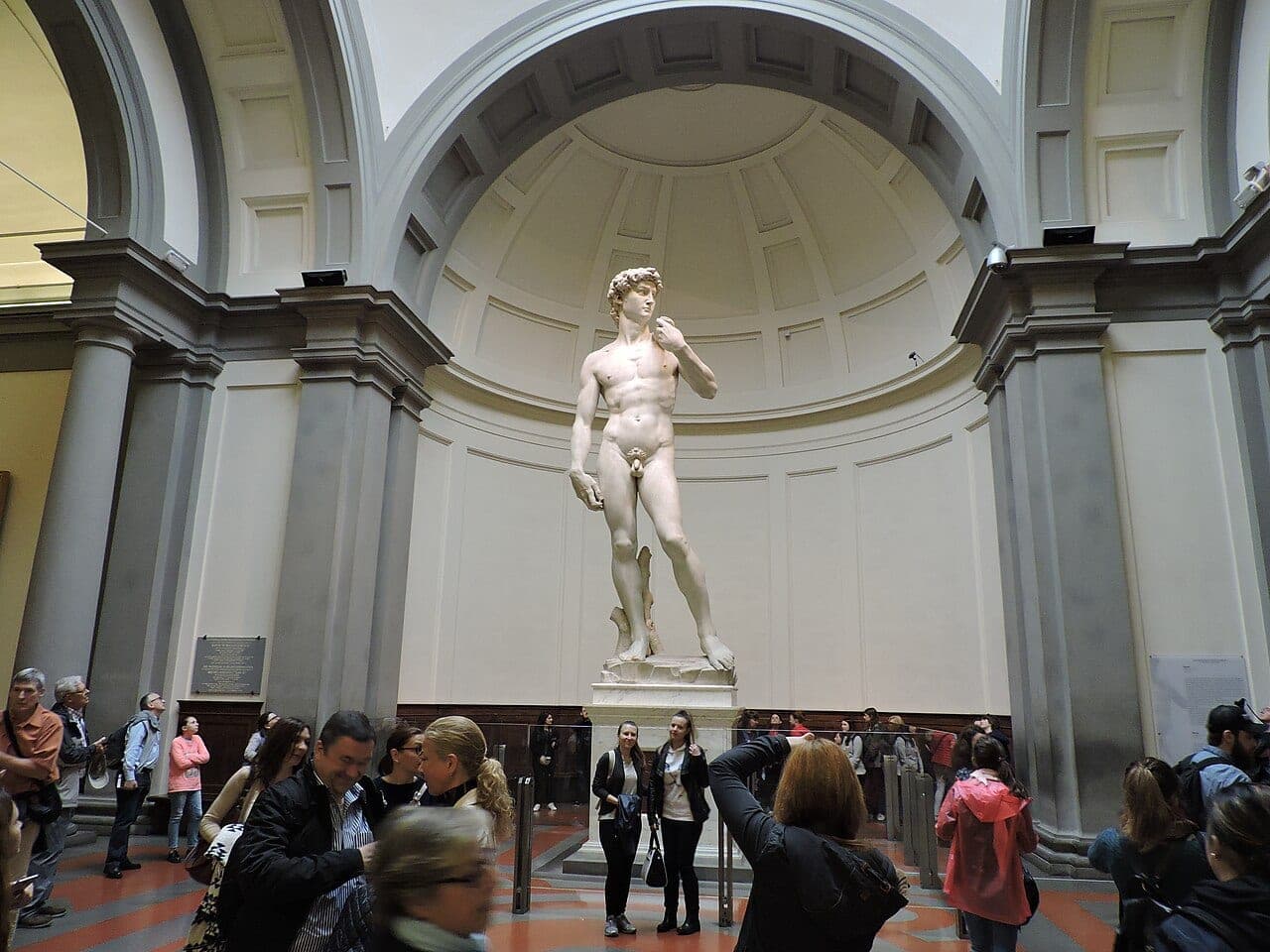
 The Tribuna was built around the statue in 1882, after seventy years of argument about how to get it out of the weather. The block it came from had been abandoned by two earlier sculptors as unworkable. Photograph by Dimitris Kamaras, CC BY 2.0, via Wikimedia Commons.
By the middle of the nineteenth century, cracks had been noted in the statue, particularly around the left leg and ankle, and the risks of leaving so important a work in the open had become clear. In 1873 the original was moved indoors to the Galleria dell'Accademia for protection. For its new home the architect Emilio De Fabris designed a purpose-built tribune, a domed apse lit from above by a skylight, so that daylight falls on the figure from overhead; the tribuna was completed in 1882. To keep a David in the square where it had stood since 1504, a marble replica was installed in the Piazza della Signoria in 1910.
The statue's condition has remained a subject of care and study. The restoration of 2003 to 2004 was the first major cleaning since 1843, and later analysis has drawn attention to fine fractures in the ankles, which bear the weight of the leaning pose. The museum now carries out regular maintenance, including periodic dusting with soft brushes, and monitors the marble closely.
The question of who owns the David has also been raised. In 2010 the municipality of Florence asserted a claim to ownership, which the Italian culture ministry disputed on behalf of the state; the matter of whether the statue belongs to the city or to the nation has been debated without a definitive public resolution. The gallery presents the work while that question sits in the background rather than the foreground of a visit.
The David is not the only Michelangelo in the building. The long corridor leading to the tribune is lined with his four unfinished Prisoners, also called the Slaves, blocked out around 1520 to 1534 for the ill-fated tomb of Pope Julius II. The rough figures appear to strain out of the surrounding marble, and because they were never completed they show, more plainly than any finished statue could, how Michelangelo cut a figure loose from the block. Near them stands his unfinished Saint Matthew, begun about 1506 for a series of apostles intended for the cathedral, another study in work interrupted.
Beyond the sculpture, the gallery holds a substantial collection of Florentine painting from the thirteenth to the sixteenth centuries, including gold-ground panels of the Gothic period and works by later masters associated with the city. Among the painted objects is the celebrated Adimari wedding chest, a fifteenth-century panel showing a Florentine marriage procession.
The Salone dell'Ottocento, the Nineteenth-Century Hall, houses the Gipsoteca Bartolini, a gallery of plaster casts and models by the sculptor Lorenzo Bartolini and his pupil Luigi Pampaloni, both of whom taught at the academy. More than ninety plaster models are displayed, many still studded with the small metal pins used as reference points to transfer measurements from model to marble, a direct record of nineteenth-century studio practice.
Reached through the gallery is the Museum of Musical Instruments, drawn from the collections of the Medici and Lorraine grand dukes. It includes instruments by Antonio Stradivari and by Bartolomeo Cristofori, the instrument-keeper at the Medici court who is credited with inventing the piano, making the room a record of the grand-ducal love of music alongside the gallery's art.
The Accademia is a museum with two overlapping identities. It was born as a teaching collection, a place where students learned by looking, and much of what it holds still speaks to process and instruction: the unfinished Prisoners, the pinned plaster models, the sequence of paintings arranged for study. From 1873 it became something else as well, the shrine of a single masterpiece and, by extension, of Michelangelo himself.
The David gives the gallery its wider meaning. Carved for the Florentine Republic and set before the seat of its government, the figure came to represent both the city and an ideal of civic and human confidence, and it has been reproduced and cited more widely than almost any other work of Western sculpture. Bringing it indoors in 1873 was among the earliest cases of moving a major public monument into a museum specifically to preserve it, an approach that later became common practice for fragile outdoor works. To stand in De Fabris's skylit tribune is to see the statue as its nineteenth-century guardians intended, lifted out of the weather and lit from above.
The Galleria dell'Accademia is at Via Ricasoli 58/60 in central Florence, close to the cathedral and the Piazza San Marco. It is open Tuesday to Sunday, generally from 8:15 in the morning until about 6:50 in the evening, with last entry roughly half an hour before closing, and it is closed on Mondays and on 1 January, 1 May and 25 December. Hours can vary with the season and with special evening openings, so the official site is the place to confirm before a visit.
Because the museum is compact and admits only a limited number of people at a time, timed-entry tickets and advance booking are strongly advised, especially in the high season, when queues for same-day entry can be long. Tickets are sold through the official ticketing service, and reduced or free admission applies to certain categories of visitor under Italian rules. Allowing between one and two hours is usually enough to see the David, the Prisoners, the plaster-cast gallery, the painting rooms and the instruments without rushing. For current hours, prices and accessibility, the museum's own website is the authoritative source.
The Tribuna was built around the statue in 1882, after seventy years of argument about how to get it out of the weather. The block it came from had been abandoned by two earlier sculptors as unworkable. Photograph by Dimitris Kamaras, CC BY 2.0, via Wikimedia Commons.
By the middle of the nineteenth century, cracks had been noted in the statue, particularly around the left leg and ankle, and the risks of leaving so important a work in the open had become clear. In 1873 the original was moved indoors to the Galleria dell'Accademia for protection. For its new home the architect Emilio De Fabris designed a purpose-built tribune, a domed apse lit from above by a skylight, so that daylight falls on the figure from overhead; the tribuna was completed in 1882. To keep a David in the square where it had stood since 1504, a marble replica was installed in the Piazza della Signoria in 1910.
The statue's condition has remained a subject of care and study. The restoration of 2003 to 2004 was the first major cleaning since 1843, and later analysis has drawn attention to fine fractures in the ankles, which bear the weight of the leaning pose. The museum now carries out regular maintenance, including periodic dusting with soft brushes, and monitors the marble closely.
The question of who owns the David has also been raised. In 2010 the municipality of Florence asserted a claim to ownership, which the Italian culture ministry disputed on behalf of the state; the matter of whether the statue belongs to the city or to the nation has been debated without a definitive public resolution. The gallery presents the work while that question sits in the background rather than the foreground of a visit.
The David is not the only Michelangelo in the building. The long corridor leading to the tribune is lined with his four unfinished Prisoners, also called the Slaves, blocked out around 1520 to 1534 for the ill-fated tomb of Pope Julius II. The rough figures appear to strain out of the surrounding marble, and because they were never completed they show, more plainly than any finished statue could, how Michelangelo cut a figure loose from the block. Near them stands his unfinished Saint Matthew, begun about 1506 for a series of apostles intended for the cathedral, another study in work interrupted.
Beyond the sculpture, the gallery holds a substantial collection of Florentine painting from the thirteenth to the sixteenth centuries, including gold-ground panels of the Gothic period and works by later masters associated with the city. Among the painted objects is the celebrated Adimari wedding chest, a fifteenth-century panel showing a Florentine marriage procession.
The Salone dell'Ottocento, the Nineteenth-Century Hall, houses the Gipsoteca Bartolini, a gallery of plaster casts and models by the sculptor Lorenzo Bartolini and his pupil Luigi Pampaloni, both of whom taught at the academy. More than ninety plaster models are displayed, many still studded with the small metal pins used as reference points to transfer measurements from model to marble, a direct record of nineteenth-century studio practice.
Reached through the gallery is the Museum of Musical Instruments, drawn from the collections of the Medici and Lorraine grand dukes. It includes instruments by Antonio Stradivari and by Bartolomeo Cristofori, the instrument-keeper at the Medici court who is credited with inventing the piano, making the room a record of the grand-ducal love of music alongside the gallery's art.
The Accademia is a museum with two overlapping identities. It was born as a teaching collection, a place where students learned by looking, and much of what it holds still speaks to process and instruction: the unfinished Prisoners, the pinned plaster models, the sequence of paintings arranged for study. From 1873 it became something else as well, the shrine of a single masterpiece and, by extension, of Michelangelo himself.
The David gives the gallery its wider meaning. Carved for the Florentine Republic and set before the seat of its government, the figure came to represent both the city and an ideal of civic and human confidence, and it has been reproduced and cited more widely than almost any other work of Western sculpture. Bringing it indoors in 1873 was among the earliest cases of moving a major public monument into a museum specifically to preserve it, an approach that later became common practice for fragile outdoor works. To stand in De Fabris's skylit tribune is to see the statue as its nineteenth-century guardians intended, lifted out of the weather and lit from above.
The Galleria dell'Accademia is at Via Ricasoli 58/60 in central Florence, close to the cathedral and the Piazza San Marco. It is open Tuesday to Sunday, generally from 8:15 in the morning until about 6:50 in the evening, with last entry roughly half an hour before closing, and it is closed on Mondays and on 1 January, 1 May and 25 December. Hours can vary with the season and with special evening openings, so the official site is the place to confirm before a visit.
Because the museum is compact and admits only a limited number of people at a time, timed-entry tickets and advance booking are strongly advised, especially in the high season, when queues for same-day entry can be long. Tickets are sold through the official ticketing service, and reduced or free admission applies to certain categories of visitor under Italian rules. Allowing between one and two hours is usually enough to see the David, the Prisoners, the plaster-cast gallery, the painting rooms and the instruments without rushing. For current hours, prices and accessibility, the museum's own website is the authoritative source.
History and founding
Michelangelo's David
The collection
Cultural significance
Visiting
References and resources
- Galleria dell'Accademia, official site: history, collections, hours and tickets.
- Galleria dell'Accademia: Collections: the museum's account of the David, the Prisoners, the Gipsoteca Bartolini and the painting rooms.
- Britannica: Accademia (art gallery, Florence): overview of the gallery and its holdings.
- Wikipedia: Galleria dell'Accademia: founding in 1784, the 1873 arrival of the David and the collection.
- Wikipedia: David (Michelangelo): the statue's making, the move indoors, the tribune, conservation and the ownership question.
- Wikipedia: Prisoners (Michelangelo): the unfinished Slaves carved for the tomb of Julius II.
- Wikipedia: Museum of Musical Instruments (Florence): the grand-ducal instruments, including works by Stradivari and Cristofori.