Heritage · Museum
Uffizi Galleries: Iconic Art, History & Exhibits
Uffizi Galleries showcases a rich collection of artifacts, art, and cultural history. Explore exhibits, key highlights, and visitor information.Written to last.
By Confinity Heritage Editorial · Updated 2026-07-20 · 7-minute readQuiet tools, kept out of the way.
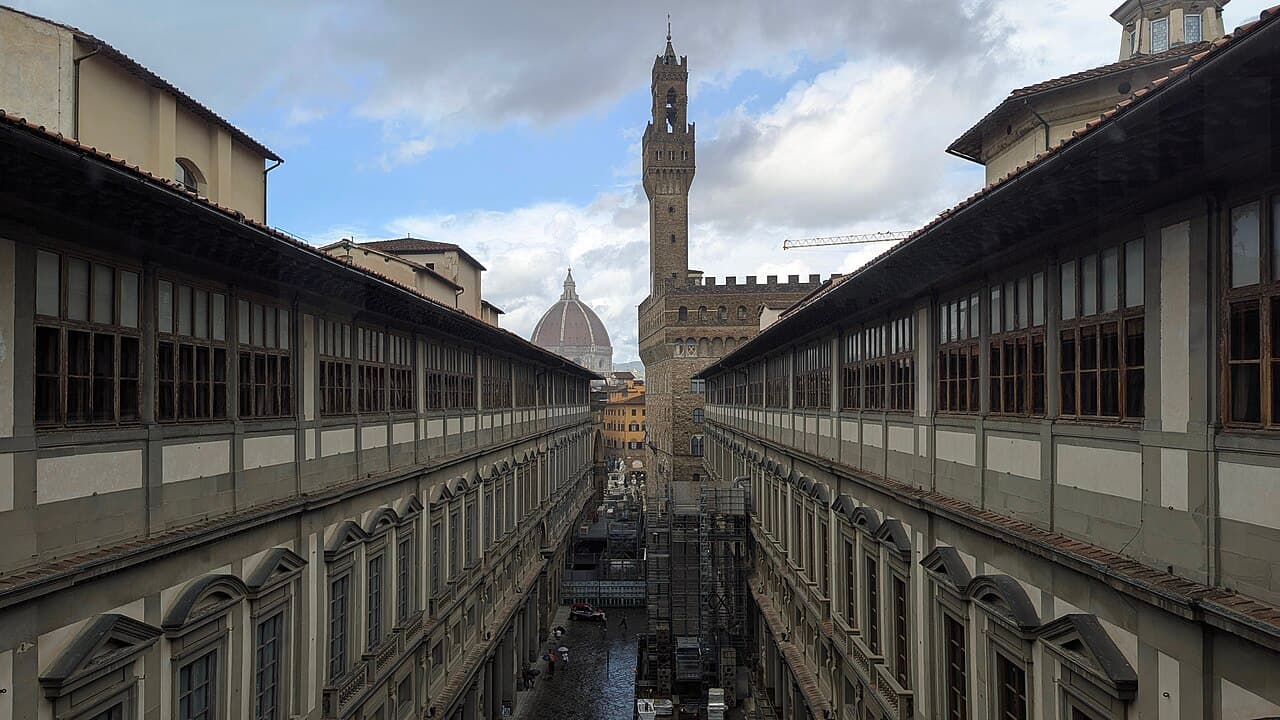
The Uffizi Galleries (Galleria degli Uffizi) occupy a long, U-shaped palace on the north bank of the Arno in Florence, a short walk from the Palazzo Vecchio and the cathedral. The building was never designed to hold paintings. The painter and architect Giorgio Vasari laid it out from 1560 as a block of government offices for Cosimo I de' Medici, the first Grand Duke of Tuscany, and the name records that original purpose: uffizi is simply the old Italian word for "offices." Over the following two centuries the corridors and rooms filled with the sculpture and painting the Medici had gathered, and in 1769 the collection was opened to the public. Today it is among the most visited art museums in the world, receiving 5,249,968 visitors in 2024. Much of what hangs there is on the spot the family chose for it, in the building the family built, because of a single legal document signed by the last of the Medici in 1737.
Cosimo I de' Medici had reunited Florence under his rule and wanted the scattered magistracies, guilds and administrative bodies of the Tuscan state gathered under one roof and close to the seat of power at the Palazzo Vecchio. In 1560 he gave the commission to Vasari, better known to later readers as the author of the Lives of the Most Excellent Painters, Sculptors, and Architects. Vasari cleared a strip of the medieval city between the Palazzo Vecchio and the river and built two long parallel wings joined by a short block at the Arno end, producing the narrow courtyard that still frames the approach today.
Vasari died in 1574 with the work unfinished. It was carried on by Alfonso Parigi and Bernardo Buontalenti, and the palace was substantially complete by about 1580. Even before the offices were finished, the Medici began using the upper floor for something other than paperwork. Cosimo's son Francesco I de' Medici had Buontalenti build the Tribuna, an octagonal room finished in 1584 and crowned with a dome lined in mother-of-pearl, to display the most prized paintings, statues, gems and natural curiosities in one concentrated space. The Tribuna is often described as the seed of the museum: a room built purely to show art, inside a building meant for government.
Through the seventeenth century the family kept adding, and later Medici opened the galleries informally to travellers who asked to see them. The decisive change came under the House of Lorraine, who inherited Tuscany after the Medici line ended. Grand Duke Peter Leopold reorganised the collection and, on 24 June 1769, the feast of Florence's patron Saint John, opened the Uffizi to the general public. It was one of the earliest galleries anywhere conceived as a public institution rather than a private treasury. Florence formally constituted it as a museum in 1865, during the brief period when the city served as capital of the newly unified Kingdom of Italy.
The building has survived two events that could have destroyed it. In November 1966 the Arno burst its banks, sending water and mud through the ground floor and the storerooms and prompting one of the largest art-rescue and conservation efforts of the century. On 27 May 1993 a Mafia car bomb exploded beside the museum in the Via dei Georgofili, killing five people, including two children, and damaging or destroying a number of works; several paintings, among them two by Bartolomeo Manfredi, were lost. The gallery repaired the damage and reopened, and the attack is remembered as an assault on the city's shared inheritance rather than on any one owner.
In recent decades a long modernization programme known as the Nuovi Uffizi (New Uffizi) has reorganised the exhibition rooms, roughly increasing the display space, adding climate control and security systems and reopening galleries that had long been in storage. The work has let the museum show more of its collection and rehang paintings in better light and sequence, while keeping Vasari's building and its historic character intact.
The Uffizi is, above all, the place to understand the Italian Renaissance in sequence. Its rooms run roughly in chronological order, so a visitor can trace how painting moved from the gold-ground altarpieces of the late Middle Ages toward the naturalism and perspective of the fifteenth and sixteenth centuries. The early rooms set three large enthroned Madonnas side by side, including Giotto's Ognissanti Madonna of around 1310, so the shift toward weight and space is visible in a single glance.
The best-known rooms belong to Sandro Botticelli. His Birth of Venus, painted in tempera on canvas around 1484–1486, shows the goddess arriving on the shore on a scallop shell, blown by the winds and met by an attendant with a cloak. It was among the first large works of the period to treat a full-length classical nude outside a religious subject. Beside it hangs the Primavera, a tempera panel from the late 1470s or early 1480s, an allegory of spring set in an orange grove and read for centuries as a poem in paint about love, fertility and renewal. Both were painted for members of the Medici circle and remain their most famous images.
From there the collection moves through the generation that followed. Leonardo da Vinci's early Annunciation pairs a precisely observed garden with the angel's greeting to Mary, and the museum also holds his unfinished Adoration of the Magi. Michelangelo's only certain surviving panel painting, the Doni Tondo of about 1505–1506, presents the Holy Family in a tight, sculptural knot of figures. Raphael is represented by portraits and Madonnas, and Titian's Venus of Urbino of 1538 is one of the most influential reclining nudes in Western art. The later rooms carry the story into the seventeenth century with Caravaggio, whose Medusa painted on a ceremonial shield and Bacchus both belong to the museum, and with Artemisia Gentileschi's Judith Beheading Holofernes.
Two features set the Uffizi apart from other great picture galleries. The first is its depth in a single school: because the Medici were Florentines collecting the art of their own city and region across generations, the museum holds an unusually complete record of Tuscan and central Italian painting rather than a broad sampling of everything. The second is its collection of artists' self-portraits, begun in the mid-seventeenth century by Cardinal Leopoldo de' Medici and grown into one of the largest assemblies of its kind, with faces added over the centuries down to living artists. Alongside the paintings, the corridors are lined with ancient Roman marble statues and busts, many of them copies of lost Greek originals, that the Medici prized as highly as the pictures.
The collection reaches beyond Italy. Northern European painting is represented by Albrecht Dürer, Lucas Cranach the Elder, Peter Paul Rubens and a Rembrandt self-portrait, a reminder that the Medici and their successors bought widely abroad as well as at home. The museum also holds one of the foremost collections of works on paper anywhere, the Gabinetto dei Disegni e delle Stampe (the department of prints and drawings), founded on Cardinal Leopoldo's holdings and grown into tens of thousands of sheets. Because paper cannot bear constant light, those drawings and engravings are shown in rotation and in temporary exhibitions rather than on permanent view, which is one reason repeat visits to the Uffizi rarely repeat themselves.
Vasari's design is admired as much as its contents. The two wings enclose a courtyard so narrow and long that it works almost like a covered street, drawing the eye down toward a screen of columns and, beyond it, the Arno. Ground-floor arcades in grey pietra serena stone set off pale plastered walls, a restrained scheme typical of Florentine civic architecture, while the top floor, where the gallery now sits, was fitted with large windows to bring daylight into the rooms. Building a long, purpose-lit upper gallery for display was an unusual idea for the 1560s and is one reason the Uffizi is cited in histories of museum design.
 The corridor runs about a kilometre from the Palazzo Vecchio to the Pitti Palace, over the Ponte Vecchio and through a church, and it was built in five months so a duke need never walk in the street. Photograph by Txllxt TxllxT, CC BY-SA 4.0, via Wikimedia Commons.
The most famous piece of Medici engineering here is the Vasari Corridor. In 1564 Cosimo I asked Vasari to build a raised, enclosed walkway so the ducal family could pass from the Palazzo Vecchio, through the Uffizi, over the river and into their residence at the Palazzo Pitti without descending into the public streets. Vasari completed it in 1565, in time for the wedding of Francesco de' Medici to Joanna of Austria. The corridor runs for roughly a kilometre, threads along the top of the Ponte Vecchio, and bends around the medieval Torre dei Mannelli whose owners refused to let it cut through their tower. For much of its length it is pierced with windows that let the family watch the city and the market on the bridge below while remaining unseen.
The passage carries its own history. Cardinal Leopoldo's self-portraits hung along it for generations. The corridor was damaged in the 1966 flood and again by the 1993 bombing, which shattered its windows over the Ponte Vecchio. After years of closure for safety work, it reopened to visitors in December 2024 as a bare architectural route rather than a hung gallery, so that walking it is now an experience of the structure itself and the views it was built to command.
Few buildings compress so much of a period's meaning into one plan. The Uffizi began as an instrument of Medici government, a way of housing the bureaucracy of a new dynasty in a single dignified block near the ruler's palace. Within a generation the same family had begun turning its upper floor into a stage for the art they patronised, and within two centuries the offices had become a public museum. That arc, from administration to display to shared institution, is one of the clearest illustrations available of how the private collections of Renaissance princes became the public museums of modern Europe.
The gallery also helped shape how museums are built and how art is shown. Its long, top-lit corridors and its practice of arranging works so that a visitor moves through a story influenced later galleries across the continent. Its self-portrait collection created a genre of collecting that other institutions imitated. And because it opened its doors to the public relatively early, in 1769, it belongs to the small group of institutions that established the idea that a great collection is held in trust for everyone rather than reserved for its owners.
For Florence, the Uffizi is inseparable from the city's identity. The Renaissance was, to a large degree, a Florentine achievement, and the Uffizi is where the evidence of that achievement is concentrated and kept in public view. Generations of writers and travellers on the Grand Tour treated a visit as essential, and the museum remains central to how the city is understood and why millions come to it each year.
The single most consequential fact about the Uffizi is not a painting but a promise. When the Medici male line failed, the collection could easily have been broken up, sold across Europe or carried off by the incoming rulers, as happened to many princely collections when their dynasties ended. That it was not is the work of Anna Maria Luisa de' Medici, the last member of the ruling family.
After the death of her brother Gian Gastone in 1737 left her the family's heir, Anna Maria Luisa negotiated an agreement, the Patto di Famiglia or Family Pact, signed on 31 October 1737 with the incoming House of Lorraine. Under it she left the entire Medici collection to the Tuscan state on one binding condition: that nothing was ever to be removed from Florence, and that the works were to be kept for the benefit of the public and to draw visitors to the city. The pact covered not only the paintings and sculptures of the Uffizi but the family's holdings across the Palazzo Pitti and the Medici villas.
The clause is unusual in the history of collecting. It bound future governments as much as future heirs, and it defined the collection's value in terms of the public and of the city rather than of any private owner. It is the reason the Birth of Venus, the Primavera, the Leonardo, the Michelangelo and the ancient marbles are still in Florence and can be seen close to where they were made. Anna Maria Luisa died on 18 February 1743 and is buried in the Basilica of San Lorenzo, the Medici's own church. Florence still marks the anniversary of her death each year in her memory, with free admission to civic museums, in recognition of the bequest that kept its greatest inheritance whole and at home.
The Uffizi stands at Piazzale degli Uffizi 6, in the historic centre of Florence, a few minutes on foot from the Piazza della Signoria and the Ponte Vecchio and close to the main railway stations. It is open Tuesday to Sunday, generally from 8:15 in the morning to about 6:30 in the evening, and closed on Mondays as well as 1 January and 25 December; opening times can vary with the season, so it is worth checking the official site before a visit.
Because it is one of the busiest museums in Italy, advance booking is strongly advised. Timed entry tickets can be reserved online through the official ticketing service, which also offers combined and multi-day passes covering the neighbouring Palazzo Pitti and Boboli Gardens. Prices vary by season and by how far ahead they are bought, and reduced or free entry applies to certain categories of visitor, including, under Italian rules, minors and, at reduced rates, young adults from the European Union. The reopened Vasari Corridor is ticketed separately and sells out quickly, so it needs its own reservation.
The galleries occupy the upper floors and are reached by stairs and lifts, and step-free access is available for visitors who need it. Allowing roughly three hours gives time to move through the collection without rushing; arriving at opening or in the later afternoon tends to mean smaller crowds than the middle of the day. For current hours, prices, accessibility details and temporary exhibitions, the museum's own website is the authoritative source.
The corridor runs about a kilometre from the Palazzo Vecchio to the Pitti Palace, over the Ponte Vecchio and through a church, and it was built in five months so a duke need never walk in the street. Photograph by Txllxt TxllxT, CC BY-SA 4.0, via Wikimedia Commons.
The most famous piece of Medici engineering here is the Vasari Corridor. In 1564 Cosimo I asked Vasari to build a raised, enclosed walkway so the ducal family could pass from the Palazzo Vecchio, through the Uffizi, over the river and into their residence at the Palazzo Pitti without descending into the public streets. Vasari completed it in 1565, in time for the wedding of Francesco de' Medici to Joanna of Austria. The corridor runs for roughly a kilometre, threads along the top of the Ponte Vecchio, and bends around the medieval Torre dei Mannelli whose owners refused to let it cut through their tower. For much of its length it is pierced with windows that let the family watch the city and the market on the bridge below while remaining unseen.
The passage carries its own history. Cardinal Leopoldo's self-portraits hung along it for generations. The corridor was damaged in the 1966 flood and again by the 1993 bombing, which shattered its windows over the Ponte Vecchio. After years of closure for safety work, it reopened to visitors in December 2024 as a bare architectural route rather than a hung gallery, so that walking it is now an experience of the structure itself and the views it was built to command.
Few buildings compress so much of a period's meaning into one plan. The Uffizi began as an instrument of Medici government, a way of housing the bureaucracy of a new dynasty in a single dignified block near the ruler's palace. Within a generation the same family had begun turning its upper floor into a stage for the art they patronised, and within two centuries the offices had become a public museum. That arc, from administration to display to shared institution, is one of the clearest illustrations available of how the private collections of Renaissance princes became the public museums of modern Europe.
The gallery also helped shape how museums are built and how art is shown. Its long, top-lit corridors and its practice of arranging works so that a visitor moves through a story influenced later galleries across the continent. Its self-portrait collection created a genre of collecting that other institutions imitated. And because it opened its doors to the public relatively early, in 1769, it belongs to the small group of institutions that established the idea that a great collection is held in trust for everyone rather than reserved for its owners.
For Florence, the Uffizi is inseparable from the city's identity. The Renaissance was, to a large degree, a Florentine achievement, and the Uffizi is where the evidence of that achievement is concentrated and kept in public view. Generations of writers and travellers on the Grand Tour treated a visit as essential, and the museum remains central to how the city is understood and why millions come to it each year.
The single most consequential fact about the Uffizi is not a painting but a promise. When the Medici male line failed, the collection could easily have been broken up, sold across Europe or carried off by the incoming rulers, as happened to many princely collections when their dynasties ended. That it was not is the work of Anna Maria Luisa de' Medici, the last member of the ruling family.
After the death of her brother Gian Gastone in 1737 left her the family's heir, Anna Maria Luisa negotiated an agreement, the Patto di Famiglia or Family Pact, signed on 31 October 1737 with the incoming House of Lorraine. Under it she left the entire Medici collection to the Tuscan state on one binding condition: that nothing was ever to be removed from Florence, and that the works were to be kept for the benefit of the public and to draw visitors to the city. The pact covered not only the paintings and sculptures of the Uffizi but the family's holdings across the Palazzo Pitti and the Medici villas.
The clause is unusual in the history of collecting. It bound future governments as much as future heirs, and it defined the collection's value in terms of the public and of the city rather than of any private owner. It is the reason the Birth of Venus, the Primavera, the Leonardo, the Michelangelo and the ancient marbles are still in Florence and can be seen close to where they were made. Anna Maria Luisa died on 18 February 1743 and is buried in the Basilica of San Lorenzo, the Medici's own church. Florence still marks the anniversary of her death each year in her memory, with free admission to civic museums, in recognition of the bequest that kept its greatest inheritance whole and at home.
The Uffizi stands at Piazzale degli Uffizi 6, in the historic centre of Florence, a few minutes on foot from the Piazza della Signoria and the Ponte Vecchio and close to the main railway stations. It is open Tuesday to Sunday, generally from 8:15 in the morning to about 6:30 in the evening, and closed on Mondays as well as 1 January and 25 December; opening times can vary with the season, so it is worth checking the official site before a visit.
Because it is one of the busiest museums in Italy, advance booking is strongly advised. Timed entry tickets can be reserved online through the official ticketing service, which also offers combined and multi-day passes covering the neighbouring Palazzo Pitti and Boboli Gardens. Prices vary by season and by how far ahead they are bought, and reduced or free entry applies to certain categories of visitor, including, under Italian rules, minors and, at reduced rates, young adults from the European Union. The reopened Vasari Corridor is ticketed separately and sells out quickly, so it needs its own reservation.
The galleries occupy the upper floors and are reached by stairs and lifts, and step-free access is available for visitors who need it. Allowing roughly three hours gives time to move through the collection without rushing; arriving at opening or in the later afternoon tends to mean smaller crowds than the middle of the day. For current hours, prices, accessibility details and temporary exhibitions, the museum's own website is the authoritative source.
History and founding
The collection
The building and the Vasari Corridor
Cultural significance
What it preserves (the Medici bequest that kept the art in Florence)
Visiting
References and resources
- Uffizi Galleries, official site: hours, tickets, collection database and news.
- Uffizi Galleries: About us: the museum's own account of its history and 1769 opening.
- Uffizi Galleries: The Uffizi: building history and collection overview.
- Uffizi Galleries: Tickets and hours: official opening times and admission.
- Wikipedia: Uffizi: building, history, visitor figures and incidents.
- Wikipedia: Vasari Corridor: the elevated passage from the Palazzo Vecchio to the Palazzo Pitti.
- Wikipedia: Anna Maria Luisa de' Medici: the 1737 Family Pact that kept the collection in Florence.
- Wikipedia: The Birth of Venus: dating, medium and provenance of Botticelli's painting.
- Wikipedia: Tribuna of the Uffizi: Buontalenti's octagonal display room of 1584.
- Wikipedia: Via dei Georgofili bombing: the 1993 attack beside the gallery.