Heritage · Country
Grenada Culture and Heritage
A single nutmeg on the national flag, a Georgian harbour town wrapped around a horseshoe bay, and a cliff at Sauteurs where the island's first people chose the sea over surrender. This is a guide to Grenada's heritage and to the saraca feast and Big Drum with which Grenadians keep their ancestors close.Written to last.
By Confinity Heritage Editorial · Updated 2026-07-31 · 8-minute readQuiet tools, kept out of the way.
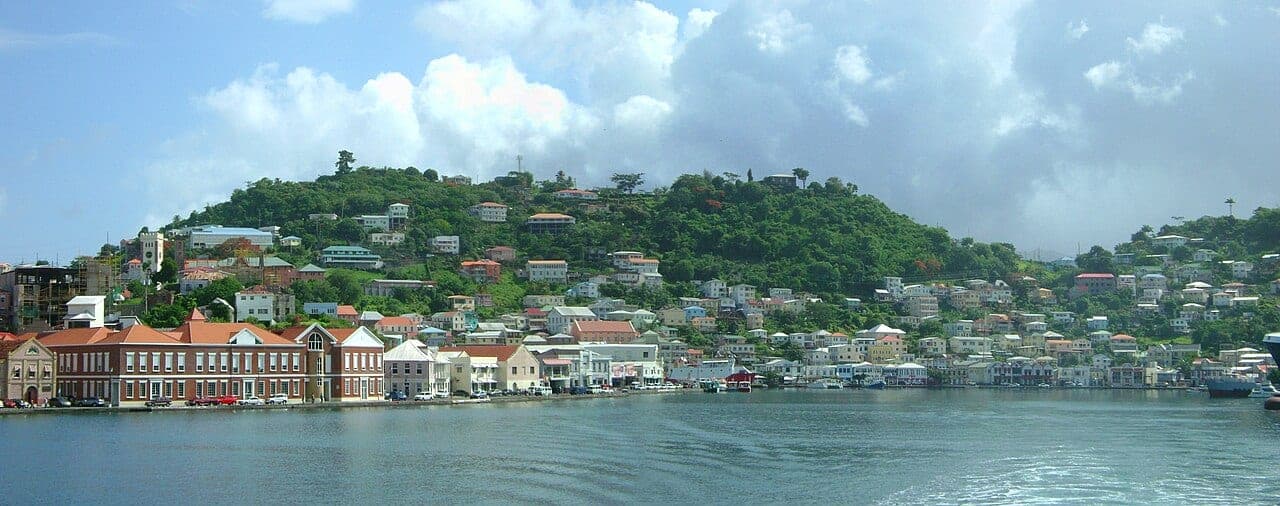
Grenada is the only nation on earth whose flag carries a nutmeg, and the emblem is honestly earned. The southernmost of the Windward Islands grows so much nutmeg and mace that it answers to the name Isle of Spice, and the scent of drying spice hangs over the processing stations at Gouyave and Grenville. At the heart of it all is St George's, a capital of red-tiled roofs and warm brick that climbs the hills around a horseshoe harbour called the Carenage, with the guns of Fort George looking down from the promontory above the anchorage.
Yet the deeper subject of any Grenadian heritage archive is memory, and memory here is not gentle. It reaches back to the Kalinago who leapt from a cliff at Sauteurs rather than be taken, through the plantations and the enslaved Africans whose descendants make up most of the island today, to the drum that still calls the "Old Parents" home on the sister island of Carriacou.
Grenada is a three-island state at the southern end of the Windward chain, roughly 140 kilometres north of Venezuela and Trinidad. The main island and its dependencies, Carriacou and Petite Martinique, together cover about 344 square kilometres and are home to some 114,000 people, according to Encyclopaedia Britannica. The land is volcanic and steep, a green interior of rainforest rising to Mount St Catherine, with the Grand Étang lake set in a caldera near the centre.
The economy and the identity both run on spice. Grenada is the world's second-largest producer of nutmeg after Indonesia, and nutmeg and its lacy red covering, mace, remain among the island's most valuable exports. That single crop is why the national flag, adopted at independence in 1974, shows a split nutmeg in its left triangle. Cocoa, once the leading crop before spice overtook it, has returned as a premium export, and the fishing towns of the west coast supply markets across the region.
St George's. The capital is widely held to be among the most photogenic harbour towns in the Caribbean. Georgian brick warehouses, brought as ships' ballast, sit beside French colonial buildings roofed in curved red tiles, and the whole town wraps around the Carenage, the inner harbour where schooners still tie up. Fort George crowns the headland; the short Sendall Tunnel, cut in 1895, links the harbour side to the market square and the Esplanade. Above the town rise the twin spires of the Roman Catholic cathedral and the tower of St George's Anglican Church, both landmarks of the skyline.
 St George's is built around a drowned volcanic crater, which is why the harbour is so deep and why the town climbs the way it does. New York Public Library, public domain, via Wikimedia Commons.
Gouyave. On the west coast in the parish of St John, Gouyave is the island's spice and fishing capital, home to one of the largest nutmeg processing stations, where the crop is still sorted, floated and graded by hand on wooden trays. The town is known as the place that "never sleeps," and its weekly Fish Friday street event has turned the daily catch into a gathering that draws visitors and residents alike.
Grenville. Grenada's second town, sometimes called Rainbow City, sits on the windward east coast in St Andrew. It grew as a shipping point for spice and sugar and keeps a busy Saturday market and its own nutmeg station.
Hillsborough. The main town of Carriacou, Hillsborough is the hub of a sister island celebrated for wooden boatbuilding, its August regatta and, above all, the Big Drum and saraca traditions that keep African ancestral memory more intact here than almost anywhere in the eastern Caribbean.
The first Grenadians were Arawak-speaking peoples, later followed and displaced by the Kalinago, the Island Carib, who knew the island by names such as Camerhogne. Christopher Columbus sighted it in 1498 but no European settled for a century and a half. Sustained colonisation began around 1649 to 1650, when Jacques Dyel du Parquet, governor of Martinique, led a French expedition that founded a settlement near the future St George's.
Relations with the Kalinago collapsed into war almost at once. The most enduring memory of that conflict is preserved at Sauteurs, at the promontory called Carib's Leap, or Leapers' Hill. As handed down, in 1651 the last of the island's Kalinago fighters, cornered by French forces, chose to leap from the cliff into the sea rather than surrender, and the French named the village Sauteurs, meaning "jumpers," for what they had seen, an account preserved at Leapers' Hill. The site remains a place of solemn reflection.
Under French and then British rule the island became a plantation society, and this part of the history asks to be told plainly. Sugar, and later coffee and cotton, were worked by enslaved Africans brought across the Atlantic in large numbers; by the time Britain formally acquired Grenada at the Treaty of Paris in 1763, the enslaved population numbered many thousands, and it continued to grow under British planters. Ownership of the island itself changed hands with the wars of empire: the French retook it in 1779 and Britain regained it in 1783. In 1795 and 1796 the free-coloured planter Julien Fédon, drawing on ideas from the French and Haitian revolutions, led an uprising of enslaved and free people that held much of the island for more than a year before British forces suppressed it; Fédon himself was never captured. Slavery was abolished across the British Empire under the act of 1833, with apprenticeship ending in 1838, after which indentured labourers from India arrived from 1857 to work the estates.
The spice economy that defines Grenada today took hold after 1843, when nutmeg trees carried from the East Indies were established on the island and thrived in its volcanic soil, gradually overtaking sugar. Grenada moved toward self-government in the twentieth century and became an independent state within the Commonwealth on 7 February 1974, with Eric Gairy as its first prime minister. In March 1979 the New Jewel Movement, led by Maurice Bishop, took power and formed the People's Revolutionary Government; in October 1983, after Bishop and several others were killed amid a split within the leadership, a United States-led force intervened on the island. Grenada returned to constitutional elections in 1984. In September 2004 Hurricane Ivan struck directly, damaging most buildings and destroying much of the nutmeg crop, and the years since have been ones of steady rebuilding of both the towns and the spice groves.
English is the official language of Grenada, used in government, schooling and the press. In everyday speech most Grenadians use Grenadian Creole English, an English-lexicon creole shaped by West African grammar and vocabulary. Alongside it survives Grenadian Creole French, a French-based patois once widely spoken and now heard mainly among older people and preserved in the island's place names, from Sauteurs and Lance aux Épines to the many hills called Morne.
The name Grenada itself is a memory of empire. Spanish sailors named the island after the city of Granada in Andalusia; the French rendered it La Grenade and the British anglicised it to Grenada. The layering of Kalinago, French and English names across the same coastline is itself a record of who held the island and when, and reading a Grenadian map is a short course in the island's past.
Spice is the first fact of Grenadian culture and the last note in its kitchen. Nutmeg, mace, cinnamon, clove and cocoa scent the markets and the cooking, and the national dish, oil down, gathers the island's produce into a single pot: breadfruit, salted meat and chicken, dumplings, callaloo and ground provisions simmered in coconut milk with turmeric until the liquid is absorbed. It is food made for sharing, cooked at beach limes and family gatherings the length of the island.
Music and masquerade carry the culture into the streets, above all at Spicemas, the national carnival held each August. Its characters descend from the plantation era and the emancipation that followed: the Jab Jab, or Jab Molassie, covered in black oil or molasses and dragging chains, turns the memory of bondage into a defiant street parade, while the Shortknee masqueraders and the pre-dawn J'ouvert fill the roads before Carnival Monday. Calypso and its faster cousin soca provide the sound, and the annual calypso competitions remain a stage for social commentary in song. On Carriacou the deepest tradition is the Big Drum, or Nation dance, in which three drums and call-and-response singing summon the African "nations," Cromanti, Igbo, Manding, Temne, Kongo and others, from whom the islanders trace descent. Carriacou also keeps its own Parang string-band festival and a folk Shakespeare Mas in which players trade verses from the plays.
Grenada is overwhelmingly Christian, and the shape of its churches records which empire held the island longest. Roman Catholicism, the legacy of French settlement, remains the largest single tradition, while Anglican and other Protestant churches, together the larger share overall, reflect the long British period. Sunday worship and the church calendar order much of ordinary life, and the cathedral spires of St George's are among the island's defining landmarks.
Running through and beneath this Christian practice is an Afro-Caribbean spirituality that never disappeared. It is clearest on Carriacou, where the Big Drum is not entertainment alone but a religious act, honouring the ancestors and the African nations, and where the saraca feast offers food to the "Old Parents." Across the islands, beliefs about spirits, dreams, healing and the presence of the dead sit alongside churchgoing rather than in opposition to it, so that a family may attend Mass and also keep the older obligations to those who came before.
Grenadian mourning joins Christian rite to African memory. A death is followed by the wake, often called the nine-night, a stretch of evenings when neighbours fill the yard to sing hymns and sankeys, drink coffee, tell stories and keep the bereaved company until the funeral, and again on the ninth night when the spirit is understood to take its leave. Church funerals and burial follow Christian form, but the gathering, the food and the singing around them are the community's own.
On Carriacou remembrance takes its fullest shape in the saraca and the Big Drum. The saraca is a thanksgiving and offering feast inherited from African ancestors, at which families cook and share a set of customary foods, rice and peas, ground provisions, cornmeal coo-coo and boiled fowl, as a meal set aside for the Old Parents, the ancestral spirits, described by the Grenada National Trust. A saraca may be held to give thanks, to answer a dream, or as a Tombstone Feast, the Maroon ceremony that marks the raising of a headstone and gathers kin from across the diaspora. At its centre the drums are played and the Nation dances performed, and the songs of the Big Drum are addressed directly to the nations and the dead, making the ceremony an act of living genealogy in which the ancestors are named, fed and remembered by their descendants.
Grenadian records are French, then British, then interrupted, and each layer left a different kind of document.
France held the island from 1649 and Catholic parish registers begin in that period; Britain took it in 1763 and Anglican registers and the colonial administration follow. Civil registration dates from the nineteenth century and is held by the Registrar General in St George's, with the Grenada National Archives holding the wider series and further material at Kew.
The slave registers of 1817 to 1834 are the central genealogical source, naming individuals with age, origin and often mother, updated across triennial returns, followed by the compensation records. Before them, plantation inventories and the levy lists.
Indenture followed emancipation here as elsewhere: several thousand Indian labourers arrived from 1857, and their emigration records connect Grenadian families to specific districts in India.
Two twentieth-century events left gaps. The revolution of 1979, the collapse of 1983 and the American invasion that followed damaged government records and dispersed a good deal, and the Grenadian state has spent years reconstructing series. And Hurricane Ivan in 2004 destroyed or damaged the great majority of the island's buildings, including archives and church registers, and the loss of parish books to water is the kind of damage that does not make the news but ends a family's search.
The diaspora is large, in Britain, Trinidad, New York and Canada, and holds much of the recent record.
The built heritage of Grenada centres on St George's and its forts. Fort George, begun by French engineers as Fort Royal in the first decade of the eighteenth century and renamed for King George III after the British takeover, commands the entrance to the Carenage and remains in use as the island's police headquarters, its ramparts and cut-stone galleries among the best-preserved colonial military works in the region. The surrounding historic district, with its brick warehouses and tiled French colonial houses, is recognised as one of the Caribbean's most intact harbour townscapes and has long been considered for World Heritage listing.
The island's past is gathered at the Grenada National Museum, housed in St George's in a building that began about 1704 as a French army barracks and prison. Its collections trace the story from the Indigenous era through the colonial and plantation centuries to the events of 1979 to 1983, holding artefacts, documents and the everyday objects of Grenadian life. A newer and unusual form of preservation lies just offshore at Molinere Bay, where in 2006 the British sculptor and ecologist Jason deCaires Taylor created what is described as the world's first underwater sculpture park, casting figures from members of the local community and sinking them to seed new coral after Hurricane Ivan, a project since named by National Geographic among its wonders. The Grenada National Trust and the tourism authority together work to document and protect forts, estate ruins, churches and the intangible traditions of the sister islands.
Grenada's documentary heritage is increasingly reaching audiences beyond the islands. The Grenada National Museum and the National Trust maintain online guides to the island's sites, and researchers can consult digitised colonial records for Grenada through the wider British Caribbean archives, including registers of enslaved people that descendants use to trace family lines.
The intangible heritage of Carriacou has also entered the archive. Field recordings of Big Drum songs and Nation dances gathered by ethnomusicologists in the twentieth century have been preserved and, in part, released for study, keeping the melodies available to a generation of islanders who now live abroad. The underwater park at Molinere has become one of the region's most photographed heritage sites, its images drawing attention to Grenadian culture and to the health of its reefs.
For a small nation, Grenada's cultural reach runs far, carried by a large diaspora in Britain, the United States, Canada and Trinidad. Grenadian and Grenadian-descended writers have given the islands a literary voice: Merle Collins and Jean Buffong have written the island into fiction and poetry, and the American poet Audre Lorde drew on her Grenadian parentage, most directly after returning to Carriacou. In music the island's calypso and soca artists compete across the region, and Spicemas has become a fixture of the summer carnival circuit that links Grenada to Trinidad, Notting Hill and Brooklyn.
Spice itself remains the island's signature abroad. Grenadian nutmeg, mace, cocoa and the chocolate now made on the island have built a premium reputation, and the recovery of the spice groves after 2004 has become a point of national pride.
The spice groves come back. After Hurricane Ivan destroyed most of the nutmeg trees in 2004, growers and cooperatives replanted across the parishes, and the slow-maturing groves have returned Grenada to its place as a leading nutmeg exporter, keeping alive the heritage crop that defines the flag.
A sculpture park that grows coral. The Molinere park, begun in 2006 as both art and reef restoration, drew global attention to Grenadian waters, helped a damaged bay recover, and inspired similar underwater installations around the world while remaining rooted in casts of the island's own people.
Carriacou keeps the nations alive. Against the long odds faced by African traditions across the Caribbean, the Big Drum, the saraca and the Tombstone Feast survive on Carriacou as living ceremony, passed to younger islanders and to the diaspora who return to dance the nations of their ancestors.
A harbour town preserved. Fort George and the tiled streets around the Carenage have endured hurricanes and the changes of three centuries, and continued stewardship by the National Trust and local authorities keeps St George's among the most complete colonial harbour towns in the region.
St George's is built around a drowned volcanic crater, which is why the harbour is so deep and why the town climbs the way it does. New York Public Library, public domain, via Wikimedia Commons.
Gouyave. On the west coast in the parish of St John, Gouyave is the island's spice and fishing capital, home to one of the largest nutmeg processing stations, where the crop is still sorted, floated and graded by hand on wooden trays. The town is known as the place that "never sleeps," and its weekly Fish Friday street event has turned the daily catch into a gathering that draws visitors and residents alike.
Grenville. Grenada's second town, sometimes called Rainbow City, sits on the windward east coast in St Andrew. It grew as a shipping point for spice and sugar and keeps a busy Saturday market and its own nutmeg station.
Hillsborough. The main town of Carriacou, Hillsborough is the hub of a sister island celebrated for wooden boatbuilding, its August regatta and, above all, the Big Drum and saraca traditions that keep African ancestral memory more intact here than almost anywhere in the eastern Caribbean.
The first Grenadians were Arawak-speaking peoples, later followed and displaced by the Kalinago, the Island Carib, who knew the island by names such as Camerhogne. Christopher Columbus sighted it in 1498 but no European settled for a century and a half. Sustained colonisation began around 1649 to 1650, when Jacques Dyel du Parquet, governor of Martinique, led a French expedition that founded a settlement near the future St George's.
Relations with the Kalinago collapsed into war almost at once. The most enduring memory of that conflict is preserved at Sauteurs, at the promontory called Carib's Leap, or Leapers' Hill. As handed down, in 1651 the last of the island's Kalinago fighters, cornered by French forces, chose to leap from the cliff into the sea rather than surrender, and the French named the village Sauteurs, meaning "jumpers," for what they had seen, an account preserved at Leapers' Hill. The site remains a place of solemn reflection.
Under French and then British rule the island became a plantation society, and this part of the history asks to be told plainly. Sugar, and later coffee and cotton, were worked by enslaved Africans brought across the Atlantic in large numbers; by the time Britain formally acquired Grenada at the Treaty of Paris in 1763, the enslaved population numbered many thousands, and it continued to grow under British planters. Ownership of the island itself changed hands with the wars of empire: the French retook it in 1779 and Britain regained it in 1783. In 1795 and 1796 the free-coloured planter Julien Fédon, drawing on ideas from the French and Haitian revolutions, led an uprising of enslaved and free people that held much of the island for more than a year before British forces suppressed it; Fédon himself was never captured. Slavery was abolished across the British Empire under the act of 1833, with apprenticeship ending in 1838, after which indentured labourers from India arrived from 1857 to work the estates.
The spice economy that defines Grenada today took hold after 1843, when nutmeg trees carried from the East Indies were established on the island and thrived in its volcanic soil, gradually overtaking sugar. Grenada moved toward self-government in the twentieth century and became an independent state within the Commonwealth on 7 February 1974, with Eric Gairy as its first prime minister. In March 1979 the New Jewel Movement, led by Maurice Bishop, took power and formed the People's Revolutionary Government; in October 1983, after Bishop and several others were killed amid a split within the leadership, a United States-led force intervened on the island. Grenada returned to constitutional elections in 1984. In September 2004 Hurricane Ivan struck directly, damaging most buildings and destroying much of the nutmeg crop, and the years since have been ones of steady rebuilding of both the towns and the spice groves.
English is the official language of Grenada, used in government, schooling and the press. In everyday speech most Grenadians use Grenadian Creole English, an English-lexicon creole shaped by West African grammar and vocabulary. Alongside it survives Grenadian Creole French, a French-based patois once widely spoken and now heard mainly among older people and preserved in the island's place names, from Sauteurs and Lance aux Épines to the many hills called Morne.
The name Grenada itself is a memory of empire. Spanish sailors named the island after the city of Granada in Andalusia; the French rendered it La Grenade and the British anglicised it to Grenada. The layering of Kalinago, French and English names across the same coastline is itself a record of who held the island and when, and reading a Grenadian map is a short course in the island's past.
Spice is the first fact of Grenadian culture and the last note in its kitchen. Nutmeg, mace, cinnamon, clove and cocoa scent the markets and the cooking, and the national dish, oil down, gathers the island's produce into a single pot: breadfruit, salted meat and chicken, dumplings, callaloo and ground provisions simmered in coconut milk with turmeric until the liquid is absorbed. It is food made for sharing, cooked at beach limes and family gatherings the length of the island.
Music and masquerade carry the culture into the streets, above all at Spicemas, the national carnival held each August. Its characters descend from the plantation era and the emancipation that followed: the Jab Jab, or Jab Molassie, covered in black oil or molasses and dragging chains, turns the memory of bondage into a defiant street parade, while the Shortknee masqueraders and the pre-dawn J'ouvert fill the roads before Carnival Monday. Calypso and its faster cousin soca provide the sound, and the annual calypso competitions remain a stage for social commentary in song. On Carriacou the deepest tradition is the Big Drum, or Nation dance, in which three drums and call-and-response singing summon the African "nations," Cromanti, Igbo, Manding, Temne, Kongo and others, from whom the islanders trace descent. Carriacou also keeps its own Parang string-band festival and a folk Shakespeare Mas in which players trade verses from the plays.
Grenada is overwhelmingly Christian, and the shape of its churches records which empire held the island longest. Roman Catholicism, the legacy of French settlement, remains the largest single tradition, while Anglican and other Protestant churches, together the larger share overall, reflect the long British period. Sunday worship and the church calendar order much of ordinary life, and the cathedral spires of St George's are among the island's defining landmarks.
Running through and beneath this Christian practice is an Afro-Caribbean spirituality that never disappeared. It is clearest on Carriacou, where the Big Drum is not entertainment alone but a religious act, honouring the ancestors and the African nations, and where the saraca feast offers food to the "Old Parents." Across the islands, beliefs about spirits, dreams, healing and the presence of the dead sit alongside churchgoing rather than in opposition to it, so that a family may attend Mass and also keep the older obligations to those who came before.
Grenadian mourning joins Christian rite to African memory. A death is followed by the wake, often called the nine-night, a stretch of evenings when neighbours fill the yard to sing hymns and sankeys, drink coffee, tell stories and keep the bereaved company until the funeral, and again on the ninth night when the spirit is understood to take its leave. Church funerals and burial follow Christian form, but the gathering, the food and the singing around them are the community's own.
On Carriacou remembrance takes its fullest shape in the saraca and the Big Drum. The saraca is a thanksgiving and offering feast inherited from African ancestors, at which families cook and share a set of customary foods, rice and peas, ground provisions, cornmeal coo-coo and boiled fowl, as a meal set aside for the Old Parents, the ancestral spirits, described by the Grenada National Trust. A saraca may be held to give thanks, to answer a dream, or as a Tombstone Feast, the Maroon ceremony that marks the raising of a headstone and gathers kin from across the diaspora. At its centre the drums are played and the Nation dances performed, and the songs of the Big Drum are addressed directly to the nations and the dead, making the ceremony an act of living genealogy in which the ancestors are named, fed and remembered by their descendants.
Grenadian records are French, then British, then interrupted, and each layer left a different kind of document.
France held the island from 1649 and Catholic parish registers begin in that period; Britain took it in 1763 and Anglican registers and the colonial administration follow. Civil registration dates from the nineteenth century and is held by the Registrar General in St George's, with the Grenada National Archives holding the wider series and further material at Kew.
The slave registers of 1817 to 1834 are the central genealogical source, naming individuals with age, origin and often mother, updated across triennial returns, followed by the compensation records. Before them, plantation inventories and the levy lists.
Indenture followed emancipation here as elsewhere: several thousand Indian labourers arrived from 1857, and their emigration records connect Grenadian families to specific districts in India.
Two twentieth-century events left gaps. The revolution of 1979, the collapse of 1983 and the American invasion that followed damaged government records and dispersed a good deal, and the Grenadian state has spent years reconstructing series. And Hurricane Ivan in 2004 destroyed or damaged the great majority of the island's buildings, including archives and church registers, and the loss of parish books to water is the kind of damage that does not make the news but ends a family's search.
The diaspora is large, in Britain, Trinidad, New York and Canada, and holds much of the recent record.
The built heritage of Grenada centres on St George's and its forts. Fort George, begun by French engineers as Fort Royal in the first decade of the eighteenth century and renamed for King George III after the British takeover, commands the entrance to the Carenage and remains in use as the island's police headquarters, its ramparts and cut-stone galleries among the best-preserved colonial military works in the region. The surrounding historic district, with its brick warehouses and tiled French colonial houses, is recognised as one of the Caribbean's most intact harbour townscapes and has long been considered for World Heritage listing.
The island's past is gathered at the Grenada National Museum, housed in St George's in a building that began about 1704 as a French army barracks and prison. Its collections trace the story from the Indigenous era through the colonial and plantation centuries to the events of 1979 to 1983, holding artefacts, documents and the everyday objects of Grenadian life. A newer and unusual form of preservation lies just offshore at Molinere Bay, where in 2006 the British sculptor and ecologist Jason deCaires Taylor created what is described as the world's first underwater sculpture park, casting figures from members of the local community and sinking them to seed new coral after Hurricane Ivan, a project since named by National Geographic among its wonders. The Grenada National Trust and the tourism authority together work to document and protect forts, estate ruins, churches and the intangible traditions of the sister islands.
Grenada's documentary heritage is increasingly reaching audiences beyond the islands. The Grenada National Museum and the National Trust maintain online guides to the island's sites, and researchers can consult digitised colonial records for Grenada through the wider British Caribbean archives, including registers of enslaved people that descendants use to trace family lines.
The intangible heritage of Carriacou has also entered the archive. Field recordings of Big Drum songs and Nation dances gathered by ethnomusicologists in the twentieth century have been preserved and, in part, released for study, keeping the melodies available to a generation of islanders who now live abroad. The underwater park at Molinere has become one of the region's most photographed heritage sites, its images drawing attention to Grenadian culture and to the health of its reefs.
For a small nation, Grenada's cultural reach runs far, carried by a large diaspora in Britain, the United States, Canada and Trinidad. Grenadian and Grenadian-descended writers have given the islands a literary voice: Merle Collins and Jean Buffong have written the island into fiction and poetry, and the American poet Audre Lorde drew on her Grenadian parentage, most directly after returning to Carriacou. In music the island's calypso and soca artists compete across the region, and Spicemas has become a fixture of the summer carnival circuit that links Grenada to Trinidad, Notting Hill and Brooklyn.
Spice itself remains the island's signature abroad. Grenadian nutmeg, mace, cocoa and the chocolate now made on the island have built a premium reputation, and the recovery of the spice groves after 2004 has become a point of national pride.
The spice groves come back. After Hurricane Ivan destroyed most of the nutmeg trees in 2004, growers and cooperatives replanted across the parishes, and the slow-maturing groves have returned Grenada to its place as a leading nutmeg exporter, keeping alive the heritage crop that defines the flag.
A sculpture park that grows coral. The Molinere park, begun in 2006 as both art and reef restoration, drew global attention to Grenadian waters, helped a damaged bay recover, and inspired similar underwater installations around the world while remaining rooted in casts of the island's own people.
Carriacou keeps the nations alive. Against the long odds faced by African traditions across the Caribbean, the Big Drum, the saraca and the Tombstone Feast survive on Carriacou as living ceremony, passed to younger islanders and to the diaspora who return to dance the nations of their ancestors.
A harbour town preserved. Fort George and the tiled streets around the Carenage have endured hurricanes and the changes of three centuries, and continued stewardship by the National Trust and local authorities keeps St George's among the most complete colonial harbour towns in the region.
National Overview
Notable Cities
Historical Foundations
Linguistic and Etymological Roots
Cultural Identity
Religion and Spirituality
Remembrance and Mourning Traditions
Tracing a Family in Grenada
Heritage Preservation Efforts
Digital Heritage
Contemporary Cultural Influences
Success Stories
References and resources
- Encyclopaedia Britannica: Grenada: geography, history and cultural background of the three-island state.
- Wikipedia: Grenada: overview of the nation, its history, economy and the nutmeg flag.
- Wikipedia: Leapers' Hill (Carib's Leap): the 1651 site at Sauteurs and its memory.
- Grenada National Trust: Saraca: the ancestral thanksgiving feast and Tombstone tradition of Carriacou.
- Wikipedia: Big Drum: the Nation dance and its African antecedents.
- Molinere Underwater Sculpture Park, Jason deCaires Taylor: the 2006 park in Molinere Bay.
- Wikipedia: Grenada National Museum: the museum in the former French barracks in St George's.
- Wikipedia: Fort George, Grenada: the French Fort Royal, renamed under British rule.
- Pure Grenada, Grenada Tourism Authority: heritage sites, Carriacou traditions and Spicemas.