Heritage · Country
Indonesia Culture and Heritage
From the buffalo funerals of the Toraja highlands to the cremation towers of Bali, Indonesia gathers seventeen thousand islands and hundreds of peoples into one nation bound by the vow of unity in diversity. A guide to the archipelago's heritage, its layered faiths, and the many ways Indonesians keep company with their dead.Written to last.
By Confinity Heritage Editorial · Updated 2026-07-31 · 8-minute readQuiet tools, kept out of the way.
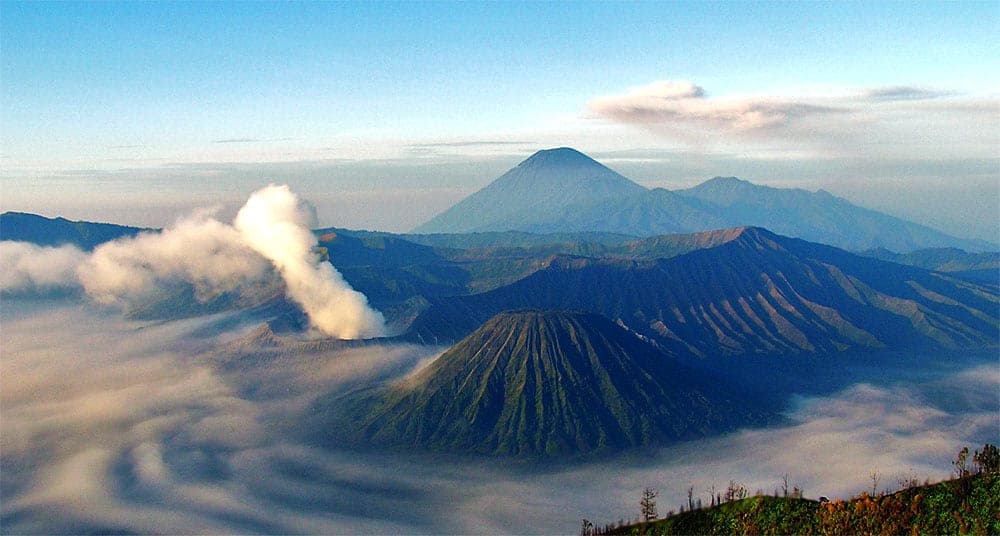
Indonesia is drawn across the equator in roughly seventeen thousand pieces. The republic gathers some 17,000 islands into a single country that runs more than 5,000 kilometres from the western tip of Sumatra to the highlands of Papua, along the seam between the Indian and Pacific oceans. It is the largest Muslim-majority nation on earth, yet no single faith or people defines it: Hindu Bali keeps its own temple calendar, the ninth-century Buddhist terraces of Borobudur rise from central Java, Christian and animist communities hold much of the eastern islands, and more than 700 languages are spoken across the archipelago. The state that binds them takes its motto from a fourteenth-century Javanese poem, Bhinneka Tunggal Ika, unity in diversity, and its guiding philosophy from the five principles of Pancasila.
Indonesia also keeps some of the most elaborate remembrance traditions found anywhere. In the highlands of Sulawesi, the Toraja treat a recently dead relative as a sick person still at home, sometimes for months or years, before a funeral that can gather thousands; in Bali, the cremation rite of Ngaben sends the soul onward toward rebirth in a blaze of towers and animal-shaped sarcophagi. The country has also had to hold a harder kind of memory: the mass killings of 1965 and 1966 left an estimated several hundred thousand to more than a million people dead, many in unmarked graves, and in 2023 the state formally acknowledged the episode among the gross human rights violations of its past.
Indonesia is the world's largest archipelagic state, spread over about 1.9 million square kilometres of land and a far greater area of sea. The island count settles near 17,000, of which several thousand are inhabited, gathered around five main landmasses: Sumatra, Java, Borneo (shared as Kalimantan), Sulawesi and the western half of New Guinea, called Papua. The 2025 population is estimated at more than 280 million, the fourth largest of any country, with much of it concentrated on Java.
The country divides into 38 provinces, several holding special status, among them Yogyakarta, Aceh and Papua. Jakarta, on Java's north coast, is the historic capital and the centre of a metropolitan region of some thirty million; a new capital, Nusantara, is rising in the forests of East Kalimantan. The founding ideology, Pancasila, sets out five principles: belief in one God, a just and civilised humanity, the unity of Indonesia, democracy guided by consensus, and social justice for all. The Javanese, about two-fifths of the population, and the Sundanese are the largest of hundreds of ethnic groups.
Jakarta. The capital grew from the pepper port of Sunda Kelapa, seized by the Dutch East India Company in 1619 and rebuilt as Batavia, and is now the core of Jabodetabek, a region of around thirty million and one of the fastest-sinking cities in the world, a pressure behind the move to a new capital in Kalimantan.
Yogyakarta. The cultural heart of Java is a self-governing sultanate within reach of both Borobudur and Prambanan; its own Cosmological Axis, a sacred line from Mount Merapi to the southern sea, was inscribed by UNESCO in 2023, and it remains a centre of court gamelan, dance, wayang and fine batik.
Surabaya. The country's second city and busiest eastern port earned the name "City of Heroes" for the battle its people fought against returning colonial forces in November 1945, still marked each year on Heroes' Day.
Bandung. The cool highland city of West Java hosted the 1955 Asian-African Conference, where newly independent states met to chart a path between the Cold War blocs.
Palembang. On the Musi River in southern Sumatra, Palembang was the seat of Srivijaya, the maritime empire that controlled the region's sea lanes for centuries before Java's rise.
The islands were peopled over millennia, chiefly by Austronesian voyagers who spread through the archipelago from around four thousand years ago, while fossils at Sangiran on Java record human ancestors from more than a million years back. From the seventh century the Buddhist sea power of Srivijaya, based at Palembang, controlled the Strait of Malacca and became a renowned centre of Buddhist learning. On Java, the Sailendra and Mataram dynasties raised Borobudur and Prambanan in the ninth century. The greatest of the pre-Islamic states was Majapahit, founded in 1293 in eastern Java, whose prime minister Gajah Mada swore to bring the whole archipelago under one canopy; at its fourteenth-century height under King Hayam Wuruk its influence reached across much of maritime Southeast Asia.
 Brahma at Prambanan, the great Hindu complex raised in Java within a century of Buddhist Borobudur. Photograph by Photo Dharma, CC BY 2.0, via Wikimedia Commons.
Islam arrived gradually with Muslim traders from the thirteenth century and spread through coastal sultanates such as Demak, which helped bring Majapahit down by the early sixteenth century. The same era drew Europeans east in pursuit of the spice islands: cloves, nutmeg and mace grew almost nowhere else but the Moluccas, and the trade brought first the Portuguese and then the Dutch, whose East India Company won a violent monopoly over the Banda islands in 1621. Company rule gave way to the colonial Netherlands East Indies, which by the early twentieth century governed nearly the whole archipelago. Japanese occupation from 1942 to 1945 broke the colonial order, and on 17 August 1945 Sukarno and Mohammad Hatta declared independence; a four-year revolution followed before the Netherlands recognised Indonesian sovereignty in 1949. Sukarno's presidency gave way in the mid-1960s to the three-decade New Order of Suharto, which ended with the Reformasi movement of 1998.
The national language, Bahasa Indonesia, is a standardised form of Malay, long the trading lingua franca of the region, rather than the tongue of the largest ethnic group. Its adoption was a deliberate act of unity: at the 1928 Youth Congress, nationalist delegates swore the Sumpah Pemuda, the Youth Pledge, to one homeland, one nation and one language, choosing Malay precisely because it belonged to no dominant group. That choice let a country of extraordinary linguistic range hold together, for catalogues of the world's languages count more than 700 living tongues in Indonesia, second only to neighbouring Papua New Guinea, and many of the smallest are endangered.
The country's name is a nineteenth-century coinage from Greek roots, indos, India, and nesos, island, joined to mean the Indian islands, brought into use by European scholars around 1850 and later adopted by the independence movement in place of the colonial "Netherlands East Indies". An older indigenous name, Nusantara, from Old Javanese words for the outer islands, has been revived for the new capital, and the motto Bhinneka Tunggal Ika comes directly from the fourteenth-century Kakawin Sutasoma of the poet Mpu Tantular.
Indonesian culture is defined by a family of arts the wider world now knows by their Indonesian names. Batik, the technique of drawing patterns in wax before dyeing cloth, is worn from village ceremonies to presidential meetings and was inscribed by UNESCO in 2009, with a companion listing for the training that keeps the craft alive. Gamelan, the tuned bronze percussion orchestra of Java and Bali whose interlocking gongs have influenced composers worldwide, received its own UNESCO recognition in 2021.
At the meeting point of both is wayang, the shadow-puppet theatre in which a single puppeteer, the dalang, voices every character, directs the gamelan and performs episodes from the Ramayana, the Mahabharata and Javanese legend across a night that can last until dawn; UNESCO inscribed it in 2008. Around these run the bamboo angklung of West Java, the wavy-bladed kris, the sailing pinisi of the Bugis, the martial art of pencak silat and the ikat and songket weaving of the eastern islands, each in turn recognised by UNESCO.
Indonesia recognises six official religions, Islam, Protestant Christianity, Catholicism, Hinduism, Buddhism and Confucianism, and the first principle of Pancasila requires belief in one God without naming which. About 87 per cent of Indonesians are Muslim, overwhelmingly Sunni, giving the country the largest Muslim population of any nation; Javanese Islam in particular has long absorbed older Hindu, Buddhist and animist currents. Christianity, around a tenth of the population, is strongest among the Batak of Sumatra, the Minahasa of northern Sulawesi, the Toraja, and across the eastern islands and Papua.
Brahma at Prambanan, the great Hindu complex raised in Java within a century of Buddhist Borobudur. Photograph by Photo Dharma, CC BY 2.0, via Wikimedia Commons.
Islam arrived gradually with Muslim traders from the thirteenth century and spread through coastal sultanates such as Demak, which helped bring Majapahit down by the early sixteenth century. The same era drew Europeans east in pursuit of the spice islands: cloves, nutmeg and mace grew almost nowhere else but the Moluccas, and the trade brought first the Portuguese and then the Dutch, whose East India Company won a violent monopoly over the Banda islands in 1621. Company rule gave way to the colonial Netherlands East Indies, which by the early twentieth century governed nearly the whole archipelago. Japanese occupation from 1942 to 1945 broke the colonial order, and on 17 August 1945 Sukarno and Mohammad Hatta declared independence; a four-year revolution followed before the Netherlands recognised Indonesian sovereignty in 1949. Sukarno's presidency gave way in the mid-1960s to the three-decade New Order of Suharto, which ended with the Reformasi movement of 1998.
The national language, Bahasa Indonesia, is a standardised form of Malay, long the trading lingua franca of the region, rather than the tongue of the largest ethnic group. Its adoption was a deliberate act of unity: at the 1928 Youth Congress, nationalist delegates swore the Sumpah Pemuda, the Youth Pledge, to one homeland, one nation and one language, choosing Malay precisely because it belonged to no dominant group. That choice let a country of extraordinary linguistic range hold together, for catalogues of the world's languages count more than 700 living tongues in Indonesia, second only to neighbouring Papua New Guinea, and many of the smallest are endangered.
The country's name is a nineteenth-century coinage from Greek roots, indos, India, and nesos, island, joined to mean the Indian islands, brought into use by European scholars around 1850 and later adopted by the independence movement in place of the colonial "Netherlands East Indies". An older indigenous name, Nusantara, from Old Javanese words for the outer islands, has been revived for the new capital, and the motto Bhinneka Tunggal Ika comes directly from the fourteenth-century Kakawin Sutasoma of the poet Mpu Tantular.
Indonesian culture is defined by a family of arts the wider world now knows by their Indonesian names. Batik, the technique of drawing patterns in wax before dyeing cloth, is worn from village ceremonies to presidential meetings and was inscribed by UNESCO in 2009, with a companion listing for the training that keeps the craft alive. Gamelan, the tuned bronze percussion orchestra of Java and Bali whose interlocking gongs have influenced composers worldwide, received its own UNESCO recognition in 2021.
At the meeting point of both is wayang, the shadow-puppet theatre in which a single puppeteer, the dalang, voices every character, directs the gamelan and performs episodes from the Ramayana, the Mahabharata and Javanese legend across a night that can last until dawn; UNESCO inscribed it in 2008. Around these run the bamboo angklung of West Java, the wavy-bladed kris, the sailing pinisi of the Bugis, the martial art of pencak silat and the ikat and songket weaving of the eastern islands, each in turn recognised by UNESCO.
Indonesia recognises six official religions, Islam, Protestant Christianity, Catholicism, Hinduism, Buddhism and Confucianism, and the first principle of Pancasila requires belief in one God without naming which. About 87 per cent of Indonesians are Muslim, overwhelmingly Sunni, giving the country the largest Muslim population of any nation; Javanese Islam in particular has long absorbed older Hindu, Buddhist and animist currents. Christianity, around a tenth of the population, is strongest among the Batak of Sumatra, the Minahasa of northern Sulawesi, the Toraja, and across the eastern islands and Papua.
 Borobudur, built in the ninth century and later abandoned to jungle and ash for centuries. Photograph by Jakub Halun, CC BY-SA 4.0, via Wikimedia Commons.
Bali is the great exception, holding an Indonesian form of Hinduism, Agama Hindu Dharma, in which temple festivals order the calendar of every village. Buddhism, the faith that raised Borobudur, survives among Chinese-Indonesian communities and at restored temples across Java. Beneath the recognised religions run older streams: kejawen, the Javanese mysticism that blends Islamic, Hindu and indigenous belief, and the local faiths grouped as aliran kepercayaan, which a 2017 Constitutional Court ruling allowed citizens to record on their identity cards.
For the Muslim majority, mourning follows Islamic custom softened by local practice: the body is washed, shrouded and buried, usually within a day, lying on its side facing Mecca. In Java and beyond, families then hold tahlilan, gatherings to recite prayers for the dead on the third, seventh, fortieth, hundredth and thousandth days after a death. Before Ramadan and at the Eid holiday, millions travel home in the annual mudik migration and visit family graves to clean them and scatter flowers, a practice known as nyekar.
The most elaborate death rites belong to two smaller communities. In Tana Toraja, in the highlands of South Sulawesi, a person who has died is spoken of as to makula, merely sick, and kept in the family tongkonan, the ancestral house with its soaring boat-shaped roof, while relatives gather the resources for a funeral that may be years away. The Rambu Solo ceremony that follows can draw thousands of guests across several days and centres on the sacrifice of water buffalo and pigs, whose numbers mark the standing of the dead. The deceased are laid in cliff tombs, cave graves or coffins hung on rock faces, watched over by tau-tau, carved effigies in their likeness; each August, in the ritual of Ma'nene, families reopen the tombs to clean, groom and re-dress their ancestors.
In Bali, the Hindu rite of Ngaben cremates the body to free the soul for its journey toward rebirth. The dead are carried in tall bade towers and, for high families, in bull-shaped sarcophagi that burn with the body; because the ceremony is costly, villages often bury their dead for a time and later hold mass cremations together, so that no family is priced out of the rite, and the ashes are returned to the sea.
Indonesia also carries a national memory that is harder to mark. Following the failed movement of 30 September 1965, in which several army generals were killed, an anti-communist purge swept the country across 1965 and 1966; estimates of the dead range from several hundred thousand to more than a million people accused of ties to the Communist Party, many buried in graves that were never recorded. In January 2023 the government publicly acknowledged the killings among a list of past gross human rights violations and expressed its regret. The work of naming and remembering those dead continues, quietly and without full consensus, among the families they left behind.
On Hindu Bali the calendar of the dead runs on its own 210-day cycle. At Galungan the ancestors are held to return to the family compound for ten days, every gate on the island raises an arched bamboo penjor to mark the address, and at Kuningan the yellow rice offerings must be finished before noon, because that is when the visitors go back.
Indonesian records are Dutch in form, enormous in quantity and difficult in the parts that matter most recently.
The Netherlands East Indies ran a civil registration system that applied in full to Europeans, in modified form to Chinese and other Foreign Orientals, and barely at all to the Indigenous population, who were governed under customary law. That tiering is the central fact of Indonesian genealogy: a Dutch or Indo family has a complete paper trail, a Chinese Indonesian family has a good one, and most Indonesian families have almost none before the twentieth century.
The Arsip Nasional in Jakarta and the Nationaal Archief in The Hague hold the colonial series between them. The Kong Koan archive, the records of the Chinese Council that administered Batavia's Chinese community from the seventeenth century, survives and is one of the richest sources of its kind anywhere, holding marriage, death and burial registers of a community over three centuries.
Islamic marriage registration through the KUA office is the practical vital record for most Indonesian families in the modern period, alongside civil registration that became universal only gradually.
The great silence is 1965 and 1966. Somewhere between half a million and a million people were killed and around a million more imprisoned, and there is no official list, no exhumation programme and no state accounting. Families of the dead were marked in their identity papers for decades afterwards. What documentation exists has been assembled by survivors, by the national human rights commission, and by researchers working from local testimony.
Indonesia holds ten UNESCO World Heritage sites, six cultural and four natural, the most of any country in Southeast Asia. The best known is Borobudur in central Java, the largest Buddhist temple in the world, a ninth-century mountain of carved stone left overgrown and decaying until an international campaign led by UNESCO and the Indonesian government dismantled and rebuilt it between 1975 and 1982, resetting more than a million blocks. Nearby Prambanan, the grand ninth-century Hindu complex dedicated to Shiva, was inscribed alongside it in 1991, with the Komodo and Ujung Kulon national parks; the list also takes in Sangiran's early-human site, Lorentz National Park in Papua, the rainforests of Sumatra, Bali's subak irrigation landscape, the Ombilin mining town of Sawahlunto and the Cosmological Axis of Yogyakarta, added in 2023.
Indonesia has also won wide recognition for its living traditions, with more than a dozen elements on UNESCO's intangible heritage lists, and domestic protection rests on the 2010 Law on Cultural Conservation and the national heritage register. A separate front is the return of colonial-era objects: since 2023 the Netherlands has repatriated hundreds of artefacts taken in nineteenth-century wars, and the National Museum in Jakarta, badly damaged by fire in September 2023, reopened in 2024 with an exhibition built around this returning heritage.
Indonesia's memory institutions have built a growing digital presence. The National Library, Perpustakaan Nasional, runs Indonesia OneSearch, a portal drawing together the catalogues of libraries, museums and archives, and the free iPusnas e-library, while its Indonesiana portal and the national manuscript register, Ingatan Kolektif Nasional, work to record and open the country's written heritage.
That heritage is fragile: manuscripts written on palm leaf, bark and paper survive in humid conditions in monasteries, mosques and private hands across the islands. International efforts have raced to digitise them, among them DREAMSEA, the Digital Repository of Endangered and Affected Manuscripts in Southeast Asia, run from an Islamic-studies centre in Jakarta, and the British Library's Endangered Archives Programme, together making tens of thousands of pages of Javanese, Balinese and Acehnese texts freely available online. Since the 2023 fire, museums too have treated digital records as insurance against the loss of the objects themselves.
Modern Indonesian culture reaches well beyond the archipelago. Its literature is anchored by Pramoedya Ananta Toer, whose Buru Quartet, composed in his head during years of political imprisonment, ranks among the major achievements of Southeast Asian fiction. Its cinema has grown into a confident industry, from the action film The Raid to directors such as Joko Anwar and Garin Nugroho, while the home-grown genre of dangdut fills stadiums.
Indonesian food travels with its people, and dishes such as rendang and nasi goreng regularly top international polls of favourite meals, and batik is worn as both a national dress and a diplomatic one, marked by its own national day each October. Bali remains one of Asia's most visited destinations, and the pressures of that popularity have made the balance between tourism and heritage a live national question. Through all of it runs the founding promise of a single nation made from many peoples, still being negotiated island by island.
A monument raised from the ground twice. Borobudur, abandoned for centuries and close to collapse, was saved by one of the largest heritage rescues ever attempted: between 1975 and 1982, UNESCO and Indonesia took the temple apart, treated its foundations, and rebuilt it block by block, returning it to the living landscape of Java.
One language for seven hundred. By choosing Malay, the tongue of traders rather than of its largest people, and swearing to it in the 1928 Youth Pledge, the independence movement gave a country of more than 700 languages a shared voice without erasing its own; those minority languages, though pressured, are now being documented and taught.
Ancestors coming home. After decades of quiet negotiation, the Netherlands began in 2023 to return hundreds of objects taken during the colonial era, and the National Museum in Jakarta, itself damaged by fire that year, reopened in 2024 with these returning works at the centre of its story.
The fragile page, made permanent. Programmes such as DREAMSEA and the Endangered Archives Programme have photographed tens of thousands of pages of manuscripts that humidity, insects and time were quietly destroying, so that Javanese, Balinese and Acehnese writing survives in open archives even where the originals may not.
Borobudur, built in the ninth century and later abandoned to jungle and ash for centuries. Photograph by Jakub Halun, CC BY-SA 4.0, via Wikimedia Commons.
Bali is the great exception, holding an Indonesian form of Hinduism, Agama Hindu Dharma, in which temple festivals order the calendar of every village. Buddhism, the faith that raised Borobudur, survives among Chinese-Indonesian communities and at restored temples across Java. Beneath the recognised religions run older streams: kejawen, the Javanese mysticism that blends Islamic, Hindu and indigenous belief, and the local faiths grouped as aliran kepercayaan, which a 2017 Constitutional Court ruling allowed citizens to record on their identity cards.
For the Muslim majority, mourning follows Islamic custom softened by local practice: the body is washed, shrouded and buried, usually within a day, lying on its side facing Mecca. In Java and beyond, families then hold tahlilan, gatherings to recite prayers for the dead on the third, seventh, fortieth, hundredth and thousandth days after a death. Before Ramadan and at the Eid holiday, millions travel home in the annual mudik migration and visit family graves to clean them and scatter flowers, a practice known as nyekar.
The most elaborate death rites belong to two smaller communities. In Tana Toraja, in the highlands of South Sulawesi, a person who has died is spoken of as to makula, merely sick, and kept in the family tongkonan, the ancestral house with its soaring boat-shaped roof, while relatives gather the resources for a funeral that may be years away. The Rambu Solo ceremony that follows can draw thousands of guests across several days and centres on the sacrifice of water buffalo and pigs, whose numbers mark the standing of the dead. The deceased are laid in cliff tombs, cave graves or coffins hung on rock faces, watched over by tau-tau, carved effigies in their likeness; each August, in the ritual of Ma'nene, families reopen the tombs to clean, groom and re-dress their ancestors.
In Bali, the Hindu rite of Ngaben cremates the body to free the soul for its journey toward rebirth. The dead are carried in tall bade towers and, for high families, in bull-shaped sarcophagi that burn with the body; because the ceremony is costly, villages often bury their dead for a time and later hold mass cremations together, so that no family is priced out of the rite, and the ashes are returned to the sea.
Indonesia also carries a national memory that is harder to mark. Following the failed movement of 30 September 1965, in which several army generals were killed, an anti-communist purge swept the country across 1965 and 1966; estimates of the dead range from several hundred thousand to more than a million people accused of ties to the Communist Party, many buried in graves that were never recorded. In January 2023 the government publicly acknowledged the killings among a list of past gross human rights violations and expressed its regret. The work of naming and remembering those dead continues, quietly and without full consensus, among the families they left behind.
On Hindu Bali the calendar of the dead runs on its own 210-day cycle. At Galungan the ancestors are held to return to the family compound for ten days, every gate on the island raises an arched bamboo penjor to mark the address, and at Kuningan the yellow rice offerings must be finished before noon, because that is when the visitors go back.
Indonesian records are Dutch in form, enormous in quantity and difficult in the parts that matter most recently.
The Netherlands East Indies ran a civil registration system that applied in full to Europeans, in modified form to Chinese and other Foreign Orientals, and barely at all to the Indigenous population, who were governed under customary law. That tiering is the central fact of Indonesian genealogy: a Dutch or Indo family has a complete paper trail, a Chinese Indonesian family has a good one, and most Indonesian families have almost none before the twentieth century.
The Arsip Nasional in Jakarta and the Nationaal Archief in The Hague hold the colonial series between them. The Kong Koan archive, the records of the Chinese Council that administered Batavia's Chinese community from the seventeenth century, survives and is one of the richest sources of its kind anywhere, holding marriage, death and burial registers of a community over three centuries.
Islamic marriage registration through the KUA office is the practical vital record for most Indonesian families in the modern period, alongside civil registration that became universal only gradually.
The great silence is 1965 and 1966. Somewhere between half a million and a million people were killed and around a million more imprisoned, and there is no official list, no exhumation programme and no state accounting. Families of the dead were marked in their identity papers for decades afterwards. What documentation exists has been assembled by survivors, by the national human rights commission, and by researchers working from local testimony.
Indonesia holds ten UNESCO World Heritage sites, six cultural and four natural, the most of any country in Southeast Asia. The best known is Borobudur in central Java, the largest Buddhist temple in the world, a ninth-century mountain of carved stone left overgrown and decaying until an international campaign led by UNESCO and the Indonesian government dismantled and rebuilt it between 1975 and 1982, resetting more than a million blocks. Nearby Prambanan, the grand ninth-century Hindu complex dedicated to Shiva, was inscribed alongside it in 1991, with the Komodo and Ujung Kulon national parks; the list also takes in Sangiran's early-human site, Lorentz National Park in Papua, the rainforests of Sumatra, Bali's subak irrigation landscape, the Ombilin mining town of Sawahlunto and the Cosmological Axis of Yogyakarta, added in 2023.
Indonesia has also won wide recognition for its living traditions, with more than a dozen elements on UNESCO's intangible heritage lists, and domestic protection rests on the 2010 Law on Cultural Conservation and the national heritage register. A separate front is the return of colonial-era objects: since 2023 the Netherlands has repatriated hundreds of artefacts taken in nineteenth-century wars, and the National Museum in Jakarta, badly damaged by fire in September 2023, reopened in 2024 with an exhibition built around this returning heritage.
Indonesia's memory institutions have built a growing digital presence. The National Library, Perpustakaan Nasional, runs Indonesia OneSearch, a portal drawing together the catalogues of libraries, museums and archives, and the free iPusnas e-library, while its Indonesiana portal and the national manuscript register, Ingatan Kolektif Nasional, work to record and open the country's written heritage.
That heritage is fragile: manuscripts written on palm leaf, bark and paper survive in humid conditions in monasteries, mosques and private hands across the islands. International efforts have raced to digitise them, among them DREAMSEA, the Digital Repository of Endangered and Affected Manuscripts in Southeast Asia, run from an Islamic-studies centre in Jakarta, and the British Library's Endangered Archives Programme, together making tens of thousands of pages of Javanese, Balinese and Acehnese texts freely available online. Since the 2023 fire, museums too have treated digital records as insurance against the loss of the objects themselves.
Modern Indonesian culture reaches well beyond the archipelago. Its literature is anchored by Pramoedya Ananta Toer, whose Buru Quartet, composed in his head during years of political imprisonment, ranks among the major achievements of Southeast Asian fiction. Its cinema has grown into a confident industry, from the action film The Raid to directors such as Joko Anwar and Garin Nugroho, while the home-grown genre of dangdut fills stadiums.
Indonesian food travels with its people, and dishes such as rendang and nasi goreng regularly top international polls of favourite meals, and batik is worn as both a national dress and a diplomatic one, marked by its own national day each October. Bali remains one of Asia's most visited destinations, and the pressures of that popularity have made the balance between tourism and heritage a live national question. Through all of it runs the founding promise of a single nation made from many peoples, still being negotiated island by island.
A monument raised from the ground twice. Borobudur, abandoned for centuries and close to collapse, was saved by one of the largest heritage rescues ever attempted: between 1975 and 1982, UNESCO and Indonesia took the temple apart, treated its foundations, and rebuilt it block by block, returning it to the living landscape of Java.
One language for seven hundred. By choosing Malay, the tongue of traders rather than of its largest people, and swearing to it in the 1928 Youth Pledge, the independence movement gave a country of more than 700 languages a shared voice without erasing its own; those minority languages, though pressured, are now being documented and taught.
Ancestors coming home. After decades of quiet negotiation, the Netherlands began in 2023 to return hundreds of objects taken during the colonial era, and the National Museum in Jakarta, itself damaged by fire that year, reopened in 2024 with these returning works at the centre of its story.
The fragile page, made permanent. Programmes such as DREAMSEA and the Endangered Archives Programme have photographed tens of thousands of pages of manuscripts that humidity, insects and time were quietly destroying, so that Javanese, Balinese and Acehnese writing survives in open archives even where the originals may not.
National Overview
Notable Cities
Historical Foundations
Linguistic and Etymological Roots
Cultural Identity
Religion and Spirituality
Remembrance and Mourning Traditions
Tracing a Family in Indonesia
Heritage Preservation Efforts
Digital Heritage
Contemporary Cultural Influences
Success Stories
References and resources
- UNESCO World Heritage Centre: Indonesia. The country's ten World Heritage sites, from Borobudur and Prambanan to Komodo.
- UNESCO Intangible Cultural Heritage: Indonesia. Batik, wayang, gamelan, pinisi and the rest of Indonesia's inscriptions.
- Encyclopaedia Britannica: Indonesia. Geography, history and society.
- List of World Heritage Sites in Indonesia (Wikipedia). Inscription dates and site types.
- National Library of Indonesia: Indonesia OneSearch. The national portal aggregating libraries, museums and archives.
- DREAMSEA: Digital Repository of Endangered and Affected Manuscripts in Southeast Asia. Digitised manuscripts from across the region.
- The Diplomat: Indonesia's Jokowi Admits to Serious Past Human Rights Abuses (2023). The 2023 state acknowledgement that included the 1965-66 killings.
- The Art Newspaper: Indonesia's national museum reopens after devastating fire (2024). The 2023 fire and 2024 reopening with repatriated heritage.